
Payroll Tax Compliance Automation Market Size and Share
Market Overview
| Study Period | 2020 - 2031 |
|---|---|
| Market Size (2026) | USD 1.71 Billion |
| Market Size (2031) | USD 2.91 Billion |
| Growth Rate (2026 - 2031) | 11.13 % |
| Fastest Growing Market | Asia-Pacific |
| Largest Market | North America |
| Market Concentration | Medium |
Major Players *Disclaimer: Major Players sorted in no particular order Image © Mordor Intelligence. Reuse requires attribution under CC BY 4.0. | |
Payroll Tax Compliance Automation Market Analysis by Mordor Intelligence
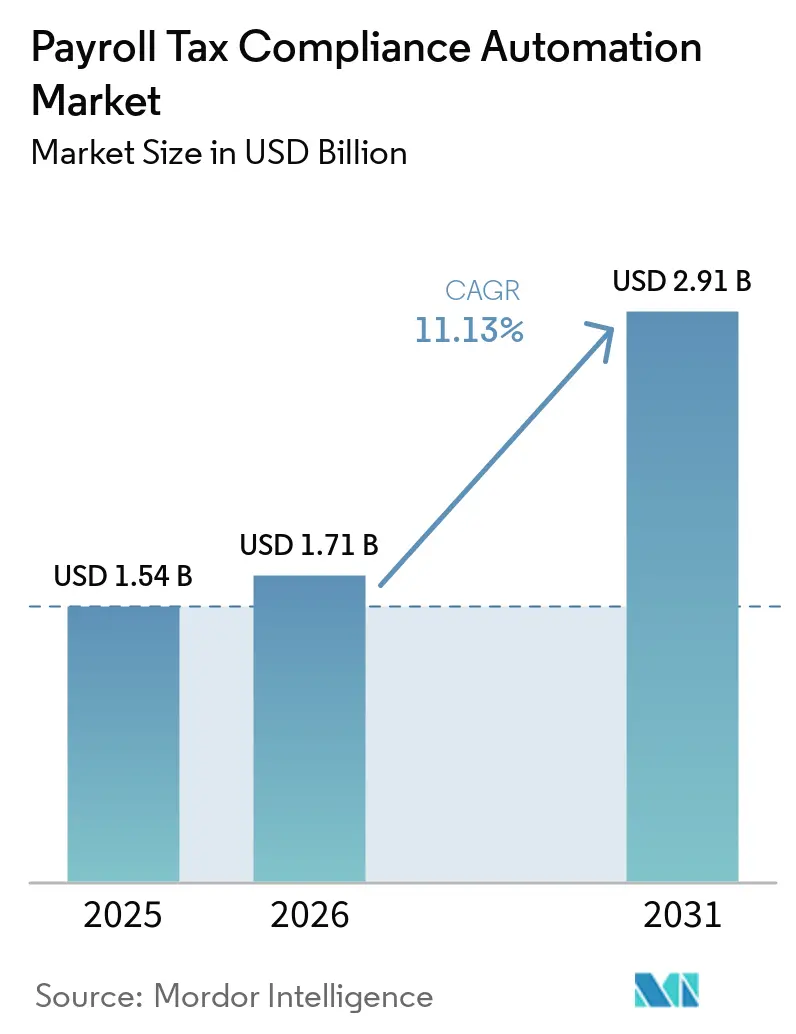
The payroll tax compliance automation market size is expected to increase from USD 1.54 billion in 2025 to USD 1.71 billion in 2026 and reach USD 2.91 billion by 2031, growing at a CAGR of 11.13% over 2026-2031. Mounting jurisdictional fragmentation, the February 2026 enforcement deadline for the One Big Beautiful Bill Act, and accelerating government-led digitalization in Asia-Pacific are prompting employers to adopt purpose-built platforms that capture overtime premiums, occupation codes, and multi-state add-back logic. Cloud migration remains uneven as on-premises systems dominate legacy installations, yet rapid innovation in agentic AI is lowering error rates and compressing payroll close cycles. Vendor consolidation continues as incumbent human capital management vendors launch AI-enabled modules, while cloud-native disruptors leverage single-platform architectures to penetrate multinational accounts. Heightened data-security concerns following high-profile breaches are intensifying demand for SOC 2-certified environments, zero-trust authentication, and hybrid deployment options.
Key Report Takeaways
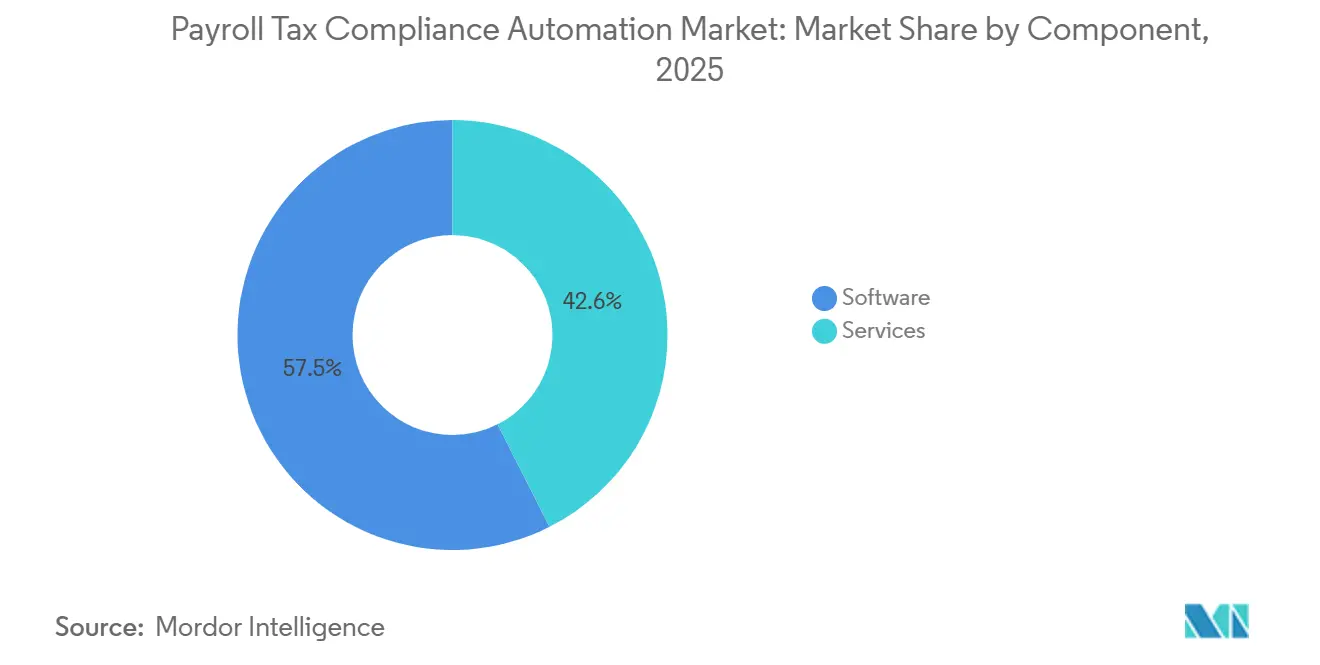
- By component, software led with 57.45% revenue share in 2025, while services are expanding at a 14.01% CAGR through 2031.
- By geography, North America commanded 36.18% of 2025 revenue, while Asia-Pacific is forecast to register the fastest 13.26% CAGR to 2031.
- By deployment mode, on-premises systems represented 62.11% of 2025 installations, whereas cloud deployments are advancing at a 14.32% CAGR.
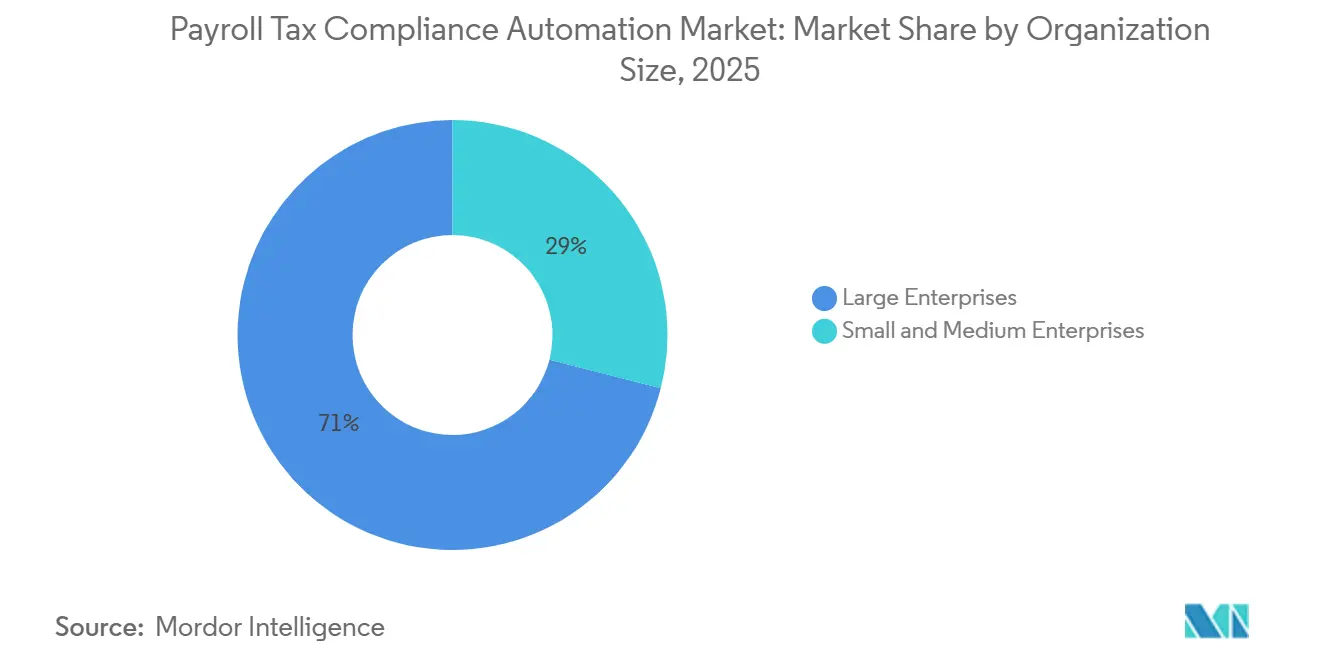
- By organization size, large enterprises held 71.02% of 2025 spending, whereas small and medium enterprises are growing at a 13.61% CAGR.
- By industry vertical, BFSI captured 22.14% of 2025 revenue, whereas IT and telecommunication is projected to post the highest 12.41% CAGR to 2031.
- By solution type, tax filing and remittance automation accounted for 33.62% share in 2025, while compliance monitoring platforms are scaling at a 12.89% CAGR.
Note: Market size and forecast figures in this report are generated using Mordor Intelligence’s proprietary estimation framework, updated with the latest available data and insights as of January 2026.
Market Trends and Insights
Drivers Impact Analysis of Payroll Tax Compliance Automation Market*
| Driver | (~) % Impact on CAGR Forecast | Geographic Relevance | Impact Timeline |
|---|---|---|---|
| Escalating Global Regulatory Complexity | +3.2% | North America, Europe, Asia-Pacific | Medium term (2-4 years) |
| Rapid Adoption of Cloud-Based Payroll | +2.8% | North America, Europe, emerging Asia-Pacific and Middle East | Short term (≤ 2 years) |
| Expansion of Cross-Border Remote Workforces | +2.1% | North America, Europe, Asia-Pacific tech hubs | Medium term (2-4 years) |
| Integration of AI and Machine Learning | +1.9% | Early adoption in North America and Europe, spreading to APAC | Short term (≤ 2 years) |
| Government Digitalization Initiatives | +1.5% | India, China, Southeast Asia, Brazil, Argentina, UAE, Nigeria | Long term (≥ 4 years) |
| Rising Penalties for Filing Errors | +1.3% | Highest in North America and Europe, global relevance | Short term (≤ 2 years) |
| Source: Mordor Intelligence | |||
Escalating Global Regulatory Complexity
Over 7,000 U.S. tax authorities, the EU Pay Transparency Directive, and India’s four Labour Codes have simultaneously expanded payroll data points employers must track, validate, and report. The One Big Beautiful Bill Act removes transition relief after 2025, compelling systems to distinguish FLSA-required overtime from contractual premiums, trace tipped employees by occupation code, and manage state add-back logic. European employers face similar pressure as member states transpose EU 2023/970 by 2026, while BFSI firms in India must redesign compensation to ensure basic pay and dearness allowance equal at least 50% of remuneration. Heightened fragmentation is pushing organizations toward rule-based engines that ingest real-time feeds, apply jurisdiction-specific logic, and generate audit trails fit for inspection.
Rapid Adoption of Cloud-Based Payroll Platforms
Organizations are accelerating cloud migration to access continuous compliance updates and AI-driven validation without maintaining their own infrastructure. Offerings such as UKG One View Direct deliver real-time multi-country data, whereas Symmetry Tax Logic AI automates jurisdiction mapping across 150 countries.[1]Despite cloud’s 14.32% CAGR, on-premises instances remain prevalent due to data-sovereignty rules and customization needs, resulting in hybrid architectures that keep sensitive data local and leverage cloud for analytics. Small businesses lead cloud uptake, citing vendor-managed compliance updates and reduced maintenance overhead.
Expansion of Cross-Border Remote Workforces
Distributed teams require consolidated withholding, contribution, and remittance workflows across dozens of regimes. Platforms from Lano, KOMP Global, and UKG aggregate calculations for 150-plus jurisdictions, mitigating the manual mapping that 57% of Latin American employers say saps productivity. Divergent schemes, such as U.S. Social Security, Saudi GOSI, and India EPF, plus upcoming programs like Minnesota Paid Family and Medical Leave, elevate demand for single-interface platforms that reduce penalty exposure.
Integration of AI and Machine Learning for Real-Time Compliance
Agentic AI is transforming payroll from post-run error correction to pre-submission validation. SAP’s April 2026 launch of four AI Payroll Agents allows PostNL to project an 80% reduction in support tickets by automating anomaly detection, rules mapping, and data reconciliation. Symmetry Tax Logic AI and Avalara Agentic AI similarly cut manual intervention, while 69% of small businesses already deploy AI in payroll operations.
Restraints Impact Analysis of Payroll Tax Compliance Automation Market*
| Restraint | (~) % Impact on CAGR Forecast | Geographic Relevance | Impact Timeline |
|---|---|---|---|
| Data Security and Privacy Concerns | -1.8% | Europe, North America, Asia-Pacific | Short term (≤ 2 years) |
| High Switching Costs From Legacy Systems | -1.5% | North America, Europe, growing in Asia-Pacific | Medium term (2-4 years) |
| Shortage of Specialized Payroll Talent | -1.1% | Global, particularly India and Australia | Long term (≥ 4 years) |
| Fragmented Local Tax Jurisdictions | -0.9% | United States, Europe, parts of Asia-Pacific | Long term (≥ 4 years) |
| Source: Mordor Intelligence | |||
Data Security and Privacy Concerns in Cloud Deployments
Centralized repositories of Social Security numbers and wage data attract sophisticated cybercriminals. The Storm-2755 campaign in April 2026 diverted Canadian payroll deposits by hijacking sessions, exposing weaknesses in basic multifactor authentication. Breach notification mandates under GDPR intensify cost exposures, prompting enterprises to demand SOC 2 Type II facilities, encryption at rest, privileged-access monitoring, and local hosting options, all of which elevate implementation complexity.
High Switching Costs From Legacy Payroll Systems
Decades-old custom calculations, intertwined modules, and downstream GL integrations make extraction and validation labor-intensive. Small businesses lack in-house expertise, only 13% employ compliance specialists, so they rely on vendor-managed cutovers and parallel testing. The compressed timeline preceding the February 2026 OBBBA deadline magnified the financial risk of downtime, reinforcing a preference for phased migrations rather than green-field deployments.
*Our forecasts treat driver/restraint impacts as directional, not additive. The impact forecasts reflect baseline growth, mix effects, and variable interactions.
Payroll Tax Compliance Automation Market Segment Analysis
By Component:
Services Close the Gap With SoftwareThe payroll tax compliance automation market share for software remained dominant at 57.45% in 2025, yet the services segment is projected to grow at a 14.01% CAGR through 2031 as employers outsource configuration and regulatory monitoring to external specialists. Managed-service providers are capitalizing on the One Big Beautiful Bill Act’s granular overtime tracking requirements, India’s Labour Code audits, and Brazil’s FGTS Digital submissions, packaging advisory, change management, and filing support in subscription bundles.
Services uptake is even faster in emerging markets where local-language documentation, electronic payslips, and data integration with revenue authorities demand on-the-ground expertise. Although core engines continue to underpin transaction processing, revenue is shifting toward value-added services that reduce penalty risk, accelerate deployment, and offer on-demand audit support.
By Solution Type:
Monitoring Platforms Gain MomentumTax filing and remittance engines accounted for 33.62% of 2025 spending, yet compliance monitoring platforms are scaling at a 12.89% CAGR as employers pivot from reactive filing to continuous validation. Vendors embed regulatory feeds that flag anomalies before submission, meeting penalty regimes that escalate from 2% to 15% for late deposits.
Platforms that interpret OBBBA overtime criteria, segregate qualified tips, and validate occupation codes underpin this shift, while AI agents generate audit trails that satisfy internal and external auditors. SAP's four AI Payroll Agents exemplify the integration of compliance monitoring with filing automation, enabling PostNL to anticipate approximately 80% cost reduction for payroll questions by automating routine inquiries and validating data against jurisdiction-specific rules.[2]Transactional filing remains essential, but autonomous monitoring is emerging as the differentiator for multinational payroll operations.
By Deployment Mode:
Cloud Narrows the On-Premises LeadAlthough on-premises installations held 62.11% of 2025 deployments, the payroll tax compliance automation market size for cloud solutions is expanding at 14.32% CAGR as enterprises seek real-time rule updates and lower infrastructure costs. Cloud-native platforms simplify multi-country compliance by rolling out configuration changes centrally, an advantage underscored by Nigeria’s phased e-invoicing mandate and UAE’s Wage Protection System.
Large financial and healthcare organizations still favor private clouds or hybrid instances for sensitive data, but improvements in tenant-level encryption, regional hosting, and configurable workflows are eroding resistance. Vendors now position cloud migration not merely as cost optimization but as a compliance imperative amid accelerating statutory change.
By Organization Size:
SMEs Accelerate AdoptionLarge enterprises drove 71.02% of 2025 revenue, yet small and medium enterprises logged a 13.61% CAGR as high error rates and limited in-house expertise encourage turnkey adoption. Surveys show 60% of small firms experience payroll errors in at least some cycles and 46% lean on providers for compliance, creating fertile ground for subscription platforms bundling payroll, HR, and tax filing.
AI uptake is especially high: 77% of SMEs believe the technology elevates compliance, but 83% still demand human oversight, leading vendors to pair AI validation with accessible specialist support. While absolute spending remains skewed toward large enterprises, SMEs are reshaping vendor roadmaps toward simplified implementation, pre-configured rules, and pay-as-you-go pricing.
By Industry Vertical:
BFSI Dominates, IT and Telecom SurgesBFSI captured 22.14% of 2025 revenue as India’s Labour Codes forced banks and fintechs to recalculate basic pay, provident-fund obligations, and gratuity thresholds. Mandatory multi-state compliance accelerated platform rollouts that can dynamically adjust variable-pay components and social-security contributions.
Conversely, IT and telecommunication is the fastest-growing vertical at 12.41% CAGR thanks to globally distributed development teams and contractor engagement. Complexities around permanent establishment, social-security equalization, and localized leave mandates propel demand for multi-jurisdiction platforms equipped with automated withholding logic, cross-border payment rails, and compliance dashboards.
Geography Analysis
North America Payroll Tax Compliance Automation Market
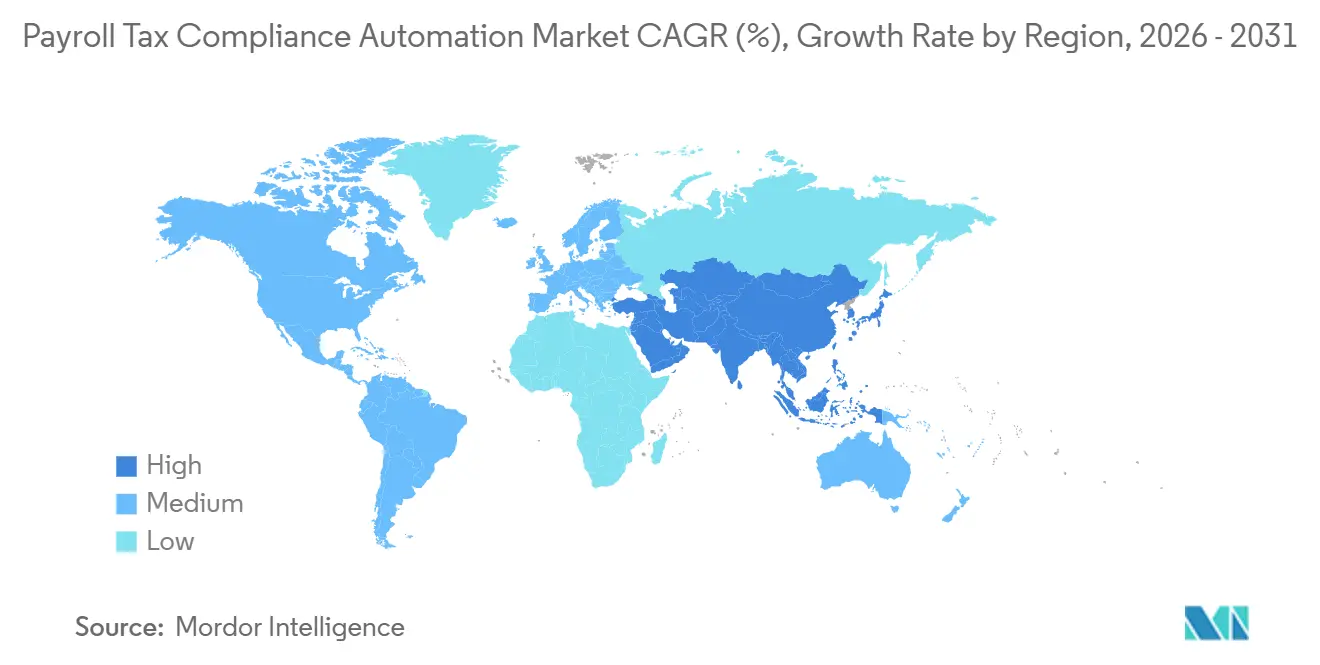
North America generated 36.18% of 2025 revenue, anchored by the United States’ 7,000-plus tax jurisdictions, stringent penalty schedules, and the February 2026 OBBBA enforcement deadline. Large acquisitions, such as Paychex’s USD 4.1 billion purchase of Paycor and Intuit’s integration of GoCo, underscore the region’s consolidation trend aimed at scale and cross-selling AI-enabled compliance tools.[3] Cyber threats such as Storm-2755 further sharpen board-level focus on payroll security, driving investments in zero-trust architectures.
APAC and South America Payroll Tax Compliance Automation Market
Asia-Pacific is forecast to grow at a 13.26% CAGR to 2031, propelled by India’s Labour Codes, China’s e-invoice expansion, and Singapore’s Platform Workers Act. Surveys reveal 80% of regional employers confront regulatory complexity with fewer staff, spurring adoption of AI validation and managed compliance. Government portals such as India e-Shram and Brazil eSocial favor cloud-native integrations, giving a structural lift to local service providers.
EMEA and South America Payroll Tax Compliance Automation Market
Europe grapples with the 2026 transposition of the EU Pay Transparency Directive, GDPR cross-border data-transfer hurdles, and rising enforcement of on-time filing, prompting 53% of employers to outsource payroll. South America enforces new digital mandates, including Brazil’s FGTS Digital and Argentina’s Libro de Sueldos Digital, while Middle East and Africa authorities tighten wage-protection and e-invoicing rules. Nigeria’s phased electronic fiscal system and UAE’s salary-payment deadlines illustrate how statutory digitization is expanding addressable demand across the broader payroll tax compliance automation market.
Competitive Landscape
Incumbent HCM vendors such as ADP, Paychex, Workday, and Ceridian maintain entrenched positions through integrated suites and long-standing client relationships. Cloud-native challengers, Gusto, Rippling, Papaya Global, and Lano, exploit unified architectures, rapid deployment, and AI features to court SMEs and multinational startups. Paychex’s takeover of Paycor, Rippling’s USD 450 million fund-raise, and SAP’s AI Payroll Agents highlight strategic imperatives: scale, platform convergence, and automation.
Technology rivalry now centers on agentic AI that anticipates rule changes, resolves exceptions autonomously, and generates conversational explanations for employees. Differentiation also emerges in vertical depth, BFSI wage-code engines, healthcare ACA modules, and public-sector pension calculators.
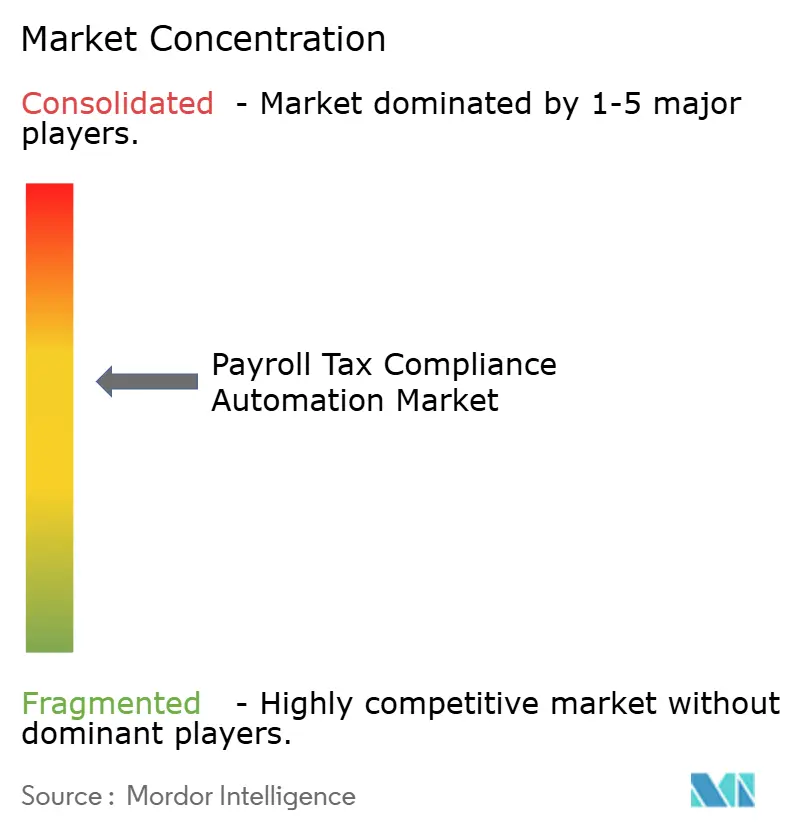
Data-security posture, certified controls, and local hosting options have become gating factors for enterprise deals, particularly in Europe. Overall, mid-tier concentration coupled with active venture backing signals a moderately concentrated market where innovation cadence often trumps legacy scale.
Payroll Tax Compliance Automation Industry Leaders
-
Automatic Data Processing, Inc.
-
Workday, Inc.
-
SAP SE
-
Oracle Corporation
-
UKG Inc.
- *Disclaimer: Major Players sorted in no particular order
Payroll Tax Compliance Automation Market Companies Covered in this Report
- Automatic Data Processing, Inc.
- Paychex, Inc.
- Intuit Inc.
- Workday, Inc.
- Ceridian HCM Holding Inc.
- Sage Group plc
- Oracle Corporation
- SAP SE
- Gusto, Inc.
- Zenefits Global, Inc.
- Paycor HCM, Inc.
- Rippling People Center Inc.
- BambooHR LLC
- UKG Inc.
- Patriot Software Company, Inc.
- Paylocity Holding Corporation
- TriNet Group, Inc.
- Papaya Global Ltd.
- Justworks, Inc.
- CloudPay Inc.
Recent Industry Developments in Payroll Tax Compliance Automation Market
- April 2026: SAP debuted four AI Payroll Agents to automate validation, alert resolution, and data integration, with PostNL expecting 80% lower inquiry costs.
- April 2026: Microsoft exposed Storm-2755 attacks diverting Canadian payroll deposits via adversary-in-the-middle tactics.
- May 2025: Rippling secured USD 450 million at a USD 16.8 billion valuation to expand unified workforce management.
- April 2025: Paychex finalized its USD 4.1 billion acquisition of Paycor, creating a combined base of 800,000 customers.
Global Payroll Tax Compliance Automation Market Report Scope
The Payroll Tax Compliance Automation Market, encompassing software and AI-driven platforms, dominates in streamlining the calculation, filing, remittance, and reporting of payroll taxes across diverse jurisdictions. These advanced systems not only stay updated with statutory rules but also pinpoint compliance risks, detect anomalies, and guarantee audit-ready precision in payroll tax processes. Enterprises leverage these tools to minimize manual errors, sidestep penalties, and navigate intricate multi-state or multi-country tax challenges. The market's growth is bolstered by heightened regulatory fluctuations, a globally dispersed workforce, and a pressing need for automated, real-time compliance insights.
The Payroll Tax Compliance Automation Market Report is Segmented by Component (Software, and Services), Solution Type (Payroll Tax Calculation Engines, Tax Filing and Remittance Automation, Compliance Monitoring and Regulatory Updates Platforms, Withholding and Deduction Management Systems, Multi-Jurisdictional Payroll Compliance Modules, and Other Solution Types), Deployment Mode (Cloud, and On-Premises), Organization Size (Small and Medium Enterprises, and Large Enterprises), Industry Vertical (BFSI, Healthcare, IT and Telecommunication, Retail, Manufacturing, Government, and Other Industry Verticals), and Geography (North America, South America, Europe, Asia-Pacific, Middle East, and Africa). The Market Forecasts are Provided in Terms of Value (USD).
Segmentation Overview
| Software |
| Services |
| Payroll Tax Calculation Engines |
| Tax Filing and Remittance Automation |
| Compliance Monitoring and Regulatory Updates Platforms |
| Withholding and Deduction Management Systems |
| Multi‑Jurisdictional Payroll Compliance Modules |
| Other Solution Types |
| Cloud |
| On-Premises |
| Small and Medium Enterprises |
| Large Enterprises |
| BFSI |
| Healthcare |
| IT and Telecommunication |
| Retail |
| Manufacturing |
| Government |
| Other Industry Verticals |
| North America | United States |
| Canada | |
| Mexico | |
| South America | Brazil |
| Argentina | |
| Rest of South America | |
| Europe | Germany |
| United Kingdom | |
| France | |
| Italy | |
| Spain | |
| Russia | |
| Rest of Europe | |
| Asia-Pacific | China |
| India | |
| Japan | |
| South Korea | |
| Australia | |
| Rest of Asia-Pacific | |
| Middle East | Saudi Arabia |
| United Arab Emirates | |
| Turkey | |
| Rest of Middle East | |
| Africa | South Africa |
| Nigeria | |
| Rest of Africa |
| By Component | Software | |
| Services | ||
| By Solution Type | Payroll Tax Calculation Engines | |
| Tax Filing and Remittance Automation | ||
| Compliance Monitoring and Regulatory Updates Platforms | ||
| Withholding and Deduction Management Systems | ||
| Multi‑Jurisdictional Payroll Compliance Modules | ||
| Other Solution Types | ||
| By Deployment Mode | Cloud | |
| On-Premises | ||
| By Organization Size | Small and Medium Enterprises | |
| Large Enterprises | ||
| By Industry Vertical | BFSI | |
| Healthcare | ||
| IT and Telecommunication | ||
| Retail | ||
| Manufacturing | ||
| Government | ||
| Other Industry Verticals | ||
| By Geography | North America | United States |
| Canada | ||
| Mexico | ||
| South America | Brazil | |
| Argentina | ||
| Rest of South America | ||
| Europe | Germany | |
| United Kingdom | ||
| France | ||
| Italy | ||
| Spain | ||
| Russia | ||
| Rest of Europe | ||
| Asia-Pacific | China | |
| India | ||
| Japan | ||
| South Korea | ||
| Australia | ||
| Rest of Asia-Pacific | ||
| Middle East | Saudi Arabia | |
| United Arab Emirates | ||
| Turkey | ||
| Rest of Middle East | ||
| Africa | South Africa | |
| Nigeria | ||
| Rest of Africa | ||
Key Questions Answered in the Report
What is the payroll tax compliance automation market size in 2026?
The payroll tax compliance automation market size is projected to stand at USD 1.71 billion in 2026, reflecting sustained growth momentum.
Which region is expected to grow the fastest through 2031?
Asia-Pacific is forecast to expand at a 13.26% CAGR through 2031 on the back of government digital mandates and multi-jurisdiction workforce growth.
Why are services gaining share against software?
Organizations increasingly outsource rule updates, implementation, and audit support, driving services growth at a 14.01% CAGR even as software remains foundational.
How is AI changing payroll compliance?
Agentic AI now validates data pre-submission, interprets new rules, and resolves anomalies, reducing inquiry costs by up to 80% for early adopters such as PostNL.
Which industry vertical commands the largest share?
BFSI leads with 22.14% of 2025 spending due to stringent wage-code changes and provident-fund obligations in markets like India.