
North America HR Compliance Software Market Size and Share
Market Overview
| Study Period | 2020 - 2031 |
|---|---|
| Forecast Data Period | 2026 - 2031 |
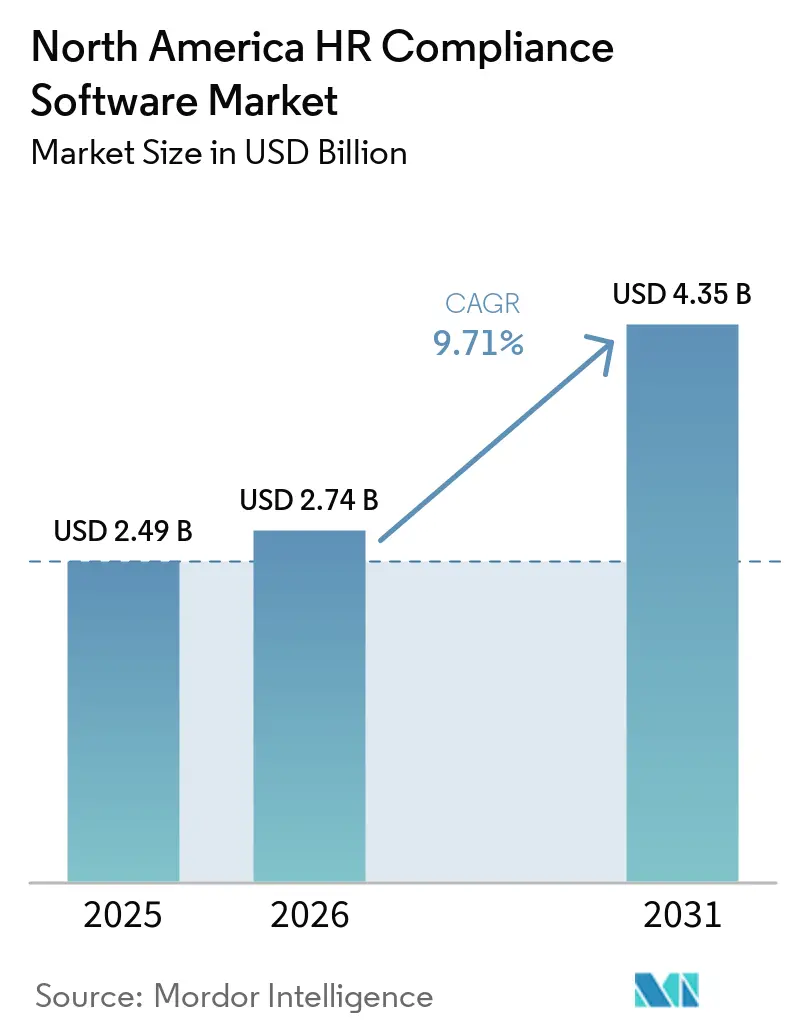
| Base Year Market Size (2025) | USD 2.49 Billion |
| Market Size (2026) | USD 2.74 Billion |
| Market Size (2031) | USD 4.35 Billion |
| Growth Rate (2026 - 2031) | 9.71 % |
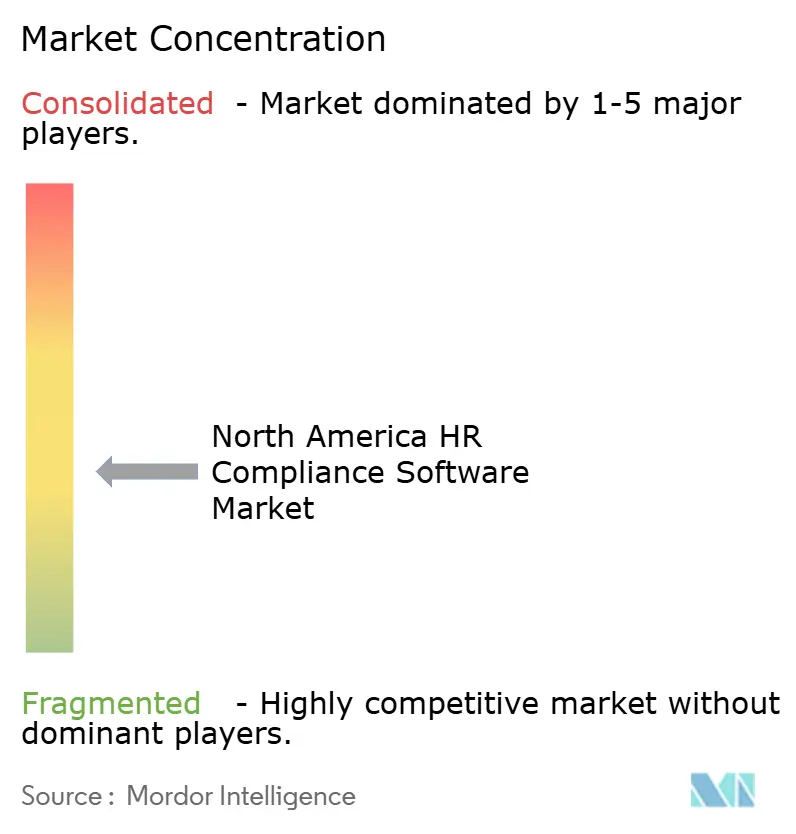
| Market Concentration | Medium |
Major Players *Disclaimer: Major Players sorted in no particular order Image © Mordor Intelligence. Reuse requires attribution under CC BY 4.0. | |
North America HR Compliance Software Market Analysis by Mordor Intelligence
The North America HR Compliance Software market size was valued at USD 2.49 billion in 2025 and is projected to reach USD 4.35 billion by 2031, registering a CAGR of 9.71% during 2026-2031. Growth remains tied to a regulatory landscape that keeps adding new obligations across hiring, payroll, documentation, privacy, and workplace AI use, pushing employers toward systems that can continuously monitor change and maintain audit-ready records. The North America HR Compliance Software market is also benefiting from the fact that compliance work is no longer limited to large legal teams, because software has become a day-to-day operating requirement for HR and payroll teams across both large enterprises and smaller firms. Demand remains durable because employers are managing more dispersed workforces, more state and provincial rules, and more internal scrutiny over how decisions are recorded and defended. The North America HR Compliance Software market is further shaped by a shift in vendor strategy, with large platforms adding AI to payroll and compliance workflows while specialist providers focus on narrow but critical areas such as policy generation, I-9 workflows, and cross-border coordination. That combination supports expansion across core compliance applications, cloud delivery, and specialized tools that solve specific workflow gaps.
Key Report Takeaways
- By functionality, HR Compliance and Regulatory Management held 56.41% of the North America HR Compliance Software market share in 2025, while Time and Attendance Compliance is projected to expand at a 10.54% CAGR through 2031.
- By deployment mode, cloud accounted for 67.89% of the North America HR Compliance Software market in 2025, while hybrid is projected to grow at a 11.18% CAGR through 2031.
- By organization size, large enterprises accounted for 72.14% of revenue in 2025, while small and medium-sized enterprises are projected to grow at an 11.67% CAGR through 2031.
- By end-user industry, information technology and telecommunications held 28.19% share in 2025, while healthcare and life sciences are projected to expand at a 10.09% CAGR through 2031.
- By geography, the United States held 70.26% share of the North America HR Compliance Software market size in 2025, while Canada is projected to record the fastest growth at a 10.85% CAGR through 2031.
Note: Market size and forecast figures in this report are generated using Mordor Intelligence’s proprietary estimation framework, updated with the latest available data and insights as of January 2026.
Market Trends and Insights
Drivers Impact Analysis of North America HR Compliance Software Market*
| Driver | (~) % Impact on CAGR Forecast | Geographic Relevance | Impact Timeline |
|---|---|---|---|
| Rising Multi-State Wage, Leave, and Pay-Transparency Complexity | +2.2% | US nationwide | Short term (≤ 2 years) |
| Cloud-First Compliance Automation Adoption Among Small and Medium-Sized Enterprises | +1.8% | US and Canada nationwide, with density in major metro SME clusters | Medium term (2-4 years) |
| Remote and Hybrid Work Expanding Jurisdictional Exposure | +1.5% | US, multi-state employers, Canada | Short term (≤ 2 years) |
| AI-Enabled Audit Readiness and Compliance Analytics | +1.4% | US and Canada as primary adopters, spill-over to Mexico multinationals | Medium term (2-4 years) |
| State AI-in-Hiring Rules Creating New Governance Demand | +1.0% | US, New York City, Canada with pending AIDA | Short term (≤ 2 years) |
| Canada and Mexico Compliance Digitization Expanding Cross-Border Orchestration Needs | +0.7% | Canada and Mexico, with spill-over to US-headquartered multinationals | Medium term (2-4 years) |
| Source: Mordor Intelligence | |||
Rising Multi-State Wage, Leave, and Pay-Transparency Complexity
The North America HR Compliance Software market continues to gain momentum amid the growing volume of rule changes employers must track across multiple jurisdictions. ADP stated in its Q3 fiscal 2026 filing that more than 200 HR-related compliance laws were enacted across the United States in the opening months of 2026 alone, underscoring how quickly the legal baseline is evolving for employers with operations in more than one state.[1] Mitratech reported that 54% of organizations said their compliance needs had increased over the prior 2 years, and 75% said their compliance posture had changed during that period, which reinforces that this is not a short-term spike in activity. The same report pointed to pay transparency laws and data privacy requirements as part of the expanding set of obligations that HR teams are now expected to manage through repeatable processes rather than informal tracking. In the North America HR Compliance Software market, regulatory management remains central to buying decisions, as employers need a system that maps obligations, logs updates, and preserves evidence of compliance actions across locations. It also increases the value of platforms that connect policy changes with downstream workflows, such as job posting reviews, employee notices, and payroll adjustments.
Cloud-First Compliance Automation Adoption Among Small and Medium-Sized Enterprises
The North America HR Compliance Software market is seeing faster adoption among smaller employers because the cost of staying compliant through manual methods is rising, while access to software is becoming easier. Gusto said in April 2026 that it serves more than 500,000 small businesses in the United States, and that those customers already rely on the platform for payroll, tax credits, compliance, and HR, showing how compliance software has moved into the mainstream of small-business workflows. Gusto also acquired Mosey to close the compliance gap for small businesses, underscoring how vendors view state and local compliance as a direct product opportunity rather than an adjacent service. Paychex reported fiscal third-quarter 2026 revenue of USD 1.8 billion and said clients are increasingly relying on its advisory and benefits solutions to navigate complex, compliance-critical HR and workforce challenges in a dynamic environment. That pattern matters because the North America HR Compliance Software market is not expanding only through large enterprise contracts; it is also expanding through subscription models that serve smaller employers with limited internal compliance staff. As a result, software adoption among SMEs is increasingly tied to the ability to deliver updates automatically, present clear tasks, and combine payroll, registrations, filings, and alerts into a single workflow.
Remote and Hybrid Work Expanding Jurisdictional Exposure
The North America HR Compliance Software market is also supported by the spread of remote and hybrid work, which has widened the number of jurisdictions that many employers must manage simultaneously. Gusto highlighted remote I-9 verification with guided form completion and E-Verify integration for distributed teams, reflecting how routine onboarding tasks now need to work across dispersed employee locations without compromising compliance steps. Rippling's January 2026 release added default sick leave and holiday policies for U.S. companies and supported compliant payroll in Mexico, along with other countries, indicating vendors are adapting their products to employers whose workforces no longer sit in a single legal environment. This shift increases the need for software that can align location data, leave rules, tax forms, year-end filings, and onboarding documents across state and country boundaries without forcing HR teams to manually rebuild processes. For the North America HR Compliance Software market, hybrid work has therefore become more than a workplace design choice, because it directly changes how often employers need to update policies and how carefully they need to document actions by employee location. That keeps demand high for platforms that can coordinate compliance steps continuously rather than only at the point of hire.
AI-Enabled Audit Readiness and Compliance Analytics
AI is becoming an important growth driver for the North America HR Compliance Software market because employers want compliance tools that can surface issues before they become payroll errors, documentation gaps, or audit exposure. UKG launched Pro Pay with Workforce AI in May 2026 and said the product can detect, analyze, and resolve payroll issues before they affect employees, reducing payroll processing time from days to hours while maintaining human oversight. UKG also described tools for payroll auditing, anomaly detection, and variance analysis based on historical data, which shows how compliance functionality is being embedded directly into transaction review rather than handled after the fact. Mitratech found that 51% of HR leaders ranked AI governance as the top emerging compliance trend over the next 12 to 18 months, indicating that buyer attention is already shifting toward the governance and oversight of automated decisions. In the North America HR Compliance Software market, this raises the value of platforms that can document decision logic, support human review, and create a traceable record of action as AI tools are used more widely in HR processes. It also favors vendors with large proprietary compliance datasets, since those firms can position AI as a controlled extension of existing payroll and regulatory knowledge.
Restraints Impact Analysis of North America HR Compliance Software Market*
| Restraint | (~) % Impact on CAGR Forecast | Geographic Relevance | Impact Timeline |
|---|---|---|---|
| Legacy HRIS and Payroll Integration Friction | -1.5% | US, large enterprise concentration, Canada | Medium term (2-4 years) |
| Employee Data Privacy and Sovereignty Concerns | -1.2% | US, state-level privacy laws, Canada, Mexico | Medium term (2-4 years) |
| Limited Trust in Pure-AI Compliance Recommendations | -1.0% | US and Canada, acute in regulated sectors, healthcare, finance | Short term (≤ 2 years) |
| Canada and Mexico Localization Burden for Multi-Jurisdiction Workflows | -0.7% | Canada and Mexico, and cross-border US employers | Long term (≥ 4 years) |
| Source: Mordor Intelligence | |||
Legacy HRIS and Payroll Integration Friction
Integration debt remains a meaningful brake on the North America HR Compliance Software market, especially in large organizations that still run several HR and payroll systems side by side. Mitratech identified a compliance infrastructure gap, where many organizations continue to rely on fragmented systems, manual processes, and informal coordination, making it harder to translate policy changes into consistent operational steps. That fragmentation matters because compliance software only works well when it can draw clean data from payroll, onboarding, identity, and time systems without repeated manual fixes. WorkBright responded to this friction by expanding its platform to work with more than 200 HR systems, demonstrating that implementation speed and connector breadth are part of the product value itself. ADP's addition of WorkForce Software capabilities into its broader HCM stack also points to the same issue, since enterprise buyers still need stronger links between workforce management, payroll, and compliance tasks across large environments. For the North America HR Compliance Software market, vendors that reduce integration effort will continue to win faster, while platforms that require heavy custom work may see longer sales cycles and slower rollouts.
Employee Data Privacy and Sovereignty Concerns
Data privacy is creating a second layer of compliance work in the North America HR Compliance Software market, as the same systems used to manage employment obligations must also protect employee data under tightening legal rules. Canada's Bill C-27 would establish the Consumer Privacy Protection Act and the Artificial Intelligence and Data Act, strengthening private-sector privacy law and setting out obligations for high-impact AI systems, including oversight, audits, and penalties for serious non-compliance. Paychex said in its fiscal 2026 earnings release that compliance with data privacy and AI laws and regulations is a material risk area, confirming that privacy obligations now sit close to the core HCM product strategy rather than outside it. ADP also emphasizes enterprise-level security and data privacy in its large-enterprise HCM offering, indicating that buyers increasingly treat trust, hosting controls, and data governance as part of compliance software selection. These requirements can slow adoption when employers need local hosting, tighter consent controls, or legal review before moving sensitive worker data into a new system. They also raise the bar for cross-border platforms, because expansion into Canada and Mexico is not only a feature question, it is a data architecture question.
*Our forecasts treat driver/restraint impacts as directional, not additive. The impact forecasts reflect baseline growth, mix effects, and variable interactions.
North America HR Compliance Software Market Segment Analysis
By Functionality:
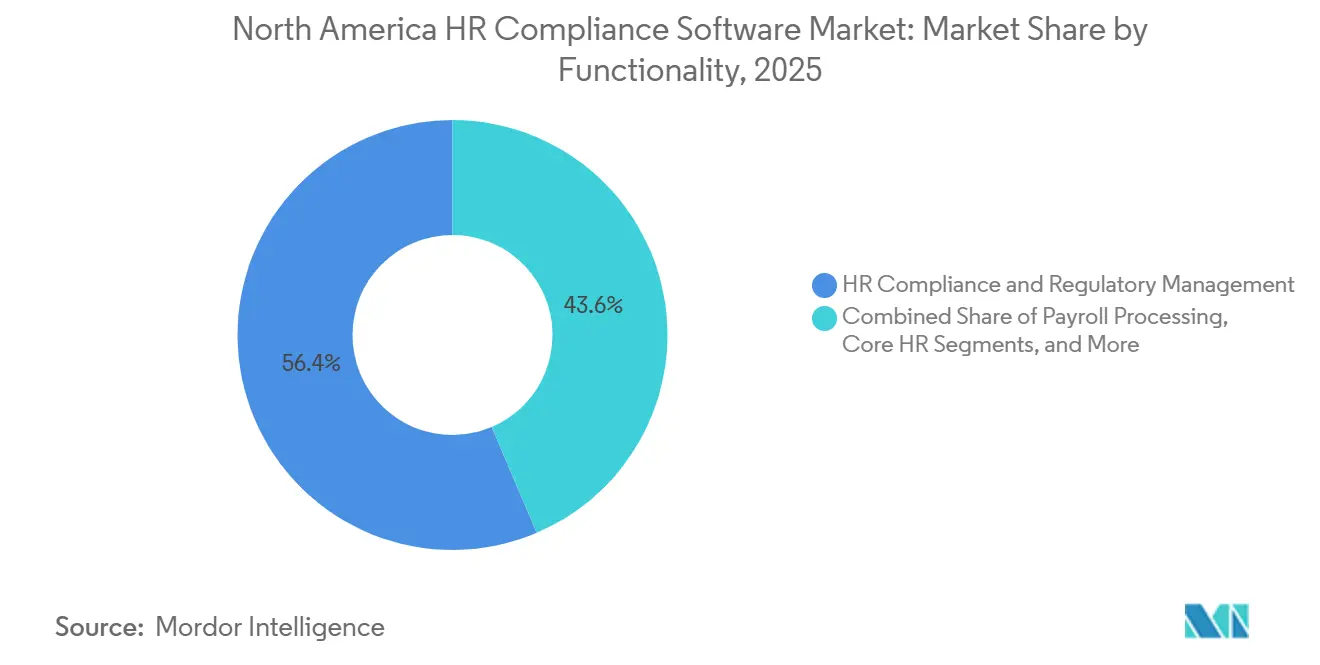
Regulatory Management Anchors Revenue While Attendance Compliance AcceleratesHR Compliance and Regulatory Management accounted for 56.41% of 2025 revenue, making it the largest functionality in the North America HR Compliance Software market. That lead reflects its role as the base system employers use to identify applicable rules, track updates, store records, and show evidence of action across federal, state, provincial, and local frameworks. ADP said more than 200 HR-related laws were enacted across the United States in the first months of 2026, which supports the need for a core system that can keep pace with legal change without relying on manual review. In practice, this keeps regulatory management at the center of most buying decisions because other functions work best when that legal baseline is already organized and up to date.
Time and Attendance Compliance is projected to expand at a 10.54% CAGR through 2031, which makes it the fastest-growing functionality in the North America HR Compliance Software industry. Growth in this area is tied to rising pressure on employers to maintain accurate records for hourly work, shift changes, remote onboarding, and eligibility checks. ADP's November 2025 acquisition of WorkForce Software added advanced time-and-attendance compliance and scheduling capabilities to its platform suite, indicating that major vendors view this workflow as a strategic growth area rather than a peripheral module. WorkBright's compliance automation for I-9 and E-Verify also illustrates how attendance, hiring readiness, and audit trails are increasingly integrated within a single operating process. Payroll Processing, Core HR, and other compliance-focused tools continue to matter, but the strongest growth is moving toward functions that sit closer to the daily recordkeeping burden employers face.

By Deployment Mode:
Cloud Dominates While Hybrid Builds Long-Term MomentumCloud held 67.89% of the North America HR Compliance Software market share in 2025, which confirms that most buyers prefer delivery models that can update rules and workflows without local patching. The appeal is straightforward, since employers dealing with constant payroll, leave, hiring, and documentation changes need a system that stays current with minimal intervention. Cloud delivery also aligns with how many HR teams now work, as compliance actions often span payroll staff, managers, remote employees, and external reviewers. This keeps the North America HR Compliance Software market oriented toward platforms that can push updates quickly and keep data visible across connected workflows.
Hybrid is projected to grow at a 11.18% CAGR through 2031, indicating that many enterprises still prefer a staged approach rather than a full replacement of legacy payroll and HR cores. In those accounts, buyers often keep established systems for sensitive records or deep customization while adding cloud layers for regulatory management, document workflows, and analytics. Rippling's January 2026 updates, including native Canadian year-end filing support and tax exemption handling, show how cloud tools can roll out localized compliance changes faster than more rigid architectures.[2] On-premise remains relevant in settings with strict internal controls, but the North America HR Compliance Software industry is moving toward models that combine core system stability with faster compliance refresh cycles. That is why hybrid is gaining momentum even while cloud remains the clear revenue leader.
By Organization Size:
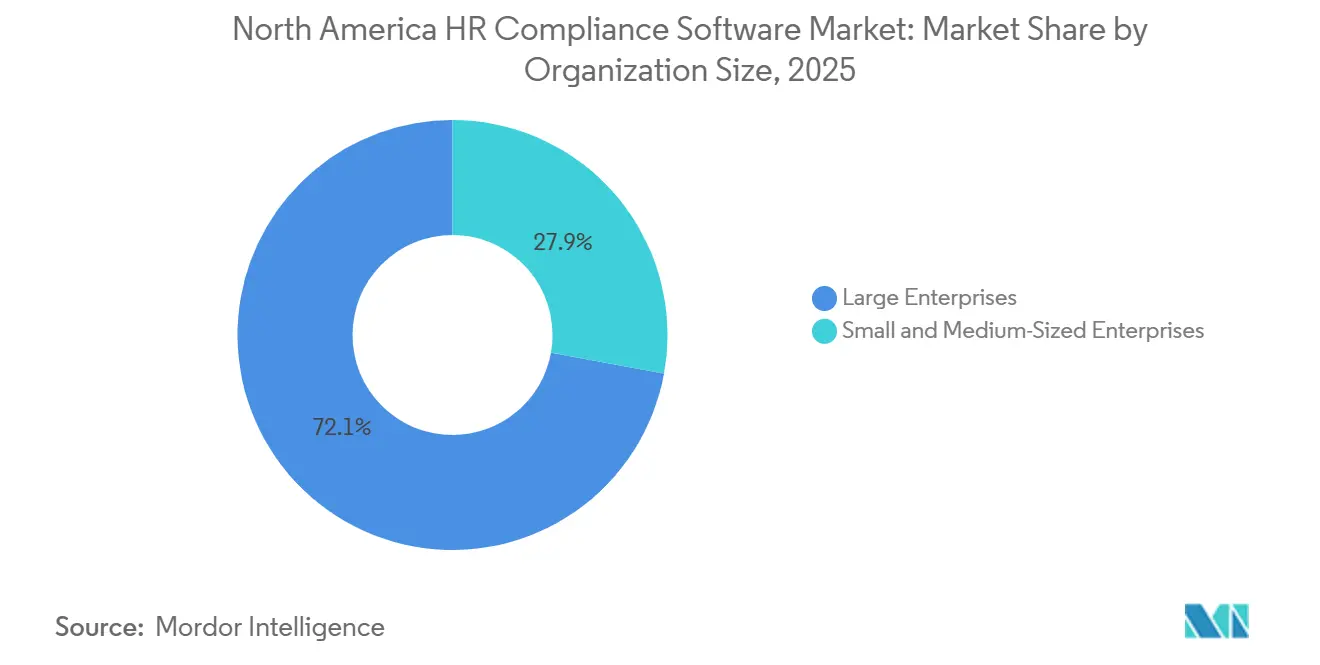
Large Enterprises Lead Revenue as SMEs Grow FasterLarge enterprises accounted for 72.14% of revenue in 2025, reflecting their higher compliance intensity and broader system needs in the North America HR Compliance Software market. These employers manage more entities, more employee categories, more cross-border reporting, and more layers of approvals, which raises both software spend and the depth of functionality required. Enterprise contracts also tend to center on audit history, workflow control, data security, and integration with broader HCM or ERP environments rather than a single policy tool. That keeps large organizations as the main revenue anchor even as the buyer base broadens.
Small and medium-sized enterprises are projected to expand at a 11.67% CAGR through 2031, making them the fastest-growing segment by organization size. Gusto's base of more than 500,000 small business customers and its acquisition of Mosey show how the SME segment of the North America HR Compliance Software market is shifting toward bundled compliance workflows rather than ad hoc outside support. ComplianceHR provides legally defensible guidance across all 50 U.S. states and municipal jurisdictions, while SixFifty automates document generation and legal updates across federal, state, and local employment laws, demonstrating that specialist vendors are also targeting this segment with focused, high-value tools. The result is a market where large enterprises still provide most revenue, but smaller employers are adopting faster because software has become easier to buy and harder to postpone. That growth pattern should continue to broaden the customer base of the North America HR Compliance Software market over the forecast period.
By End-User Industry:
IT and Telecom Lead While Healthcare and Life Sciences Expand QuicklyInformation Technology and Telecommunications held a 28.19% share in 2025, making it the largest end-user segment in the North America HR Compliance Software market. This lead aligns with the sector's large remote workforce, high hiring volume, heavy use of digital workflows, and early adoption of AI-enabled processes that demand tighter documentation and review. Mitratech found that AI governance is the top emerging compliance trend for 51% of HR leaders, a point that is especially relevant in technology-led hiring environments where automated tools are already common. Gusto's support for remote I-9 verification and distributed team workflows also reflects the operational needs that are especially common among technology and telecom employers.
Healthcare and Life Sciences is projected to grow at a 10.09% CAGR through 2031, which makes it the fastest-growing end-user segment in the North America HR Compliance Software industry. Demand in this area is tied to layered documentation requirements, sensitive employee information, and the need for stronger workforce controls around schedules, records, and policy consistency. ComplianceHR specifically serves life science and health care, while also maintaining content across the full employee lifecycle, demonstrating how specialist compliance tools are built for sectors where a weak audit trail carries greater consequences. BFSI, manufacturing, retail and e-commerce, and public sector users also remain important because they combine workforce scale with complex reporting and policy administration needs. Even so, healthcare's faster pace suggests the North America HR Compliance Software market is deepening in industries where compliance is tightly tied to operational continuity and risk control.
Geography Analysis
United States HR Compliance Software Market
The United States held 70.26% share of the North America HR Compliance Software market size in 2025, making it the clear center of regional demand. That position reflects the scale and pace of employment law change in the country, which requires employers to manage a federal baseline alongside state and local rules that shift frequently. ADP stated that more than 200 HR-related compliance laws were enacted in the first months of 2026, which helps explain why U.S. buyers continue to prioritize automated tracking and documentation tools. Mitratech's survey of 500 U.S. HR leaders showed that 54% saw compliance needs increase over the prior 2 years and 75% saw meaningful change in their compliance posture, which confirms that software demand is rooted in structural process pressure.[3] The country also supports a broad customer base, with Gusto serving more than 500,000 small businesses and Paychex serving around 800,000 customers, which shows that the North America HR Compliance Software market in the United States spans both enterprise and SME demand.
Canada HR Compliance Software Market
Canada is projected to record the fastest growth at a 10.85% CAGR through 2031, which gives it the strongest forward trajectory in the regional mix. A key reason is the country's evolving privacy and AI rulebook, since Bill C-27 would introduce the Consumer Privacy Protection Act, the Artificial Intelligence and Data Act, and a new tribunal structure for enforcement. Vendors are already responding, and Rippling added support for Canadian T4, T4A, and RL-1 filing workflows, along with handling of Indigenous employee tax exemptions, in its January 2026 update. That combination suggests Canadian growth is being driven by both regulatory preparation and product localization, which strengthens the long-term position of the North America HR Compliance Software market in the country.
Mexico HR Compliance Software Market
Mexico remains the smallest country market in the region, but it is becoming increasingly digital and increasingly important to cross-border employers. IMSS launched a pilot on July 1, 2025, for digital platform companies and workers to enter the social security system, with employer registration, monthly salary adjustments, and digital communications built into the compliance process. Rippling also added compliant payroll support for Mexico, which shows that major software vendors see demand building for country-specific compliance workflows inside broader workforce platforms. As more employers need a single system to handle obligations in the United States, Canada, and Mexico, Mexico's role in the North America HR Compliance Software market should keep rising, even from a smaller starting base.
Competitive Landscape
The North America HR Compliance Software market remains moderately fragmented, with scaled platforms such as ADP, Paychex, and UKG holding strong positions in large accounts, while cloud-native and specialist vendors compete across smaller, more focused workflows. Competition is increasingly shaped by 3 product priorities: regulatory update speed, AI support within compliance tasks, and the ability to connect HR, payroll, and documentation data in a single environment. The market also includes fast-moving challengers such as Gusto, Rippling, Dayforce, and Paylocity, each of which is trying to widen its reach through workflow automation or industry-specific depth. This structure keeps pricing and product design active because buyers can choose between broad suites and focused solutions depending on internal complexity. It also means the North America HR Compliance Software market is unlikely to consolidate into a small closed group in the near term.
Large vendors are using acquisitions and platform investment to defend their share and fill workflow gaps. Dayforce was taken private in a USD 12.3 billion transaction completed in February 2026, a move that underscores continued financial confidence in HCM and compliance software at scale. ADP added WorkForce Software in November 2025 to strengthen time-and-attendance compliance and workforce management within its broader HCM stack, underscoring how labor-intensive compliance workflows are becoming central to competition. UKG's Pro Pay with Workforce AI and Paychex's broader emphasis on compliance-critical HR challenges point in the same direction, with AI positioned as an operational aid rather than a separate feature set.
Mid-market and specialist competition is also growing. Gusto's acquisition of Mosey and Paylocity's acquisition of Grayscale show how vendors are expanding into state and local compliance, high-volume recruiting, and workflow automation to serve buyers that need more than basic payroll support. WorkBright competes through deep integration, while ComplianceHR, SixFifty, and OnBlick focus on legally defensible guidance, automated employment documents, immigration compliance, and I-9 audit workflows.[4] That mix leaves room for vendors that can connect cross-border workflows across the United States, Canada, and Mexico without forcing employers into separate country tools. It also favors providers that can clearly demonstrate trust, documentation quality, and deployment speed as much as they demonstrate feature breadth.
North America HR Compliance Software Industry Leaders
-
UKG Inc.
-
Paychex, Inc.
-
Automatic Data Processing, Inc.
-
Deel, Inc.
-
Namely, Inc.
- *Disclaimer: Major Players sorted in no particular order
North America HR Compliance Software Market Companies Covered in this Report
- Automatic Data Processing, Inc.
- Paychex, Inc.
- UKG Inc.
- Dayforce, Inc.
- Paycom Software, Inc.
- Paylocity Holding Corporation
- Gusto, Inc.
- BambooHR LLC
- TriNet Group, Inc.
- Rippling, Inc.
- Deel, Inc.
- Namely, Inc.
- PrismHR, Inc.
- ComplianceHR, LLC
- SixFifty Technologies, LLC
- OnBlick Inc.
- WorkBright, Inc.
- Trak Holdings LLC (HRlogics)
- Compliance Works Inc.
- Vensure Employer Services, Inc.
- Insynctive, Inc.
Recent Industry Developments in North America HR Compliance Software Market
- May 2026: Paychex launched WISE, an agentic AI platform embedded across its Paychex Flex and Paycor solutions, with compliance-specific agents providing regulatory guidance, task completion, and proactive alerts in the flow of work; the platform draws on Paychex's multi-decade compliance dataset to deliver what the company positioned as a "digital workforce" for HR and compliance administration.
- May 2026: UKG unveiled Pro Pay with Workforce AI at Payroll Congress 2026, an agentic AI payroll and compliance solution that detects errors, orchestrates resolution workflows, and maintains human oversight, compressing payroll cycle times from days to hours while reducing compliance risk for frontline and hourly workforces.
- April 2026: Gusto acquired Mosey, an AI-powered state and local compliance platform specializing in business registration, license renewals, and agency mail management, to anchor its planned Gusto Business Compliance product; the acquisition expands Gusto's compliance coverage for its now 500,000-customer small business base.
- April 2026: Paylocity acquired Grayscale Labs, an AI-powered recruiting automation company, to expand its hiring compliance and high-volume workforce management capabilities and reduce time-to-hire for organizations subject to state-level AI-in-hiring disclosure requirements.
North America HR Compliance Software Market Report Scope
The North America HR Compliance Software Market comprises digital solutions that help organizations comply with labor laws, workplace regulations, and data governance standards across the U.S. and Canada. These platforms oversee policy enforcement, employee relations, reporting mandates, and adapt to regional compliance changes. By integrating with Human Resources Information System (HRIS) and payroll systems, they automate audits, track risks, and handle regulatory reporting. The market thrives on the complexities of labor legislation, potential litigation, and an increasing focus on employee rights and workplace governance.
The North America HR Compliance Software Market Report is Segmented by Functionality (HR Compliance and Regulatory Management, Time and Attendance Compliance, Payroll Processing, Core HR, and Other Functionalities), Deployment Mode (Cloud, On-premise, and Hybrid), Organization Size (Large Enterprises, and Small and Medium-Sized Enterprises), End-user Industry (Banking, Financial Services and Insurance, Healthcare and Life Sciences, Information Technology and Telecommunications, Manufacturing, Retail and E-commerce, Government and Public Sector, and Other End-User Industries), and Geography (United States, Canada, and Mexico). The Market Forecasts are Provided in Terms of Value (USD).
Segmentation Overview
| HR Compliance and Regulatory Management |
| Time and Attendance Compliance |
| Payroll Processing |
| Core HR |
| Other Functionalities |
| Cloud |
| On-premise |
| Hybrid |
| Large Enterprises |
| Small and Medium-Sized Enterprises |
| Banking, Financial Services and Insurance |
| Healthcare and Life Sciences |
| Information Technology and Telecommunications |
| Manufacturing |
| Retail and E-commerce |
| Government and Public Sector |
| Other End-User Industries |
| United States |
| Canada |
| Mexico |
| By Functionality | HR Compliance and Regulatory Management |
| Time and Attendance Compliance | |
| Payroll Processing | |
| Core HR | |
| Other Functionalities | |
| By Deployment Mode | Cloud |
| On-premise | |
| Hybrid | |
| By Organization Size | Large Enterprises |
| Small and Medium-Sized Enterprises | |
| By End-user Industry | Banking, Financial Services and Insurance |
| Healthcare and Life Sciences | |
| Information Technology and Telecommunications | |
| Manufacturing | |
| Retail and E-commerce | |
| Government and Public Sector | |
| Other End-User Industries | |
| By Geography | United States |
| Canada | |
| Mexico |
Key Questions Answered in the Report
What is the current and forecast value of the North America HR Compliance Software market?
The North America HR Compliance Software market was valued at USD 2.49 billion in 2025 and is projected to reach USD 4.35 billion by 2031, growing at a 9.71% CAGR during 2026-2031.
Which functionality leads revenue in North America HR compliance software?
HR Compliance and Regulatory Management led with 56.41% of 2025 revenue, which reflects its role as the main system for tracking obligations, updates, and audit records.
Which deployment model is most widely used across HR compliance software in North America?
Cloud was the leading deployment model with 67.89% share in 2025, supported by faster updates and easier compliance maintenance across changing rules.
Which buyer group is growing fastest in this space?
Small and medium-sized enterprises are projected to grow the fastest at an 11.67% CAGR through 2031, as compliance software becomes a core operating tool for smaller employers.
Which country leads regional demand and which country is growing fastest?
The United States led with 70.26% share in 2025, while Canada is expected to grow the fastest at a 10.85% CAGR through 2031.
Which end-user segment shows the strongest expansion ahead?
Healthcare and life sciences is projected to grow the fastest at a 10.09% CAGR through 2031, while information technology and telecommunications remained the largest segment in 2025 with 28.19% share.