
AI-powered Payroll Analytics Market Size and Share
Market Overview
| Study Period | 2020 - 2031 |
|---|---|
| Market Size (2026) | USD 1.39 Billion |
| Market Size (2031) | USD 2.86 Billion |
| Growth Rate (2026 - 2031) | 15.51 % |
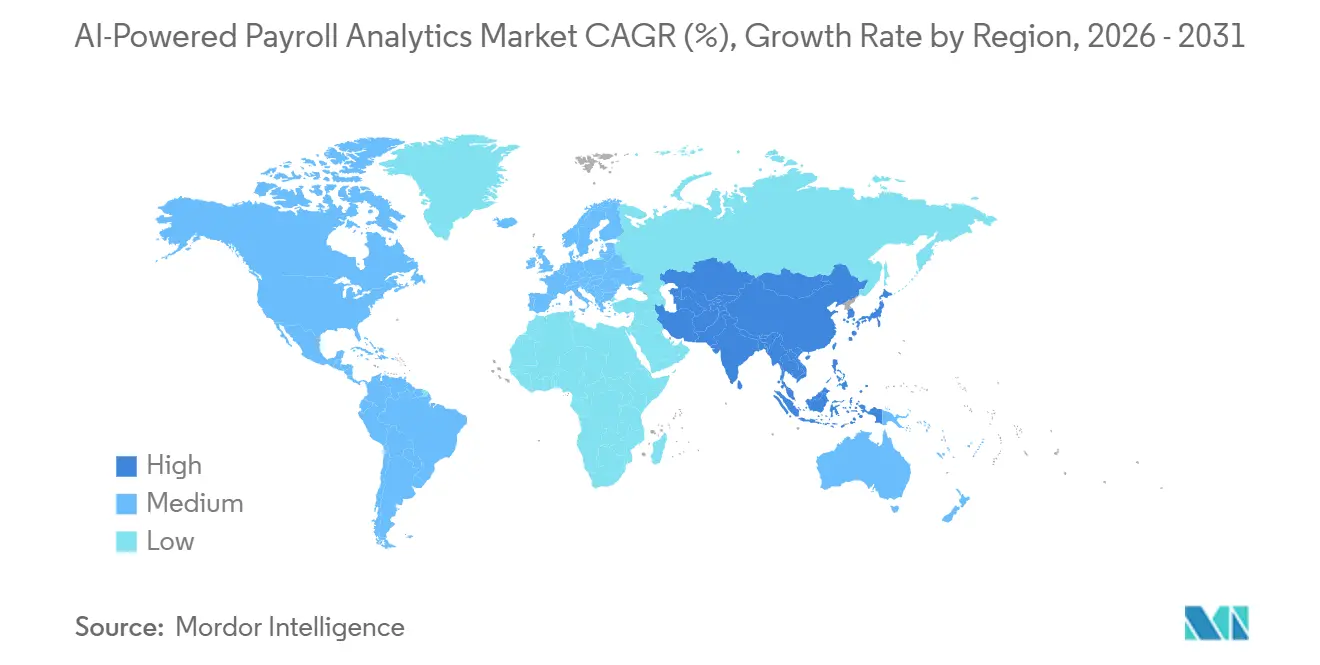
| Fastest Growing Market | Asia-Pacific |
| Largest Market | North America |
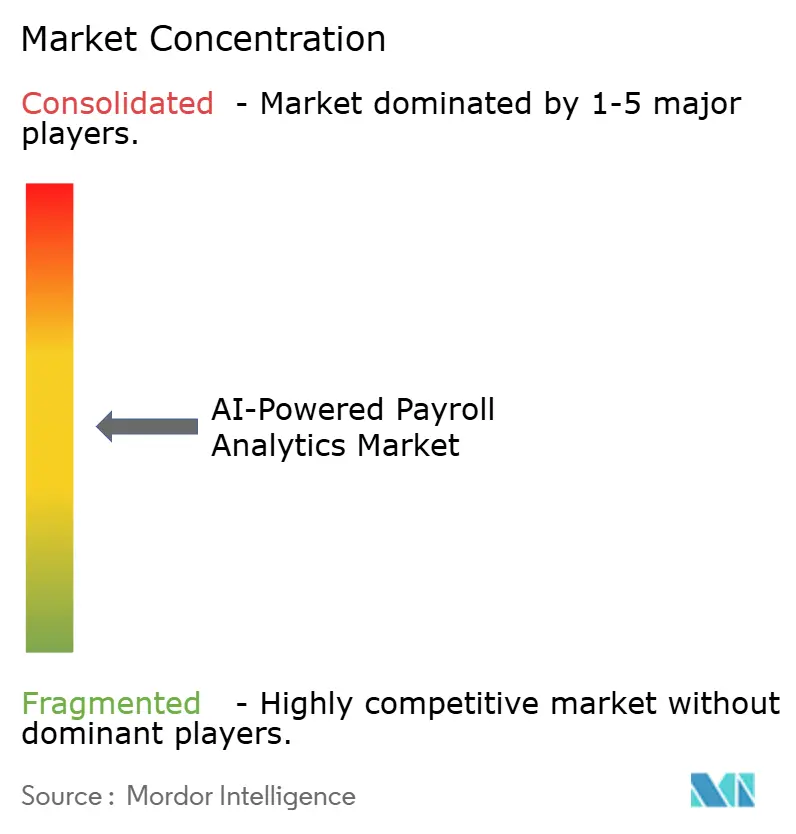
| Market Concentration | Medium |
Major Players *Disclaimer: Major Players sorted in no particular order Image © Mordor Intelligence. Reuse requires attribution under CC BY 4.0. | |
AI-powered Payroll Analytics Market Analysis by Mordor Intelligence
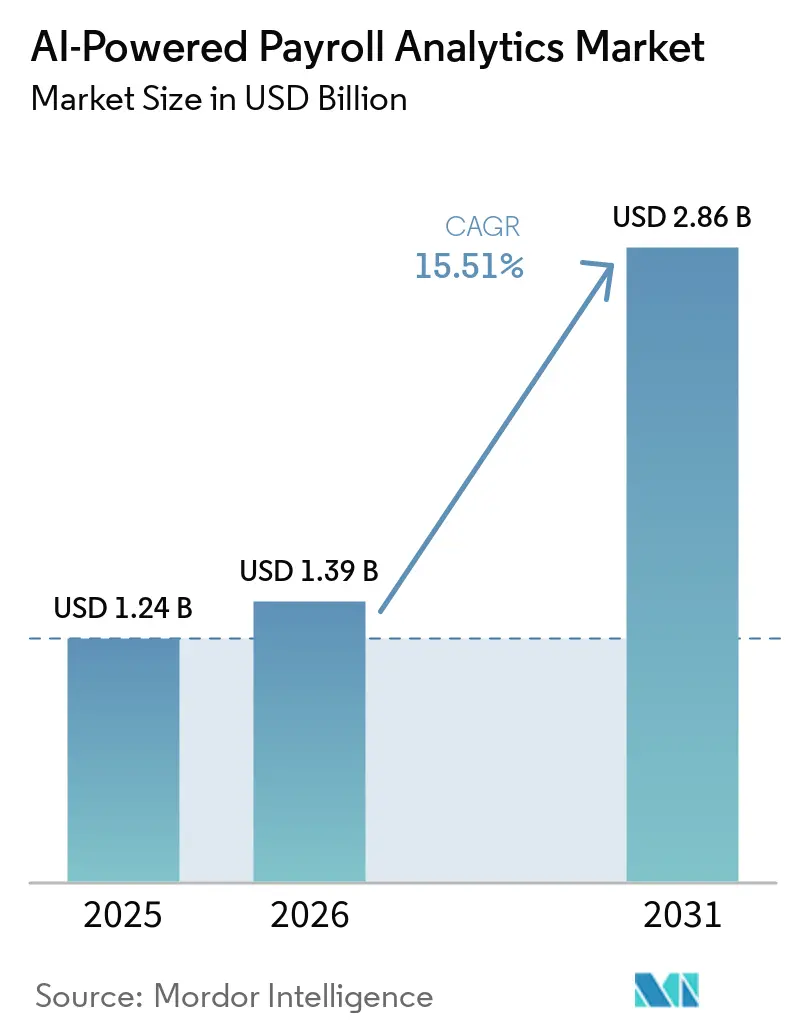
The AI-powered Payroll Analytics Market size is expected to grow from USD 1.24 billion in 2025 to USD 1.39 billion in 2026 and is forecast to reach USD 2.86 billion by 2031 at a 15.51% CAGR over 2026-2031. Continuous regulatory change is reframing payroll from a back-office task into a real-time intelligence layer that informs head-count planning, cost optimization, and pay-equity compliance. Cloud-native suites equipped with embedded machine-learning agents are displacing on-premise architectures because they compress implementation times, eliminate manual reconciliations, and make advanced analytics financially accessible to small teams. Venture-capital inflows, illustrated by the USD 300 million raise of Deel and the USD 31 million Series A of Niural, are intensifying feature velocity and lowering price-performance ratios as new entrants vie for cross-border clients. At the same time, mid-market customers are switching vendors at record levels, signaling that legacy providers face churn risk if they cannot deliver explainable AI, sovereign-cloud options, and audit-ready data pipelines.
Key Report Takeaways
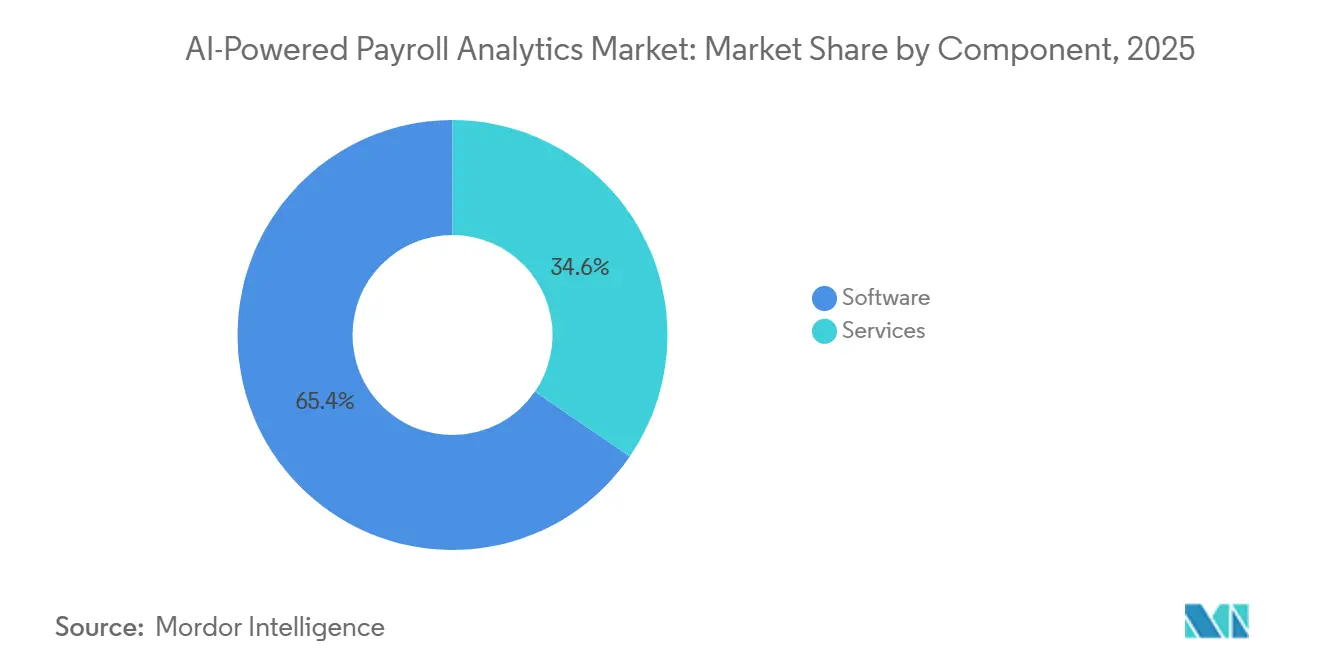
- By component, software captured 65.44% of 2025 revenue while services are the fastest-growing segment at a 17.78% CAGR through 2031.
- By analytics type, predictive payroll analytics led with 34.11% of the AI-powered Payroll Analytics Market share in 2025, whereas fraud and anomaly detection is projected to accelerate at a 17.05% CAGR.
- By deployment mode, cloud-based suites accounted for 64.01% of the AI-powered Payroll Analytics Market size in 2025 and are expanding at an 18.22% CAGR through 2031 as enterprises migrate away from legacy on-premise stacks.
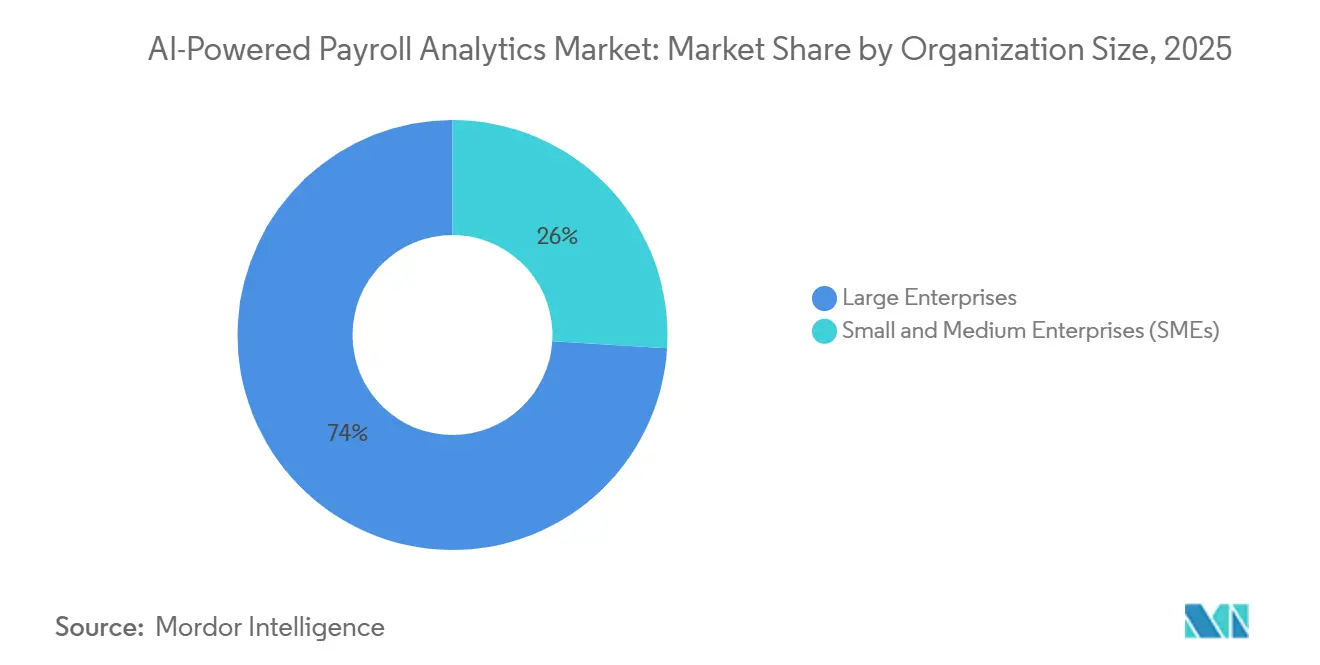
- By organization size, large enterprises held 74.02% of spending in 2025, yet small and medium enterprises represent the growth engine with an 18.89% CAGR to 2031.
- By industry vertical, BFSI generated 22.71% of global revenue in 2025, while IT and telecommunications enjoys the highest forecast growth at 16.14% CAGR.
- By geography, North America dominated with 38.14% of 2025 revenue, whereas Asia-Pacific is on track to post a 16.51% CAGR through 2031.
Note: Market size and forecast figures in this report are generated using Mordor Intelligence’s proprietary estimation framework, updated with the latest available data and insights as of January 2026.
Market Trends and Insights
Drivers Impact Analysis of AI-powered Payroll Analytics Market*
| Driver | (~) % Impact on CAGR Forecast | Geographic Relevance | Impact Timeline |
|---|---|---|---|
| Rapid Adoption of Cloud-Based Payroll Suites | +3.8% | Global, early in North America and Europe | Medium term (2-4 years) |
| Increasing Regulatory Complexity in Multi-Country Payroll | +3.2% | Global, acute in EU, North America, APAC | Long term (≥ 4 years) |
| Growing Demand for Real-Time Payroll Insights to Improve Workforce Planning | +2.9% | Global, strongest in North America and APAC | Medium term (2-4 years) |
| AI-Driven Fraud Detection and Payroll Compliance Monitoring | +2.5% | Global, BFSI, healthcare, large enterprises | Short term (≤ 2 years) |
| Rising Venture-Capital Funding Into HR Tech Start-Ups | +1.7% | Global, concentrated in North America and Europe | Short term (≤ 2 years) |
| Integration of Payroll Analytics With Financial Wellness Programs | +1.4% | North America and Europe, emerging APAC | Medium term (2-4 years) |
| Source: Mordor Intelligence | |||
Rapid Adoption of Cloud-Based Payroll Suites
Elastic compute, API-first architectures, and turnkey AI modules are pushing enterprises to abandon on-premise deployments. Workday added more than 60 Australian payroll customers within two years of launch, and at least half were already live by late 2025.[1]ADP’s three-cloud partnership with AWS, Azure, and GCP unlocked monetization of anonymized payroll datasets, powering benchmarking tools that smaller rivals cannot match. Workday’s Deployment Agent, available February 2026, is projected to cut implementation timelines by 25%, a value proposition resonating with midsize companies that lack dedicated IT resources. The Australian Payroll Association reported that 23.6% of payroll teams cited poor systems integration as a bottleneck, an inefficiency cloud-native platforms are designed to remove. Collectively, these developments place cloud at the center of the AI-powered Payroll Analytics Market growth narrative.
Increasing Regulatory Complexity in Multi-Country Payroll
The EU Pay Transparency Directive (effective June 6 2026) mandates gender-segmented pay-gap disclosure, while California’s SB 464 imposes annual pay-data reporting with escalating fines for inaccuracies. New York City’s Int. 982-A and Ontario’s Working for Workers Four Act extend similar obligations, compelling employers to embed compliance intelligence into everyday payroll workflows. Enterprises operating across five or more jurisdictions already manage 50-plus statutory changes annually, rendering manual updates untenable. Vendors are responding by shipping AI agents that scan legislative feeds and auto-configure withholding tables, a capability now cited as top-three in RFPs across North America and Europe. Persistent rule churn therefore underpins the long-run trajectory of the AI-powered Payroll Analytics Market.
Growing Demand for Real-Time Payroll Insights to Improve Workforce Planning
Volkswagen Group Services trimmed report-generation time from seven days to seconds and raised productivity 85% after embedding IBM Planning Analytics into its payroll-finance workflow. A Forrester TEI model found that a USD 3 billion retailer captured USD 29.34 million in three-year benefits, including USD 12.66 million in manager productivity gains, once real-time payroll data fed scenario models. Rover Insights reports that 41% of mid-market switching decisions in Q1 2026 were triggered by compliance gaps, while 34% stemmed from multi-state expansion needs. Such pain points are driving demand for unified datasets that join time-tracking, HR, and finance records into a single analytic fabric. As firms shift from retrospective cost reconciliation toward proactive head-count optimization, the AI-powered Payroll Analytics Market is becoming a linchpin for strategic workforce planning.
AI-Driven Fraud Detection and Payroll Compliance Monitoring
Seventy percent of payroll leaders reported at least one payroll-related cyber incident in the past two years. Workday’s Financial Test Suite, entering general availability in H2 2026, performs background audits to halt duplicate payments before funds settle. Zalaris notes that anomaly-detection engines trained on 24 months of history can flag incremental salary drift and pension irregularities invisible to rule-based scripts. ADP Assist, launched January 2026, bundles persona-based AI agents that alert users to missing tax IDs and variance spikes, closing the loop between detection and remediation. Heightened board oversight of ISO 27001 and SOC 2 attestations magnifies vendor-selection scrutiny, positioning explainable fraud analytics as a premium differentiator inside the AI-powered Payroll Analytics Market.
Restraints Impact Analysis of AI-powered Payroll Analytics Market*
| Restraint | (~) % Impact on CAGR Forecast | Geographic Relevance | Impact Timeline |
|---|---|---|---|
| Data Privacy and Cross-Border Data Transfer Restrictions | -2.1% | EU, California, emerging APAC | Long term (≥ 4 years) |
| Shortage of Payroll Data Science Talent | -1.8% | India, Australia, UK, North America | Medium term (2-4 years) |
| Legacy Payroll Infrastructure in Large Enterprises | -1.3% | Global, on-premise ERP estates | Medium term (2-4 years) |
| High Initial Integration Costs for SMEs | -1.1% | Global, budget-constrained SMEs | Short term (≤ 2 years) |
| Source: Mordor Intelligence | |||
Data Privacy and Cross-Border Data Transfer Restrictions
California’s CPPA rules effective October 2025 require anti-bias testing, cybersecurity audits, and opt-out flows for automated pay decisions, materially increasing compliance budgets for multistate employers. The U.S. Department of Justice Bulk Data Transfer Rule (April 2025) limits offshore administrative access, compelling global vendors to introduce sovereign-cloud regions. Under GDPR, companies lacking approved safeguards face suspension of data flows, spurring demand for customer-managed encryption keys and confidential-computing enclaves. Each additional safeguard adds latency, cost, and legal exposure, tempering adoption velocity in the AI-Powered Payroll Analytics industry.
Shortage of Payroll Data Science Talent
ManpowerGroup’s 2026 survey of 39,063 employers ranks AI model development as the scarcest skill set globally. ADP shows 75% of Indian companies and 43% of Australian firms suffer payroll staffing gaps, pushing organizations to cross-train non-payroll employees or outsource complex analytics. SHRM notes that 80% of U.S. HR teams struggle to source candidates with systems-management expertise. Vendors are countering with low-code dashboards and pre-built anomaly libraries, but talent scarcity still elongates deployment timelines, mildly suppressing the AI-powered Payroll Analytics Market growth trajectory.
*Our forecasts treat driver/restraint impacts as directional, not additive. The impact forecasts reflect baseline growth, mix effects, and variable interactions.
AI-powered Payroll Analytics Market Segment Analysis
By Component:
Services Surge as Integration Complexity MountsImplementation, consulting, and support services accounted for the fastest growth inside the AI-powered Payroll Analytics Market, advancing at 17.78% CAGR as enterprises tackled legacy ERP integration, sovereign-cloud provisioning, and pay-equity reporting. Although software maintained a 65.44% revenue share in 2025, buyers increasingly view code as commodity and outcomes as premium. Vendors that wrap turnkey playbooks around GDPR transfer impact assessments and California CPPA audits capture higher attach rates.
Demand for post-go-live tuning is also accelerating. Quarterly bias audits, model-drift remediation, and legislative rule-engine updates require human oversight that internal teams often lack. Zalaris recommends at least four compliance validation cycles per year to keep AI outputs defensible. Consequently, services revenues are projected to lift their share of the AI-powered Payroll Analytics Market size as organizations treat continuous optimization as essential to safeguard brand and regulatory standing.
By Analytics Type:
Fraud Detection Gains Urgency Amid Cyber IncidentsPredictive payroll analytics held a 34.11% revenue share in 2025, but fraud and anomaly detection is rising faster, reflecting heightened cyber-security threats and stricter audit obligations. With 70% of enterprises encountering at least one payroll breach in two years, boards now mandate continuous monitoring regimes. Workday’s Financial Test Suite adds automated stop-payment controls, underscoring a pivot from identification to prevention.
Convergence is emerging. Suites now bundle cost modeling, pay-equity diagnostics, and anomaly scanning in a unified canvas, simplifying role-based access governance and evidentiary logging. Vendors that can surface variance root causes inside minutes, rather than days, are winning bake-offs, suggesting that fraud analytics will continue enlarging its slice of the AI-powered Payroll Analytics Market share over the forecast horizon.
By Deployment Mode:
Cloud Ascends as Enterprises Prioritize AgilityCloud held 64.01% of 2025 deployments and is expanding at an 18.22% CAGR, powered by hyperscaler cost curves and regionally segregated sovereign variants. Workday’s Australian client wins demonstrate that even highly regulated industries accept multi-tenant SaaS when security controls and local data clusters are in place. ADP leverages tri-cloud redundancy to monetize aggregated payroll benchmarks, a data-network effect unavailable to on-premise operators.
Hybrid patterns are surfacing where sensitive identifiers remain on-premise, while pseudonymized aggregates flow to cloud-based analytics engines. This topology satisfies Schrems II proportionality tests and emerging localization statutes in India and Saudi Arabia. Accordingly, cloud-centric roadmaps will define the next chapter of the AI-powered Payroll Analytics Market, even though pockets of mainframe-bound payroll logic persist among heavily customized manufacturers and public agencies.
By Organization Size:
SMEs Embrace Affordable SaaS and Embedded AILarge enterprises still dominate spending at 74.02% because multinational tax regimes, union contracts, and complex benefits structures demand robust analytics. Yet SMEs represent the steepest trajectory, expanding at 18.89% CAGR. 39% of surveyed small firms used at least one AI tool in Q4 2024, and that share has since climbed.
Price points below USD 10 per employee per month, free trials, and conversational onboarding reverse historical barriers. Valeria’s WhatsApp-based setup resolves 94% of payroll queries without human intervention. Such frictionless experiences resonate with restaurants, retailers, and logistics operators that operate on thin margins. Consequently, the SME cohort is set to widen its slice of the AI-powered Payroll Analytics Market size, even if absolute dollar volume remains skewed toward conglomerates.
By Industry Vertical:
BFSI Leads, IT and Telecom AccelerateBFSI commanded 22.71% of 2025 revenue because banking regulators enforce stringent audit readiness and pay-equity disclosure. Continuous reconciliation between payroll ledgers, GL postings, and capital-adequacy calculations drives premium analytics spend.
In contrast, IT and telecommunications is slated for a 16.14% CAGR as geographically dispersed engineering teams, usage-based revenue models, and frequent restructuring events require scenario modeling that fuses head-count, skills, and project P&L data. Retail and healthcare trail at moderate growth rates but increasingly tap AI-powered scheduling to curb overtime leakage and compliance penalties, sustaining a broadening demand base for the AI-Powered Payroll Analytics industry.
Geography Analysis
North America AI-powered Payroll Analytics Market
North America generated 38.14% of global revenue in 2025, sustained by California SB 464, New York City Int. 982-A, and Ontario’s Working for Workers Four Act that mandate granular pay-data reporting. Vendor consolidation, exemplified by Paychex’s USD 4.1 billion acquisition of Paycor, gave buyers access to platforms serving one in eleven U.S. private-sector workers, reinforcing scale economies that accelerate feature rollout.
APAC and Africa AI-powered Payroll Analytics Market
Asia-Pacific is the fastest-growing territory at 16.51% CAGR. India’s 75% payroll-staff shortage and Australia’s 43% coverage gap have driven companies toward automation and anomaly detection.[2]Workday’s rapid Australian uptake shows regional appetite for AI-infused compliance alerts, while African start-ups such as PaidHR expand footprints across 49 currencies, illustrating untapped frontier opportunities.
EMEA and South America AI-powered Payroll Analytics Market
Europe records steady adoption propelled by the EU Pay Transparency Directive effective June 2026. SD Worx’s acquisition of Paie and RH Solutions in February 2026 increased its French SME client base by 1,100 accounts, signaling intensified mid-market competition. South America and the Middle East and Africa remain early-stage but are seeing cloud-first entrants plug into volatile currency zones and fragmented tax landscapes, adding long-tail momentum to the AI-powered Payroll Analytics Market.
Competitive Landscape
The AI-powered Payroll Analytics Market is moderately fragmented. Incumbents such as ADP, Workday, and Paychex capitalize on decades-deep data reservoirs to train predictive models, launch persona-based AI agents, and upsell benchmarking dashboards. ADP Assist, released January 2026, layers audit bots onto a client base of 42 million earners, creating a network-scale barrier for challengers.[3]Paychex completed its USD 4.1 billion acquisition of Paycor in April 2025, combining 800,000 customers and emphasizing AI-driven HR technology and advisory solutions to strengthen its upmarket position.
Disruptors including Deel, Rippling, and Papaya Global pursue native payroll engines in dozens of jurisdictions, reducing dependence on local aggregators and improving data granularity. Deel’s USD 17.3 billion valuation underscores investor conviction that cross-border design coupled with AI compliance scanning can seize mid-market share.
Strategic M&A is accelerating. Workday absorbed Paradox and agreed to acquire Sana for USD 1.1 billion, weaving conversational interfaces and AI-native learning into its HCM core.Acrisure paid USD 1.1 billion for Heartland Payroll to boost small-business penetration. These moves suggest that ecosystem control and proprietary datasets will define sustainable advantage, nudging market structure toward a tighter oligopoly over the forecast period.
AI-powered Payroll Analytics Industry Leaders
-
Automatic Data Processing, Inc.
-
Workday, Inc.
-
Oracle Corporation
-
UKG Inc.
-
SAP SE
- *Disclaimer: Major Players sorted in no particular order
AI-powered Payroll Analytics Market Companies Covered in this Report
- Automatic Data Processing, Inc.
- Paychex, Inc.
- Paycom Software, Inc.
- Ceridian HCM Holding Inc.
- Paycor HCM, Inc.
- Intuit Inc.
- Workday, Inc.
- Gusto, Inc.
- Rippling People Center, Inc.
- Zenefits LLC
- BambooHR LLC
- UKG Inc.
- Oracle Corporation
- SAP SE
- Ramco Systems Limited
- Zoho Corporation Private Limited
- Deel, Inc.
- Papaya Global Ltd.
- Neeyamo Enterprise Solutions Private Limited
- Namely Inc.
Recent Industry Developments in AI-powered Payroll Analytics Market
- March 2026: ADP announced a strategic partnership with Pine Services Group to embed AI-enabled HCM suites across construction-focused ERP resellers.
- February 2026: SD Worx acquired French outsourcing specialist Paie and RH Solutions, adding 1,100 SME customers and EUR 9 million (USD 9.6 million) in 2025 revenue.
- February 2026: Valeria raised USD 2 million to commercialize an AI-native payroll platform for frontline industries.
- January 2026: ADP launched ADP Assist, an ensemble of persona-based AI agents that auto-audit payroll variances and generate natural-language insights.
Global AI-powered Payroll Analytics Market Report Scope
The AI‑Powered Payroll Analytics Market encompasses platforms harnessing artificial intelligence, machine learning, and predictive modeling. They delve into payroll data to refine workforce cost management. By shedding light on labor trends, pay discrepancies, compliance challenges, and forecasting, these solutions bolster payroll efficiency. Organizations gravitate towards AI payroll analytics to enhance accuracy, curb fraud, refine budgeting, and bolster data-driven decisions in HR and finance. The surge in this market is propelled by a digital payroll overhaul, the intricacies of a multi-country workforce, and an appetite for real-time analytics in contemporary HCM frameworks.
The AI-powered Payroll Analytics Market Report is Segmented by Component (Software, and Services), Analytics Type (Predictive Payroll Analytics, Automated Compliance and Risk Analytics, Payroll Fraud and Anomaly Detection, AI‑Optimized Workforce Cost Modeling, AI‑Driven Pay Equity and Compensation Analytics, and Other Analytics Type), Deployment Mode (Cloud, and On-Premise), Organization Size (Small and Medium Enterprises [SMEs], and Large Enterprises), Industry Vertical (IT and Telecommunications, BFSI, Healthcare, Retail and E-Commerce, Manufacturing, Government and Public Sector, and Other Industry Verticals), and Geography (North America, South America, Europe, Asia-Pacific, Middle East, and Africa). The Market Forecasts are Provided in Terms of Value (USD).
Segmentation Overview
| Software | |
| Services | Implementation Services |
| Consulting Services | |
| Support and Maintenance Services |
| Predictive Payroll Analytics |
| Automated Compliance and Risk Analytics |
| Payroll Fraud and Anomaly Detection |
| AI?Optimized Workforce Cost Modeling |
| AI?Driven Pay Equity and Compensation Analytics |
| Other Analytics Type |
| Cloud |
| On-Premise |
| Small and Medium Enterprises (SMEs) |
| Large Enterprises |
| IT and Telecommunications |
| BFSI |
| Healthcare |
| Retail and E-Commerce |
| Manufacturing |
| Government and Public Sector |
| Other Industry Verticals |
| North America | United States |
| Canada | |
| Mexico | |
| South America | Brazil |
| Argentina | |
| Rest of South America | |
| Europe | Germany |
| United Kingdom | |
| France | |
| Italy | |
| Spain | |
| Rest of Europe | |
| Asia-Pacific | China |
| India | |
| Japan | |
| Australia | |
| South Korea | |
| Rest of Asia-Pacific | |
| Middle East | Saudi Arabia |
| United Arab Emirates | |
| Turkey | |
| Rest of Middle East | |
| Africa | South Africa |
| Nigeria | |
| Rest of Africa |
| By Component | Software | |
| Services | Implementation Services | |
| Consulting Services | ||
| Support and Maintenance Services | ||
| By Analytics Type | Predictive Payroll Analytics | |
| Automated Compliance and Risk Analytics | ||
| Payroll Fraud and Anomaly Detection | ||
| AI?Optimized Workforce Cost Modeling | ||
| AI?Driven Pay Equity and Compensation Analytics | ||
| Other Analytics Type | ||
| By Deployment Mode | Cloud | |
| On-Premise | ||
| By Organization Size | Small and Medium Enterprises (SMEs) | |
| Large Enterprises | ||
| By Industry Vertical | IT and Telecommunications | |
| BFSI | ||
| Healthcare | ||
| Retail and E-Commerce | ||
| Manufacturing | ||
| Government and Public Sector | ||
| Other Industry Verticals | ||
| By Geography | North America | United States |
| Canada | ||
| Mexico | ||
| South America | Brazil | |
| Argentina | ||
| Rest of South America | ||
| Europe | Germany | |
| United Kingdom | ||
| France | ||
| Italy | ||
| Spain | ||
| Rest of Europe | ||
| Asia-Pacific | China | |
| India | ||
| Japan | ||
| Australia | ||
| South Korea | ||
| Rest of Asia-Pacific | ||
| Middle East | Saudi Arabia | |
| United Arab Emirates | ||
| Turkey | ||
| Rest of Middle East | ||
| Africa | South Africa | |
| Nigeria | ||
| Rest of Africa | ||
Key Questions Answered in the Report
What is the current AI-powered Payroll Analytics Market size and how fast will it grow?
The AI-powered Payroll Analytics Market size stands at USD 1.39 billion in 2026 and is projected to reach USD 2.86 billion by 2031, reflecting a 15.51% CAGR.
Which deployment model is expanding the fastest?
Cloud-based payroll analytics is the fastest-growing deployment mode, registering an 18.22% CAGR as organizations migrate from on-premise systems to elastic, API-first platforms.
Which analytics type shows the strongest momentum?
Payroll fraud and anomaly detection is forecast to expand at a 17.05% CAGR, outpacing predictive analytics as enterprises prioritize real-time risk mitigation.
Why are small and medium enterprises adopting AI-powered payroll tools?
Affordable SaaS pricing, embedded AI agents that remove the need for data-science expertise, and regulatory pressure to file accurate pay-data reports are driving an 18.89% CAGR in SME adoption.
How is regulation shaping vendor selection?
Statutes such as the EU Pay Transparency Directive and California SB 464 compel buyers to demand explainable AI, sovereign-cloud options, and automated compliance updates, reshaping RFP scoring criteria.