
Middle East And Africa Online Grocery Delivery Market Size and Share
Market Overview
| Study Period | 2020 - 2031 |
|---|---|
| Forecast Data Period | 2026 - 2031 |
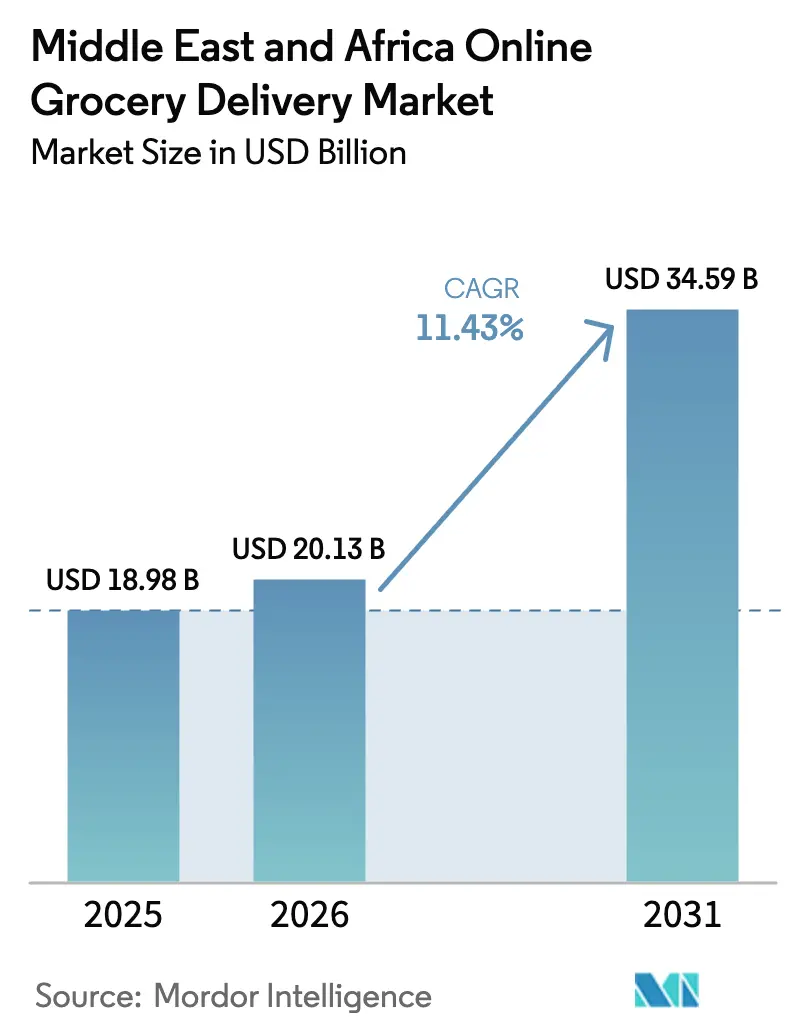
| Base Year Market Size (2025) | USD 18.98 Billion |
| Market Size (2026) | USD 20.13 Billion |
| Market Size (2031) | USD 34.59 Billion |
| Growth Rate (2026 - 2031) | 11.43 % |
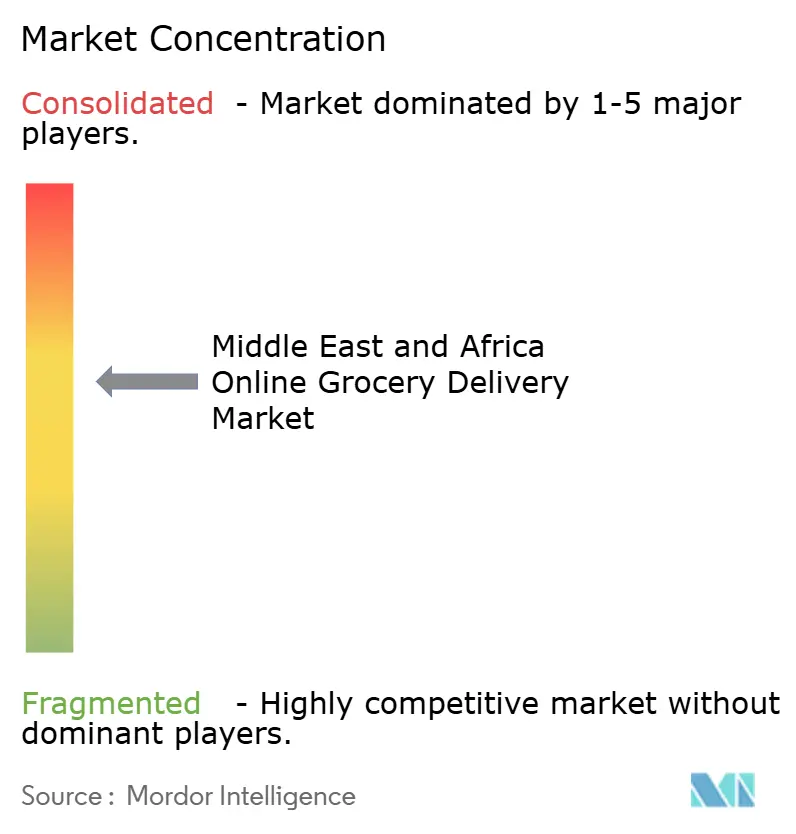
| Market Concentration | Medium |
Major Players *Disclaimer: Major Players sorted in no particular order Image © Mordor Intelligence. Reuse requires attribution under CC BY 4.0. | |
Middle East And Africa Online Grocery Delivery Market Analysis by Mordor Intelligence
The Middle East And Africa Online Grocery Delivery Market size is expected to increase from USD 18.98 billion in 2025 to USD 20.13 billion in 2026 and reach USD 34.59 billion by 2031, growing at a CAGR of 11.43% over 2026-2031.
Strong smartphone penetration, denser dark-store networks in Gulf cities, and innovative fulfilment formats anchored at fuel stations continue to compress delivery windows and broaden customer reach. Quick-commerce services offering sub-30-minute delivery are expanding the addressable market for time-pressed households, while scheduled services remain relevant for value-oriented bulk orders. Platforms that embed buy-now-pay-later, social commerce features, and artificial intelligence-driven inventory tools are boosting average basket values, reducing spoilage, and improving order accuracy. Competitive intensity is rising as well-capitalized regional champions collide with new entrants backed by global tech majors, nudging operators toward vertical integration, business-to-business expansion, and proprietary technology stacks.
Key Report Takeaways
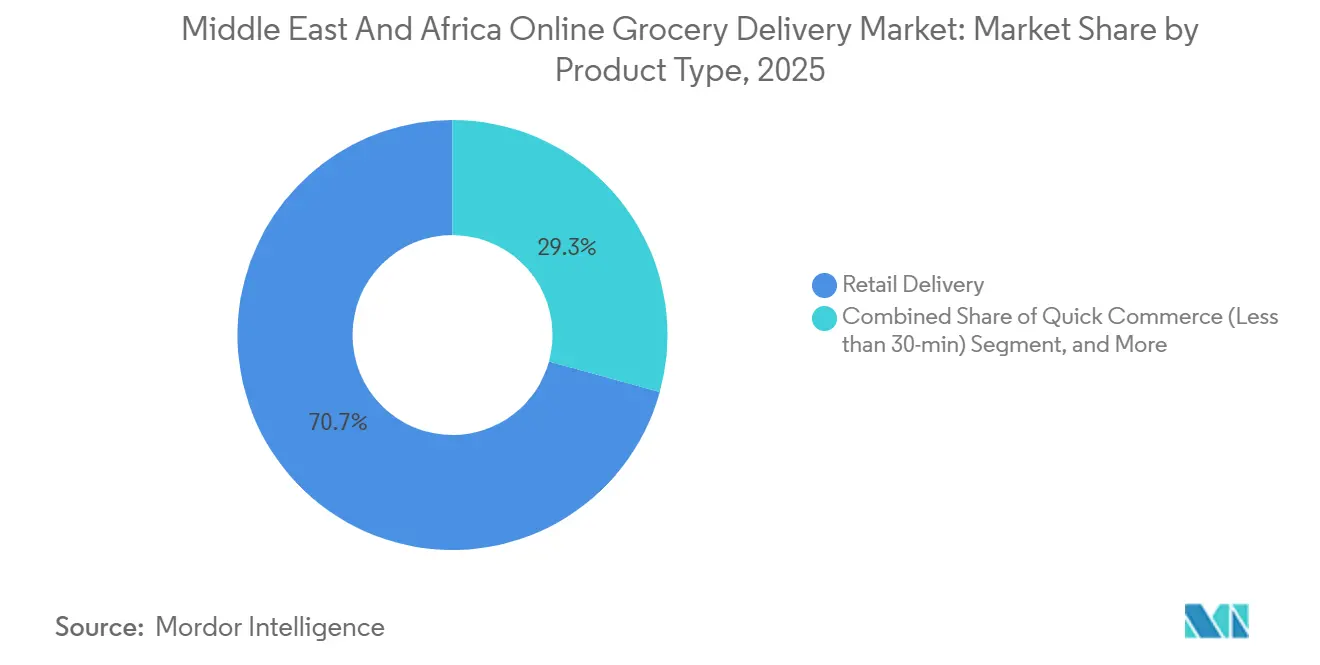
- By product type, retail delivery held 70.73% of the online grocery delivery market share in 2025, whereas Quick Commerce is forecast to expand at a 14.01% CAGR to 2031.
- By delivery speed, Standard delivery captured 56.91% of the online grocery delivery market size in 2025, while Instant delivery is advancing at a 13.23% CAGR through 2031.
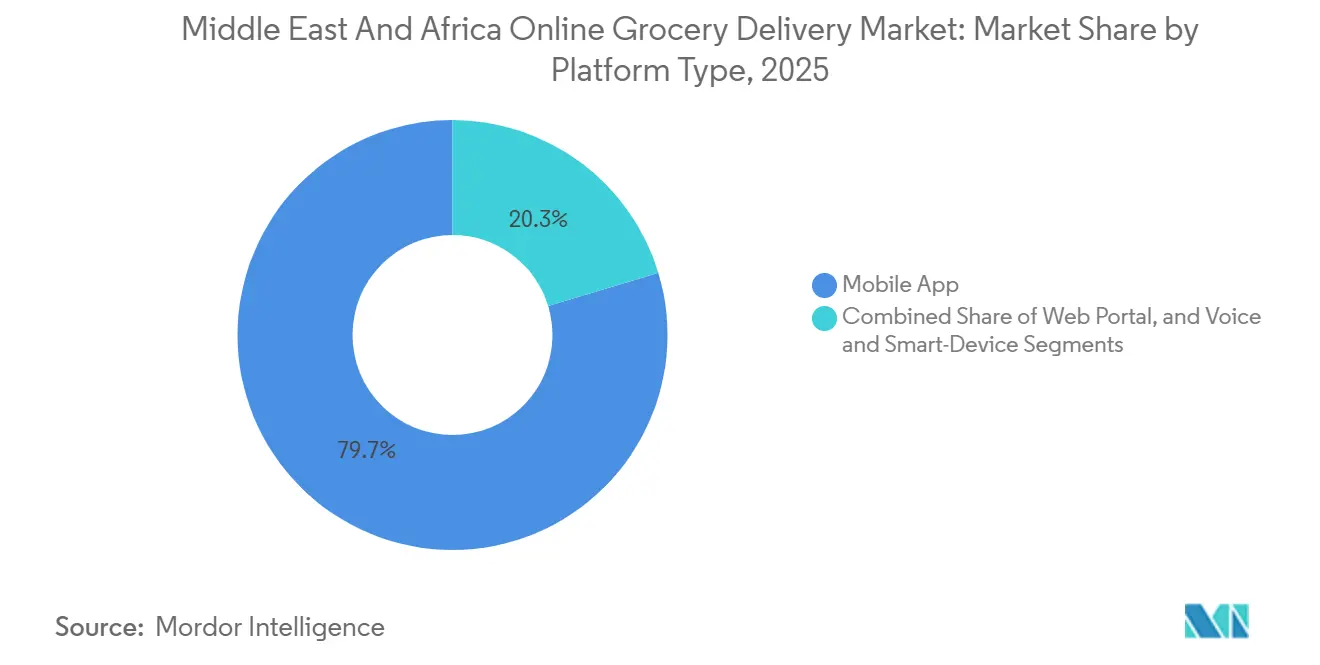
- By platform type, mobile apps processed 79.68% of 2025 transactions; web portals are projected to post the highest 11.86% CAGR to 2031.
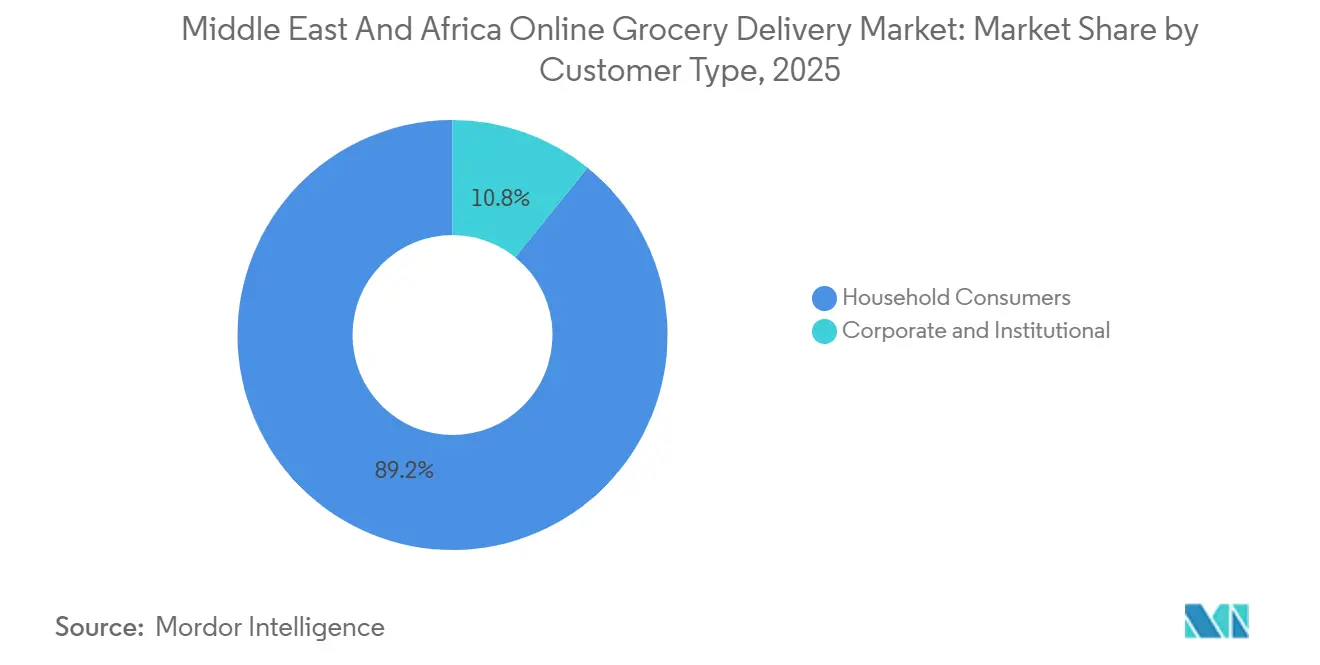
- By customer type, household consumers accounted for 89.19% of 2025 revenue, yet the corporate segment is projected to log an 11.48% CAGR to 2031.
- By geography, the United Arab Emirates led with 27.26% revenue share in 2025, while Saudi Arabia is poised for the fastest 12.67% CAGR to 2031.
Note: Market size and forecast figures in this report are generated using Mordor Intelligence’s proprietary estimation framework, updated with the latest available data and insights as of January 2026.
Worldwide, activity is shaped by contributions from multiple regions, with Middle east and africa representing one of the more structurally developed among them. The global report on online grocery delivery market by Mordor Intelligence reflects how these regional layers combine into a single system.
Middle East And Africa Online Grocery Delivery Market Trends and Insights
Drivers Impact Analysis*
| Driver | (~) % Impact on CAGR Forecast | Geographic Relevance | Impact Timeline |
|---|---|---|---|
| Expansion of Quick-Commerce Dark-Store Networks | +2.8% | Gulf Cooperation Council, urban Egypt and South Africa | Short term (≤ 2 years) |
| Rising Smartphone and Internet Penetration | +2.3% | Saudi Arabia, United Arab Emirates, Qatar, Kuwait, Bahrain, Oman, Egypt, South Africa, Kenya, Nigeria | Medium term (2-4 years) |
| AI-Driven Hyperlocal Inventory Optimization | +1.9% | United Arab Emirates, Saudi Arabia, Qatar; pilots in Egypt and Kenya | Medium term (2-4 years) |
| Rapid Urbanization and Time-Pressed Lifestyles | +1.7% | Gulf Cooperation Council | Short term (≤ 2 years) |
| Increasing Digital Payment Adoption | +1.4% | United Arab Emirates, Saudi Arabia, Egypt, South Africa, Kenya, Nigeria | Short term (≤ 2 years) |
| Petro-Retail Fulfilment Hubs | +1.2% | Gulf Cooperation Council | Medium term (2-4 years) |
| Source: Mordor Intelligence | |||
Expansion of Quick-Commerce Dark-Store Networks
Dark stores in Gulf cities have shortened typical delivery windows to under 30 minutes, redefining consumer expectations for fresh groceries. Careem’s April 2025 tie-up with Tamimi Markets in Riyadh showcases premium, curated assortments delivered in 20 minutes.[1]Careem, “Careem and Tamimi Markets bring premium grocery delivery to Riyadh,” careem.com Carrefour’s 24-hour express service in Dubai fulfills orders within 60 minutes from a 10,000-SKU catalog. Deliveroo HOP and talabat Mart are scaling similar models, signaling a region-wide shift toward instant fulfillment. Well-capitalized operators enjoy first-mover advantages, though automation and real-time inventory systems raise capital barriers for smaller rivals.
Rising Smartphone and Internet Penetration
Smartphones are now a daily fixture for 96% of users in the United Arab Emirates and Saudi Arabia.[2]Deloitte Middle East, “Deloitte’s Digital Consumer Trends 2025,” deloitte.com PwC found that 57% of regional shoppers make purchases primarily via mobile, double the global average. High social-commerce engagement, with 73% of consumers buying through social media, encourages grocery apps to embed shoppable content. Growing use of generative artificial intelligence opens the door to chat-based ordering, though 25% of users remain privacy-conscious under new Gulf data-protection laws. Platforms that balance personalization and compliance are likely to capture incremental share.
AI-Driven Hyperlocal Inventory Optimization
Yango Tech’s AInventory, launched in March 2025, combines computer vision and IoT sensors to hit 98% order-fulfillment accuracy for Talabat Mart. Al-Futtaim’s trials of autonomous shelf-scanning robots further illustrate retailers’ appetite for data-rich replenishment tools. Personalized, artificial intelligence-powered promotions generate click-through rates 30% higher than generic offers, supporting larger baskets. Compliance with ISO 9001 and ISO 22000 standards ensures traceability as algorithms increasingly govern stocking decisions. Operators that master proprietary artificial intelligence stand to dominate premium and specialty categories.
Rapid Urbanization and Time-Pressed Lifestyles
More than 80% of Gulf residents now live in urban centers, amplifying demand for time-saving services. Dual-income households, expanded female workforce participation under Vision 2030, and congested commutes push shoppers toward instant convenience. Dark-store density and reliable road infrastructure make sub-30-minute delivery economically viable in cities such as Dubai and Riyadh. Platforms that couple round-the-clock service with targeted promotions during late-night and early-morning periods are monetizing latent demand that brick-and-mortar stores cannot reach.
Restraints Impact Analysis*
| Restraint | (~) % Impact on CAGR Forecast | Geographic Relevance | Impact Timeline |
|---|---|---|---|
| High Last-Mile Costs and Low Profit Margins | -1.8% | Nigeria, Kenya, Egypt, Morocco, secondary Gulf cities | Short term (≤ 2 years) |
| Limited Cold-Chain Capacity in Africa | -1.3% | Nigeria, Kenya, Egypt, Morocco, rest of Africa | Medium term (2-4 years) |
| Price Sensitivity and Perceived Premiums | -0.9% | Egypt, South Africa, Nigeria, Kenya, price-conscious Gulf | Short term (≤ 2 years) |
| Data-Localization and Compliance | -0.7% | United Arab Emirates, Saudi Arabia, Qatar, Egypt, South Africa | Medium term (2-4 years) |
| Source: Mordor Intelligence | |||
High Last-Mile Costs and Low Profit Margins
Delivery expenses consume 15-25% of order value in Gulf cities and exceed 30% in sprawling African metros, eroding profitability. Jumia’s withdrawal from food delivery across seven African countries underlines the challenge. Rising fuel prices and local hiring mandates further inflate costs. Subscription models and minimum-basket thresholds help offset these pressures but favor scale players able to drive higher order density.
Limited Cold-Chain Capacity in Africa
Cold-chain gaps in Nigeria, Kenya, and Egypt elevate spoilage risk and confine platforms to ambient goods. Breadfast’s plan to raise USD 13 million for infrastructure upgrades underscores the capital intensity of chilled logistics.[3]Wamda, “Breadfast in talks with IFC for USD 13 million backing,” wamda.com Energy-reliant refrigeration adds operating costs where grid power is unreliable. Regulatory enforcement of food-safety standards is uneven, leaving compliance risks that discourage aggressive expansion into secondary cities.
*Our forecasts treat driver/restraint impacts as directional, not additive. The impact forecasts reflect baseline growth, mix effects, and variable interactions.
Segment Analysis
By Product Type: Quick Commerce Outpaces Retail Delivery In Growth Velocity
Retail Delivery commanded 70.73% of 2025 revenue, confirming its role as the low-cost backbone of the online grocery delivery market. However, Quick Commerce is on track for a 14.01% CAGR, buoyed by platforms such as Careem and talabat that routinely meet 20-minute service levels. Meal-kit providers like Calo and JustCook are layering culinary expertise and portion-controlled packaging onto this ecosystem, appealing to health-conscious professionals. Specialty and ethnic grocery offerings meet the needs of expatriate communities, while pharmacy items further blur category lines. Operators must balance the capital intensity of dark stores with the culinary and packaging know-how required for meal kits, ensuring high inventory turnover to sustain margins.
Quick Commerce drives higher purchase frequency by converting top-up trips into digital orders. Meanwhile, Retail Delivery retains price-sensitive bulk baskets, underlining a bifurcated demand curve. Meal kits, although small in value, create brand stickiness and upselling opportunities. Platforms able to leverage private-label assortments and data-driven personalization are poised to capture incremental wallet share, even as category boundaries converge.



By Delivery Speed: Instant Fulfillment Captures Premium Segments
Standard delivery held 56.91% of 2025 sales, favored by value-oriented households planning weekly stock-ups. Instant delivery is growing at 13.23% as affluent consumers pay for speed, supported by Carrefour’s 24-hour express and Tamimi-Careem’s 20-minute premium service. Same-day fulfillment fills a middle ground for planned yet time-sensitive baskets. Subsidies and dynamic pricing help absorb high logistics costs, but densifying dark-store grids remain critical.
Ultra-fast entrants such as Keeta amplify competitive stakes by offering drone delivery and aggressive promotions. Operators that leverage artificial intelligence-based demand forecasting and automated micro-fulfillment center technology can improve pick-and-pack efficiency, making sub-two-hour windows profitable in dense urban corridors. Standard delivery will remain viable for large, non-urgent purchases, especially in peripheral African markets where infrastructure lags.
By Platform Type: Mobile Apps Dominate, Voice Commerce Emergent
Mobile apps processed 79.68% of 2025 transactions, reflecting the region’s mobile-first culture. Seamless user interfaces, in-app wallets, and social-commerce integrations sustain double-digit growth. Web portals, while a minority, serve corporate procurement needs and older desktop users, posting an 11.86% CAGR as InstaShop leverages its GroCart acquisition for bulk ordering. Voice and smart-device channels remain nascent but are poised for lift as connected-device adoption rises.
Super-apps that integrate ride-hailing, payments, and grocery delivery deepen customer engagement by cross-selling across verticals. Personalization through artificial intelligence and voice assistants can streamline basket building and boost repeat rates. Privacy-centric design, necessitated by Gulf data-protection laws, will become a differentiator as voice adoption scales.
By Customer Type: Household Consumers Anchor Demand, Corporate Segment Emerging
Household consumers generated 89.19% of 2025 revenue and will remain the dominant customer group through 2031 due to urban living and dual-income time pressures. High-frequency staples such as laban and bananas underscore habitual usage.[4]Gulf News, “What people ordered online in the UAE in 2025,” gulfnews.com Extreme purchase behavior, including single customers placing over 1,200 annual orders, validates stickiness.
Corporate and institutional demand is rising as hotels, restaurants, and small retailers digitize procurement. InstaShop-GroCart now offers 5,000 wholesale SKUs, while Emirates Flight Catering sources vertically farmed produce through GMG. Platforms must adapt with bulk-pack sizing, credit terms, and procurement dashboards. Early movers will likely command loyalty before broader competition intensifies.
Geography Analysis
The United Arab Emirates contributed 27.26% of 2025 revenue, supported by dense urban clusters and a tech-literate population. Talabat’s USD 7.4 billion gross merchandise value and Careem’s 3.4 million orders illustrate scale advantages, while Carrefour’s round-the-clock express service reinforces convenience. Saudi Arabia, however, is positioned for the fastest 12.67% CAGR through 2031 as Vision 2030 investments modernize digital infrastructure and diversify income sources. Jahez, HungerStation, and Keeta have ignited a price-and-speed race, each leveraging large delivery fleets and dark-store partnerships to secure share.
Qatar, Kuwait, Bahrain, and Oman form a lucrative second tier of high-income, densely populated markets, attracting expansion from Gulf incumbents and global entrants alike. Turkey’s sizable population and maturing e-commerce ecosystem represent a longer-term upside, though currency volatility poses risks.
Africa offers a fragmented yet promising landscape. South Africa’s Checkers Sixty60 and Woolworths show traditional retailers adapting quickly, while Egypt’s Breadfast secures development finance to extend into secondary cities. Nigeria and Kenya confront cold-chain and last-mile hurdles, yet growing mobile-money penetration and urbanization support gradual adoption. International retailers like Carrefour leverage franchise models to hedge risk, as evidenced by its 2026 Ethiopia entry. Operators targeting Africa must blend patient capital with partnerships that bridge logistics and payment gaps.
Mordor Intelligence provides coverage of the online grocery delivery market across other key regional markets, including Asia and South America, each with their regulatory frameworks and demand patterns.
Regulatory Landscape
Regulation for online grocery delivery across the Middle East and Africa is tightening around platform conduct, consumer protection, and food safety, with the most prescriptive moves concentrated in the Gulf. In the United Arab Emirates, Federal Decree-Law No. 14 of 2023 on trading by modern technological means sets the legal basis for e-commerce obligations, while the Ministry of Economy issued Ministerial Decision No. 32 of 2026 addressing exclusive dealing agreements in digital food promotion and delivery services. This affects how platforms structure exclusivity with retailers and brands.
In Saudi Arabia, the Ministry of Commerce enforces the E-Commerce Law, which emphasizes authentication and disclosure requirements for e-shops and intermediaries, reinforcing accountability for marketplace-style grocery operators. Qatar added an operational compliance layer in April 2026 when the Ministry of Commerce and Industry released a delivery activities and services guideline, including requirements around price transparency and food-safety and packaging practices, with delivery prices electronically linked to the ministry. Regionally, Gulf Standardization Organization (GSO) food handling and labeling standards (including rules tied to transport conditions and expiration-date requirements) continue to anchor cold-chain, packaging, and traceability practices that online grocers must replicate in dark stores and last-mile workflows.
Value Chain Analysis
The value chain starts with brand owners, farms, and food manufacturers, along with importers that supply retailers and wholesalers, then routes through inventory-holding nodes such as supermarkets, dark stores, and micro-fulfillment points. Order capture and demand generation are driven by digital platforms and super-app ecosystems (including Talabat, Noon, HungerStation, and InstaShop), while merchandising, pricing, and promotions are increasingly managed through platform tools such as AI-enabled inventory and picking optimization. Payments are processed through cards, wallets, and BNPL options, and customer service and refund management sit with the platform layer, giving operators strong control over consumer experience and repeat behavior.
Fulfillment and last-mile execution connect retailers and platforms through in-store pickers, dedicated dark-store staff, third-party fleets, and in-house rider networks. Temperature-controlled handling and packaging are becoming differentiators, particularly for fresh and chilled baskets. Newer regulatory guidance in markets such as Qatar raises requirements around safe delivery and packaging that prevents contamination, which translates into tighter standard operating procedures across picking, packing, and dispatch. Data and transparency requirements are also showing up more explicitly across the chain, as regulators scrutinize platform practices and, in some cases, require clearer access to operational information that can reshape how platforms handle commissions, pricing logic, and partner reporting.
Competitive Landscape
Regional leadership remains contestable. Talabat’s public listing and USD 7.4 billion 2024 gross merchandise value highlight its Gulf dominance, yet Careem’s super-app strategy captures cross-category wallet share. Noon capitalizes on petro-retail partnerships and a broad e-commerce base, while Instashop doubles down on wholesale after absorbing GroCart. Keeta, backed by Meituan, raises the bar with drone permits and deep subsidy war-chests, targeting 20% Middle East share by 2028.
Strategic moves concentrate on technology and vertical integration. Yango Tech’s artificial intelligence inventory system, FreshToHome’s farm-to-table model, and ADNOC-noon’s fuel-station micro-fulfillment hubs demonstrate varied paths to margin improvement. Regulatory compliance under Gulf data-protection laws elevates operational complexity, favoring incumbents with local data centers. Market entry barriers include capital-intensive dark-store automation and the need for proprietary artificial intelligence to sustain rapid fulfillment without eroding margins. Niche disruptors in meal kits, fresh produce, and wholesale procurement continue to exploit gaps that broad-based platforms overlook, keeping the market dynamic.
Middle East And Africa Online Grocery Delivery Industry Leaders
Talabat Holding plc
Noon AD Holdings One Person Company LLC
InstaShop Ltd.
HungerStation Company LLC
Kibsons International LLC
- *Disclaimer: Major Players sorted in no particular order

Market Opportunities and Future Outlook
The formalization of digital commerce and delivery rules across key Gulf markets creates scope for compliant operating models that simplify merchant onboarding and reduce consumer friction. Qatar's April 2026 guideline for delivery activities and services, including requirements tied to price transparency and electronic linking of delivery prices with the ministry, supports opportunities for platforms to build standardized integrations and audit-ready pricing workflows that can be replicated across partner networks. In the UAE, Ministerial Decision No. 32 of 2026 on exclusive dealing agreements in digital food promotion and delivery services increases the value of flexible partnership structures, prompting platforms and grocers to adjust exclusivity arrangements, assortment access, and promotional mechanics while managing compliance risk.
Technology-led execution is another near-term opportunity as operators turn speed into margin and expand category penetration, particularly as quick-commerce formats move beyond top-up shopping. In-market proof points include Yango Tech's AInventory being deployed to support Talabat Mart with a reported 98% fulfillment accuracy, and retail-led express offerings such as Carrefour's 24-hour express service in Dubai that fulfills within 60 minutes from a large catalog. In parts of Africa, cold-chain gaps constrain fresh and chilled expansion, which creates room for targeted infrastructure upgrades and financing-backed logistics buildouts, supported by Breadfast's discussions with IFC for up to USD 13 million to deepen Egyptian quick-commerce infrastructure.
Recent Industry Developments
- July 2026: Uber Technologies acquired Delivery Hero, including Talabat and HungerStation. The deal signals major consolidation in MEA online delivery and reconfigures regional competitive dynamics, particularly for Talabat and HungerStation operations.
- June 2026: Noon AD Holdings One Person Company LLC partners with Dubai Silicon Oasis to create testbeds for startups for in-house delivery tech. The collaboration advances last-mile and delivery technology capabilities and accelerates tech development in the MEA quick-delivery ecosystem.
- May 2026: Talabat Holding plc reports Q1 2026 results and launches a 2026 investment programme focused on the Everyday App strategy. The initiative strengthens the platform ecosystem and expands consumer wallet and ordering capabilities.


Research Methodology Framework and Report Scope
Market Definition and Coverage
This market covers the value of groceries ordered through online channels and delivered to end users across the Middle East and Africa, including the fees tied to fulfilling and delivering those grocery baskets through digital platforms.
Scope exclusions: Restaurant meal delivery and non-grocery retail deliveries (such as electronics and apparel) are excluded unless they are sold as part of a grocery order.
Segmentation Overview
- By Product Type
- Retail Delivery
- Quick Commerce (Less than 30-min)
- Meal-Kit Delivery
- Specialty and Ethnic Grocery
- Pharmacy and Health Items
- By Delivery Speed
- Standard (Next-Day +)
- Same-Day (2-12 h)
- Instant (Less than 2 h)
- By Platform Type
- Mobile App
- Web Portal
- Voice and Smart-Device
- By Customer Type
- Household Consumers
- Corporate and Institutional
- By Geography
- Middle East
- United Arab Emirates
- Saudi Arabia
- Qatar
- Kuwait
- Bahrain
- Oman
- Turkey
- Rest of Middle East
- Africa
- South Africa
- Egypt
- Nigeria
- Kenya
- Morocco
- Rest of Africa
- Middle East
Data Sources, Market Sizing, and Validation
Desk Research
Desk research was used to map the demand context and to set realistic ranges for key inputs before we spoke to market participants. We referred to public sources such as national statistics offices and central banks (for inflation and consumer spend trends), customs and trade portals where relevant to food imports, FAO food supply and price indicators, and telecom or digital economy regulators that publish connectivity and digital adoption metrics.
We also reviewed company filings, investor presentations, and reputable press to understand fulfillment expansion, delivery fee patterns, and category pushes that can change order values over time. Where needed, we used paid subscriptions for company financials and intelligence, and for shipment-level import and export data to sanity check food and grocery availability trends that influence online assortment depth. The desk sources listed here are illustrative, and we used additional public documents and datasets for cross-checking and clarification.
Primary Interviews and Surveys
Primary work uses expert interviews and surveys with grocery retailers, online marketplaces, delivery operators, payment specialists, and logistics managers across the Middle East and Africa. Their input helps test basket value, order frequency, delivery fees, channel mix, and quick-commerce activity, while also filling country data gaps. Responses are checked against retail and payment signals, with re-contact when assumptions need clarification.
Distribution of primary research fieldwork respondents
| Company type | Respondent position |
|---|---|
| Top tier: 29% | CXOs: 18% |
| Mid tier: 46% | Functional/Unit leaders: 30% |
| Smaller Players: 25% | Managers: 52% |
Market-Sizing & Forecasting
Sizing started with a top-down demand pool build that links regional grocery retail spend to online penetration and then converts it into delivered order value using typical basket size and order frequency patterns by market maturity. Once that number was formed, we corroborated it with selective bottom-up approximations using sampled price points, observed delivery fee ranges, and channel checks on how much volume is handled by retailer-led delivery versus platform-led fulfillment.
Inputs that were treated as explicit model levers included urban population concentration, smartphone and internet usage trends, grocery price inflation, average order value progression, delivery fee and service charge practices, and the share of quick commerce versus scheduled delivery in the total mix. When coverage was thin for smaller countries, gaps were handled through proxying from similar markets and then adjusting for purchasing power, logistics constraints, and online adoption, before being re-validated in interviews.
Forecasting used scenario analysis supported by expert views on how fast online penetration can move, how delivery economics may normalize, and how assortment depth and cold-chain availability affect repeat ordering. This kept the forward view practical, because each driver can be traced back to a small set of measurable assumptions.
Data Validation & Update Cycle
Outputs were checked through triangulation across independent signals, including implied per capita online grocery spend, consistency versus overall e-commerce momentum, and whether projected basket sizes stayed realistic against food inflation and income trends. Variances were reviewed in multiple steps, starting with analyst level checks on inputs and formulas, followed by a second review that challenges outliers and forces rationale to be documented.
If large gaps appeared against interview feedback or new public disclosures, respondents were re-contacted and assumptions were revised before sign-off. Reports are refreshed annually, and interim updates are made when material events occur, such as sharp inflation changes, regulation shifts, or major fulfillment expansions. Before delivery, a fresh validation pass is completed so clients receive the latest updated view.
Mordor Intelligence's Middle East and Africa Online Grocery Delivery Market Estimate Compared With Other Published Estimates
Published market sizes for MEA online grocery delivery can look far apart because the studies do not always count the same revenue lines, geographies, or delivery models, and then they apply different base-year inflation and currency timing. Differences also come from how each publisher treats quick commerce, scheduled delivery, and whether marketplace commissions are counted in full or only as net revenue.
The main gap comes from mixing restaurant food delivery and broader e-commerce into the total, where Mordor Intelligence counts only grocery orders delivered to end users and aligns 2025 values to a single base-year currency and inflation setup before forecasting forward.
Benchmark comparison
| Source | Market Size | Gaps in Research Methodology |
|---|---|---|
| Mordor Intelligence | USD 18.98 B (2025) | |
| Trade Journal A | USD 7.47 B (2025) | Uses a narrower definition that blends grocery with select meal-oriented baskets and may net out platform value through revenue-only reporting, which compresses totals versus full order value models. |
| Regional Consultancy B | USD 82.83 B (2024) | Appears to size a broader online grocery retail universe and may include non-delivered online grocery sales or adjacent retail categories, and it also uses a different base year which amplifies the level difference. |
The table shows that scope choices matter more than math, especially around what counts as grocery delivery value and whether adjacent categories are included. By keeping inputs tied to penetration, basket value, order frequency, and delivery fee practices, the estimate stays traceable to clear drivers that can be rechecked and updated in a repeatable way.


Key Questions Answered in the Report
How large is the Middle East and Africa online grocery delivery market today?
The online grocery delivery market size reached USD 20.13 billion in 2026 and is projected to hit USD 34.59 billion by 2031 at an 11.43% CAGR.
Which delivery model is growing fastest?
Quick Commerce, defined by sub-30-minute fulfillment, is forecast to grow at 14.01% annually through 2031, outpacing scheduled Retail Delivery.
Why is Saudi Arabia considered the key growth engine?
Government digital-infrastructure spending, rising female workforce participation, and aggressive platform partnerships are driving a 12.67% CAGR in Saudi Arabia through 2031.
What is the biggest operational challenge for platforms?
High last-mile costs, which can exceed 30% of order value in some African metros, remain the main barrier to profitability despite technology improvements.
How are companies improving inventory accuracy?
Operators deploy artificial intelligence-powered tools such as Yango Tech’s AInventory, achieving fulfillment accuracy rates of 98% and reducing stockouts.
Page last updated on:





