
Medical Tubing Market Size and Share
Market Overview
| Study Period | 2020 - 2031 |
|---|---|
| Market Size (2026) | USD 14.52 Billion |
| Market Size (2031) | USD 21.86 Billion |
| Growth Rate (2026 - 2031) | 8.52 % |
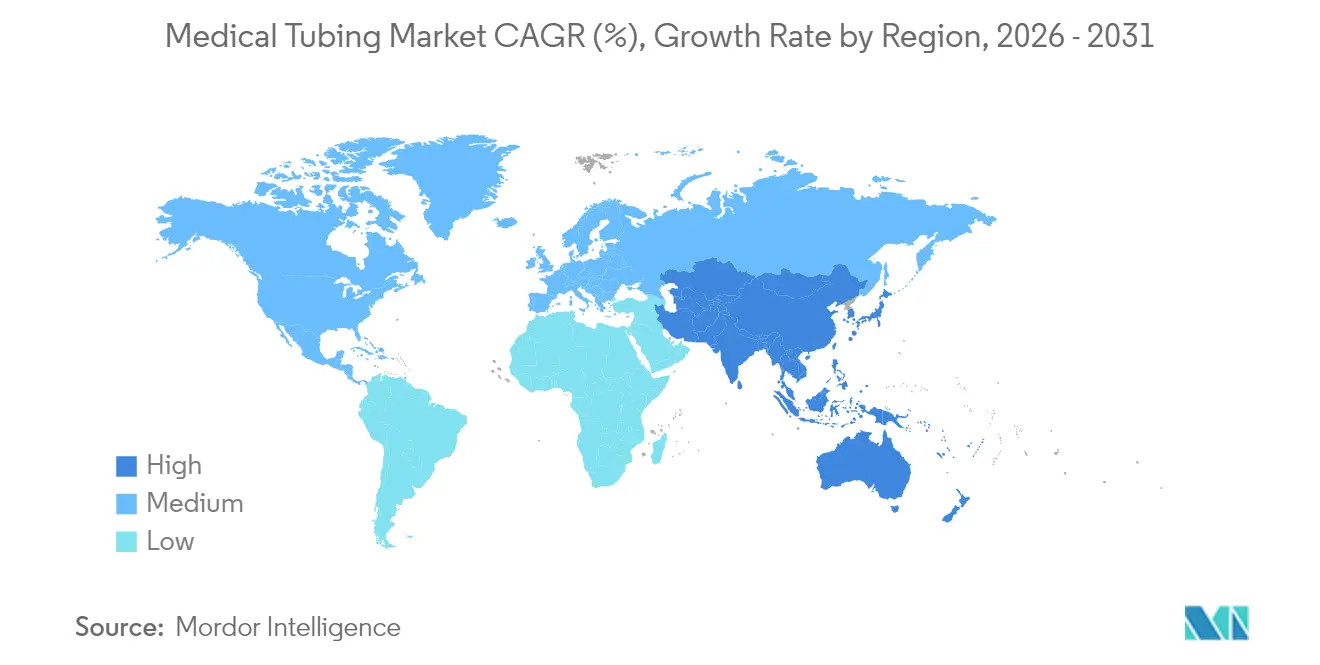
| Fastest Growing Market | Asia-Pacific |
| Largest Market | North America |
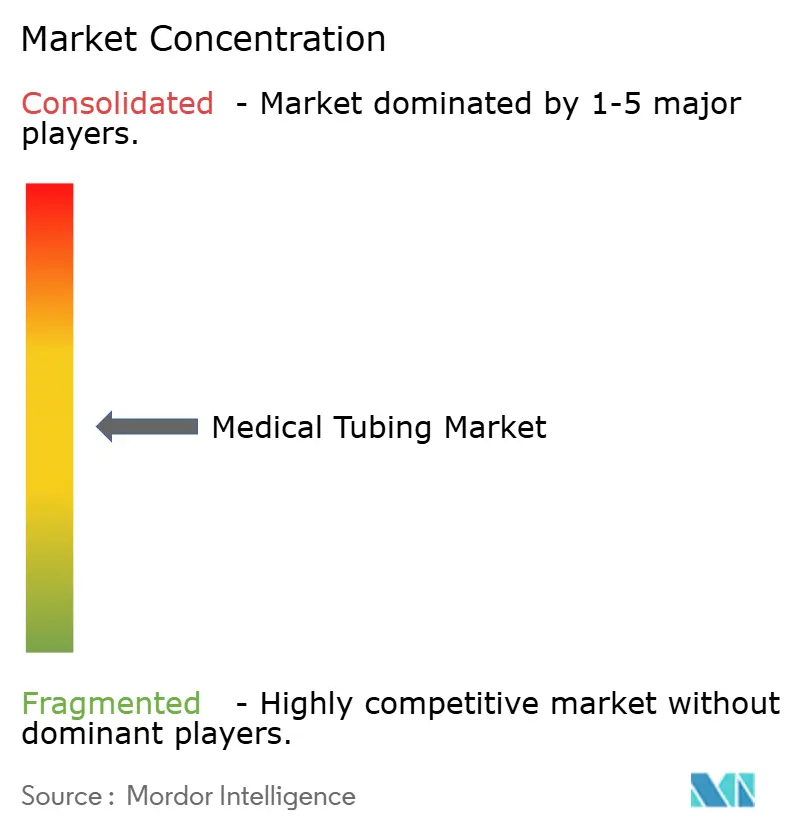
| Market Concentration | Medium |
Major Players *Disclaimer: Major Players sorted in no particular order Image © Mordor Intelligence. Reuse requires attribution under CC BY 4.0. | |
Medical Tubing Market Analysis by Mordor Intelligence
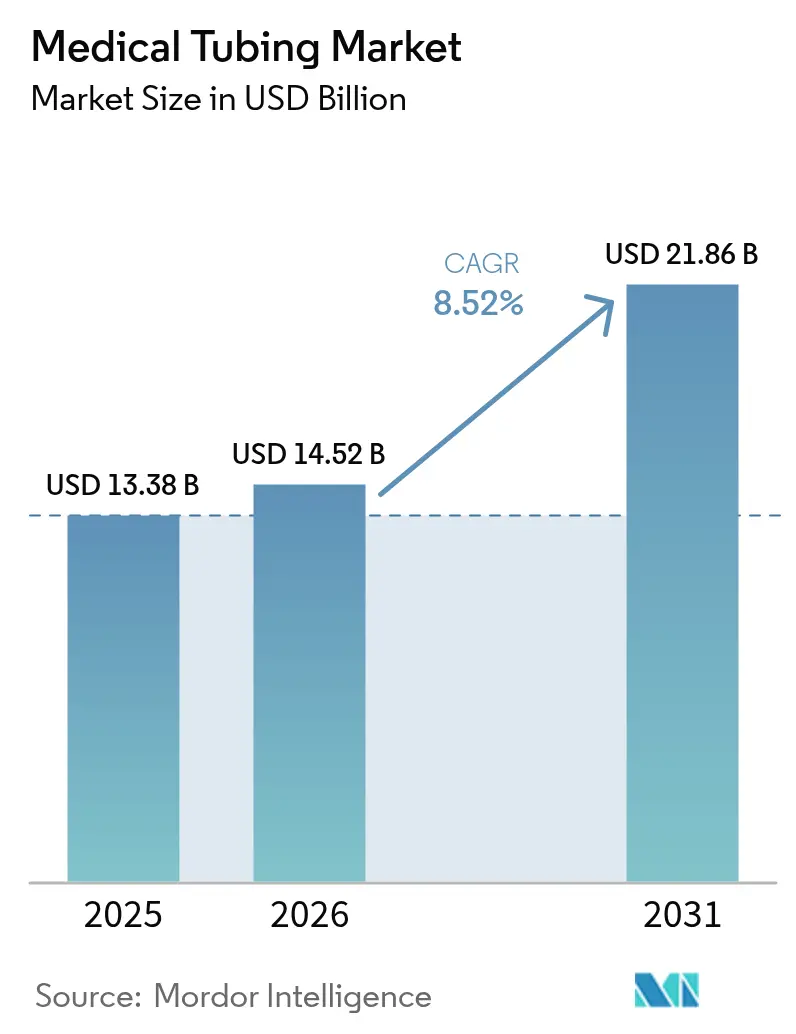
The medical tubing market size was valued at USD 13.38 billion in 2025 and estimated to grow from USD 14.52 billion in 2026 to reach USD 21.86 billion by 2031, at a CAGR of 8.52% during the forecast period (2026-2031). Robust demand arises from minimally invasive procedures, rapid expansion of home-based care, and the integration of smart sensors that turn formerly passive conduits into active data channels. Premium-priced specialty polymers, micro-extrusion technologies, and sensor-ready designs headline the next phase of growth, while hospitals continue to anchor high-volume consumption. At the same time, supply chain exposure for medical-grade PVC and silicone and mounting environmental regulations inject strategic risk that producers must navigate. Competitive intensity is set to climb as mid-tier companies pursue M&A to secure extrusion capacity and regulatory expertise.
Key Report Takeaways
- By application, drug delivery systems led with 29.31% revenue share in 2025, while smoke evacuation and suction tubing is advancing at an 11.45% CAGR through 2031.
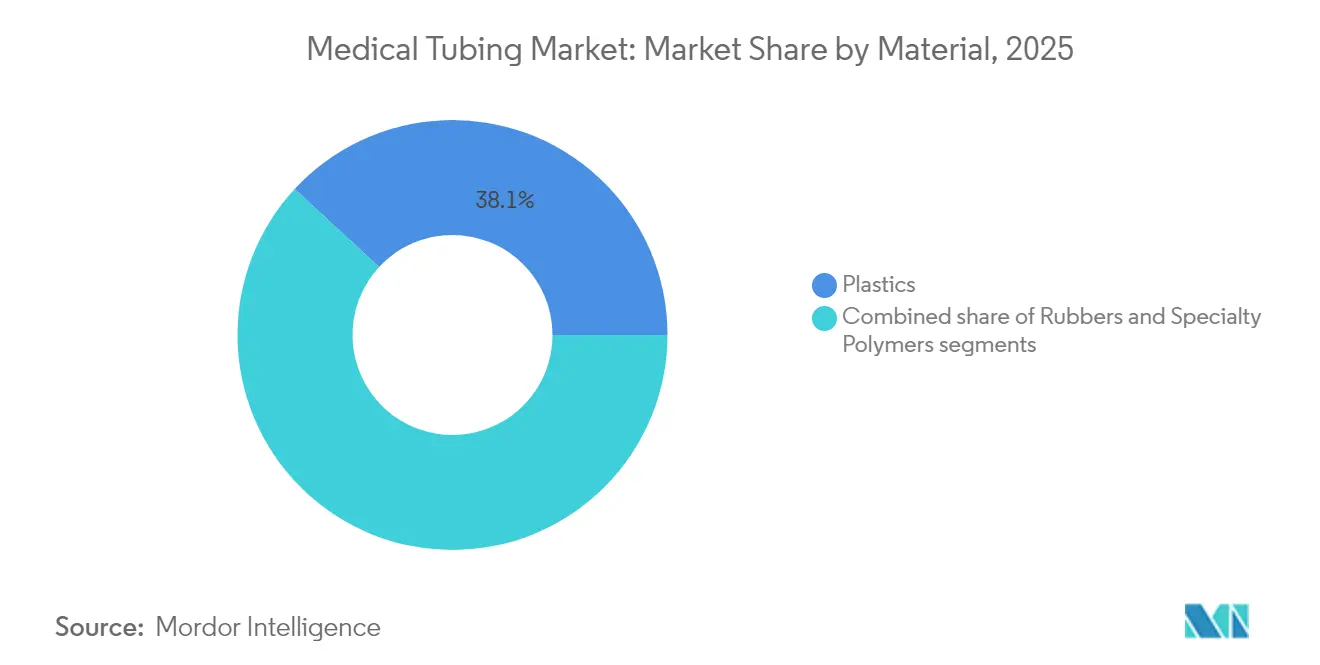
- By material, plastics commanded 38.12% of the medical tubing market share in 2025 and specialty polymers are projected to expand at a 10.18% CAGR between 2026-2031.
- By structure, single-lumen products held 40.92% share of the medical tubing market size in 2025, whereas micro-extruded tubing shows the fastest 11.02% CAGR to 2031.
- By manufacturing process, single-screw extrusion secured 48.05% share of the medical tubing market size in 2025, while micro-extrusion is set to move at a 10.51% CAGR.
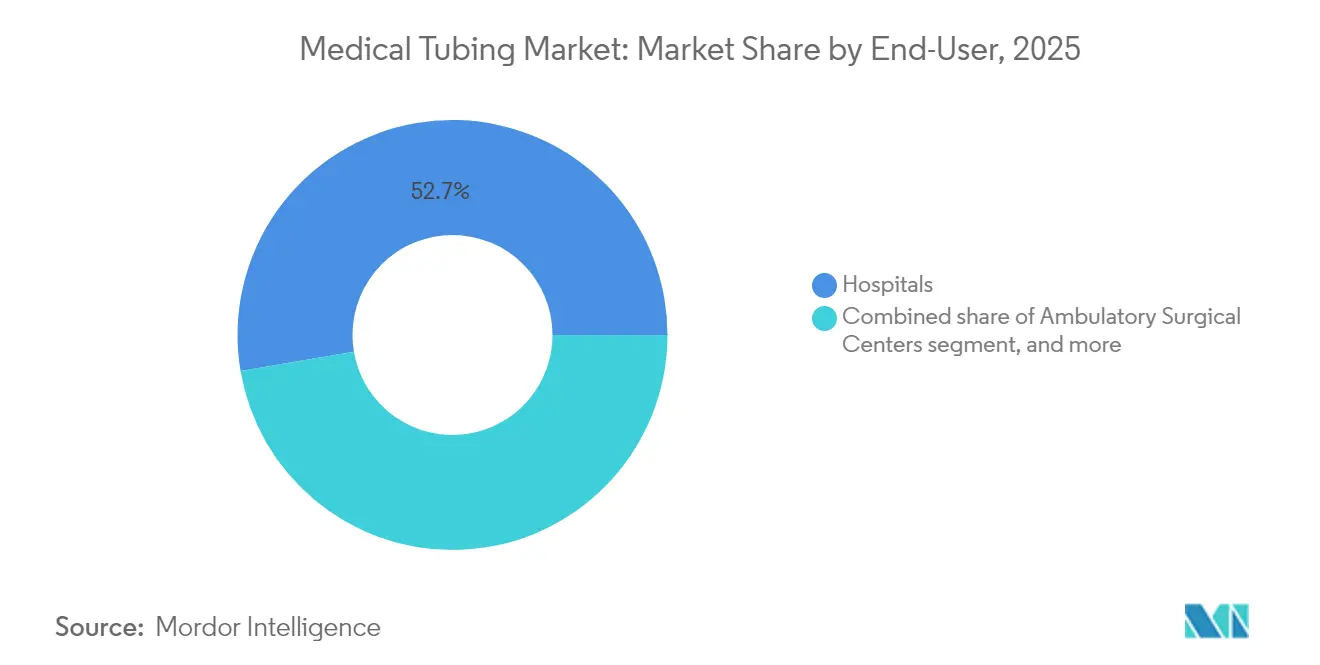
- By end-user, hospitals held 52.68% revenue in 2025, yet home-care environments are pacing at 11.24% CAGR.
- By geography, North America occupied 41.02% of the medical tubing market share in 2025, and Asia-Pacific is forecast to grow at a 9.38% CAGR to 2031.
Note: Market size and forecast figures in this report are generated using Mordor Intelligence’s proprietary estimation framework, updated with the latest available data and insights as of 2026.
Market Trends and Insights
Drivers Impact Analysis of Medical Tubing Market*
| Driver | % Impact on CAGR Forecast | Geographic Relevance | Impact Timeline |
|---|---|---|---|
| Expanding Global Healthcare Expenditure | +1.8% | Global, strongest in North America & Asia-Pacific | Medium term (2-4 years) |
| Rising Prevalence of Chronic and Age-Related Diseases | +2.1% | Mature economies worldwide | Long term (≥ 4 years) |
| Growing Demand for Minimally Invasive Therapeutic Procedures | +1.5% | North America & Europe lead, Asia-Pacific catching up | Medium term (2-4 years) |
| Increased Adoption of Disposable Medical Devices for Infection Prevention | +1.3% | Global, accelerated post-COVID | Short term (≤ 2 years) |
| Continuous Advancements in Medical Polymer and Extrusion Technologies | +1.0% | R&D hubs in North America & Europe | Long term (≥ 4 years) |
| Emerging Home-Based and Point-of-Care Treatment Modalities | +0.9% | Initially developed markets, spreading globally | Medium term (2-4 years) |
| Source: Mordor Intelligence | |||
Rising Prevalence of Chronic and Age-Related Diseases
CDC data show 76.4% of U.S. adults living with at least one chronic condition[1]. Long-term therapies such as dialysis, cardiovascular interventions, and sustained drug infusion depend on reliable tubing able to remain in-body or in-home for extended periods. An aging population magnifies at-home treatment, prompting need for user-friendly sets with audible alarms and kink-resistant lumens. Cardiovascular disease growth boosts adoption of advanced catheter tubing designed for pulsed-field ablation and transcatheter valve replacement. Disposable lines protect immunocompromised patients by minimizing infection risk in frequent infusion scenarios.
Growing Demand for Minimally Invasive Therapeutic Procedures
Interventional radiology alone is projected to exceed USD 43 billion by 2029 and requires ultra-slim catheters with high torsional stability[2]. Thermally drawn polymer fibers now permit MR-guided therapy that avoids ionizing radiation, shifting design goals toward non-ferromagnetic materials and tight tolerances[3]. Device leaders such as Medtronic have incorporated modified diamond frames that improve access during transcatheter valve deployment. Tip geometry innovation further refines aspiration and stent delivery, all increasing demand for precision micro-extrusion.
Increased Adoption of Disposable Medical Devices for Infection Prevention
Post-pandemic protocols lock in single-use preference across central venous, enteral, and suction lines. Hospitals calculate that disposables offset sterilization labor, capital equipment depreciation, and litigation risk. Antimicrobial coatings and low-protein-binding materials limit biofilm growth, while updated FDA guidance clarifies the biocompatibility test suite and accelerates clearances. Simplified supply chains further appeal to procurement teams that aim to slash reprocessing complexity.
Continuous Advancements in Medical Polymer and Extrusion Technologies
AI-assisted Extrusion 4.0 platforms monitor wall thickness in real time, trimming scrap and enabling <0.1 mm inner diameters with ±2 µm tolerance. Hot-melt methods support continuous pharmaceutical tubing production with improved drug solubility. Specialty grades such as ultra polyimide extend thermal and chemical resistance envelopes for electrosurgical and neurovascular devices. Bio-circular polyamide 11 reduces carbon footprint while meeting ISO 10993 expectations.
Restraints Impact Analysis of Medical Tubing Market*
| Restraints Impact Analysis | (~) % Impact on CAGR Forecast | Geographic Relevance | Impact Timeline |
|---|---|---|---|
| Stringent Regulatory Compliance and Validation Requirements | −1.2% | North America & Europe | Long term (≥ 4 years) |
| High Capital Investment for Medical-Grade Extrusion Facilities | −0.8% | Major manufacturing hubs in Asia-Pacific & North America | Medium term (2-4 years) |
| Supply Chain Vulnerabilities in Medical-Grade Polymers | −0.7% | Global, most acute in import-dependent regions | Short to medium term (≤ 4 years) |
| Environmental Sustainability Pressures on PVC and Silicone Usage | −0.6% | Europe leads, regulations expanding worldwide | Long term (≥ 4 years) |
| Source: Mordor Intelligence | |||
Stringent Regulatory Compliance and Validation Requirements
Manufacturers must align quality systems with ISO 13485:2016 by February 2026 under the FDA’s amended regulation. Updated guidance now demands exhaustive chemical characterization, pushing extractable and leachable studies into multi-month projects that lengthen R&D cycles. In Europe, MDR, REACH, and RoHS layers elevate documentation effort, especially for PVC lines containing stabilizers. The emergent crackdown on PFAS adds uncertainty for fluoropolymer users, forcing pipeline audits and potential material swaps. High user fees amplify overhead, and smaller firms without in-house regulatory teams face margin squeeze or exit decisions.
High Capital Investment for Medical-Grade Extrusion Facilities
Cleanroom space, laser micrometers, multilayer dies, and real-time SPC systems drive start-up budgets well into tens of millions. Currency fluctuations and rising interest expenses further stress ROI models. Asian clusters mitigate some cost via labor savings, yet demand tight process validation that often imports Western consultants. The capital hurdle encourages joint ventures or outright acquisition by diversified conglomerates seeking market entry without greenfield risk.
*Our forecasts treat driver/restraint impacts as directional, not additive. The impact forecasts reflect baseline growth, mix effects, and variable interactions.
Medical Tubing Market Segment Analysis
By Material:
Specialty Polymers Drive InnovationPlastics retained 38.12% share of the medical tubing market in 2025 owing to mature supply chains and competitive cost structures. Specialty polymers, however, are advancing at a 10.18% CAGR as complex cardiovascular, neurovascular, and drug delivery devices require superior lubricity, kink resistance, and bio-inertness. The sustainability debate has accelerated substitution of conventional PVC with TPEs that deliver comparable clarity and softness absent DEHP plasticizers. Ultra polyimide, PEBAX, and bio-circular PA11 are now mainstream in premium catheter assemblies. Suppliers that can scale these resins under ISO 13485-compliant conditions gain pricing power. Regulatory scrutiny surrounding PFAS is encouraging early moves toward fluorine-free alternatives in high-pressure angiographic lines.
Polymer innovation also answers recyclability mandates, with advanced depolymerization research aiming at closed-loop medical PVC recovery. Specialty elastomers command higher ASPs yet prove cost-neutral over life cycle due to fewer device failures. Material data sheets now include embodied carbon metrics that hospital sustainability officers review during tenders. As a result the medical tubing market size attributed to specialty polymers is projected to headline absolute gains through 2031.

By Application:
Drug Delivery Systems Lead MarketDrug delivery systems accounted for 29.31% of 2025 revenue, underscoring the central role tubing plays in precision dosing and infusion accuracy. Chemotherapy, biologics, and long-acting injectables depend on tight inner-diameter tolerances and low extractables to maintain compound integrity. Smoke evacuation and suction lines, growing at 11.45% CAGR, reflect heightened surgeon awareness of airborne particulate hazards in operating theatres. Catheter-based cardiovascular therapy remains an anchor, yet product life cycles shorten as hospitals seek next-generation devices that cut fluoroscopy time and radiation dose.
Dialysis and extended IV therapies spur demand for kink-resistant silicone-free lines safe for overnight use. Enteral feeding sets incorporate antimicrobial layers and RFID tags to combat misconnections. Peristaltic pump demand remains stable as lab automation expands. 3D-printed, patient-matched airway stents illustrate early clinical adoption of additive tubing, hinting at wider customization potential. Together these dynamics secure drug delivery’s leadership while enabling high-growth niches that elevate overall medical tubing market value.
By Structure:
Micro-Extruded Solutions Gain MomentumSingle-lumen formats still capture 40.92% of the medical tubing market size because they meet generic fluid-transfer needs at low cost. Yet micro-extruded tubing, expanding 11.02% annually, represents the innovation frontier where inner diameters below 0.1 mm enable neurovascular guidewires and pediatric interventions. Multilayer designs pair lubricious inner cores with torque-stable outers, optimizing pushability without raising profile. Braided reinforcements provide burst integrity for high-pressure angiography while maintaining cross-sectional thinness.
Sensor-integrated smart tubing embeds micro-electrodes and fiber-optic elements that stream flow and temperature data to clinicians. Co-extrusion allows radiopaque stripes for fluoroscopic visibility without secondary coating. Manufacturers that master concentricity below 3% variation improve trackability and reduce clinical friction. These advances position structural differentiation as a significant pricing lever inside the medical tubing market.
By End-User:
Home-Care Settings Show Rapid ExpansionHospitals held 52.68% revenue in 2025, reflecting steady baseline demand for bulk disposables and advanced surgical kits. Yet home-care environments are pacing at 11.24% CAGR as payors incentivize shorter inpatient stays. Remote monitoring devices with cellular gateways rely on leak-free tubing that activates alarms upon occlusion, empowering patients to manage dialysis or drug infusion independently. Ambulatory surgical centers seek quick-connect tubing to minimize turnover time between cases.
Diagnostic labs prioritize chemical resistance and low sorption to safeguard assay integrity. Healthcare consolidation shifts bargaining power toward integrated delivery networks that audit supplier environmental profiles. Tubing producers able to certify e-IFU compliance and sustainable packaging gain an edge as procurement teams broaden evaluation criteria beyond unit price.
By Manufacturing Process:
Micro-Extrusion Technologies AdvanceSingle-screw extrusion preserved 48.05% share in 2025 thanks to high throughput and low tooling cost. Micro-extrusion, growing 10.51% per year, satisfies escalating demand for ultra-small lumens and multi-durometer profiles used in neurovascular catheters. Twin-screw lines enable precise pigment and radiopaque filler dispersion, critical for multilayer products. AI-enabled Extrusion 4.0 platforms deploy closed-loop laser gauges that correct die swell in real time, driving CpK improvements above 1.67.
Additive manufacturing offers rapid prototypes and limited-run niche items, trimming concept-to-clinic cycles by months. Continuous hot-melt extrusion in pharma tubing removes solvents from the production chain, meeting increasingly stringent environmental norms. Investment in these processes reinforces supply continuity and differentiates producers within the medical tubing market.
Geography Analysis
North America Medical Tubing Market
North America retained 41.02% of 2025 revenue, propelled by high per-capita healthcare spend, a mature device manufacturing base, and a reimbursement climate that rewards advanced catheter systems. U.S. hospitals lead global adoption of sensor-ready lines that link seamlessly to electronic medical records, while Canada’s universal coverage sustains steady baseline demand. The medical tubing market size in North America also benefits from concentrated R&D clusters and close industry–faculty collaboration that accelerates commercialization.
APAC Medical Tubing Market
Asia-Pacific represents the fastest-growing region at 9.38% CAGR through 2031. China and India spearhead expansion due to broad population bases, chronic disease incidence, and domestic production scale-ups supported by multinational joint ventures. Lubrizol’s USD 350 million investment near Chennai exemplifies inbound capital directed at regional extrusion capacity that cuts lead times for local OEMs. ASEAN’s 620 million inhabitants and harmonized regulatory work-sharing further entice suppliers eager to diversify beyond legacy Western demand.
Europe Medical Tubing Market
Europe maintains moderate growth driven by regulatory harmonization under MDR and a strong push for recyclable medical polymers. Germany anchors manufacturing, while Nordic innovation focuses on low-carbon materials compatible with hospital sustainability goals. The EU Packaging and Packaging Waste Regulation, which sets 2030 recyclability targets, is accelerating shift toward bio-circular resins and closed-loop designs. Overall regional progress remains steady despite Brexit-related complexity affecting United Kingdom certification pathways.
Regulatory Landscape
In the United States, medical tubing suppliers operate under FDA oversight spanning device classification and quality-system compliance. A key compliance inflection is the Quality Management System Regulation (QMSR) at 21 CFR Part 820 becoming effective in February 2026, which aligns FDA quality expectations with ISO 13485:2016 and tightens supplier controls, validation, and documentation expectations for outsourced extrusion, finishing, and assembly. Product-specific classification also shapes pathways for commodity tubing, for example ventilator tubing under 21 CFR 868.5975 as a Class I device that is exempt from premarket notification.
In Europe, tubing used within medical devices is governed through the EU Medical Device Regulation (MDR) (Regulation (EU) 2017/745) conformity assessment obligations and an evolving standards framework tied to the Official Journal of the European Union (OJEU). In June 2026, the European Commission published Implementing Decisions (EU) 2026/1231 and 2026/1313 updating the lists of harmonised standards for MDR and IVDR, which affects how manufacturers demonstrate presumption of conformity for design, testing, and documentation. Standardization updates also continue at the component level, such as CEN publishing EN ISO 17256:2026 for respiratory therapy tubing and connectors in May 2026, supporting clearer technical baselines for anesthesia and respiratory applications.
Value Chain Analysis
The medical tubing value chain begins with medical-grade polymer and additive inputs (PVC, silicone, TPEs, polyolefins, and higher-performance materials such as PEEK and PTFE), along with radiopaque fillers, colorants, and coating chemistries that influence lubricity and biofilm resistance. These materials flow to compounders and precision extruders that convert resins into single-lumen, multilayer, reinforced, and micro-extruded profiles, then pass through secondary operations including cleanroom cutting, bonding, tip forming, braiding, coating, and assembly into sets and subassemblies. Quality and biocompatibility testing (commonly aligned to ISO 10993) and material qualification practices (including USP Class VI for certain plastics) are built into incoming inspection, in-process controls, and final release.
Midstream participants include vertically integrated tubing and component specialists (for example Saint-Gobain, Freudenberg Medical, Zeus Industrial Products, and Nordson Medical) that bundle compounding, extrusion, and finishing to deliver validated, traceable parts to device OEMs. Downstream, distributors and catalog suppliers (such as Avantor and Qosina) support prototyping and small-batch demand, while major device manufacturers (including Medtronic, Boston Scientific, and Abbott) integrate tubing into catheters, drug delivery, and infusion systems. Bottlenecks typically cluster around specialty resin availability, cleanroom capacity, and validation bandwidth, where any material change can trigger requalification and extend lead times across the chain.
Competitive Landscape
The market shows moderate fragmentation as top multinationals pursue vertical integration and process automation, yet hundreds of regional extrusion specialists serve local OEMs. Saint-Gobain leverages silicone molding depth and proprietary PEBAX blends to equip high-performance neurovascular catheters. W. L. Gore fields ePTFE-based grafts and obtained FDA breakthrough status for its EXCLUDER TAMBE system, reinforcing leadership in complex aortic repair. Freudenberg expanded with a new Galway plant that adds 100 jobs and broadens balloon catheter capacity.
M&A activity is reshaping the field. Integer paid USD 140 million for Pulse Technologies to secure laser-machining expertise, while MMT added GenX Medical to deepen micro-extrusion reach. Such deals bundle regulatory files, intellectual property, and capacity, enabling broader customer lock-in. Concurrently, AI-driven Extrusion 4.0 and antimicrobial coating IP differentiate bidders in high-value proposals.
White-space opportunities involve sensor-integrated smart tubing, additive manufacturing for patient-specific airway guides, and PFAS-free high-pressure lines. Suppliers that master recyclable formulations and document carbon savings win inclusion on hospital sustainability scorecards. Vertical integration that marries resin compounding, cleanroom extrusion, tip forming, and final assembly shortens lead times, cementing the strategic advantage for full-service providers within the medical tubing market.
Medical Tubing Industry Leaders
-
Saint-Gobain
-
Freudenberg Medical
-
W. L. Gore & Associates, Inc.
-
The Lubrizol Corporation
-
Raumedic AG
- *Disclaimer: Major Players sorted in no particular order
Medical Tubing Market Companies Covered in this Report
- Saint-Gobain
- Freudenberg
- W. L. Gore & Associates
- Lubrizol (Vesta)
- Raumedic
- Nordson Medical
- MDC Industries
- ZARYS International Group
- NewAge Industries
- TE Connectivity
- Optinova
- Teleflex Medical OEM
- Zeus Industrial Products
- Tekni-Plex
- Putnam Plastics
- Solvay Specialty Polymers
- Avient Corporation
- Qosina Corp.
- Duke Empirical
- Merit Medical (Q-VT)
Market Opportunities and Future Outlook
Material substitution away from fluoropolymer-dependent designs is creating whitespace in catheter liners and lubricious inner layers as scrutiny on PFAS intensifies across jurisdictions. In 2026, multiple named suppliers commercialized PFAS-free alternatives for catheter manufacturing, including Avient introducing GlideTech Formulations (January 2026) and Zeus introducing PFX Flex (March 2026) as an alternative to film-cast PTFE. These launches support OEM redesign programs that reduce regulatory and liability exposure while preserving deliverability, bond strength, and sterilization compatibility, expanding the addressable opportunity for specialty polymers and co-extruded structures.
Capacity localization and ISO 13485-aligned manufacturing footprints are another opportunity area as OEMs rebalance supply risk and audit requirements under tighter quality-system expectations. In July 2026, Lubrizol and Polyhose inaugurated an ISO 13485-certified medical tubing facility in Chennai focused on precision extruded tubing for neurovascular and cardiovascular devices, adding in-region capability for Asia-Pacific device manufacturing hubs. Premium silicone and biopharma-oriented tubing demand is also being shaped by sterility and single-use workflows, reinforced by moves such as Freudenberg Medicals ISO Class 5 CleanAssure cleanroom launch in Kaiserslautern (April 2026) for sterile single-use assemblies, which increases pull for validated tubing assemblies and higher-value finishing services rather than commodity-only extrusion.
Recent Industry Developments in Medical Tubing Market
- July 2026: Lubrizol and Polyhose inaugurated a new ISO 13485-certified medical tubing manufacturing facility in Chennai, India, focused on precision extruded tubing for neurovascular and cardiovascular devices. The added regional capacity supports shorter lead times for Asia-Pacific OEM programs and strengthens local supply options for complex catheter applications.
- October 2025: Freudenberg Medical acquired Fuji Seiko, a Japan-based manufacturer specializing in high-precision micro tubing for minimally invasive medical devices. The acquisition broadened Freudenbergs micro-tubing capabilities and expanded its manufacturing footprint in a key Asia-based supply cluster serving advanced catheter and device platforms.
- December 2024: Abbott completed the first leadless left bundle branch pacing procedures using its investigational AVEIR Conduction System, which relies on specialized delivery components, including tubing within the delivery pathway. Progress in leadless pacing procedures increases requirements for precise, kink-resistant delivery and catheter tubing in electrophysiology workflows.
Medical Tubing Market Report Scope and Research Methodology
Market Definition and Coverage
For this study, the medical tubing market is defined as revenue earned from tubing and tube assemblies used to transfer fluids, gases, or devices in medical and biopharma settings, across disposable and durable use cases.
Scope exclusions: We exclude non-medical industrial tubing, general packaging films, and stand-alone devices where tubing is not a meaningful part of the selling price.
Segments Covered in This Report
- By Material
- Plastics
- Rubbers
- Specialty Polymers
- By Application
- Bulk Disposable Tubing
- Drug Delivery Systems
- Catheters & Cannulas
- Dialysis & IV Infusion
- Peristaltic Pump Tubing
- Gas Supply & Ventilation Tubing
- Smoke Evacuation & Suction Tubing
- Enteral & Feeding Tubes
- By Structure
- Single Lumen
- Co-Extruded / Multilayer
- Multi Lumen
- Braided / Reinforced
- Micro-extruded
- Sensor-integrated (Smart)
- By End-User
- Hospitals
- Ambulatory Surgical Centers
- Diagnostic Laboratories
- Home-care Settings
- By Manufacturing Process
- Single-screw Extrusion
- Twin-screw Extrusion
- Micro-extrusion
- 3-D Printing / Additive Manufacturing
- Geography
- North America
- United States
- Canada
- Mexico
- Europe
- Germany
- United Kingdom
- France
- Italy
- Spain
- Rest of Europe
- Asia-Pacific
- China
- Japan
- India
- Australia
- South Korea
- Rest of Asia-Pacific
- Middle East & Africa
- GCC
- South Africa
- Rest of Middle East & Africa
- South America
- Brazil
- Argentina
- Rest of South America
- North America
Data Sources, Market Sizing, and Validation
Desk Research
Desk research started with building a fact base on procedure volumes, device utilization patterns, and regulatory context that influence tubing demand. We used public sources to anchor assumptions, including data and publications from the US FDA, the US Centers for Disease Control and Prevention (CDC), the World Health Organization (WHO), the World Bank, and the US International Trade Commission (USITC) where relevant to materials and cross-border flows.
To translate these signals into a market model, we also reviewed company annual reports, investor presentations, product catalogs, and trusted press coverage for cues on product mix shifts like multi-lumen, co-extruded, and specialty polymer tubing. Patent databases were checked to see where innovation is concentrated, and an import-export shipment-level database was selectively used to sanity-check major trade corridors and unit value movement. The sources named above are illustrative only, and many other references were also used for data collection, cross-checking, and clarification.
Primary Interviews and Surveys
Primary work focused on validating pricing logic, material substitution trends, and regional demand drivers that are not cleanly visible in public datasets. We spoke with tubing manufacturers, contract manufacturers, distributors, and procurement or engineering stakeholders from end-use settings. The goal was to confirm how material mix (for example, specialty polymers) translates into finished tubing ASPs and how demand differs across major regions.
Distribution of primary research fieldwork respondents
| Company type | Respondent position | Region |
|---|---|---|
| Top tier: 35% | CXOs: 13% | APAC: 45% |
| Mid tier: 51% | Functional/Unit leaders: 42% | EMEA: 36% |
| Smaller Players: 14% | Managers: 45% | Americas: 19% |
Market-Sizing & Forecasting
Market sizing was built using a top-down and bottom-up combination, where the top-down side reconstructs demand from medical device production and usage intensity across major tubing-consuming applications, and then cascades it into regions. Once the demand pool was built, we applied fit-for-purpose price bands by material and structure, and then converted it into value.
On the validation side, we used selective bottom-up checks, including sampled supplier revenue mapping, channel checks on high-volume disposable tubing, and ASP times volume spot tests in a few high-usage applications. The model relied on practical inputs such as minimally invasive procedure growth, IV and infusion therapy utilization, catheterization volumes, home-care adoption, and resin and specialty polymer price movement that influences finished tubing ASPs. For forecasting, scenario analysis was used so adoption of specialty tubing, reimbursement-linked procedure variability, and material availability constraints could be flexed without breaking the core model. When gaps appeared in bottom-up checks, we used ranges and then narrowed them using interview feedback and cross-region consistency tests.
Data Validation & Update Cycle
Totals were cross-checked against independent signals like procedure trends, device shipment direction, and trade unit values to keep outputs realistic. Outliers were flagged, assumptions were revisited, and a second analyst review was completed before sign-off to remove calculation errors and any double counting.
The report is refreshed on an annual cycle, and interim checks are triggered when material events occur, such as major regulatory shifts, large capacity additions, or sharp resin price movements. Before delivery, the model receives a final pass so the numbers reflect the most current information available at that time.
Mordor Intelligence's Medical Tubing Market Size Compared Against Other Published Estimates
Published market values for medical tubing do not always match because scope boundaries and the way ASPs are handled can vary by publisher, especially when product mix is shifting toward specialty polymers and higher value structures. Differences also come from how regions are converted into USD and which year is treated as the main reference point.
A refresh-led difference is common, where newer price bands, quarterly currency timing, and late-breaking procedure normalization change the current-year value more than the long-term trend does, and these refresh checks are built into the published number by Mordor Intelligence.
Benchmark comparison
| Source | Market Size | Gaps in Research Methodology |
|---|---|---|
| Mordor Intelligence | USD 13.38 B (2025) | |
| Trade Journal A | USD 14.23 B (2025) | The estimate appears to use a faster near-term growth step and broader price escalation, which can lift 2025 value if specialty tubing ASP uplift is applied uniformly across applications. |
| Industry Bulletin B | USD 12.53 B (2025) | This number aligns to a tighter scope and may apply more conservative ASP bands or earlier-year currency conversion timing, which can pull down the USD total even when volumes trend similarly. |
Across the three figures, the spread is mainly explained by how quickly pricing is updated, how aggressively specialty mix is assumed to expand, and how currency timing is handled for regional rollups. By keeping the inputs tied to observable demand signals and re-checking pricing assumptions before finalizing totals, the resulting market value stays traceable and repeatable for decision-making.
Key Questions Answered in the Report
What is the expected value of the medical tubing market in 2031?
The market is forecast to reach USD 21.86 billion by 2031.
Which application currently leads revenue?
Drug delivery systems generated the largest 29.31% share in 2025.
Which region is growing fastest?
Asia-Pacific shows the fastest 9.38% CAGR through 2031.
Why are specialty polymers gaining traction?
They deliver superior kink resistance, lubricity, and sustainability credentials valued in advanced catheter systems.
How is regulation affecting material choices?
Stricter FDA and EU rules plus PFAS limits are pushing manufacturers toward fluorine-free and recyclable alternatives.
What manufacturing technology is expanding quickest?
Micro-extrusion is growing at a 10.51% CAGR thanks to demand for ultra-small, multi-layer tubing used in minimally invasive devices.