
Infant Formula Ingredients Market Size and Share
Market Overview
| Study Period | 2021 - 2031 |
|---|---|
| Market Size (2026) | USD 25.48 Billion |
| Market Size (2031) | USD 36.31 Billion |
| Growth Rate (2026 - 2031) | 6.09 % |
| Fastest Growing Market | Asia Pacific |
| Largest Market | Asia Pacific |
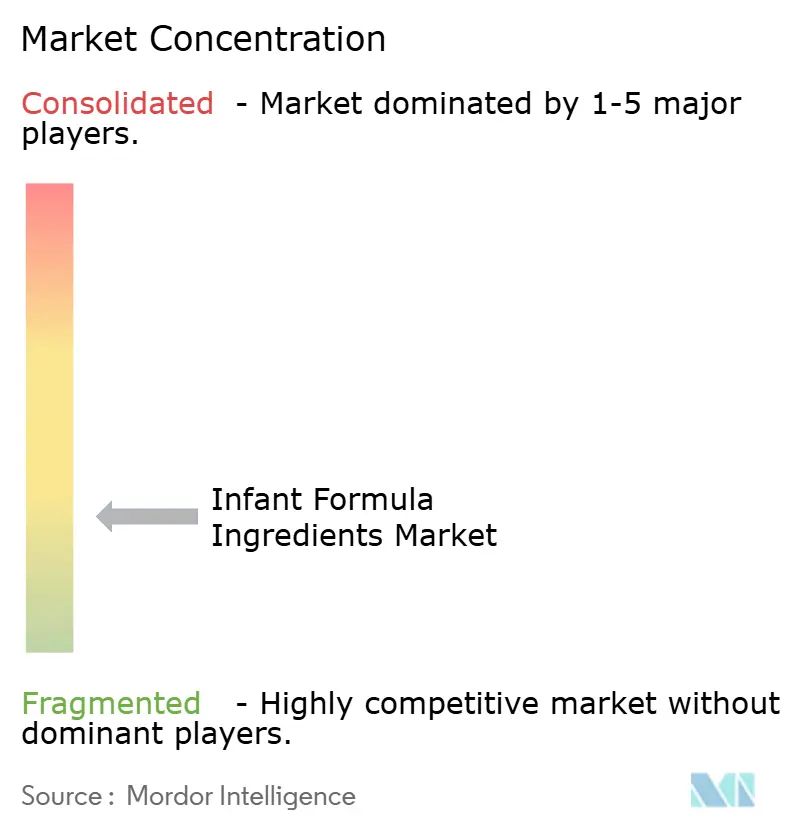
| Market Concentration | Low |
Major Players *Disclaimer: Major Players sorted in no particular order Image © Mordor Intelligence. Reuse requires attribution under CC BY 4.0. | |
Infant Formula Ingredients Market Analysis by Mordor Intelligence
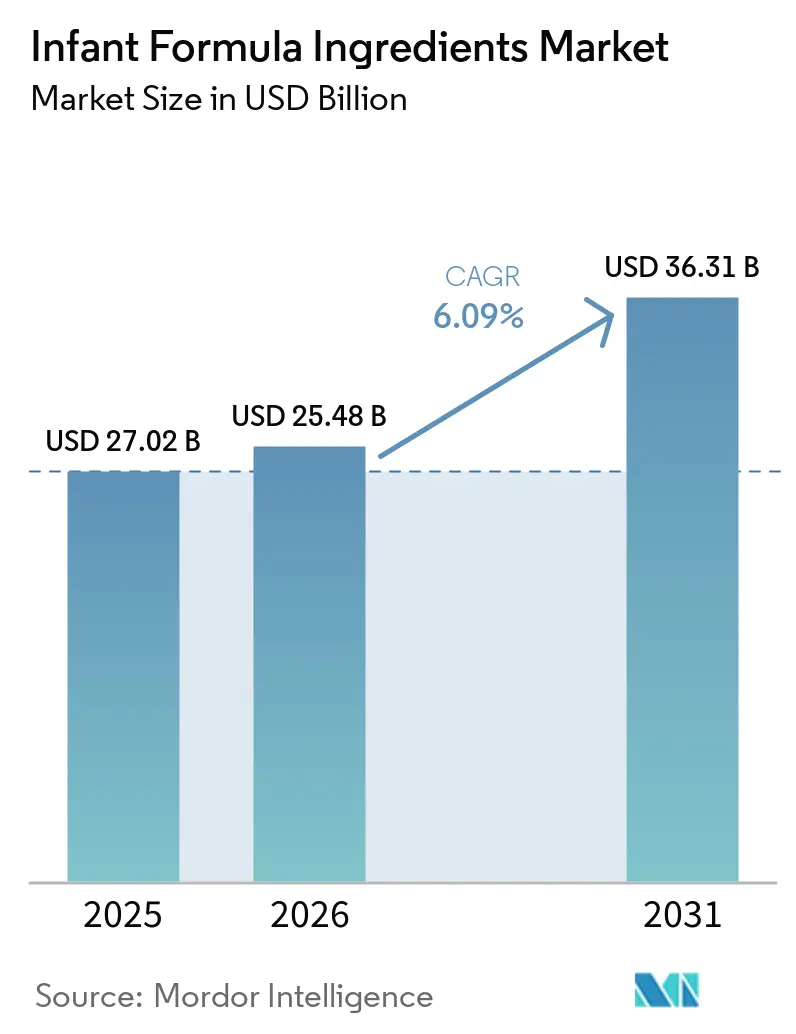
The Infant Formula Ingredients Market size is expected to increase from USD 27.02 billion in 2025 to USD 28.67 billion in 2026 and reach USD 36.31 billion by 2031, growing at a CAGR of 6.09% over 2026-2031. Rising female workforce participation in Asia-Pacific and the Middle East is expanding the addressable base for formula nutrition, while improved neonatal care supports demand for medically adapted products. An estimated 15 million preterm births occur each year, which sustains clinical demand for protein hydrolysates and amino acid-based inputs[1]. The FDA initiated Operation Stork Speed in March 2025 and requested information on nutrient requirements in May 2025, bringing greater attention to safety documentation and ingredient specifications. The infant formula ingredients market is also moving toward integrated ingredient bundles that combine HMOs, probiotics, and functional proteins, which can increase supplier switching costs. Breastfeeding advocacy remains a material constraint because the World Health Assembly has extended attention to digital marketing of breast-milk substitutes
Key Report Takeaways
- By ingredient, carbohydrates held 39.68% in 2025, while prebiotics and probiotics are forecast to expand at an 8.16% CAGR through 2031.
- By source, cow milk held 67.46% of the infant formula ingredients market share in 2025, while goat milk recorded the highest projected CAGR at 8.11% through 2031.
- By form, powder held 72.61% of the infant formula ingredients market share in 2025, while liquid and semi-liquid products are projected to grow at a 7.78% CAGR through 2031.
- By certification, conventional products held a 73.62% share in 2025, while organic products are forecast to grow at an 8.55% CAGR through 2031.
- By application, Standard Infant Formula Stage 1 accounted for 47.12% of total market value in 2025, while specialty formulas are advancing at an 8.37% CAGR through 2031.
- By geography, Asia-Pacific accounted for 55.33% of total market value in 2025 and is forecast to expand at an 8.34% CAGR through 2031.
Note: Market size and forecast figures in this report are generated using Mordor Intelligence’s proprietary estimation framework, updated with the latest available data and insights as of January 2026.
Market Trends and Insights
Drivers Impact Analysis of Infant Formula Ingredients Market*
| Driver | (~) % Impact on CAGR Forecast | Geographic Relevance | Impact Timeline |
|---|---|---|---|
| Rising parental awareness of infant nutrition | +1.5% | Global, led by APAC and North America | Short term (≤ 2 years) |
| Demand for functional and specialty ingredients | +1.2% | Global, strongest in APAC and Europe | Medium term (2-4 years) |
| Government-funded fortification mandates | +0.6% | South Asia, Sub-Saharan Africa, Southeast Asia | Long term (≥ 4 years) |
| Clean label and organic ingredient trends | +0.8% | North America and EU core, spill-over to APAC | Medium term (2-4 years) |
| Commercialisation of precision-fermented HMOs | +0.7% | Global, early gains in China, India, Canada | Medium term (2-4 years) |
| Growing demand for multifunctional infant formula ingredients | +0.5% | Global, premium segment | Long term (≥ 4 years) |
| Source: Mordor Intelligence | |||
Rising Parental Awareness of Infant Nutrition
Parents' growing understanding of nutrition and increased access to digital health platforms are driving significant changes in consumer behavior, particularly in their demand for detailed transparency in ingredient formulations and nutrient absorption data. Access to evidence-based parenting information has changed formula purchasing decisions in the infant formula ingredients market. Parents are examining labels more closely and seeking ingredients supported by nutritional and clinical evidence. This behavior increases demand for validated components across both premium and mid-tier products. Formula manufacturers must therefore secure reliable access to clinical-grade bioactive ingredients to maintain product specifications. That requirement can place pressure on manufacturers that lack long-term supply arrangements. It also supports the position of suppliers with documented safety and application capabilities.
Demand for Functional and Specialty Ingredients
The infant formula ingredients market is shifting toward products designed to more closely reflect selected functions of breast milk. More than 12 HMO structures are commercially available in 2026, compared with 2-3 a decade earlier, allowing manufacturers to develop multi-HMO blends. DSM-Firmenich and Novonesis are pairing HMOs with selected probiotic strains to support synbiotic positioning. A 2025 randomized trial found that a partially hydrolyzed whey formula containing 6 manufactured HMOs and 2 probiotic strains was safe, well tolerated, and associated with improved gut health measures. These findings give formula brands a documented basis for differentiation above conventional probiotic-only products. The wider availability of such ingredient systems is raising the functional standard expected in the premium segment.
Government-Funded Fortification Mandates
National nutrition programs support continuing demand for vitamins, minerals, and protein matrices in the infant formula ingredients market. India’s Poshan Abhiyaan continues to support nutrition and micronutrient infrastructure across the country[2]. Codex Standard CXS 72-1981 sets requirements for infant formula and formulas for special medical purposes intended for infants. Countries aligning domestic rules with Codex may require manufacturers to upgrade ingredients and product specifications. Smaller producers that previously used inputs below international standards can face reformulation requirements. This favors suppliers that already hold recognized regulatory and safety documentation.
Commercialization of Precision-Fermented HMOs
Precision fermentation is improving the availability of HMO ingredients in the infant formula ingredients market. DSM-Firmenich received approval for GLYCARE 2'-FL and LNnT in China and approval for GLYCARE 2'-FL in India during 2025. China established a regulatory basis for the use of 2'-FL and LNnT as food nutritional fortifiers. FDA GRAS reviews and the European Union Novel Food process remain important gates for new HMO structures. Suppliers that can complete these processes can access high-value formula applications. The resulting regulatory requirements favor companies with fermentation expertise and established evidence packages.
Restraints Impact Analysis of Infant Formula Ingredients Market*
| Restraint | (~) % Impact on CAGR Forecast | Geographic Relevance | Impact Timeline |
|---|---|---|---|
| Intensifying advocacy for breastfeeding as the optimal choice | -0.8% | Global, amplified in Sub-Saharan Africa and Southeast Asia | Short term (≤ 2 years) |
| Food allergy and intolerance prevalence | -0.5% | North America, EU, urban APAC | Medium term (2-4 years) |
| Stringent regulatory scrutiny and compliance costs | -0.6% | Global, especially China, EU, and US | Long term (≥ 4 years) |
| Price sensitivity in ingredient sourcing | -0.4% | South Asia, Sub-Saharan Africa, South America | Medium term (2-4 years) |
| Source: Mordor Intelligence | |||
Intensifying Advocacy for Breastfeeding as the Optimal Choice
The World Health Assembly adopted a May 2025 resolution that allows member states to request WHO support for regulating digital marketing of breast-milk substitutes. The measure covers social media, influencer activity, and targeted online advertising. Restrictions in these channels can make it more difficult for formula brands to reach first-time parents, particularly in emerging markets. Higher customer acquisition costs can affect the growth of premium and specialty formula products. Ingredient suppliers are indirectly exposed when their customers depend heavily on digital brand building. The infant formula ingredients market must therefore account for marketing restrictions alongside product and safety regulations.
Food Allergy and Intolerance Prevalence
Cow milk protein allergy affects 2-3% of infants globally and increases demand for specialized formulas. This demand requires extensively hydrolyzed proteins and amino acid-based inputs that need advanced fractionation and quality controls. The infant formula ingredients market benefits from the value created by specialty formulas, but suppliers must meet more demanding technical requirements. Companies without validated hydrolysis and purification capabilities may be excluded from these clinical applications. This can concentrate specialty ingredient supply among vertically integrated processors. The main constraint is the added cost and sourcing complexity rather than a direct decline in clinical demand.
*Our forecasts treat driver/restraint impacts as directional, not additive. The impact forecasts reflect baseline growth, mix effects, and variable interactions.
Infant Formula Ingredients Market Segment Analysis
By Ingredient:
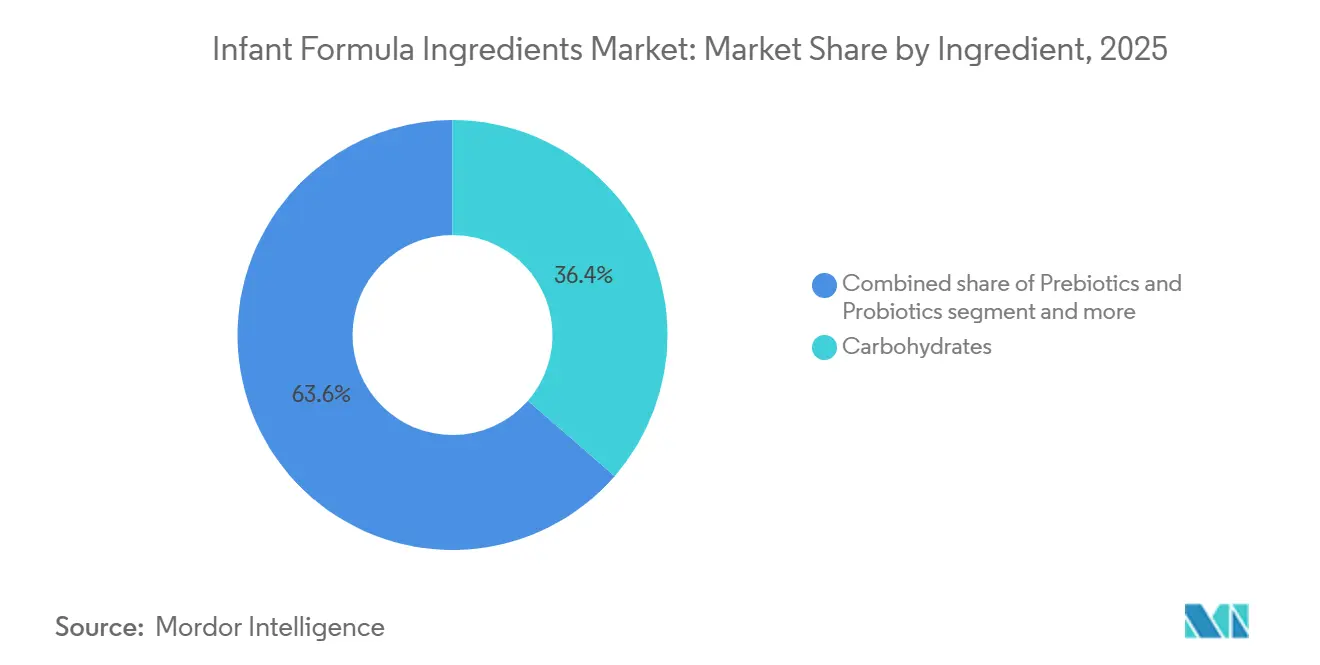
Functional Bioactives Narrow the Gap with Standard MatricesCarbohydrates represented the largest market segment, accounting for a 39.68% share in 2025, primarily due to sustained lactose demand from traditional formula manufacturers. The prebiotics and probiotics segment is expected to register a CAGR of 8.16% through 2031. Within the protein segment, precision fermentation facilitates the production of human casein micelles, offering superior digestibility and nutrient absorption relative to bovine proteins. Growth in the vitamins and minerals segment is reinforced by government fortification mandates, especially in emerging markets where regulations targeting micronutrient deficiencies necessitate enhanced supplementation.
Food Standards Australia New Zealand approved MFGM-WPC as a nutritive substance in infant formula in 2025[3]. Proteins, vitamins, minerals, and HMOs complete the major ingredient groups. Lactoferrin and bioactive whey fractions support clinically differentiated products, while Glanbia Nutrition identifies early-life nutrition as an application area. HMOs are smaller by volume but are becoming more widely available as commercial options expand. Nucleotides, taurine, and structured lipids support nutritional completeness and product differentiation.

By Source:
Goat Milk Gains Clinical Credibility Beyond Allergy UseCow milk led the source segment with a 67.46% share in 2025 because it has broad supply infrastructure, cost efficiency, and regulatory acceptance. Goat milk is the fastest-growing source, at an 8.11% CAGR through 2031. Its A2-dominant beta-casein profile and smaller fat globules support its use for infants with mild digestive sensitivity. Soy and protein hydrolysates are used in medically indicated formulations. ESPGHAN’s 2025 public consultation on biotics in infant and follow-on formulas illustrates the continuing clinical focus on product composition.
Cow milk remains central to volume supply, but its value profile is changing as manufacturers add bioactive components. Commodity fractions face margin pressure when customers seek specialized nutrition claims. Goat whey protein concentrates and demineralized whey powder are important inputs for goat milk formulas. Species segregation and composition validation can support premium pricing for suppliers that maintain consistent specifications. The infant formula ingredients industry is therefore using source selection as both a nutritional and commercial choice.
By Form:
Powder Dominates but Liquid Gains Ground in Clinical SettingsPowder accounted for 72.61% of the infant formula ingredients market size in 2025. Its lead is supported by shelf-life advantages, reduced cold-chain dependence, and established distribution systems. Liquid and semi-liquid products are forecast to grow at a 7.78% CAGR through 2031. Hospitals and neonatal intensive care units use sterile ready-to-feed products to reduce reconstitution error for preterm and immunocompromised infants. The FDA’s review of formula nutrient requirements is also increasing attention on product controls in the United States and the infant formula ingredients market.
The European Union maintains detailed limits for contaminants in infant formula products, which can favor producers with established analytical testing programs. Powder is expected to remain the principal format because it serves cost-sensitive and geographically dispersed markets. Ready-to-feed products can gain value in clinical channels where precision and safety carry greater weight. FrieslandCampina Ingredients reported plans to expand MFGM and whey protein isolate capacity for early-life nutrition applications. These investments can support both powder and liquid product development.
By Certification/Nature:
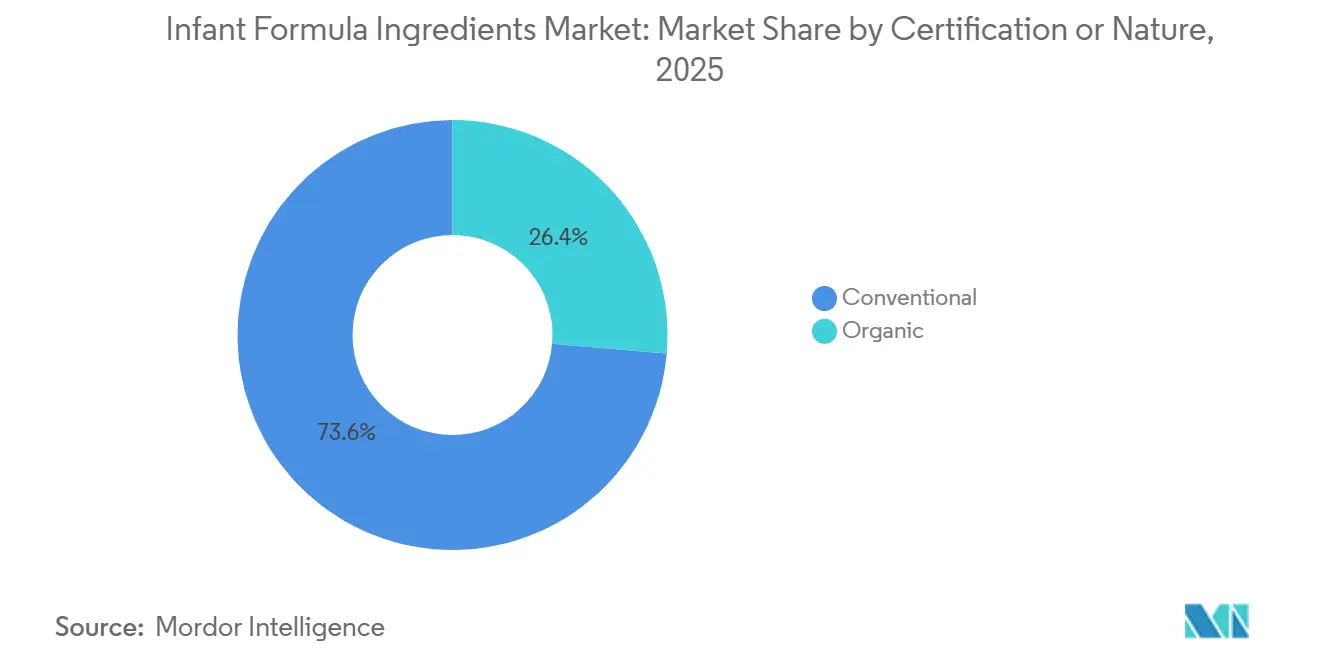
Organic’s Premium Resilience Challenges Standard-Segment GrowthConventional certification held 73.62% of the segment in 2025 because conventional dairy matrices remain accessible across a broad range of markets. Organic products are projected to record the highest growth across the reported segmentation types, at an 8.55% CAGR through 2031. This performance reflects continuing clean-label interest among parents seeking certified ingredients in the infant formula ingredients market. EU rules set composition and labeling requirements for infant and follow-on formulas. Commission Delegated Regulation EU 2025/2017 strengthened criteria for certain protein hydrolysate formulations, which can favor companies with established evidence and compliance capabilities.
Organic sourcing adds complexity through certified dairy procurement and traceability requirements, which can favor established cooperatives with deeper farm-level networks. Organic goat milk combines clean-label and digestibility claims within one product position. This combination is relevant to premium products in China, Australia, and the United Kingdom. Conventional inputs will remain important because they offer lower cost and wider availability. The infant formula ingredients market therefore retains room for both certified organic inputs and conventional supply systems.
By Application:
Specialty Formulas Lead Value Creation Beyond Stage 1Standard Infant Formula Stage 1 held 47.12% of the infant formula ingredients market size in 2025. It is used as the sole nutritional source for non-breastfed infants from birth to 6 months under Codex and national rules. Specialty formulas are the fastest-growing application category, with an 8.37% CAGR through 2031. Demand is linked to clinical needs such as cow milk protein allergy. These formulations require higher-value hydrolysates and amino acid ingredients, and Carbery identifies infant nutrition as a market focus.
Follow-On Formula Stage 2 and Growing-Up Milk Stage 3 cover the 6-36-month period. Manufacturers are aligning their specifications with premium Stage 1 positions to strengthen product continuity. ESPGHAN’s work on probiotics, prebiotics, synbiotics, postbiotics, and HMO analogues continues to influence clinically oriented formula development. Specialty inclusion in later-stage products can help brands sustain premium value beyond infancy. This keeps specialty formulas important to value creation in the infant formula ingredients industry.
Geography Analysis
APAC and America Infant Formula Ingredients Market
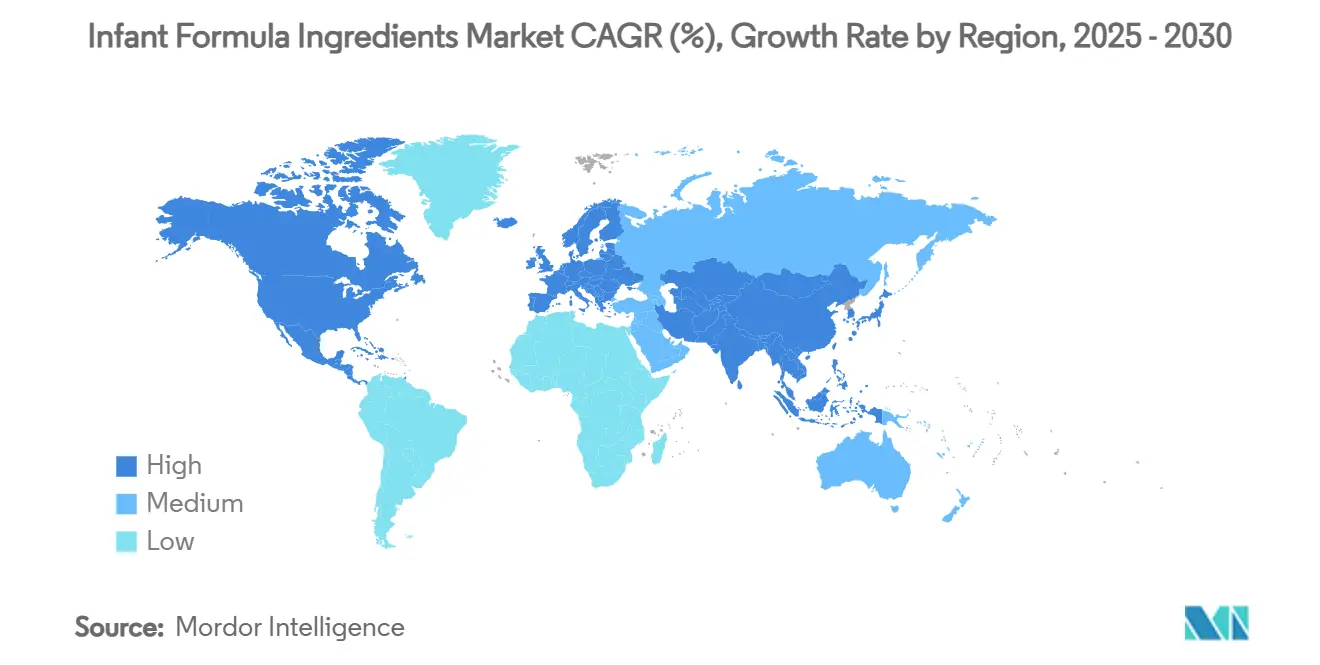
Asia-Pacific accounted for 55.33% of total market value in 2025 and is forecast to grow at an 8.34% CAGR through 2031. China remains the largest country-level opportunity in the region, supported by its GB standards framework. India is gaining importance after approvals for DSM-Firmenich GLYCARE 2'-FL and Novonesis MyOli 5HMOMIX broadened access to commercially produced HMOs. DSM-Firmenich reported approval for GLYCARE 2'-FL in India during 2025. Thailand approved FrieslandCampina Ingredients’ Vivinal MFGM for infant formula use in February 2025.
North America and Europe are the second- and third-largest geographic blocks. North American demand is shaped by premium organic, specialty, and hypoallergenic products. The FDA’s Operation. Europe has a closely updated regulatory framework for infant formula and specialized formulations. Regulation EU 2025/2017 updated technical requirements for certain protein hydrolysate formulas.
South America, the Middle East, and Africa are smaller segments in the infant formula ingredients market but offer longer-term potential. Brazil benefits from urbanization and demand for premium formula products, while the Middle East and Africa are seeing rising formula use alongside urban growth and expanding hospital births. These markets remain import dependent, which increases exposure to supply disruption and currency movements. The UAE and Saudi Arabia are developing as premium formula distribution hubs with retail and cold-chain infrastructure that can support bioactive-enriched products.
Europe Infant Formula Ingredients Market
The United States and Canada show increased consumer demand for hypoallergenic, organic, and specialty formulas due to growing parental awareness of food sensitivities and functional nutrition. Ingredient manufacturers are developing plant-based proteins, non-GMO sources, and bioactive components to address these requirements. Europe maintains regulatory oversight through EFSA's assessment procedures for novel ingredients, with human-identical milk oligosaccharides receiving multiple approvals in 2024. The region's emphasis on sustainability and clean label formulations increases demand for organic and precision-fermented ingredients.
LATAM and MEA Infant Formula Ingredients Market
Latin America shows growth potential, driven by improving birth rates in Brazil and Mexico, and increasing urbanization that enhances access to modern retail and healthcare. Government nutrition programs and public-private partnerships improve early-life nutrition awareness, benefiting formula manufacturers. The market is moving toward fortified formulas with functional proteins, essential fatty acids, and prebiotics to address micronutrient deficiencies and gut health. The Middle East and Africa market continues to develop, supported by rising incomes, urbanization, and women's workforce participation, resulting in increased demand for infant nutrition products.
Competitive Landscape
The infant formula ingredients market comprises vertically integrated dairy cooperatives and science-led specialty suppliers. Vertically integrated dairy cooperatives include FrieslandCampina Ingredients, Fonterra, Arla Foods Ingredients, and Glanbia, while DSM-Firmenich, Novonesis, Kerry Group, and BENEO are science-led specialty suppliers. Competition is increasingly based on integrated systems that combine HMOs, prebiotics, and functional proteins. These systems reduce development work for formula manufacturers and can raise switching costs across the infant formula ingredients market. FrieslandCampina Ingredients reported 5.60% revenue growth in its Ingredients division during the first half of 2025 and identified early-life nutrition as a growth area.
FrieslandCampina Ingredients opened an Application Centre in Singapore in September 2025 to support tailored ingredient solutions in Japan, Korea, Australia, New Zealand, and Southeast Asia. Arla Foods Ingredients received approval from Food Standards Australia New Zealand for Lacprodan MFGM-10 in infant formula during 2025. The approval included exclusive commercialization rights for at least 15 months in Australia and strengthened Arla’s position in the infant formula ingredients market. The infant formula ingredients market also has openings for suppliers that combine clinical documentation with sustainable sourcing credentials. These capabilities are relevant to premium European organic and Asia-Pacific super-premium products.
Kerry Group launched Plenibiotic in 2025 and advanced LC40 and BfM26 human milk probiotic strains for infant and maternal nutrition. DSM-Firmenich completed the sale of its Feed Enzymes Alliance stake to Novonesis in June 2025, enabling greater focus on its Health, Nutrition, and Care portfolio, including GLYCARE. Suppliers are also exposed to the operational and reputational requirements associated with the International Code of Marketing of Breast-Milk Substitutes and the WHA78 resolution. The infant formula ingredients market remains consolidated around capable dairy and biotechnology suppliers, but innovation in bioactives keeps competitive positions active.
Infant Formula Ingredients Industry Leaders
-
FrieslandCampina Ingredients
-
Fonterra Co-operative Group Limited
-
Arla Foods amba
-
Glanbia plc
-
DSM-Firmenich
- *Disclaimer: Major Players sorted in no particular order
Infant Formula Ingredients Market Companies Covered in this Report
- FrieslandCampina Ingredients
- Fonterra Co-operative Group Limited
- Arla Foods amba
- Glanbia plc
- DSM-Firmenich
- BASF SE
- Kerry Group plc
- Ingredia SA
- Carbery Group
- Novonesis
- SudzuckerGroup (BENEO)
- Kirin Holdings Company
- Synlait Milk Ltd
- Hilmar Ingredients
- DuPont Nutrition & Health
- Agropur Cooperative
- Vitablend Nederland B.V.
- Kyowa Hakko Europe GmbH
- BioGaia AB
- Jennewein Biotechnologie GmbH
Recent Industry Developments in Infant Formula Ingredients Market
- March 2026: dsm-firmenich announced the expansion of its human milk oligosaccharide (HMO) portfolio for early-life nutrition following regulatory approvals across China, Malaysia, and Thailand. Its GLYCARE® 3SL 9001 (3’-sialyllactose) received approval in China for use in infant formula, follow-on formula, formulated milk powders for children, and foods for special medical purposes for infants.
- May 2025: BENEO and WACKER launched 2’-Fucosyllactose (2’-FL) globally as a new HMO ingredient for early-life nutrition. The ingredient, one of the most extensively studied HMOs found in human milk, was initially made available to the European market.
- December 2024: DSM-Firmenich introduced a dry form of vitamin A for infant nutrition products. The product, "Dry Vit A Palmitate for Early Life Nutrition," represents an advancement in infant nutrition technology, improving nutrient delivery for formula-fed infants worldwide.
Global Infant Formula Ingredients Market Report Scope
Segmentation Overview
| Carbohydrates |
| Fats and Oils |
| Proteins |
| Vitamins and Minerals |
| Prebiotics and Probiotics |
| Human Milk Oligosaccharides (HMOs) |
| Others |
| Cow Milk |
| Goat Milk |
| Soy |
| Protein Hydrolysates |
| Others |
| Powder |
| Liquid and Semi-Liquid |
| Conventional |
| Organic |
| Standard Infant Formula (Stage 1) |
| Follow-On Formula (Stage 2) |
| Growing-Up Milk (Stage 3) |
| Specialty Formula |
| North America | United States |
| Canada | |
| Mexico | |
| Rest of North America | |
| Europe | Germany |
| United Kingdom | |
| France | |
| Italy | |
| Spain | |
| Netherlands | |
| Sweden | |
| Poland | |
| Belgium | |
| Rest of Europe | |
| Asia-Pacific | China |
| India | |
| Japan | |
| Australia | |
| South Korea | |
| Vietnam | |
| Indonesia | |
| Thailand | |
| Singapore | |
| Rest of Asia-Pacific | |
| South America | Brazil |
| Argentina | |
| Chile | |
| Peru | |
| Colombia | |
| Rest of South America | |
| Middle East and Africa | United Arab Emirates |
| Saudi Arabia | |
| South Africa | |
| Nigeria | |
| Egypt | |
| Morocco | |
| Turkey | |
| Rest of Middle East and Africa |
| By Ingredient | Carbohydrates | |
| Fats and Oils | ||
| Proteins | ||
| Vitamins and Minerals | ||
| Prebiotics and Probiotics | ||
| Human Milk Oligosaccharides (HMOs) | ||
| Others | ||
| By Source | Cow Milk | |
| Goat Milk | ||
| Soy | ||
| Protein Hydrolysates | ||
| Others | ||
| By Form | Powder | |
| Liquid and Semi-Liquid | ||
| By Certification/Nature | Conventional | |
| Organic | ||
| By Application | Standard Infant Formula (Stage 1) | |
| Follow-On Formula (Stage 2) | ||
| Growing-Up Milk (Stage 3) | ||
| Specialty Formula | ||
| By Geography | North America | United States |
| Canada | ||
| Mexico | ||
| Rest of North America | ||
| Europe | Germany | |
| United Kingdom | ||
| France | ||
| Italy | ||
| Spain | ||
| Netherlands | ||
| Sweden | ||
| Poland | ||
| Belgium | ||
| Rest of Europe | ||
| Asia-Pacific | China | |
| India | ||
| Japan | ||
| Australia | ||
| South Korea | ||
| Vietnam | ||
| Indonesia | ||
| Thailand | ||
| Singapore | ||
| Rest of Asia-Pacific | ||
| South America | Brazil | |
| Argentina | ||
| Chile | ||
| Peru | ||
| Colombia | ||
| Rest of South America | ||
| Middle East and Africa | United Arab Emirates | |
| Saudi Arabia | ||
| South Africa | ||
| Nigeria | ||
| Egypt | ||
| Morocco | ||
| Turkey | ||
| Rest of Middle East and Africa | ||
Key Questions Answered in the Report
What is the forecast growth rate for infant formula ingredients?
The Infant Formula Ingredients Market is forecast to grow at a CAGR of 6.09% from 2026 to 2031, reaching USD 36.31 billion by 2031.
Which ingredient category is growing fastest in infant formula?
Prebiotics and probiotics are the fastest-growing ingredient category, with a projected CAGR of 8.16% through 2031.
Which source leads infant formula ingredient supply?
Cow milk led by source with 67.46% share in 2025, supported by broad supply infrastructure and regulatory acceptance.
Which region leads demand for infant formula ingredients?
Asia-Pacific held 55.33% share in 2025 and is forecast to grow at 8.34% CAGR through 2031.