
Cloud-based Contact Center Market Size and Share
Market Overview
| Study Period | 2020 - 2031 |
|---|---|
| Market Size (2026) | USD 40.35 Billion |
| Market Size (2031) | USD 116.33 Billion |
| Growth Rate (2026 - 2031) | 23.60 % |
| Fastest Growing Market | Asia Pacific |
| Largest Market | North America |
| Market Concentration | Medium |
Major Players *Disclaimer: Major Players sorted in no particular order Image © Mordor Intelligence. Reuse requires attribution under CC BY 4.0. | |
Cloud-based Contact Center Market Analysis by Mordor Intelligence
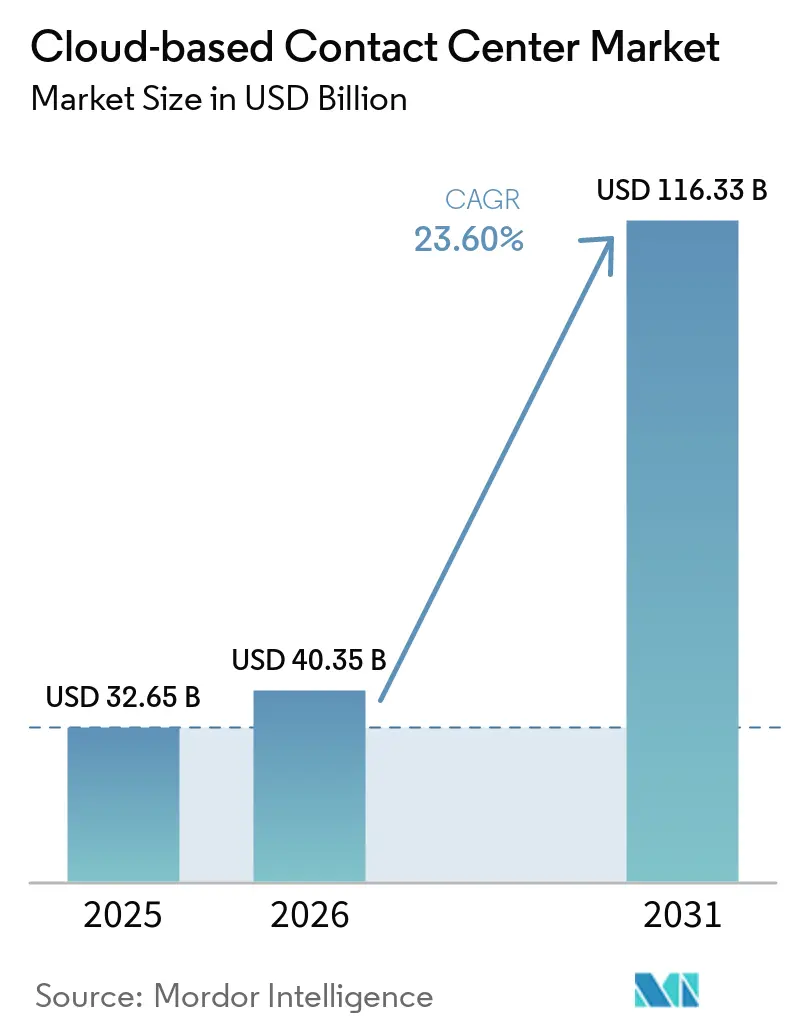
The cloud-based contact center market size is expected to grow from USD 32.65 billion in 2025 to USD 40.35 billion in 2026 and is forecast to reach USD 116.33 billion by 2031 at 23.6% CAGR over 2026-2031. Heightened demand stems from enterprises replacing static on-premise infrastructure with agile platforms that scale alongside omnichannel traffic, real-time analytics, and permanent remote workforces. Organizations now treat contact centers as revenue generators that surface actionable customer intelligence, leading providers to embed AI at each interaction layer. Public cloud elasticity accelerates adoption among large enterprises, while subscription pricing removes cost barriers for small and medium businesses. Competitive intensity is rising as hyperscalers bundle CCaaS with broader cloud estates, compressing prices yet expanding innovation velocity.
Key Report Takeaways
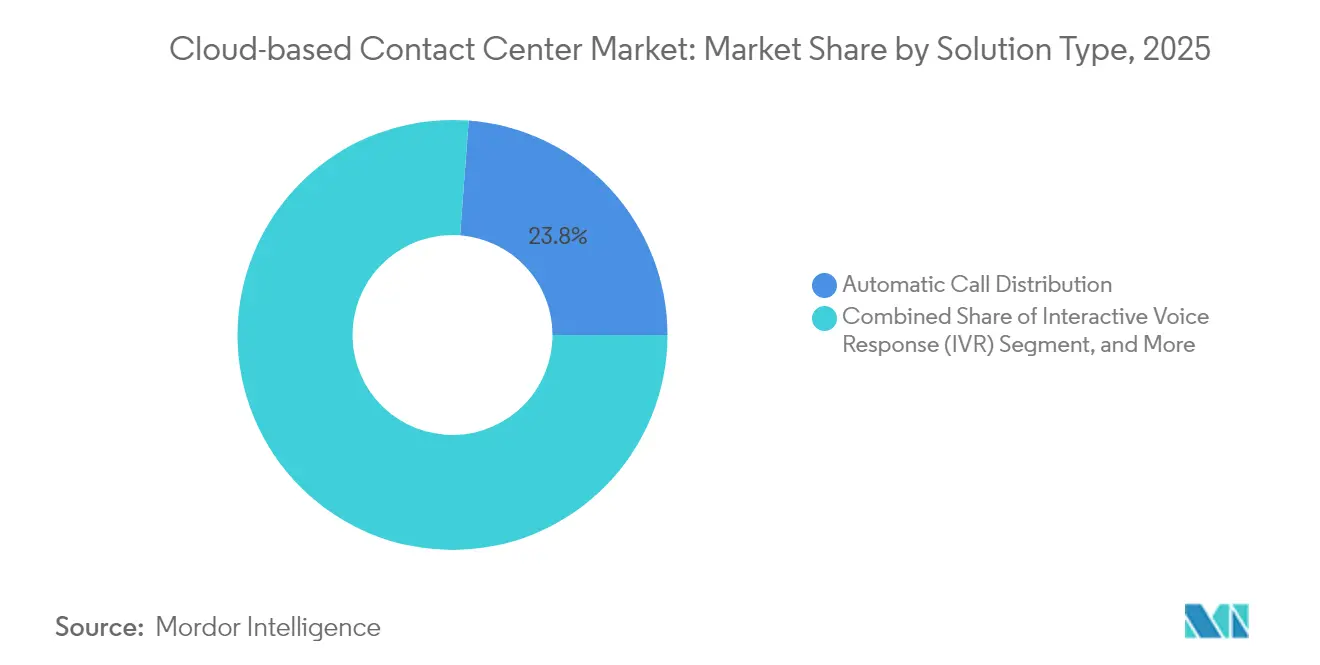
- By solution type, Automatic Call Distribution led with 23.80% of the cloud-based contact center market share in 2025, while Analytics and Reporting is projected to expand at an 18.1% CAGR to 2031.
- By deployment model, the public-cloud segment commanded 51.20% share of the cloud-based contact center market size in 2025; hybrid-cloud architectures are advancing at a 21.1% CAGR through 2031.
- By service, professional services accounted for 44.90% of the cloud-based contact center market size in 2025, whereas managed services posted the fastest 17.1% CAGR through 2031.
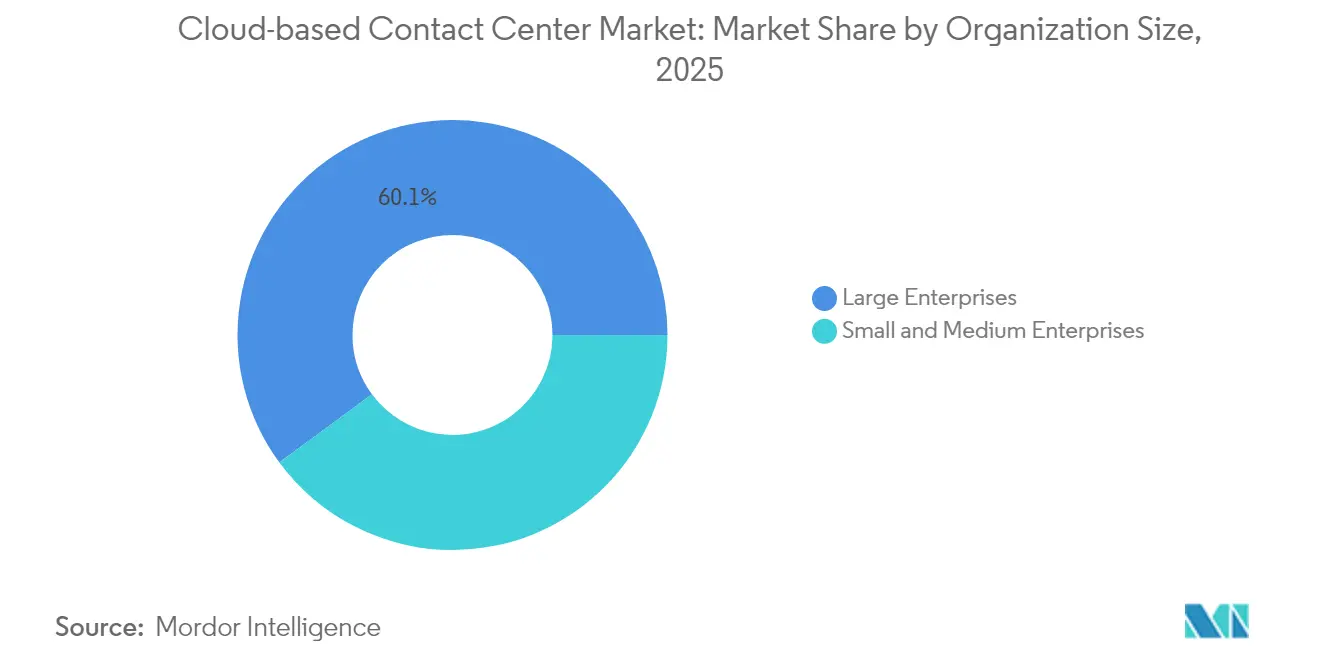
- By organization size, large enterprises held 60.10% of the cloud-based contact center market share in 2025; SMEs are projected to grow at a 18.3% CAGR to 2031.
- By end-user industry, BFSI led with 18.40% revenue share in 2025; healthcare and life sciences registers the strongest 19.9% CAGR through 2031.
- By geography, North America dominated with 37.80% revenue share in 2025, while Asia-Pacific is set to rise at a 15.2% CAGR through 2031.
Note: Market size and forecast figures in this report are generated using Mordor Intelligence’s proprietary estimation framework, updated with the latest available data and insights as of 2026.
Market Trends and Insights
Drivers Impact Analysis of Cloud-based Contact Center Market*
| Driver | (~) % Impact on CAGR Forecast | Geographic Relevance | Impact Timeline |
|---|---|---|---|
| Surge in remote and hybrid work adoption | +4.2% | North America; Europe | Short term (≤ 2 years) |
| Rapid shift to omnichannel engagement | +5.8% | Global; APAC leading | Medium term (2-4 years) |
| Lower cap-ex and faster deployment | +3.6% | Emerging markets; SME focus | Short term (≤ 2 years) |
| AI-driven agent-assist at cloud scale | +6.4% | North America; APAC | Medium term (2-4 years) |
| 5G network slicing for ultra-low latency CX | +2.1% | Urban APAC | Long term (≥ 4 years) |
| Industry-specific compliant CCaaS platforms | +1.8% | North America; EU; healthcare and BFSI | Medium term (2-4 years) |
| Source: Mordor Intelligence | |||
Rapid Shift to Omnichannel Customer Engagement
Contact volumes now begin on social channels, pivot to chat, and conclude over voice, demanding a unified agent desktop that legacy equipment cannot deliver economically. Cloud platforms integrate new channels in weeks, not quarters: Genesys Cloud added WhatsApp voice notes so agents can exchange audio messages without leaving workflow screens. Omnichannel alignment also collapses data silos, letting analytics reveal lifetime value signals in real time. Five9’s Deepgram-powered speech recognition improves alphanumeric transcription accuracy two-fold, raising self-service containment and cutting transfers. Enterprises that harmonize channels convert contact centers into proactive insight engines, boosting revenue as every interaction informs personalized outreach. The trend gains urgency in APAC, where mobile-first consumers expect fluid channel hopping, spurring double-digit regional adoption.
AI-Driven Agent-Assist Use-Cases Requiring Cloud Scale
Generative AI workloads need GPUs and elastic compute that exceed on-premise budgets. AWS Connect’s real-time summarization and Five9’s Genius AI Suite show how cloud economics democratize deep-learning models that guide agents mid-conversation [1]Five9, “Five9 Expands Global Footprint with New Data Centers in India,” five9.com . McKinsey reports 72% of CX leaders believe AI will materially reshape operations, yet human call volumes decline slowly, pushing blended models that elevate rather than replace agents. Continuous cloud updates refresh models weekly, keeping intent detection current with slang and product launches. Financial upside is clear: automated self-service averages USD 0.10 per contact versus USD 8 for live support, freeing spend for strategic CX investments.
Lower Cap-Ex and Faster Deployment Than On-Premise
Subscription pricing converts contact-center outlays from capital to operating budgets—vital for SMEs with thin cash reserves. Nearly 49% of small and mid-size businesses have adopted or plan CCaaS deployments, citing go-live timelines under 90 days. Five9’s new Indian data centers cut last-mile latency and remove the burden of local hardware procurement. Mid-tier centers with 50-250 seats report 40% higher first-contact resolution once migrated, proof that speed plus feature breadth inverts the legacy value equation. The democratization cycle accelerates growth among underserved firms previously priced out of advanced CX tooling.
Cyber-Security and Data-Privacy Concerns
Customer interaction data is a magnet for cybercriminals and regulators, making zero-trust frameworks mandatory. Upcoming GDPR+ amendments incorporate AI transparency, forcing providers to surface model logic for every automated decision. Although hyperscalers invest billions in security, risk-averse organizations, especially hospitals, still view on-premise servers as safer. The perception gap lengthens sales cycles, subtracting 2.8 percentage points from forecast CAGR. Providers answer by offering regional data residency, customer-managed keys, and SOC-2 Type II attestations to calm compliance officers. As audits confirm parity—or superiority—of cloud defenses, resistance is expected to fade beyond 2026.
Restraints Impact Analysis of Cloud-based Contact Center Market*
| Restraint | (~) % Impact on CAGR Forecast | Geographic Relevance | Impact Timeline |
|---|---|---|---|
| Cyber-security and data-privacy concerns | -2.8% | EU; healthcare | Short term (≤ 2 years) |
| Cloud-service downtime and vendor lock-in | -1.9% | Mission-critical sectors worldwide | Medium term (2-4 years) |
| Complex migration of legacy IVR and CRM | -2.1% | North America; Europe | Medium term (2-4 years) |
| Cross-border data-sovereignty burdens | -1.4% | EU; APAC financial services | Long term (≥ 4 years) |
| Source: Mordor Intelligence | |||
Cyber-security & Data-privacy Concerns
Enterprise security apprehensions regarding cloud-based contact centers stem from legitimate concerns about data exposure and regulatory compliance, particularly as customer interaction data represents high-value targets for cybercriminals and regulatory scrutiny. The implementation of zero trust architecture becomes mandatory for cloud contact center deployments, with organizations requiring comprehensive security frameworks that exceed traditional perimeter-based protection models. GDPR, TCPA, HIPAA, and PCI-DSS compliance requirements create complex security obligations that some organizations perceive as easier to manage with on-premise infrastructure, despite cloud providers' typically superior security capabilities.
Complex Migration of Legacy IVR & CRM Integrations
Legacy system integration complexity creates significant barriers to cloud contact center adoption, particularly for large enterprises with extensive on-premise infrastructure investments and customized workflows that resist standardization. The migration of Interactive Voice Response systems and Customer Relationship Management integrations requires careful planning to avoid service disruptions, with many organizations underestimating the technical complexity and resource requirements for successful transitions. Established enterprises often maintain decades-old telephony infrastructure with custom integrations that cloud platforms cannot easily replicate, creating migration projects that extend beyond anticipated timelines and budgets. Growth in the cloud telephony service market remains modest but stable as such institutions modernize legacy PBX hardware on a one-for-one basis.
*Our forecasts treat driver/restraint impacts as directional, not additive. The impact forecasts reflect baseline growth, mix effects, and variable interactions.
Cloud-based Contact Center Market Segment Analysis
By Solution Type:
Analytics Drive Intelligence RevolutionAnalytics and Reporting applications are forecast to grow at an 18.1% CAGR, reflecting demand for actionable insights that elevate customer lifetime value. In 2025 Automatic Call Distribution still held a 23.80% cloud-based contact center market share, anchoring routing logic that funnels queries to the right expertise. The convergence of speech analytics, sentiment scoring, and KPI dashboards turns every interaction into a dataset that steers marketing, product, and service decisions. Five9 offers 140 pre-built reports alongside AI-generated recommendations, making enterprise-grade analytics accessible to firms with limited data staffs.
Workforce Engagement Management (WEM) adoption is accelerating as planners connect agent well-being to CX outcomes. NICE’s Employee Engagement Manager automates shift bidding and performance nudges, improving retention and boosting sales by 20% among engaged teams. Integrating WEM with analytics lets supervisors predict staffing around promotional spikes or outages. Dialer tools, while still relevant for campaigns, see tempered growth as compliance caps outbound volumes. Overall, providers that unify routing, analytics, and WEM into one pane gain stickier deployments and upsell paths.



By Deployment Model:
Hybrid Cloud Gains Strategic MomentumPublic cloud offerings captured 51.20% of the cloud-based contact center market size in 2025 as enterprises targeted quick wins and global reach. Yet hybrid architecture, projected to expand at 21.1% CAGR, is the strategic sweet spot for regulated industries balancing sovereignty with innovation. Cisco notes 82% of enterprises now run hybrid estates, segmenting workloads by sensitivity and latency . Hybrid lets banks keep core call recording on private nodes while leveraging public regions for burst analytics, satisfying auditors without sacrificing agility.
Multi-cloud permutations add another control layer: if one provider suffers an outage, traffic reroutes seamlessly. Huawei Cloud’s 106% hybrid-cloud growth in APAC illustrates regional appetite for sovereign nodes paired with global feature catalogs. Private cloud lingers for defense and critical infrastructure, but lifecycle economics increasingly favor managed hybrid stacks where vendors shoulder patching, scaling, and compliance paperwork. Decision frameworks thus pivot from blanket prohibitions to workload-by-workload placement.
By Service:
Managed Services Accelerate Operational OutsourcingProfessional services represented 44.90% of 2025 revenue because initial migrations demand design, integration, and change-management expertise. As environments stabilize, managed services flourish, growing 17.1% annually as clients hand day-to-day tuning to specialists. Providers bundle KPI monitoring, bot retraining, and compliance reporting into fixed-fee contracts that outperform in-house teams on cost and uptime. Alvaria’s Employee Experience Management suite folds WEM telemetry into managed engagements, giving customers continuous workforce optimization without extra licenses .
Training and support services remain a pillar because every quarterly release adds capabilities that staff must master. Vendors increasingly deliver on-demand micro-learning and AI-based coaching that shortens proficiency curves. Overall, service depth becomes a key differentiator: technology parity is narrowing, so vendors that guarantee ROI through white-glove operations capture renewals and referrals.
By Organization Size:
SMEs Drive Democratic Access RevolutionLarge enterprises still account for 60.10% revenue, aided by scale and integration teams that exploit full platform breadth. Yet SMEs, expanding at 18.3% CAGR, are the growth engine as pay-as-you-go pricing removes entry hurdles. Cloud solutions auto-scale from five to 500 agents, letting retailers add seasonal seats in days. NICE defines SMEs as firms under 500 employees, and within that cohort, contact centers of 50-250 seats register the largest efficiency gains post-migration.
For startups, CCaaS is often the first telephony investment, skipping PBX ownership entirely. For mid-market firms, cloud unlocks AI features from tone analysis to predictive routing previously reserved for Fortune 500 budgets. Vendor competition centers on simplified onboarding, pre-built CRM connectors, and marketplace apps that let non-technical users add capabilities. As SME adoption widens, regional channel partners and MSPs become critical to penetrate local language and compliance nuances.
By End-User Industry:
Healthcare Leads Digital TransformationBFSI institutions held an 18.40% slice of 2025 revenue because stringent Know-Your-Customer and fraud controls make omnichannel transparency essential. However, healthcare and life sciences grow fastest at a 19.9% CAGR as telehealth normalizes and patient-experience scores influence reimbursements. IBM’s work with Rhode Island’s Department of Health shows CCaaS platforms can quintuple case investigation speed, demonstrating public-sector value .
Retail and e-commerce firms deploy CCaaS to weave physical and digital storefronts into seamless journeys, converting browsing signals into real-time offers. Logistics providers rely on voice and SMS alerts that shave minutes off delivery windows. Government adoption is rising as budgets migrate from cap-ex hardware refreshes to opex subscriptions, enhancing citizen engagement while meeting secure-by-default mandates. Across industries, vertical-specific compliance certifications and out-of-box integrations now drive vendor shortlisting more than generic feature counts.
Geography Analysis
North America Cloud-based Contact Center Market
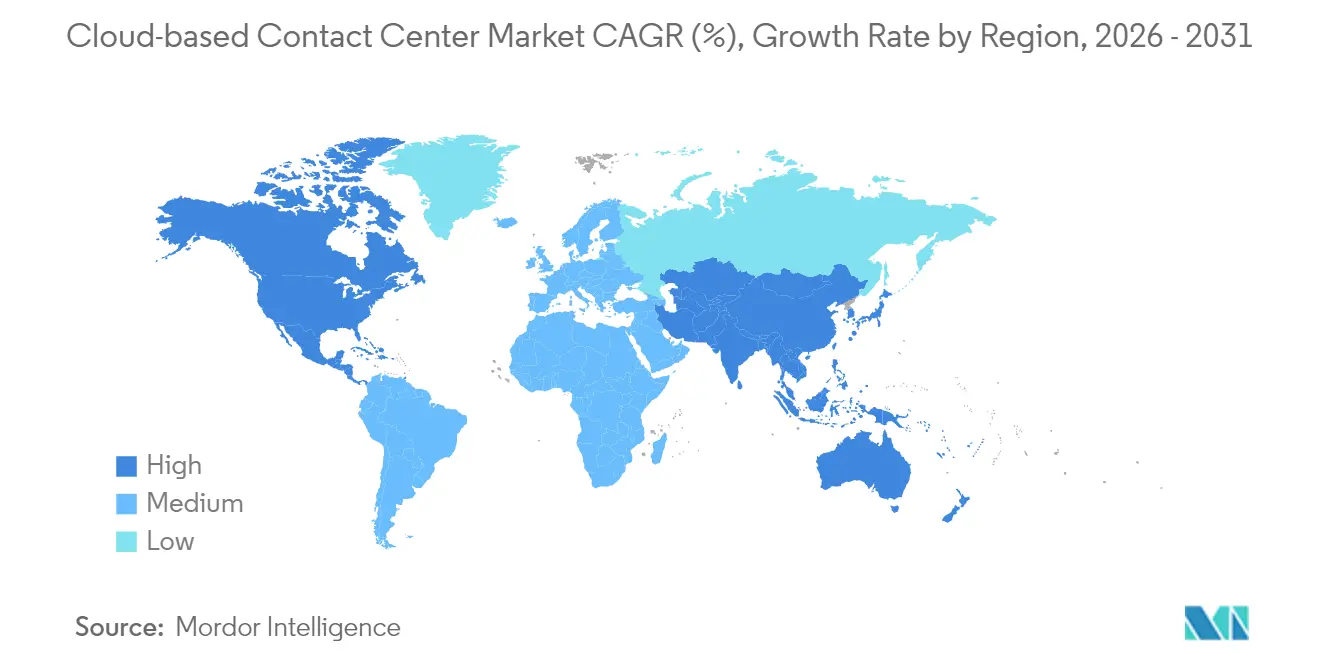
North America contributed 37.80% of 2025 revenue, buoyed by mature broadband, early cloud buy-in, and proactive customer-experience budgeting. Hyperscalers operate dense regional data-center footprints, delivering sub-50 ms latency that powers real-time transcription and sentiment analytics. Market maturity means net-new logo growth slows, so providers focus on AI upsells and outcome-based renewals. Consolidation is underway as private-equity firms acquire niche CCaaS vendors to build end-to-end CX suites.
APAC Cloud-based Contact Center Market
Asia-Pacific is on track for a 15.2% CAGR through 2031, propelled by smartphone ubiquity, government cloud-first edicts, and expanding fiber coverage. Five9’s dual Indian data centers exemplify investments that respect data-localization rules while assuring performance. Developed markets like Japan demand advanced AI orchestration, whereas Southeast Asian SMEs prioritize cost and multilingual bots. Regional telcos partner with CCaaS providers, bundling SIP trunks, 5G slices, and CPaaS APIs to accelerate uptake among emerging digital merchants.
EMEA and LATAM Cloud-based Contact Center Market
Europe balances opportunity with regulatory rigor. GDPR plus emerging AI-governance laws drive hybrid deployments anchored in local zones. Providers that certify ISO 27001 and offer in-region disaster recovery gain advantage. Economic headwinds push enterprises toward opex models that stretch budgets without new datacenter builds. Growth pockets exist in Central and Eastern Europe where legacy estates persist, and in public-sector digitization funds earmarked for post-pandemic citizen-service modernization. Elsewhere, Latin America, Middle East, and Africa record high double-digit adoption albeit from lower bases, paced by telecom infrastructure rollouts and fintech booms.

Regulatory Landscape
Regulation for cloud-based contact centers centers on privacy, telecom consumer protection, and public-sector cloud authorization, with compliance obligations varying by jurisdiction. In the United States, California Consumer Privacy Act updates effective January 1, 2026 expanded requirements tied to deletion, correction, and opt-out rights for automated decision-making technology, raising the bar for how CCaaS platforms handle AI-driven routing, profiling, and customer data access workflows. In parallel, the FCC published a Notice of Proposed Rulemaking in April 2026 (CG Docket No. 26-52) focused on foreign call centers and related disclosures and reporting, adding operational scrutiny for service providers using offshore contact center resources.
Outside the US, data sovereignty and government procurement controls increasingly shape deployment models. European and public-sector buyers place greater weight on sovereign-cloud frameworks such as Germany's BSI C5 and France's SecNumCloud, pushing vendors toward in-region data residency, audit artifacts, and hardened configurations. For government workloads, FedRAMP scope and authorization pathways remain a gate for cloud contact center adoption in US federal agencies, influencing vendor roadmaps and partner ecosystems around secure-by-default configurations and continuous compliance.
Value Chain Analysis
The CCaaS value chain begins with hyperscale and regional cloud infrastructure that supplies compute, storage, networking, and security services used to run microservices-based contact center platforms. On top of this layer, CCaaS vendors provide core interaction and workflow capabilities (ACD, IVR, dialing, analytics, and workforce engagement management) and embed AI for transcription, summarization, agent assist, and automation. A critical enabling layer is carrier connectivity and session services, where enterprises and vendors use SIP trunking and CPaaS components to route voice and digital channels; BYOC configurations are increasingly used to diversify carrier dependencies and support resilience requirements.
Downstream, professional services partners, systems integrators, and managed service providers execute migration from legacy telephony and CRM/IVR integrations, then operate and optimize environments through KPI monitoring, bot tuning, and compliance reporting. Application ecosystems (CRM, ticketing, identity, and security tools) provide connectors and APIs that reduce time-to-value, while data governance and compliance controls (for example, privacy and sector rules in healthcare and payments) influence architecture choices such as hybrid deployments, regional tenancy, and selective recording and redaction across channels.
Competitive Landscape
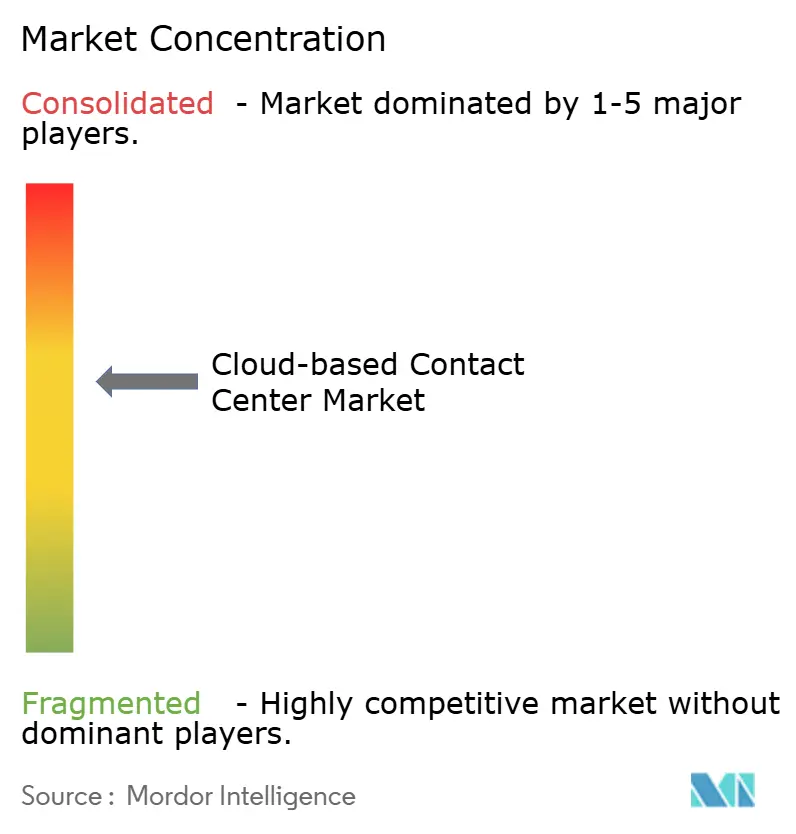
Market structure is moderately concentrated: NICE, Genesys, and Five9 together generate more than USD 4 billion in annual recurring revenue, yet their combined share remains below 35%, leaving room for challengers. Hyperscalers like AWS Connect bundle per-minute pricing with broader cloud portfolios, squeezing license rates and forcing incumbents to accelerate feature releases. Genesys’ USD 1.5 billion injection from Salesforce and ServiceNow underscores investment appetite for AI-infused CX stacks.
Differentiation pivots on depth of AI, vertical blueprints, and an ecosystem that shortens time-to-value. Vendors roll out domain-specific language models—healthcare, banking, retail—to raise accuracy without manual tuning. Strategic alliances proliferate: Verint and Five9 launched cloud-to-cloud integrations that fuse workforce management with omnichannel routing. Meanwhile, AI-native disruptors tout usage-based fees and 30-day onboarding, winning greenfield SME deals.
Pricing pressure coexists with rising switching costs as platforms entrench through proprietary data lakes and analytics dashboards. To hedge lock-in fears, buyers insist on open APIs and bring-your-own-model capabilities. Provider roadmaps now spotlight responsible-AI toolkits, customer-managed encryption keys, and carbon-aware routing, aligning with environmental, social, and governance procurement criteria. Overall, sustainable leadership demands continuous innovation, robust compliance posture, and services that translate technology into measurable business outcomes.
Cloud-based Contact Center Industry Leaders
Avaya Contact Center (Ayaya Group)
RingCentral Inc.
Genesys Telecommunications Laboratories Inc.
3CLogic Inc.
Five9 Inc.
- *Disclaimer: Major Players sorted in no particular order
Cloud-based Contact Center Market Companies Covered in this Report
- Amazon Web Services (Amazon Connect)
- NICE Ltd.
- Genesys Telecommunications Laboratories Inc.
- Five9 Inc.
- Cisco Systems Inc.
- RingCentral Inc.
- 8x8 Inc.
- Avaya LLC
- Talkdesk Inc.
- Vonage Holdings Corp.
- Twilio Inc.
- Dialpad Inc.
- Content Guru Limited
- Mitel Networks Corporation
- Odigo SAS
- Aspect Software Group Ltd.
- Alvaria, Inc.
- Sprinklr Inc.
- SAP SE
- Zoom Video Communications Inc.

Market Opportunities and Future Outlook
A key whitespace is compliance-grade AI orchestration for regulated contact centers, where buyers want enforceable controls at the model and interaction level rather than relying on post-call sampling. The EU AI Act taking effect on August 2, 2026 introduces disclosure obligations for certain AI interactions and increases governance pressure around higher-risk uses such as emotion AI and automated decisioning, which lifts demand for built-in audit trails, policy-based prompt controls, and configurable disclosure scripts inside contact flows. In payments, PCI DSS v4.0 (effective March 2025) tightens requirements that impact telephone payments, reinforcing opportunities for CCaaS vendors and partners that package DTMF masking and pause-resume recording patterns with compliant implementations.
Another opportunity is the build-around pattern for AI, where enterprises layer third-party or custom AI services on top of CCaaS to cover gaps in native capabilities and reduce lock-in. AWS introduced Connect AI Agents Guardrails in June 2026, highlighting a market shift toward standardized guardrails, monitoring, and auditability as reusable building blocks. This supports expansion for vendors and integrators that offer open APIs, model-agnostic architectures, and managed services that continuously govern PII redaction, retention, and explainability across channels and geographies, particularly for hybrid-cloud deployments driven by sovereignty and cross-border data constraints.
Recent Industry Developments in Cloud-based Contact Center Market
- July 2026: Genesys announced the acquisition of Pinkfish to accelerate agentic orchestration and workflow execution in Genesys Cloud AI. The acquisition strengthens Genesys's ability to connect AI agents to enterprise tools and actions through orchestrated workflows, supporting more autonomous customer service operations.
- February 2026: RingCentral announced integration of OpenAI frontier models, including GPT-5.2, into its voice AI communications platform to enhance RingCentral AI Receptionist (AIR) and AI Virtual Assistant (AVA). The update puts more advanced AI into frontline voice workflows, increasing competitive pressure on CCaaS vendors to match performance and control in voice automation.
- December 2024: Uniphore and Konecta announced a plan to co-develop industry-specific generative AI customer experience solutions for clients in the United States and United Kingdom, with a stated five-year revenue target. The partnership pointed to growing demand for verticalized AI packages that combine platform capabilities with services-led deployment and domain tuning.


Cloud-based Contact Center Market Report Scope and Research Methodology
Market Definition and Coverage
For this report, the market covers revenue earned from cloud delivered contact center platforms and related services that enable customer interactions across voice and digital channels, and that are sold as subscription or managed offerings to end users across regions.
Scope exclusions: We exclude on-premises contact center software and hardware, and we also exclude general unified communications tools that are not sold or used as contact center solutions.
Segments Covered in This Report
- By Solution Type
- Automatic Call Distribution (ACD)
- Interactive Voice Response (IVR)
- Predictive / Progressive Dialers
- Computer Telephony Integration (CTI)
- Analytics and Reporting
- Workforce Engagement Management
- By Deployment Model
- Public Cloud
- Private Cloud
- Hybrid Cloud
- Multi-Cloud
- By Service
- Professional Services
- Managed Services
- Training and Support Services
- By Organization Size
- Small and Medium Enterprises ( less than 1,000 seats )
- Large Enterprises ( Greater than or equal to 1,000 seats )
- By End-User Industry
- Banking, Financial Services and Insurance
- IT and Telecommunications
- Retail and e-Commerce
- Healthcare and Life Sciences
- Logistics and Transportation
- Media and Entertainment
- Government and Public Sector
- By Geography
- North America
- United States
- Canada
- Mexico
- South America
- Brazil
- Argentina
- Rest of South America
- Europe
- United Kingdom
- Germany
- France
- Italy
- Russia
- Rest of Europe
- Asia-Pacific
- China
- Japan
- India
- South Korea
- Rest of Asia-Pacific
- Middle East and Africa
- Middle East
- Israel
- Saudi Arabia
- United Arab Emirates
- Turkey
- Rest of Middle East
- Africa
- South Africa
- Egypt
- Rest of Africa
- Middle East
- North America
Data Sources, Market Sizing, and Validation
Desk Research
Desk research is used to set the market boundary, align terminology, and collect anchor data points that can be checked repeatedly. We reviewed public material such as regulatory and telecom references, labor and service sector statistics, and digital adoption indicators that influence contact center migration.
Typical sources include official communications and ICT releases (such as ITU), macro and services data (such as World Bank and OECD), trade and economic statistics (such as UN Comtrade), cybersecurity and cloud guidance from government agencies (such as NIST), and peer reviewed papers that track contact center technology adoption and performance. This is supported with company filings, earnings call transcripts, investor presentations, association websites, and reputed press, and then cross checked using paid subscriptions for company financials and intelligence, news and financials, patent databases, and an import and export shipment level database where relevant. The desk sources listed here are illustrative only, and many other public and paid references were also used for collection, validation, and clarification.
Primary Interviews and Surveys
Primary work is used to validate adoption timing, pricing direction, and what is actually counted as CCaaS revenue versus adjacent tools. We spoke with a mix of solution providers, channel partners, system integrators, and enterprise buyers across key regions to confirm deployment mixes (public, private, and hybrid), contract terms, and replacement cycles, and then used follow up questions to close gaps seen in secondary inputs.
Distribution of primary research fieldwork respondents
| Company type | Respondent position | Region |
|---|---|---|
| Top tier: 37% | CXOs: 14% | APAC: 44% |
| Mid tier: 47% | Functional/Unit leaders: 26% | EMEA: 31% |
| Smaller Players: 16% | Managers: 60% | Americas: 25% |
Market-Sizing & Forecasting
Sizing starts with a top-down demand pool build that links enterprise contact volumes and digital engagement growth to CCaaS penetration by region, and then translates that into annual spend using observed subscription and service pricing ranges. Once the market total is created, it is checked and adjusted using selective bottom-up approximations such as sampled vendor revenue disclosures, channel checks on deal sizes, and ASP multiplied by installed seat estimates for major use cases.
Key inputs in the model include cloud adoption rates in enterprise IT, contact center seat growth and remote agent mix, migration rates from on-prem to cloud, typical subscription price bands by enterprise size, attach rates for managed and professional services, and regional wage inflation that can change automation and self-service investment decisions. When a variable is not available consistently, we use a bounded assumption range agreed with interview feedback, and we document the trigger points that would move the assumption up or down.
Forecasting is done using scenario analysis supported by trend smoothing on the main demand drivers, and the scenarios are weighted based on expert expectations around AI feature adoption, compliance driven upgrades, and procurement cycles. This keeps the forecast repeatable with limited inputs, and it still reflects how buying decisions are made in real programs.
Data Validation & Update Cycle
Outputs are triangulated by checking the implied spend per seat, service attach rates, and regional growth patterns against independent signals gathered during research. Any large variance is reviewed through a second analyst pass, and the assumptions behind the variance are re-tested with additional calls when the gap cannot be explained by scope or timing.
The report is refreshed annually, and interim updates are completed when a material event changes pricing, product scope, or demand indicators. Before delivery, a final review pass is done so the market size, forecasts, and narrative reflect the latest available public information and the most recent primary feedback.
Mordor Intelligence's Global Cloud Based Contact Center Market Size Compared Against Other Published Estimates
Published market size figures for cloud-based contact centers often do not match because the market boundary is not the same across studies, and because the base year and currency timing can shift the number even when the trend is similar. Differences also show up when one estimate counts only platform subscriptions, and another adds broader customer experience software or adjacent UC tools.
Contract pricing checks, observed subscription-per-seat ranges, and service attach rate validation are the evidence points that keep Mordor Intelligence tied to CCaaS-specific revenues, which is why numbers that fold in wider contact center software bundles or longer implementation services can look higher. Another common driver is the growth path assumption, since some publishers use an aggressive AI adoption curve without verifying procurement lead times and regional compliance effects.
Benchmark comparison
| Source | Market Size | Gaps in Research Methodology |
|---|---|---|
| Mordor Intelligence | USD 32.65 B (2025) | |
| Global Consultancy A | USD 40.73 B (2025) | This figure appears to apply a broader inclusion set that can capture more deployment variants and adjacent customer experience tooling, and it can also reflect a different revenue recognition treatment for bundled services in large contracts. |
| Industry Publisher B | USD 39.10 B (2025) | The estimate likely uses a wider component scope across public, private, and hybrid deployments with less visible separation between pure CCaaS platform revenue and surrounding solution stacks, which can lift the 2025 total. |
The spread across the three values mainly comes from what is counted as in-scope revenue and how bundled services are treated in multi-year deals. By keeping the model anchored on repeatable demand indicators and practical price checks, the resulting number stays transparent and easier to reconcile when assumptions are updated.


Key Questions Answered in the Report
What is the projected value of the cloud-based contact center market by 2031?
The cloud-based contact center market is expected to reach USD 116.33 billion by 2031.
Which region will grow fastest over the forecast period?
Asia-Pacific is forecast to post a 15.2% CAGR through 2031, the highest among all regions.
Which deployment model is gaining momentum among regulated industries?
Hybrid-cloud configurations are expanding at a 21.1% CAGR as firms balance agility with data sovereignty.
Why are SMEs adopting cloud-based contact centers rapidly?
Subscription pricing, quick deployment, and built-in AI features remove infrastructure and cost barriers for SMEs.
Page last updated on:


 Your data is secure and never sold or shared.


