
GCC Frontline Worker Technology Market Size and Share
Market Overview
| Study Period | 2020 - 2031 |
|---|---|
| Forecast Data Period | 2026 - 2031 |
| Base Year Market Size (2025) | USD 0.44 Billion |
| Market Size (2026) | USD 0.52 Billion |
| Market Size (2031) | USD 1.56 Billion |
| Growth Rate (2026 - 2031) | 24.57 % |
| Market Concentration | Medium |
Major Players *Disclaimer: Major Players sorted in no particular order Image © Mordor Intelligence. Reuse requires attribution under CC BY 4.0. | |
GCC Frontline Worker Technology Market Analysis by Mordor Intelligence
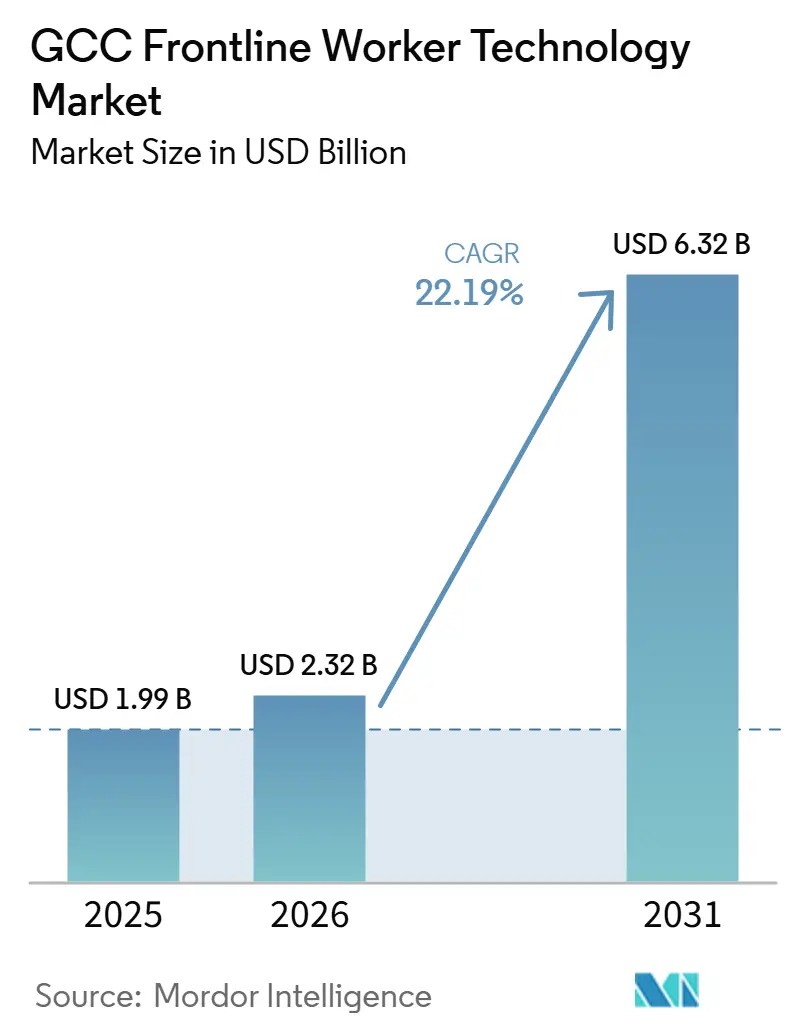
The GCC frontline worker technology market size is expected to increase from USD 0.44 billion in 2025 to USD 0.52 billion in 2026 and reach USD 1.56 billion by 2031, growing at a CAGR of 24.57% over 2026-2031. Growth is being supported by large digital transformation programs across Saudi Arabia, the UAE, and Qatar, where public institutions and major enterprises are moving field operations, workforce coordination, and compliance processes into digital systems. Demand is also rising because construction, oil and gas, logistics, and public administration employers are under pressure to manage larger mobile workforces with better visibility, faster task execution, and stronger safety documentation. Cloud and AI infrastructure expansion across the region is making deployment more practical for regulated industries, while subscription pricing is widening access beyond the largest enterprises. Competition centers on platform depth, integration capabilities, mobile usability, and local support, with global enterprise vendors facing specialist frontline platforms that deploy faster and support multilingual workforces. Integration complexity, device hardening needs, and sensitivity to project spending cycles still create friction, but the GCC frontline worker technology market continues to benefit from durable demand across large project-driven sectors through 2031.
Key Report Takeaways
- By component, software held 79.11% share in 2025, while services are projected to expand at a 24.91% CAGR through 2031.
- By deployment mode, cloud-based platforms held 74.66% of the GCC frontline worker technology market share in 2025 and are projected to record the fastest CAGR at 26.18% through 2031.
- By organization size, large enterprises held 71.66% share in 2025, while SMEs are expected to expand at a 27.33% CAGR through 2031.
- By application, workforce execution and task management accounted for 24.99% share in 2025, while safety and compliance management is projected to advance at a 28.44% CAGR through 2031.
- By end-user industry, construction held 26.11% share in 2025, while government and public administration are projected to grow at a 29.66% CAGR through 2031.
- By geography, Saudi Arabia held 44.12% share in 2025, while the UAE is projected to expand at a 31.81% CAGR through 2031.
Note: Market size and forecast figures in this report are generated using Mordor Intelligence’s proprietary estimation framework, updated with the latest available data and insights as of January 2026.
Market Trends and Insights
Drivers Impact Analysis of GCC Frontline Worker Technology Market*
| Driver | (~) % Impact on CAGR Forecast | Geographic Relevance | Impact Timeline |
|---|---|---|---|
| Rising Investment in Connected Field Operations | +5.3% | GCC-wide, strongest in Saudi Arabia and the UAE | Short term (≤ 2 years) |
| Mandatory Safety and Compliance Digitization | +4.6% | Saudi Arabia, the UAE, and Qatar core, Kuwait and Oman secondary | Short term (≤ 2 years) |
| Rapid Cloud-Native Workforce Orchestration Adoption | +3.9% | Saudi Arabia and the UAE core, Qatar and Bahrain secondary | Medium term (2-4 years) |
| Expansion of AI-Assisted Dispatch and Remote Supervision | +3.5% | UAE and Saudi Arabia primary, GCC-wide spillover | Medium term (2-4 years) |
| Data Residency Requirements for Frontline Applications | +2.0% | Saudi Arabia and the UAE primary, Qatar secondary | Short term (≤ 2 years) |
| Multilingual Workforce Design Across Expat-Dense Operations | +1.4% | GCC-wide, strongest in the UAE and Qatar | Long term (≥ 4 years) |
| Source: Mordor Intelligence | |||
Rising Investment in Connected Field Operations
Public and private investment in digital operations is creating a strong demand base for the GCC frontline worker technology market. Large national programs are moving beyond office digitization and now include field workforce management, operational visibility, and mobile service delivery as part of day-to-day execution. This matters because construction sites, transport networks, industrial facilities, and public services all require tools to coordinate large worker populations across multiple locations. Procurement behavior is also changing, as major project owners increasingly expect contractors and subcontractors to work through digital systems rather than manual reporting. That trend gives the GCC frontline worker technology market a more stable demand pattern than one driven only by voluntary software adoption. Microsoft’s announced USD 15.2 billion AI and cloud commitment in the UAE through 2029 also strengthens the regional technology base that supports these deployments.[1]
Mandatory Safety and Compliance Digitization
Safety and compliance requirements are turning digital frontline systems into a practical necessity in high-risk work environments across the GCC frontline worker technology market. Construction, energy, and industrial employers are under pressure to maintain digital records for permits, incidents, training, and hazard reporting because paper processes are slower to verify and harder to audit. This is one reason safety and compliance management is the fastest-growing application area in the GCC frontline worker technology market. The shift also changes vendor selection, because platforms that combine workflow control, monitoring, and traceable records are more useful than stand-alone communication tools. As project owners tighten operational standards, adoption is being pushed down the supply chain to smaller contractors that must meet the same documentation expectations. Honeywell’s regional work on automation and digitalization for infrastructure projects reflects how compliance and operational control are now being packaged together in frontline technology deployments.[2]
Rapid Cloud-Native Workforce Orchestration Adoption
Cloud adoption is reshaping how the GCC frontline worker technology market is being deployed across large enterprises and regulated sectors. Cloud-based platforms already held a dominant share in 2025, indicating that enterprises in the region now prefer centralized systems that support multiple sites, user groups, and workflows from a single environment. The real advantage is not only a lower infrastructure burden but also faster rollout, easier updates, and a pricing model that reduces the upfront commitment for new users. This model is especially important in a region where employers often need to onboard project teams quickly and then expand usage across additional sites. Sovereign infrastructure is also reducing barriers for sensitive workloads, which supports wider enterprise adoption across public administration and large industrial operations. Microsoft’s planned expansion of AI and cloud investment in the UAE supports that direction by increasing the capacity available for enterprise-grade digital platforms.
Expansion of AI-Assisted Dispatch and Remote Supervision
AI-enabled tasking and dispatch tools are becoming a meaningful growth layer within the GCC frontline worker technology market. Employers are moving from simple scheduling and messaging toward systems that can prioritize tasks, route work, surface exceptions, and support supervisors in real time. This shift is especially relevant in logistics, industrial operations, and large service environments where response time and coordination directly affect output. The value of these tools increases as more operational data flows into the platform, since better field data improves future routing, planning, and workforce decisions. That creates higher switching costs for customers who commit early to one platform and train their teams around its workflows. WorkJam’s January 2026 release, which embedded AI into communication, task management, learning, and scheduling workflows, supporting more than 50 languages, shows how vendors are trying to move AI into practical frontline use rather than keeping it as a separate feature set.[3]
Restraints Impact Analysis of GCC Frontline Worker Technology Market*
| Restraint | (~) % Impact on CAGR Forecast | Geographic Relevance | Impact Timeline |
|---|---|---|---|
| Integration Complexity with Legacy ERP, EAM, and OT Systems | -2.6% | GCC-wide, most acute in Saudi Arabia industrial zones and Kuwait energy operations | Medium term (2-4 years) |
| User Adoption Friction in Heat-Intensive and Shift-Based Work Environments | -2.0% | GCC-wide, strongest in construction and oil and gas | Long term (≥ 4 years) |
| Cybersecurity and Device Hardening Costs for Distributed Fleets | -1.5% | GCC-wide, elevated in regulated sectors | Medium term (2-4 years) |
| Fragmented Procurement Across Small Contractors and Subcontractors | -0.9% | GCC-wide, highest in Saudi Arabia and the UAE construction chains | Long term (≥ 4 years) |
| Source: Mordor Intelligence | |||
Integration Complexity with Legacy ERP, EAM, and OT Systems
Integration remains one of the clearest constraints on the GCC frontline worker technology market, especially in industrial and asset-heavy environments. Many employers already operate ERP, asset management, and operational systems that were not designed to connect easily with newer mobile platforms. That creates deployment delays, increases implementation costs, and often shifts project focus away from frontline use cases toward back-end system work. The challenge is more serious in sectors where field data must move across enterprise software, operational control environments, and compliance systems without interruption. Vendors with ready connectors and stronger implementation ecosystems, therefore, have an advantage over those that rely on heavier customization. This is one reason the services side of the GCC frontline worker technology market is growing strongly alongside software adoption, since integration work remains a recurring requirement.
User Adoption Friction in Heat-Intensive and Shift-Based Work Environments
User adoption can slow the GCC frontline worker technology market when platforms are not designed for the daily reality of frontline work in the region. Workers often operate in heat-intensive conditions, on rotating shifts, and in multilingual teams where training time is limited and device use must stay simple. If an application is hard to navigate, relies on constant connectivity, or does not align with the pace of fieldwork, adoption weakens even when management supports the rollout. That can reduce the quality of operational data and weaken the value of analytics, scheduling, and AI-driven recommendations built on those inputs. The issue is not a lack of demand for technology, but the need for platforms and devices that are practical in the environments where work happens. WorkJam’s emphasis on multilingual workflow support and Honeywell’s localized mobile device production in Saudi Arabia both reflect how usability and field readiness influence adoption outcomes.
*Our forecasts treat driver/restraint impacts as directional, not additive. The impact forecasts reflect baseline growth, mix effects, and variable interactions.
GCC Frontline Worker Technology Market Segment Analysis
By Component:
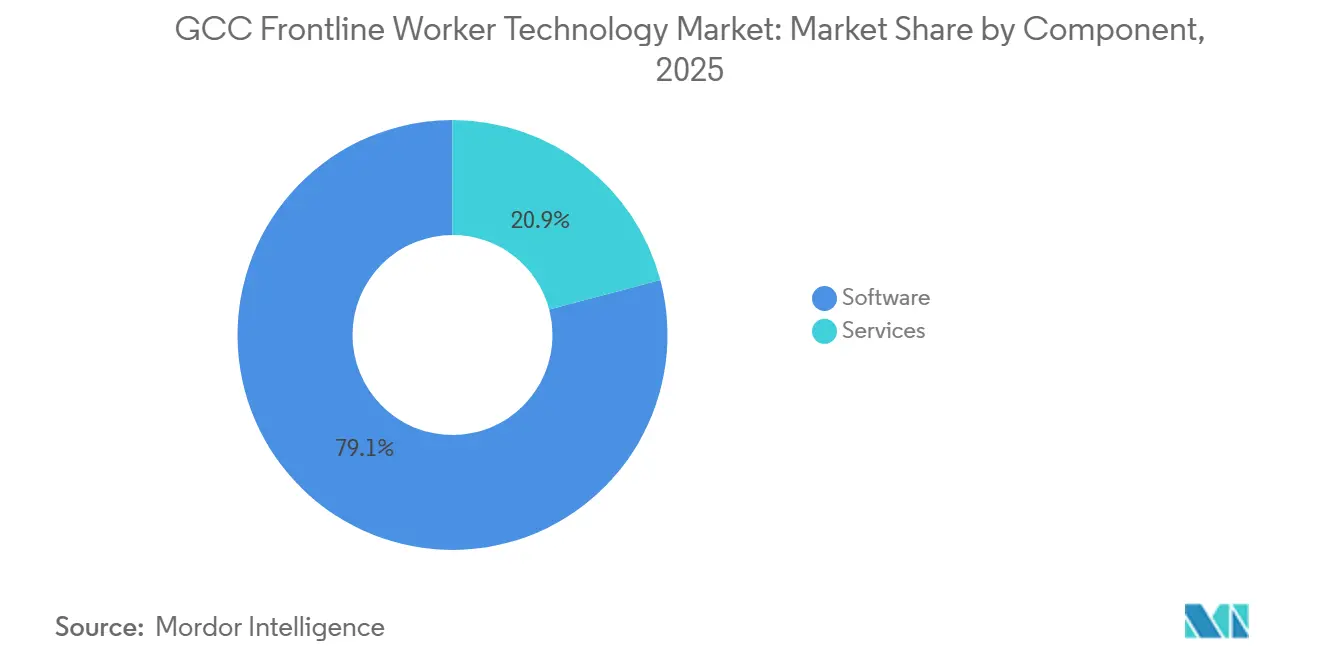
Software Dominates While Services Build Long-Term RevenueSoftware accounted for 79.11% of the GCC frontline worker technology market share in 2025, indicating that buyers still place the greatest value on core platforms that bring tasking, communication, safety, and analytics into a single environment. That leadership reflects the region’s preference for integrated tools that can support multi-site operations without forcing workers to move across many separate applications. In practical terms, software remains the center of adoption because employers first need a system of record for workforce execution before they expand into more specialized services. The largest deals, therefore, continue to begin with platform licenses and then widen into broader operational use.
Software accounted for 79.11% of the GCC frontline worker technology market share in 2025, indicating that buyers still place the greatest value on core platforms that bring tasking, communication, safety, and analytics into a single environment. That leadership reflects the region’s preference for integrated tools that can support multi-site operations without forcing workers to move across many separate applications. In practical terms, software remains the center of adoption because employers first need a system of record for workforce execution before they expand into more specialized services. The largest deals, continue to begin with platform licenses and then widen into broader operational use.er 2025 partnership activity in Saudi Arabia, including a local training center, fits this pattern of building in-country capability around enterprise platform adoption.
By Deployment Mode:
Cloud-Based Platforms Consolidate The MarketCloud-based deployment held 74.66% of the GCC frontline worker technology market share in 2025 and was also the fastest-growing deployment model with a 26.18% CAGR through 2031. That combination shows that cloud is not only the current standard, but also the main path for future expansion across the region. Employers prefer cloud delivery because it supports faster rollout, centralized updates, and easier scaling across sites, crews, and contractor layers. It also aligns with subscription pricing, lowering the barrier to first adoption and later expansion.
On-premises and hybrid models remain relevant where data-handling rules or internal control requirements limit full cloud migration. The GCC frontline worker technology market, therefore, is not moving toward a single deployment model in every case, but toward a cloud-first architecture that allows for regulated variations. As sovereign and local infrastructure expands, the balance continues to move in favor of cloud-based systems for more workloads. That matters because the GCC frontline worker technology market size is increasingly tied to deployments that can scale quickly across public and private organizations without heavy infrastructure setup at each site. Microsoft’s UAE investment plans support that environment by strengthening regional cloud capacity, while large enterprise partnerships in Dubai demonstrate that AI-enabled frontline workflows are being layered on that same infrastructure.[4]
By Organization Size:
Enterprises Lead But SMEs Are Closing The Spending GapLarge enterprises accounted for 71.66% of the GCC frontline worker technology market in 2025, mirroring the structure of the region’s major sectors. Oil and gas, construction, government, and large industrial groups dominate spending because they manage the biggest frontline workforces and face the greatest need for operational consistency across multiple sites. These buyers also have the budgets and internal teams needed to support deployment at scale. As a result, large enterprises remain the anchor customers for both global platform providers and regional implementation partners.
The SME segment is projected to expand at a 27.33% CAGR through 2031, which makes it the fastest-growing organization size category. This growth is being pushed by lighter SaaS tools, per-seat pricing, and the spread of digital compliance requirements from large project owners down to subcontractors. Many smaller firms are adopting these systems not only to improve productivity but also to remain eligible to work within regulated contractor networks. That makes digital frontline tools more of a participation requirement than a purely discretionary technology decision. WorkJam’s 2026 release, which embedded AI directly into existing workflows and supported more than 50 languages, illustrates how vendors are adjusting product design for organizations with limited IT capacity and diverse workforces.
By Application:
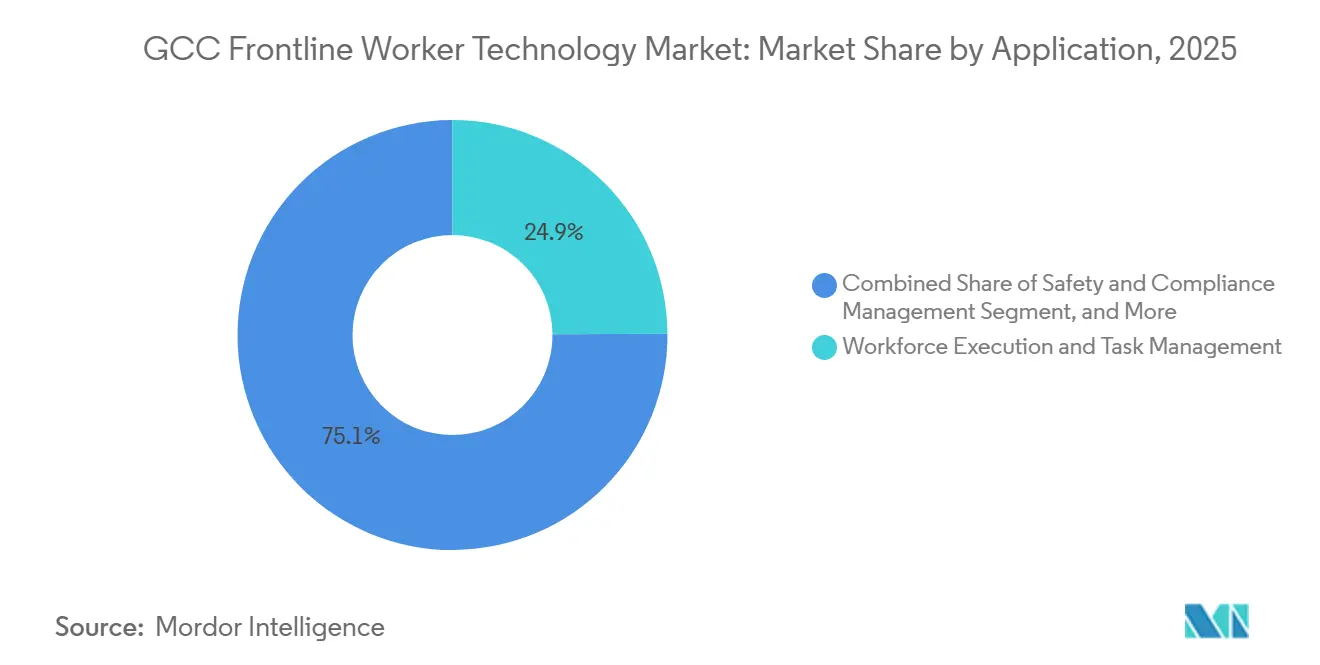
Task Management Anchors Demand While Safety Platforms ScaleWorkforce execution and task management accounted for the largest share at 24.99% in 2025, confirming that frontline platforms are still adopted first for everyday operational coordination. Employers need systems that can assign work, track completion, and keep supervisors informed across dispersed teams, especially in construction, logistics, and industrial settings. That makes task management the operational core of the GCC frontline worker technology market. It is the function that most directly ties the platform to daily output and labor utilization.
Safety and compliance management is projected to grow at a 28.44% CAGR through 2031, which makes it the fastest-expanding application area. This growth reflects tighter documentation expectations in high-risk environments and the need for digital proof of work, training, and incident handling. Other application groups, such as scheduling, learning, analytics, and communication, are also becoming more interconnected as buyers move away from single-use tools. The application mix is therefore shifting from separate modules toward workflow systems in which a single field event can trigger tasks, alerts, follow-up actions, and performance reporting within the same environment. Zebra’s 2026 launch of Workcloud BI and Workcloud IO reflects this direction by linking frontline work orchestration with broader enterprise systems through a shared integration layer.

By End-User Industry:
Construction Anchors Volumes While Government Accelerates FastestConstruction held 26.11% share in 2025, giving it the largest position among end-user industries in the GCC frontline worker technology market. This leadership comes from the region’s large project pipeline and the complexity of coordinating workers across many sites, trades, languages, and subcontracting layers. Frontline tools are especially relevant in construction because managers need better visibility into tasks, attendance, safety actions, and field reporting. The scale of project execution in the region keeps construction at the center of demand.
Government and public administration is projected to grow at a 29.66% CAGR through 2031, making it the fastest-growing end-user segment. Public-sector growth is supported by broad workforce digitalization programs that are advancing AI, workflow automation, and service productivity across public administration. This does not displace other sectors, since industrial manufacturing, healthcare and life sciences, transportation and logistics, hospitality, and retail also continue to create meaningful demand for frontline platforms. Still, the government opportunity stands out because policy priorities, workforce training, and digital service delivery are being aligned in a more coordinated way than in many private sectors. The World Government Summit’s 2025 work on public-sector workforce development and the UAE’s 2026 enterprise AI push both demonstrate how institutional digitalization is expanding the addressable market for GCC frontline worker technology.
Geography Analysis
Saudi Arabia Frontline Worker Technology Market
Saudi Arabia held 44.12% of the GCC frontline worker technology market share in 2025, maintaining its leading regional position. Its scale is supported by the execution of the Vision 2030 program, large contractor ecosystems, and the need to digitize workforce management across construction, industrial, and public-sector operations. The country also benefits from in-country technology localization, which improves access to devices and enterprise support for major frontline deployments. Honeywell’s October 2025 launch of a production line for mobile computers in Dhahran shows how vendors are aligning with local industrial priorities and placing supply closer to end users in the Kingdom.
United Arab Emirates Frontline Worker Technology Market
The UAE is projected to grow at a 31.81% CAGR through 2031, making it the fastest-growing national segment in the GCC frontline worker technology market. Growth there is being driven by the overlap of sovereign AI investment, enterprise digital transformation, and public-sector workforce modernization. Microsoft’s announced investment of USD 15.2 billion through 2029 strengthens the infrastructure base available for cloud and AI-led frontline deployments. Dubai Holding’s May 2026 enterprise AI partnership with Microsoft also signals that large UAE groups are embedding AI across multiple frontline-heavy operations simultaneously. That combination gives the UAE a strong role in shaping how the GCC frontline worker technology market evolves across cloud delivery, AI-enabled coordination, and service productivity.
GCC Frontline Worker Technology Market
Qatar, Kuwait, Oman, and Bahrain account for the remaining regional demand, and a different operating context is shaping each. Qatar continues to support adoption through infrastructure and energy-related digital operations, while Kuwait shows growing demand for energy-sector modernization and broader AI-linked field deployment. Oman is building public-sector digital service capacity through its Government Digital Transformation Program, backed by OMR 170 million (approximately USD 441 million) in the source material. Bahrain remains the smallest market, but it stands out for regulatory activity that could support more structured enterprise technology procurement over time. Together, these markets broaden the base of the GCC frontline worker technology market, even though their absolute scale remains below that of Saudi Arabia and the UAE.
Competitive Landscape
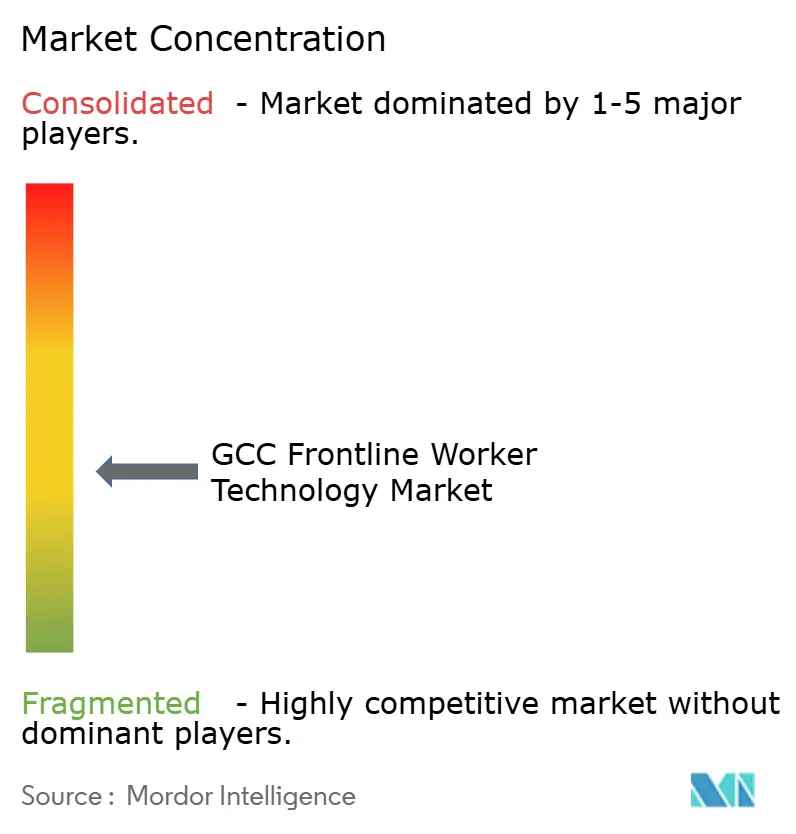
The GCC frontline worker technology market is moderately fragmented at the upper tier, where Zebra Technologies, Honeywell, Microsoft, SAP SE, Oracle, ServiceNow, and IFS compete for large enterprise accounts. Their advantage usually comes from existing enterprise relationships, deeper integration, and the ability to support regulated clients with broader workflow and infrastructure capabilities. These companies are often favored by buyers in construction, oil and gas, manufacturing, and government, where deployment risk matters as much as product features. That gives the top tier a durable position in large and complex deals.
A second competitive layer includes purpose-built platforms such as WorkJam, Connecteam, Staffbase, Beekeeper, Poka, Augmentir, and Dozuki. These vendors tend to compete on speed, simpler deployment, mobile-first design, multilingual support, and lower ownership cost for mid-market and SME users. Their appeal is strongest when employers want faster time-to-value and do not need the full stack of a major enterprise software suite. That white space is especially visible among subcontractors and smaller frontline-heavy operators that still rely on messaging tools or light productivity apps. LumApps and Beekeeper’s July 2025 merger, which created a larger AI-powered employee experience platform serving more than 7 million users across 2,000-plus clients, shows that specialist players are also seeking scale and breadth as competition intensifies.
Strategic moves increasingly center on AI, integration, and regional enablement rather than simple feature expansion. Zebra’s June 2026 launch of Zebra Nucleus, Workcloud BI, and Workcloud IO marked a push to more closely connect frontline orchestration with enterprise systems and real-time decision support. Honeywell’s expansion of local device manufacturing in Saudi Arabia and its February 2026 Kortech collaboration showed a parallel effort to deepen operational relevance across infrastructure and industrial settings. ServiceNow’s Saudi-linked training and ecosystem buildout through the NextEra partnership also reflects the importance of local capability and implementation reach in this market. Across the GCC frontline worker technology market, vendors that can show measurable gains in compliance execution, dispatch speed, and operational visibility are in the strongest position to convert pilot projects into larger contracts.
GCC Frontline Worker Technology Industry Leaders
-
Zebra Technologies Corporation
-
Honeywell International Inc.
-
Microsoft Corporation
-
SAP SE
-
Oracle Corporation
- *Disclaimer: Major Players sorted in no particular order
GCC Frontline Worker Technology Market Companies Covered in this Report
- Zebra Technologies Corporation
- Honeywell International Inc.
- TeamViewer AG
- Microsoft Corporation
- Oracle Corporation
- SAP SE
- IFS AB
- PTC Inc.
- ServiceNow, Inc.
- Salesforce, Inc.
- Dozuki, Inc.
- Augmentir, Inc.
- Poka Inc.
- Beekeeper AG
- WorkJam, Inc.
- Staffbase GmbH
- Connecteam Ltd.
- Fujitsu Limited
- Trimble Inc.
- Hexagon AB
Recent Industry Developments in GCC Frontline Worker Technology Market
- June 2026: SAP SE announced that EMSTEEL Group, one of the UAE's largest publicly traded steel and building materials manufacturers, has adopted RISE with SAP as part of a comprehensive digital and industrial transformation program. The implementation establishes a cloud-enabled operational foundation and prepares EMSTEEL for Business AI and agentic capabilities across its enterprise functions.
- May 2026: Dubai Holding and Microsoft announced a landmark enterprise AI partnership embedding AI across hospitality, real estate, telecommunications, investment, and entertainment operations, described as the first deployment of its kind at enterprise scale in the broader Middle East and Africa region.
- February 2026: Honeywell signed a Memorandum of Understanding with Kortech, a subsidiary of Hassan Allam Holding, to collaborate on automating and digitizing critical infrastructure projects across Egypt, Saudi Arabia, and the UAE. The partnership combines Honeywell's automation and digital technologies with Kortech's turnkey infrastructure solutions for data centers, transportation projects, and smart-city developments.
- January 2026: WorkJam announced a major platform release at NRF 2026 Retail's Big Show, embedding AI capabilities directly within frontline operational workflows, covering communication, task management, learning, and scheduling, with support for over 50 languages to address multilingual workforce environments.
GCC Frontline Worker Technology Market Report Scope
The GCC frontline worker technology market encompasses the ecosystem of software and services designed to empower non-desk employees who primarily perform their duties outside a traditional office setting. This includes tools that facilitate employee communication, task management, scheduling, knowledge sharing, and performance tracking across sectors such as retail, manufacturing, healthcare, and logistics. The market features cloud-based, on-premises, and hybrid deployment models tailored to the operational needs of organizations of varying sizes, aiming to improve operational efficiency, safety compliance, and real-time decision-making at the edge of business operations across the Gulf Cooperation Council (GCC) countries.
The GCC Frontline Worker Technology Market Report is Segmented by Component (Software and Services), Deployment (Cloud-Based, Hybrid, and On-Premises), Organization Size (Large Enterprises and Small and Medium Enterprises), Application (Employee Communication and Engagement, Workforce Execution and Task Management, Workforce Scheduling and Coordination, Learning and Knowledge Enablement, Workforce Analytics and Performance Management, Safety and Compliance Management, and Other Applications), End-User Industry (Retail and E-Commerce, Industrial Manufacturing, Healthcare and Life Sciences, Transportation and Logistics, Hospitality, Construction, Government and Public Administration, and Other Industries), and Geography (Saudi Arabia, United Arab Emirates, Qatar, Kuwait, Oman, and Bahrain). The Market Forecasts are Provided in Terms of Value (USD).
Segmentation Overview
| Software |
| Services |
| Cloud-Based |
| Hybrid |
| On-Premises |
| Large Enterprises |
| Small and Medium Enterprises |
| Employee Communication and Engagement |
| Workforce Execution and Task Management |
| Workforce Scheduling and Coordination |
| Learning and Knowledge Enablement |
| Workforce Analytics and Performance Management |
| Safety and Compliance Management |
| Other Applications |
| Retail and E-Commerce |
| Industrial Manufacturing |
| Healthcare and Life Sciences |
| Transportation and Logistics |
| Hospitality |
| Construction |
| Government and Public Administration |
| Other Industries |
| Saudi Arabia |
| United Arab Emirates |
| Qatar |
| Kuwait |
| Oman |
| Bahrain |
| By Component | Software |
| Services | |
| By Deployment | Cloud-Based |
| Hybrid | |
| On-Premises | |
| By Organization Size | Large Enterprises |
| Small and Medium Enterprises | |
| By Application | Employee Communication and Engagement |
| Workforce Execution and Task Management | |
| Workforce Scheduling and Coordination | |
| Learning and Knowledge Enablement | |
| Workforce Analytics and Performance Management | |
| Safety and Compliance Management | |
| Other Applications | |
| By End-User Industry | Retail and E-Commerce |
| Industrial Manufacturing | |
| Healthcare and Life Sciences | |
| Transportation and Logistics | |
| Hospitality | |
| Construction | |
| Government and Public Administration | |
| Other Industries | |
| By Geography | Saudi Arabia |
| United Arab Emirates | |
| Qatar | |
| Kuwait | |
| Oman | |
| Bahrain |
Key Questions Answered in the Report
What is the current and future size of the GCC frontline worker technology market?
The GCC frontline worker technology market was valued at USD 0.44 billion in 2025, reached USD 0.52 billion in 2026, and is forecast to reach USD 1.56 billion by 2031 at a 24.57% CAGR.
Which deployment model is gaining the most traction across GCC frontline operations?
Cloud-based deployment leads adoption with a 74.66% share in 2025 and is also the fastest-growing model, with a 26.18% CAGR through 2031.
Which application area is growing the fastest in frontline platforms across the GCC?
Safety and compliance management is the fastest-growing application, projected to expand at a 28.44% CAGR through 2031 as employers shift toward digital records and traceable workflows.
Which end-user sector creates the largest revenue base for these platforms?
Construction is the largest end-user segment, holding 26.11% share in 2025 because of the region's large project pipeline and the need to coordinate dispersed field workforces.
Which GCC country is creating the strongest growth opportunity?
Saudi Arabia held the largest share at 44.12% in 2025, while the UAE is the fastest-growing country segment with a 31.81% CAGR through 2031.
Why are SMEs becoming more important in frontline technology adoption?
SMEs are projected to grow at a 27.33% CAGR because subscription pricing, lighter SaaS tools, and contractor compliance requirements are making adoption more practical and more necessary for smaller firms.