
Frontline Worker Technology In Industrial Manufacturing Market Size and Share
Market Overview
| Study Period | 2020 - 2031 |
|---|---|
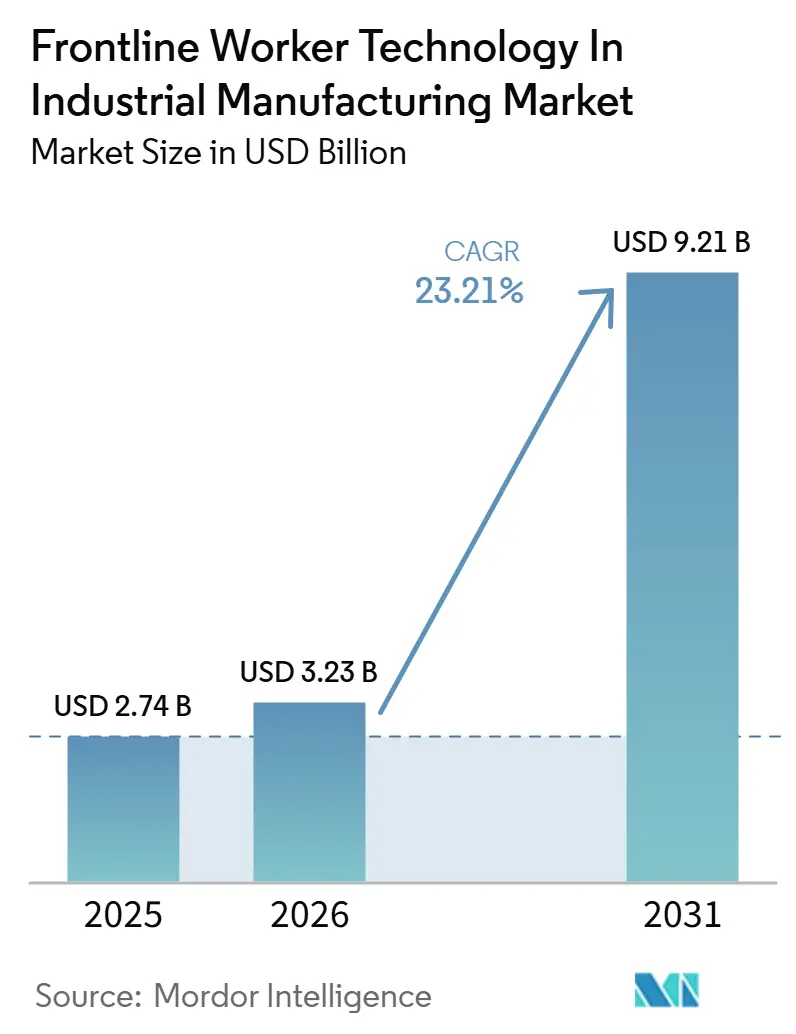
| Market Size (2026) | USD 3.23 Billion |
| Market Size (2031) | USD 9.21 Billion |
| Growth Rate (2026 - 2031) | 23.21 % |
| Fastest Growing Market | Asia-Pacific |
| Largest Market | Europe |
| Market Concentration | Medium |
Major Players *Disclaimer: Major Players sorted in no particular order Image © Mordor Intelligence. Reuse requires attribution under CC BY 4.0. | |
Frontline Worker Technology In Industrial Manufacturing Market Analysis by Mordor Intelligence
The frontline worker technology market in industrial manufacturing is expected to increase from USD 2.74 billion in 2025 to USD 3.23 billion in 2026 and reach USD 9.21 billion by 2031, growing at a CAGR of 23.31% over 2026-2031. Growth is being supported by a tighter supply of skilled labor, wider use of edge AI on factory floors, and stronger enforcement of worker safety and monitoring rules. Manufacturers are moving from paper-driven supervision and reactive safety processes toward digital systems that support live task tracking, safety alerts, and faster response. The market is also shifting away from hardware-led buying decisions because software platforms now drive most long-term value, while connected devices are increasingly treated as data-collection points. Competitive activity is widening as large industrial vendors build broader ecosystems, while smaller software-led players compete with faster deployment, better models, and clearer worker-facing workflows. Even with strong demand, rollout speed still depends on how well vendors handle integration costs, privacy concerns, and device performance in harsh plant environments.
Key Report Takeaways
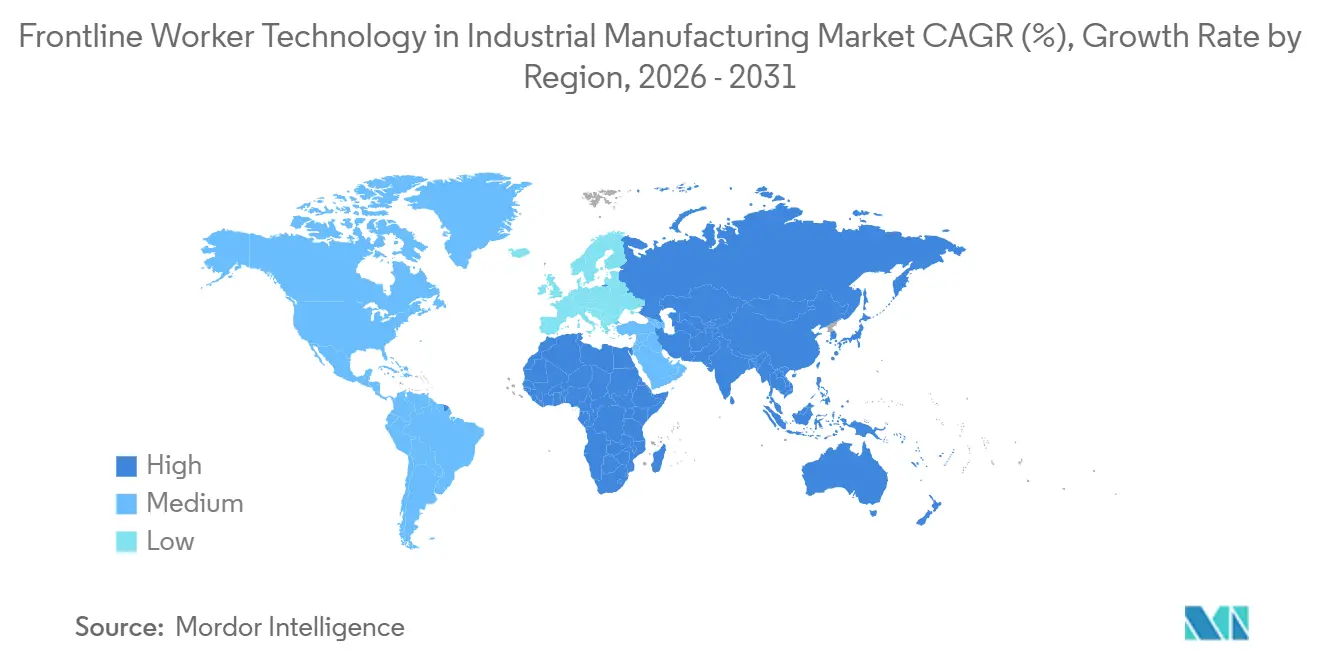
- By geography, Europe led with 33.11% revenue share in 2025, while Asia-Pacific is projected to expand at a 28.99% CAGR through 2031 in the frontline worker technology in industrial manufacturing market.
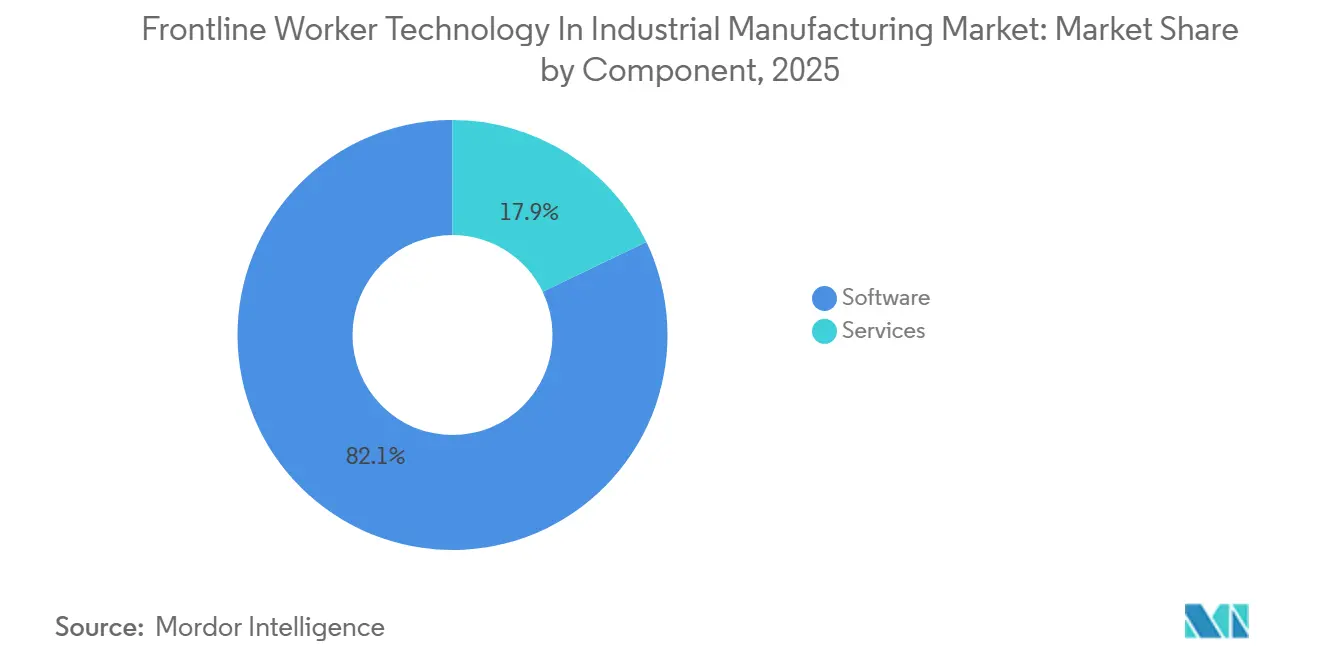
- By component, software held 82.11% share of the frontline worker technology in industrial manufacturing market in 2025, while services are projected to grow at a 24.19% CAGR through 2031.
- By deployment mode, cloud-based deployment accounted for 76.61% share of the frontline worker technology in industrial manufacturing market in 2025 and is also projected to grow at a 25.44% CAGR through 2031.
- By organization size, large enterprises captured 71.66% of the market in 2025, while SMEs are projected to expand at a 26.88% CAGR through 2031.
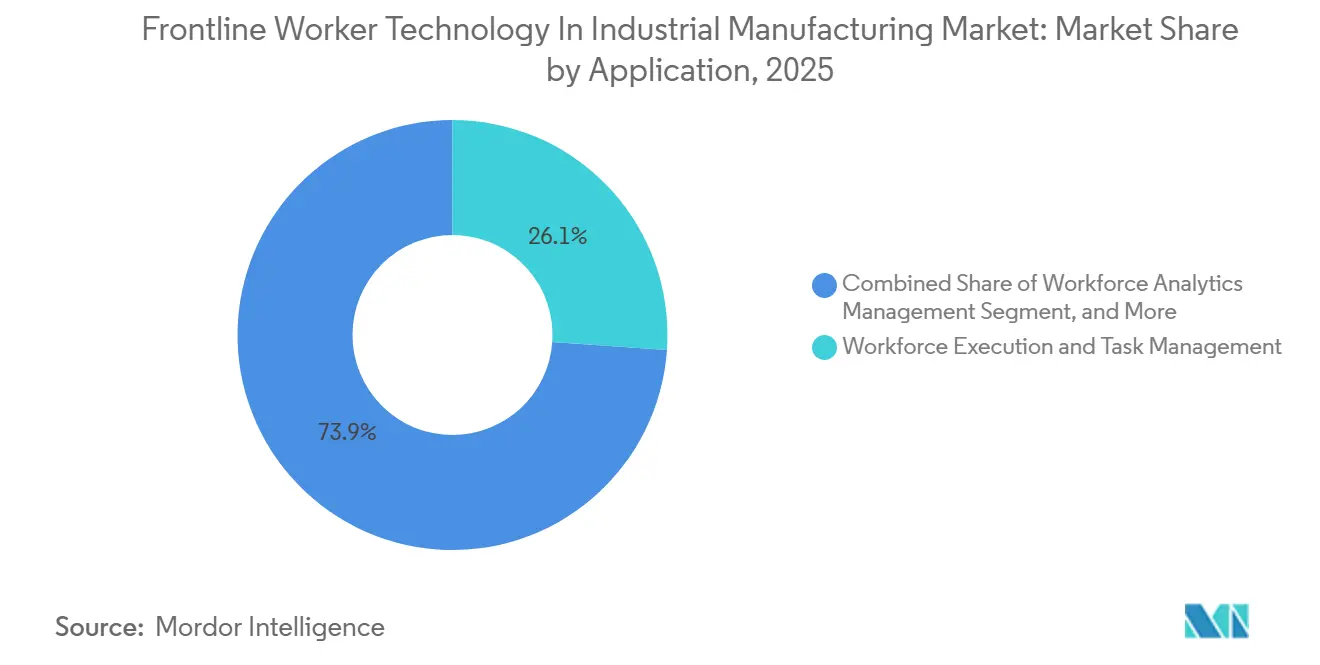
- By application, workforce execution and task management led with 26.11% share of the frontline worker technology in industrial manufacturing market in 2025, while workforce analytics and performance management are projected to record a 27.31% CAGR through 2031.
- By end-user industry, electronics and semiconductors accounted for 28.91% of the market in 2025, while industrial machinery and equipment is projected to grow at a 24.12% CAGR through 2031.
Note: Market size and forecast figures in this report are generated using Mordor Intelligence’s proprietary estimation framework, updated with the latest available data and insights as of January 2026.
Market Trends and Insights
Drivers Impact Analysis of Frontline Worker Technology In Industrial Manufacturing Market*
| Driver | (~) % Impact on CAGR Forecast | Geographic Relevance | Impact Timeline |
|---|---|---|---|
| Growing Use of AI-Powered Hazard Detection and Predictive Safety Analytics | +4.5% | Global, strongest in North America, Europe, and East Asia manufacturing hubs | Medium term (2-4 years) |
| Labor Shortages Accelerating Automation of Attendance, Compliance, and Productivity Tracking | +4.0% | North America, Western Europe, Japan, and South Korea | Long term (≥ 4 years) |
| Rising Demand for Real-Time Worker Visibility on Complex Manufacturing Sites | +3.5% | Global, led by Asia Pacific and North America | Short term (≤ 2 years) |
| Increasing Adoption of Connected PPE and Smart Wearables | +3.0% | Global, highest in Europe and Asia Pacific | Medium term (2-4 years) |
| Rising Safety Compliance Pressure Across Manufacturing Sites | +2.5% | North America, Europe, and Asia Pacific | Short term (≤ 2 years) to Medium term (2-4 years) |
| Rising Demand For Digital Worker Credentialing and Site Access Control | +2.2% | North America and Europe, with growing uptake in Asia Pacific | Medium term (2-4 years) |
| Source: Mordor Intelligence | |||
Growing Use of AI-Powered Hazard Detection and Predictive Safety Analytics
The frontline worker technology in industrial manufacturing market is gaining from the wider use of AI systems that can read video, audio, and sensor data directly near the workstation. Recent 2025 research showed that wearable-based models, such as random forests and support vector machines, were able to detect unsafe posture during tasks like pushing, pulling, and drilling in near real time.[1] This is changing how factories approach safety because alerts can now be issued before an incident develops, rather than after an injury has already occurred. The commercial value is also broadening, as the same behavior and location data can reveal weak workflow design, recurring congestion points, and supervisor blind spots that are difficult to spot through manual checks alone. As these models learn from more plant-floor data, early adopters build stronger internal datasets, making it harder for later entrants to match their performance. That dynamic is raising switching costs and giving software quality a more central role in purchasing decisions across the frontline worker technology market in industrial manufacturing.
Labor Shortages Accelerating Automation of Attendance, Compliance, And Productivity Tracking
The frontline worker technology in industrial manufacturing market is also being supported by labor shortages that are no longer treated as a short cycle issue in manufacturing. Recent reports indicate that 17.9% of manufacturing enterprises in Germany said skill shortages were affecting operations in Q2 2025, far above the long-run average of 3.7% recorded between 1991 and 2010.[2] The pressure is especially evident in plants, where onboarding time, certification status, shift attendance, and work allocation must be tracked with greater consistency than before. In that setting, automated attendance, compliance logging, and productivity tracking are becoming practical tools for maintaining stable output when skilled labor is hard to replace. The demand is not limited to production speed because manufacturers also need faster worker credentialing and more reliable proof that critical tasks were performed by qualified staff. This makes digital workforce systems part of operational resilience, which is why the frontline worker technology in industrial manufacturing market is drawing attention beyond traditional safety budgets.
Rising Demand for Real-Time Worker Visibility on Complex Manufacturing Sites
The frontline worker technology in industrial manufacturing market is benefiting from the need for real-time worker visibility across multi-shift and multi-contractor manufacturing sites. When supervisors do not have a live view of location, task status, and completion records, small delays can turn into missed handoffs, weaker response time, and compliance gaps. A 2025 benchmark report, based on data from more than 1,500 manufacturing plants, showed that deploying a connected workforce platform was associated with a 26% average productivity uplift within 90 days.[3] Further developments in 2025 also moved in this direction, introducing AI support for frontline operations to reduce cognitive load and help workers manage complex tasks across industrial environments. The value of visibility systems extends beyond safety because the same data supports scheduling, audit readiness, incident review, and faster escalation when a line or area needs intervention. As a result, manufacturers increasingly treat visibility as operating infrastructure and that is lifting demand across the frontline worker technology in industrial manufacturing market.[4]
Increasing Adoption of Connected PPE and Smart Wearables
The frontline worker technology in industrial manufacturing market is also being shaped by rising adoption of connected PPE and smart wearables in industrial settings. Smart helmets, bands, and wearable cameras are increasingly described as part of a changing occupational safety and health infrastructure, rather than as simple add-on tools. This matters because wearables now support continuous observation of ergonomic strain, worker location, first-person context, and signs of heat or fatigue within the same workflow. That broadens their use from isolated safety tasks toward ongoing operational support and documented compliance. Adoption is still constrained by certification uncertainty because some devices add data features that do not clearly fit established PPE approval frameworks. Vendors that can combine device reliability, worker comfort, and recognized safety certification are likely to gain faster approval cycles as the frontline worker technology in industrial manufacturing market expands.
Restraints Impact Analysis of Frontline Worker Technology In Industrial Manufacturing Market*
| Restraint | (~) % Impact on CAGR Forecast | Geographic Relevance | Impact Timeline |
|---|---|---|---|
| High Upfront Cost of Hardware, Software, and Site Integration | -3.0% | Global, most acute in SME-heavy sectors in Asia Pacific and South America | Short term (≤ 2 years) to Medium term (2-4 years) |
| Privacy, Labor Relations, and Worker Acceptance Challenges | -2.2% | Europe, North America, and Australia | Medium term (2-4 years) |
| Poor Interoperability With Legacy Manufacturing Systems | -1.8% | Global, strongest in brownfield heavy industrial facilities | Long term (≥ 4 years) |
| Battery Life, Durability, and Connectivity Limitations in Harsh Site Conditions | -1.3% | Global, particularly acute in foundry, chemical, and food processing sectors | Short term (≤ 2 years) to Medium term (2-4 years) |
| Source: Mordor Intelligence | |||
High Upfront Cost of Hardware, Software, And Site Integration
The frontline worker technology in industrial manufacturing market faces cost pressures due to the need for hardware, software, connectivity infrastructure, and integration with existing manufacturing systems. Deployment may require rugged devices, wearable sensors, connected worker platforms, machine integration, and facility-specific configurations. Manufacturers must also consider cybersecurity, employee training, maintenance, and legacy equipment compatibility, which increase upfront costs. Small and mid-sized manufacturers may find it difficult to justify these investments when productivity gains, safety benefits, and return on investment are uncertain. Although vendors offer subscription-based, cloud-hosted, and hardware-as-a-service models to reduce initial capital requirements, implementation costs and integration complexity continue to limit market adoption.
Privacy, Labor Relations, and Worker Acceptance Challenges
The frontline worker technology in industrial manufacturing market faces adoption challenges due to concerns over employee privacy and workplace surveillance. Biometric monitoring, real-time location tracking, and performance analytics can collect sensitive data, including physiological information, fatigue indicators, and activity patterns. Workforce trust, labor relations, and collective bargaining arrangements may also affect implementation, as employees may view these technologies as productivity monitoring tools rather than safety solutions. Varying data protection regulations and inconsistent worker-data management practices across jurisdictions further complicate multi-facility deployment. Therefore, successful adoption depends on transparent communication, robust data governance, required employee consent, and worker trust.
*Our forecasts treat driver/restraint impacts as directional, not additive. The impact forecasts reflect baseline growth, mix effects, and variable interactions.
Frontline Worker Technology In Industrial Manufacturing Market Segment Analysis
By Component:
Software Leads Spending While Services Gain Ground Through Deployment ComplexitySoftware held 82.11% of the frontline worker technology in industrial manufacturing market share in 2025, showing how strongly spending has shifted toward platforms that manage data, workflows, and intelligence over time. In the frontline worker technology in industrial manufacturing market, this position reflects recurring subscription value, broader system control, and the fact that many connected devices are now treated as replaceable endpoints rather than the center of the investment case. Buyers are putting more weight on how well platforms handle work instructions, analytics, compliance records, and interoperability than on the hardware itself. That is why software has become the anchor of both revenue capture and customer retention in this space.
Services are projected to grow at a 24.19% CAGR through 2031, indicating that implementation support is becoming increasingly important as deployments deepen. This reflects the reality that the frontline worker technology in industrial manufacturing market often requires workflow redesign, onboarding support, and change management before users see steady adoption. Recent platform expansions combining AI with augmented reality in late 2025 demonstrated how software providers are expanding their value by pairing new functionality with practical deployment support for connected workers. The frontline worker technology in industrial manufacturing industry is therefore moving toward a model where software captures the recurring layer and services help secure adoption quality. Vendors that can support both areas are better placed to defend accounts when customers scale from pilot sites to wider plant networks.
By Deployment Mode:
Cloud Sets The Baseline While Hybrid Supports Regulated OperationsCloud-based deployment accounted for 76.61% share of the frontline worker technology in industrial manufacturing market size in 2025, and it also recorded the fastest projected CAGR at 25.44% through 2031. That combination shows the frontline worker technology in industrial manufacturing market is not splitting evenly between cloud and on-premises models, because cloud is already the dominant direction for most new deployments. Buyers prefer the faster rollout, easier updates, and lower internal infrastructure burden that come with cloud delivery. It also aligns well with modular commercial models that let sites add users or functions over time.
Hybrid deployment is becoming increasingly relevant as manufacturers seek local control over sensitive data while keeping analytics and reporting in the cloud. In the frontline worker technology in industrial manufacturing market, that balance matters most in regulated settings where data handling rules, cybersecurity standards, or internal IT policies limit a fully cloud-only design. Recent collaborative work in 2025 showed how secure connected worker support could be delivered through compliant cloud environments for sustainment operations, rather than relying on a fully isolated build. On-premises systems still matter in tightly controlled facilities, but they are serving a narrower group of users than before. The frontline worker technology in industrial manufacturing industry is therefore consolidating around cloud-first architecture, with hybrid design acting as the practical middle ground for more sensitive operations.
By Organization Size:
Large Enterprises Dominate Today While SMEs Expand FasterLarge enterprises held 71.66% of the 2025 market, which reflects their stronger budgets, deeper IT teams, and ability to spread integration costs across several plants. In the frontline worker technology in industrial manufacturing market, these companies have also been early adopters because they manage more complex operations and face higher costs when safety, quality, or labor coordination breaks down. Large groups can support longer deployment cycles and are often better positioned to connect worker systems with broader digital manufacturing programs. That combination has kept them in the lead on both deployment scale and revenue contribution.
SMEs are projected to grow at a 26.88% CAGR through 2031, and the frontline worker technology in industrial manufacturing market size for SMEs is projected to expand at 26.88% CAGR between 2026 and 2031. This faster rise is being enabled by cloud delivery and subscription models that lower the need for heavy on-site infrastructure. A 2025 industry report stated that AI-powered software solutions were improving access to automation for smaller manufacturers, which supports a broader opening for connected worker systems as well. A 2025 study also found no statistically significant difference in digital technology acceptance between medium and small enterprises, which suggests the main barrier was financial rather than cultural. In the frontline worker technology in industrial manufacturing market, vendors that simplify setup, shorten time to value, and reduce minimum commitments are likely to win a larger share of SME adoption.
By Application:
Task Execution Holds The Largest Position While Analytics Shapes The Next Spending PhaseWorkforce execution and task management led with 26.11% share in 2025, and this segment accounted for 26.11% share of the frontline worker technology in industrial manufacturing market size in 2025. In the frontline worker technology in industrial manufacturing market, that position reflects the need to digitize work orders, standard procedures, checklists, and shop-floor task records that still sit at the center of daily plant activity. Many manufacturers begin here because it replaces visible manual bottlenecks and creates a clearer structure for operators and supervisors. It also builds the base layer of worker and process data that later applications depend on.
Workforce analytics and performance management is projected to grow at a 27.31% CAGR through 2031, and the frontline worker technology in industrial manufacturing market size for workforce analytics and performance management is projected to expand at 27.31% CAGR between 2026 and 2031. This signals that the frontline worker technology in industrial manufacturing market is moving from digitizing tasks toward turning plant-floor data into better decisions. A 2025 study on manufacturing MIS tools found that analytics linked to labor planning, absenteeism monitoring, and productivity optimization helped reduce idle time and improve shift planning in factory settings. Communication, safety management, scheduling, and learning tools remain important because they support different stages of the worker lifecycle and help unify fragmented tasks into a more usable operating system. Vendors that integrate these functions into a single platform are likely to achieve stronger customer retention than providers focused on isolated use cases.

By End-User Industry:
Electronics And Semiconductors Lead While Industrial Machinery And Equipment Grows FastestElectronics and semiconductors held 28.91% of the 2025 end-user market, and this segment accounted for 28.91% share of the frontline worker technology in industrial manufacturing market size in 2025. The frontline worker technology in industrial manufacturing market has been especially relevant for this sector because precision assembly, strict process control, and high defect sensitivity make worker support systems more valuable. A single error can prevent high-value output, thereby shortening the payback period for digital work guidance, monitoring, and compliance support. These conditions have kept electronics and semiconductors at the front of adoption.
Industrial machinery and equipment is projected to grow at a 24.12% CAGR through 2031, and that pace shows where demand is broadening next in the frontline worker technology in industrial manufacturing market. A 2025 report highlighted that automation and digitalization were creating notable skills gaps across manufacturing, including sectors where knowledge transfer and role-specific competence remain critical. Machinery and equipment producers face that issue directly because many maintenance and precision roles still depend on worker skill that cannot be fully replaced through robotics. Automotive, pharmaceuticals and chemicals, food and beverage, and aerospace and defense also remain relevant because each has its own training, documentation, and traceability requirements. In the frontline worker technology in industrial manufacturing market, vendors that tailor workflows and compliance features by industry are likely to compete more effectively than those offering a single generic product.
Geography Analysis
Europe and Germany Frontline Worker Technology in Industrial Manufacturing Market
Europe held 33.11% of the frontline worker technology in industrial manufacturing market share in 2025, which made it the largest regional market. The frontline worker technology in industrial manufacturing market has been strong in Europe because the region combines dense advanced manufacturing clusters with a regulatory environment that pushes employers toward better documentation of worker safety and operating practices. Germany remains especially important because high automation density increases the need for clear human-machine coordination on the factory floor. Recent industry data reported that Germany had 449 robots per 10,000 manufacturing employees in 2025, ranking it among the most automated manufacturing economies in the world. That level of automation does not reduce the need for connected worker tools, because it often increases the need for live supervision, guided tasks, and clearer interaction rules between people and machines.
APAC Frontline Worker Technology in Industrial Manufacturing Market
Asia-Pacific is projected to grow at a 28.99% CAGR through 2031, and it represents the fastest-growing part of the frontline worker technology in industrial manufacturing market size over the forecast period. The frontline worker technology in industrial manufacturing market is expanding quickly in the region because large-scale manufacturing, rising labor costs, and smart factory programs are pushing companies toward more digital workforce control. Japan has shown this direction clearly through company-led development of AI tools for frontline operations. A major strategic alliance expanded in October 2025 to develop AI agents for frontline worker operations in manufacturing lines and social infrastructure. South Korea is also relevant because high robotics density creates a practical need for stronger software support around worker supervision, communication, and task flow. India and Southeast Asia are gaining attention as electronics production expands and newly onboarded workforces need structured guidance, training, and oversight at scale.
The Americas and MEA Frontline Worker Technology in Industrial Manufacturing Market
North America accounted for a significant share of revenue in 2025 across the frontline worker technology in industrial manufacturing market. Labor cost pressure and stricter enforcement have kept interest in adoption high, especially where absenteeism, machine safety, and task accountability affect output. A national emphasis program on amputations in manufacturing remained active through 2025 and into 2026, which kept attention on real-time monitoring and documented machine-related safety controls. South America remained less mature, but it is developing alongside broader industrial digitization in sectors such as automotive, food and beverage, and chemicals. Middle East and Africa still represented a smaller share, though smart manufacturing investment in Gulf economies and the gradual digitalization of selected African manufacturing sites are supporting steady long-term interest.
Competitive Landscape
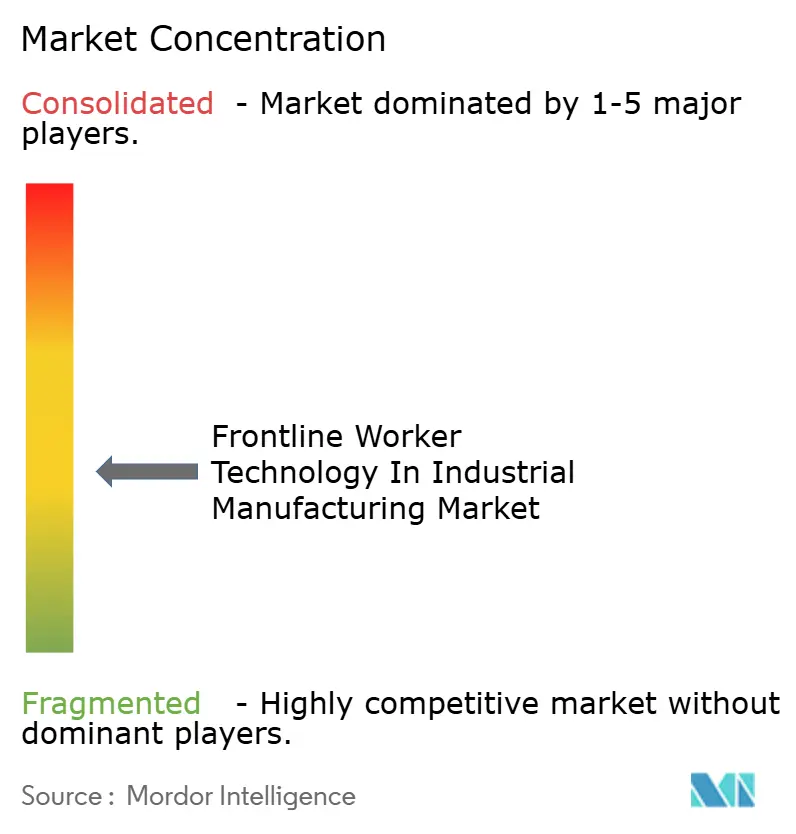
The frontline worker technology in industrial manufacturing market remained moderately fragmented, though competitive positions are starting to consolidate around broader software capability and ecosystem reach. Large industrial groups compete through platform breadth, integration depth, and enterprise relationships. The frontline worker technology in industrial manufacturing market also includes specialized vendors that compete through faster deployment, worker usability, and focused AI-led workflows. No single vendor held a dominant global position, so product direction and execution speed matter more than scale alone. This keeps competition active across both plant-wide transformation projects and narrower use cases tied to safety, task guidance, and frontline analytics.
The frontline worker technology in industrial manufacturing market is increasingly shaped by strategic moves that extend platforms beyond workflow digitization. The launch of an intelligence center in June 2026 to connect engineering, manufacturing, supply chain, and service data for industrial AI orchestration shows a clear push to embed frontline tools into a wider digital thread. A new guided work platform launched in January 2026 combined voice-driven guided work with analytics, enabling supervisors to plan, assign, and monitor tasks in real time. A partnership announced in May 2026 aimed to extend remote visual support to specialized headsets for hands-free assistance in frontline environments. These moves show that vendors are competing by combining hardware, software, analytics, and remote support into more complete operating systems.
The frontline worker technology in industrial manufacturing market still has open space in SME-focused offerings, industry-specific compliance modules, and better connections between wearables and core plant systems. The rise of AI agents is pushing the category forward, as vendors now aim to automate recommendations, anomaly review, and record updates rather than simply display instructions to workers. The presentation of a new AI-driven platform at a major 2026 industrial trade show demonstrated how connected workforce platforms are moving toward real-time automated recommendations for manufacturing teams. Procurement standards are also becoming more demanding because manufacturers want audit-ready outputs, cleaner integration, and clearer worker adoption, not just feature lists. In this setting, vendors that combine reliable deployment with high-quality data and practical frontline usability are likely to improve their standing faster than those competing solely on device novelty.
Frontline Worker Technology In Industrial Manufacturing Industry Leaders
-
Zebra Technologies Corporation
-
Honeywell International Inc.
-
Siemens AG
-
Microsoft Corporation
-
PTC Inc.
- *Disclaimer: Major Players sorted in no particular order
Frontline Worker Technology In Industrial Manufacturing Market Companies Covered in this Report
- 36Zero Group Ltd.
- Aatmunn, Inc.
- Aetheer, Inc.
- Augmentir, Inc.
- Epicore Biosystems, Inc.
- Zebra Technologies
- Hexagon AB
- Honeywell International Inc.
- StrongArm Technologies
- Librestream Technologies Inc.
- M?kuSafe, Inc.
- Microsoft Corporation
- PTC Inc.
- ProGlove GmbH
- RealWear Inc.
- RedZone, Inc.
- Siemens AG
- SlateSafety, Inc.
- Trimble Inc.
- Vuzix Corporation
Recent Industry Developments in Frontline Worker Technology In Industrial Manufacturing Market
- June 2026: Siemens launched Intelligence Center X, an industrial AI orchestration software designed to enable hybrid human-AI agent workforces with shared context and lifecycle intelligence. The platform connects data across engineering, manufacturing, supply chain, and service operations within the Siemens Xcelerator portfolio, positioning Siemens to capture the AI-agent layer of the frontline worker technology stack.
- June 2026: VITURE unveiled Helix, the first AI safety eyewear platform built on NVIDIA's XR AI solution, at Augmented World Expo 2026 in Long Beach, California. Helix, engineered to ANSI Z87.1-2025 standards with certification in progress, streams the operator's first-person view to a multimodal AI for real-time coaching and compliance capture, targeting industrial manufacturing and laboratory environments.
- June 2026: MākuSafe was awarded a National Safety Council Work to Zero Workplace Fatigue Pilot Grant in partnership with WSP. The program, exceeding USD 60,000 in grant value, deploys MākuSafe's connected worker wearable platform to monitor fatigue-related physical, environmental, and cognitive strain indicators in real-world field personnel environments.
- May 2026: MākuSafe launched MākuSmart AI in beta, a conversational AI capability integrated into its connected worker platform. The system analyzes wearable environmental and ergonomic data alongside frontline MyVoice communications to identify risk patterns and recommend hazard-reduction actions, targeting safety managers in industrial manufacturing facilities.
Global Frontline Worker Technology In Industrial Manufacturing Market Report Scope
The frontline worker technology in industrial manufacturing market refers to the ecosystem of software and services designed to empower non-desk employees operating on factory floors, production lines, and within industrial warehouse environments. This includes tools tailored for assembly workers, machine operators, and maintenance technicians to facilitate communication, task execution, shift scheduling, knowledge sharing, and safety and compliance management. The market encompasses cloud-based, on-premises, and hybrid deployment models utilized by organizations of varying sizes across various manufacturing sectors, including automotive, electronics, pharmaceuticals, and food and beverage. These technologies aim to bridge the communication gap between corporate management and on-the-ground personnel, thereby minimizing production downtime, streamlining quality control, ensuring worker safety, and improving overall operational efficiency on the shop floor.
The Frontline Worker Technology in Industrial Manufacturing Market Report is Segmented by Component (Software, and Services), Deployment (Cloud-Based, Hybrid, and On-Premises), Organization Size (Large Enterprises, and Small and Medium Enterprises), Application (Employee Communication and Engagement, Workforce Execution and Task Management, Workforce Scheduling and Coordination, Learning and Knowledge Enablement, Workforce Analytics and Performance Management, Safety and Compliance Management, and Other Applications), End-user Industry (Automotive, Electronics and Semiconductors, Industrial Machinery and Equipment, Pharmaceuticals and Chemicals, Food and Beverage, Aerospace and Defense, and Other End-user Industries), and Geography (North America, South America, Europe, Asia-Pacific, and Middle East and Africa). The Market Forecasts are Provided in Terms of Value (USD).
Segmentation Overview
| Software |
| Services |
| Cloud-Based |
| Hybrid |
| On-Premises |
| Large Enterprises |
| Small and Medium Enterprises |
| Employee Communication and Engagement |
| Workforce Execution and Task Management |
| Workforce Scheduling and Coordination |
| Learning and Knowledge Enablement |
| Workforce Analytics and Performance Management |
| Safety and Compliance Management |
| Other Applications |
| Automotive |
| Electronics and Semiconductors |
| Industrial Machinery and Equipment |
| Pharmaceuticals and Chemicals |
| Food and Beverage |
| Aerospace and Defense |
| Other End-user Industries |
| North America | United States | |
| Canada | ||
| Mexico | ||
| South America | Brazil | |
| Argentina | ||
| Rest of South America | ||
| Europe | Germany | |
| United Kingdom | ||
| France | ||
| Italy | ||
| Spain | ||
| Russia | ||
| Rest of Europe | ||
| Asia-Pacific | China | |
| India | ||
| Japan | ||
| South Korea | ||
| Australia | ||
| Rest of Asia-Pacific | ||
| Middle East and Africa | Middle East | Saudi Arabia |
| United Arab Emirates | ||
| Rest of Middle East | ||
| Africa | South Africa | |
| Nigeria | ||
| Rest of Africa | ||
| By Component | Software | ||
| Services | |||
| By Deployment | Cloud-Based | ||
| Hybrid | |||
| On-Premises | |||
| By Organization Size | Large Enterprises | ||
| Small and Medium Enterprises | |||
| By Application | Employee Communication and Engagement | ||
| Workforce Execution and Task Management | |||
| Workforce Scheduling and Coordination | |||
| Learning and Knowledge Enablement | |||
| Workforce Analytics and Performance Management | |||
| Safety and Compliance Management | |||
| Other Applications | |||
| By End-user Industry | Automotive | ||
| Electronics and Semiconductors | |||
| Industrial Machinery and Equipment | |||
| Pharmaceuticals and Chemicals | |||
| Food and Beverage | |||
| Aerospace and Defense | |||
| Other End-user Industries | |||
| By Geography | North America | United States | |
| Canada | |||
| Mexico | |||
| South America | Brazil | ||
| Argentina | |||
| Rest of South America | |||
| Europe | Germany | ||
| United Kingdom | |||
| France | |||
| Italy | |||
| Spain | |||
| Russia | |||
| Rest of Europe | |||
| Asia-Pacific | China | ||
| India | |||
| Japan | |||
| South Korea | |||
| Australia | |||
| Rest of Asia-Pacific | |||
| Middle East and Africa | Middle East | Saudi Arabia | |
| United Arab Emirates | |||
| Rest of Middle East | |||
| Africa | South Africa | ||
| Nigeria | |||
| Rest of Africa | |||
Key Questions Answered in the Report
What is the current and future value of frontline worker technology in industrial manufacturing?
The sector was valued at USD 2.74 billion in 2025, reached USD 3.23 billion in 2026, and is forecast to reach USD 9.21 billion by 2031 at a 23.31% CAGR.
Which region leads adoption in this space?
Europe led in 2025 with a 33.11% share, supported by advanced manufacturing clusters and stricter worker safety documentation requirements.
Which region is growing the fastest through 2031?
Asia-Pacific is projected to record the fastest growth, with a 28.99% CAGR, supported by large-scale manufacturing expansion and smart factory investment.
Which deployment model is most widely used?
Cloud-based deployment led with 76.61% share in 2025 and is also the fastest-growing model through 2031, showing strong buyer preference for flexible delivery.
What application area attracts the most spending today?
Workforce execution and task management held the largest application share at 26.11% in 2025 because manufacturers still need to digitize work orders, procedures, and daily task tracking.
Which end-user group shows the strongest demand?
Electronics and semiconductors led with 28.91% share in 2025, while industrial machinery and equipment is projected to grow fastest at a 24.12% CAGR through 2031.