
GCC Digital Workplace Market Size and Share
Market Overview
| Study Period | 2020 - 2031 |
|---|---|
| Forecast Data Period | 2026 - 2031 |
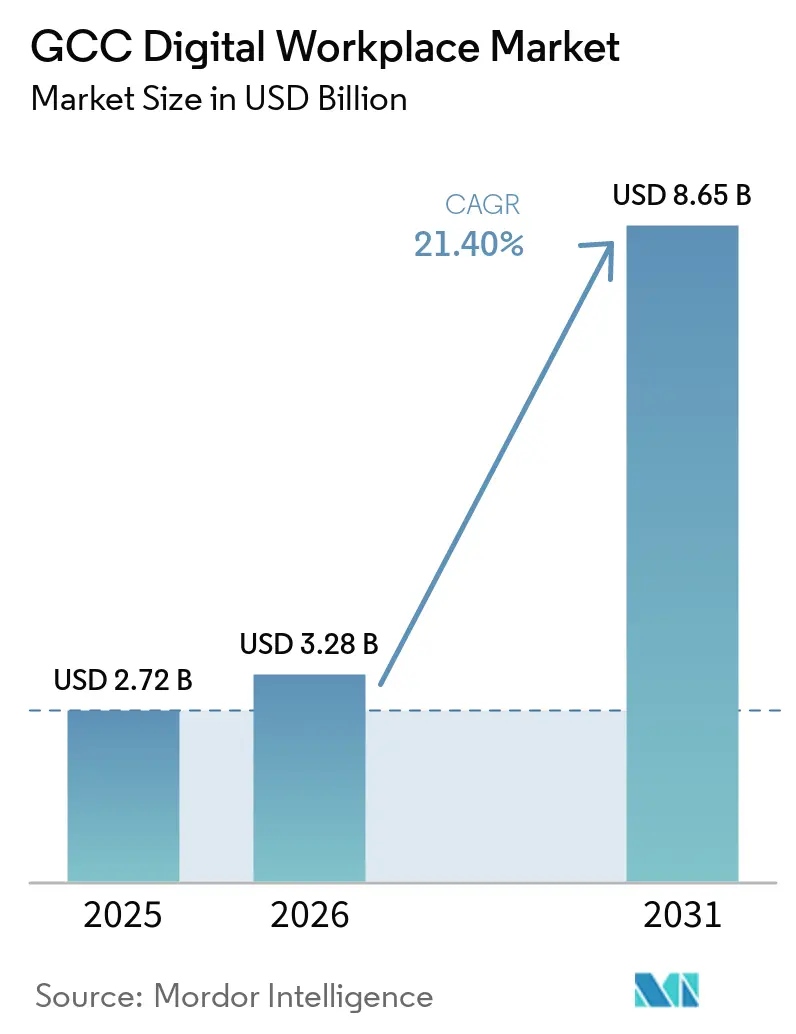
| Base Year Market Size (2025) | USD 2.72 Billion |
| Market Size (2026) | USD 3.28 Billion |
| Market Size (2031) | USD 8.65 Billion |
| Growth Rate (2026 - 2031) | 21.40 % |
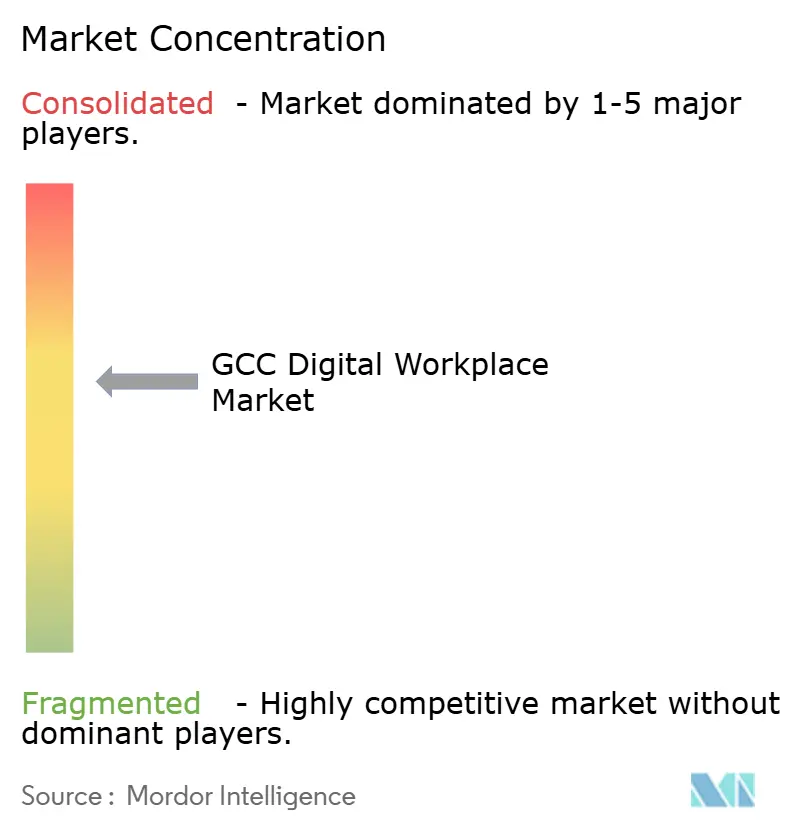
| Market Concentration | Medium |
Major Players *Disclaimer: Major Players sorted in no particular order Image © Mordor Intelligence. Reuse requires attribution under CC BY 4.0. | |
GCC Digital Workplace Market Analysis by Mordor Intelligence
The GCC digital workplace market size is expected to increase from USD 2.72 billion in 2025 to USD 3.28 billion in 2026 and reach USD 8.65 billion by 2031, growing at a CAGR of 21.40% over 2026-2031. The GCC digital workplace market is expanding on the back of sovereign digital transformation programs that have moved workplace modernization from a corporate IT choice to a public policy priority across Saudi Arabia and the UAE. The GCC digital workplace market is also seeing faster adoption as AI deployment is now being tied to daily workflow tools, employee experience platforms, and integrated communications systems rather than isolated pilot programs. Multi-year government mandates have created a steadier demand base for the GCC digital workplace market because spending decisions are linked to long planning cycles and not only to annual enterprise budget reviews. Local language requirements, stronger compliance expectations, and in-country hosting needs are creating room for vendors that can combine regional fit with proven platform depth. Integration complexity and data residency obligations still slow some rollouts, but local infrastructure expansion continues to support a strong growth path for the GCC digital workplace market.
Key Report Takeaways
- By component, solutions held 71.42% of the GCC digital workplace market in 2025 and are projected to grow at a 21.93% CAGR through 2031.
- By deployment mode, cloud accounted for 68.76% of the GCC digital workplace market in 2025 and is projected to expand at a 22.37% CAGR through 2031.
- By organization size, large enterprises held 65.74% of the GCC digital workplace market in 2025, while small and medium-sized enterprises are projected to expand at a 22.79% CAGR through 2031.
- By end-user industry, government and public sector held 25.64% of the GCC digital workplace market in 2025, while healthcare is projected to expand at a 22.46% CAGR through 2031.
- By geography, Saudi Arabia held 48.85% of the GCC digital workplace market in 2025, while the United Arab Emirates is projected to expand at a 22.13% CAGR through 2031.
Note: Market size and forecast figures in this report are generated using Mordor Intelligence’s proprietary estimation framework, updated with the latest available data and insights as of January 2026.
Market Trends and Insights
Drivers Impact Analysis of GCC Digital Workplace Market*
| Driver | (~) % Impact on CAGR Forecast | Geographic Relevance | Impact Timeline |
|---|---|---|---|
| Accelerated Shift to Hybrid Work Operating Models | +4.8% | Global, concentrated impact in the United Arab Emirates, Saudi Arabia, and Qatar | Short term (≤ 2 years) |
| Greater Adoption of AI-Assisted Workflow Automation and Knowledge Retrieval | +3.9% | The United Arab Emirates and Saudi Arabia, as primary adopters, spill over to Kuwait and Bahrain | Medium term (2-4 years) |
| Public Sector Digitization Programs and Workforce Modernization | +3.4% | Saudi Arabia, the United Arab Emirates, and Qatar | Short term (≤ 2 years) |
| Cloud-First Workplace Modernization in Large GCC Enterprises | +2.8% | Saudi Arabia and UAE core, Qatar and Kuwait secondary | Medium term (2-4 years) |
| Rising Demand for Unified Employee Experience Platforms | +2.2% | United Arab Emirates and Saudi Arabia, with early expansion to Oman and Bahrain | Medium term (2-4 years) |
| Increased Need for Zero-Touch Endpoint Provisioning Across Distributed Workforces | +1.6% | United Arab Emirates, Qatar, and Saudi Arabia, with spill-over to the rest of the GCC | Long term (≥ 4 years) |
| Source: Mordor Intelligence | |||
Accelerated Shift To Hybrid Work Operating Models
The GCC digital workplace market is being shaped by hybrid work becoming a standard operating model for knowledge-heavy roles across the region. This shift is expanding spending beyond collaboration software into identity management, endpoint security, device control, and remote access design. The GCC digital workplace market is also becoming more complex, as many enterprises manage teams across Saudi Arabia, the United Arab Emirates, and offshore delivery locations simultaneously. That operating model forces buyers to prioritize interoperability across different regulatory and administrative environments. Procurement cycles are therefore becoming broader because platform choices now affect governance, compliance, and service delivery together. This has kept recurring demand strong for integrators and managed service providers long after the first deployment phase is completed.
Greater Adoption of AI-Assisted Workflow Automation and Knowledge Retrieval
The GCC digital workplace market is seeing AI move quickly from experimentation to embedded, daily use within enterprise workflow tools. AI copilots, knowledge retrieval layers, and task automation tools are now being folded into broader workplace platforms rather than purchased as separate utilities. IBM stated that GCC enterprises are redesigning their operating models around AI, indicating that platform buying is shifting from feature-led decisions to integrated transformation programs.[1] The GCC digital workplace market is also being pushed by the unusually large scale of deployments in government-linked organizations and sovereign wealth-backed enterprises. Those rollouts are often designed for very large employee populations, which speeds vendor expansion and raises the importance of governance, orchestration, and Arabic-language usability. As a result, the GCC digital workplace market is rewarding vendors that can integrate AI tools with communications, endpoint management, and employee experience functions within a single operating environment.
Public Sector Digitization Programs and Workforce Modernization
The GCC digital workplace market has one of its strongest demand anchors in public sector digitization programs across Saudi Arabia and the United Arab Emirates. Abu Dhabi’s Government Digital Strategy 2025-2027 committed AED 13 billion (USD 3.5 billion) to digital government modernization and set targets, including 200+ AI solutions across government entities. Saudi Arabia’s Qiwa platform served over 2 million registered establishments and more than 13 million workers in Q1 2026, underscoring the scale of state-backed digital workplace systems in the region. The United Arab Emirates Federal Authority for Government Human Resources launched its HR 2.0 Talent Management program in 2025, tying workforce redesign to digital transformation and AI adoption in government roles. The GCC digital workplace market benefits from these programs because they create large reference deployments that set standards for identity, collaboration, workflow, and employee service design. They also raise the commercial value of vendors that can support Arabic interfaces, formal compliance documentation, and multi-year implementation support.
Cloud-First Workplace Modernization in Large GCC Enterprises
The GCC digital workplace market is moving further toward cloud-led modernization as large enterprises consolidate fragmented systems into fewer platforms. This shift is not only about infrastructure efficiency; cloud migration is also becoming the foundation for AI-ready workplace tools. Microsoft confirmed that its Saudi Arabia East datacenter region will be available for customers to run cloud workloads starting in Q4 2026, providing a stronger local foundation for regulated enterprise deployments. Microsoft also announced in-country data processing for Microsoft 365 Copilot in the United Arab Emirates, reducing a key concern for buyers that had linked workplace AI adoption to data localization requirements. The GCC digital workplace market is therefore seeing cloud projects pull in unified communications, endpoint management, and workflow automation during the same buying cycle. This pattern favors vendors that can present one platform story across productivity, governance, and security requirements.
Restraints Impact Analysis of GCC Digital Workplace Market*
| Restraint | (~) % Impact on CAGR Forecast | Geographic Relevance | Impact Timeline |
|---|---|---|---|
| Integration of Complexity Across Legacy Identity, Device, and Collaboration Stacks | -2.9% | GCC-wide, the highest friction is in Saudi Arabia and Kuwait | Medium term (2-4 years) |
| Data Residency and Sovereignty Constraints on Cloud Workplace Rollouts | -2.3% | Saudi Arabia, the United Arab Emirates, and Qatar | Short term (≤ 2 years) |
| End User Change Resistance and Low Digital Process Maturity in Some Organizations | -1.6% | Bahrain, Oman, and Kuwait SME sector, and select government sub-agencies | Medium term (2-4 years) |
| Talent Shortage in Digital Workplace Architecture and Managed Services | -1.2% | GCC-wide, most acute in Oman and Bahrain | Long term (≥ 4 years) |
| Source: Mordor Intelligence | |||
Integration of Complexity Across Legacy Identity, Device, And Collaboration Stacks
The GCC digital workplace market still faces a major friction point: legacy IT environments built over years of disconnected procurement. Many organizations operate several identity directories, overlapping endpoint tools, and parallel collaboration suites at the same time. That structure makes new deployments slower, because every digital workplace layer has to connect with existing access controls, devices, and governance rules. The GCC digital workplace market is especially exposed in public sector, banking, energy, and other sectors where older systems remain deeply embedded in daily operations. Audit and cybersecurity requirements often reveal these architecture gaps, but fixing them can require long transition periods and careful change control. Until identity and middleware environments become more unified, this issue will continue to moderate the pace of large-scale workplace transformation.
Data Residency and Sovereignty Constraints on Cloud Workplace Rollouts
The GCC digital workplace market is also constrained by data residency and sovereignty requirements that shape where and how workplace platforms can operate. Buyers in regulated sectors often need local hosting, local processing, and clear control over sensitive workloads before approving cloud-first rollouts. Microsoft’s UAE in-country data processing for Microsoft 365 Copilot and its planned Saudi Arabia datacenter region both show that vendors are responding directly to these localization requirements. The GCC digital workplace market, therefore, favors well-capitalized vendors that can support local data-plane infrastructure and formal compliance workflows. Regional challengers can still compete, but participation becomes more difficult when regulated buyers require deep infrastructure commitments and broad security assurances. This restraint is likely to ease gradually, but multi-country orchestration across all GCC jurisdictions remains operationally demanding.
*Our forecasts treat driver/restraint impacts as directional, not additive. The impact forecasts reflect baseline growth, mix effects, and variable interactions.
GCC Digital Workplace Market Segment Analysis
By Component:
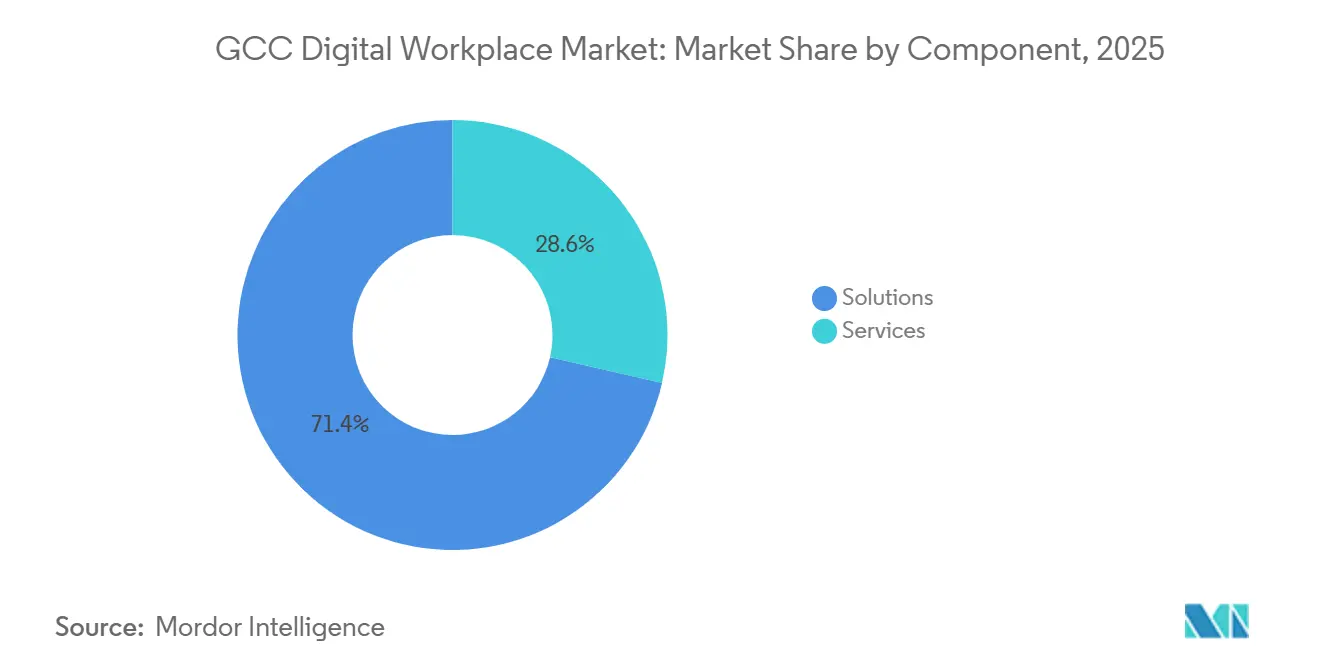
Solutions Anchor Spend As AI Reshapes Sub-Segment PrioritiesSolutions captured 71.42% of the GCC digital workplace market share in 2025, confirming that software platforms remained the main center of spending across the GCC digital workplace market. Unified communication and collaboration tools, unified endpoint management, and employee experience platforms formed the main demand base within this segment. The GCC digital workplace market is now pulling workflow automation and knowledge management into the same buying cycle as communications and device management. IBM’s view of an AI-centered operating model redesign reflects this platform-consolidation pattern, in which enterprises are assessing workplace tools as part of a broader transformation. This has raised the strategic value of vendors that can connect productivity, governance, and workflow design within one operating environment.
The services segment held a smaller share, but its commercial importance continued to rise as the GCC digital workplace market became harder to deploy and govern at scale. Implementation support, architecture design, managed operations, and compliance documentation all gained weight as organizations worked through legacy integration challenges. The GCC digital workplace market also continued to create service demand through identity harmonization, rollout support, and post-deployment optimization. Virtual desktop infrastructure and cloud PC adoption added another service layer because many enterprises were shifting from device-led capital spending to per-seat operational models. Even so, solutions remained the primary demand anchor, because most vendor differentiation still centered on platform breadth, AI readiness, and integration depth.
By Deployment Mode:
Cloud Leads As Sovereign Infrastructure Resolves The Residency BarrierCloud accounted for 68.76% share of the GCC digital workplace market size in 2025, making it the dominant deployment mode across the GCC digital workplace market. This lead reflects enterprises' growing comfort with subscription-based delivery, reduced provisioning friction, and faster access to new AI-enabled workplace features. Microsoft’s support for in-country data processing for Microsoft 365 Copilot in the United Arab Emirates and its Saudi Arabia datacenter rollout, scheduled for Q4 2026, directly addressed the localization concerns that had slowed some regulated buyers.[2] The GCC digital workplace market, therefore, saw the old tradeoff between agility and compliance begin to weaken. On-premises deployment remains relevant in defense, intelligence, and critical infrastructure settings, where local control remains essential.
Hybrid deployment drew strong attention because the GCC digital workplace market still included many large enterprises that needed dual-mode operating models. These buyers often kept sensitive workloads in tightly controlled environments while moving broader collaboration and productivity layers into the cloud. That pattern created recurring work for integration partners because architecture, policy, and reporting standards had to function across both modes. The GCC digital workplace market also favored hybrid models in organizations where modernization was being phased by business unit, country, or data sensitivity tier. Over time, sovereign and in-country infrastructure is likely to shift more of these deployments toward cloud, but the hybrid path remains commercially important in the near term.
By Organization Size:
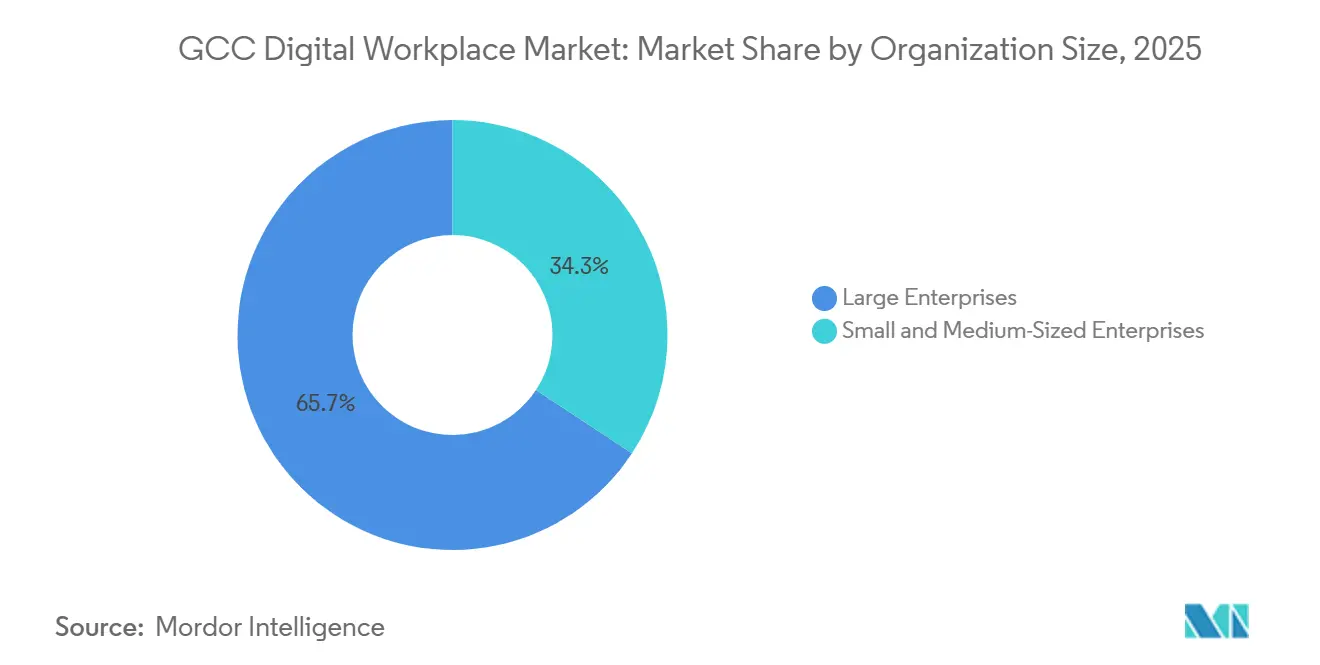
SME Momentum Builds As Cloud Economics And Policy Incentives ConvergeSmall and medium-sized enterprises are projected to expand at a 22.79% CAGR from 2026 to 2031, making them the fastest-growing organization-size segment in the GCC digital workplace market. This growth shows that the GCC digital workplace market is no longer driven solely by very large accounts, as volume growth from smaller firms is becoming more meaningful. Cloud-native subscription pricing, simpler deployment models, and partner-led delivery are lowering the practical entry barrier for these buyers. Zoho Corporation opened its first United Arab Emirates data centers in Dubai and Abu Dhabi in January 2026, while ManageEngine reported 20% growth in the UAE during 2025, indicating strong demand for localized workplace and IT management deployments. Government-backed SME digitization programs also widened the pool of first-time software subscribers across the region, which is helping channel partners gain influence in the GCC digital workplace market.
Large enterprises held 65.74% of the GCC digital workplace market in 2025, thereby remaining the largest revenue base, even as the SME segment accelerated. Their demand was anchored by multi-year contracts, formal procurement cycles, and higher compliance requirements, especially in state-linked organizations and regulated sectors. The GCC digital workplace market still depends heavily on these larger accounts for platform standardization, reference wins, and long-duration service contracts. At the same time, SME adoption cycles are often shorter, which means vendors can prove value faster and expand usage with fewer layers of internal approval. This combination is reshaping go-to-market priorities across the GCC digital workplace market, with channel strategy, localization, and flexible packaging becoming more central.
By End-User Industry:
Government Anchors Spending While Healthcare Emerges as a Growth EngineThe government and public sector held 25.64% of the GCC digital workplace market in 2025, making it the largest end-user group in the GCC digital workplace market. This position reflects centralized procurement, formal digital mandates, and broad workforce modernization programs that extend across ministries, agencies, and affiliated entities. Abu Dhabi reported 95% AI training completion among more than 30,000 public employees in 2025 and highlighted the rollout of 200+ AI solutions across government entities, underscoring the scale of institutional workplace change already underway. Dubai also directed all government services to be integrated into a unified digital platform by April 2026, creating a direct near-term pull for collaboration, workflow, and employee service platforms. These programs keep public sector demand structurally strong by aligning workplace tooling with service delivery reform and workforce capability-building.
Healthcare is projected to expand at a 22.46% CAGR from 2026 to 2031, making it the fastest-growing end-user segment in the GCC digital workplace market. Hospitals and healthcare groups are adopting integrated clinical, administrative, and workforce systems that require the same digital workplace foundation used in broader enterprise environments. Oracle announced in January 2026 that Alrajhi Medicine in Saudi Arabia adopted Oracle Health and Oracle Fusion Cloud Applications as a unified digital platform, marking a clear example of full-stack healthcare digitization in the region. Compliance and data governance requirements are shaping vendor choice here, which favors providers that can combine healthcare workflow understanding with in-country deployment readiness. Other sectors such as IT and telecommunications, BFSI, manufacturing, retail, education, energy and utilities, and legal and professional services remained part of the wider demand base, but each contributed a smaller revenue pool than government or healthcare.
Geography Analysis
Saudi Arabia Digital Workplace Market
Saudi Arabia held 48.85% of the GCC digital workplace market share in 2025, giving it the largest market share in the GCC. This scale reflects both the size of the Saudi economy and the intensity of public-sector modernization underway across ministries and large employers. The GCC digital workplace market in Saudi Arabia also benefits from strong policy alignment between digital government goals, workforce modernization, and enterprise cloud adoption. In Q1 2026, the Qiwa platform served over 2 million registered establishments and more than 13 million workers, with over 12 million documented contracts, demonstrating the national scale of workplace digitization in the kingdom.[3] Microsoft’s confirmation that its Saudi Arabia East datacenter region will be available for cloud workloads from Q4 2026 further strengthens the local infrastructure base that regulated workplace deployments need.
United Arab Emirates Digital Workplace Market
The United Arab Emirates is projected to expand at a 22.13% CAGR from 2026 to 2031, making it the fastest-growing geography in the GCC digital workplace market. Abu Dhabi’s Government Digital Strategy 2025-2027 committed AED 13 billion (USD 3.5 billion) and targets the world’s first AI-native government by 2027, which has already translated into broad public-sector deployment activity. Abu Dhabi also reported 95% AI training completion across more than 30,000 public employees in 2025 and the rollout of 200+ AI solutions across government entities. Dubai’s Higher Committee for Future Technology and Digital Economy endorsed an executive plan in June 2026 to support the private sector’s transition to agentic AI, which directly supports the GCC digital workplace market in the United Arab Emirates. Abu Dhabi also announced Microsoft investment plans of more than USD 7.9 billion in the United Arab Emirates from 2026 to 2029 for AI and cloud infrastructure expansion, which improves local enterprise platform readiness.
GCC Digital Workplace Market
Qatar, Kuwait, Oman, Bahrain, and the rest of GCC made up the remaining demand base of the GCC digital workplace market at different levels of maturity. Cisco signed a letter of intent with Qatar’s Ministry of Interior in May 2025 for collaboration on AI and cybersecurity infrastructure, showing continued investment in secure digital foundations that support workplace modernization. Oman’s Ministry of Transport, Communications and Information Technology launched a digital transformation change management framework in 2025 to build readiness across government agencies. Kuwait, Bahrain, and the rest of GCC remain earlier-stage opportunity pools where cloud foundations, local partner networks, and Arabic-language support can still expand vendor reach across the GCC digital workplace market.
Competitive Landscape
The GCC digital workplace market is moderately consolidated in core solutions, where large global vendors hold strong positions in government and large-enterprise accounts. These vendors benefit from long contracts, broad product portfolios, local infrastructure investments, and established relationships with regional integrators. The GCC digital workplace market becomes more contested in employee experience, intranet, workflow automation, and digital employee experience categories, where specialized vendors can still carve out space. ServiceNow expanded its AI agent governance capabilities through deeper integration with Microsoft in May 2026, linking ServiceNow AI Control Tower to Microsoft Agent 365 and extending its reach inside one of the region’s most widely used workplace ecosystems.[4] LumApps also entered a definitive agreement in April 2026 to acquire Comeen, extending its AI employee hub from communication into physical workplace experience management.
The GCC digital workplace market still offers clear whitespace in Arabic-language AI interfaces, compliance-ready endpoint tools for SMEs, and managed workplace services for healthcare. Vendors without in-country infrastructure face a harder path in government and regulated sectors, because local hosting and formal assurance requirements are rising. Zoho Corporation opened its first United Arab Emirates data centers in January 2026 as part of an AED 100 million (USD 27.2 million) regional investment, and ManageEngine reported 20% growth in the United Arab Emirates during 2025, showing that regional challengers can build traction with localized delivery. Cisco and ServiceNow also deepened their partnership in April 2025 to integrate Cisco AI Defense with ServiceNow SecOps, which strengthened the governance position of both companies in enterprise AI rollouts.
That matters because the GCC digital workplace market increasingly rewards vendors that can align productivity gains with risk control and compliance oversight. Co-opetition remains a defining feature of the GCC digital workplace market. Google Cloud and ServiceNow deepened their strategic partnership in April 2026 around AI agents for enterprise operations, while Google Cloud named ServiceNow its 2026 Global Partner of the Year across several AI categories. Microsoft’s continuing infrastructure buildout in Saudi Arabia and the United Arab Emirates is also strengthening the wider ecosystem that adjacent workplace vendors rely on. The result is a GCC digital workplace market where scale, compliance posture, localization, and delivery depth remain as important as product breadth.
GCC Digital Workplace Industry Leaders
-
Microsoft Corporation
-
Cisco Systems, Inc.
-
ServiceNow, Inc.
-
Citrix Systems, Inc.
-
Google LLC
- *Disclaimer: Major Players sorted in no particular order
GCC Digital Workplace Market Companies Covered in this Report
- Microsoft Corporation
- Cisco Systems, Inc.
- ServiceNow, Inc.
- Citrix Systems, Inc.
- Google LLC
- Zoom Communications, Inc.
- IBM Corporation
- Dell Technologies Inc.
- Lenovo Group Limited
- SAP SE
- Oracle Corporation
- HCL Technologies Limited
- Accenture plc
- LumApps SAS
- Ivanti, Inc.
- TeamViewer SE
- Zoho Corporation
Recent Industry Developments in GCC Digital Workplace Market
- May 2026: ServiceNow expanded its AI agent governance capabilities through a deeper integration with Microsoft, connecting ServiceNow AI Control Tower to Microsoft Agent 365 and making ServiceNow AI specialists available in the Microsoft Agent 365 Marketplace. The partnership directly governs AI agent sprawl across the most widely deployed workplace suite in GCC enterprise environments.
- April 2026: LumApps entered a definitive agreement to acquire Comeen, a workplace experience platform specializing in space management, digital signage, and visitor services, in a transaction expected to close in May 2026. The deal extends LumApps' AI employee hub from digital communication into physical workplace management, directly competing with enterprise workspace platforms in the GCC.
- April 2026: ServiceNow and Google Cloud deepened their strategic partnership at Google Cloud Next '26, unveiling AI agents spanning 5G networking, retail, and IT systems for autonomous enterprise operations. Google Cloud named ServiceNow its 2026 Global Partner of the Year across multiple enterprise AI categories, reinforcing the partnership's scale relevance for GCC enterprise deployments.
- January 2026: Zoho Corporation opened its first data centers in the United Arab Emirates, in Dubai and Abu Dhabi, as part of an AED 100 million (USD 27 million) regional investment, hosting over 100 Zoho and ManageEngine cloud solutions. ManageEngine reported 20% growth in the United Arab Emirates during 2025, led by demand from financial services, government, and manufacturing segments.
GCC Digital Workplace Market Report Scope
The GCC Digital Workplace Market encompasses the adoption and integration of digital tools, technologies, and platforms that enable seamless collaboration, communication, and productivity within organizations across the Gulf Cooperation Council (GCC) countries. The study focuses on solutions such as cloud-based platforms, virtual collaboration tools, and advanced analytics, providing insights into market growth, the competitive landscape, and technological advancements.
The GCC Digital Workplace Market is Segmented by Component [Solutions (Unified Communication and Collaboration, Unified Endpoint Management, Enterprise Mobility Management, Employee Experience Platforms and Intranet, Workflow Automation and Knowledge Management, and Virtual Desktop Infrastructure and Cloud PC), and Services], Deployment Mode (Cloud, On-Premises, and Hybrid), Organization Size (Large Enterprises, and Small and Medium-Sized Enterprises), End-User Industry (IT and Telecommunications, BFSI, Healthcare, Manufacturing, Retail, Government and Public Sector, Education, Energy and Utilities, Legal and Professional Services, and Other End-User Industries), and Geography (Saudi Arabia, United Arab Emirates, Qatar, Kuwait, Oman, Bahrain, and Rest of GCC). The Market Sizes and Forecasts are Provided in Terms of Value (USD).
Segmentation Overview
| Solutions | Unified Communication and Collaboration |
| Unified Endpoint Management | |
| Enterprise Mobility Management | |
| Employee Experience Platforms and Intranet | |
| Workflow Automation and Knowledge Management | |
| Virtual Desktop Infrastructure and Cloud PC | |
| Services |
| Cloud |
| On-Premises |
| Hybrid |
| Large Enterprises |
| Small and Medium-Sized Enterprises |
| IT and Telecommunications |
| BFSI |
| Healthcare |
| Manufacturing |
| Retail |
| Government and Public Sector |
| Education |
| Energy and Utilities |
| Legal and Professional Services |
| Other End-User Industries |
| Saudi Arabia |
| United Arab Emirates |
| Qatar |
| Kuwait |
| Oman |
| Bahrain |
| Rest of GCC |
| By Component | Solutions | Unified Communication and Collaboration |
| Unified Endpoint Management | ||
| Enterprise Mobility Management | ||
| Employee Experience Platforms and Intranet | ||
| Workflow Automation and Knowledge Management | ||
| Virtual Desktop Infrastructure and Cloud PC | ||
| Services | ||
| By Deployment Mode | Cloud | |
| On-Premises | ||
| Hybrid | ||
| By Organization Size | Large Enterprises | |
| Small and Medium-Sized Enterprises | ||
| By End-User Industry | IT and Telecommunications | |
| BFSI | ||
| Healthcare | ||
| Manufacturing | ||
| Retail | ||
| Government and Public Sector | ||
| Education | ||
| Energy and Utilities | ||
| Legal and Professional Services | ||
| Other End-User Industries | ||
| By Geography | Saudi Arabia | |
| United Arab Emirates | ||
| Qatar | ||
| Kuwait | ||
| Oman | ||
| Bahrain | ||
| Rest of GCC |
Key Questions Answered in the Report
What is the current and forecast value of the GCC digital workplace sector?
The GCC digital workplace market size is expected to increase from USD 2.72 billion in 2025 to USD 3.28 billion in 2026 and reach USD 8.65 billion by 2031, growing at a 21.40% CAGR over 2026-2031.
Which segment led by component in 2025?
Solutions led by components with 71.42% of value in 2025, supported by strong demand for communications, endpoint management, and employee experience platforms.
Which deployment model is most widely used across GCC organizations?
Cloud led deployment with 68.76% share in 2025, helped by subscription delivery, faster feature access, and growing in-country infrastructure support.
Which end-user group contributes the most spending, and which one is growing the fastest?
Government and public sector held the largest share at 25.64% in 2025, while healthcare is projected to grow the fastest at a 22.46% CAGR through 2031.
Which country leads regional demand, and which one is expanding the fastest?
Saudi Arabia held the largest share at 48.85% in 2025, while the United Arab Emirates is projected to post the fastest growth at a 22.13% CAGR through 2031.
What is driving adoption among smaller businesses in the GCC?
Small and Medium-Sized Enterprises are projected to grow at a 22.79% CAGR, supported by cloud-native pricing, localized hosting, simpler rollout models, and government-backed digitization programs.