
Frontline Workers Training Market Size and Share
Market Overview
| Study Period | 2019 - 2030 |
|---|---|
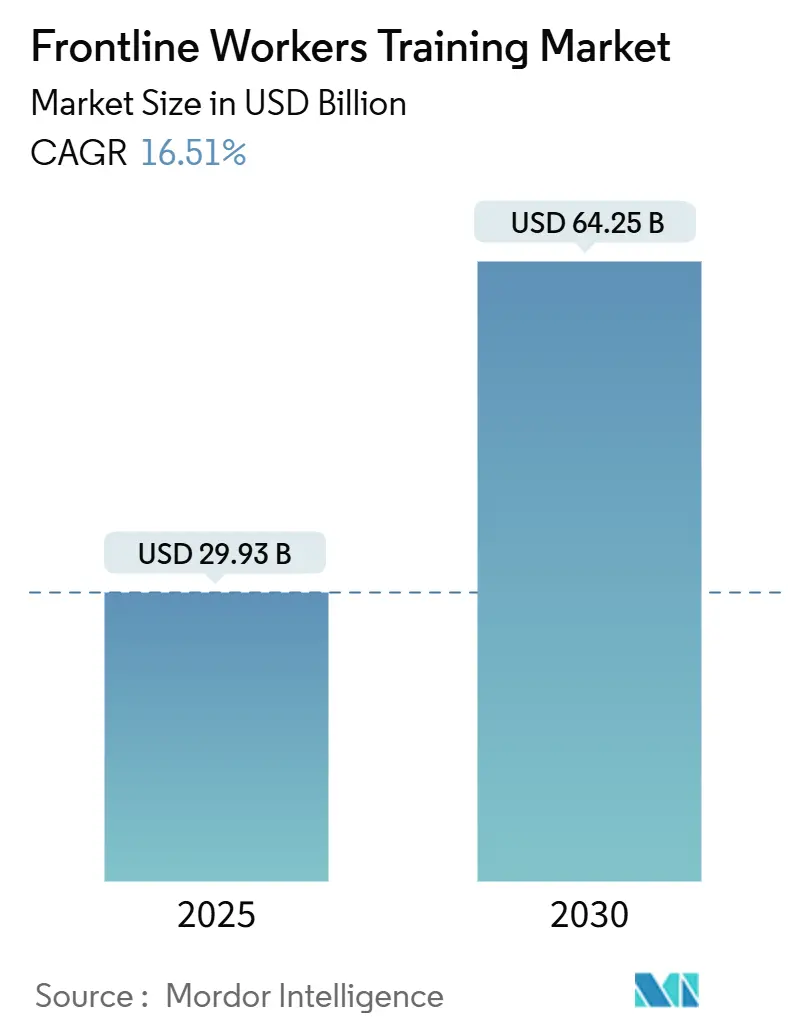
| Market Size (2025) | USD 29.93 Billion |
| Market Size (2030) | USD 64.25 Billion |
| Growth Rate (2025 - 2030) | 16.51 % |
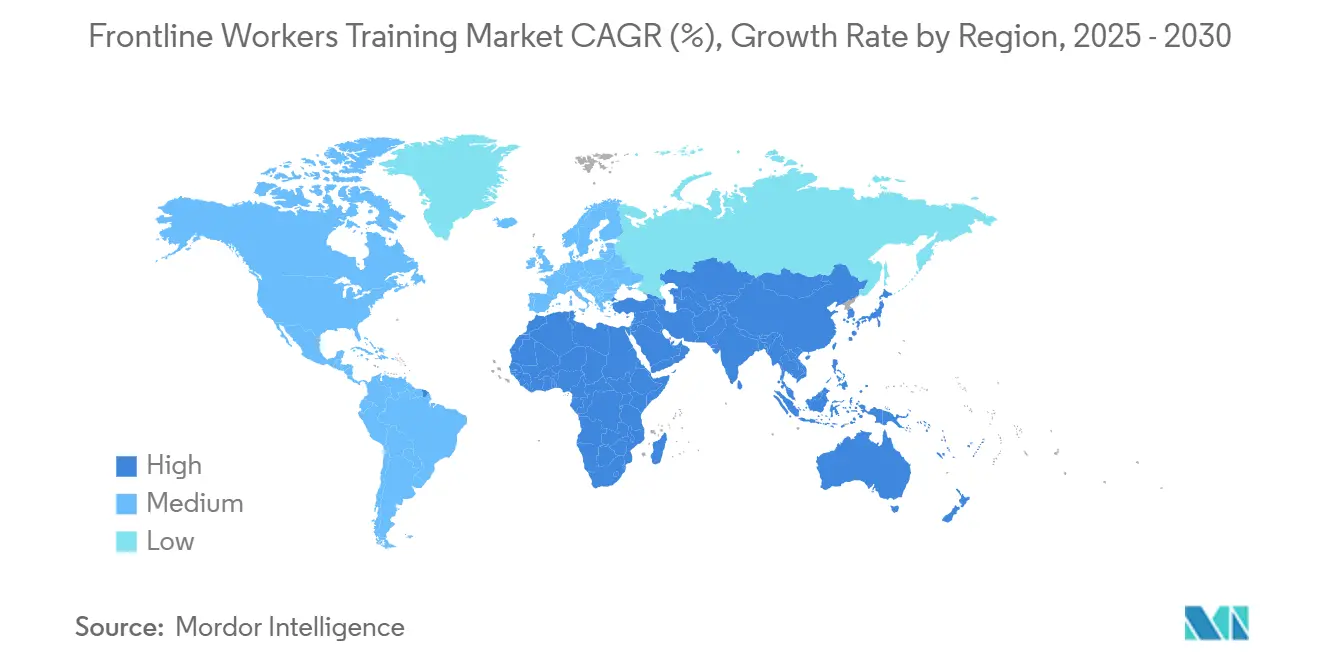
| Fastest Growing Market | Asia Pacific |
| Largest Market | North America |
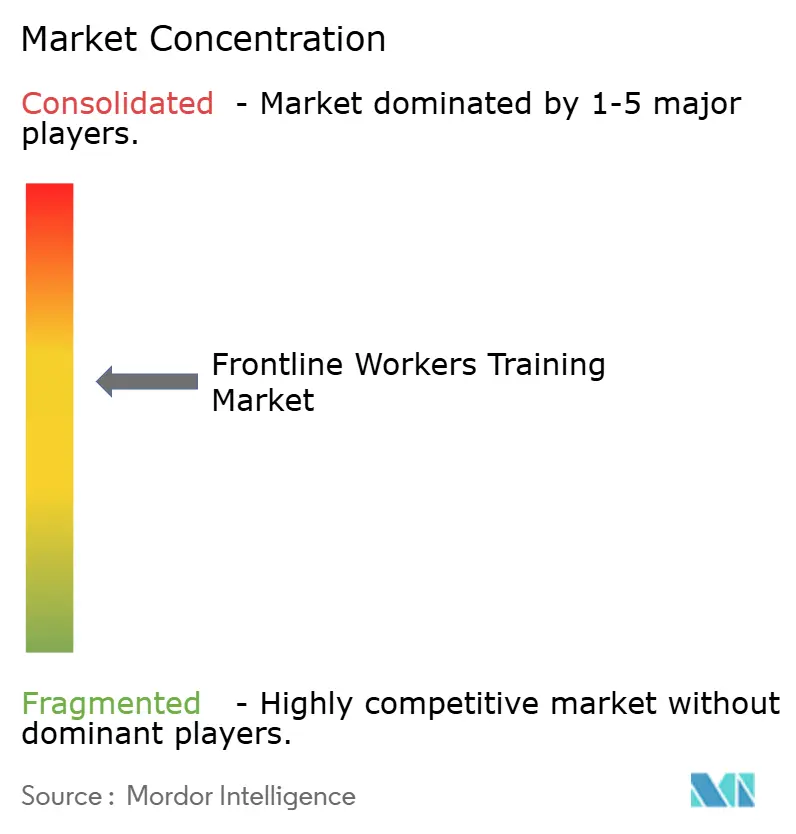
| Market Concentration | Medium |
Major Players *Disclaimer: Major Players sorted in no particular order Image © Mordor Intelligence. Reuse requires attribution under CC BY 4.0. | |
Frontline Workers Training Market Analysis by Mordor Intelligence
The frontline workers training market size stands at USD 29.93 billion in 2025 and is forecast to reach USD 64.25 billion by 2030, reflecting a 16.51% CAGR over the period. Digitization of deskless workforce development, mobile-first delivery, and tighter regulatory oversight are reshaping spending patterns across industries. Companies are accelerating investments in AI-driven adaptive learning engines, VR simulations, and micro-learning to reduce errors, shorten onboarding cycles, and document compliance. North America remains the largest regional buyer thanks to OSHA’s interactive-training guidance, while Asia-Pacific outpaces all other regions as governments fund large-scale upskilling programs for manufacturing and healthcare frontline personnel. Persistent high turnover in retail and hospitality, combined with deadlines such as the FDA’s February 2026 Quality Management System Regulation, sustains double-digit growth trajectories for blended learning solutions.
Key Report Takeaways
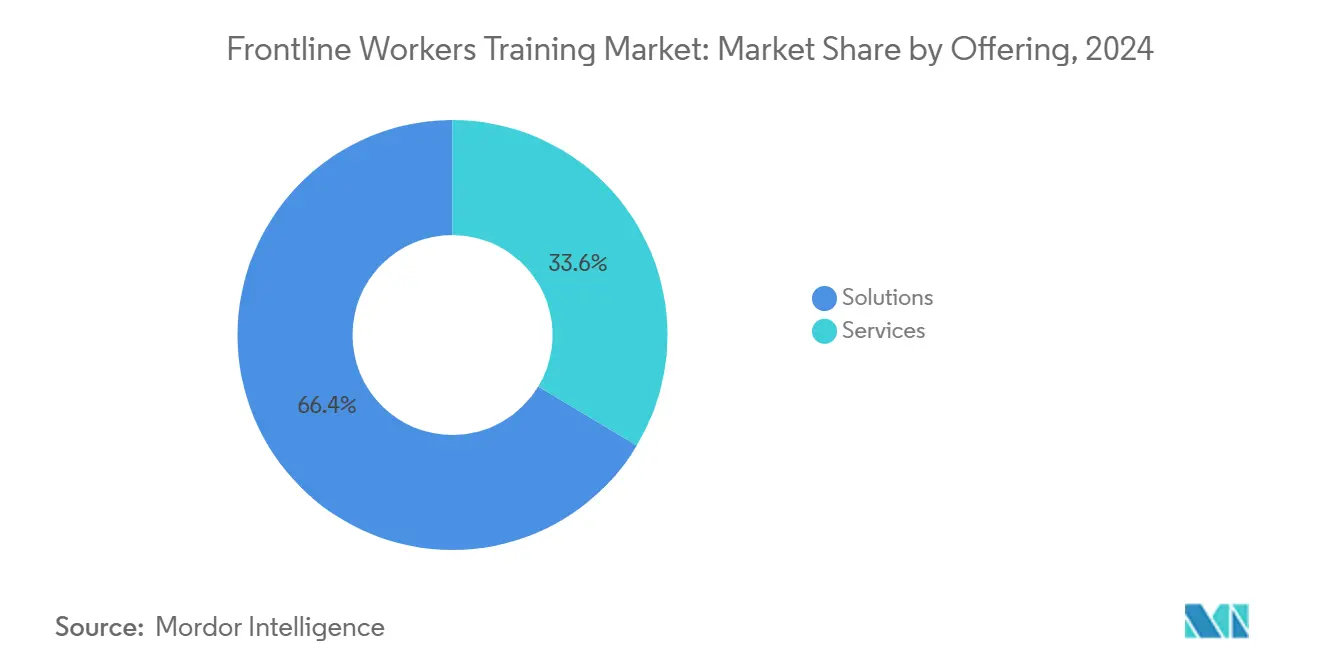
- By offering, Solutions held 66.4% of the frontline workers training market share in 2024; Services are expanding at an 18.3% CAGR through 2030.
- By mode of learning, Online formats accounted for 71.2% of the frontline workers training market size in 2024 and remain the fastest-growing at 18.0% CAGR.
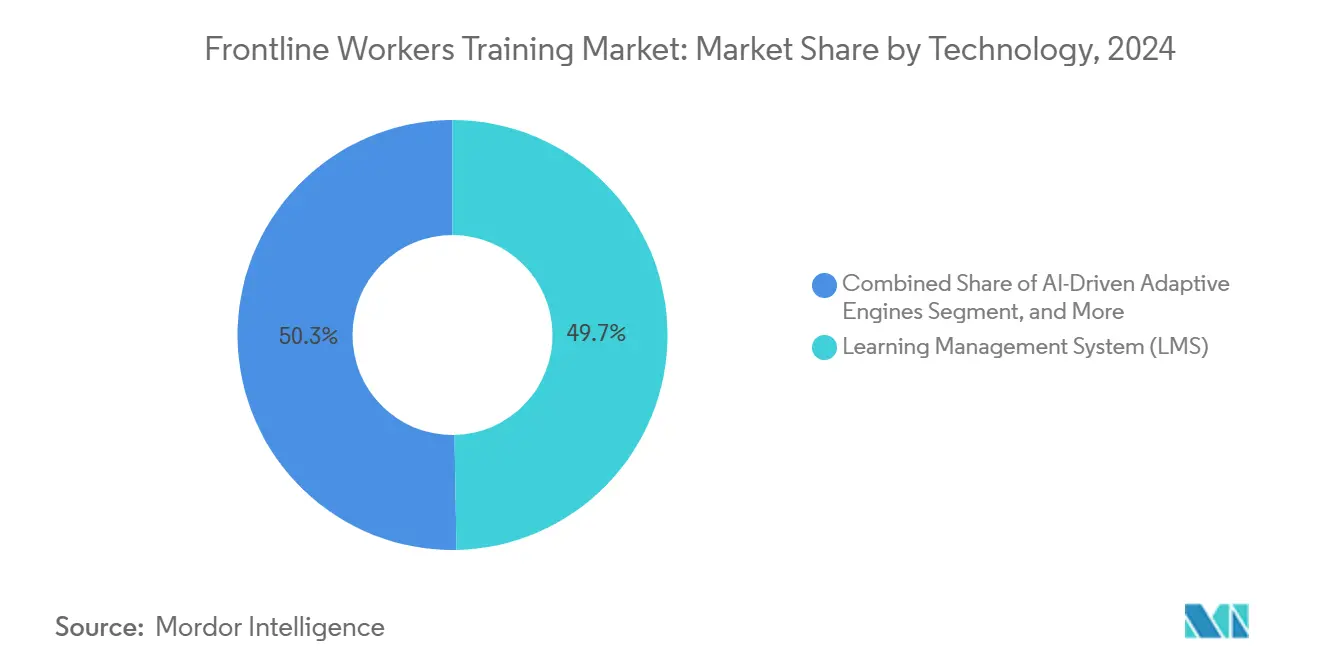
- By technology, Learning Management Systems led with 49.7% share of the frontline workers training market size in 2024, while AI-driven adaptive engines record a 17.6% CAGR to 2030.
- By industry vertical, Retail captured 27.8% of frontline workers training market share in 2024; Healthcare registers the fastest 16.8% CAGR as compliance needs intensify.
- By geography, North America retained 38.5% share of the frontline workers training market size in 2024, whereas Asia-Pacific advances at a 17.1% CAGR to 2030.
Note: Market size and forecast figures in this report are generated using Mordor Intelligence’s proprietary estimation framework, updated with the latest available data and insights as of January 2026.
Market Trends and Insights
Drivers Impact Analysis of Frontline Workers Training Market*
| Driver | (~) % Impact on CAGR Forecast | Geographic Relevance | Impact Timeline |
|---|---|---|---|
| Rapid adoption of mobile-first learning | +4.1% | APAC, North America | Medium term (2–4 years) |
| Regulatory compliance mandates | +3.3% | North America, EU, APAC | Short term (≤ 2 years) |
| BYOD and super-app integration | +3.0% | Global retail & hospitality | Medium term (2–4 years) |
| AI-generated micro-learning | +2.5% | North America, EU, APAC | Long term (≥ 4 years) |
| High retail-hospitality turnover | +2.0% | Urban centers worldwide | Short term (≤ 2 years) |
| VR/AR safety simulations | +1.7% | North America, EU, China, India | Long term (≥ 4 years) |
| Source: Mordor Intelligence | |||
Rapid adoption of mobile-first learning platforms
Smartphone-based delivery closes the historical access gap for deskless employees, 57% of whom prefer training on personal devices. Walmart’s geofencing safeguards demonstrate how retailers balance security with convenience. Super-app architecture merges scheduling, chat, and learning, minimizing context switching. Asia-Pacific shows outsized momentum thanks to ubiquitous mobile internet and limited desktop availability. Scalable mobile platforms let firms push uniform content to global frontline teams without building computer labs or training centers.
Regulatory compliance mandates for safety and health training
OSHA insists that computer-based safety courses include interactive elements, making blended formats mandatory for U.S. employers. The FDA’s 2026 QMSR forces device makers to align frontline competencies with ISO 13485 standards. ComplianceWire’s CFR Part 11-ready LMS automates audit trails. Financial institutions follow suit; the ABA offers free frontline compliance courses to 4,000 member banks.[1]New mandates on cyber hygiene and AI governance widen the scope of compulsory training investments.
BYOD and super-app training embeds into workforce chat tools
Embedding learning in tools workers already use raises engagement. Retailers use unified apps for rosters, messaging, and training, cutting log-in friction. Hospitality brands deploy sandboxing and remote-wipe features to protect customer data while permitting personal-device learning. Just-in-time modules appear as workers scan inventory or clock in, linking learning to job tasks. The approach supports multilingual chatbots, expanding reach in markets with linguistic diversity.
AI-generated micro-learning content accelerates course creation
Large language models build scenario-based lessons in seconds, slicing instructional-design cycles and reducing cost. Adaptive engines map worker performance data to knowledge gaps, launching remedial clips that lift retention. Automatic translation solves multilingual challenges in Asia, Europe, and the Middle East. Continuous content refresh aligns with fast-moving regulatory updates, especially in healthcare and fintech. The strategy scales without proportional growth in instructional headcount.
Restraints Impact Analysis of Frontline Workers Training Market*
| Restraint | (~) % Impact on CAGR Forecast | Geographic Relevance | Impact Timeline |
|---|---|---|---|
| Time-on-task constraints | -1.3% | Global manufacturing, healthcare | Short term (≤ 2 years) |
| Budget limitations in SMEs | -1.0% | Emerging markets, rural areas | Medium term (2–4 years) |
| Digital fatigue & low bandwidth | -0.8% | APAC emerging, Sub-Saharan Africa, LatAm | Long term (≥ 4 years) |
| Data-privacy worries | -0.7% | EU, privacy-conscious regions | Medium term (2–4 years) |
| Source: Mordor Intelligence | |||
Time-on-task constraints for deskless staff
Frontline employees often cannot leave stations for extended lessons, especially in ICUs or assembly lines. Employers respond with 2-5-minute bursts that fit natural breaks, though fragmentation risks lower comprehension. Shift patterns hinder synchronous webinars, raising demand for asynchronous mobile media. Training equals down-time, so managers weigh skill gains against lost output, limiting course length.
Budget limitations in SMEs
Firms with <100 staff struggle with LMS license fees and custom content costs. Reliance on external consultants inflates total ownership. Currency volatility in emerging economies deters long contracts. SaaS subscription tiers and pay-per-use libraries partially ease the burden but bandwidth fees and device procurement remain obstacles.
*Our forecasts treat driver/restraint impacts as directional, not additive. The impact forecasts reflect baseline growth, mix effects, and variable interactions.
Frontline Workers Training Market Segment Analysis
By Offering:
Services Drive Implementation SuccessSolutions maintained a 66.4% share of the frontline workers training market size in 2024, yet Services grew 18.3% annually as clients sought deployment expertise and change-management support. Organizations increasingly realize that software alone does not deliver competency gains; integration, localization, and measurement services do. Consultants map OSHA or ISO 13485 requirements to course catalogs, configure geofencing policies, and coach supervisors on micro-coaching tactics. Custom content crews transform legacy SOPs into mobile micro-lessons enriched with AR overlays.
Service revenue also benefits from ongoing analytics engagements. Providers benchmark completion and proficiency data against industry peers, flagging gaps ahead of audits. Success fees tied to error-rate reductions or incident-free days shift billing toward outcome-based models. As AI personalization deepens, data-science services tuned to frontline context-language mix, literacy, and device access-become indispensable. Vendors that bundle platform licenses with managed services lock in multi-year renewals, fueling steady expansion.
By Mode of Learning:
Online Dominance AcceleratesOnline formats captured 71.2% of frontline workers training market share in 2024 and will compound at 18.0% CAGR through 2030. Always-on access fits variable shift patterns and supports rapid content updates when safety rules change. In-app push notifications nudge learners during idle spells, lifting completion rates. Cloud hosting eliminates travel and venue expenses associated with classroom programs, a decisive factor for multinational rollouts.
Offline or blended experiences persist where tactile skills matter. Healthcare labs still require observed needle-stick practice. Manufacturers test lock-out tag-out procedures in real workshops. VR and AR shrink the offline share by simulating equipment interaction remotely, yet regulators in aviation and nuclear power continue to mandate physical sign-offs. As network coverage improves, the boundary between online and offline narrows, but physical assessments will remain a compliance cornerstone.
By Technology:
AI Adaptive Engines Gain MomentumLearning Management Systems held 49.7% of frontline workers training market size in 2024, anchoring content storage, tracking, and reporting. However, AI-adaptive engines, advancing at 17.6% CAGR, personalize pacing, difficulty, and language. These engines analyze quiz latency and error patterns, then re-sequence modules to close knowledge gaps, raising pass rates without extra instructor time.
Mobile micro-learning apps thrive on brevity. QR codes on equipment launch 90-second refresher clips right before operation. VR/AR platforms, though smaller, cut incident rates in confined-space entry drills by creating realistic practice environments. Gamification layers-leaderboards, streak counters, virtual badges-drive peer competition and retention. Vendors increasingly bundle these modalities into unified suites to avoid siloed data and duplicate admin overhead.

By Industry Vertical:
Healthcare Accelerates Past RetailRetail accounted for 27.8% share of frontline workers training market size in 2024, its dominance tied to constant churn and large seasonal cohorts. Chain stores standardize customer-service scripts and loss-prevention drills across thousands of outlets via mobile apps. Time-to-competence metrics guide scheduling algorithms, ensuring new hires reach productivity thresholds before peak hours.
Healthcare’s 16.8% CAGR reflects surging regulatory scrutiny. QMSR and HIPAA updates compel hospitals to document every skill refresh. AI chatbots deliver dosage calculators and emergency checklists on secure devices at bedside, enhancing patient safety. Manufacturing requires lock-out tag-out, quality management, and digital-twin literacy as Industry 4.0 spreads. BFSI invests in AML, KYC, and cyber-hygiene micro-lessons; India’s BFSI Skill Council curates vernacular modules to widen reach.[2] Hospitality blends language training and service standards across multicultural teams, leveraging VR role-play to refine soft skills.
Geography Analysis
North America Frontline Workers Training Market
North America held 38.5% of frontline workers training market share in 2024, driven by OSHA enforcement, FDA mandates, and heavy enterprise cloud spending. Google’s USD 15 million grant for government AI skills and Adobe’s USD 100 million pledge to train 30 million learners underline corporate commitment. Mature broadband coverage and high smartphone penetration ease mobile rollouts, while union contracts increasingly embed paid training clauses.
APAC Frontline Workers Training Market
Asia-Pacific leads growth with a 17.1% CAGR to 2030. China’s program to fill a 200,000-person semiconductor gap and India’s Skill Impact Bond channel public-private capital into scalable mobile learning. Indonesia’s Prakerja scholarships have trained 18.9 million adults, proving the impact of cash-linked credentials. Still, Gallup reports 72% of APAC frontline employees lack computer access, forcing providers to optimize for low-bandwidth and WhatsApp bots.
EMEA and LATAM Frontline Workers Training Market
Europe balances opportunity with compliance friction. GDPR limits data granularity, prompting on-device anonymization and strict consent flows. Vocational apprenticeship traditions support blended programs that marry e-learning with onsite mentorship. Sustainability targets drive new curricula on energy audits and circular practices. Latin America, the Middle East, and Africa trail in infrastructure but present greenfield demand; vendors tailor offline sync and SMS quizzes while governments roll out digital-skills blueprints.
Competitive Landscape
The marketplace is moderately fragmented. Dozens of niche vendors specialize by sector or modality, yet hyperscale cloud providers are bundling their productivity suites with training layers. Microsoft’s Azure-backed alliance with Pearson for AI credentials illustrates the convergence of certification and cloud infrastructure. Adobe and Google channel large funding pools into free or subsidized content, raising competitive pressure on smaller platforms.
Differentiation now hinges on AI depth, analytics transparency, and mobile UX. Providers infuse natural-language chatbots, multilingual subtitles, and sentiment analysis dashboards. Integrated hardware propositions-smart glasses with real-time SOP overlays=emerge in manufacturing and logistics. Honeywell’s survey of industrial executives found 94% intend to widen AI use, signaling procurement preference for vendors that tie training to measurable plant-floor efficiencies.[3]
Consolidation looms as enterprises demand single-pane administration across LMS, micro-learning, VR, and compliance reporting. Capital-rich players scout acquisitions of specialist VR studios and content-localization firms. Still, white-space persists in offline-capable delivery and SMS-based learning for low-connectivity markets. Vendors that solve those gaps or offer outcome-based pricing stand to gain share quickly.
Frontline Workers Training Industry Leaders
-
Microsoft Corporation
-
PTC Inc.
-
Honeywell International Inc.
-
Adobe Inc.
-
Google LLC
- *Disclaimer: Major Players sorted in no particular order
Frontline Workers Training Market Companies Covered in this Report
- Axonify Inc.
- Strivr Labs, Inc.
- GP Strategies Corporation
- Cornerstone OnDemand, Inc.
- Microsoft Corporation
- PTC Inc.
- Honeywell International Inc.
- Heuristix Digital Technologies Private Limited (Disprz)
- eduMe Limited
- Epignosis LLC (TalentCards)
- Lingio AB
- Seven Taps, Inc.
- HSI - Health and Safety Institute Inc.
- Vector Solutions, LLC (ClickSafety)
- 360Learning SA
- myQuest Learning, Inc.
- Adobe Inc.
- Google LLC
- Continu, Inc.
- Axon Enterprise, Inc.
Recent Industry Developments in Frontline Workers Training Market
- June 2025: Google revamped its Grow platform to focus on AI courses aligned with business priorities.
- March 2025: Groupe La Poste deployed Cornerstone Learn and goFLUENT to deliver multilingual training to 250,000 employees in 63 countries.
- February 2025: The Indian government approved the continuation and restructuring of the Skill India Programme, reinforcing national commitment to frontline skills.
- January 2025: Pearson and Microsoft formed a strategic partnership to launch AI-powered credentials using Microsoft Azure and Pearson VUE testing.
Global Frontline Workers Training Market Report Scope
Segmentation Overview
| Solutions |
| Services |
| Online |
| Offline |
| Blended |
| Learning Management System (LMS) |
| Mobile Micro-learning Apps |
| VR/AR Immersive Platforms |
| AI-Driven Adaptive Engines |
| Other Technologies |
| Retail |
| Healthcare |
| Manufacturing |
| Hospitality |
| Banking, Financial Services and Insurance (BFSI) |
| Transportation and Logistics |
| Other Industry Verticals |
| North America | United States | |
| Canada | ||
| Mexico | ||
| Europe | Germany | |
| United Kingdom | ||
| France | ||
| Italy | ||
| Spain | ||
| Rest of Europe | ||
| Asia-Pacific | China | |
| Japan | ||
| India | ||
| South Korea | ||
| Australia | ||
| Rest of Asia-Pacific | ||
| South America | Brazil | |
| Argentina | ||
| Rest of South America | ||
| Middle East and Africa | Middle East | Saudi Arabia |
| United Arab Emirates | ||
| Rest of Middle East | ||
| Africa | South Africa | |
| Rest of Africa | ||
| By Offering | Solutions | ||
| Services | |||
| By Mode of Learning | Online | ||
| Offline | |||
| Blended | |||
| By Technology | Learning Management System (LMS) | ||
| Mobile Micro-learning Apps | |||
| VR/AR Immersive Platforms | |||
| AI-Driven Adaptive Engines | |||
| Other Technologies | |||
| By Industry Vertical | Retail | ||
| Healthcare | |||
| Manufacturing | |||
| Hospitality | |||
| Banking, Financial Services and Insurance (BFSI) | |||
| Transportation and Logistics | |||
| Other Industry Verticals | |||
| By Geography | North America | United States | |
| Canada | |||
| Mexico | |||
| Europe | Germany | ||
| United Kingdom | |||
| France | |||
| Italy | |||
| Spain | |||
| Rest of Europe | |||
| Asia-Pacific | China | ||
| Japan | |||
| India | |||
| South Korea | |||
| Australia | |||
| Rest of Asia-Pacific | |||
| South America | Brazil | ||
| Argentina | |||
| Rest of South America | |||
| Middle East and Africa | Middle East | Saudi Arabia | |
| United Arab Emirates | |||
| Rest of Middle East | |||
| Africa | South Africa | ||
| Rest of Africa | |||
Key Questions Answered in the Report
What is the current value of the frontline workers training market?
The frontline workers training market size is USD 29.93 billion in 2025 and is forecast to reach USD 64.25 billion by 2030.
Which region leads spending on frontline workforce training?
North America holds 38.5% of global spending, propelled by OSHA requirements and sizable enterprise budgets.
Which technology segment is growing fastest?
AI-driven adaptive engines show a 17.6% CAGR as companies prioritize personalized learning paths.
Why is healthcare training demand accelerating?
Stricter compliance mandates and complex medical procedures push healthcare to a 16.8% CAGR through 2030.
How are mobile-first approaches influencing training?
Mobile-first platforms improve access for deskless staff, lifting engagement and allowing just-in-time micro-learning on personal devices.
What limits adoption in small enterprises?
Budget constraints, limited in-house expertise, and device procurement costs slow LMS deployments in SMEs.