
Recruitment Software Market Size and Share
Market Overview
| Study Period | 2020 - 2031 |
|---|---|
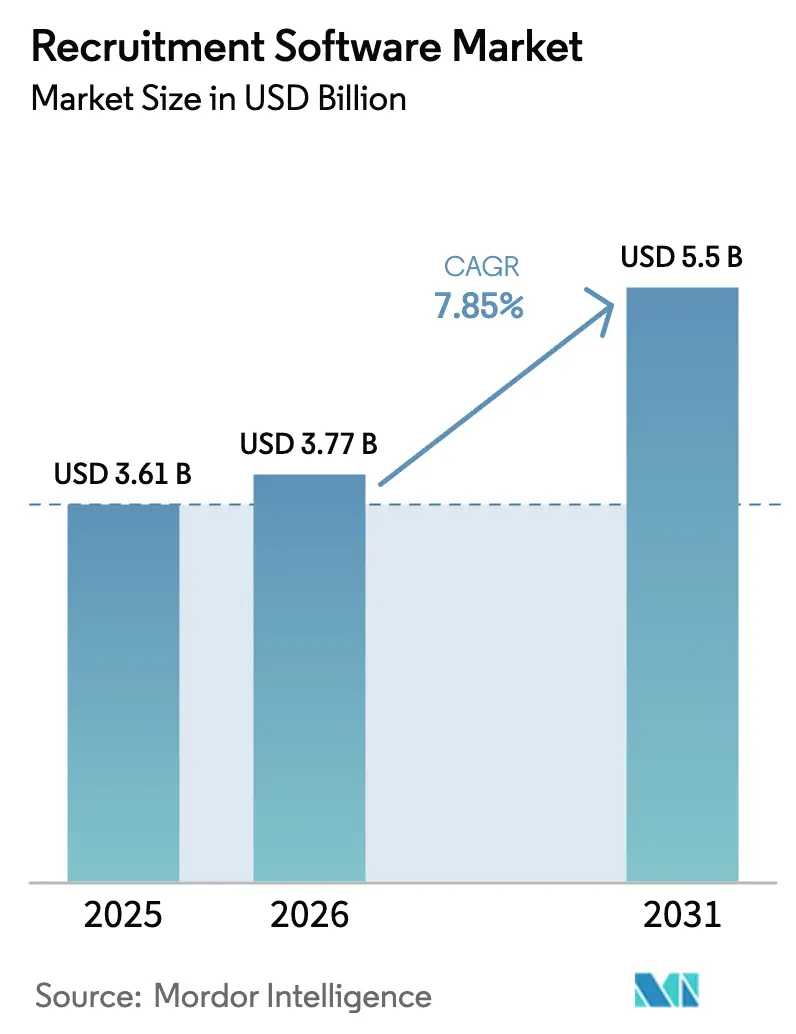
| Market Size (2026) | USD 3.77 Billion |
| Market Size (2031) | USD 5.5 Billion |
| Growth Rate (2026 - 2031) | 7.85 % |
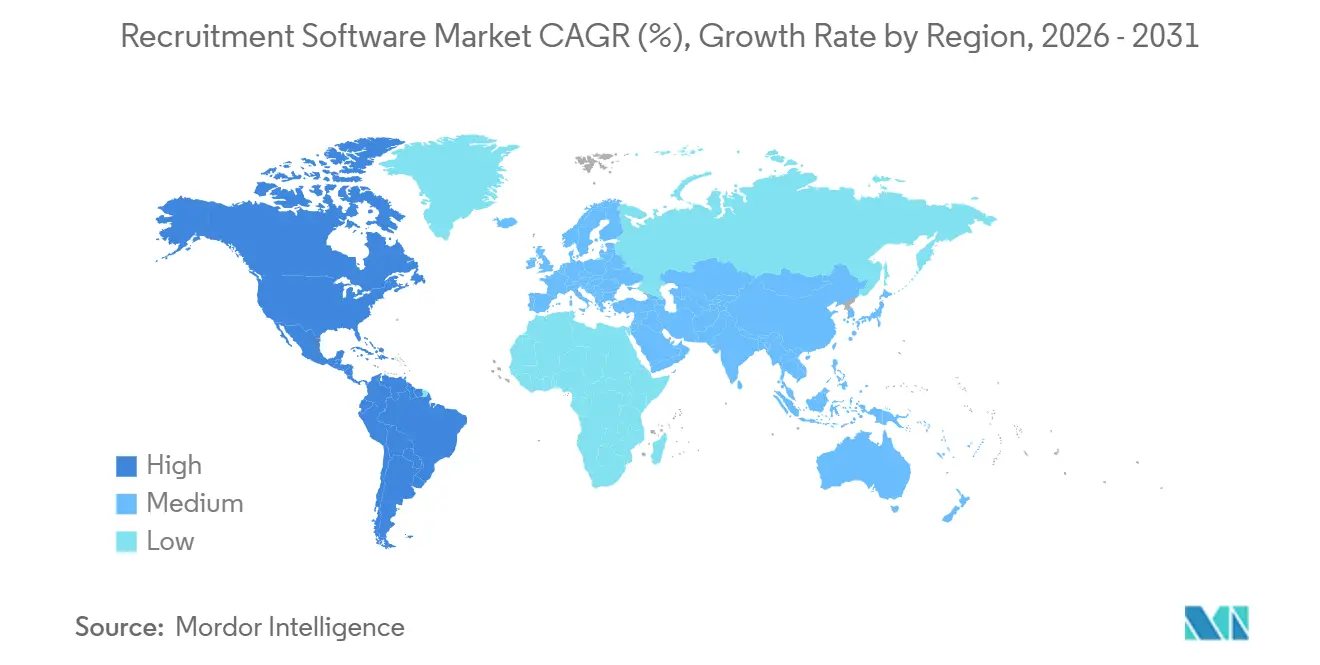
| Fastest Growing Market | Asia-Pacific |
| Largest Market | North America |
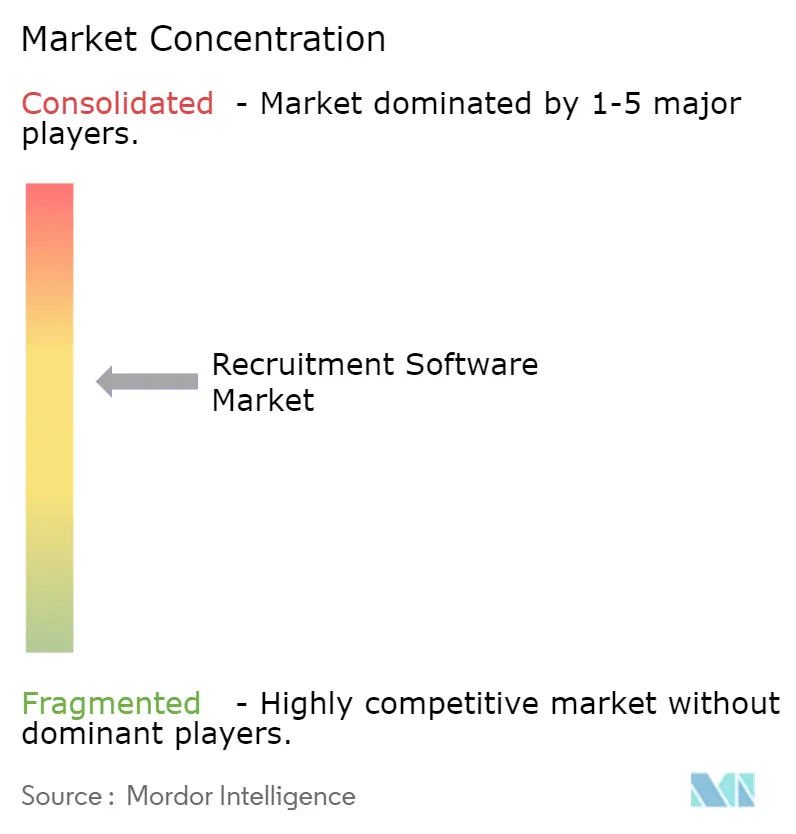
| Market Concentration | Medium |
Major Players *Disclaimer: Major Players sorted in no particular order Image © Mordor Intelligence. Reuse requires attribution under CC BY 4.0. | |
Recruitment Software Market Analysis by Mordor Intelligence
The Recruitment Software Market size is projected to expand from USD 3.61 billion in 2025 and USD 3.77 billion in 2026 to USD 5.5 billion by 2031, registering a CAGR of 7.85% between 2026 to 2031. Cloud deployment already anchors nearly seven-tenths of spending, and its elastic compute supports generative-AI copilots that shorten hiring cycles. Buyers also prioritize integrated suites that connect sourcing, engagement, assessment, and onboarding, replacing legacy point tools. Healthcare providers are modernizing fastest because clinician shortages demand accelerated credential checks, while Asia-Pacific enterprises widen addressable demand as they formalize talent pipelines. Vendors that embed explainable AI, bias mitigation, and pre-built connectors for major HRIS platforms command premium pricing.
Key Report Takeaways
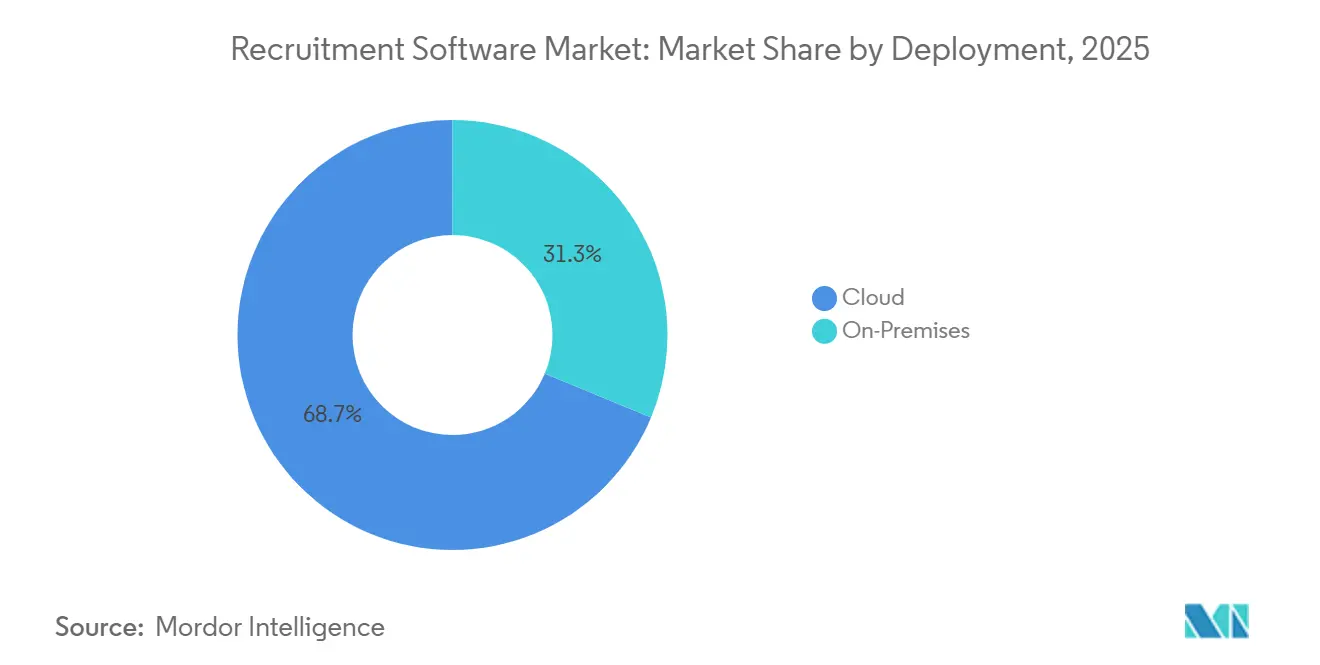
- By deployment, the cloud segment captured 68.73% of recruitment software market share in 2025 and is on track to grow at a 9.21% CAGR through 2031.
- By organization size, large enterprises held 60.95% of spending in 2025, whereas SMEs are forecast to rise at a 10.23% CAGR through 2031.
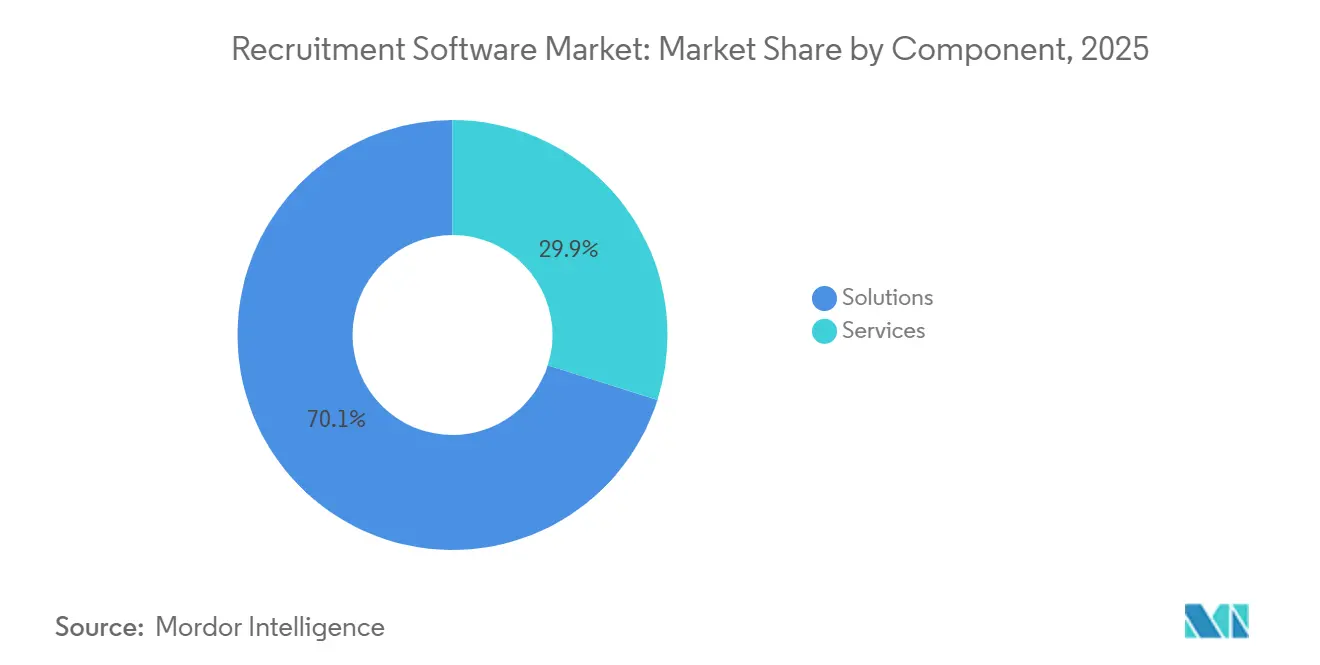
- By component, solutions represented 70.11% of 2025 revenue, yet services are expanding at an 8.74% CAGR on the back of bias-audit and integration projects.
- By functionality, applicant-tracking systems retained 53.87% share in 2025, while talent-analytics tools are climbing at a 9.82% CAGR.
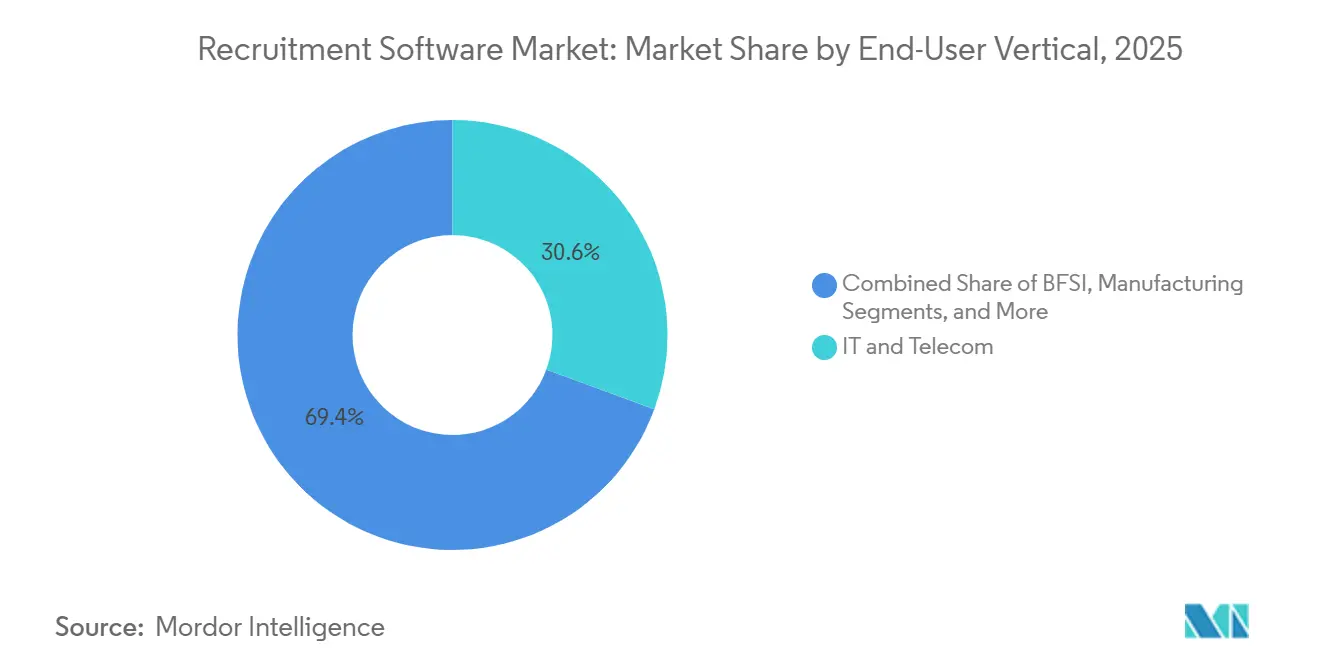
- By end-user vertical, IT and Telecom led with 30.62% revenue share in 2025; healthcare and life sciences are advancing at an 8.05% CAGR to 2031.
- By geography, North America commanded 34.62% of 2025 revenue, but Asia-Pacific is projected to expand at a 10.66% CAGR through 2031.
Note: Market size and forecast figures in this report are generated using Mordor Intelligence’s proprietary estimation framework, updated with the latest available data and insights as of January 2026.
Market Trends and Insights
Drivers Impact Analysis of Recruitment Software Market*
| Driver | (~)% Impact on CAGR Forecast | Geographic Relevance | Impact Timeline |
|---|---|---|---|
| Cloud-first adoption across HR tech stacks | +1.8% | Global, with North America and Europe leading enterprise migrations | Medium term (2-4 years) |
| Explosion of AI/ML use-cases in talent acquisition workflows | +2.1% | Global, concentrated in North America, Europe, and Asia Pacific IT hubs | Short term (≤ 2 years) |
| Surge in remote and hybrid hiring models post COVID-19 | +1.2% | Global, with Asia Pacific and Latin America seeing accelerated adoption | Medium term (2-4 years) |
| Growth of social-media recruiting and employer-branding platforms | +0.9% | North America and Europe mature markets; Asia Pacific and Middle East emerging | Long term (≥ 4 years) |
| Emergence of autonomous agentic ATS with generative-AI copilots | +1.6% | North America and Europe early adopters; Asia Pacific following | Short term (≤ 2 years) |
| VC funding shift toward skills-graph and bias-mitigation analytics | +0.7% | North America venture capital concentration; spillover to Europe and Asia Pacific | Long term (≥ 4 years) |
| Source: Mordor Intelligence | |||
Cloud-First Adoption Across HR Tech Stacks
Enterprises are decommissioning on-premises Applicant Tracking Systems in favor of unified SaaS suites that cut ownership costs and remove data silos. Oracle’s 2025 release of autonomous recruiting agents inside Fusion Cloud HCM shows how multi-tenant platforms now automate screening, interview scheduling and offer letters from one interface. Vendors pool anonymized hiring data to train matching algorithms, boosting fill-rate accuracy. Although broadband gaps slow adoption in parts of Latin America and Africa, sovereign-cloud offers and edge compute are narrowing residency barriers. The trend raises integration demand from the recruitment software market vendors, as firms connect cloud recruiting to payroll and performance modules for a single worker record.
Explosion of AI and ML Use-Cases
AI has shifted from pilot scope to enterprise staple. LinkedIn’s live listings feed 134 million vacancies into models that optimize ad spend and predict candidate success. Generative copilots from iCIMS and Workday draft outreach, create interview questions and summarize feedback in seconds, trimming cycle time by up to half. Regulators, however, now treat automated hiring as high risk. The EU AI Act obliges explainability dashboards and conformity assessments, steering buyers to vendors with built-in bias detection.[1]European Union, “Artificial Intelligence Act,” artificialintelligenceact.eu Platforms that deliver transparent scoring alongside predictive insights gain a compliance edge in the recruitment software market.
Surge in Remote and Hybrid Hiring Models Post COVID-19
Global employers rely on asynchronous video interviews and digital onboarding to source talent beyond headquarters. ManpowerGroup’s fourth-quarter 2025 survey recorded a +40% net employment outlook in India and +34% in China, with remote hiring prominent across IT roles. Tools such as HireVue cut hiring time from six weeks to six days for healthcare systems by automating screening and scheduling.[2]HireVue, “AI-Driven Video Interview Platform,” hirevue.com Yet dispersed workforces add identity-verification and tax-compliance complexity. Vendors now embed geo-fencing, blockchain credential checks and multi-jurisdiction alerting to ensure lawful onboarding.
Emergence of Autonomous Agentic ATS with Generative-AI Copilots
Agentic AI executes multi-step recruiting workflows without human prompts. Workday’s USD 1 billion purchase of Paradox in August 2025 underscores C-suite appetite for conversational agents that answer candidate questions and arrange interviews. Fountain applies similar logic to hourly roles, slashing recruiter workload by 60% in retail and logistics. Regulators still insist on human oversight when an algorithm declines an applicant, so vendors engineer tiered autonomy that automates routine gestures while reserving final approval for people managers.
Restraints Impact Analysis of Recruitment Software Market*
| Restraint | (~)% Impact on CAGR Forecast | Geographic Relevance | Impact Timeline |
|---|---|---|---|
| Data-privacy and algorithmic-bias compliance costs | -1.3% | Europe (GDPR, EU AI Act), North America (CCPA, NYC Local Law 144), global spillover | Short term (≤ 2 years) |
| Integration complexity with ageing HRIS/ERP landscapes | -0.9% | Global, concentrated in large enterprises with legacy SAP, Oracle, and Workday deployments | Medium term (2-4 years) |
| SME price-sensitivity and low ATS awareness in emerging markets | -0.6% | Asia Pacific (India, Southeast Asia), Latin America, Africa | Long term (≥ 4 years) |
| Growing buyer fatigue from overlapping point solutions | -0.4% | North America and Europe mature markets with high vendor density | Medium term (2-4 years) |
| Source: Mordor Intelligence | |||
Data-Privacy and Algorithmic-Bias Compliance Costs
The EU AI Act, GDPR Article 22 and New York City Local Law 144 demand bias audits, risk logs and human review, adding USD 0.5–2 million per enterprise rollout. Penalties climb to 7% of global turnover for non-compliance, a threat that redirects budgets from innovation to legal overhead. Large vendors can amortize these costs, while mid-tier suppliers face margin pressure or forced consolidation. Clients therefore gravitate toward providers that certify models and publish continual audit summaries.
Integration Complexity with Ageing HRIS/ERP Landscapes
Many employers still run payroll and core HR on 15-year-old on-premises systems that lack APIs. Recruitment platforms must build brittle custom connectors, delaying deployments and inflating service fees. Middleware from MuleSoft or Dell Boomi eases some friction but introduces new licenses and latency. As a result, mid-market firms delay upgrades, and large enterprises limit feature adoption to avoid data-sync errors. Vendors in the recruitment software market that ship pre-built adapters for SAP SuccessFactors, Oracle HCM and ADP gain significant competitive leverage.
*Our forecasts treat driver/restraint impacts as directional, not additive. The impact forecasts reflect baseline growth, mix effects, and variable interactions.
Recruitment Software Market Segment Analysis
By Deployment:
Cloud Dominance Accelerates with Agentic AICloud deployments accounted for 68.73% of 2025 revenue, and that slice is growing faster than the overall recruitment software market at a 9.21% CAGR to 2031. This leadership stems from instant scalability and continuous feature drops, including GPU-intensive large language model inference that on-premises servers cannot afford. Oracle’s October 2025 cloud agents illustrate the edge, drawing lessons from anonymized cross-client data to recommend shortlists automatically. On-premises systems remain in sectors such as defense and banking that impose data-sovereignty mandates, but hybrid architectures now let sourcing and engagement modules reside in cloud while candidate records stay behind the firewall. As sovereign-cloud programs mature, even regulated buyers are expected to migrate analytics workloads, narrowing the deployment divide.
The recruitment software market size for cloud deployments is forecast to add USD 1.3 billion by 2031, while on-premises revenue stays nearly flat. Vendors embed cost calculators that prove total ownership savings within 18 months, convincing finance teams to shift budgets from capital expenditure to operating expenditure. This transition unlocks recurring revenue streams and positions providers to cross-sell analytics and learning modules once the core ATS is live. Buyers that embrace full-cloud stacks also gain faster regulatory updates, an advantage as bias-audit mandates evolve yearly.


By Organization Size:
SMEs Drive Volume Growth Despite Budget ConstraintsLarge enterprises still bring 60.95% of 2025 revenue in the recruitment software market, thanks to global head-counts that justify premium contracts. Yet, SME demand represents the fastest-growing cohort; the segment is forecast to post a 10.23% CAGR by 2031, as modular, seat-based pricing lowers the entry barrier. Freemium packages from BambooHR and Recruitee start at around USD 50 per user per month, allowing 10-person startups to access AI ranking and automated outreach typically reserved for Fortune 500 HR teams.
Awareness remains low in emerging economies where spreadsheets still track applicants, so vendors localize mobile-first interfaces and partner with regional payroll companies to bundle recruitment features. The recruitment software market share among SMEs is expected to tick up from 39% in 2025 to 45% by 2031. To capture that lift, suppliers streamline onboarding with click-and-connect job-board integrations, minimizing IT dependence for resource-constrained businesses.
By Component:
Services Surge as Compliance and Integration Complexity EscalateSolutions commanded 70.11% of 2025 spending, but professional and managed services revenue is growing at an 8.74% CAGR because buyers need external support for bias audits and legacy integrations. The recruitment software market size tied to services exceeded USD 1 billion in 2026 and is projected to nearly double by 2031. Providers package fixed-fee conformity-assessment bundles that document data lineage, risk logs and human-override workflows required under the EU AI Act.
Managed-services contracts also rise as mid-market clients outsource talent-pipeline execution entirely. Outcome-based pricing promises set reductions in time-to-fill, shifting risk to vendors but elevating switching costs. Software-only challengers must either form alliances with large integrators or build in-house consulting arms, a strategic fork that favors capital-rich incumbents.
By Functionality:
Talent Analytics Overtakes Traditional ATS as Strategic PriorityApplicant-tracking systems held 53.87% share in 2025, yet demand is tilting rapidly toward predictive insights. Talent-analytics tools are forecast to outpace every other segment with a 9.82% CAGR, fueled by skills graphs that map more than one billion career paths and surface internal and external candidates. Eightfold AI’s platform demonstrates how analytics now drive requisition decisions, rather than just reporting hires.
Suites bundle CRM, onboarding and assessment to knit continuous journeys, converting recruitment software industry talk from transaction processing to talent intelligence. As scrutiny of bias rises, assessment vendors are embedding AI proctoring and fairness metrics. Greenhouse’s Real Talent engine, launched in September 2025, integrates those analytics straight into the core workflow to defend ATS incumbency.[3]Greenhouse, “Real Talent Candidate Discovery,” greenhouse.com The recruitment software market size attributable to analytics, therefore, carries the highest margin profile, encouraging intense investment.
By End-User Vertical:
Healthcare Leads Growth Amid Structural Labor ShortagesIT and Telecom captured 30.62% of 2025 revenue, but healthcare and life sciences post the fastest trajectory at an 8.05% CAGR. U.S. nurse vacancies topping 200,000 in 2025 forced hospital chains to adopt automated license verification and shift-preference matching. Vivian Health’s AI assistant launched in October 2025 cut average nurse hire times from 66 days to 45 days.
Specialist platforms now bundle credential tracking and Joint Commission compliance to address sector-specific pain points, giving them defensible advantages over horizontal suites. Manufacturing and retail embrace mobile-first, high-volume hiring engines such as Fountain, which automates SMS-based workflows that scale to thousands of hourly applicants. As industry regulations tighten, vertical expertise becomes a key differentiator in vendor selection.

Geography Analysis
North America Recruitment Software Market
North America generated 34.62% of 2025 revenue, reflecting deep HR-tech penetration, high IT budgets and strict equal-opportunity enforcement. Major incumbents like Workday, Oracle and SAP maintain headquarters or significant operations in the region, shortening feedback loops for product iterations. Consolidation is high, as Paychex acquired Paycor in January 2025 to bolster distribution among mid-size employers.[4]Paychex, “Paychex to Acquire Paycor,” paychex.com Growth, however, decelerates relative to emerging regions because most large enterprises already run modern ATS suites.
APAC Recruitment Software Market
Asia-Pacific is the fastest-growing region at a 10.66% CAGR through 2031. India’s IT-services giants hire hundreds of thousands of graduates each year, demanding platforms that screen millions of résumés. China’s state-owned enterprises favor domestic vendors for data sovereignty, but foreign multinationals standardize on global suites with localized Mandarin interfaces. Japan and South Korea retain referral-centric norms, yet aging demographics compel digital hiring to widen talent pools. Southeast Asian markets, notably Indonesia and Vietnam, represent white space; smartphone penetration exceeds desktop usage, so lightweight, app-centric recruiting tools gain traction.
EMEA and LATAM Recruitment Software Market
Europe sits between these dynamics. GDPR and the EU AI Act raise compliance complexity, but free movement within the European Union expands candidate pools, prompting employers to implement bias-monitored sourcing. Germany’s mid-sized manufacturers face skilled-trade shortages, and the United Kingdom’s post-Brexit labor squeeze fuels adoption. The Middle East and Africa remain nascent; Saudi Arabia’s Vision 2030 infrastructure projects elevate formal hiring systems, while South Africa and Nigeria show early mobile-first uptake. Latin America’s cloud demand clusters in Brazil and Argentina but is tempered by currency volatility that shrinks import budgets for subscription software.

Regulatory Landscape
Regulation of recruitment software is tightening around automated decision-making, privacy, and pay equity, raising compliance requirements for cloud-first ATS and talent-analytics deployments. Under the EU AI Act, recruitment AI is treated as high-risk, with obligations covering risk management, data governance, transparency, and human oversight. The Digital Omnibus agreement advanced the timing of some high-risk obligations from August 2, 2026 to December 2, 2027, which is already influencing how vendors plan governance and control features.
In the United States, New York City Local Law 144 requires independent annual bias audits for automated employment decision tools, while EEOC guidance affects how vendors structure accountability within hiring workflows. The EU Pay Transparency Directive transposition deadline was June 7, 2026, which increases pressure on multinational employers to prepare for cross-country pay-gap reporting, supported by more standardized job architectures.
Value Chain Analysis
The recruitment software value chain begins with data ingestion from job boards, social networks, career sites, and internal pools. It then runs through applicant-tracking system (ATS) and recruiting CRM workflows, and eventually connects to onboarding and core HR systems where worker records are maintained.
On the enterprise backbone, HCM suites from SAP SuccessFactors, Workday, and Oracle HCM act as the system of record, while specialist modules like assessments, background checks, video interviewing, and credential verification connect through APIs and marketplaces. Underneath the applications, cloud infrastructure and data governance are tied to sub-processing in SaaS deployments by hyperscalers such as AWS and Microsoft Azure. As agentic AI capabilities move into production, the chain also extends to model governance, audit trails, and pre-built connectors to major HRIS platforms, which increasingly shape deployment speed and total rollout cost.
Competitive Landscape
Roughly 45-50% of global revenue of the recruitment software market is concentrated among the top 10 vendors, making the sector moderately fragmented. Acquisitions accelerated in 2025 as incumbents bought AI assets rather than building them. SAP’s September 2025 purchase of SmartRecruiters modernized SuccessFactors recruiting workflows. Workday also made consecutive acquisitions of Paradox and Sana to fold conversational AI and learning graphs into its HCM suite. ADP similarly launched WorkForce Suite in November 2025, integrating time and talent on a joint data model.
Technology differentiation centers on three vectors. First, the depth of autonomous agents: Paradox automates candidate scheduling via SMS and WhatsApp, reducing recruiter workload up to 60%. Second, live bias mitigation: platforms post public model audits to reassure regulators. Third, integration breadth: pre-built connectors for Oracle, SAP, Workday and ADP decide enterprise access. Vertical specialists defend against suite vendors by embedding compliance workflows, for example, Vivian Health’s license verification for nurses. Over the next five years, rising audit costs and buyer preference for unified suites are expected to reduce the long-tail vendor count, yet niches such as hourly hiring and gig marketplaces will still support independent innovators.
Recruitment Software Industry Leaders
SAP SE
Workday, Inc.
Oracle Corporation
Automatic Data Processing, Inc.
International Business Machines Corporation (IBM)
- *Disclaimer: Major Players sorted in no particular order
Recruitment Software Market Companies Covered in this Report
- SAP SE
- Workday, Inc.
- Oracle Corporation
- Automatic Data Processing, Inc.
- International Business Machines Corporation
- iCIMS, Inc.
- UKG Inc.
- Ceridian HCM Holding Inc.
- Cornerstone OnDemand, Inc.
- Greenhouse Software, Inc.
- SmartRecruiters, Inc.
- Jobvite, Inc.
- BambooHR LLC
- Bullhorn, Inc.
- Lever, Inc.
- Zoho Corporation Pvt. Ltd.
- ClearCompany Talent Management, LLC
- Recruitee B.V.
- PeopleAdmin, Inc.
- Trakstar, LLC
- Eightfold AI, Inc.
- Phenom People, Inc.
- Avature Limited
- Paycor, Inc.

Market Opportunities and Future Outlook
A key whitespace centers on compliance-grade AI for high-risk hiring use cases, where buyers want bias testing, auditability, and human oversight built into the workflow. The EU AI Act high-risk designation and NYC Local Law 144 regimes are pushing platforms toward governance features, while the first reporting cycle under the EU Pay Transparency Directive is due in 2027.
There is also a clear pull toward suite-level modernization and cross-vendor integrations that reduce point-solution fragmentation while keeping candidate journeys consistent. In practice, SAP SuccessFactors deployments that incorporate Joule-powered recruiting assistants and ongoing SmartRecruiters integration show how front-end recruiting can be modernized within established ERP backbones, while preserving HR data integrity. This direction has relevance for cross-country rollouts in regulated markets across Asia-Pacific.
Recent Industry Developments in Recruitment Software Market
- June 2026: SAP SE announces the global go-live of the SmartRecruiters integration within SAP SuccessFactors to enhance recruiting workflows. The integration expands the enterprise recruiting suite capabilities and strengthens SAP's position in the market.
- June 2026: Oracle Corporation is named a Leader in the 2026 Gartner Magic Quadrant for Talent Acquisition (Recruiting) Suites. The designation reinforces Oracle's leadership in recruiting software and could influence enterprise purchasing decisions in 2026.
- May 2026: SAP SE announced Joule powered Recruiting Assistants for intelligent matching and interview coordination. The move introduces AI native recruiting capability within the core SAP SuccessFactors suite and accelerates automated workflows.


Recruitment Software Market Report Scope and Research Methodology
Market Definition and Coverage
This market covers paid software platforms that help employers and staffing teams plan, run, and measure recruiting workflows, from job posting and sourcing through screening, selection support, and onboarding handoffs. Revenue is counted from software subscriptions and related usage-based pricing tied to recruiting functions.
Scope exclusions: We exclude general HRIS payroll suites unless recruiting modules are clearly priced and sold as recruitment software. We also exclude job board advertising spend that is not packaged as software revenue.
Segments Covered in This Report
- By Deployment
- On-Premises
- Cloud
- By Organization Size
- Small and Medium Enterprises (SMEs)
- Large Enterprises
- By Component
- Solutions
- Services
- By Functionality
- Applicant Tracking System (ATS)
- Recruitment CRM/Marketing
- Onboarding Software
- Talent Analytics and AI Tools
- Background-check/Assessment Modules
- By End-User Vertical
- IT and Telecom
- BFSI
- Retail and E-commerce
- Manufacturing
- Healthcare and Life Sciences
- Other End-User Verticals
- By Geography
- North America
- United States
- Canada
- Mexico
- South America
- Brazil
- Argentina
- Rest of South America
- Europe
- Germany
- United Kingdom
- France
- Italy
- Spain
- Rest of Europe
- Asia-Pacific
- China
- Japan
- India
- South Korea
- ASEAN
- Rest of Asia-Pacific
- Middle East
- Saudi Arabia
- United Arab Emirates
- Rest of Middle East
- Africa
- South Africa
- Nigeria
- Rest of Africa
- North America
Data Sources, Market Sizing, and Validation
Desk Research
Desk research is used to set the market boundaries, build the historical context, and collect stable external signals that influence recruiting tech spend. We mainly refer to public sources such as the US Bureau of Labor Statistics (job openings and separations), Eurostat labor market indicators, OECD employment data, and World Bank macro series to normalize hiring activity by region and year.
We also review regulatory and reporting signals that shape product requirements, including EEOC guidance themes and privacy and data-handling updates, along with public procurement notices for digital HR tools. Company filings, investor decks, and credible press coverage are then used to understand pricing direction, cloud migration pace, and suite consolidation patterns. We use selectively sourced paid subscriptions for company financials and patent databases when a claim needs stronger backing. These examples are not exhaustive, and we checked additional public sources for data collection, validation, and clarification.
Primary Interviews and Surveys
Primary work is done through expert interviews and structured surveys with software providers, implementation partners, recruiters, and HR operations leaders who own tool selection and budgets. For a global view, we ensure inputs reflect differences in hiring volume, compliance needs, and cloud adoption across major regions, and then we use these conversations to pressure-test assumptions such as average contract values, module attach rates, and renewal behavior.
Distribution of primary research fieldwork respondents
| Company type | Respondent position | Region |
|---|---|---|
| Top tier: 35% | CXOs: 13% | APAC: 51% |
| Mid tier: 51% | Functional/Unit leaders: 40% | EMEA: 29% |
| Smaller Players: 14% | Managers: 47% | Americas: 20% |
Market-Sizing & Forecasting
Sizing starts with a top-down build where hiring activity and digital recruiting adoption are translated into an addressable spend pool, then totals are allocated across regions using enterprise mix and software penetration. After that structure is in place, we corroborate results with selective bottom-up checks, such as sampled pricing times estimated customer counts, channel feedback on deal sizes, and supplier revenue splits where disclosures are available.
Key inputs used in the model include job openings and hiring intensity indicators, cloud deployment share, average subscription pricing by organization size, implementation and support attach where it is sold with the platform, and the pace at which point tools are replaced by integrated suites. Because the main drivers do not move in a straight line each year, forecasting is done using scenario analysis supported by expert consensus on budget cycles and regional hiring outlook. Where bottom-up information is missing for smaller vendors or emerging geographies, gaps are handled using cluster-based assumptions from similar buyer profiles, followed by sensitivity checks before finalizing.
Data Validation & Update Cycle
Validation is done by triangulating the model output against independent signals such as hiring trend data, software spending direction mentioned in interviews, and observable shifts in cloud adoption and bundling. If a number looks off, we trace it back to the driver level, check for currency and timing issues, and rework until the variance stays within a reasonable band.
Before sign-off, the work goes through multi-step analyst review where assumptions, math logic, and year-to-year movements are challenged. If a major inconsistency is found, we re-contact relevant respondents to confirm whether the change is real or due to interpretation. Reports are refreshed annually, with interim updates for material events, and a final pre-delivery pass is completed so clients receive the latest updated view.
Mordor Intelligence's Recruitment Software Market Size Compared With Other Published Estimates
Published market numbers for recruitment software can vary widely even when they appear to cover the same scope, mainly because coverage choices are not consistent. Differences usually come from whether services are counted, how adjacent categories such as online recruitment are treated, and which year is used as the starting point.
The table shows a spread that is mostly explained by scope and timing. In the Mordor Intelligence approach, the core focus stays on recruitment software value, while job board advertising that is not sold as software is kept out. The forecast is anchored to the 2025 to 2031 study window.
Benchmark comparison
| Source | Market Size | Gaps in Research Methodology |
|---|---|---|
| Mordor Intelligence | USD 3.61 B (2025) | |
| Trade Journal A | USD 3.02 B (2024) | Uses a 2024 base and explicitly includes a services component, which can pull value into the market total that some software-only views keep separate. |
| Global Consultancy B | USD 3.30 B (2024) | Starts from a 2024 estimate and runs a longer horizon to 2034, which can rely more on aggressive adoption and price lift assumptions when near-term hiring cycles are uncertain. |
Reading the three figures together, the main takeaway is that base year choice and what gets counted alongside software subscriptions drive most of the variance. Our approach stays traceable to a defined demand pool, and it is kept repeatable by tying inputs back to hiring indicators, pricing logic, and interview-led checks before totals are finalized.


Key Questions Answered in the Report
How big is the recruitment software market in 2026?
The recruitment software market size is USD 3.77 billion in 2026.
What is the expected CAGR for recruitment platforms through 2031?
Market value is forecast to grow at a 7.85% CAGR from 2026 to 2031.
Which deployment model is growing fastest?
Cloud deployment is expanding at a 9.21% CAGR, driven by AI workloads and elastic compute.
Why is healthcare adoption accelerating?
Nurse and clinician shortages require faster credential checks, and AI assistants cut time-to-fill from 66 days to 45 days.
Which region will contribute the most incremental revenue?
Asia Pacific is projected to add the largest share of new revenue, advancing at a 10.66% CAGR.
How concentrated is vendor competition?
The top 10 suppliers hold roughly 45–50% of global revenue, indicating moderate concentration.
Page last updated on:


 Your data is secure and never sold or shared.


