
Soft Skills Training Market Size and Share
Market Overview
| Study Period | 2020 - 2031 |
|---|---|
| Market Size (2026) | USD 43.15 Billion |
| Market Size (2031) | USD 68.41 Billion |
| Growth Rate (2026 - 2031) | 9.65 % |
| Fastest Growing Market | Asia Pacific |
| Largest Market | North America |
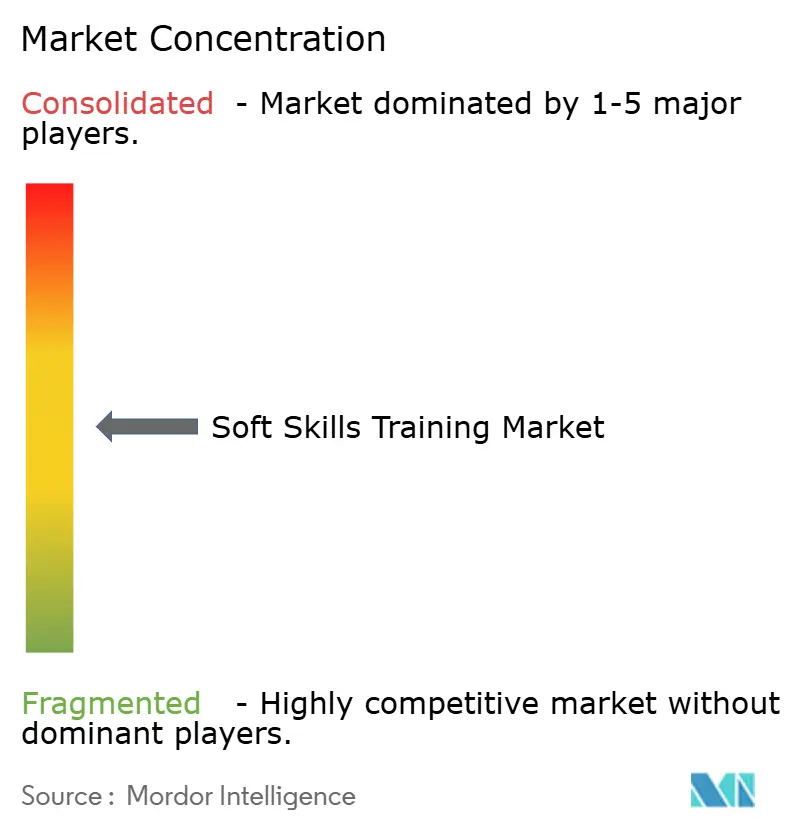
| Market Concentration | Medium |
Major Players *Disclaimer: Major Players sorted in no particular order Image © Mordor Intelligence. Reuse requires attribution under CC BY 4.0. | |
Soft Skills Training Market Analysis by Mordor Intelligence
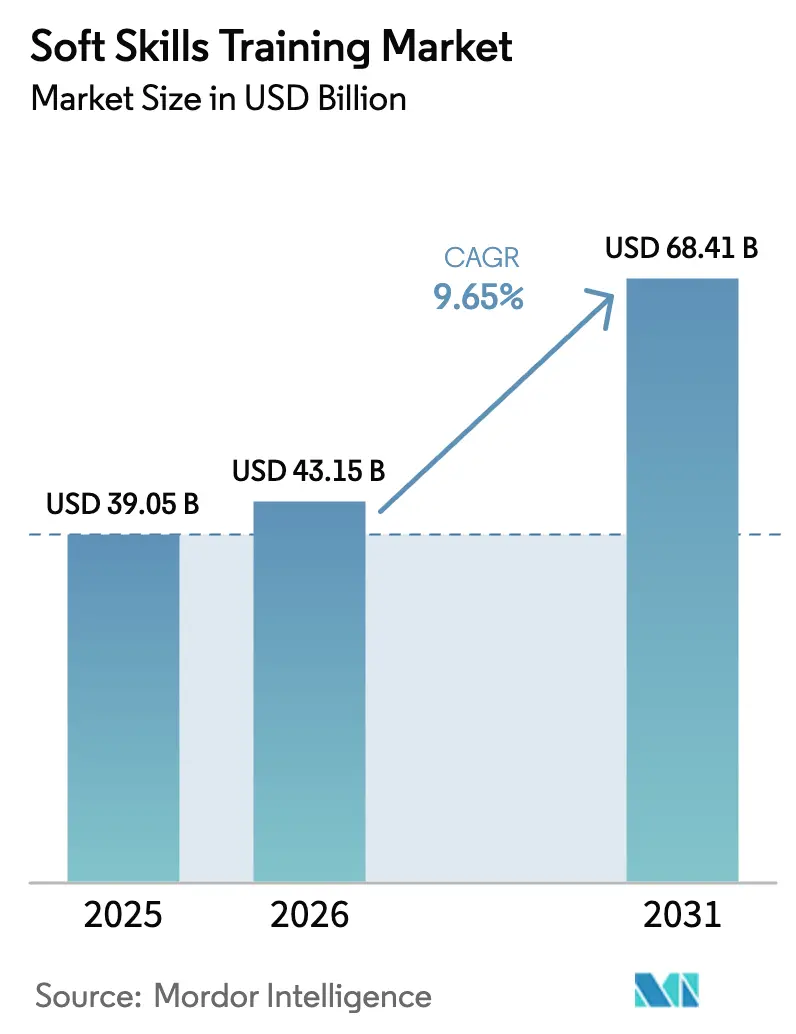
The Soft skills training market size was valued at USD 39.05 billion in 2025 and estimated to grow from USD 43.15 billion in 2026 to reach USD 68.41 billion by 2031, at a CAGR of 9.65% during the forecast period (2026-2031). A rapid shift toward hybrid work, fast-moving AI adoption, and rising employee mobility are pushing learning and development budgets toward interpersonal capabilities rather than purely technical courses. Enterprises now treat leadership, adaptability, and emotional intelligence as revenue-critical skills, particularly as AI agents begin to automate routine tasks. Organizations also prioritize measurable behavior change, driving demand for platforms that blend in-person feedback with adaptive digital modules. Regional momentum is split between North America, which concentrates on outcome tracking, and Asia Pacific, which is scaling programs quickly amid workforce expansion and government mandates.
Key Report Takeaways
- By delivery mode, blended learning captured 33.62% revenue share of the Soft skills training market in 2025, and it is advancing at a 10.11% CAGR through 2031.
- By skills type, leadership and management held 28.91% of Soft skills training market share in 2025, while adaptability and resilience is projected to expand at a 9.93% CAGR through 2031.
- By certification status, certification-oriented courses accounted for 41.53% share of the Soft skills training market size in 2025 and are expected to grow at a 10.25% CAGR through 2031.
- By end-user industry, IT and telecom contributed 22.84% revenue share in 2025, whereas healthcare and life sciences is forecast to post the fastest 10.42% CAGR to 2031.
- By geography, North America commanded 39.66% share of the Soft skills training market in 2025, but Asia Pacific is predicted to be the quickest region with a 10.55% CAGR during 2026-2031.
Note: Market size and forecast figures in this report are generated using Mordor Intelligence’s proprietary estimation framework, updated with the latest available data and insights as of 2026.
Global Soft Skills Training Market Trends and Insights
Drivers Impact Analysis*
| Driver | (~) % Impact on CAGR Forecast | Geographic Relevance | Impact Timeline |
|---|---|---|---|
| Hybrid-Workforce Collaboration Demand | +2.1% | Global, with concentration in North America and Europe | Short term (≤ 2 years) |
| Corporate Leadership-Development Priorities | +1.8% | Global, strongest in North America and Asia Pacific | Medium term (2-4 years) |
| Rise of Mobile and Micro-Learning Platforms | +1.5% | Global, with early adoption in Asia Pacific and North America | Short term (≤ 2 years) |
| Government-Funded Upskilling Initiatives | +1.3% | Europe, North America, and Asia Pacific core markets | Medium term (2-4 years) |
| AI-Driven Behavioral Analytics for Personalization | +1.6% | North America and Europe, expanding to Asia Pacific | Long term (≥ 4 years) |
| ESG-Linked Human-Capital Disclosure Mandates | +1.0% | Europe and North America, with spillover to multinational operations globally | Long term (≥ 4 years) |
| Source: Mordor Intelligence | |||
Hybrid-Workforce Collaboration Demand
Permanent hybrid schedules unmasked gaps in virtual teamwork, forcing companies to teach managers how to run inclusive online meetings, build trust across time zones, and prevent duplicated work. Completion data show that teams lacking structured collaboration training suffer deadlines slips and disengagement costs that outweigh program fees. Enterprises now pair technology rollouts with soft-skill courses so employees can exploit collaboration tools fully, transforming these programs into urgent rather than discretionary spend. The driver exerts its strongest pull in North America and Europe, where hybrid models are entrenched, yet multinationals replicate the playbook globally as distributed teams become normal.
Corporate Leadership-Development Priorities
Leadership curricula now emphasize psychological safety, inclusive decision making, and oversight of AI-augmented workflows. Senior executives receive coaching on AI ethics and governance, while middle managers focus on explaining algorithmic decisions to front-line staff. This role-specific approach replaces the former one-size-fits-all model and fuels vendor demand for modular content mapped to experience levels. Organizations that neglect to realign leadership development with AI-enabled operating models encounter lower engagement and higher turnover as managers struggle to balance automation and human empathy.
ESG-Linked Human-Capital Disclosure Mandates
Regulatory pressure to disclose workforce development metrics is transforming training from a discretionary expense to a compliance requirement. The EU's Corporate Sustainability Reporting Directive (CSRD), effective for large companies in 2025, mandates disclosure of employee training hours and skills development investments.[1]European Union, “Corporate Sustainability Reporting Directive,” eur-lex.europa.eu The US SEC proposed similar human-capital disclosure rules in 2024, though implementation remains uncertain. The strategic implication is that training vendors must now provide audit-trail documentation and standardized metrics that satisfy external reporting, not just internal L&D dashboards. Companies are consolidating training onto fewer platforms to simplify compliance, benefiting integrated providers like Skillsoft and LinkedIn Learning over point-solution vendors. The insight is that ESG mandates create a moat for incumbents with enterprise-grade reporting infrastructure, while disadvantaging smaller specialists who lack compliance features.
AI-Driven Behavioral Analytics for Personalization
Adaptive engines now track learner behavior, identify concept mastery gaps, and reorder content dynamically, raising completion and retention metrics. Enterprises with thousands of employees value this precision because blanket programs often overspend on skills participants already possess. Vendors who embed behavioral analytics shift bargaining power from content catalogs to algorithmic capability, enabling premium pricing tied to demonstrable improvement in engagement or productivity. Privacy regulations in Europe create compliance hurdles, though anonymization techniques are beginning to win employee acceptance.
Restraints Impact Analysis*
| Restraint | (~) % Impact on CAGR Forecast | Geographic Relevance | Impact Timeline |
|---|---|---|---|
| Budget Constraints in SMEs | -1.2% | Global, with acute pressure in emerging markets and recession-exposed sectors | Short term (≤ 2 years) |
| Difficulty Measuring Soft-Skill ROI | -0.9% | Global, particularly in cost-conscious North America and Europe | Medium term (2-4 years) |
| Language and Localization Complexity | -0.7% | Asia Pacific, Middle East, and multilingual European markets | Long term (≥ 4 years) |
| Free MOOCs Intensifying Price Pressure | -0.8% | Global, with strongest impact on individual learners and education sector | Medium term (2-4 years) |
| Source: Mordor Intelligence | |||
Budget Constraints in SMEs
Small and medium enterprises trim learning budgets quickly when revenue pressure rises because training is funded as a share of sales rather than as capital expenditure.[2]Government of Canada, “Budget 2025: Skills Development Investments,” canada.ca Many SMEs also lack internal L&D staff to negotiate volume discounts, forcing them to buy per-seat licenses at premium prices. Vendors respond by offering freemium access yet rely on upselling certification fees, a tactic that often cannibalizes revenue and slows overall market expansion. The restraint is most severe in emerging economies where credit tightens first during downturns, dampening near-term growth for the Soft skills training market.
Difficulty Measuring Soft-Skill ROI
Interpersonal competencies translate into outcomes such as lower churn or higher customer satisfaction, but these benefits unfold indirectly and are hard to model. Without clear attribution, finance teams treat soft-skill programs as overhead, exposing them to cost-cutting rounds. Platforms that attach predictive analytics and correlate training exposure with performance metrics in specific roles gain a competitive edge because they convert an intangible benefit into a data-backed business case. Until such analytics become mainstream, many firms under-invest relative to the potential payoff, capping market growth in several mature regions.
*Our forecasts treat driver/restraint impacts as directional, not additive. The impact forecasts reflect baseline growth, mix effects, and variable interactions.
Segment Analysis
By Delivery Mode: Blended Learning Extends Its Lead
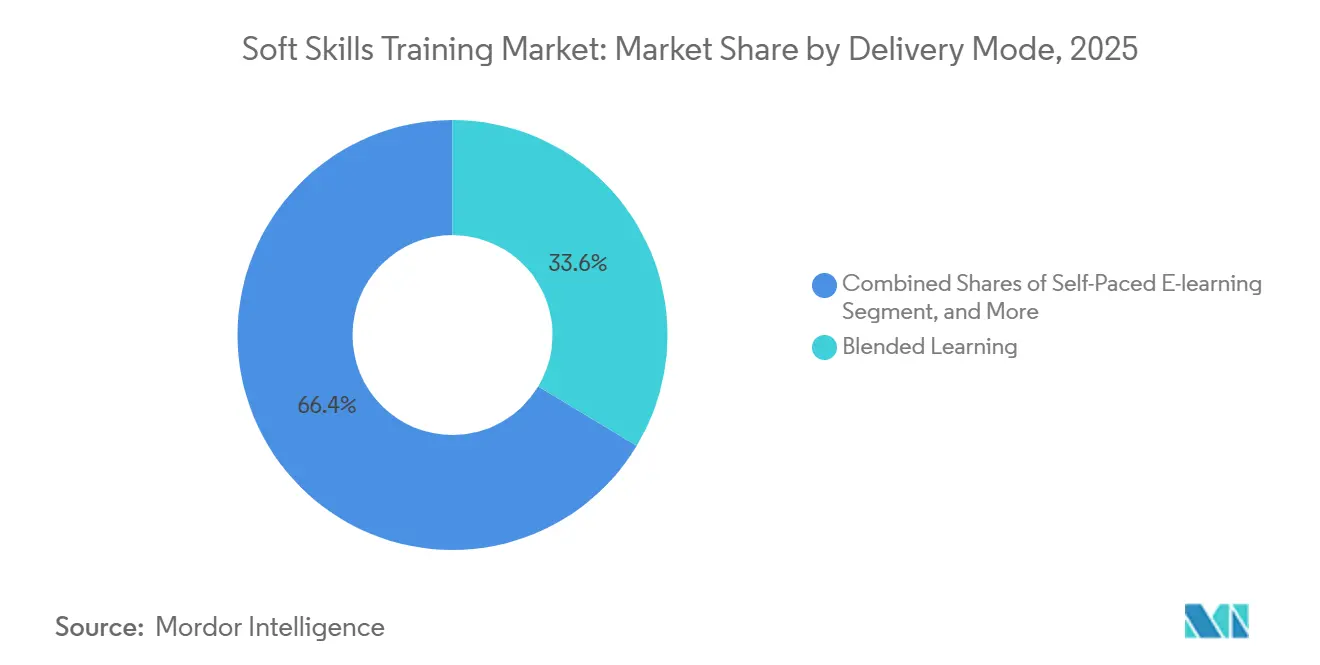
Blended programs accounted for 33.62% revenue share of the Soft skills training market in 2025 and are on track for a 10.11% CAGR from 2026-2031, giving them the strongest growth profile among delivery models. Organizations prefer these programs because digital modules scale content efficiently while face-to-face workshops provide coaching moments that embed behavioral change. In contrast, self-paced e-learning still holds the largest user base yet suffers low completion, which erodes its revenue contribution over time. Online instructor-led formats cooled after an early pandemic boom because extended video sessions created fatigue, though AI-supported virtual facilitators may revive interest. Offline classroom sessions remain valuable for executive cohorts or crisis simulations where confidentiality and immersion justify travel budgets.
Blended models also support data collection that feeds adaptive algorithms, creating a feedback loop that improves program precision. Enterprises bundle asynchronous lessons, collaborative projects, and live feedback in one pathway, generating artifact-level evidence for ESG reporting requirements. This structure aligns with compliance needs while satisfying learner demand for flexible scheduling. With procurement teams demanding proof of impact, vendors offering mature blended frameworks backed by analytics win multi-year contracts, further consolidating the segment’s lead in the Soft skills training market.



By Skills Type: Adaptability and Resilience Accelerate
Leadership and management remained the largest contributor at 28.91% Soft skills training market share in 2025, reflecting perennial executive attention to strategic direction and people oversight. However, adaptability and resilience is registering the fastest 9.93% CAGR because employees confront continuous AI-driven role changes and economic volatility. Communication and presentation skills keep steady demand for client-facing roles, while collaboration content addresses persistent friction in hybrid teams. Programs aimed at creativity and critical thinking gain traction as companies differentiate human insight from automated outputs, and emotional intelligence modules now anchor many leadership paths after research linked those competencies to higher innovation scores.
Vendors increasingly unbundle course catalogs into micro-certificates tied to discrete outcomes such as shortening product cycles or improving clinical error rates. The trend weakens the appeal of generic “soft skills” bundles and raises the bar for context-rich scenarios modeled on each industry’s workflows. Providers who localize role-specific examples, for instance adapting conflict-resolution exercises for cross-border project teams, win higher repeat enrollments, boosting the segment’s contribution to the broader Soft skills training market size.
By Certification Status: Credentials Gain Momentum
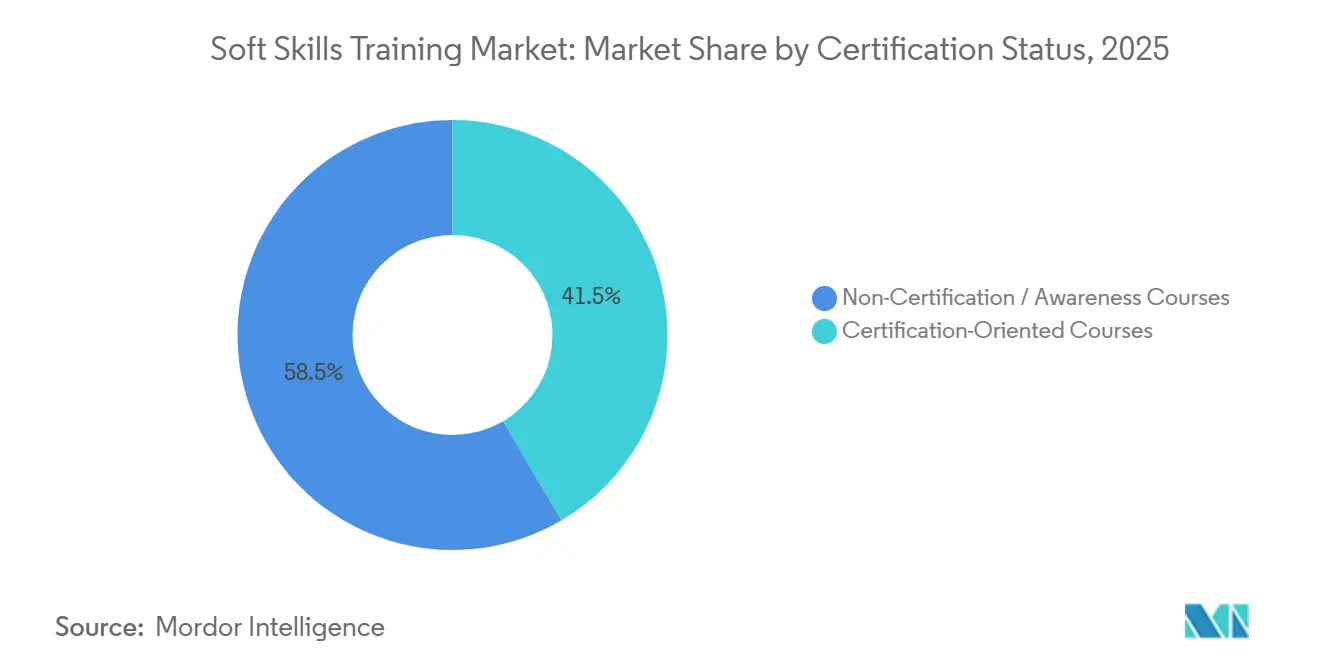
Certification-oriented courses captured 41.53% revenue share in 2025 and are expected to advance at a 10.25% CAGR through 2031, eclipsing non-certification courses in both growth and perceived value. Portable credentials help employees signal verified proficiency to prospective employers, which aligns with rising job mobility. Governments also direct public upskilling funds toward accredited programs with measurable employment outcomes, accelerating institutional demand. Non-certification courses still serve organizational culture or awareness needs, yet they face scrutiny during budgeting rounds because ROI proof trails certified alternatives.
Providers therefore negotiate partnerships with professional associations to align assessments with industry standards. Stackable certificates that articulate into degree pathways or licensing schemes enhance learner motivation and justify premium pricing. Platforms lacking recognized exams risk commoditization as free open-access resources fill basic knowledge gaps. This divergence widens revenue dispersion within the Soft skills training market and encourages consolidation around credential-ready offerings.
By End-User Industry: Healthcare Drives Upside
IT and telecom generated 22.84% of Soft skills training market revenues in 2025 owing to large technology workforces that regularly upskill in customer consultation and agile management. Looking ahead, healthcare and life sciences carry the hottest growth at 10.42% CAGR because post-pandemic operating stress underscored how communication lapses cause medical errors. Hospitals now embed interpersonal modules into nurse residency and physician leadership tracks, expanding addressable spend beyond compliance courses. BFSI maintains stable purchasing patterns around ethical decision making and client empathy as digital banking spreads.
Retail and e-commerce allocate training toward frontline service engagement as competition for consumer loyalty tightens. Government and defense fund leadership cultivation for mission readiness, while education institutions split budgets between faculty pedagogy and student career preparation. Manufacturing sectors connect lean production success with shop-floor communication, driving gradual yet steady adoption of team-based problem solving curricula. Customization by vertical remains non-negotiable because domain-specific vocabulary accelerates knowledge transfer.
Geography Analysis
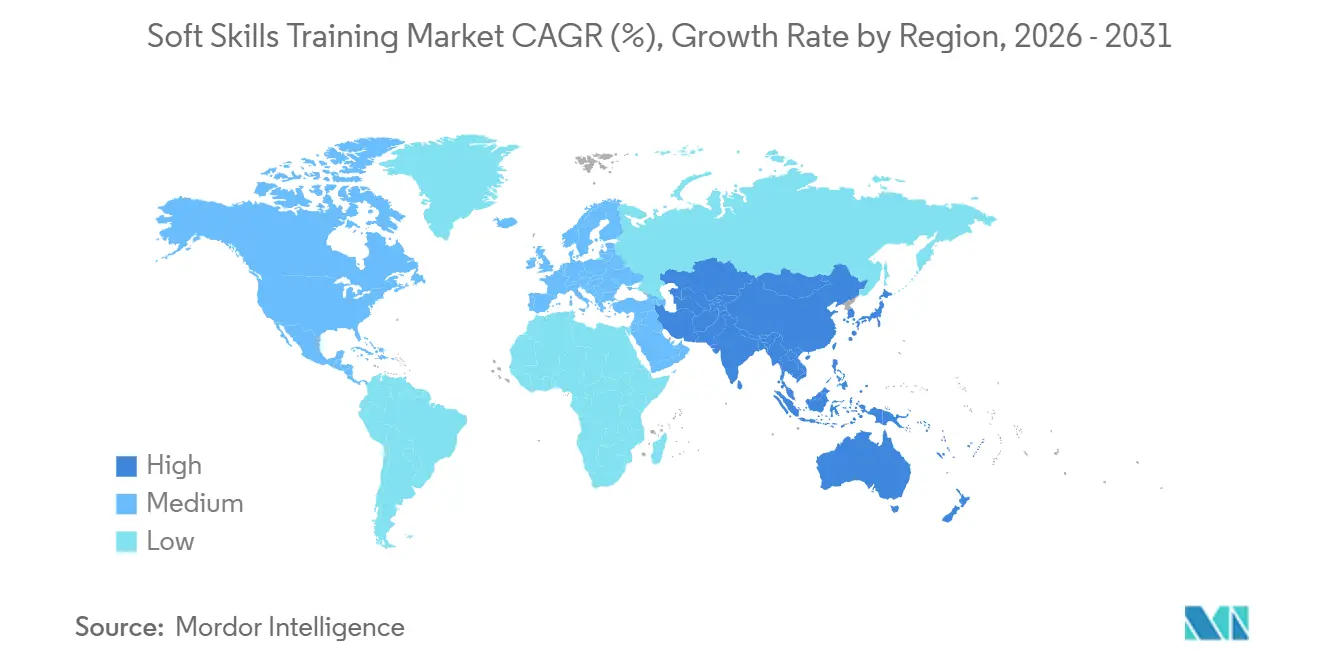
North America retained 39.66% share of the Soft skills training market in 2025, benefiting from mature corporate learning ecosystems and large per-employee training budgets. Buyers in the United States and Canada increasingly demand platform analytics that correlate training exposure with productivity metrics, boosting contracts for vendors able to embed behavioral dashboards. Government funding in Canada, totaling CAD 450 million (USD 340 million) in 2025, further stimulates regional demand, especially for certification-linked programs.[3]Bank of Canada, “Average Annual Exchange Rates 2025,” bankofcanada.ca Even so, overall North American growth moderates compared with emerging regions because enterprises there already possess sizable installed course libraries.
Europe follows closely with demand shaped by labor directives and sustainability regulations. The Corporate Sustainability Reporting Directive requires large European firms to disclose workforce development investments starting in 2025, effectively converting many learning initiatives into compliance obligations. Public funds such as the United Kingdom’s GBP 275 million (USD 350 million) 2025 training allocation sharpen focus on accredited upskilling, while multilingual workforces raise localization requirements that favor providers with robust translation pipelines. Germany, France, and Spain allocate significant budgets to manufacturing-related interpersonal skills, supporting steady but competitive revenue streams.
Asia Pacific is forecast to record the fastest 10.55% CAGR during 2026-2031 as governments in China, India, Japan, and South Korea anchor economic policy on human-capital development. China’s corporate upskilling mandates push firms to adopt large-scale blended programs, and India’s thriving IT services sector invests in client communication excellence to protect offshore contracts. Japan confronts demographic headwinds, prompting emphasis on knowledge transfer from retiring experts to younger teams, while South Korean conglomerates cultivate global leadership pipelines. Vendors successful in the region tailor offerings to local languages, exam requirements, and device preferences such as mobile-first interfaces.
Middle East markets, led by Saudi Arabia and the United Arab Emirates, inject public funds through diversification visions that include leadership and innovation courses for national talent. Africa’s opportunity is nascent outside South Africa, yet growth potential exists where mobile networks can bypass limited physical infrastructure. South America experiences cyclical spending linked to macroeconomic swings, but multinational subsidiaries keep a baseline of demand for customer service and compliance training.

Competitive Landscape
The Soft skills training market is fragmented, with no single provider controlling more than 8% global revenue, reflecting low entry barriers and diverse niche requirements. Major platforms such as Skillsoft, LinkedIn Learning, and Coursera exploit extensive content libraries to service broad corporate clusters, bundling authoring tools and analytics to defend renewal rates. Specialist firms like Franklin Covey, Dale Carnegie, and Cegos trade on long-standing reputations in executive coaching and culture change, commanding premium fees for instructor-led modules woven into blended journeys.
Competitive attention has moved from catalog breadth to learning efficacy, making AI-powered personalization a centerpiece of differentiation. Vendors integrate adaptive engines that diagnose learner gaps, reorder material on the fly, and benchmark skill acquisition with behavioral metrics, delivering evidence for ESG or board reporting. Acquisitions of analytics startups illustrate an arms race for algorithmic sophistication, while partnerships with professional bodies secure accreditation pipelines that reinforce high-margin credential courses.
Large enterprises increasingly build in-house academies, favoring platforms that offer flexible content creation suites, social features, and integrations with HR systems. This shift threatens pure-content providers that cannot pivot beyond licensing. Conversely, opportunity remains in vertical specialties such as healthcare communication or financial compliance, where domain expertise outweighs generic coverage. Smaller vendors carving out these niches achieve outsized influence but face scaling constraints without capital for localization and technology upgrades.
Soft Skills Training Industry Leaders
Skillsoft Corporation
LinkedIn Corporation
Coursera Inc.
Udemy Inc.
Pluralsight Inc.
- *Disclaimer: Major Players sorted in no particular order

Recent Industry Developments
- February 2026: Skillsoft released a privacy-first adaptive engine compliant with European data standards, strengthening its value proposition for multinational clients.
- January 2026: LinkedIn Learning launched its "Skills Graph 2.0" powered by generative AI, which maps individual competency gaps against organizational needs in real-time.
- December 2025: Skillsoft completed its acquisition of SumTotal Systems for USD 200 million, consolidating learning management and talent development capabilities.
- November 2025: Udemy Business expanded into Latin America with localized content in Portuguese and Spanish, partnering with regional enterprises in Brazil, Mexico, and Argentina.


Global Soft Skills Training Market Report Scope
The Soft Skills Training Market refers to the industry focused on providing training programs aimed at enhancing interpersonal, communication, and professional skills that are essential for personal and organizational success. This market encompasses various delivery modes, skill types, certification statuses, and caters to diverse end-user industries across different geographical regions. The training programs are designed to improve leadership, teamwork, adaptability, emotional intelligence, and other critical soft skills
The Soft Skills Training Market Report is Segmented by Delivery Mode (Online Instructor-Led, Self-Paced E-learning, Blended Learning, and Offline/Workshop/Classroom), Skills Type (Leadership and Management, Communication and Presentation, Collaboration and Teamwork, Time and Productivity, Creativity and Critical Thinking, Emotional Intelligence and Empathy, and Adaptability and Resilience), Certification Status (Certification-Oriented Courses and Non-Certification/Awareness Courses), End-User Industry (BFSI, Healthcare and Life Sciences, Retail and E-Commerce, Government and Defense, Education, Hospitality and Tourism, IT and Telecom, Manufacturing and Industrial, and Other End-User Industries), and Geography (North America, South America, Europe, Asia-Pacific, Middle East, and Africa). The Market Forecasts are Provided in Terms of Value (USD).
| Online Instructor-Led |
| Self-Paced E-learning |
| Blended Learning |
| Offline / Workshop / Classroom |
| Leadership and Management |
| Communication and Presentation |
| Collaboration and Teamwork |
| Time and Productivity |
| Creativity and Critical Thinking |
| Emotional Intelligence and Empathy |
| Adaptability and Resilience |
| Certification-Oriented Courses |
| Non-Certification / Awareness Courses |
| BFSI |
| Healthcare and Life Sciences |
| Retail and E-Commerce |
| Government and Defense |
| Education |
| Hospitality and Tourism |
| IT and Telecom |
| Manufacturing and Industrial |
| Other End-User Industries |
| North America | United States |
| Canada | |
| Mexico | |
| South America | Brazil |
| Argentina | |
| Rest of South America | |
| Europe | Germany |
| United Kingdom | |
| France | |
| Spain | |
| Rest of Europe | |
| Asia-Pacific | China |
| Japan | |
| India | |
| South Korea | |
| Rest of Asia-Pacific | |
| Middle East | Saudi Arabia |
| United Arab Emirates | |
| Turkey | |
| Rest of Middle East | |
| Africa | South Africa |
| Rest of Africa |
| By Delivery Mode | Online Instructor-Led | |
| Self-Paced E-learning | ||
| Blended Learning | ||
| Offline / Workshop / Classroom | ||
| By Skills Type | Leadership and Management | |
| Communication and Presentation | ||
| Collaboration and Teamwork | ||
| Time and Productivity | ||
| Creativity and Critical Thinking | ||
| Emotional Intelligence and Empathy | ||
| Adaptability and Resilience | ||
| By Certification Status | Certification-Oriented Courses | |
| Non-Certification / Awareness Courses | ||
| By End-User Industry | BFSI | |
| Healthcare and Life Sciences | ||
| Retail and E-Commerce | ||
| Government and Defense | ||
| Education | ||
| Hospitality and Tourism | ||
| IT and Telecom | ||
| Manufacturing and Industrial | ||
| Other End-User Industries | ||
| By Geography | North America | United States |
| Canada | ||
| Mexico | ||
| South America | Brazil | |
| Argentina | ||
| Rest of South America | ||
| Europe | Germany | |
| United Kingdom | ||
| France | ||
| Spain | ||
| Rest of Europe | ||
| Asia-Pacific | China | |
| Japan | ||
| India | ||
| South Korea | ||
| Rest of Asia-Pacific | ||
| Middle East | Saudi Arabia | |
| United Arab Emirates | ||
| Turkey | ||
| Rest of Middle East | ||
| Africa | South Africa | |
| Rest of Africa | ||


Key Questions Answered in the Report
How large will the Soft skills training market be by 2031?
It is projected to reach USD 68.41 billion by 2031, expanding at a 9.65% CAGR from 2026.
Which delivery model is growing fastest?
Blended learning is advancing at a 10.11% CAGR because it mixes scalable digital content with high-impact in-person coaching.
Why is healthcare investing heavily in soft-skills programs?
Post-pandemic staffing gaps revealed that communication failures raise medical error risk, pushing healthcare and life sciences to a 10.42% CAGR through 2031.
What makes certification-oriented courses attractive?
Portable credentials signal verified competence to employers and align with government funding criteria, driving a 10.25% CAGR for this segment.
Which region offers the strongest growth outlook?
Asia Pacific leads with a projected 10.55% CAGR as China, India, Japan, and South Korea scale corporate upskilling mandates.
How are vendors differentiating in a fragmented landscape?
Providers embed AI-driven personalization and secure accreditation partnerships to demonstrate measurable behavior change and satisfy ESG reporting needs.
Page last updated on:


 Your data is secure and never sold or shared.


