
Fox Nuts Market Size and Share
Market Overview
| Study Period | 2021 - 2031 |
|---|---|
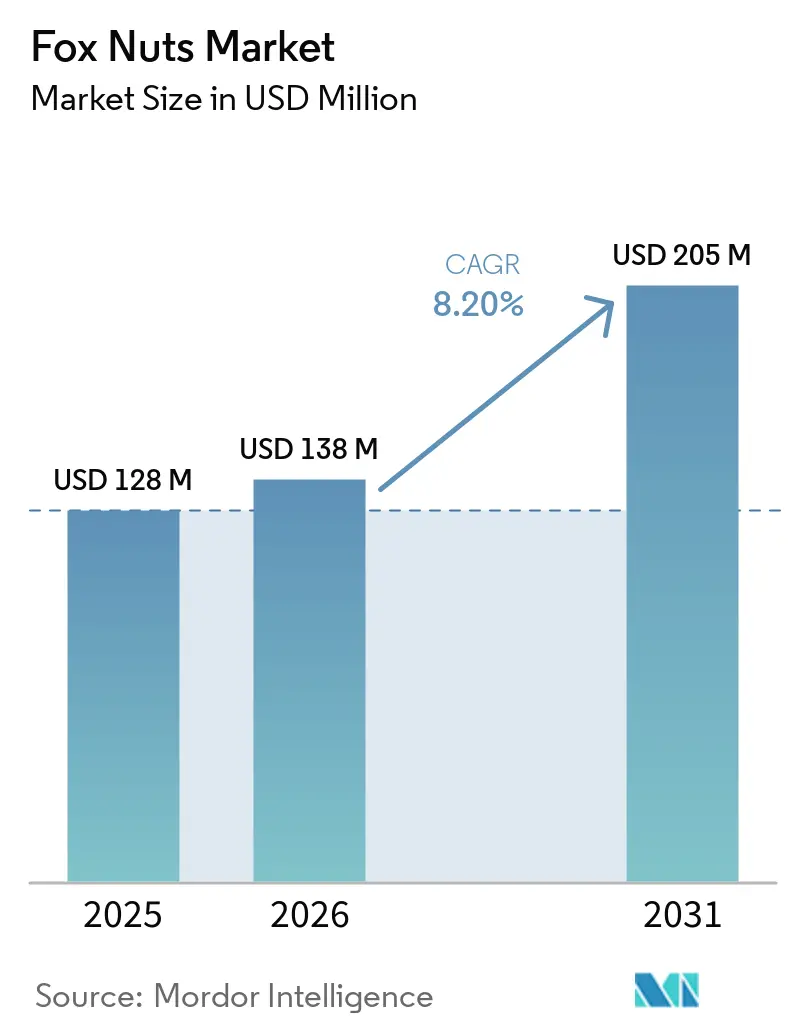
| Market Size (2026) | USD 138 Million |
| Market Size (2031) | USD 205 Million |
| Growth Rate (2026 - 2031) | 8.20 % |
| Fastest Growing Market | North America |
| Largest Market | Asia Pacific |
| Market Concentration | Medium |
Major Players *Disclaimer: Major Players sorted in no particular order Image © Mordor Intelligence. Reuse requires attribution under CC BY 4.0. | |
Fox Nuts Market Analysis by Mordor Intelligence
The fox nuts market size is projected to increase from USD 128 million in 2025 to USD 138 million in 2026 and reach USD 205 million by 2031, growing at a CAGR of 8.20% over 2026-2031. Expanding cultivation in India, premium positioning in Western retail markets, and a shift toward direct-to-consumer channels are driving both volume growth and price realization in the fox nuts market, despite challenges in the plant-based snacks segment. The Asia-Pacific region remains a key demand center due to established consumption patterns, while North America is emerging as a high-growth market, fueled by retailer emphasis on gluten-free and plant-based protein products. Processed and flavored variants dominate the market, reflecting strong consumer demand for convenient, ready-to-eat snack options that cater to evolving taste preferences. Additionally, organic fox nuts are gaining popularity as clean-label regulations become stricter, prompting investments in certified and traceable supply chains. The rapid expansion of online and omnichannel retail is enhancing accessibility and enabling faster brand growth, supported by investments in digital presence and the expansion of physical distribution networks in both emerging and established markets.
Key Report Takeaways
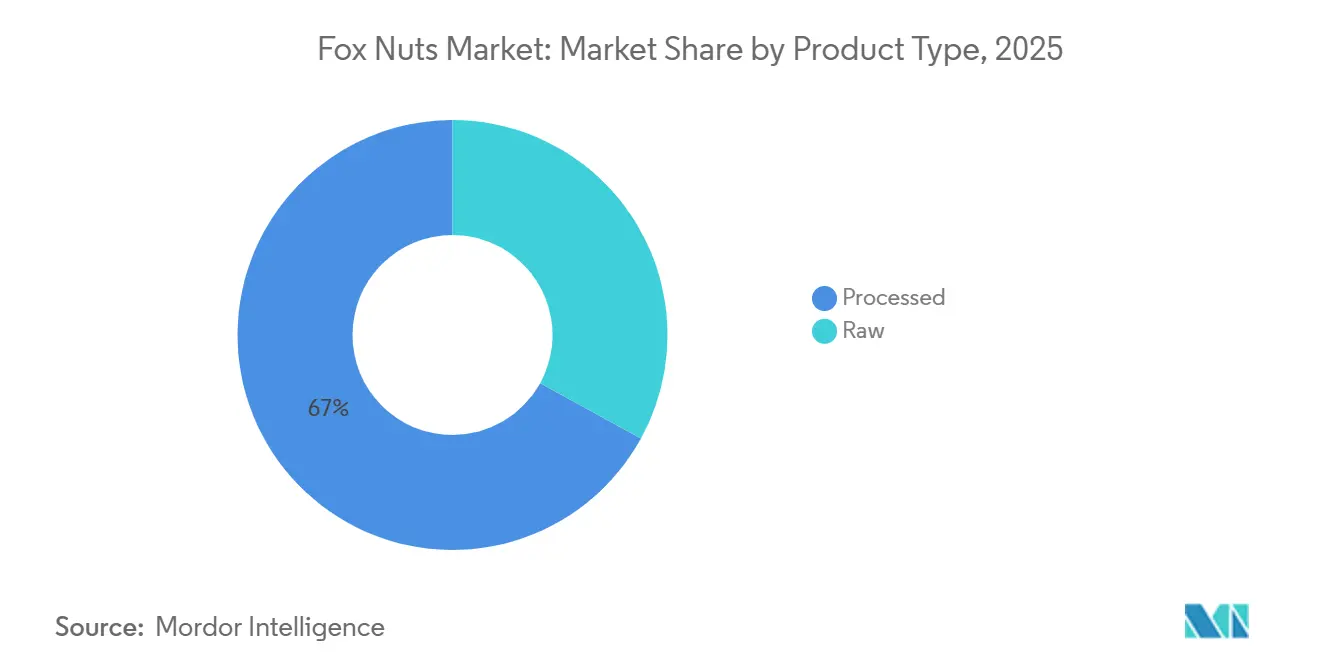
- By type, processed/flavored products accounted for the largest share of 67% of the fox nuts market in 2025 and are also the fastest-growing segment in the fox nuts market size, projected to grow at a 10.2% CAGR during 2026-2031.
- By nature, conventional fox nuts accounted for the largest share of 70% of the fox nuts market size in 2025, while organic variants are the fastest-growing segment in the fox nuts market share, projected to grow at a 12.5% CAGR during 2026-2031.
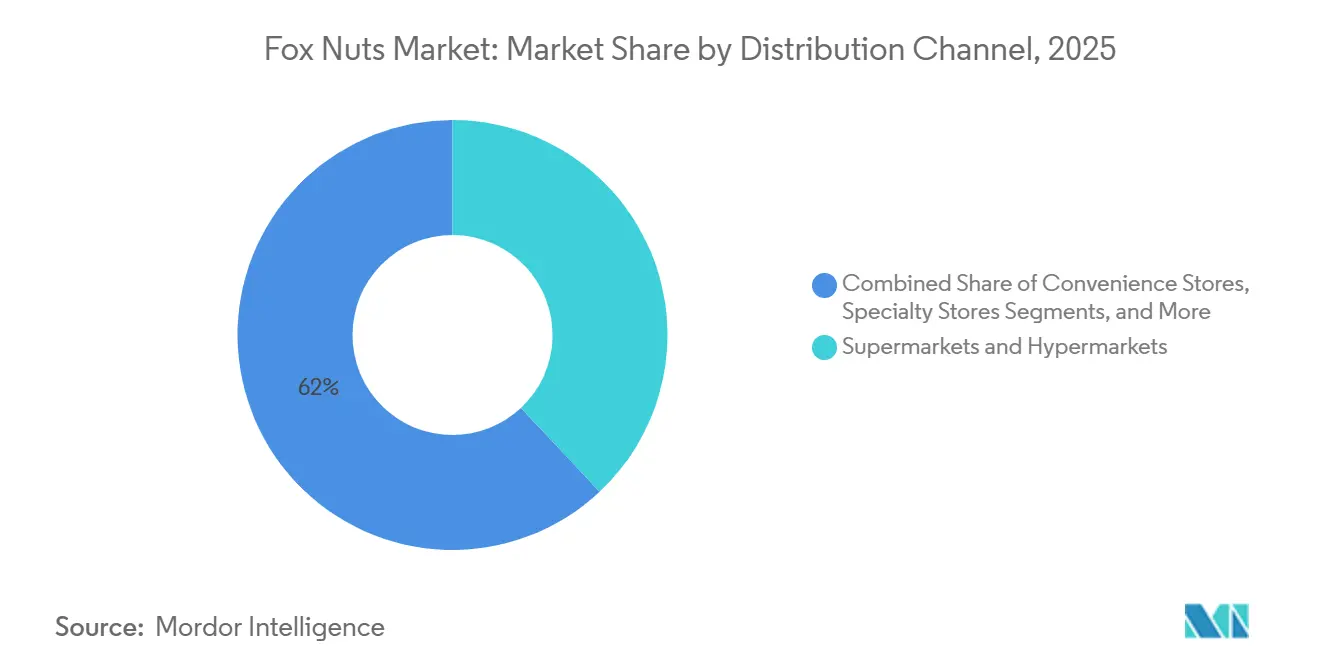
- By distribution channel, supermarkets and hypermarkets accounted for the largest share of 38% of the fox nuts market in 2025, while online and D2C platforms are the fastest-growing segment in the fox nuts market, projected to grow at a 12.5% CAGR during 2026-2031.
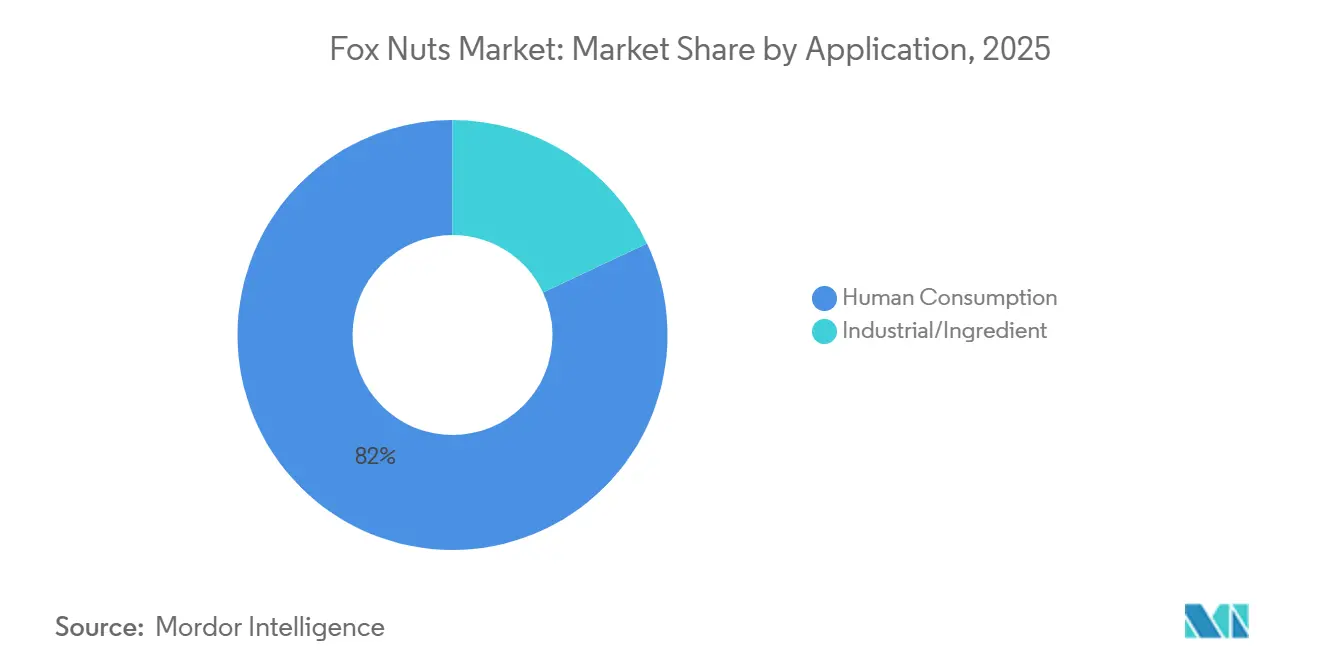
- By application, human consumption accounted for the largest share of 82% of the fox nuts market in 2025, while industrial/ingredient use is the fastest-growing segment in the fox nuts market share, projected to grow at a 9.9% CAGR during 2026-2031.
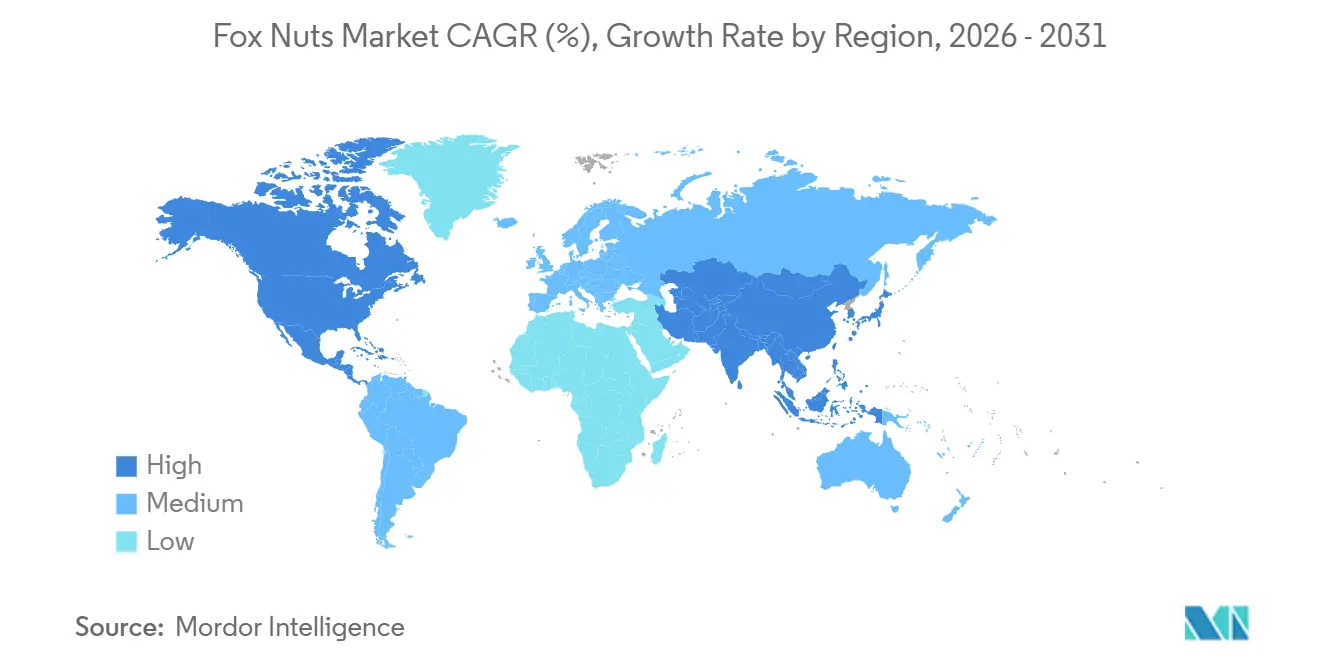
- By geography, Asia-Pacific accounted for the largest share of 58% of the fox nuts market size in 2025, while North America is the fastest-growing region in the fox nuts market share, projected to grow at a 9.3% CAGR during 2026-2031.
Note: Market size and forecast figures in this report are generated using Mordor Intelligence’s proprietary estimation framework, updated with the latest available data and insights as of January 2026.
Global Fox Nuts Market Trends and Insights
Drivers Impact Analysis*
| Driver | (~) % Impact on CAGR Forecast | Geographic Relevance | Impact Timeline |
|---|---|---|---|
| Growing demand for low-calorie, protein-rich snacks | +1.8% | Global, peak in North America and Europe | Medium term (2-4 years) |
| Rising popularity of plant-based and gluten-free diets | +1.5% | North America, Europe, and urban Asia-Pacific | Medium term (2-4 years) |
| Rapid expansion of online retail platforms | +1.3% | Global, led by Asia-Pacific and North America | Short term (≤ 2 years) |
| Premiumization of traditional Asian superfoods in Western markets | +1.2% | North America, Europe, and the Middle East | Medium term (2-4 years) |
| Introduction of vacuum-roasting and nitrogen-flush packaging technologies | +0.9% | Global, early adoption in Asia-Pacific and North America | Long term (≥ 4 years) |
| Adoption of contract farming models that stabilize raw-material prices | +0.7% | Asia-Pacific core, spillover to Middle East and Africa | Long term (≥ 4 years) |
| Source: Mordor Intelligence | |||
Growing Demand for Low-Calorie, Protein-Rich Snacks
Protein has become a key factor influencing snack preferences among the United States consumers, alongside a rising demand for low- or no-added-sugar options[1]Source: International Food Information Council, “2024 Food and Health Survey,” ific.org. Fox nuts serve as a naturally nutrient-rich alternative to traditional snacks, offering protein with fewer calories compared to many conventional products. Regulatory updates from the Food and Drug Administration are prompting brands to reformulate products by lowering sodium and saturated fat levels to align with revised “healthy” criteria. In response, supermarkets are allocating more shelf space to protein-based snacks, often at the expense of traditional confectionery items. Furthermore, employer-supported wellness programs that incentivize healthier purchasing behaviors are reducing consumer costs, fostering greater adoption and repeat purchases across North America.
Rising Popularity of Plant-Based and Gluten-Free Diets
Europe's gluten-free market is experiencing steady growth, with Germany accounting for a significant share of the demand. In the United States, a considerable number of households purchase plant-based foods, reflecting a stable consumer base despite short-term sales variations[2]Source: Good Food Institute, “US Plant-Based Food Sales 2023,” gfi.org. Fox nuts cater effectively to both vegan and gluten-free preferences, allowing brands to position them within the expanding "free-from" segment and achieve premium pricing compared to traditional snacks. In the Asia-Pacific region, consumer interest in functional foods remains robust, particularly for products with antioxidant and anti-inflammatory properties. This increasing demand is driving export growth from India, with a significant portion directed toward the United States.
Rapid Expansion of Online Retail Platforms
Digital channels currently represent a smaller share of global snack sales but are rapidly expanding, supported by increasing consumer adoption of online purchasing. Recent investments in direct-to-consumer models highlight strong confidence in digital distribution, with brands focusing on expanding retail and online touchpoints alongside subscription-based offerings that improve repeat purchases. In markets such as China, high online penetration in health-related categories sets a benchmark for digital growth, influencing strategies in Western markets. Features such as subscription discounts, detailed product pages, influencer marketing, and targeted advertising are helping brands educate consumers and drive retention, particularly for premium snack categories like fox nuts.
Premiumization of Traditional Asian Superfoods in Western Markets
Flavored fox nuts are priced at a premium compared to traditional snack options, driven by their perceived functional and health benefits. Consumers are willing to pay higher prices for these attributes. Brands focusing on "better-for-you" products are experiencing significantly faster growth than the broader snack category and are attracting considerable mergers and acquisitions activity. Key acquisitions in the food industry reflect a strategic shift toward health-oriented portfolios, with investments moving away from traditional confectionery segments. Private equity interest in plant-based and functional snacks is also increasing, providing robust funding for innovation in categories such as fox nuts. Additionally, positioning fox nuts with wellness ingredients like matcha or turmeric in retail settings enhances their superfood image and supports premium pricing strategies.
Restraints Impact Analysis*
| Restraint | (~) % Impact on CAGR Forecast | Geographic Relevance | Impact Timeline |
|---|---|---|---|
| Limited agro-climatic zones suitable for cultivation | −1.4% | Asia-Pacific core, spillover to South America and Africa | Long term (≥ 4 years) |
| High production costs for certified-organic supply chains | −1.1% | Global, most acute in North America and Europe | Medium term (2-4 years) |
| Fragmented grower base causing quality variability | −0.9% | Asia-Pacific, Africa, and South America | Medium term (2-4 years) |
| Short shelf life in humid climates without cold-chain logistics | −0.8% | Asia-Pacific, Middle East, and Africa | Short term (≤ 2 years) |
| Source: Mordor Intelligence | |||
Limited Agro-Climatic Zones Suitable for Cultivation
Commercial production relies on shallow, stagnant water and warm temperatures, conditions predominantly found in Bihar’s Mithila wetlands, which form the core of India’s export supply. Pilot projects in Bangladesh and Nepal have shown lower yields due to challenges such as soil salinity and pest pressure. Variability in weather patterns, including delayed monsoons, has disrupted planting cycles, causing supply fluctuations and exerting pressure on processor margins. Future expansion is contingent on stable groundwater availability. However, increasing depletion in key growing regions such as Bihar eastern Uttar Pradesh, and West Bengal poses a significant limitation [3]Source: Central Ground Water Board, “Groundwater Depletion Gangetic Plain,” cgwb.gov.in. This geographic concentration introduces a single-point failure risk where events such as floods or pest outbreaks could disrupt 60-80% of global supply within a single season.
High Production Costs for Certified-Organic Supply Chains
Obtaining United States Department of Agriculture (USDA) organic certification entails upfront costs for growers, with a cost-share cap of USD 750, leaving farmers to cover a substantial portion independently. During the required transition period, yields typically decrease by 15%–30%, negatively affecting short-term profitability[4]Source: Agricultural Marketing Service, “Organic Certification Cost Share Program,” ams.usda.gov . Additionally, manual harvesting contributes to elevated production costs, while stringent European traceability requirements impose further compliance challenges. These factors collectively strain operating margins, necessitating processor support to facilitate certification, ensure a stable supply, and enable scalability.
*Our forecasts treat driver/restraint impacts as directional, not additive. The impact forecasts reflect baseline growth, mix effects, and variable interactions.
Segment Analysis
By Product Type: Processed/Flavored Variants Drive Premiumization
Processed/flavored fox nuts represented the largest share, accounting for 67% of the fox nuts market size in 2025. This reflects a strong consumer preference for value-added, ready-to-eat products that offer enhanced taste and convenience. This segment is also the fastest-growing, with a projected CAGR of 10.2% during 2026-2031, driven by rising demand for healthy snacking options and ongoing product innovation in both sweet and savory variants.
Advancements in processing technologies, such as vacuum roasting, are contributing to improved product quality, extended shelf life, and compliance with export standards in developed markets. Furthermore, brands are diversifying product portfolios and strengthening distribution through modern retail and e-commerce channels, increasing product visibility and accessibility. The growing preference for premium, functional snacks and clean-label products is also supporting market growth, enabling processed fox nuts to compete effectively with traditional snack categories while achieving higher price points.



By Nature: Organic Certification Unlocks Premium Channels
Conventional fox nuts are projected to account for the largest share, representing 70% of the fox nuts market size in 2025. This dominance is attributed to lower production costs, established supply chains, and broader availability through mass-market retail channels. Their affordability and familiarity among consumers have driven strong volume demand, particularly in price-sensitive markets. Organic fox nuts represent the fastest-growing segment, with an anticipated CAGR of 12.5% during 2026-2031. This growth is fueled by increasing consumer preference for clean-label and certified products, especially in developed markets. Regulatory developments and retailer emphasis on healthier product portfolios are further accelerating the shift toward organic offerings, particularly in North America and Europe.
Although organic certification entails higher upfront costs and potential yield reductions during the transition period, premium pricing and robust demand in specialty retail channels mitigate these challenges. Consequently, the market is evolving into a two-tier structure: conventional products cater to high-volume demand, while organic variants achieve higher margins through their differentiated positioning in health-focused segments.
By Distribution Channel: E-Commerce Rewrites Retail Economics
Supermarkets and hypermarkets represented the largest share, accounting for 38% of the fox nuts market in 2025. This dominance is attributed to their bulk procurement capabilities and strong in-store visibility. Convenience stores also hold a notable share, supported by impulse purchases and the availability of single-serve formats. Specialty health-food stores play a significant role by offering premium organic and flavored variants, appealing to health-conscious consumers.
Online retail and D2C channels are the fastest-growing segments, with a projected CAGR of 12.5% during 2026-2031. This growth is driven by increasing digital adoption and enhanced product accessibility. E-commerce facilitates rapid product innovation through real-time consumer feedback and supports targeted marketing strategies. Furthermore, direct brand engagement and storytelling foster consumer trust and authenticity, boosting adoption in premium and health-focused segments.
By Application: Industrial Use Gains as Reformulation Accelerates
Human consumption is projected to account for the largest share, at 82%, of the fox nuts market size in 2025. This growth is supported by the widespread availability of snack packs across retail channels and increasing consumer preference for healthier snacking options. Regulatory developments, such as stricter “healthy” criteria set by the United States Food and Drug Administration (FDA), are prompting brands to highlight the nutritional benefits of fox nuts. This emphasis is strengthening their position as a healthier alternative and sustaining demand across both mainstream and premium market segments.
The industrial/ingredient segment is projected to be the fastest-growing, with a projected CAGR of 9.9% during 2026-2031. This growth is driven by rising demand from bakery, cereal, and snack manufacturers seeking plant-based protein alternatives with lower fat content. Enhanced supply chain integration and quality standardization are ensuring consistent product specifications required by large-scale food manufacturers. Additionally, cost advantages over traditional nuts are encouraging reformulation efforts, supporting the increased use of fox nuts as a functional ingredient in processed food applications.
Geography Analysis
In 2025, the Asia-Pacific region accounted for the largest share of 58% of the fox nuts market size, driven by India’s strong export base and rising demand in China’s health supplement market, where online channels play a key role in product distribution. Regional growth is supported by increasing disposable incomes and government initiatives, such as the establishment of the National Makhana Board in 2025. The board oversees a scheme valued at about USD 56 million, spanning from 2025-26 to 2030-31, aimed at expanding cultivation and improving processing infrastructure. However, the fox nut market in the region remains fragmented, with most growers operating on small landholdings. This fragmentation results in inconsistent quality and higher rejection rates in export markets, which continue to limit overall export competitiveness.
North America is the fastest-growing region, with a projected CAGR of 9.3% from 2026 to 2031. Growth is fueled by strong consumer demand for plant-based, gluten-free, and protein-rich snacks. The United States and Canada are key import destinations, with demand focused on premium, flavored, and ready-to-eat retail formats. Regulatory changes, such as the United States Food and Drug Administration's (FDA) updated "healthy" labeling criteria, are encouraging retailers to prioritize minimally processed snack options, improving shelf positioning. Additionally, brand investments in omnichannel retail strategies and subscription-based e-commerce platforms are enhancing market penetration and driving repeat purchases.
Europe, the Middle East, Africa, and South America are experiencing steady but varied growth in the fox nuts market, influenced by regulatory frameworks, consumer awareness, and climatic conditions. In Europe, demand for gluten-free and organic products remains strong, though stricter traceability regulations are increasing compliance costs, benefiting established distributors. In the Middle East, growth is supported by premium retail and hospitality channels, though high humidity poses challenges for shelf life and storage. Africa and South America are emerging markets, with demand primarily concentrated in urban centers and expatriate communities, which limits broader market expansion opportunities.

Competitive Landscape
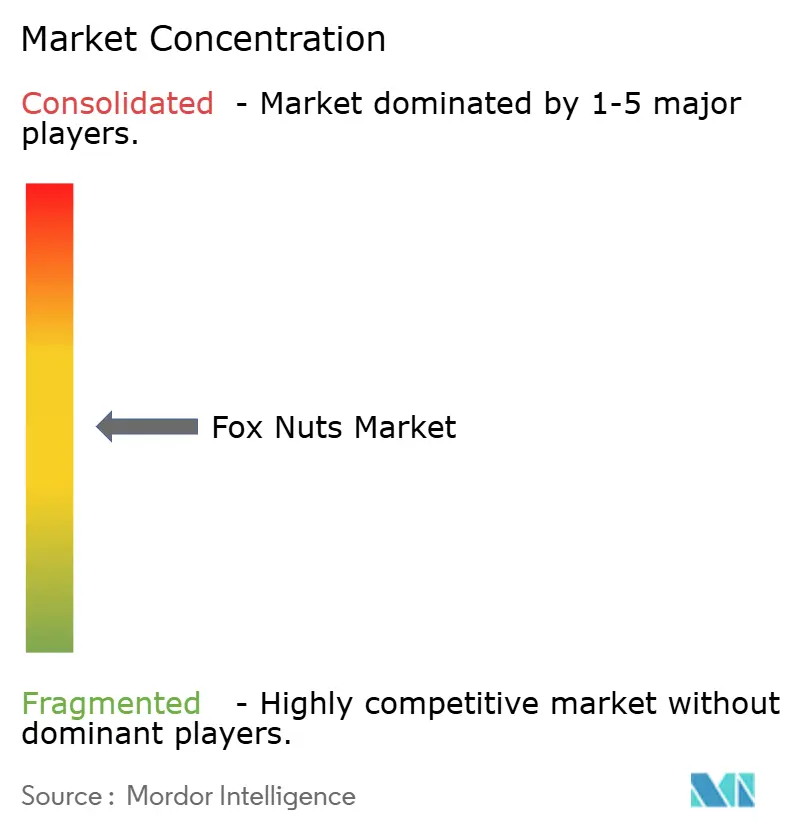
The fox nuts market demonstrates moderate concentration in 2025, with key players such as Madhubani Makhana Pvt. Ltd., Shaktisudha Makhana, Makhana Amrit Mantra Pte. Ltd., Indulge Foods Pvt. Ltd. (Farmley), and Sattviko holding significant revenue shares. The remaining market share is split between regional processors and emerging, digitally native brands. Companies like S.T Makhana, National Makhana Udyog, Mithila Makhana Pvt. Ltd., and Agricour India are focusing on strengthening supply networks and regional distribution. Meanwhile, Indulge Foods Pvt. Ltd. (Farmley) is expanding its presence through direct-to-consumer models, influencer-led marketing, and omnichannel retail. The shift toward branded and value-added products is intensifying competition, particularly in the flavored and ready-to-eat segments, as new entrants gain traction with differentiated offerings.
Rising interest in health-focused snacking is further intensifying competition, with both established players and newer brands investing in product innovation and premium positioning. Companies such as Delicéo Foods Pvt. Ltd., Harry Food Processing, The Indian Makhana, and TirhutWala Innovations Pvt. Ltd. are prioritizing improvements in product quality, packaging formats, and shelf stability to meet evolving retail demands in international markets. Advancements in processing techniques, such as vacuum roasting and controlled packaging environments, are enabling longer shelf life and consistent quality, which are critical for expanding exports to regions like North America and Europe.
Backward integration and operational efficiency are emerging as key differentiators in the competitive landscape. Shaktisudha Makhana and Mithila Makhana Pvt. Ltd. are strengthening relationships with farmers to secure raw material supplies and enhance cost stability. Additionally, companies such as Mera Kisan India and Darnif Exim are improving their procurement and export capabilities. The increasing adoption of automation and modern processing infrastructure is enabling higher throughput and reducing labor dependency, allowing companies to scale operations more efficiently. Simultaneously, the market is witnessing growing interest in functional and ingredient applications, positioning fox nuts beyond traditional snacking into broader health and nutrition segments.
Fox Nuts Industry Leaders
Madhubani Makhana Pvt. Ltd.
Shaktisudha Makhana
Makhana Amrit Mantra Pte. Ltd.
Indulge Foods Pvt. Ltd. (Farmley)
Sattviko
- *Disclaimer: Major Players sorted in no particular order

Recent Industry Developments
- September 2025: The Government of India launched the National Makhana Board with an allocation of approximately USD 12 million. The initiative aims to strengthen processing infrastructure, provide farmer training, promote exports, and support value addition. This is projected to formalize the fox nuts value chain and drive long-term market growth.
- June 2025: NutriPop won AgriNovus Indiana’s Velocity accelerator, receiving USD 25,000 from a USD 75,000 prize pool to advance the development of flavored fox nuts for the United States consumers. This reflects increasing innovation in value-added products, driving the growth of the fox nuts market beyond its traditional regions.
- February 2025: The Indian Council of Agricultural Research–Central Institute of Post-Harvest Engineering and Technology (CIPHET) licensed advanced makhana processing machinery, including a preliminary roaster and popping system, to Videhanutra India Private Limited (Bihar). This shift from manual to mechanized processing is anticipated to enhance production efficiency, reduce labor dependency, and improve scalability within the fox nuts market.
- December 2024: The Bihar Government organized a “Makhana Mahotsav” in Bengaluru to promote makhana consumption and expand trade linkages across southern India. The event focused on connecting producers with buyers and raising awareness of makhana’s nutritional benefits, thereby supporting demand growth in the fox nuts market.


Global Fox Nuts Market Report Scope
The fox nuts market covers the production, processing, and distribution of fox nuts (makhana) for human consumption, primarily driven by demand for healthy, plant-based snack and ingredient options. The Fox Nuts Market Report is Segmented by Product Type (Raw, and Processed/Flavored), by Nature (Conventional, and Organic), by Distribution Channel (Supermarkets and Hypermarkets, Convenience Stores, Specialty Stores, and Online Retail and D2C), by Application (Human Consumption, and Industrial/Ingredient), and by Geography (North America, South America, Europe, Asia-Pacific, Middle East and Africa). The Market Forecasts are Provided in Terms of Value (USD).
| Raw |
| Processed/Flavored |
| Conventional |
| Organic |
| Supermarkets and Hypermarkets |
| Convenience Stores |
| Specialty Stores |
| Online Retail and D2C |
| Human Consumption |
| Industrial/Ingredient |
| North America | United States |
| Canada | |
| Rest of North America | |
| South America | Brazil |
| Argentina | |
| Rest of South America | |
| Europe | Germany |
| United Kingdom | |
| Russia | |
| Rest of Europe | |
| Asia-Pacific | China |
| India | |
| Japan | |
| Australia | |
| Rest of Asia-Pacific | |
| Middle East | Saudi Arabia |
| United Arab Emirates | |
| Rest of Middle East | |
| Africa | South Africa |
| Kenya | |
| Rest of Africa |
| By Product Type | Raw | |
| Processed/Flavored | ||
| By Nature | Conventional | |
| Organic | ||
| By Distribution Channel | Supermarkets and Hypermarkets | |
| Convenience Stores | ||
| Specialty Stores | ||
| Online Retail and D2C | ||
| By Application | Human Consumption | |
| Industrial/Ingredient | ||
| By Geography | North America | United States |
| Canada | ||
| Rest of North America | ||
| South America | Brazil | |
| Argentina | ||
| Rest of South America | ||
| Europe | Germany | |
| United Kingdom | ||
| Russia | ||
| Rest of Europe | ||
| Asia-Pacific | China | |
| India | ||
| Japan | ||
| Australia | ||
| Rest of Asia-Pacific | ||
| Middle East | Saudi Arabia | |
| United Arab Emirates | ||
| Rest of Middle East | ||
| Africa | South Africa | |
| Kenya | ||
| Rest of Africa | ||


Key Questions Answered in the Report
What is the market size of fox nuts market and at what CAGR it is projected to post between 2026 and 2031?
The fox nuts market size is projected to increase from USD 138 million in 2026 and reach USD 205 million by 2031, growing at a CAGR of 8.20% over 2026-2031.
Which region shows the fastest expansion through 2026-2031?
North America leads with a projected 9.3% CAGR through 2026-2031, driven by protein and gluten-free demand.
Why are processed and flavored variants gaining the largest share?
They command 40%-60% retail premiums and already held 67% of global revenue in 2025.
How long can shelf life stretch with nitrogen-flush packaging?
Modified-atmosphere pouches can extend freshness to about 180 days under controlled humidity.
Page last updated on:


 Your data is secure and never sold or shared.


