
Rye Market Size and Share

Rye Market Analysis by Mordor Intelligence
The global rye market, valued at USD 3.80 billion in 2026, is projected to reach USD 4.60 billion by 2031, growing at a CAGR of 4.20%. Momentum stems from steady bakery demand in Europe, rising interest from North American distillers, and expanding feed use across Asia[3]Source: Food and Agriculture Organization, “FAOSTAT Crops Database,” fao.org . Tight Black Sea supplies have redirected trade toward Poland and Canada, while carbon-credit programs in the United States and Canada help growers offset lower grain prices. Craft spirits premiums, hybrid-seed yield gains, and health-driven consumer preferences for whole-grain products further buoy sentiment, though recurring fungal pressure, acreage competition, and stricter food-safety limits temper the outlook.
Key Report Takeaways
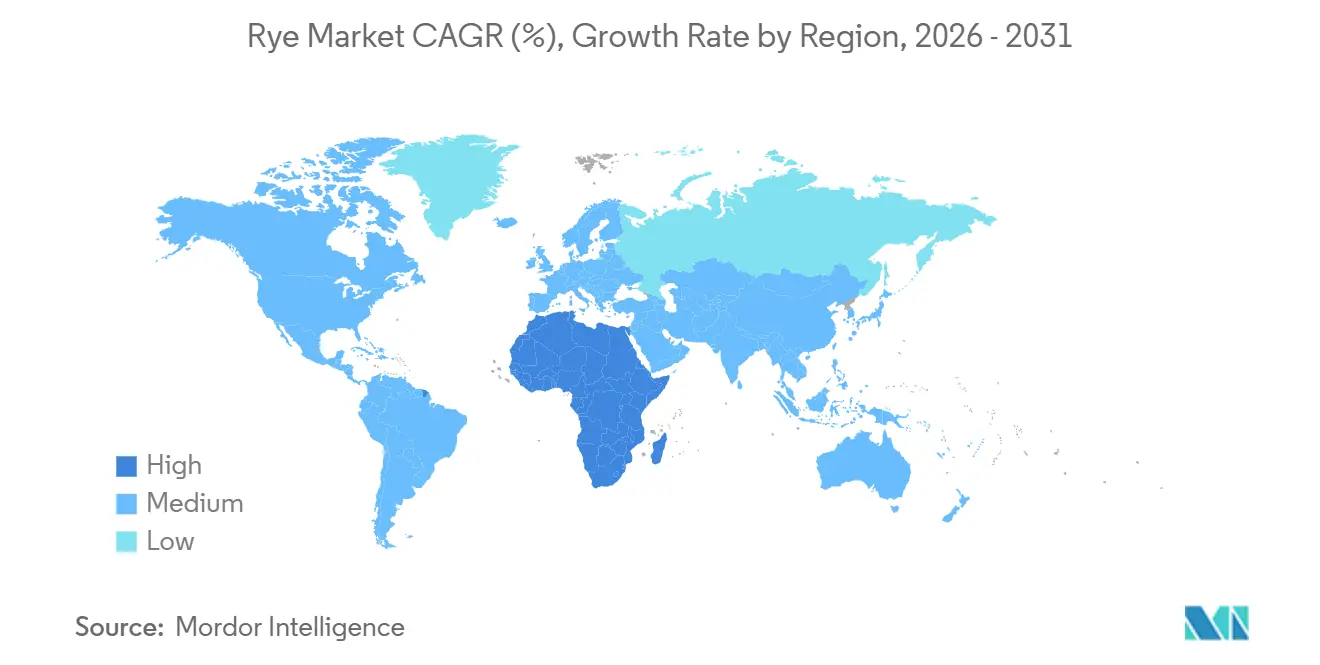
- By geography, Europe dominated the rye market with a 42% share in 2025, while the Asia-Pacific region is anticipated to register a CAGR of 5.4% during the forecast period through 2031.
Note: Market size and forecast figures in this report are generated using Mordor Intelligence’s proprietary estimation framework, updated with the latest available data and insights as of January 2026.
Market Trends and Insights
Drivers Impact Analysis of Rye Market*
| Driver | (~) % Impact on CAGR Forecast | Geographic Relevance | Impact Timeline |
|---|---|---|---|
| Expansion in certified organic acreage | +0.8% | North America and Europe, with emerging adoption in South America | Medium term (2 to 4 years) |
| Government-backed export incentives for low-protein rye grades | +0.6% | Europe, North America, spillover to South America | Short term (≤ 2 years) |
| Surging demand from bakery and breakfast-cereal manufacturers | +1.2% | Global, with concentration in Europe, North America, and urban Asia-Pacific | Long term (≥ 4 years) |
| Emergence of rye-based craft spirits and specialty beers | +0.9% | North America, Europe, and select Asia-Pacific markets | Medium term (2 to 4 years) |
| Carbon-credit monetization of winter-rye cover crops | +0.5% | North America, pilot programs in Europe | Long term (≥ 4 years) |
| Uptake of hybrid rye in high-fiber livestock diets | +0.7% | Europe, North America, and Asia-Pacific | Medium term (2 to 4 years) |
| Source: Mordor Intelligence | |||
Expansion in Certified Organic Acreage
Retail premiums for organic rye flour have stayed several times higher than conventional grades, encouraging farmers to complete the three-year transition that unlocks certification[1]Source: USDA Risk Management Agency, “Organic Price Elections,” rma.usda.gov. Contracts with regional millers give growers predictable floor prices, while European eco-scheme payments sweeten returns and reduce exposure to grain-price swings. The shift lowers synthetic fungicide use, indirectly easing ergot pressure, yet it also raises the need for tighter agronomic monitoring to keep yields on par with conventional fields.
Government-Backed Export Incentives for Low-Protein Rye Grades
Credit guarantees under the USDA GSM-102 program and similar European tools cut freight risk. Traders seize these windows to clear surplus feed-grade lots that carry protein discounts, supporting on-farm cash flow and moderating domestic price swings. Because allocations are fixed by budget cycles, the lift they provide to the rye commodity market is most visible during the first half of each marketing year. The geographic relevance spans Europe and North America, with spillover effects in South American origins, as Argentina and Brazil explore rye as a winter rotation crop.
Surging Demand From Bakery and Breakfast-Cereal Manufacturers
Health-focused consumers gravitate to whole-grain bread, crackers, and cereals that highlight rye’s fiber and beta-glucan content, reinforcing its premium positioning against wheat. German and Scandinavian culinary traditions keep per-capita intake high, while North American artisan bakeries and Asian urban retailers push rye into new product lines. Millers respond by upgrading stone-milling capacity and by seeking traceable, contaminant-free grain, tightening quality spreads in the rye commodity market.
Emergence of Rye-Based Craft Spirits and Specialty Beers
Rye’s spicy flavor notes give distillers and brewers a distinctive edge in crowded premium categories. Contract distillers expand mash bills that feature rye at majority inclusion, while European craft brewers experiment with grist formulations that enhance mouthfeel and color. Premiums for malting-grade grain reward growers who adopt hybrids and apply late-season fungicides, reinforcing the value of clean, high-enzyme rye in the supply chain.
Restraints Impact Analysis of Rye Market*
| Restraint | (~) % Impact on CAGR Forecast | Geographic Relevance | Impact Timeline |
|---|---|---|---|
| Recurring fungal disease outbreaks | -0.9% | Europe, North America, Russia | Short term (≤ 2 years) |
| Yield losses due to erratic spring frosts | -0.5% | Russia, Northern Europe, Canadian Prairies | Medium term (2 to 4 years) |
| Acreage competition from higher-margin oilseeds and corn | -1.1% | North America, South America, Eastern Europe | Long term (≥ 4 years) |
| Stricter global mycotoxin limits impacting milling economics | -0.7% | Europe, North America, Asia-Pacific | Medium term (2 to 4 years) |
| Source: Mordor Intelligence | |||
Recurring Fungal Disease Outbreaks
Wet springs and cool flowering periods allow Claviceps spores to infect rye heads, raising cleaning costs and lowering milling yields. New European limits tighten tolerances, forcing mills to install optical sorters or source higher-cost hybrid grain. When outbreaks spike, livestock feeders also curb purchases because their ergot thresholds are even stricter than human food standards. The challenge limits rye's competitiveness in feed markets, where ergot alkaloid thresholds for livestock are stricter than for human consumption, capping inclusion rates and narrowing demand.
Yield Losses From Erratic Spring Frosts
Late frosts damage flowering spikes, cutting test weight, and relegating grain to lower-priced feed channels. Climate models predict more frequent temperature swings, making planting schedules and varietal choice increasingly critical in northern latitudes. Farmers hedge by shifting acreage south or by favoring faster-maturing hybrids, but both responses add cost and complexity. The challenge underscores the value of hybrid rye's faster maturity and stress tolerance, creating a competitive wedge for seed companies investing in cold-hardiness traits.
*Our forecasts treat driver/restraint impacts as directional, not additive. The impact forecasts reflect baseline growth, mix effects, and variable interactions.
Geography Analysis
Europe Rye Market
Europe remained the largest territory, accounting for 42.0% of the rye market value in 2025. Germany, Poland, and Denmark generated about 4.5 million metric tons, helped by hybrid seed penetration above 70% in Germany and Denmark. Stricter 0.2 grams per kilogram ergot limits have forced millers to add USD 2.2–5.4 million in optical sorters, squeezing margins but enhancing food safety assurance [2]Source: European Commission, “Common Agricultural Policy Reports,” agriculture.ec.europa.eu . Russia’s supply shortfall raised European import dependence on Poland and the Baltics, widening basis by EUR 8–12 per metric ton (USD 8.6–13.0).
APAC Rye Market
The Asia-Pacific region exhibits the fastest growth rate of 5.4% through 2031, as China’s feed trials and Japanese organic baking niches mature. Chinese integrators saved CNY 20–30 per metric ton (approximately USD 2.8–4.1) in ration costs at 5–10% rye inclusion, indicating potential for scale-up once phytosanitary protocols are finalized. South Korea subsidized rye imports for feed at KRW 50,000–80,000 per metric ton (USD 37–59), while Japan’s premium organic flour segment posted 12% annual growth. These early-stage markets reduce Europe’s historic consumption dominance.
The Americas Rye Market
North America's Canadian acreage surge offsets United States declines driven by corn and soybean profitability. Carbon-credit incentives sustain winter planting even when grain economics weaken. Mexico draws on craft whiskey ambitions and organic baking channels. South America, though still small, is trending as Argentina and Brazil test rye in soybean-corn rotations and chase non-GMO premiums.


Regulatory Landscape
Rye trade and first-point handling are shaped by food-safety contaminant controls and plant health rules, with ergot and broader mycotoxin compliance acting as a key gate for milling-grade shipments. In Europe, the tightened ergot tolerance referenced in the market context (0.2 g/kg) has increased testing and sorting requirements and influenced procurement specifications across growers, collectors, and millers.
Cross-border market access also hinges on phytosanitary standard-setting and trade-policy frameworks. The US Department of Agriculture, through APHIS participation in the IPPC and NAPPO processes, continues to align regional phytosanitary standards that affect import protocols for cereals, while the EU enacted Regulation (EU) 2026/687 (March 11, 2026) to operationalize safeguard clauses tied to the EU-Mercosur Partnership and Interim Trade Agreements, reinforcing the importance of rules-of-origin documentation for preferential treatment where applicable.
Value Chain Analysis
The rye value chain starts with input suppliers (hybrid and conventional seed, fertilizers, and crop protection), then moves through on-farm production, local elevators and commercial warehouses, and onward to traders and first-point processors. Downstream demand pull comes primarily from food (millers supplying bakery and cereal manufacturers), beverage (maltsters, brewers, and distillers), and feed compounders, with merchants coordinating grading, blending, and shipment programs across domestic and export lanes.
Quality assurance and logistics are the main friction points. Mycotoxin and ergot risk drives segregation, cleaning, and investment in optical sorting at milling interfaces, while seasonal storage, drying, and transport availability affect the ability to preserve test weight and meet contract specifications. Trade corridor disruptions in Eastern Europe and the Black Sea amplify these bottlenecks, encouraging origin diversification toward EU/Baltic and North American supply and raising the value of identity-preserved lots for distilling and specialty food channels.
Competitive Landscape
Competition is moderate, with the top five traders control a significant share of 2025 revenue. Archer Daniels Midland is leveraging Great Lakes and Gulf export nodes to serve distillers and feed mills. Louis Dreyfus Company followed, channeling Baltic and German rye into intra-EU trade lanes. The July 2025 merger of Bunge and Viterra, valued at USD 34 billion, lifted combined North American storage to 400 million bushels, narrowing origination options for Prairie growers and intensifying rivalry with ADM and CHS.
Seed innovation is a pivotal battleground. KWS’s PollenPlus platform delivers 30–40% yield gains and 40% ergot-incidence reductions, attracting premiums of USD 15–25 per acre. Bayer’s DEKALB unit and Limagrain’s Saaten-Union vie for share with fusarium-tolerant hybrids. Specialty millers such as Bay State Milling and Texas-based Barton Springs Mill capture value through stone-ground organic flours, achieving retail margins triple farm-gate grain. Digital agronomy services that pinpoint ergot hotspots and tailor nitrogen rates save growers USD 10–15 per acre, creating sticky ecosystems that favor large merchants invested in data platforms.
Storage and logistics assets remain critical. Bunge–Viterra controls significant Gulf elevation, ADM dominates barge traffic, and Louis Dreyfus links Baltic ports to German interiors. Mid-tier merchants seek differentiation via traceability and sustainability certifications, while new entrants explore carbon-credit bundling to gain a foothold.
Market Opportunities and Future Outlook
Hybrid rye technology and agronomy support programs are widening the addressable pool of consistent, low-contaminant grain for food, feed, and beverage end uses. In January 2026, Teagasc launched a Rye Growers Guide at Ireland's National Tillage Conference in Kilkenny, formalizing best practices around nutrition and disease control and strengthening execution for growers and supply partners that need tighter specifications. On the supply side, hybrid-seed platforms that reduce ergot incidence and stabilize yields also help millers and distillers manage quality risk without relying solely on post-harvest sorting.
Geographic whitespace is most visible where feed and industrial channels are still in trial or early commercialization. APAC feed trials and import programs highlighted in the report context create room for standardized phytosanitary protocols and repeatable shipment programs, while dual-purpose rye (grain plus anaerobic digestion feedstock) links to on-farm energy and nutrient-cycling projects that value early harvest windows and predictable biomass. Tight and disrupted Black Sea availability, including the documented Ukraine production-consumption gap, keeps attention on alternative origins and encourages traders and processors to build multi-origin coverage and traceability to protect continuity.
Recent Industry Developments in Rye Market
- July 2026: KWS expanded its hybrid rye breeding program in North America, including breeding stations in Illinois, Idaho, and Minnesota and a new greenhouse facility in Kimberly, Idaho. The added breeding and controlled-environment capacity supports faster trait development and scaling of hybrid seed supply, reinforcing availability for growers supplying food, feed, and distilling channels.
- July 2025: CJME highlighted the rollout of a new generation of hybrid rye and related breeding innovation in the field. Greater awareness and agronomic confidence around hybrids support adoption momentum and strengthens the pipeline of higher-spec grain for buyers that prioritize consistency and lower contamination risk.
- May 2024: Archer Daniels Midland (ADM) ramped up its regenerative agriculture program and set new greenhouse gas targets that influence how it structures grain supply contracts, including cereals such as rye. The program expansion increased the pull for verified practices and documentation, supporting carbon-credit and sustainability-linked procurement models in key origination regions.


Rye Market Report Scope and Research Methodology
Market Definition and Coverage
This market is defined as global revenue generated from rye grain traded and used across food, feed, beverage, and industrial uses, counted at the primary crop value before it becomes a processed ingredient.
Scope exclusions: Excludes rye-based processed products such as flour, malt, flakes, and other downstream derivatives.
Segments Covered in This Report
- North America
- United States
- Production Analysis(Area Harvested, Yield, and Production Volume)
- Consumption Analysis (Consumption Value and Volume)
- Import Market Analysis (Import Value, Volume, and Key Supplying Markets)
- Export Market Analysis ( Export Value, Volume, and Key Destinations Markets)
- Wholesale Price Trend Analysis and Forecast
- Regulatory Framework
- List of Key Players
- Logistics and Infrastructure
- Seasonality Analysis
- Canada
- Production Analysis(Area Harvested, Yield, and Production Volume)
- Consumption Analysis (Consumption Value and Volume)
- Import Market Analysis (Import Value, Volume, and Key Supplying Markets)
- Export Market Analysis ( Export Value, Volume, and Key Destinations Markets)
- Wholesale Price Trend Analysis and Forecast
- Regulatory Framework
- List of Key Players
- Logistics and Infrastructure
- Seasonality Analysis
- United States
- Europe
- Germany
- Production Analysis(Area Harvested, Yield, and Production Volume)
- Consumption Analysis (Consumption Value and Volume)
- Import Market Analysis (Import Value, Volume, and Key Supplying Markets)
- Export Market Analysis ( Export Value, Volume, and Key Destinations Markets)
- Wholesale Price Trend Analysis and Forecast
- Regulatory Framework
- List of Key Players
- Logistics and Infrastructure
- Seasonality Analysis
- Poland
- Production Analysis(Area Harvested, Yield, and Production Volume)
- Consumption Analysis (Consumption Value and Volume)
- Import Market Analysis (Import Value, Volume, and Key Supplying Markets)
- Export Market Analysis ( Export Value, Volume, and Key Destinations Markets)
- Wholesale Price Trend Analysis and Forecast
- Regulatory Framework
- List of Key Players
- Logistics and Infrastructure
- Seasonality Analysis
- Russia
- Production Analysis(Area Harvested, Yield, and Production Volume)
- Consumption Analysis (Consumption Value and Volume)
- Import Market Analysis (Import Value, Volume, and Key Supplying Markets)
- Export Market Analysis ( Export Value, Volume, and Key Destinations Markets)
- Wholesale Price Trend Analysis and Forecast
- Regulatory Framework
- List of Key Players
- Logistics and Infrastructure
- Seasonality Analysis
- France
- Production Analysis(Area Harvested, Yield, and Production Volume)
- Consumption Analysis (Consumption Value and Volume)
- Import Market Analysis (Import Value, Volume, and Key Supplying Markets)
- Export Market Analysis ( Export Value, Volume, and Key Destinations Markets)
- Wholesale Price Trend Analysis and Forecast
- Regulatory Framework
- List of Key Players
- Logistics and Infrastructure
- Seasonality Analysis
- United Kingdom
- Production Analysis(Area Harvested, Yield, and Production Volume)
- Consumption Analysis (Consumption Value and Volume)
- Import Market Analysis (Import Value, Volume, and Key Supplying Markets)
- Export Market Analysis ( Export Value, Volume, and Key Destinations Markets)
- Wholesale Price Trend Analysis and Forecast
- Regulatory Framework
- List of Key Players
- Logistics and Infrastructure
- Seasonality Analysis
- Denmark
- Production Analysis(Area Harvested, Yield, and Production Volume)
- Consumption Analysis (Consumption Value and Volume)
- Import Market Analysis (Import Value, Volume, and Key Supplying Markets)
- Export Market Analysis ( Export Value, Volume, and Key Destinations Markets)
- Wholesale Price Trend Analysis and Forecast
- Regulatory Framework
- List of Key Players
- Logistics and Infrastructure
- Seasonality Analysis
- Germany
- Asia-Pacific
- China
- Production Analysis(Area Harvested, Yield, and Production Volume)
- Consumption Analysis (Consumption Value and Volume)
- Import Market Analysis (Import Value, Volume, and Key Supplying Markets)
- Export Market Analysis ( Export Value, Volume, and Key Destinations Markets)
- Wholesale Price Trend Analysis and Forecast
- Regulatory Framework
- List of Key Players
- Logistics and Infrastructure
- Seasonality Analysis
- India
- Production Analysis(Area Harvested, Yield, and Production Volume)
- Consumption Analysis (Consumption Value and Volume)
- Import Market Analysis (Import Value, Volume, and Key Supplying Markets)
- Export Market Analysis ( Export Value, Volume, and Key Destinations Markets)
- Wholesale Price Trend Analysis and Forecast
- Regulatory Framework
- List of Key Players
- Logistics and Infrastructure
- Seasonality Analysis
- Japan
- Production Analysis(Area Harvested, Yield, and Production Volume)
- Consumption Analysis (Consumption Value and Volume)
- Import Market Analysis (Import Value, Volume, and Key Supplying Markets)
- Export Market Analysis ( Export Value, Volume, and Key Destinations Markets)
- Wholesale Price Trend Analysis and Forecast
- Regulatory Framework
- List of Key Players
- Logistics and Infrastructure
- Seasonality Analysis
- Australia
- Production Analysis(Area Harvested, Yield, and Production Volume)
- Consumption Analysis (Consumption Value and Volume)
- Import Market Analysis (Import Value, Volume, and Key Supplying Markets)
- Export Market Analysis ( Export Value, Volume, and Key Destinations Markets)
- Wholesale Price Trend Analysis and Forecast
- Regulatory Framework
- List of Key Players
- Logistics and Infrastructure
- Seasonality Analysis
- China
- South America
- Brazil
- Production Analysis(Area Harvested, Yield, and Production Volume)
- Consumption Analysis (Consumption Value and Volume)
- Import Market Analysis (Import Value, Volume, and Key Supplying Markets)
- Export Market Analysis ( Export Value, Volume, and Key Destinations Markets)
- Wholesale Price Trend Analysis and Forecast
- Regulatory Framework
- List of Key Players
- Logistics and Infrastructure
- Seasonality Analysis
- Argentina
- Production Analysis(Area Harvested, Yield, and Production Volume)
- Consumption Analysis (Consumption Value and Volume)
- Import Market Analysis (Import Value, Volume, and Key Supplying Markets)
- Export Market Analysis ( Export Value, Volume, and Key Destinations Markets)
- Wholesale Price Trend Analysis and Forecast
- Regulatory Framework
- List of Key Players
- Logistics and Infrastructure
- Seasonality Analysis
- Brazil
- Middle East
- Turkey
- Production Analysis(Area Harvested, Yield, and Production Volume)
- Consumption Analysis (Consumption Value and Volume)
- Import Market Analysis (Import Value, Volume, and Key Supplying Markets)
- Export Market Analysis ( Export Value, Volume, and Key Destinations Markets)
- Wholesale Price Trend Analysis and Forecast
- Regulatory Framework
- List of Key Players
- Logistics and Infrastructure
- Seasonality Analysis
- Israel
- Production Analysis(Area Harvested, Yield, and Production Volume)
- Consumption Analysis (Consumption Value and Volume)
- Import Market Analysis (Import Value, Volume, and Key Supplying Markets)
- Export Market Analysis ( Export Value, Volume, and Key Destinations Markets)
- Wholesale Price Trend Analysis and Forecast
- Regulatory Framework
- List of Key Players
- Logistics and Infrastructure
- Seasonality Analysis
- Iraq
- Production Analysis(Area Harvested, Yield, and Production Volume)
- Consumption Analysis (Consumption Value and Volume)
- Import Market Analysis (Import Value, Volume, and Key Supplying Markets)
- Export Market Analysis ( Export Value, Volume, and Key Destinations Markets)
- Wholesale Price Trend Analysis and Forecast
- Regulatory Framework
- List of Key Players
- Logistics and Infrastructure
- Seasonality Analysis
- Turkey
- Africa
- South Africa
- Production Analysis(Area Harvested, Yield, and Production Volume)
- Consumption Analysis (Consumption Value and Volume)
- Import Market Analysis (Import Value, Volume, and Key Supplying Markets)
- Export Market Analysis ( Export Value, Volume, and Key Destinations Markets)
- Wholesale Price Trend Analysis and Forecast
- Regulatory Framework
- List of Key Players
- Logistics and Infrastructure
- Seasonality Analysis
- Egypt
- Production Analysis(Area Harvested, Yield, and Production Volume)
- Consumption Analysis (Consumption Value and Volume)
- Import Market Analysis (Import Value, Volume, and Key Supplying Markets)
- Export Market Analysis ( Export Value, Volume, and Key Destinations Markets)
- Wholesale Price Trend Analysis and Forecast
- Regulatory Framework
- List of Key Players
- Logistics and Infrastructure
- Seasonality Analysis
- South Africa
Data Sources, Market Sizing, and Validation
Desk Research
Desk research started with building a clean fact base for rye harvested area, yield, production, and trade by country, using public statistical series such as FAOSTAT, USDA PSD, and UN Comtrade. We also referenced sources such as the International Grains Council, national agriculture ministries, and central bank FX and inflation tables to keep pricing and currency conversions consistent.
To link supply signals to demand reality, we reviewed company annual reports and investor presentations from grain handlers and ingredient processors, along with trade press coverage on Black Sea supply, EU crop conditions, and export restrictions. In a few places, paid databases were used only for company financials and for shipment-level import and export cross-checks. The sources listed here are illustrative, and many other public datasets and documents were reviewed for data collection, validation, and clarification.
Primary Interviews and Surveys
Primary work was used to pressure-test the desk numbers, especially the pricing spreads between farm-gate and first handling points, typical quality discounts, and how rye moves into food versus feed in different years. Interviews included growers and cooperatives, traders and storage operators, mill-adjacent buyers, and downstream users, to confirm the demand pool and the pace of substitution with other grains across APAC, EMEA, and the Americas.
Distribution of primary research fieldwork respondents
| Company type | Respondent position | Region |
|---|---|---|
| Top tier: 29% | CXOs: 13% | APAC: 52% |
| Mid tier: 56% | Functional/Unit leaders: 28% | EMEA: 29% |
| Smaller Players: 15% | Managers: 59% | Americas: 19% |
Market-Sizing & Forecasting
Sizing was built using top-down and bottom-up logic, where production, utilization, and trade data reconstruct the annual rye grain demand pool, and then average price bands convert those volumes into revenue by region and globally. Because reported series can differ by country and year, we adjusted for carry-in and carry-out where meaningful and aligned marketing-year versus calendar-year effects before totals were finalized.
Key model inputs included rye production (tons), harvested area and yield shifts, import and export volumes, inventory tightness signals, and regional price indicators (farm-gate and first handling spreads), which were then filtered through FX assumptions for USD conversion. When price series were missing or not comparable, we filled gaps using closely linked cereal price relationships and interview-based ranges, and then checked that implied values stayed realistic versus trade unit values.
For forecasting, we ran scenario analysis around yield volatility, acreage response, and trade policy sensitivity, and the base case was anchored to expert views on likely normalization after weather-driven spikes. We used selective bottom-up approximations as a cross-check, mainly by sampling country volumes and multiplying by validated price points, then comparing the implied totals against the modeled result to correct outliers.
Data Validation & Update Cycle
Validation was done through multiple checks so the final numbers are not driven by one dataset or one assumption. We compared the modeled value against independent signals like implied unit values from trade flows, regional production plus net trade balances, and year-to-year price movements to spot unusual jumps.
When variances were found, the logic was revisited, interview notes were rechecked, and follow-up calls were triggered for the countries or variables that caused the swing. The work is reviewed in steps by another analyst before sign-off, and the report is refreshed annually with interim updates when material events occur (such as major harvest shocks or policy changes). Before delivery, we complete a final freshness pass so clients receive the most up-to-date view available.
Mordor Intelligence's Global Rye Market Size Compared With Other Published Estimates
Published rye market values can differ even when they look like they measure the same thing, since firms may not align on what rye means in revenue terms, which year they anchor on, and how they convert volumes into value. Differences also show up when one study leans more on production and trade series, while another leans more on downstream consumption proxies.
Processed rye products like flour and malt sit outside Mordor Intelligence's scope here, which is why estimates that blend grain with ingredient revenue often land higher even before forecasts are applied. Gaps can also come from using different price points (farm-gate versus wholesale), applying different FX timing, and publishing either conservative or more optimistic yield and acreage scenarios, which can move the total in a crop market that is weather sensitive.
Benchmark comparison
| Source | Market Size | Gaps in Research Methodology |
|---|---|---|
| Mordor Intelligence | USD 3.80 B (2026) | |
| Global Consultancy A | USD 4.17 B (2025) | Uses a broader rye definition that appears to mix primary grain value with some processed rye applications, and the year basis is earlier, which changes the price environment used for conversion. |
| Industry Publisher B | USD 3.76 B (2024) | Anchors on a different base year and longer forecast window, and the type segmentation suggests processed forms are included, which can lift value beyond the grain-only pool. |
The spread in the table is mainly explained by scope and price basis, and then amplified by the selected base year and forecast assumptions. By keeping the model tied to observable production, trade, and grain price signals, we end up with a number that is easier to trace and repeat when new harvest and trade data are released.


Key Questions Answered in the Report
What is the current size of the rye market?
The rye market is valued at USD 3.8 billion in 2026 and is forecast to grow to USD 4.6 billion by 2031.
Why are Canadian rye shipments becoming more prominent in trade flows?
Recent supply shortfalls in Russia and Poland have opened space for Canadian grain, supported by reliable rail links to United States distillers and improving port access.
Why is rye attractive as a cover crop?
Rye sequesters an average of 0.19 metric ton CO₂e per acre each season and improves soil structure, allowing farmers to earn carbon credits and boost field health.
How do carbon-credit programs influence rye planting decisions in the United States and Canada?
Payments tied to winter-cover sequestration offset lower grain margins, encouraging growers to maintain or expand acreage.
How do mycotoxin rules impact rye trade?
Tighter limits require enhanced testing and segregation, raising processing costs and occasionally restricting exports from high-risk production zones.
Page last updated on:


 Your data is secure and never sold or shared.


