
Nutmeg Market Size and Share
Nutmeg Market Analysis by Mordor Intelligence
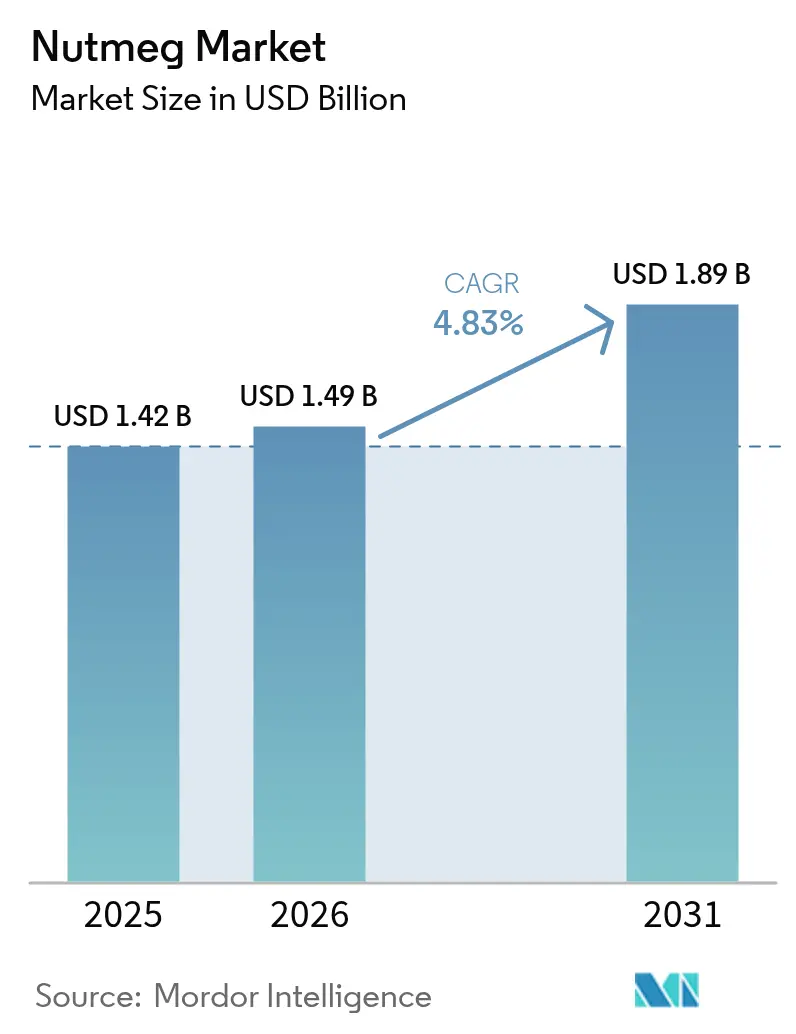
Nutmeg Market size in 2026 is estimated at USD 1.49 billion, growing from 2025 value of USD 1.42 billion with 2031 projections showing USD 1.89 billion, growing at 4.83% CAGR over 2026-2031. The market’s forward momentum is tempered by sharp supply-side swings linked to extreme weather in Indonesia and Grenada, two regions that collectively underpin most export volumes. Buyers confront geographic concentration risk because Indonesia alone shipped USD 129 million of the USD 238 million global trade value in the latest complete trade year. Demand strength rests on clean-label adoption in food manufacturing, premiumization in personal care, and early-stage pharmaceutical research into myristicin-rich extracts. Meanwhile, processing innovation is nudging value from whole seed toward high-margin essential oils and oleoresins. Consolidation moves by McCormick, Marubeni, and other multinationals signal a race to secure flavor technology and traceable supply.
Key Report Takeaways
- By geography, Asia-Pacific led with 61.20% of the nutmeg market share in 2025, whereas the Middle East is the fastest-growing region at 7.08% CAGR through 2031.
Note: Market size and forecast figures in this report are generated using Mordor Intelligence’s proprietary estimation framework, updated with the latest available data and insights as of 2026.
Market Trends and Insights
Drivers Impact Analysis of Nutmeg Market*
| Driver | (~) % Impact on CAGR Forecast | Geographic Relevance | Impact Timeline |
|---|---|---|---|
| Rising demand for natural clean-label ingredients in food and beverages | +1.2% | North America and EU premium markets | Medium term (2–4 years) |
| Expansion of processed ethnic and gourmet foods | +0.8% | Core Asia-Pacific with spill-over to North American urban centers | Long term (≥4 years) |
| Rising popularity of exotic flavors in bakery and RTD beverages | +0.6% | North America and EU; emerging Asia-Pacific cities | Short term (≤2 years) |
| Premium personal care and cosmetics demand for natural aromatics | +0.5% | Global premium skincare and fragrance hubs | Medium term (2–4 years) |
| Sustainable sourcing mandates from multinational spice buyers | +0.4% | Indonesia and Grenada supply chains | Medium term (2–4 years) |
| Pharmaceutical Research and Development on myristicin-rich botanicals | +0.3% | Research hubs in North America, EU, and Japan | Long term (≥4 years) |
| Source: Mordor Intelligence | |||
Rising demand for natural clean-label ingredients in food and beverages
Food manufacturers are replacing synthetic preservatives with botanical alternatives that deliver both flavor and microbial protection. Studies show that nutmeg oil at 0.05% concentration maintains sensory quality while lowering lipid oxidation in chicken patties, allowing formulators to meet label-friendly mandates without added cost layers. The spice also inhibits E. coli and L. monocytogenes across varied pH and temperature conditions, supporting broader adoption in processed meats and ready meals. Premium brands use nutmeg’s dual function—flavor plus shelf-life extension—to justify higher product pricing. The shift is most pronounced in North American and European premium chilled foods, where transparent ingredient lists shape repeat purchase behavior. Formulators increasingly treat the compound as a single-line solution rather than stacking multiple synthetics, simplifying procurement and formulation matrices.
Expansion of processed ethnic and gourmet foods
Globalized palates have pushed nutmeg into mainstream packaged meals far beyond Western desserts. Large Asian conglomerates now market ready-to-eat rendang and biryani that rely on nutmeg for signature warmth.[1]PT Mitra Ayu, “Spice Blend Product Specifications,” mitraayu.co.id At the same time, diaspora brands in the United States and Canada have normalized Southeast Asian spice blends on grocery shelves, expanding baseline volumes. Nutmeg’s compatibility with high-pressure processing and retort sterilization supports mass-market scale without flavor loss. Beverage innovators have integrated the spice into premium chai and golden milk formulations, taking advantage of its perceived wellness halo and aromatic depth. Continuous demand from ethnic processors, therefore, reinforces predictable order books for exporters.
Rising popularity of exotic flavors in bakery and RTD beverages
Search analytics show an uptick in consumer discourse about “nutty-creamy” seasonal flavors, especially around autumn coffee specials. Nutmeg aligns with this trend by delivering complexity that pairs with pumpkin, chocolate, or dairy. Industrial bakeries value the spice’s thermal stability, allowing flavor consistency across high-temperature lines. Beverage SMEs use essential oil fractions to craft proprietary profiles that stand out in crowded RTD aisles. Predictable demand spikes during festive periods let procurement teams plan forward contracts and hedge against raw material swings. Higher margin positioning also provides leeway to absorb transportation cost inflation without eroding profitability.
Pharmaceutical research and development on myristicin-rich botanicals
Early-stage trials demonstrate myristicin’s neuroprotective and anti-inflammatory effects, encouraging pharma-botanical collaborations in the United States, Germany, and Japan. Extract suppliers able to deliver consistent chemical profiles secure contracts priced well above culinary grades. The sector remains nascent because clinical pathways extend beyond 10 years, but even pilot-scale demand lifts average farm-gate prices for high-purity material. Academic partnerships accelerate compound characterization, feeding a pipeline of nutraceutical prototypes that enlarge addressable demand over the long term.
Restraints Impact Analysis of Nutmeg Market*
| Restraint | (~) % Impact on CAGR Forecast | Geographic Relevance | Impact Timeline |
|---|---|---|---|
| Production and price volatility due to climate-sensitive yields | -1.8% | Indonesia, Grenada, wider tropical belt | Short term (≤ 2 years) |
| Stringent aflatoxin and pesticide residue limits | -1.1% | EU and North America import markets | Medium term (2–4 years) |
| Fragmented farmer base limits traceability and certification | -0.9% | Indonesia, India, other smallholder regions | Long term (≥ 4 years) |
| Adverse consumer perceptions around allergenic reactions | -0.7% | Developed markets with high food-safety awareness | Medium term (2–4 years) |
| Source: Mordor Intelligence | |||
Production and price volatility due to climate-sensitive yields
Hurricane Ivan destroyed 70% of Grenada’s nutmeg trees in a single season, proving how one event can erase decades of output.[2]Deutsche Gesellschaft für Internationale Zusammenarbeit (GIZ), “Climate Resilience in Grenada’s Spice Sector,” giz.de Similar shocks affect Indonesian islands, where 99.81% of farms are smallholdings lacking irrigation or wind-break infrastructure. Uneven rainfall and rising night-time temperatures stress trees and cut yields, triggering price spikes that ripple through contract manufacturing schedules. Replacement cycles are painfully slow because saplings need 7–10 years to mature. Manufacturers, therefore, diversify suppliers or hold higher inventory, tying up working capital.
Stringent aflatoxin and pesticide residue limits
European Union regulations cap aflatoxin B1 levels at 5 micrograms per kilogram for dried spices, forcing exporters to invest in post-harvest drying tunnels and steam sterilization lines. Studies show 80% incidence rates of aflatoxin contamination in untreated samples from humid Indonesian warehouses. Import rejections lead to reputational damage and sunk logistics costs. Compliance is easier for large processors with in-house labs, but cost-sharing often squeezes farm-gate prices, discouraging the very improvements that regulators seek.
*Our forecasts treat driver/restraint impacts as directional, not additive. The impact forecasts reflect baseline growth, mix effects, and variable interactions.
Geography Analysis
APAC Nutmeg Market
Asia-Pacific commanded 61.20% of the nutmeg market share in 2025, anchored by Indonesia’s 76% contribution to global output and a USD 129 million export tally. North Maluku’s coastal micro-climate and well-drained volcanic soils support year-round flowering, yet the average farm yield is only 479 kg/ha compared with Malaysia and Sri Lanka’s higher-productivity orchards, presenting a clear agronomic upside. Chronic underinvestment in drying infrastructure exposes the chain to aflatoxin risk, prompting buyers to co-finance solar tunnel projects. Regional governments now trial clonal planting material that bears fruit in five years instead of the customary seven, widening long-run supply potential.
MEA and APAC Nutmeg Market
The Middle East is projected to grow at 7.08% CAGR through 2031 as Saudi Arabia and the UAE consolidate re-export hubs supplying North Africa. Food service operators in these markets pivot toward premium spice blends for convenience-driven consumer segments, reinforcing annual contract demand. Although volumes trail Asia-Pacific, higher per-kilogram margins attract processors keen to offset freight inflation. Climatic resilience concerns drive importers to diversify sourcing beyond Indonesia, creating openings for India’s Kerala, Sri Lanka’s Central Province, and Papua New Guinea.
Europe, North America and APAC Nutmeg Market
Europe and North America constitute mature destinations where unit growth is low, but value per kilogram is elevated due to stringent quality and sustainability requirements. Import regulations cap aflatoxin and pesticide residues, rewarding suppliers with on-site labs and HACCP certification. Grenada, branded as the “Isle of Spice,” is still rebuilding tree stock lost to Hurricane Ivan. Recovery programs funded by development agencies target grafted stock that withstands Category 4 winds, yet commercial output will not reach pre-2004 levels before 2030. India’s emerging regions in Tamil Nadu and Karnataka add incremental diversification, while Sri Lanka enjoys an agronomic advantage with 22–34 °C temperatures and fertile mountain soils that produce high essential oil concentrations.



Regulatory Landscape
International trade in nutmeg is anchored by FAO/WHO Codex Alimentarius Standard for Dried Seeds, Nutmeg (CXS 352-2022), which supports common definitions for quality and permitted uses in cross-border commerce. In November 2025, the Codex Alimentarius Commission adopted amendments to the food additives section of CXS 352-2022 to align it with the General Standard for Food Additives (CXS 192-1995), tightening the reference framework used by exporters and importers when specifying compliance for dried nutmeg lots.
Import markets also apply stringent contaminant limits that shape sourcing and post-harvest investment. The EU applies strict controls for mycotoxins in dried spices, including aflatoxin B1 limits commonly referenced at 5 micrograms/kg, and specific EU import controls for Indonesian nutmeg have required a health certificate and analytical results for aflatoxin presence since 2016. In India, FSSAI notified the Food Safety and Standards (Contaminants, Toxins and Residues) Amendment Regulations, 2026 in May 2026, including a maximum limit of 10 mg/kg for saffrole in beverages and foods containing nutmeg kernel or mace as ingredients, which adds another compliance checkpoint for suppliers serving South Asian processors.
Value Chain Analysis
The nutmeg value chain begins with smallholder cultivation of Myristica fragrans, often intercropped, followed by harvesting, splitting and drying, and primary grading at village level before aggregation by collectors. Material then typically moves to regency-level processors for cleaning, further drying, and food-safety interventions such as steam sterilization, before reaching domestic traders and exporters that supply importers, grinders, and extractors converting whole nutmeg into powder, essential oil, and oleoresins for food, beverage, and personal-care applications. Indonesia remains a key origin in global flows, and export logistics commonly route through hubs such as Surabaya and Bitung, creating concentration points for quality control and outbound documentation.
Value creation and risk management are increasingly concentrated in post-harvest handling and compliance. Aflatoxin and residue controls in the EU and North America drive investments into drying infrastructure, lot-level testing, and certified food-safety systems, but fragmented farm structures make traceability and consistent quality harder to scale. Digital supply-chain tools are moving closer to the farm gate: in January 2026, Koltiva announced expanded traceability programs to support Indonesian nutmeg exporters in meeting international due-diligence and buyer requirements, reflecting a shift toward verified origin, documented handling, and auditable chain-of-custody as prerequisites for accessing higher-value channels.
Market Opportunities and Future Outlook
Opportunities center on compliance-ready, value-added nutmeg products and documented sourcing that can support premium import channels. Regulatory tightening and buyer requirements in the EU and other mature markets favor exporters that can demonstrate aflatoxin control, residue management, and traceable lots aligned to Codex CXS 352-2022, which supports investment in drying, testing, and certified food-safety management systems, including HACCP-aligned operations. The May 2026 FSSAI saffrole limit for foods and beverages containing nutmeg kernel or mace also adds specification discipline for suppliers serving Indian processors, creating room for standardized, compliant ingredient offerings that can reduce downstream reformulation risk.
Supply-chain resilience and route diversification offer another practical area of focus as freight and insurance costs move around West Asia transit corridors. Mid-2026 market updates referenced tighter high-grade availability and logistics constraints affecting Indian nutmeg pricing, reinforcing the commercial case for diversified sourcing across India, Sri Lanka, and other origins to reduce reliance on single-origin supply. In parallel with food and personal-care demand, downstream diversification is also showing up in non-food initiatives: in June 2026, Universitas Muhammadiyah Yogyakarta and Nishihara Soji Holdings commenced development of a 3,000-hectare nutmeg plantation in East Nusa Tenggara linked to sustainable aviation fuel raw-material ambitions, which points to emerging industrial pathways that can create new offtake options for specific grades and supply programs.
Recent Industry Developments in Nutmeg Market
- June 2026: Universitas Muhammadiyah Yogyakarta and Nishihara Soji Holdings commenced development of a 3,000-hectare nutmeg plantation in East Nusa Tenggara targeted at sustainable aviation fuel raw materials. The project broadens nutmeg demand beyond traditional culinary and personal-care channels and raises the importance of plantation-scale agronomy and long-term feedstock contracting.
- April 2026: ID FOOD initiated nutmeg (mace) exports to India as part of a 40-container contract. The move strengthens Indonesia-to-South Asia trade corridors and highlights how state-linked exporters are using contracted volumes to stabilize offtake amid supply variability.
- January 2024: Nutmeg farmers in Pollachi, Tamil Nadu secured INR 75 lakh (USD 89.6 thousand) worth of mace orders through their Farmer Producer Company, benefiting over 50 growers. This illustrates how organized aggregation can improve market access and pricing realization for smallholders supplying quality-sensitive spice buyers.


Nutmeg Market Report Scope and Research Methodology
Market Definition and Coverage
For this study, the nutmeg market is treated as the annual value generated from nutmeg that is harvested, processed, and sold for commercial use, and then consumed mainly through food and beverage and related ingredient demand.
Scope exclusions: We exclude mace as a separate spice, synthetic flavor substitutes, and informal farm gate barter that does not pass through organized trade or commercial channels.
Segments Covered in This Report
- By Geography (Production Analysis (Volume), Consumption Analysis (Volume and Value), Import Analysis (Volume and Value), Export Analysis (Volume and Value), and Price Trend Analysis)
- North America
- United States
- Canada
- Guatemala
- South America
- Brazil
- Europe
- Netherlands
- United Kingdom
- Germany
- Spain
- Italy
- Asia-Pacific
- India
- Indonesia
- Vietnam
- Sri Lanka
- China
- Japan
- Middle East
- Saudi Arabia
- United Arab Emirates
- Africa
- South Africa
- Egypt
- North America
Data Sources, Market Sizing, and Validation
Desk Research
To build the first cut of the model, we start with public production and trade signals and then connect them to pricing and usage patterns. Sources used include global and national agriculture and trade statistics such as FAOSTAT, UN Comtrade, ITC Trade Map, and USDA data, along with customs and tariff line references where nutmeg is explicitly coded.
We also review materials that help explain why volumes and prices move, such as reports from food and spice trade bodies, peer reviewed articles on Myristica fragrans cultivation and post harvest losses, and public notes on food ingredient demand from regulators and industry press. Company annual reports and investor decks are used to understand procurement approaches and broad pricing commentary. In parallel, a paid subscription covering import export shipment level records and another one covering company financial intelligence are used selectively to validate trade routing and identify active exporters and processors. This is not an exhaustive list, and many other sources were referenced to compile data, validate assumptions, and clarify open questions.
Primary Interviews and Surveys
Primary work was used to check what the desk signals could not fully explain, especially the share of traded nutmeg that ends up in consumer packs versus industrial food use, and the typical price spreads between whole, ground, and oil forms. We spoke with stakeholders across exporting origins, major import hubs, and key consuming regions, and then used follow up questions to confirm realistic loss factors, contract terms, and near term demand direction.
Distribution of primary research fieldwork respondents
| Company type | Respondent position | Region |
|---|---|---|
| Top tier: 30% | CXOs: 13% | APAC: 44% |
| Mid tier: 56% | Functional/Unit leaders: 39% | EMEA: 29% |
| Smaller Players: 14% | Managers: 48% | Americas: 27% |
Market-Sizing & Forecasting
We size the market using a top down build that reconstructs demand from production and trade flows, and then ties those volumes to average transaction prices by form. In practice, import volumes by major consuming region are adjusted for re exports and processing losses, followed by a price step that reflects common contract mixes for whole nutmeg, ground powder, and food grade nutmeg oil.
To keep the model realistic, a few inputs are tracked closely and refreshed when new evidence appears, including harvest output and yield swings in key origin countries, export and import tonnage trends, average unit values from customs declarations, the split of demand between retail spices and industrial food manufacturing, and freight and currency effects that shift landed costs. The totals are then checked using selective bottom up approximations such as sampled exporter quotations, distributor channel checks, and a simple ASP times volume roll up for a limited set of high trade corridors, with gaps handled by using conservative ranges that are later tightened through interviews.
For forecasting, we rely mainly on scenario analysis because nutmeg pricing and availability can change quickly with weather and supply concentration. Scenarios are anchored to expected planting and harvest recovery, trade policy stability, and packaged food seasoning demand, and then validated with what industry participants said about contracting behavior and substitution risk.
Data Validation & Update Cycle
Before results are finalized, we run consistency checks across independent signals such as production, export volumes, import volumes, and observed unit values, and then investigate any sharp breaks that do not match market events. When a variance is detected, we re open key assumptions like loss factors, re export shares, and form mix, and in some cases we reconnect with respondents to confirm what changed.
Each report goes through multiple analyst reviews so calculation logic, inputs, and units stay consistent across regions and years. The dataset is refreshed annually, and interim updates are made when there are material events such as a supply shock, policy change, or a sustained price move. Before delivery, an analyst performs a fresh pass so clients receive the latest updated view.
Mordor Intelligence's Nutmeg Market Size Compared With Other Published Estimates
Published nutmeg market values can look far apart because the included products, the point in the value chain being counted, and the price assumptions are not the same. Some estimates are closer to trade value, others resemble retail value, and the difference is often not obvious unless the scope is spelled out.
Import and export tonnage trends, together with customs unit values and cross checks on re export patterns, are the evidence that keeps Mordor Intelligence's estimate tied to commercial nutmeg flows rather than broader spice adjacencies. The biggest gaps seen in other figures usually come from adding mace or downstream consumer markups, using a single static price for all forms, or applying aggressive growth even when near term harvest recovery is uncertain.
Benchmark comparison
| Source | Market Size | Gaps in Research Methodology |
|---|---|---|
| Mordor Intelligence | USD 1.49 B (2026) | |
| Industry Publisher A | USD 1.20 B (2024) | Uses an earlier base year with limited clarity on whether values reflect farm gate, export, or landed import pricing, which can understate the commercial traded value in high price years. |
| Global Publisher B | USD 1.70 B (2027) | Anchors the total on a forward year and may apply a uniform average price across applications, which can over count higher value uses without separating form mix and trade re exports. |
The table indicates that the spread is mostly explained by scope boundaries and the pricing layer used, not by a single right or wrong demand story. When trade volumes, unit values, and form mix are kept consistent, the resulting market total is easier to replicate and to stress test during planning discussions.


Key Questions Answered in the Report
What is the current value of the nutmeg market?
The nutmeg market is valued at USD 1.49 billion in 2026 and is projected to reach USD 1.89 billion by 2031.
Which region leads the nutmeg market?
Asia-Pacific dominates with 61.20% share in 2025, primarily due to Indonesia’s large-scale production.
What technological advances are shaping future nutmeg products?
Supercritical CO₂ extraction, encapsulation to preserve antioxidants, and blockchain-enabled traceability are driving product innovation and higher price realisation.
How are climate risks affecting nutmeg prices?
Extreme weather can wipe out mature trees, leading to multi-year supply shortfalls and price spikes because new plantings take 7–10 years to reach commercial yield.
Page last updated on:


 Your data is secure and never sold or shared.


