
Areca Nuts Market Size and Share
Areca Nuts Market Analysis by Mordor Intelligence
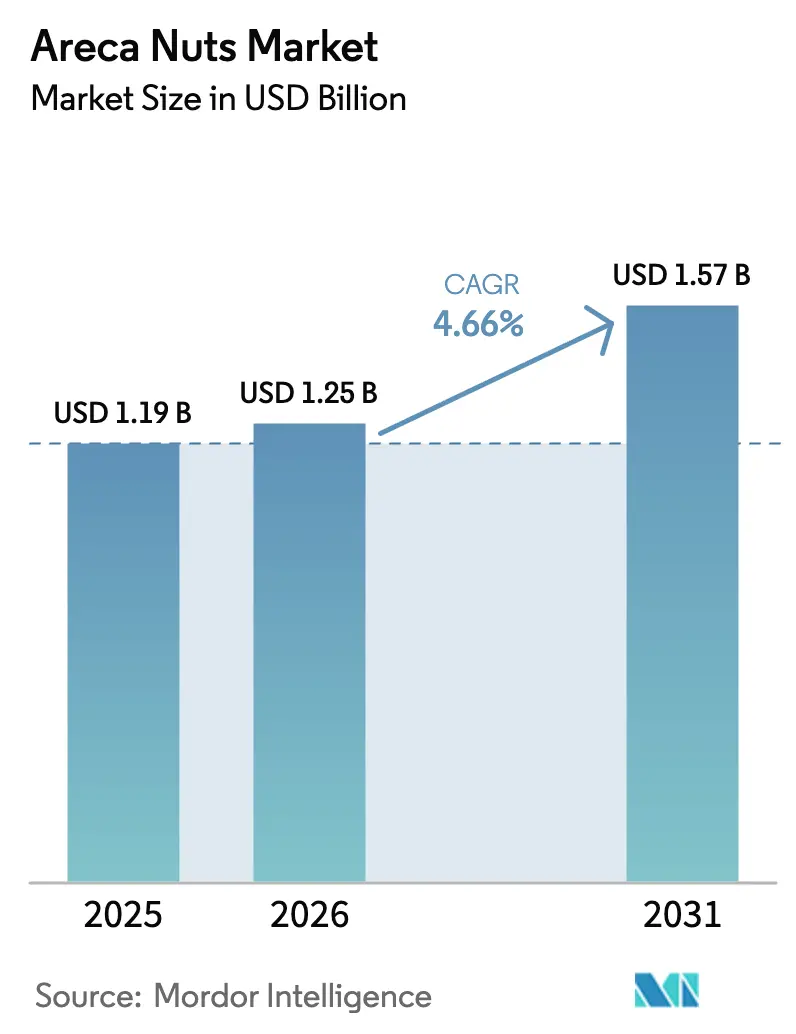
The areca nut market size was valued at USD 1.19 billion in 2025 and estimated to grow from USD 1.25 billion in 2026 to reach USD 1.57 billion by 2031, at a CAGR of 4.66% during the forecast period (2026-2031). This steady expansion in the areca nut market stems from entrenched cultural chewing habits in South and Southeast Asia, sustained urbanization-driven demand in Nepal and Bangladesh, and premium pricing for pesticide-residue-certified shipments flowing into Gulf Cooperation Council destinations. At the same time, India’s October 2025 extension of its Minimum Import Price and 100% basic customs duty underscores an increasingly protective policy stance that tightens formal trade corridors while leaving informal flows intact. Improving post-harvest infrastructure in Indonesia, Myanmar, and Pakistan keeps farm-gate prices competitive and ensures supply diversity, while ongoing disease outbreaks such as Yellow Leaf Disease in Karnataka raise production risk and incentivize investment in integrated pest management. Against this backdrop, the areca nut market continues to balance cultural resilience with intensifying regulatory scrutiny from jurisdictions classifying the nut as a Group 1 carcinogen[1]Source: The Lancet Oncology, “Global burden of cancers attributable to areca nut use in 2020 and projections to 2040,” thelancet.com.
Key Report Takeaways
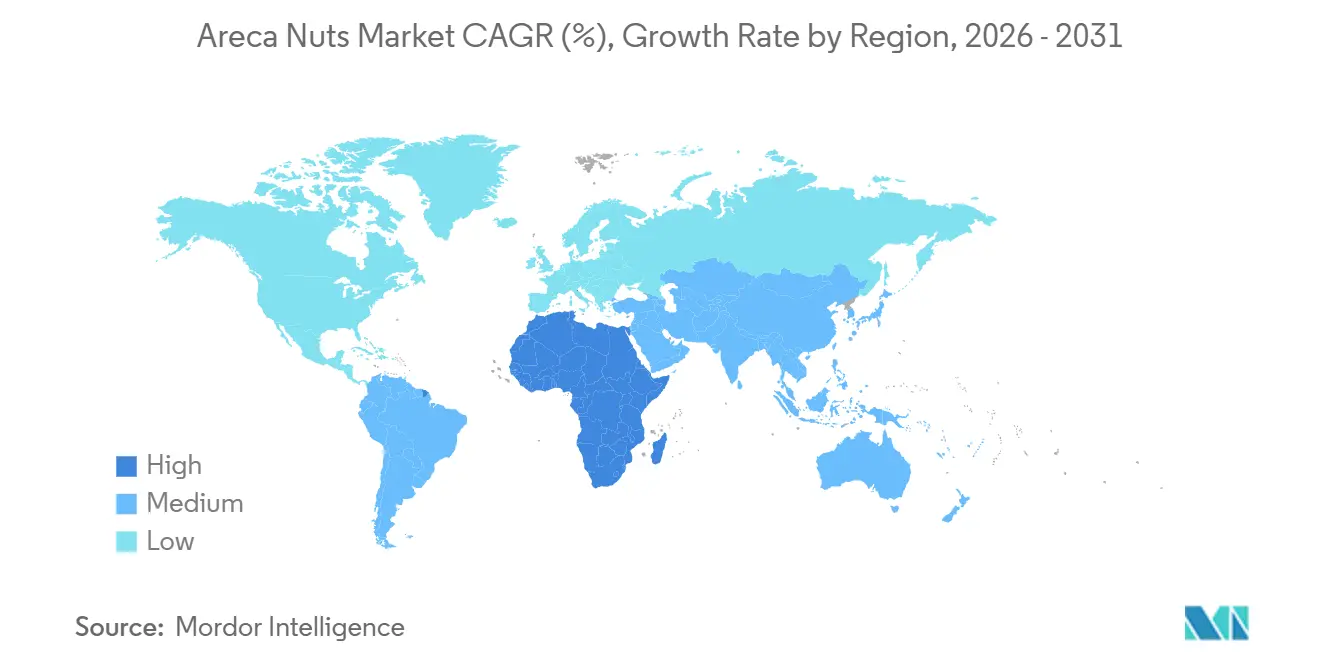
- By geography, Asia-Pacific accounted for about 88% of the Areca Nuts market size in 2025, while Africa is the fastest-growing region at a 6.1% CAGR from 2026 to 2031.
Note: Market size and forecast figures in this report are generated using Mordor Intelligence’s proprietary estimation framework, updated with the latest available data and insights as of January 2026.
Market Trends and Insights
Drivers Impact Analysis of Areca Nuts Market*
| Driver | (~) % Impact on CAGR Forecast | Geographic Relevance | Impact Timeline |
|---|---|---|---|
| Enduring cultural chewing habits in South and Southeast Asia | +0.8% | India, Bangladesh, Myanmar, Indonesia, spillover to Middle East and Africa diaspora | Long term (≥ 4 years) |
| Expansion of domestic processing capacity in India and Indonesia | +0.6% | India (Karnataka, Kerala, Assam, Mizoram) and Indonesia (Jambi, West Sumatra, Southeast Sulawesi) | Medium term (2 to 4 years) |
| Protective tariff and subsidy programs in major producer countries | +0.5% | India, Indonesia, Thailand, Bangladesh, and Sri Lanka | Medium term (2 to 4 years) |
| Premium pricing for pesticide-residue-certified and organic nuts | +0.4% | India (Kerala, Karnataka), Indonesia (Agam Regency), demand from Gulf Cooperation Council, European Union, Japan | Medium term (2 to 4 years) |
| Bio-based tannin and natural-pigment demand from leather and cosmetics sectors | +0.3% | Early adoption in Europe and North America, supply from Asia-Pacific | Long term (≥ 4 years) |
| Blockchain-enabled traceability pilots among Indian cooperatives | +0.2% | Andhra Pradesh, Karnataka, Kerala clusters | Long term (≥ 4 years) |
| Source: Mordor Intelligence | |||
Enduring Cultural Chewing Habits in South and Southeast Asia
Areca nut chewing remains embedded in religious and social ceremonies across India, Bangladesh, Myanmar, and Indonesia. More than half of global output channels into chewing products, reinforcing a demand baseline that cushions the areca nut market against policy-driven shocks. Karnataka’s sun-dried white “Chali” variety commands two-thirds of domestic Indian trade because of its mild flavor, while Kerala’s boiled red nuts dominate southern mixes. Myanmar’s steamed tender product for Chinese buyers highlights innovation inside traditional usage, and Bangladesh’s Cox’s Bazar growers continue to earn robust farm-gate revenue from diaspora shipments. Even Taiwan retains significant share despite prolonged anti-chewing campaigns, underscoring habitual stickiness among older consumers.
Expansion of Domestic Processing Capacity in India and Indonesia
New slicing, flavoring, and boiling plants drive farm-gate price competition and shorten supply chains. Mizoram secured INR 7.43 crore (USD 0.89 million) from the North Eastern Council in March 2025 for two arecanut processing units aimed at raising local price realization. Areca nut from Indonesia is in great demand, where 80% of the world’s needs are exported from Indonesia, and Jambi Province contributes 34.53% of the total national exports. Southeast Sulawesi logged its first export to Iran in January 2024, illustrating how localized infrastructure opens new destinations. In India, the Campco Limited’s lower pledge loan threshold from 1 metric ton to 0.2 metric ton aggregates smaller lots, enabling cooperatives to compete with private traders.
Protective Tariff and Subsidy Programs in Major Producer Countries
Protective tariff and subsidy programs buffer farm income by setting price floors that insulate growers from cheaper imports while enabling governments to calibrate supply stability. India’s October 2025 decision by India’s Directorate General of Foreign Trade (DGFT) to apply a Minimum Import Price of INR 351 per kilogram (USD 4.21 per kilogram) and maintain a 100% basic customs duty instantly narrowed the price gap between domestic white “Chali” nuts and Bhutanese red varieties. Thailand’s export collapse after India’s tariff wall illustrates the cross-border ripple effect. Bangkok has intensified discussions within the Bay of Bengal Initiative for Multi-Sectoral Technical and Economic Cooperation (BIMSTEC) framework to secure duty relief, emphasizing how protectionist policies in a significant market can influence regional diplomacy and supply chain dynamics. Sri Lanka’s 35% value-addition mandate for re-exports forces local processors to invest in slicing and boiling lines, elevating domestic employment but compressing trader margins as capital costs rise.
Blockchain-enabled traceability pilots among Indian cooperatives
The United Nations Development Programme India Accelerator Lab piloted a blockchain ledger for chili and turmeric that tracked many farmers in Andhra Pradesh, areca cooperatives view the model as a template for residue-certified exports. A traceable areca supply chain would meet European Union Directorate-General for Health and Food Safety audit protocols and accelerate customs clearance. Cooperatives adopting Tracenet, India’s official organic database, can pool 25 to 500 growers under group certification, cutting compliance costs. Wider rollout could unlock high-margin markets and differentiate Indian shipments from lower-priced regional competitors.
Restraints Impact Analysis of Areca Nuts Market*
| Restraint | (~) % Impact on CAGR Forecast | Geographic Relevance | Impact Timeline |
|---|---|---|---|
| Intensifying health-warning regulations and partial sales bans | −0.7% | Europe, North America, Australia, United Arab Emirates, India, Taiwan | Short term (≤ 2 years) |
| Climate-linked disease outbreaks such as Yellow Leaf Disease and Areolate Mildew | −0.6% | India (Karnataka, Kerala, Tamil Nadu, Assam), Indonesia (Sumatra), Sri Lanka | Medium term (2 to 4 years) |
| Zero-duty Duty Free Quota Free imports eroding farm-gate prices in India | −0.5% | India producer states, source countries Bhutan, Myanmar, Bangladesh | Short term (≤ 2 years) |
| Environmental, Social, and Governance driven investor pressure given carcinogen status | −0.3% | Europe and North America institutional portfolios, export-oriented Asia-Pacific processors | Long term (≥ 4 years) |
| Source: Mordor Intelligence | |||
Intensifying Health-Warning Regulations and Partial Sales Bans
The International Agency for Research on Cancer Group 1 classification accelerates placement of pictorial warnings on packs and fuels outright bans on chewing mixes in high-income economies. The United Arab Emirates prohibits betel leaf and areca nut imports, forcing traders to reroute product through informal channels into nearby Gulf Cooperation Council markets. European Union audit protocols demand laboratory verification of absence of specific alkaloids, raising compliance expenses for exporters and excluding smallholders without testing access. Taiwan’s campaigns lowered youth prevalence but left older male chewing rates above 15% in 2025, illustrating limited effectiveness without strict enforcement.
Climate-Linked Disease Outbreaks such as Yellow Leaf Disease and Areolate Mildew
Yellow Leaf Disease incidence reached above 86% in Karnataka’s core belts during 2024, with no resistant commercial varieties available. Areolate Mildew outbreaks in Kerala and Tamil Nadu force additional fungicide sprays that elevate residue levels and risk export rejection. Central Plantation Crops Research Institute initiated a USD 1.19 million research project in March 2025 to develop integrated pest management, but adoption lags among smallholders who lack extension services. Weather variability linked to El Niño patterns increases both leafhopper and fungal pressures, making disease management costs a growing burden.
*Our forecasts treat driver/restraint impacts as directional, not additive. The impact forecasts reflect baseline growth, mix effects, and variable interactions.
Geography Analysis
APAC Areca Nuts Market
Asia-Pacific generated roughly 88% of the 2025 market value, rooted in India’s twin leadership in production and imports within the areca nut market. Karnataka harvested 1 million metric tons in 2024 across 0.68 million hectares, but Yellow Leaf Disease threatens up to 96% of palms in certain belts, compelling urgent research funding. Indonesia rides productivity gains from Jambi’s Betara variety at 7.81 metric tons per hectare per year, underpinning its 38.4% export share. Nepal’s production through 2031 rebalances regional supply as Terai smallholders convert marginal land and secure Indian market access.
MEA and APAC Areca Nuts Market
Africa represents the fastest-growing region at 6.1% CAGR through 2031. Demand concentrates in Tanzania and South Africa, where East African and South Asian diaspora communities purchase chewing nuts through niche ethnic retail chains[2]Source: Food and Agriculture Organization Statistics Division, “Areca Nuts Production and Trade Statistics,” , faostat.org. Middle East consumption advances with Saudi Arabia and the United Arab Emirates posting massive 2023 import spikes despite the United Arab Emirates regulatory ban that shifts formal to informal flows. Pakistan’s processors leverage this demand by forwarding sliced, flavored nuts under organic certification, capturing premium price points.
The Americas, Europe and APAC Areca Nuts Market
North America and Europe expand modestly, largely confined to ethnic food importers who manage strict European Union Directorate-General for Health and Food Safety traceability requirements. South America and Russia show nascent expansion, serving Central Asian or South Asian migrant clusters. Thailand’s export slump illustrates the policy sensitivity of regional trade, pressing Bangkok to negotiate relief under Asian free-trade agreements. Vietnam’s border congestion exemplifies geopolitical risk to single-buyer strategies and highlights the need for diversified destinations.


Regulatory Landscape
Regulation reflects a mix of trade protection, food-safety controls, and public-health scrutiny across key consuming and importing corridors. In India, the Directorate General of Foreign Trade (DGFT) applies a Minimum Import Price framework, including a CIF threshold of INR 351 per kg for areca nut-related imports, alongside a 100% basic customs duty (extended in October 2025). This tightens formal import channels while leaving room for informal cross-border flows. Food-safety compliance is overseen by the Food Safety and Standards Authority of India (FSSAI), including an aflatoxin limit of 15 micrograms per kg for imported consignments, which raises testing and documentation requirements for exporters and traders.
Other markets rely more on import management and sale controls than on producer-side regulation. Taiwan manages areca nuts through tariff-quota based import controls and cultivation management policies led by the Ministry of Agriculture, with a stated emphasis on land-use and slope-land conservation that discourages expansion of domestic production. Product classification and processing definitions also affect duties and admissibility, with Indian customs and advance ruling decisions distinguishing raw, roasted, and provisionally preserved forms under distinct tariff headings. This increases compliance risk for processors that change moisture, curing, or roasting parameters.
Value Chain Analysis
The value chain starts with smallholder cultivation concentrated in South and Southeast Asia, followed by village-level assemblers and pre-harvest contractors who aggregate nuts and manage primary drying. Processing then splits into multiple pathways, including sun-dried white nuts (such as India’s "Chali"), boiled/red nuts, and sliced/flavored forms used by chewing-product manufacturers and ethnic retail channels. Organized procurement through cooperatives is prominent in India, with The Campco Limited improving aggregation economics (including lowering pledge loan thresholds to include smaller lots). Private processors in Indonesia, Pakistan, and Myanmar also expand slicing and curing capacity to serve export buyers.
Key bottlenecks center on post-harvest handling and compliance. High moisture and traditional drying raise aflatoxin and residue risk, increasing the value of testing, grading, and traceability for shipments to stricter destinations. Trade and regulatory frictions shape flows as well, including India’s DGFT import controls around a minimum CIF value of INR 351 per kg and FSSAI aflatoxin limits (15 micrograms per kg). These measures push traders toward higher-grade lots and stronger documentation. Informal trade persists where bans or tight controls exist, including in parts of the Gulf, while residue-certified supply chains and pilots that use systems such as Tracenet group certification and blockchain-style ledgers help support premium export segmentation.
Competitive Landscape
Competitive intensity is fragmented with top five processors holding significant share of 2025 value in the areca nut market. The Campco Limited, a Karnataka cooperative with 120,000 members, generated significant revenue and captures increase share of India’s organized trade. GM Group, Viet Delta Industrial Company, PT Ruby Privatindo, and Swastika International round out the top tier, though new digital procurement platforms now let growers bypass intermediaries and fetch better prices.
Strategic moves are accelerating. The Campco Limited announced an organic manure factory on 18 acres in September 2025 to convert areca husk into bio-fertilizer and lock in farmer loyalty while lowering chemical residues that trigger European Union rejections[3]Source: ICRA Limited, “The Campco Limited Credit Rating Report,” icra.in. Pakistan’s processors are scaling organic certified slicing for Gulf Cooperation Council markets, supported by consistent supply from Afghanistan and Central Asia. Indonesia’s Southeast Sulawesi exporters initiated shipping to Iran in January 2024, demonstrating how localized infrastructure can unlock non-traditional destinations.
Technology adoption is emerging as a competitive differentiator. The United Nations Development Programme blockchain pilot in Andhra Pradesh offers a proof-of-concept for immutable traceability that can satisfy premium buyers. Indian cooperatives testing Tracenet group certification can lower costs across 25 to 500 growers, easing entry into the organic segment. Overall, companies that integrate vertically, secure certified supply chains, and pivot toward value-added extracts stand to widen margins despite tightening regulatory headwinds.
Market Opportunities and Future Outlook
Opportunities concentrate in premium-compliant and value-added channels that help formalize trade and defend margins under tightening scrutiny. Exporters and processors that can document food-safety compliance and quality differentiation benefit from pesticide-residue-certified and organic shipments, supported by the report context that notes premium pricing for certified lots in Gulf Cooperation Council destinations. The push toward improved post-harvest infrastructure and processing is also visible in India and Southeast Asia, with new slicing, flavoring, and boiling lines and cooperative-led aggregation models that reduce fragmentation and improve lot consistency for institutional buyers.
On the supply side, disease and labor constraints are encouraging technology adoption and agronomy programs aimed at lifting usable output quality. In India, the Central Plantation Crops Research Institute initiated a USD 1.19 million integrated pest management project in March 2025 to address Yellow Leaf Disease and other outbreaks, and ICAR field demonstrations in 2025 reported average yield gains of 85.22% from improved technology packages. This supports a pathway for growers and input providers to monetize extension, diagnostics, and better orchard management. Policy engagement remains active too, with the All India Areca Growers Association urging the Union Government in June 2026 to raise the minimum import price to INR 451 per kg, reinforcing that trade-policy levers remain central to market access and realized farm-gate pricing for domestic supply chains.
Recent Industry Developments in Areca Nuts Market
- July 2026: India’s Directorate of Enforcement reported uncovering an alleged large-scale areca nut smuggling and money-laundering network linked to the India-Myanmar border route. The action pointed to heightened enforcement attention on informal trade corridors, increasing compliance and provenance requirements for traders operating near sensitive borders.
- March 2026: Pakistan notified a new betel nut import regime through the Department of Plant Protection, introducing QR-code enabled pre-shipment inspection and mandatory laboratory testing for imported consignments. The change raises the bar for documentation and quality control for suppliers targeting Pakistan, while also indicating broader regional moves to formalize imports and curb illicit flows.
- January 2026: SSB Agro inaugurated a high-capacity areca nut (kuhva) processing unit in Buhchangphai village, Kolasib district, Mizoram. The facility expands localized processing capacity closer to cultivation areas, supporting better grading and value addition and reducing dependence on long-distance movement of raw nuts.


Areca Nuts Market Report Scope and Research Methodology
Market Definition and Coverage
For this methodology, the areca nuts market is defined as the traded and consumed value of areca nuts for end uses such as direct chewing and further processing, counted at the commercial selling level across producing and importing countries.
Scope exclusions: We exclude betel leaf and other chewing additives, finished chewing mixes and branded consumer packs, and any downstream retail markups that sit beyond raw or processed nut trade.
Segments Covered in This Report
- By Geography
- North America
- United States
- Production Analysis (Area Harvested, Yield, and Production Volume)
- Consumption Analysis (Consumption Value and Volume)
- Import Market Analysis (Import Value, Volume, and Key Supplying Markets)
- Export Market Analysis (Export Value, Volume, and Key Destination Markets)
- Wholesale Price Trend Analysis and Forecast
- Regulatory Framework
- List of Key Players
- Logistics and Infrastructure
- Seasonality Analysis
- Canada
- Production Analysis (Area Harvested, Yield, and Production Volume)
- Consumption Analysis (Consumption Value and Volume)
- Import Market Analysis (Import Value, Volume, and Key Supplying Markets)
- Export Market Analysis (Export Value, Volume, and Key Destination Markets)
- Wholesale Price Trend Analysis and Forecast
- Regulatory Framework
- List of Key Players
- Logistics and Infrastructure
- Seasonality Analysis
- Mexico
- Production Analysis (Area Harvested, Yield, and Production Volume)
- Consumption Analysis (Consumption Value and Volume)
- Import Market Analysis (Import Value, Volume, and Key Supplying Markets)
- Export Market Analysis (Export Value, Volume, and Key Destination Markets)
- Wholesale Price Trend Analysis and Forecast
- Regulatory Framework
- List of Key Players
- Logistics and Infrastructure
- Seasonality Analysis
- United States
- Europe
- United Kingdom
- Production Analysis (Area Harvested, Yield, and Production Volume)
- Consumption Analysis (Consumption Value and Volume)
- Import Market Analysis (Import Value, Volume, and Key Supplying Markets)
- Export Market Analysis (Export Value, Volume, and Key Destination Markets)
- Wholesale Price Trend Analysis and Forecast
- Regulatory Framework
- List of Key Players
- Logistics and Infrastructure
- Seasonality Analysis
- Germany
- Production Analysis (Area Harvested, Yield, and Production Volume)
- Consumption Analysis (Consumption Value and Volume)
- Import Market Analysis (Import Value, Volume, and Key Supplying Markets)
- Export Market Analysis (Export Value, Volume, and Key Destination Markets)
- Wholesale Price Trend Analysis and Forecast
- Regulatory Framework
- List of Key Players
- Logistics and Infrastructure
- Seasonality Analysis
- Spain
- Production Analysis (Area Harvested, Yield, and Production Volume)
- Consumption Analysis (Consumption Value and Volume)
- Import Market Analysis (Import Value, Volume, and Key Supplying Markets)
- Export Market Analysis (Export Value, Volume, and Key Destination Markets)
- Wholesale Price Trend Analysis and Forecast
- Regulatory Framework
- List of Key Players
- Logistics and Infrastructure
- Seasonality Analysis
- Italy
- Production Analysis (Area Harvested, Yield, and Production Volume)
- Consumption Analysis (Consumption Value and Volume)
- Import Market Analysis (Import Value, Volume, and Key Supplying Markets)
- Export Market Analysis (Export Value, Volume, and Key Destination Markets)
- Wholesale Price Trend Analysis and Forecast
- Regulatory Framework
- List of Key Players
- Logistics and Infrastructure
- Seasonality Analysis
- United Kingdom
- Asia-Pacific
- China
- Production Analysis (Area Harvested, Yield, and Production Volume)
- Consumption Analysis (Consumption Value and Volume)
- Import Market Analysis (Import Value, Volume, and Key Supplying Markets)
- Export Market Analysis (Export Value, Volume, and Key Destination Markets)
- Wholesale Price Trend Analysis and Forecast
- Regulatory Framework
- List of Key Players
- Logistics and Infrastructure
- Seasonality Analysis
- India
- Production Analysis (Area Harvested, Yield, and Production Volume)
- Consumption Analysis (Consumption Value and Volume)
- Import Market Analysis (Import Value, Volume, and Key Supplying Markets)
- Export Market Analysis (Export Value, Volume, and Key Destination Markets)
- Wholesale Price Trend Analysis and Forecast
- Regulatory Framework
- List of Key Players
- Logistics and Infrastructure
- Seasonality Analysis
- Indonesia
- Production Analysis (Area Harvested, Yield, and Production Volume)
- Consumption Analysis (Consumption Value and Volume)
- Import Market Analysis (Import Value, Volume, and Key Supplying Markets)
- Export Market Analysis (Export Value, Volume, and Key Destination Markets)
- Wholesale Price Trend Analysis and Forecast
- Regulatory Framework
- List of Key Players
- Logistics and Infrastructure
- Seasonality Analysis
- Myanmar
- Production Analysis (Area Harvested, Yield, and Production Volume)
- Consumption Analysis (Consumption Value and Volume)
- Import Market Analysis (Import Value, Volume, and Key Supplying Markets)
- Export Market Analysis (Export Value, Volume, and Key Destination Markets)
- Wholesale Price Trend Analysis and Forecast
- Regulatory Framework
- List of Key Players
- Logistics and Infrastructure
- Seasonality Analysis
- China
- South America
- Brazil
- Production Analysis (Area Harvested, Yield, and Production Volume)
- Consumption Analysis (Consumption Value and Volume)
- Import Market Analysis (Import Value, Volume, and Key Supplying Markets)
- Export Market Analysis (Export Value, Volume, and Key Destination Markets)
- Wholesale Price Trend Analysis and Forecast
- Regulatory Framework
- List of Key Players
- Logistics and Infrastructure
- Seasonality Analysis
- Chile
- Production Analysis (Area Harvested, Yield, and Production Volume)
- Consumption Analysis (Consumption Value and Volume)
- Import Market Analysis (Import Value, Volume, and Key Supplying Markets)
- Export Market Analysis (Export Value, Volume, and Key Destination Markets)
- Wholesale Price Trend Analysis and Forecast
- Regulatory Framework
- List of Key Players
- Logistics and Infrastructure
- Seasonality Analysis
- Brazil
- Middle East
- United Arab Emirates
- Production Analysis (Area Harvested, Yield, and Production Volume)
- Consumption Analysis (Consumption Value and Volume)
- Import Market Analysis (Import Value, Volume, and Key Supplying Markets)
- Export Market Analysis (Export Value, Volume, and Key Destination Markets)
- Wholesale Price Trend Analysis and Forecast
- Regulatory Framework
- List of Key Players
- Logistics and Infrastructure
- Seasonality Analysis
- Saudi Arabia
- Production Analysis (Area Harvested, Yield, and Production Volume)
- Consumption Analysis (Consumption Value and Volume)
- Import Market Analysis (Import Value, Volume, and Key Supplying Markets)
- Export Market Analysis (Export Value, Volume, and Key Destination Markets)
- Wholesale Price Trend Analysis and Forecast
- Regulatory Framework
- List of Key Players
- Logistics and Infrastructure
- Seasonality Analysis
- United Arab Emirates
- Africa
- South Africa
- Production Analysis (Area Harvested, Yield, and Production Volume)
- Consumption Analysis (Consumption Value and Volume)
- Import Market Analysis (Import Value, Volume, and Key Supplying Markets)
- Export Market Analysis (Export Value, Volume, and Key Destination Markets)
- Wholesale Price Trend Analysis and Forecast
- Regulatory Framework
- List of Key Players
- Logistics and Infrastructure
- Seasonality Analysis
- South Africa
- North America
Data Sources, Market Sizing, and Validation
Desk Research
Desk research starts by mapping supply, trade, and price signals that can be checked year to year. We rely on public datasets such as FAOSTAT for crop production trends, UN Comtrade for import and export values and volumes, and national agriculture or horticulture departments in key producing countries for acreage and yield direction.
To keep the pricing and quality context realistic, we also review sources such as wholesale market bulletins, customs tariff schedules and notifications, and relevant peer-reviewed papers on areca nut processing and safety. Company annual reports and investor presentations help validate procurement patterns and exposure to areca-related raw materials. When needed, we use paid subscriptions for company financials and intelligence, patent databases, and shipment-level trade checks to reduce gaps in exporter and importer coverage. These are illustrative examples, and many other public sources were also used to validate and clarify the collected data.
Primary Interviews and Surveys
Primary work focuses on aligning the model with how the market actually trades, including typical grades, moisture and cutting formats, and how prices move across seasons. We speak with stakeholders across the chain such as growers and aggregators, processors and traders, and importers and bulk buyers, and then assumptions are rechecked across major producing and consuming regions so gaps from published trade and production series can be closed.
Distribution of primary research fieldwork respondents
| Company type | Respondent position | Region |
|---|---|---|
| Top tier: 39% | CXOs: 20% | APAC: 51% |
| Mid tier: 41% | Functional/Unit leaders: 36% | EMEA: 31% |
| Smaller Players: 20% | Managers: 44% | Americas: 18% |
Market-Sizing & Forecasting
Our core build uses a top-down approach where production and trade data reconstruct the addressable demand pool, and then value is derived using observed wholesale and trade-linked price bands. Where country reporting is uneven, apparent consumption is estimated using production plus imports minus exports, and then cross-checked with local market price references.
Selective bottom-up approximations are used as a reality check, mainly through sampled exporter and importer roll-ups, channel checks on typical shipment sizes, and volume times average selling price calculations for key corridors. The inputs that matter most for this market include harvested area and yield direction in major origins, exportable surplus versus domestic chewing demand, import policy shifts and tariff changes, wholesale price seasonality, and the share of processed forms (cut, boiled, dried) that carry different pricing. Forecasting is built using scenario analysis, and the price and volume paths are stress-tested with expert feedback so the final range does not depend on a single optimistic or conservative case.
Data Validation & Update Cycle
Validation is handled through multiple checks so the final numbers stay tied to observable signals. We compare modeled totals against independent markers such as trade values versus volumes, implied unit values, and the direction of production changes in major countries, and then any large variance is reviewed and corrected.
Before sign-off, the model and assumptions go through an internal analyst review, followed by targeted re-contacts when a price swing, policy action, or supply shock changes the story materially. Reports are refreshed annually, and interim updates are completed when market events meaningfully shift supply, trade flows, or pricing. Right before delivery, a fresh pass is done so clients receive the latest updated view.
Mordor Intelligence's Areca Nuts Market Sizing Compared With Other Published Estimates
Published market sizes for areca nuts can look far apart, even when they refer to the same crop. The gap usually comes from differences in scope, how value is priced across grades and seasons, and how trade flows are handled when reporting is patchy.
Some published figures bundle finished chewing preparations and retail-level value into the total, which lifts the number quickly. In Mordor Intelligence, the value is kept at the raw and processed nut level and then tied back to trade and wholesale price checks, which keeps the estimate closer to the nut market rather than the broader chewing products economy.
Benchmark comparison
| Source | Market Size | Gaps in Research Methodology |
|---|---|---|
| Mordor Intelligence | USD 1.25 B (2026) | |
| Trade Journal A | USD 7.98 B (2024) | Often reflects a broader value pool that can blend downstream chewing product revenues and retail pricing, and it may not separate raw nut trade value from finished mix markups or informal sales. |
| Industry Publisher B | USD 1.20 B (2024) | Uses a different pricing basis and year alignment, and in some cases assumes a faster processed-form mix shift without consistent verification from trade unit values and seasonal wholesale movement. |
The table shows that scope and pricing mechanics are doing most of the work behind the differences, not just growth assumptions. By keeping the value build traceable to production, net trade, and observed price bands, the resulting market size stays easier to reproduce and update when trade policy or harvest outcomes change.


Key Questions Answered in the Report
How big is the Areca Nuts Market?
The Areca Nuts Market size is anticipated to reach USD 1.25 billion in 2026 and grow at a CAGR of 4.66% to reach USD 1.57 billion by 2031.
Why does India import large volumes despite being the top producer?
Importers seek Bhutanese and Myanmar nuts for specialized chewing mixes, creating quality-driven demand even after protective tariffs.
Which is the fastest growing region in Areca Nuts Market?
Africa is estimated to grow at the fastest CAGR with 6.1% over the forecast period (2026-2031).
What premium opportunities exist beyond chewing products?
Certified organic nuts command 20% price premiums in the Gulf Cooperation Council, and tannin extraction for leather and cosmetics offers high-margin diversification.
Page last updated on:


 Your data is secure and never sold or shared.


