
Embodied Carbon IT Asset Lifecycle Software Market Size and Share
Market Overview
| Study Period | 2020 - 2031 |
|---|---|
| Market Size (2026) | USD 0.79 Billion |
| Market Size (2031) | USD 2.33 Billion |
| Growth Rate (2026 - 2031) | 24.15 % |
| Fastest Growing Market | Asia-Pacific |
| Largest Market | Europe |
| Market Concentration | Medium |
Major Players *Disclaimer: Major Players sorted in no particular order Image © Mordor Intelligence. Reuse requires attribution under CC BY 4.0. | |
Embodied Carbon IT Asset Lifecycle Software Market Analysis by Mordor Intelligence
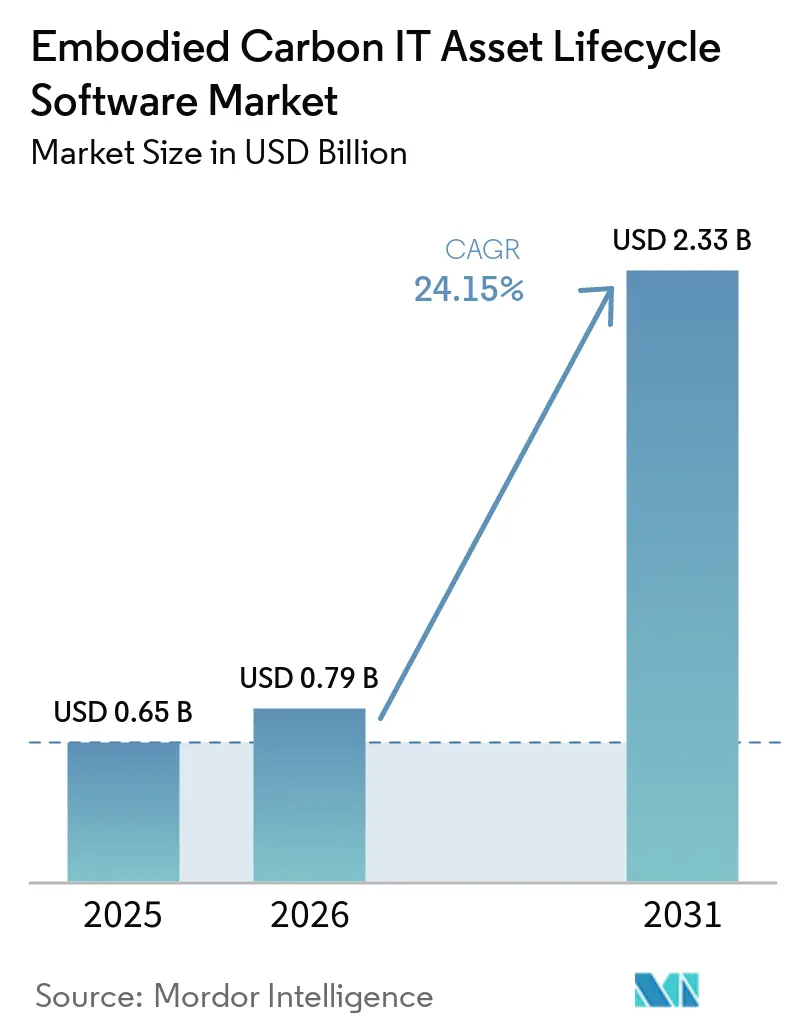
The embodied carbon IT asset lifecycle software market size was valued at USD 0.65 billion in 2025 and is forecast to reach USD 2.33 billion by 2031, expanding at a CAGR of 24.15% during 2026-2031. Demand is rising because carbon reporting for purchased IT hardware is moving from a voluntary exercise to a documented compliance task for large enterprises. Buyers are also shifting from broad estimates to product-level data that can withstand internal review, supplier scrutiny, and external assurance. The category is now sitting closer to core IT governance because procurement, asset management, sustainability reporting, and cloud cost control are increasingly reviewed together. Competition is tightening as specialist lifecycle tools, broader carbon management platforms, and LCA software vendors all target the same enterprise budgets. The strongest openings remain in audit-ready data management, carbon-aware procurement, and software that supports reuse and longer device life without weakening reporting quality.
Key Report Takeaways
- By component, software held 69.74% share of the embodied carbon IT asset lifecycle software market in 2025, while services are projected to expand at a 24.65% CAGR through 2031.
- By deployment mode, cloud-based deployment accounted for 66.12% in 2025, while hybrid is projected to grow at a 25.02% CAGR through 2031.
- By enterprise size, large enterprises held 64.85% in 2025, while small and medium enterprises are projected to expand at a 24.87% CAGR through 2031.
- By application, embodied carbon accounting accounted for 29.41% of the embodied carbon IT asset lifecycle software market in 2025, while circularity and reuse planning are projected to advance at a 25.34% CAGR through 2031.
- By end user, IT and telecom held 27.12% in 2025, while retail and e-commerce are projected to expand at a 24.92% CAGR through 2031.
- By geography, Europe held 34.56% of the embodied carbon IT asset lifecycle software market share in 2025, while Asia-Pacific is projected to grow at a 25.45% CAGR through 2031.
Note: Market size and forecast figures in this report are generated using Mordor Intelligence’s proprietary estimation framework, updated with the latest available data and insights as of January 2026.
Market Trends and Insights
Drivers Impact Analysis of Embodied Carbon IT Asset Lifecycle Software Market*
| Driver | (~) % Impact on CAGR Forecast | Geographic Relevance | Impact Timeline |
|---|---|---|---|
| Stringent Scope 3 and IT Sustainability Disclosure Requirements | +5.2% | Global, with highest regulatory intensity in the EU, US, and Australia | Short term (≤ 2 years) |
| Rising Demand for Audit-Ready Embodied Carbon Data In IT Procurement | +4.5% | Global, most advanced adoption in the EU and North America | Short term (≤ 2 years) |
| Expansion o Circular IT Practices, Reuse, and Lifecycle Extension Programs | +3.8% | EU core markets, with spillover to North America and Asia-Pacific | Medium term (2-4 years) |
| Convergence of IT Asset Management, ESG Reporting, And FinOps Workflows | +2.4% | North America and EU, increasing in Asia-Pacific enterprise segment | Medium term (2-4 years) |
| Wider Availability of Device-Level LCA Data Through APIs And Databases | +1.7% | Global | Long term (≥ 4 years) |
| Growing Enterprise Focus on Product-Level Carbon Hotspots Across IT Fleets | +1.3% | North America, EU, early adoption in Japan and Australia | Long term (≥ 4 years) |
| Source: Mordor Intelligence | |||
Stringent Scope 3 and IT Sustainability Disclosure Requirements Drive Platform Demand
Regulatory pressure is pushing carbon data for IT hardware into formal reporting cycles. ESRS E1 places purchased goods and services inside a structured climate disclosure framework, which means device-related emissions can no longer be handled as a side estimate inside broad sustainability summaries.[1] Germany’s CSRD implementation process also reinforced the need for large enterprises to prepare for reporting tied to fiscal year 2025, which moved compliance work into active budget and systems planning. This change matters because the embodied carbon IT asset lifecycle software market is being pulled by audit expectations rather than by branding goals alone. Software that connects procurement records, asset data, and emissions logic is becoming easier to justify when disclosure reviews involve finance, sustainability, and internal controls teams simultaneously. The same compliance pressure also extends to supplier networks, meaning reporting entities often need stronger upstream data collection even when their direct hardware purchasing patterns have not changed.
Rising Demand for Audit-Ready Embodied Carbon Data in IT Procurement Deepens Data Provenance Needs
Procurement teams are under growing pressure to use product-level carbon data instead of broad proxy values when they assess IT purchases. Lenovo’s 2025 rollout of configuration-level product carbon footprints for ThinkPad, built with Makersite, showed that OEM transparency is becoming a practical differentiator in enterprise buying conversations.[2] That shift matters because buyers do not just need a number; they need one that can be traced back to a specific product setup and understood across suppliers. As a result, the embodied carbon IT asset lifecycle software market is moving away from simple reporting dashboards and toward platforms that can ingest, normalize, and compare primary data from several OEM sources. This also increases the value of software that can maintain consistent records across purchasing cycles, device refreshes, and disclosure periods. Vendors that can handle supplier data variation without breaking reporting quality are likely to gain more enterprise attention.
Expansion of Circular IT Practices, Reuse, and Lifecycle Extension Programs Extends Software’s Role
Reuse and lifecycle extension are becoming more central to how enterprises manage the carbon load of their IT estates. A 2025 ITAD benchmarking study found that 34% of respondents were actively promoting ESG initiatives, up from 19% in 2023, which shows that sustainability goals are reaching operational asset disposition decisions.[3] That change expands the role of software beyond first-purchase accounting to include redeployment, refurbishment, retirement, and supporting documentation. The embodied carbon IT asset lifecycle software market benefits from this shift, as buyers increasingly want a clear record of why an asset was reused, retired, or replaced at a given point in time. BITKOM’s 2025 guidance on resource efficiency in the software lifecycle also reflects a broader expectation that technology organizations should connect sustainability outcomes with everyday software and procurement processes. Platforms that can connect carbon measurement with asset life extension are therefore in a stronger position than tools that only summarize emissions after the fact.
Convergence of IT Asset Management, ESG Reporting, and FinOps Workflows Creates A Broader Buying Center
Enterprises are increasingly treating asset records, cost control, and carbon tracking as connected management tasks rather than separate workstreams. ISO/IEC TS 19770-13:2026 provided organizations with formal guidance on incorporating sustainability aspects into IT asset management systems, making this convergence easier to standardize within existing governance processes. Flexera’s 2026 State of the Cloud Report also found that nearly 1 in 3 organizations now view reducing carbon emissions and controlling cloud costs as equal priorities. That matters because the embodied carbon IT asset lifecycle software market no longer depends only on sustainability teams to sponsor deployments. Procurement, ITAM, cloud operations, and finance teams are all becoming more relevant participants in buying and rollout decisions. Vendors that integrate cleanly with enterprise systems and operational reviews are likely to hold an advantage as this wider buyer group becomes more active.
Restraints Impact Analysis of Embodied Carbon IT Asset Lifecycle Software Market*
| Restraint | (~) % Impact on CAGR Forecast | Geographic Relevance | Impact Timeline |
|---|---|---|---|
| Fragmented Embodied Carbon Factors Across OEMs And Device Classes | -2.1% | Global, most acute in Asia-Pacific where OEM coverage is thinner | Medium term (2-4 years) |
| Integration Complexity Across ITAM, ERP, ESG, and Procurement Systems | -1.6% | Global, most severe in large enterprises with legacy IT infrastructure | Short term (≤ 2 years) |
| Security, Privacy, and Data Governance Concerns Around Asset Telemetry | -1.1% | Global, sharpest in the EU under GDPR and in regulated industries | Medium term (2-4 years) |
| Limited Standardization of IT Asset Carbon Accounting Methodologies | -0.7% | Global | Long term (≥ 4 years) |
| Source: Mordor Intelligence | |||
Fragmented Embodied Carbon Factors Across OEMs And Device Classes Limit Data Fidelity
Data quality remains uneven because product carbon information is still not published with the same depth across all hardware makers and device categories. Lenovo’s configuration-level footprint work is one example of stronger transparency, but that level of detail is not yet standard across the full supply base. Ecoinvent offers one of the largest lifecycle inventory bases available, yet no dataset library fully covers every new and specialized hardware profile entering enterprise fleets.[4] This means many platforms still need to blend supplier-specific values with modeled assumptions and secondary factors. That can weaken consistency when enterprises compare fleets across brands, form factors, and refresh cycles. The embodied carbon IT asset lifecycle software market still has strong demand, but uneven upstream data remains a real brake on confidence and implementation speed.
Integration Complexity Across ITAM, ERP, ESG, and Procurement Systems Raises Deployment Friction
Deploying these platforms often requires much more than switching on a new reporting tool. ISO guidance now clearly places sustainability within IT asset management practices, meaning software must fit into asset records, process controls, and governance workflows that already exist across the enterprise. Microsoft’s CHEM, which works with Makersite, also shows how complex hardware environments require structured models and coordinated data handling rather than isolated spreadsheets. In practice, many organizations still keep ITAM, ERP, ESG, and procurement data in separate systems, each with its own owners and formats. That creates more implementation work, more review layers, and more dependency on internal data cleanup before reporting can improve. The embodied carbon IT asset lifecycle software market, therefore, tends to move faster in organizations with mature digital records and more slowly in enterprises that still rely on older, disconnected operating stacks.
*Our forecasts treat driver/restraint impacts as directional, not additive. The impact forecasts reflect baseline growth, mix effects, and variable interactions.
Embodied Carbon IT Asset Lifecycle Software Market Segment Analysis
By Component:
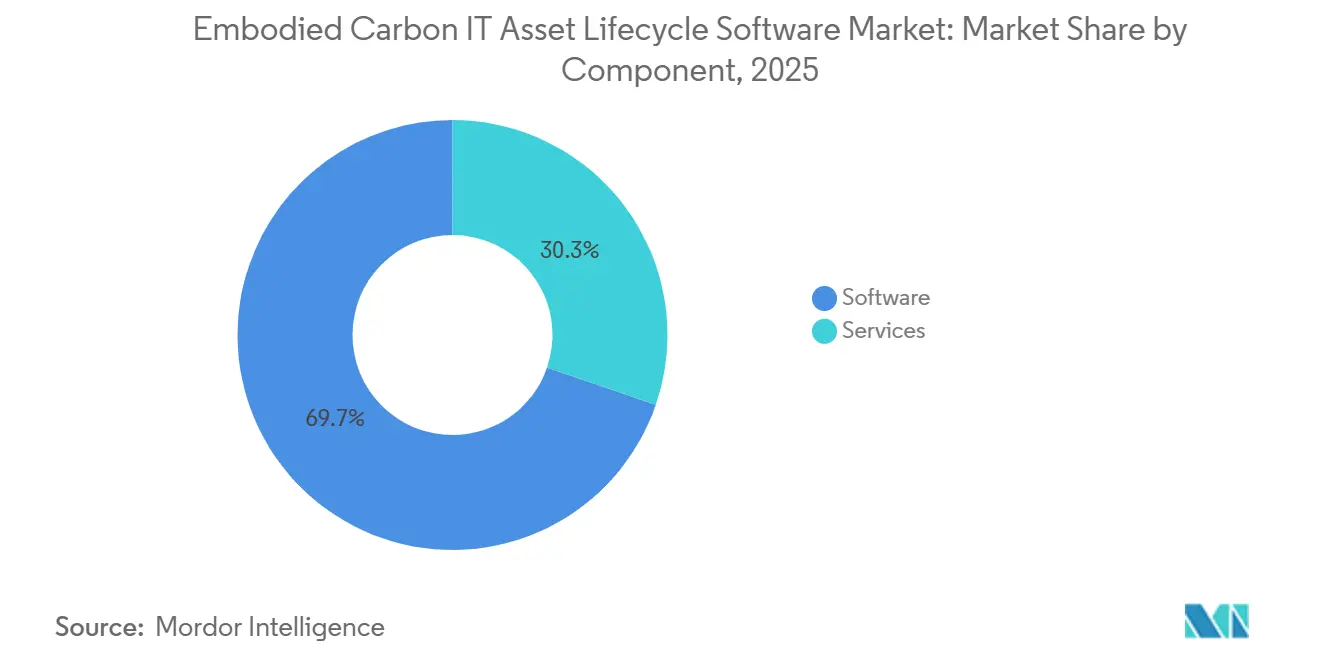
Software Leads While Services Gain DepthSoftware held 69.74% of the embodied carbon IT asset lifecycle software market in 2025, establishing it as the core delivery layer across the category. That position reflects how most buyers start by needing to collect device information, apply emissions logic, and produce consistent outputs within a single configurable system. The first enterprise question is usually about data capture and reporting repeatability, which naturally favors software before services spending expands. The embodied carbon IT asset lifecycle software market also remains software-led, as automation reduces manual carbon accounting work that many internal teams cannot sustain across multiple reporting periods. Established lifecycle and carbon platforms entered this space with proven data structures, while newer vendors focused on making those processes faster and easier to scale.
This lead does not imply that services are secondary in importance, as services are projected to expand at a 24.65% CAGR through 2031. Many buyers still need help with data preparation, methodology choices, system mapping, and the handoff between sustainability teams and IT operations. Service demand rises further when organizations want a faster route to usable outputs but do not yet have enough internal LCA or carbon accounting capacity. Sphera’s managed LCA content offering, supported by more than 20,000 datasets annually updated and third-party verified, demonstrates why content and implementation support are often sold together in complex deployments. Over time, the embodied carbon IT asset lifecycle software industry is likely to remain anchored by software revenue, while services capture more value in integration, quality control, and ongoing model governance.
By Deployment Mode:
Cloud Retains Scale While Hybrid Expands FasterCloud deployment accounted for 66.12% of the embodied carbon IT asset lifecycle software market in 2025, giving it a clear lead among delivery models. The preference is practical because cloud delivery supports faster onboarding, easier updates, and less infrastructure burden for sustainability teams that usually do not manage large internal software environments. It also works well for platforms that need frequent data refreshes from factor libraries, supplier records, and enterprise systems. Access to regularly updated lifecycle inventory content matters here, and broad databases such as ecoinvent reinforce the value of centrally managed updates rather than isolated local copies. The embodied carbon IT asset lifecycle software market still leans toward cloud because buyers want speed, flexibility, and simpler maintenance during early rollout phases.
Hybrid deployment is projected to grow at a 25.02% CAGR through 2031, which makes it the fastest-growing mode. This pattern reflects the needs of regulated organizations that want cloud-based modeling power but still prefer tighter control over telemetry, inventory detail, or internal records. Hybrid setups also appeal to enterprises that already run established governance systems on-site and do not want to move all connected data into a shared environment at once. ISO/IEC TS 19770-13:2026 supports this direction by encouraging the structured incorporation of sustainability information into existing ITAM systems rather than a one-size-fits-all architecture. On-premises deployment remains relevant in organizations with longer software replacement cycles, but the embodied carbon IT asset lifecycle software market is clearly shifting toward models that combine cloud flexibility with stronger control over sensitive data.
By Enterprise Size:
Large Enterprises Lead While SMEs AccelerateLarge enterprises accounted for 64.85% of the embodied carbon IT asset lifecycle software market in 2025, reflecting both compliance exposure and stronger spending capacity. These organizations were earlier to formalize Scope 3 programs, and they usually have the procurement complexity and reporting scale that justify specialized software. They also tend to operate broader device fleets, more suppliers, and more internal governance layers, which increases the need for structured lifecycle carbon records. Microsoft’s use of Makersite’s automated LCA platform in its CHEM framework shows how large organizations are building process-based measurement across complex hardware environments rather than relying on simplified estimates. The embodied carbon IT asset lifecycle software market, therefore, continues to draw much of its current revenue from larger buyers that need multi-team workflows and audit-ready records.
Small and medium enterprises are projected to grow at a 24.87% CAGR through 2031, which makes them the faster-moving enterprise cohort. Their growth is being shaped less by large internal sustainability departments and more by value-chain pressure coming from bigger customers. When enterprise buyers ask suppliers for better product data and cleaner supporting records, smaller technology firms also need better systems to respond. BITKOM’s 2025 resource efficiency guidance for the software lifecycle signals that these expectations are already spreading through mid-market and smaller technology organizations in Germany and related supply networks. Lower-cost SaaS models and simpler deployment paths are helping this part of the embodied carbon IT asset lifecycle software market open up faster than it did in earlier reporting cycles.
By Application:
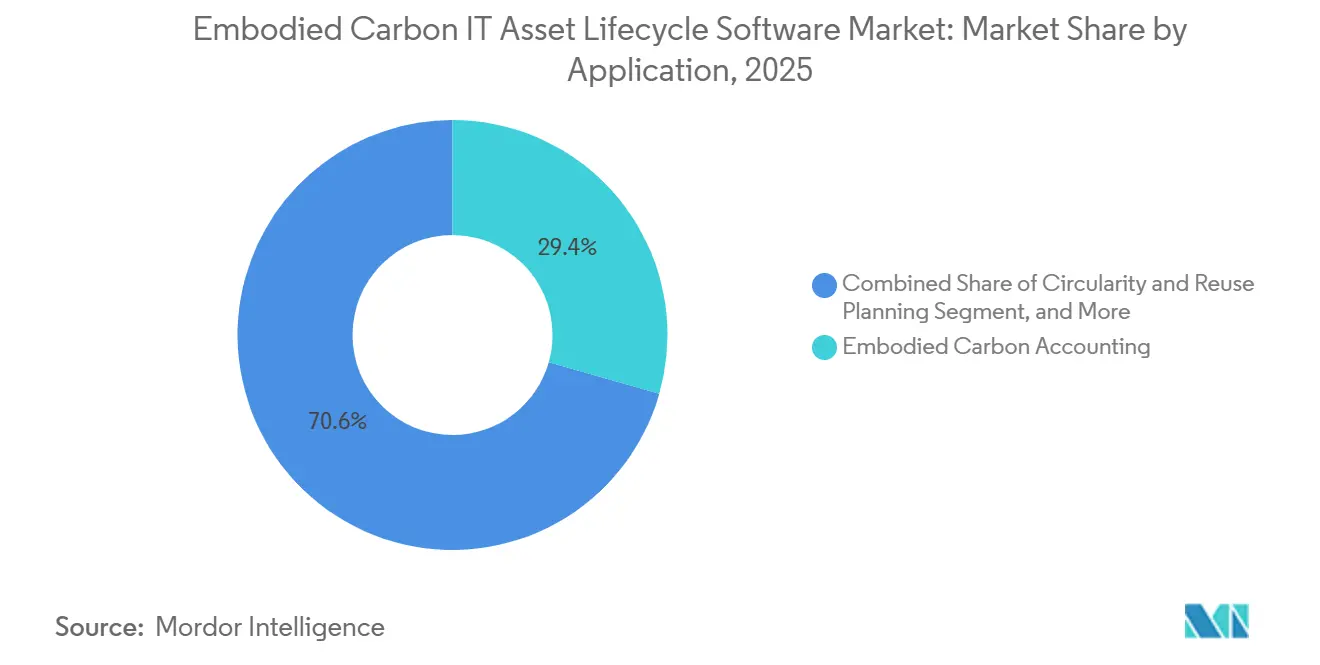
Carbon Accounting Anchors Adoption While Circularity ScalesEmbodied carbon accounting accounted for 29.41% of the embodied carbon IT asset lifecycle software market in 2025, making it the largest application area. That lead is logical because most enterprise programs begin by measuring what sits within their device purchasing footprint before moving into optimization. Reporting rules also reinforce this path, since climate disclosures require more structure around purchased goods and services data than many companies had in place before. Carbon accounting tools, therefore, became the first software layer for many buyers because they provide factor logic, audit trails, and repeatable output structures. The embodied carbon IT asset lifecycle software market keeps returning to this application as its anchor, because every subsequent use case depends on a defensible baseline.
Circularity and reuse planning are projected to expand at a 25.34% CAGR through 2031, which makes it the fastest-growing application. This reflects a practical shift in enterprise priorities, since once buyers measure embodied emissions, they quickly ask whether they can avoid new emissions by extending device life. Software becomes more valuable when it can support redeployment decisions, reuse pathways, and documented retirement logic inside the same workflow. Cascade Assets’ 2025 benchmarking showed rising ESG activity within ITAD practices, supporting the view that carbon-related reuse planning is moving into standard operating processes. BITKOM’s guidance on software lifecycle resource efficiency points in the same direction, encouraging organizations to connect technology planning with broader sustainability outcomes. As a result, this part of the embodied carbon IT asset lifecycle software market is expanding from a niche planning task into a broader operational requirement.

By End User:
IT And Telecom Stays Largest While Retail And E-Commerce Picks Up SpeedIT and telecom accounted for 27.12% of the embodied carbon IT asset lifecycle software market in 2025, making it the largest end-user vertical. The sector’s lead reflects both the scale of its device fleets and its earlier familiarity with sustainability reporting. Technology companies also tend to face more direct scrutiny over hardware sourcing, infrastructure buildout, and customer-facing climate commitments. That combination makes them more willing to invest in tools that connect procurement records with lifecycle carbon data. The embodied carbon IT asset lifecycle software market has therefore found a natural early buyer base in organizations where digital infrastructure is central to both operations and public reporting.
Retail and e-commerce are projected to expand at a 24.92% CAGR through 2031, giving it the fastest pace among end users. This vertical is supporting a large, distributed device base across stores, warehouses, logistics operations, and support networks, making hardware visibility increasingly important over time. Carbon accounting needs are also becoming harder to ignore as omnichannel operations scale and public net-zero commitments become more detailed. BFSI remains active because procurement governance and infrastructure intensity are rising together, while manufacturing, energy, and utilities are connecting IT asset tracking with broader operational systems. Government and public sector adoption is still in its early stages, but the direction of the embodied carbon IT asset lifecycle software market suggests wider uptake as procurement rules and reporting expectations become more structured across public institutions.
Geography Analysis
Europe Embodied Carbon IT Asset Lifecycle Software Market
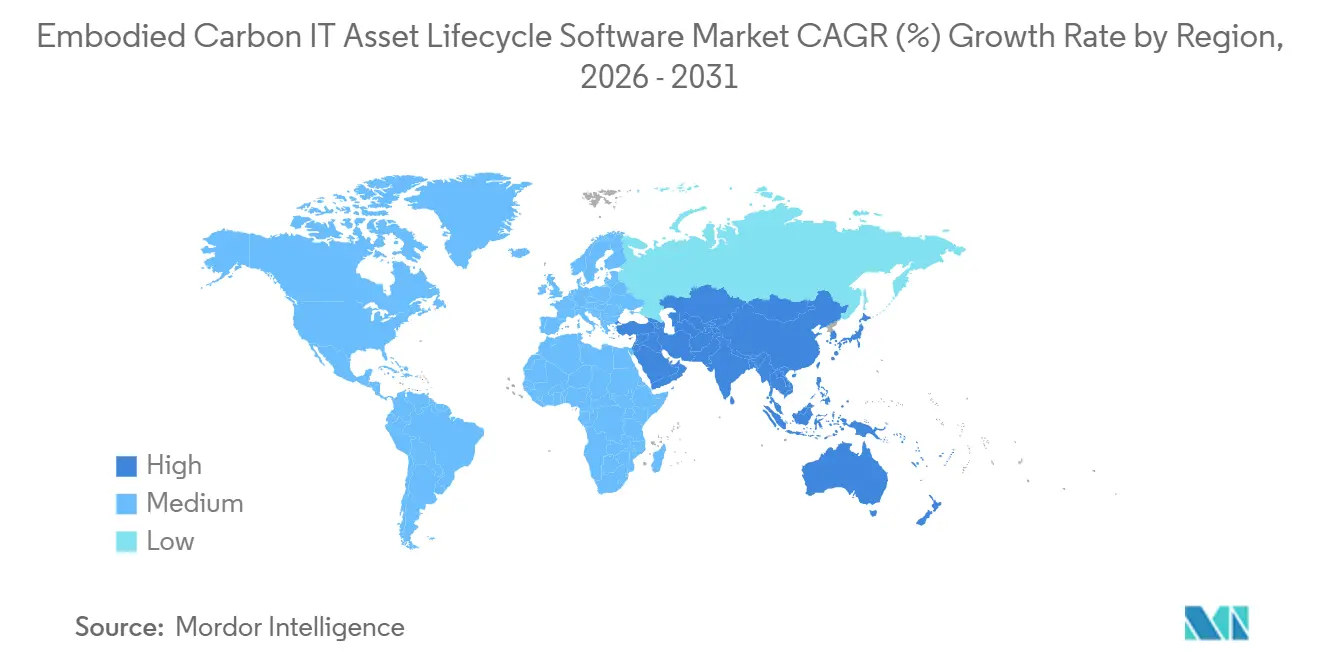
Europe held 34.56% of the embodied carbon IT asset lifecycle software market share in 2025, maintaining its leading position. Germany, the United Kingdom, and France remain the main demand centers because they combine large enterprise bases with stronger reporting expectations and more mature sustainability processes. Germany is especially important because CSRD implementation planning and corporate preparation have accelerated the need for structured reporting workflows for purchased goods and services. BITKOM’s 2025 guidance also reflects the degree to which technology and software organizations in the region are already linking resource efficiency with procurement and lifecycle planning.
APAC Embodied Carbon IT Asset Lifecycle Software Market
Asia-Pacific is projected to grow at a 25.45% CAGR through 2031, which makes it the fastest-growing region in the embodied carbon IT asset lifecycle software market. The region is entering a stronger adoption phase as disclosure practices expand across major economies and enterprise buyers demand better data from regional hardware suppliers. Japan, Australia, India, Singapore, China, and South Korea all contribute to this trend, as reporting activities and climate-related governance are becoming more formal across listed companies and large enterprises. Another factor is the region’s weight in hardware manufacturing, which means supplier-side and buyer-side pressures often rise at the same time. This creates demand not only from reporting entities, but also from OEMs and component suppliers that need cleaner product carbon data to support global customer relationships.
The Americas and MEA Embodied Carbon IT Asset Lifecycle Software Market
North America held the second-largest regional share in the embodied carbon IT asset lifecycle software market in 2025. The United States remains central because it houses several well-funded vendors and a large base of enterprises that already run structured sustainability programs. Demand in this region is moving upstream from disclosure output into procurement-stage scoring, supplier data requests, and hardware refresh decisions. South America remains earlier in adoption, while the Middle East and Africa show a split pattern with stronger activity in the UAE, Saudi Arabia, and South Africa than in the rest of the region.
Competitive Landscape
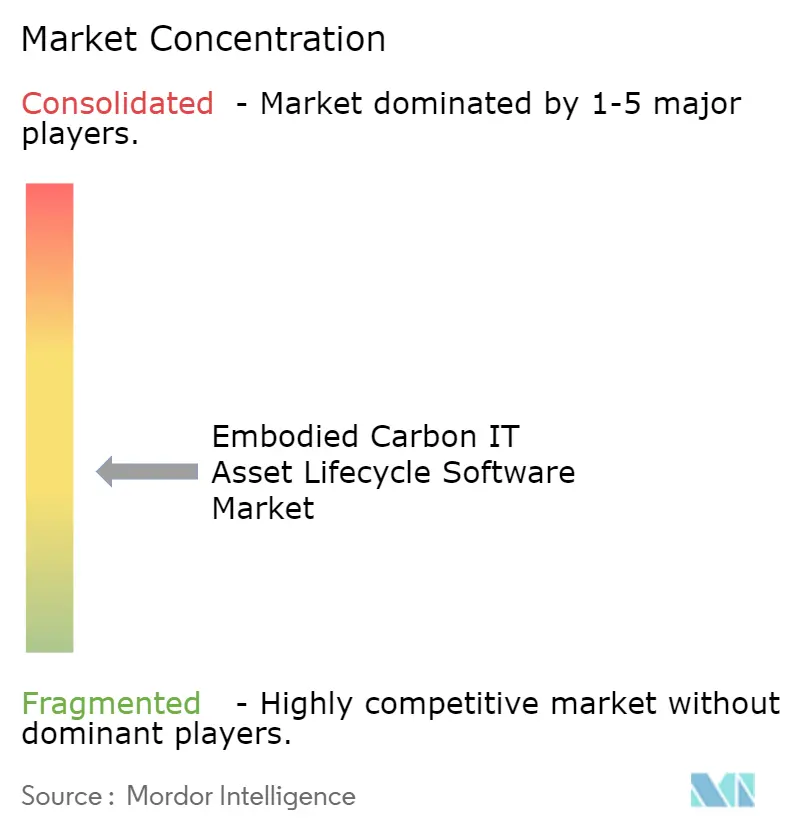
The embodied carbon IT asset lifecycle software market remains moderatlry fragmented, with no single vendor controlling a dominant position across all deployment models, use cases, or customer sizes. Competition spans broad carbon management platforms, specialist lifecycle intelligence providers, and more focused software tools built around device-level measurement and optimization. This mix exists because enterprise buyers do not all need the same depth of LCA content, the same integration path, or the same reporting scope. The embodied carbon IT asset lifecycle software market, therefore, supports multiple vendor types simultaneously, even as overlap between them continues to increase.
Strategic moves are showing where competition is heading. Makersite’s acquisition of Siemens’ SiGREEN platform became effective on June 1, 2026, and strengthened its position in supplier data exchange, product carbon footprint aggregation, and standards-aligned collaboration across value chains. Green Project Technologies acquired the Emitwise software platform on July 28, 2025, adding automated product carbon footprint functionality and supplier engagement tooling to its broader Scope 3 offering. Sphera continues to compete on content depth, supported by a managed LCA database with more than 20,000 datasets, annually updated and third-party verified. Together, these moves show that suppliers are trying to own more of the data chain rather than just the reporting screen. The embodied carbon IT asset lifecycle software market is rewarding vendors that can integrate product-level data, supplier collaboration, and enterprise reporting into a single workflow.
White space remains visible in mid-market pricing, ITAM-native integration, and workflow automation. Smaller buyers often need simpler software paths that reduce implementation burden without compromising audit discipline, creating room for vendors with lighter deployment models. Integration remains another differentiator because buyers increasingly want carbon scoring and lifecycle data to sit closer to existing asset, procurement, and cloud management processes. The embodied carbon IT asset lifecycle software market is also likely to favor vendors that can reduce manual cleanup work while maintaining clear data provenance, especially as customers move from pilot programs into repeat annual reporting cycles.
Embodied Carbon IT Asset Lifecycle Software Industry Leaders
-
One Click LCA Ltd
-
Sphera Solutions, Inc.
-
PRé Sustainability B.V.
-
GreenDelta GmbH
-
iPoint-systems GmbH
- *Disclaimer: Major Players sorted in no particular order
Embodied Carbon IT Asset Lifecycle Software Market Companies Covered in this Report
- One Click LCA Ltd
- PRé Sustainability B.V.
- Sphera Solutions, Inc.
- GreenDelta GmbH
- iPoint-systems GmbH
- Makersite GmbH
- Ecochain Technologies B.V.
- Plan A Technologies GmbH
- Greenly SAS
- Normative AB
- Persefoni AI, Inc.
- Watershed Technology, Inc.
- Sweep SAS
- Dcycle, S.L.
- Sinai Technologies, Inc.
- Emitwise Limited
- Measurabl, Inc.
- Deepki SAS
- OpenLCA GmbH
- FigBytes Inc.
Recent Industry Developments in Embodied Carbon IT Asset Lifecycle Software Market
- June 2026: Makersite's acquisition of SiGREEN, Siemens' product carbon footprint and supply chain data exchange platform, became effective on June 1, 2026, following the announcement on April 14, 2026. The combined platform adds PCF aggregation, supplier data exchange, and alignment with Catena-X, WBCSD PACT, and Together for Sustainability frameworks to Makersite's lifecycle intelligence stack, creating an end-to-end product carbon footprinting capability from raw materials to factory gate.
- May 2026: Persefoni AI launched the Persefoni Analytics Agent on May 5, 2026, an agentic AI tool enabling enterprise users to query emissions data in natural language, generate in-depth visualizations, and produce traceable, audit-ready analytical outputs grounded in the company's CO₂e Activity Ledger. The launch follows Persefoni's milestone of serving more than 500 enterprise customers globally across its USD 179 million total capital raised.
- April 2026: Watershed launched Watershed Agents on April 21, 2026 at San Francisco Climate Week, including AI agents for data cleaning and analysis that reduced time-to-actionable sustainability data by 80% in test deployments, with one customer completing a 5-hour data cleaning project in 20 minutes.
- February 2026: Normative launched Carbon Inventory Managed Services on February 17, 2026, a hands-on execution service that addresses the most common adoption bottleneck, data collection. The service delivers complete, audit-ready carbon inventories directly within clients' existing Normative platform, combining managed data aggregation with the platform's analytics and reduction planning tools.
Global Embodied Carbon IT Asset Lifecycle Software Market Report Scope
The Embodied Carbon IT Asset Lifecycle Software market refers to platforms and services that enable organizations to measure, monitor, and manage the embodied carbon emissions associated with IT assets across their entire lifecycle, from design and procurement to usage, reuse, and end-of-life disposal. These solutions provide functionalities such as embodied carbon accounting, lifecycle optimization, circularity and reuse planning, and compliance with sustainability reporting frameworks.
The Embodied Carbon IT Asset Lifecycle Software market report is segmented by Component (Software, and Services), Deployment Mode (Cloud-Based and On-Premises), Enterprise Size (Large Enterprises, and Small and Medium Enterprises), Application (Embodied Carbon Accounting, IT Asset Lifecycle Optimization, Circularity and Reuse Planning, Compliance and Reporting), End User (IT and Telecom, BFSI, Industrial Manufacturing, Energy and Utilities, Oil and Gas, Retail and E-Commerce, Construction and Infrastructure, Government and Public Sector, and Other End Users), and Geography (North America, South America, Europe, Asia-Pacific, Middle East, and Africa). The Market Forecasts are Provided in Terms of Value (USD).
Segmentation Overview
| Software |
| Services |
| Cloud-Based |
| On-Premises |
| Large Enterprises |
| Small and Medium Enterprises |
| Embodied Carbon Accounting |
| IT Asset Lifecycle Optimization |
| Circularity and Reuse Planning |
| Compliance and Reporting |
| IT and Telecom |
| BFSI |
| Industrial Manufacturing |
| Energy and Utilities |
| Oil and Gas |
| Retail and E-Commerce |
| Construction and Infrastructure |
| Government and Public Sector |
| Other End Users |
| North America | United States | |
| Canada | ||
| Mexico | ||
| South America | Brazil | |
| Argentina | ||
| Rest of South America | ||
| Europe | Germany | |
| United Kingdom | ||
| France | ||
| Italy | ||
| Spain | ||
| Russia | ||
| Rest of Europe | ||
| Asia-Pacific | China | |
| India | ||
| Japan | ||
| South Korea | ||
| Australia | ||
| Rest of Asia-Pacific | ||
| Middle East and Africa | Middle East | Saudi Arabia |
| United Arab Emirates | ||
| Turkey | ||
| Rest of Middle East | ||
| Africa | South Africa | |
| Egypt | ||
| Rest of Africa | ||
| By Component | Software | ||
| Services | |||
| By Deployment Mode | Cloud-Based | ||
| On-Premises | |||
| By Enterprise Size | Large Enterprises | ||
| Small and Medium Enterprises | |||
| By Application | Embodied Carbon Accounting | ||
| IT Asset Lifecycle Optimization | |||
| Circularity and Reuse Planning | |||
| Compliance and Reporting | |||
| By End User | IT and Telecom | ||
| BFSI | |||
| Industrial Manufacturing | |||
| Energy and Utilities | |||
| Oil and Gas | |||
| Retail and E-Commerce | |||
| Construction and Infrastructure | |||
| Government and Public Sector | |||
| Other End Users | |||
| By Geography | North America | United States | |
| Canada | |||
| Mexico | |||
| South America | Brazil | ||
| Argentina | |||
| Rest of South America | |||
| Europe | Germany | ||
| United Kingdom | |||
| France | |||
| Italy | |||
| Spain | |||
| Russia | |||
| Rest of Europe | |||
| Asia-Pacific | China | ||
| India | |||
| Japan | |||
| South Korea | |||
| Australia | |||
| Rest of Asia-Pacific | |||
| Middle East and Africa | Middle East | Saudi Arabia | |
| United Arab Emirates | |||
| Turkey | |||
| Rest of Middle East | |||
| Africa | South Africa | ||
| Egypt | |||
| Rest of Africa | |||
Key Questions Answered in the Report
What is the current and forecast value of the embodied carbon IT asset lifecycle software market?
The embodied carbon IT asset lifecycle software market was valued at USD 0.65 billion in 2025 and is forecast to reach USD 2.33 billion by 2031, growing at a 24.15% CAGR during 2026-2031.
Which region is expanding the fastest for embodied carbon IT asset lifecycle software?
Asia-Pacific is projected to record the fastest growth at a 25.45% CAGR through 2031, supported by widening disclosure activity and stronger supplier data requirements.
Which deployment model currently leads, and which one is growing the fastest?
Cloud led with 66.12% share in 2025 because buyers want easier updates and lower infrastructure burden, while hybrid is projected to grow the fastest at a 25.02% CAGR through 2031.
Why do large enterprises account for most current spending?
Large enterprises held 64.85% share in 2025 because they face heavier reporting pressure, manage broader supplier networks, and have stronger budgets for integration and governance.
Which application area is largest today, and which one is accelerating fastest?
Embodied carbon accounting was the largest application at 29.41% share in 2025, while circularity and reuse planning is projected to grow the fastest at a 25.34% CAGR through 2031.
Which end-user group is showing the strongest forward momentum?
Retail and e-commerce is projected to post the fastest CAGR at 24.92% through 2031 as operators manage larger distributed device fleets across stores, logistics, and warehouse networks.