
Cloud Carbon Footprint Tracking Software Market Size and Share
Market Overview
| Study Period | 2020 - 2031 |
|---|---|
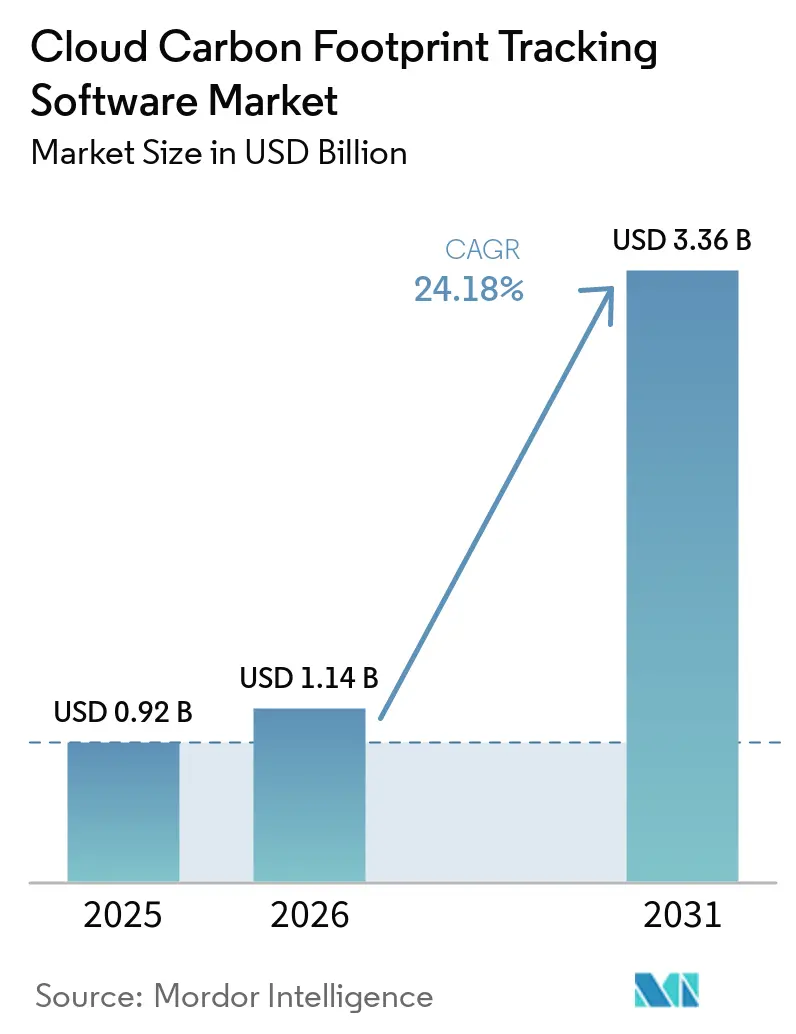
| Market Size (2026) | USD 1.14 Billion |
| Market Size (2031) | USD 3.36 Billion |
| Growth Rate (2026 - 2031) | 24.18 % |
| Fastest Growing Market | Asia-Pacific |
| Largest Market | North America |
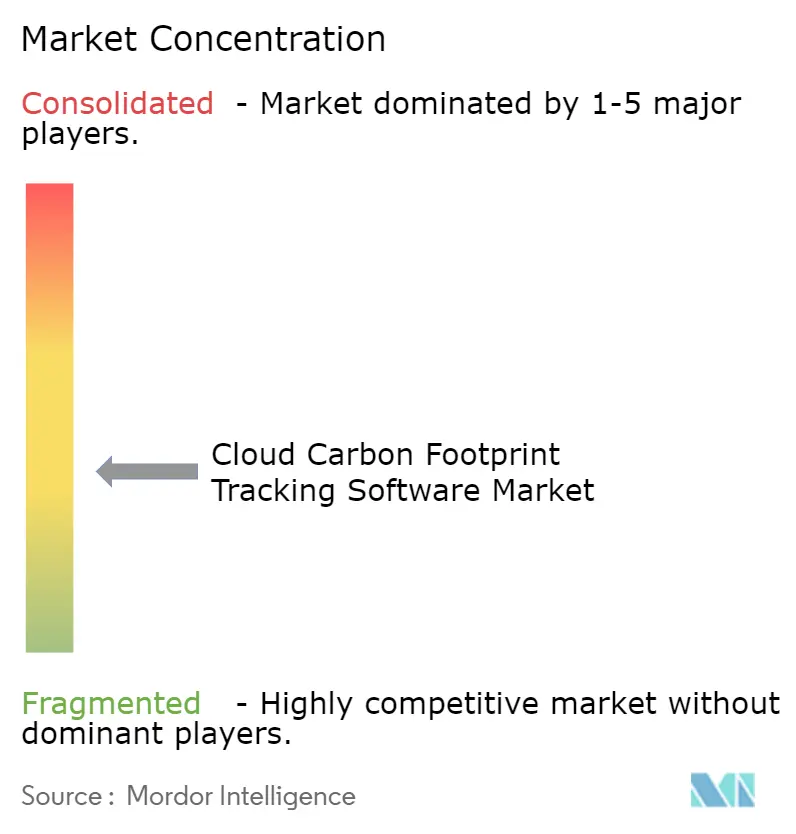
| Market Concentration | Medium |
Major Players *Disclaimer: Major Players sorted in no particular order Image © Mordor Intelligence. Reuse requires attribution under CC BY 4.0. | |
Cloud Carbon Footprint Tracking Software Market Analysis by Mordor Intelligence
The cloud carbon footprint tracking software market size is projected to be USD 0.92 billion in 2025, USD 1.14 billion in 2026, and reach USD 3.36 billion by 2031, growing at a CAGR of 24.18% from 2026 to 2031. The cloud carbon footprint tracking software market is entering a faster adoption phase as climate reporting rules now require cleaner audit trails for digital operations. The same market is also being lifted by the rising carbon cost of AI infrastructure, especially when GPU-heavy workloads result in high energy use but low effective utilization. Buyers are no longer treating carbon data as a stand-alone sustainability exercise, because cost and infrastructure teams increasingly want a single operating view across AWS, Microsoft Azure, and Google Cloud. This is creating a stronger demand for platforms that can connect directly to cloud billing, telemetry, and workload orchestration layers in real time. At the same time, differences in provider methodologies are making third-party software more important, as enterprises need a consistent reporting layer that can withstand tighter guidance on hourly emissions matching in the next reporting cycle.
Key Report Takeaways
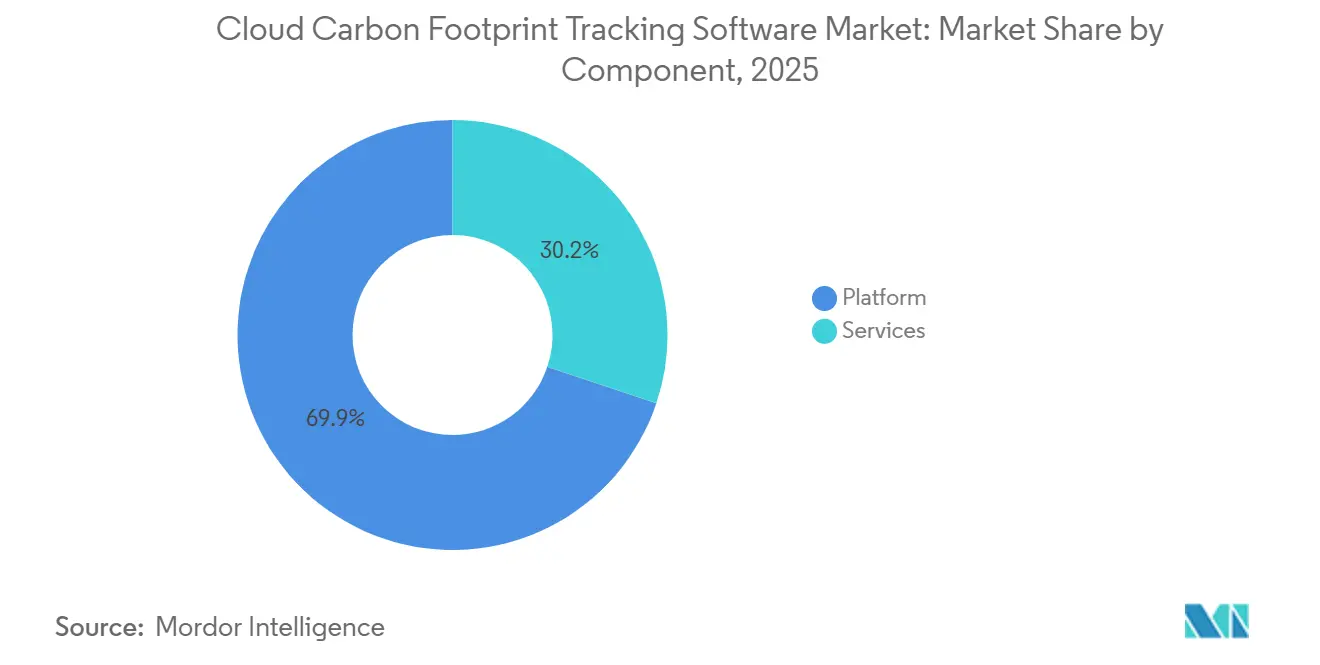
- By component, platform software held 69.85% of the cloud carbon footprint tracking software market in 2025, while services are projected to expand at a 25.12% CAGR through 2031.
- By deployment mode, cloud-based deployments accounted for 66.74% of the market in 2025, while hybrid deployment is projected to grow at a 26.03% CAGR through 2031.
- By enterprise size, large enterprises held 64.92% share in 2025, while SMEs are projected to expand at a 25.87% CAGR during 2026-2031.
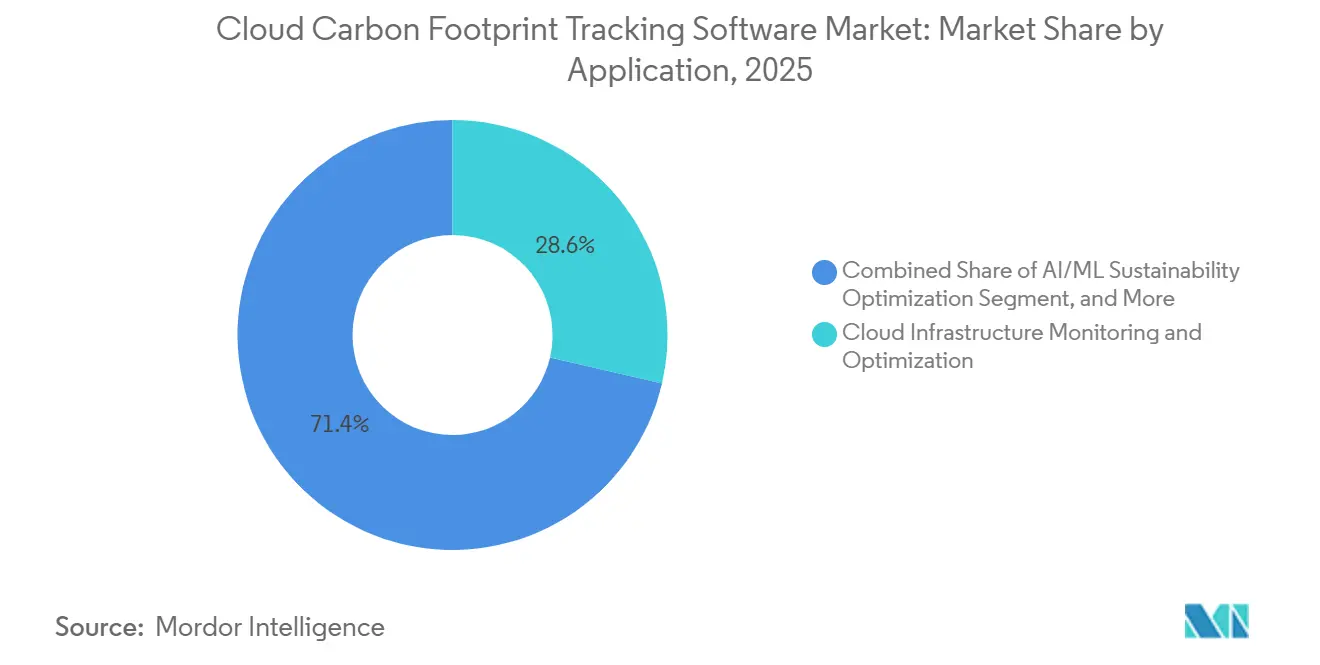
- By application, cloud infrastructure monitoring and optimization accounted for 28.63% share in 2025, while AI/ML sustainability optimization is projected to grow at a 26.41% CAGR through 2031.
- By end-user industry, IT and telecom held 26.12% share in 2025, while retail and consumer goods is projected to expand at a 24.89% CAGR through 2031.
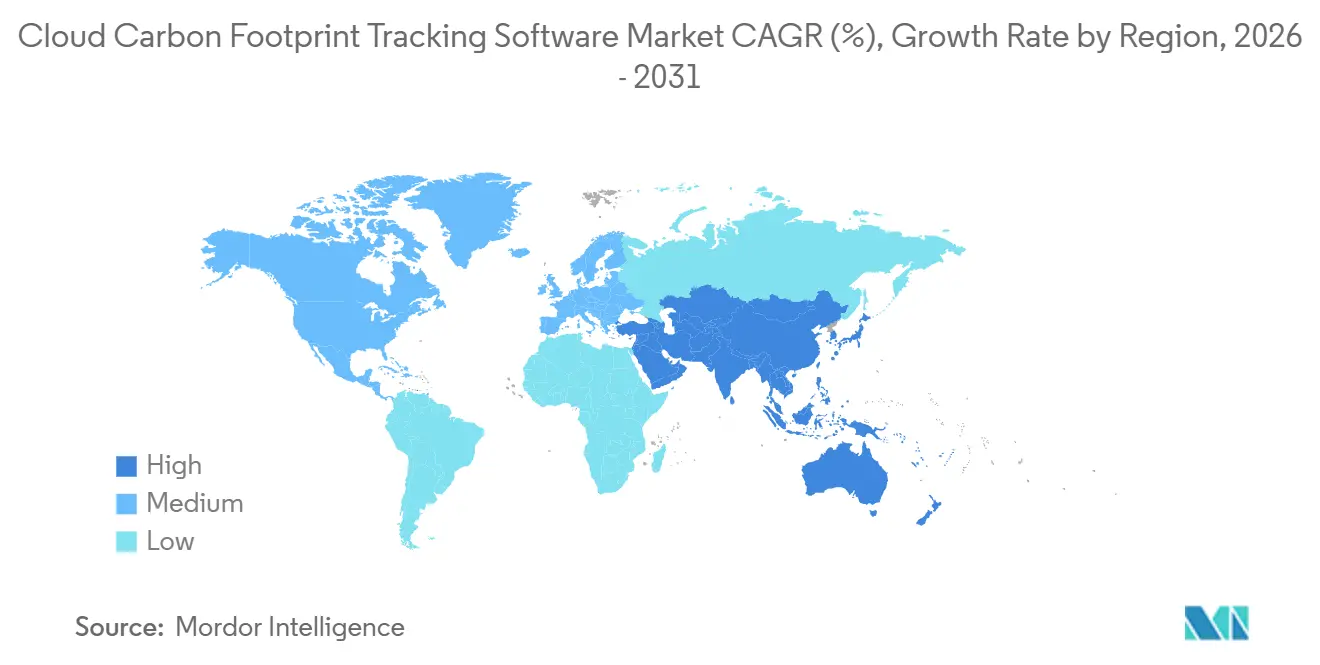
- By geography, North America held 34.56% share of the cloud carbon footprint tracking software market in 2025, while Asia-Pacific is projected to record the fastest growth at a 27.34% CAGR through 2031.
Note: Market size and forecast figures in this report are generated using Mordor Intelligence’s proprietary estimation framework, updated with the latest available data and insights as of January 2026.
Market Trends and Insights
Drivers Impact Analysis of Cloud Carbon Footprint Tracking Software Market*
| Driver | (~) % Impact on CAGR Forecast | Geographic Relevance | Impact Timeline |
|---|---|---|---|
| Mandatory Sustainability Reporting Increasing Audit-Ready Emissions Controls | +6.8% | Global, with regulatory lead in EU and North America | Short term (≤ 2 years) |
| Rising FinOps Adoption for Cloud Cost and Carbon Co-Optimization | +5.2% | North America and EU, spill-over to APAC | Medium term (2-4 years) |
| AI and GPU Workloads Increasing Elasticity and Energy Efficiency Needs | +4.1% | Global, led by North America and APAC core | Medium term (2-4 years) |
| Grid Carbon Intensity APIs Enabling Real-Time Workload Placement | +3.2% | EU, North America, with emerging APAC coverage | Medium term (2-4 years) |
| Kubernetes-Native Automation Demand Across Cloud-Native Enterprises | +2.1% | APAC, North America | Medium term (2-4 years) |
| Multi-Cloud Expansion Creating Region-Aware Scheduling Demand | +1.7% | Global | Long term (≥ 4 years) |
| Source: Mordor Intelligence | |||
Mandatory Sustainability Reporting Increasing Audit-Ready Emissions Controls
The cloud carbon footprint tracking software market is gaining direct support from mandatory reporting rules that now demand traceable emissions data for enterprise operations. The European Union’s Corporate Sustainability Reporting Directive expanded sustainability disclosure obligations and pushed companies toward more structured carbon accounting under ESRS E1 requirements.[1]European Commission, “Corporate Sustainability Reporting,” Finance - European Commission, ec.europa.eu The GHG Protocol also documented how major disclosure frameworks are integrating established greenhouse gas accounting rules into formal reporting requirements, which increases the need for tools that preserve method, source, and audit history in one place. For the cloud carbon footprint tracking software market, that shift matters because cloud activity now falls within reported Scope 2 and Scope 3 footprints rather than outside them. Enterprises, therefore, want systems that can pull cloud-provider data directly, lock methodology choices, and generate evidence that external assurance teams can review without manual reconstruction. This has made real-time, audit-ready emissions controls a purchasing priority rather than a later-stage reporting add-on.
Rising FinOps Adoption For Cloud Cost And Carbon Co-Optimization
The cloud carbon footprint tracking software market is also benefiting from FinOps teams broadening their remit from spend control to emissions visibility. The FinOps Foundation reported that 53% of European FinOps practices tracked cloud carbon in 2025, while North America remained at 29%, indicating that carbon measurement is moving from a niche practice to an operational routine in leading regions. The same survey showed that only 3% of global FinOps practices optimized resources based on carbon, compared with 15% based on cost, leaving a wide gap for software vendors to turn carbon data into active workload decisions. Flexera found in 2026 that for nearly one-third of respondents, cost optimization and reducing carbon emissions were equal priorities, suggesting that finance and sustainability goals are converging within the same operating workflows. IBM Apptio’s expansion of cloud carbon emissions reporting across major public clouds reinforced that direction by embedding emissions visibility into a platform already used for cloud cost management. As a result, the cloud carbon footprint tracking software market is being pulled into mainstream infrastructure governance, where buyers want one control surface for spend, utilization, and emissions rather than separate tools for each task.[2]Greenhouse Gas Protocol, “Overview of GHG Protocol Integration in Mandatory Climate Disclosure,” GHG Protocol, ghgprotocol.org
AI And GPU Workloads Increasing Elasticity And Energy Efficiency Needs
The cloud carbon footprint tracking software market is increasingly tied to the rapid expansion of AI infrastructure, where high-performance hardware can create large emissions loads with very uneven utilization. The United Nations University reported in June 2026 that data centers powering AI are on track to consume 945TWh by 2030, indicating a steep rise in the environmental burden associated with digital workloads.[3]United Nations University, “Rising Emissions, Depleting Water and Vanishing Land, UN Scientists, AI Is Threatening Natural Resources for Billions,” UNU-INWEH, unu.edu Cast AI’s 2026 Kubernetes optimization report showed average GPU utilization of only 5% and CPU utilization of 8% in non-optimized clusters, which means a large share of provisioned capacity still produced little useful output. A peer-reviewed study in MRS Energy and Sustainability further showed that U.S. AI data centers could emit 24-44 million tonnes of CO2e per year between 2024 and 2030, underscoring AI optimization as both an operational and disclosure issue. In the cloud carbon footprint tracking software market, this is accelerating demand for telemetry-linked tools that can attribute emissions to training jobs, inference activity, and idle GPU pools with more precision. It also explains why AI/ML sustainability optimization is the fastest-growing application area: buyers now need carbon-aware elasticity rather than general infrastructure monitoring alone.
Grid Carbon Intensity APIs Enabling Real-Time Workload Placement
The cloud carbon footprint tracking software market is gaining value from grid carbon-intensity APIs that enable more time- and location-aware workload scheduling. Electricity Maps provides real-time carbon intensity and energy mix data across more than 200 countries and territories, and this expanding coverage gives software vendors a practical data layer for grid-aware carbon accounting. A review in Nature Reviews Clean Technology noted that real-time electricity emissions data provides more accurate estimates than static annual averages, strengthening the case for granular software architectures. WattTime improved its North America marginal emissions models in March 2026, and WattTime, together with REsurety, had already released a free global hourly marginal emissions platform in 2025, which lowered data barriers for developers and enterprise users alike. Research in MRS Energy and Sustainability also showed that federated carbon intelligence architectures can combine grid signals with hardware telemetry to guide cleaner workload placement across heterogeneous environments. For the cloud carbon footprint tracking software market, this means real-time API integration is moving from an optimization feature toward a future compliance necessity as standards bodies weigh tighter time-based matching rules.
Restraints Impact Analysis of Cloud Carbon Footprint Tracking Software Market*
| Restraint | (~) % Impact on CAGR Forecast | Geographic Relevance | Impact Timeline |
|---|---|---|---|
| Integration Complexity Across Heterogeneous Cloud And Legacy Environments | -3.2% | Global | Short term (≤ 2 years) |
| Limited Carbon Data Standardization and Forecast Accuracy | -2.1% | Global | Medium term (2-4 years) |
| Data Residency and Compliance Constraints Restricting Cross-Region Scheduling | -1.3% | EU, APAC | Medium term (2-4 years) |
| Workload Performance Risk from Aggressive Carbon-Aware Deferral Policies | -0.8% | Global | Short term (≤ 2 years) |
| Source: Mordor Intelligence | |||
Integration Complexity Across Heterogeneous Cloud And Legacy Environments
The cloud carbon footprint tracking software market still faces slower rollout cycles when buyers operate across mixed ERP, multi-cloud, and on-premises environments. These projects often require one integration layer for billing and resource data, another for workload telemetry, and another for governance and assurance workflows before a usable emissions baseline can even be established. This burden increases further when companies need a single consolidated view across AWS, Microsoft Azure, Google Cloud, and legacy infrastructure that was never designed for carbon reporting. AWS’s transition from the Customer Carbon Footprint Tool to the Sustainability console in 2026 improved native reporting depth, but it also forced software vendors and enterprise users to update mappings, workflows, and internal calculation references.[4]Amazon Web Services, “Updated Carbon Methodology for the AWS Customer Carbon Footprint Tool,” AWS Cloud Financial Management Blog, aws.amazon.com In the cloud carbon footprint tracking software market, long deployment timelines can hold back mid-sized buyers that lack dedicated FinOps engineers, data teams, or sustainability systems staff. That keeps implementation services valuable, but it also slows land-and-expand adoption for vendors that depend on faster time-to-value.
Limited Carbon Data Standardization And Forecast Accuracy
The cloud carbon footprint tracking software market is also constrained by the lack of a harmonized cross-provider method for assigning emissions to customer workloads. AWS published an updated methodology for its carbon tool that referenced the GHG Protocol Corporate Standard and ISO life-cycle frameworks, yet there is still no universal rule that forces every major provider to apply the same assumptions, intervals, or allocation logic. Electricity Maps argued in its 2026 response to the GHG Protocol consultation that future standards should move toward more granular time-based matching, which shows how quickly the methodological baseline may change. Until those rules settle, some buyers will hesitate because a tool chosen today may need material recalibration before the next assurance cycle closes. In the cloud carbon footprint tracking software market, that uncertainty weakens near-term confidence in long-term procurement programs, especially when boards want software that remains defensible across several reporting periods. It also increases the appeal of vendors that build transparent, method-agnostic architectures rather than forcing customers into rigid, proprietary calculations.
*Our forecasts treat driver/restraint impacts as directional, not additive. The impact forecasts reflect baseline growth, mix effects, and variable interactions.
Cloud Carbon Footprint Tracking Software Market Segment Analysis
By Component:
Platform Dominance Reflects Integrated Monitoring DemandPlatform software held 69.85% of the cloud carbon footprint-tracking software market share in 2025, indicating that enterprises favored integrated systems over narrow point solutions. That lead reflects a clear buying pattern in the cloud carbon footprint tracking software market, where enterprises prefer one environment to view cost, emissions, and utilization together. Buyers usually want API-connected dashboards that can pull data from cloud billing, workload orchestration, and sustainability reporting layers without heavy manual reconciliation. This approach is especially attractive for large multi-cloud estates because finance, platform, and sustainability teams can work from a single operational record. IBM highlighted this direction by embedding energy and carbon metrics into resource-optimization workflows, thereby reinforcing the appeal of software that treats efficiency and sustainability as linked decisions. As a result, platform offerings have become the default entry point for most enterprise deployments in the cloud carbon footprint tracking software market.
Services are projected to expand at a 25.12% CAGR during 2026-2031, keeping the service layer strategically important even with strong platform adoption. Many customers still need help with data mapping, methodology design, assurance preparation, and integration across hybrid estates before a software deployment becomes reliable enough for board-level reporting. In the cloud carbon footprint tracking software industry, that need is especially visible among buyers that lack internal Kubernetes engineering skills or mature FinOps processes. SAP’s 2026 sustainability AI agent roadmap points to some automation of simulation and reporting preparation tasks, which could gradually shift service demand away from repetitive support work and toward higher-value advisory work. Even so, limited assurance requirements and stricter reporting expectations continue to support service demand, as many enterprises still seek external support when formalizing carbon methodologies and internal controls. This means platform revenue remains larger, but services revenue is likely to stay deeply tied to adoption quality and audit readiness in the cloud carbon footprint tracking software market.


By Deployment Mode:
Cloud-Based Leads, Hybrid Accelerates On Data Sovereignty PressuresCloud-based deployments accounted for 66.74% of the cloud carbon footprint-tracking software market in 2025, reflecting the natural fit between the product and the environment it measures. The cloud carbon footprint tracking software market favored cloud delivery because SaaS architectures can connect faster to provider APIs, update methods centrally, and scale across distributed workloads without local system maintenance. Vendors can also push new reporting features faster in cloud environments when disclosure rules or provider data structures change. AWS’s Sustainability console shift in 2026 underscored that direction by strengthening programmatic access and consolidating reporting features within the provider environment. This keeps cloud deployment as the most practical model for buyers who want quick visibility across cloud estates and standardized updates over time.
Hybrid deployment is projected to grow at a 26.03% CAGR through 2031, making it the fastest-growing model in the cloud carbon footprint tracking software market. Growth is strongest where clients must combine centralized reporting with local processing rules for telemetry, billing detail, or operational data. Regulated sectors such as financial services, healthcare, and public institutions often need that balance because data residency rules limit how far raw infrastructure data can travel. IBM Turbonomic’s availability in the AWS São Paulo region demonstrated how vendors are responding with in-country deployment options that preserve local residency without sacrificing cloud-native optimization capabilities. On-premises deployment still has a role in the cloud carbon footprint-tracking software market, especially for government and critical infrastructure users who maintain strict control over system telemetry. Vendors with flexible public cloud, private cloud, and sovereign-hosted models therefore hold an advantage when compliance rules are as important as product features.
By Enterprise Size:
Large Enterprises Anchor Revenues, SMEs Accelerate On Regulatory PullLarge enterprises commanded a 64.92% share of the market in 2025, and that base remains central to the cloud carbon footprint tracking software market. These organizations usually operate the broadest multi-cloud footprints, the deepest Kubernetes estates, and the most formal sustainability reporting structures. They also face the strongest board-level pressure to present defensible Scope 2 and Scope 3 data, especially when disclosures span global business units and supplier networks. In the cloud carbon footprint tracking software market, large enterprises have kept procurement at the forefront because they can justify dedicated tools on both compliance and operational efficiency grounds. Larger buyers also tend to demand vendor features such as policy controls, multi-entity reporting, and auditable data lineage, which smaller accounts may postpone. This keeps enterprise-grade functionality at the center of product strategy even as the customer base broadens.
SMEs are projected to expand at a 25.87% CAGR through 2031, indicating that adoption is spreading beyond the largest digital estates. The biggest pull comes from value-chain reporting, because larger firms increasingly ask suppliers for more structured emissions data under expanding sustainability disclosure expectations. The cloud carbon footprint tracking software market is therefore seeing a second wave, with smaller organizations adopting baseline measurement tools to remain procurement-ready for larger customers. Cast AI’s 2026 utilization findings also suggest that waste is not limited to hyperscale operators, because inefficient provisioning patterns can persist across smaller Kubernetes users as well. Consumption-based pricing and lighter implementation models are likely to matter more for this group than full enterprise licensing structures. That makes the SME opportunity meaningful, but vendors still need simpler onboarding if they want to convert compliance pressure into durable recurring revenue.
By Application:
Infrastructure Monitoring Leads While AI/ML Optimization AcceleratesCloud infrastructure monitoring and optimization accounted for 28.63% of the market in 2025, maintaining foundational visibility as the largest application layer. Most buyers still enter the cloud carbon footprint-tracking software market by asking a basic question: which workloads, regions, and compute choices generate the highest emissions and costs? That makes infrastructure monitoring the first system of record before reporting, scheduling, or workload-level optimization can mature. The same base layer is essential for multi-cloud organizations because emissions data becomes more useful only after cost, utilization, and hardware context are normalized within a single framework. In this sense, the cloud carbon footprint tracking software market still depends on broad observability before it can deliver sophisticated carbon-aware decisions at the application layer. This explains why infrastructure monitoring leads revenue even as more advanced use cases gain momentum.
AI/ML sustainability optimization is projected to grow at a 26.41% CAGR through 2031, making it the fastest-growing application in the cloud carbon footprint tracking software market. A 2026 study in Energy Informatics found that AI-related data center emissions could grow materially by 2030, underscoring why boards are paying closer attention to training and inference efficiency. The cloud carbon footprint tracking software market is responding with tools that integrate GPU telemetry, workload orchestration, and time-based grid signals to enable more granular carbon attribution. That same shift is also elevating multi-cloud emissions management, because enterprises need a single, normalized view of emissions when providers use different methods and reporting structures. Sustainability reporting and carbon accounting remain important because formal disclosures still drive budget approval, but they are increasingly fed by operational data rather than separate manual workflows. Application and workload carbon analytics rounds out this picture by helping engineering teams tie emissions to microservices and features, much as FinOps teams already tie costs to product units.

By End-User Industry:
IT And Telecom Leads While Retail And Consumer Goods Expands QuicklyIT and telecom accounted for 26.12% of the market in 2025, positioning the sector at the center of current demand. The cloud carbon footprint tracking software market naturally found early traction among this group because telecom operators, managed service providers, and software-led enterprises have among the heaviest cloud footprints. These firms also tend to run mature platform engineering teams, which makes integration with telemetry, orchestration, and cost systems more achievable than in many other verticals. Their exposure to large infrastructure estates means carbon tracking is closely tied to operating efficiency rather than treated as an isolated reporting exercise. In the cloud carbon footprint tracking software market, that combination of digital intensity and governance maturity continues to support early leadership for IT and telecom customers. It also makes this vertical an important proving ground for vendors that later move into more regulated or less technically mature sectors.
Retail and consumer goods are projected to grow at a 24.89% CAGR through 2031, making it the fastest-rising end-user segment. This demand is driven by the need to connect product, sourcing, and sustainability data more closely across digital supply chains. Worldly reported in 2026 that brands had modeled emissions for 400,000 products using its product impact tools, demonstrating how product-level carbon analysis is moving deeper into operating workflows. The cloud carbon footprint tracking software market is benefiting from that shift because product carbon work increasingly depends on cloud-based data platforms, supplier systems, and reporting engines working together. BFSI, energy and utilities, and industrial manufacturing also remain important because each group faces a different mix of reporting rules, energy decisions, and product footprint demands. Healthcare, government, and transportation are still early in adoption, but they represent a growing pipeline in which public reporting, digital infrastructure oversight, and operational efficiency are starting to align.
Geography Analysis
North America Cloud Carbon Footprint Tracking Software Market
North America held 34.56% of the global cloud carbon footprint-tracking software market share in 2025, maintaining the region's lead. The cloud carbon footprint tracking software market in North America benefited from a high concentration of cloud-native enterprises, mature FinOps teams, and early adoption of Kubernetes. The United States remained the core revenue center because large enterprises there were already building auditable emissions workflows around cloud operations and broader digital infrastructure needs. Canada supported demand by aligning more closely with global sustainability reporting practices, while Mexico added relevance through export-linked supply chains that increasingly align with European reporting requirements. Flexera’s 2026 results showed that 34% of North American respondents tracked their cloud carbon footprint, suggesting adoption had already moved beyond pilot use, even if Europe remained ahead.
Europe and APAC Cloud Carbon Footprint Tracking Software Market
Europe remained the most regulation-intensive region for the cloud carbon footprint tracking software market, and that kept compliance-led buying strong across major cloud-consuming economies. The region’s demand was anchored by CSRD and ESRS E1, which increased the need for auditable data capture, methodological consistency, and cross-functional reporting workflows. Asia-Pacific is projected to grow at a 27.34% CAGR through 2031, making it the fastest-growing regional market for cloud carbon footprint tracking software. Growth in Asia-Pacific is tied to the expanding public cloud footprint in India, rising disclosure expectations in Japan, and wider sustainability reporting moves across Australia and other regional markets. The region also benefits from strong demand tied to semiconductor production, digital infrastructure investment, and AI-related compute growth, which gives vendors a broad mix of enterprise and regulated buyers.
MEA and South America Cloud Carbon Footprint Tracking Software Market
South America, the Middle East, and Africa remain earlier-stage regions, but the cloud carbon footprint tracking software market is gaining clearer entry points across all 3. In South America, Brazil leads adoption because its large enterprise base and local cloud availability make in-country delivery more practical for regulated customers, a dynamic reinforced by IBM Turbonomic’s São Paulo expansion in 2026. Middle East demand is supported by state-backed digital infrastructure strategies and net-zero commitments from large enterprises, especially in Saudi Arabia and the UAE. Africa is still at an early stage, but South Africa and Nigeria are beginning to matter, as international trade relationships and digital infrastructure build-outs are creating a stronger need for emissions measurement and reporting.

Competitive Landscape
The cloud carbon footprint tracking software market is moderately fragmented, with established enterprise optimization vendors competing alongside specialist carbon data providers and newer FinOps-native platforms. IBM Turbonomic and IBM Apptio remain prominent because they connect optimization and financial governance, while Electricity Maps and WattTime bring differentiated value through granular emissions data and grid intelligence. Cast AI, CloudZero, Harness, Greenpixie, EasyVirt, Kubecost, CloudBolt, and StormForge each address a different part of the problem, from Kubernetes efficiency to AI spend allocation and multi-cloud governance. This leaves the cloud carbon footprint tracking software market without one dominant supplier, but it also creates a clear quality divide between broad control-plane platforms and narrower specialist tools. Competitive strength increasingly depends on who can combine cost allocation, carbon accounting, and workload optimization within a single operational view that enterprise buyers can trust across clouds.
A major theme in the cloud carbon footprint tracking software market is the race to unify cost and carbon metrics rather than sell carbon visibility as a stand-alone layer. Harness moved in that direction in May 2026 with Cloud and AI Cost Management, which expanded its coverage to include AI provider spend and request-level attribution. CloudZero followed with its own financial control plane for AI spend, pushing more detailed cost allocation into the same buyer conversation that already includes emissions governance. IBM reinforced enterprise credibility through its long-term Atruvia agreement, where Turbonomic-supported optimization reduced infrastructure requirements and energy use in a large banking environment. These moves show that vendors are no longer competing only on dashboard depth, as buyers increasingly want measurable operating outcomes tied to cost, utilization, and emissions.
The cloud carbon footprint tracking software market also offers an attractive white space where differentiation remains possible. Sovereign and private deployment options matter for government and regulated clients, while AI inference-level attribution is becoming more important as enterprises look beyond generic infrastructure metrics. SME-oriented products remain another opportunity, as smaller suppliers need lighter integration and easier pricing if value-chain reporting pressure is going to translate into actual software adoption. Electricity Maps’ advocacy for more granular Scope 2 accounting standards also shows that some vendors are trying to shape the rules that will define future product requirements. As standards tighten, vendors with transparent methods, trusted grid data, and flexible deployment models are likely to hold a more durable position than those that rely only on basic reporting features.
Cloud Carbon Footprint Tracking Software Industry Leaders
Watershed Technology Inc.
Persefoni AI, Inc.
SAP SE
Microsoft Corporation
Salesforce, Inc.
- *Disclaimer: Major Players sorted in no particular order
Cloud Carbon Footprint Tracking Software Market Companies Covered in this Report
- Cast AI
- Densify, Inc.
- GramLabs, Inc. d/b/a StormForge
- IBM Corporation
- Spot Software, Inc.
- Fairwinds, LLC
- Greenpixie Limited
- Electricity Maps SAS
- WattTime, Inc.
- EasyVirt SAS
- CloudBolt Software, Inc.
- Harness, Inc.
- Turbonomic, Inc.
- ProsperOps, Inc.
- Granulate Ltd.
- Manta, Inc.
- CAST AI Group, Inc.
- Kubecost, Inc.
- CloudZero, Inc.
- Replex GmbH

Recent Industry Developments in Cloud Carbon Footprint Tracking Software Market
- May 2026: Harness launched two new products, AI DLC Insights and Cloud and AI Cost Management, in beta, providing engineering and FinOps teams with real-time visibility into AI infrastructure spend down to the individual request level. Cloud and AI Cost Management extends Harness's existing FinOps platform to cover AI provider spend across OpenAI, Anthropic, AWS Bedrock, and Google Cloud Vertex AI, linking cost to agent-level ROI.
- May 2026: CloudZero launched its financial control plane for AI spend, enabling real-time multi-dimensional allocation of AI costs to products, customers, and features. The platform processes more than 14 trillion billing events annually for enterprise customers and adds AI-native attribution as a new dimension within its existing cloud cost allocation engine.
- May 2026: AWS announced the deprecation of its Customer Carbon Footprint Tool, effective June 30, 2026, and transitioned all customers to the new AWS Sustainability console, which offers programmatic API access, configurable CSV reports, and consolidated Scope 1-3 reporting. This represents a significant upgrade to AWS's native carbon measurement and reporting infrastructure.
- May 2026: SAP announced that new sustainability AI agents, covering carbon footprint simulation, sustainability reporting preparation, and packaging compliance, are targeted for general availability by end of 2026, signaling a shift toward autonomous, multi-step sustainability workflow management across finance, procurement, and supply chain teams.


Global Cloud Carbon Footprint Tracking Software Market Report Scope
The Cloud Carbon Footprint Tracking Software market refers to digital platforms and services that enable organizations to measure, monitor, and optimize greenhouse gas emissions associated with cloud computing, multi-cloud environments, and IT workloads. These solutions provide functionalities such as infrastructure monitoring, sustainability reporting, carbon accounting, FinOps-integrated carbon management, AI/ML-driven sustainability optimization, multi-cloud emissions tracking, and workload-level carbon analytics.
The Cloud Carbon Footprint Tracking Software market report is segmented by Component (Platform and Services), Deployment Mode (Cloud-Based, On-Premises, and Hybrid), Enterprise Size (Large Enterprises, and Small and Medium Enterprises), Application (Cloud Infrastructure Monitoring and Optimization, Sustainability Reporting and Carbon Accounting, FinOps-Integrated Carbon Management, AI/ML Sustainability Optimization, Multi-Cloud Emissions Management, Application and Workload Carbon Analytics), End-user Industry (Industrial Manufacturing, Energy and Utilities, BFSI, Retail and Consumer Goods, IT and Telecom, Healthcare and Life Sciences, Government and Public Sector, Transportation and Logistics, and Other End-user Industries), and Geography (North America, South America, Europe, Asia-Pacific, Middle East, and Africa). The Market Forecasts are Provided in Terms of Value (USD).
| Platform |
| Services |
| Cloud-Based |
| On-Premises |
| Hybrid |
| Large Enterprises |
| Small and Medium Enterprises |
| Cloud Infrastructure Monitoring and Optimization |
| Sustainability Reporting and Carbon Accounting |
| FinOps-Integrated Carbon Management |
| AI/ML Sustainability Optimization |
| Multi-Cloud Emissions Management |
| Application and Workload Carbon Analytics |
| Industrial Manufacturing |
| Energy and Utilities |
| BFSI |
| Retail and Consumer Goods |
| IT and Telecom |
| Healthcare and Life Sciences |
| Government and Public Sector |
| Transportation and Logistics |
| Other End-user Industries |
| North America | United States |
| Canada | |
| Mexico | |
| South America | Brazil |
| Argentina | |
| Rest of South America | |
| Europe | Germany |
| United Kingdom | |
| France | |
| Italy | |
| Spain | |
| Russia | |
| Netherlands | |
| Rest of Europe | |
| Asia-Pacific | China |
| Japan | |
| India | |
| South Korea | |
| Australia and New Zealand | |
| Rest of Asia-Pacific | |
| Middle East | Saudi Arabia |
| United Arab Emirates | |
| Rest of Middle East | |
| Africa | South Africa |
| Nigeria | |
| Rest of Africa |
| By Component | Platform | |
| Services | ||
| By Deployment Mode | Cloud-Based | |
| On-Premises | ||
| Hybrid | ||
| By Enterprise Size | Large Enterprises | |
| Small and Medium Enterprises | ||
| By Application | Cloud Infrastructure Monitoring and Optimization | |
| Sustainability Reporting and Carbon Accounting | ||
| FinOps-Integrated Carbon Management | ||
| AI/ML Sustainability Optimization | ||
| Multi-Cloud Emissions Management | ||
| Application and Workload Carbon Analytics | ||
| By End-user Industry | Industrial Manufacturing | |
| Energy and Utilities | ||
| BFSI | ||
| Retail and Consumer Goods | ||
| IT and Telecom | ||
| Healthcare and Life Sciences | ||
| Government and Public Sector | ||
| Transportation and Logistics | ||
| Other End-user Industries | ||
| By Geography | North America | United States |
| Canada | ||
| Mexico | ||
| South America | Brazil | |
| Argentina | ||
| Rest of South America | ||
| Europe | Germany | |
| United Kingdom | ||
| France | ||
| Italy | ||
| Spain | ||
| Russia | ||
| Netherlands | ||
| Rest of Europe | ||
| Asia-Pacific | China | |
| Japan | ||
| India | ||
| South Korea | ||
| Australia and New Zealand | ||
| Rest of Asia-Pacific | ||
| Middle East | Saudi Arabia | |
| United Arab Emirates | ||
| Rest of Middle East | ||
| Africa | South Africa | |
| Nigeria | ||
| Rest of Africa | ||


Key Questions Answered in the Report
What is the size outlook for the cloud carbon footprint tracking software sector?
The cloud carbon footprint tracking software market was valued at USD 0.92 billion in 2025, reaches USD 1.14 billion in 2026, and is projected to reach USD 3.36 billion by 2031 at a 24.18% CAGR.
What is driving demand for cloud carbon footprint tracking software in 2026?
The main demand drivers are mandatory sustainability reporting, broader FinOps adoption, and the rising energy burden of AI and GPU workloads. These factors are pushing enterprises to adopt audit-ready, real-time tracking tools.
Which deployment model is expanding the fastest in cloud carbon footprint tracking software?
Hybrid deployment is projected to grow the fastest at a 26.03% CAGR through 2031. Data residency rules and regulated industry requirements are supporting that shift.
Which application area is growing the fastest in this software space?
AI/ML sustainability optimization is projected to grow at a 26.41% CAGR through 2031. GPU-intensive workloads and the need for carbon-per-inference visibility are increasing demand.
Which region leads the cloud carbon footprint tracking software space today?
North America led with a 34.56% share in 2025 because of its large cloud-native enterprise base and early FinOps adoption. Asia-Pacific is expected to grow the fastest through 2031.
Which customer group contributes the most revenue today?
Large enterprises led with a 64.92% share in 2025. Their broader multi-cloud estates, reporting obligations, and governance needs make them the earliest and largest buyers.
Page last updated on:





