
Configuration Management Database (CMDB) And IT Discovery Software Market Size and Share
Market Overview
| Study Period | 2020 - 2031 |
|---|---|
| Market Size (2026) | USD 5.98 Billion |
| Market Size (2031) | USD 11.78 Billion |
| Growth Rate (2026 - 2031) | 14.52 % |
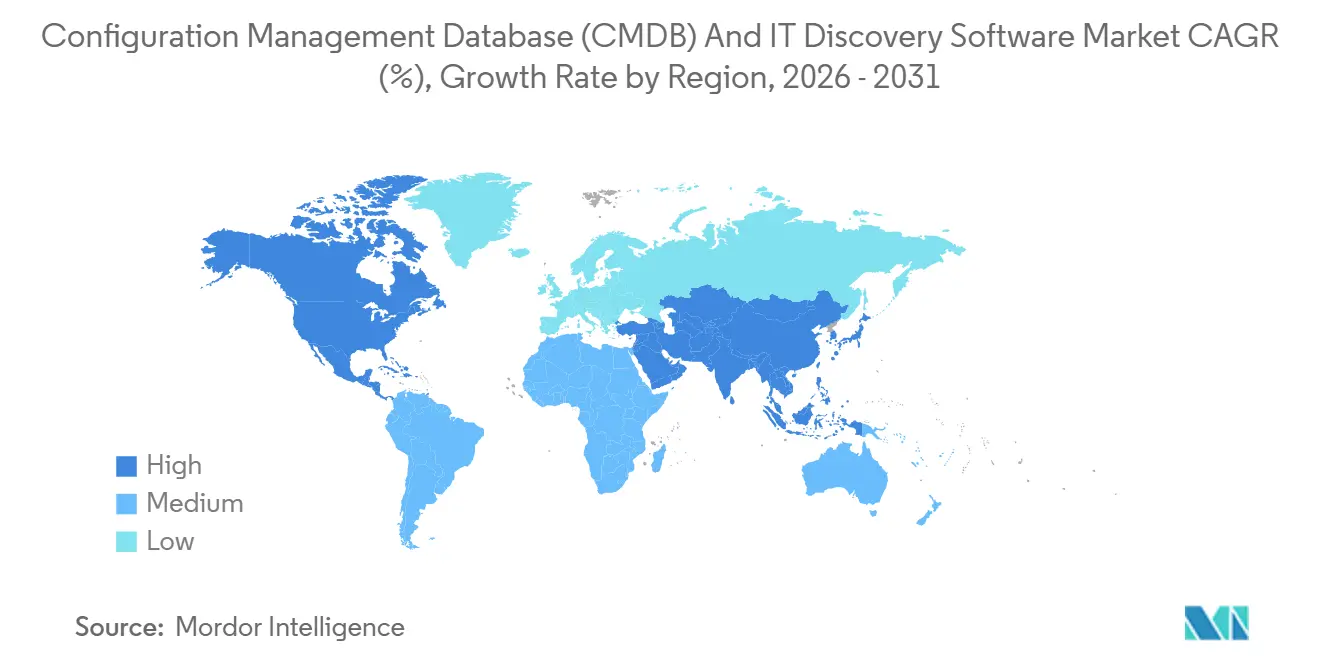
| Fastest Growing Market | Asia Pacific |
| Largest Market | North America |
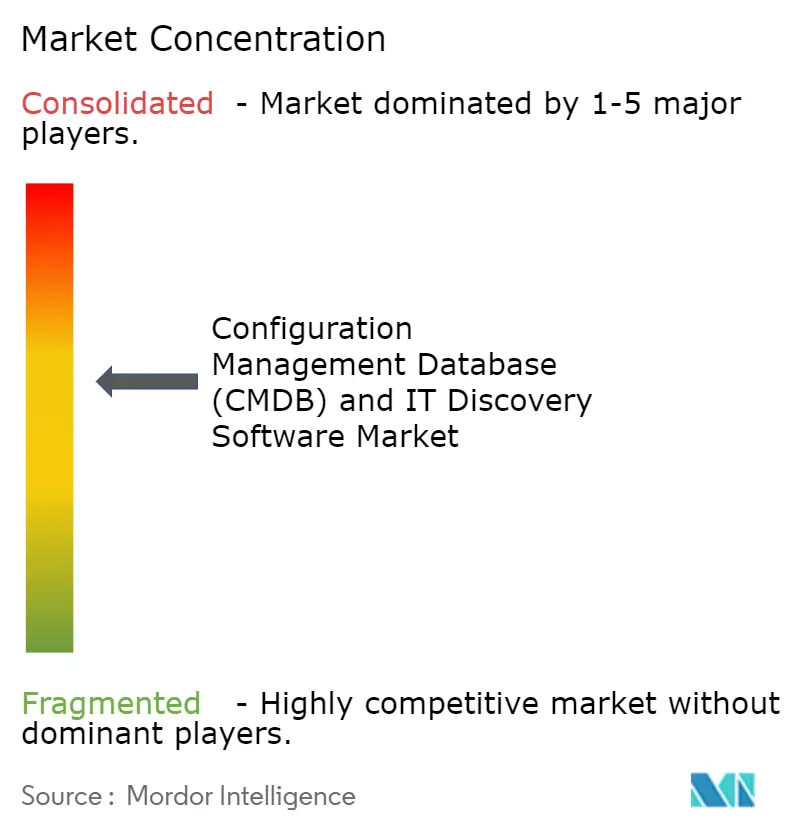
| Market Concentration | Medium |
Major Players *Disclaimer: Major Players sorted in no particular order Image © Mordor Intelligence. Reuse requires attribution under CC BY 4.0. | |
Configuration Management Database (CMDB) And IT Discovery Software Market Analysis by Mordor Intelligence
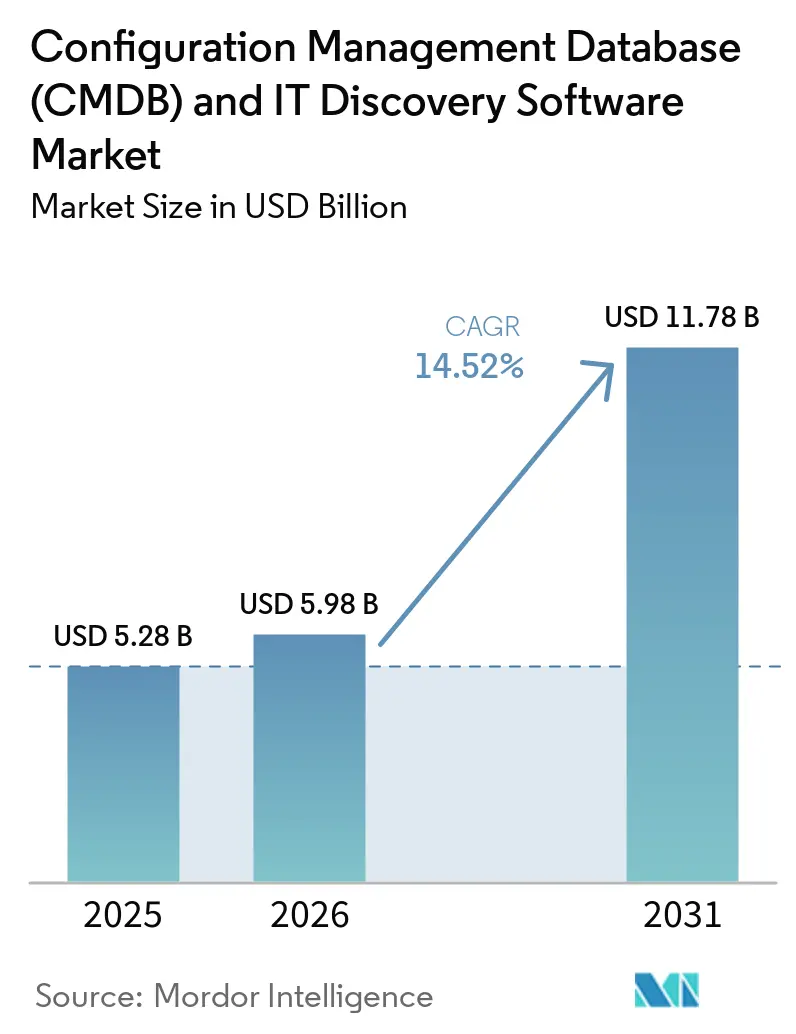
The Configuration Management Database (CMDB) and IT Discovery Software market size is projected to be USD 5.28 billion in 2025, USD 5.98 billion in 2026, and reach USD 11.78 billion by 2031, growing at a CAGR of 14.52% from 2026 to 2031. Enterprises are moving from reactive asset tracking toward AI-assisted configuration governance that feeds real-time topology data into automated remediation workflows. Heightened regulatory scrutiny, the shift to zero-trust security, and mounting pressure to align configuration data with financial operations and sustainability reporting are reinforcing the Configuration Management Database (CMDB) and IT Discovery Software market as a strategic priority. Vendor consolidation is accelerating as platform players fold discovery, incident management, and analytics into unified suites, while niche specialists focus on operational technology and medical device discovery. Cloud deployment drives growth by scaling discovery across ephemeral workloads without capital outlay, and managed services uptake is rising as organizations grapple with data-quality stewardship and skills shortages. Competitive dynamics now revolve around AI-driven dependency mapping accuracy, breadth of ecosystem integrations, and the ability to demonstrate compliance with frameworks such as DORA, ISO 27001, and U.S. Federal Reserve operational-resilience guidance.
Key Report Takeaways
- By component, software accounted for 71.45% of revenue in 2025, whereas services are advancing at a 14.92% CAGR through 2031.
- By deployment mode, cloud held 46.83% of the Configuration Management Database (CMDB) and IT Discovery Software market share in 2025, and it is the fastest-growing mode at 15.12% through 2031.
- By organization size, large enterprises contributed 47.32% of 2025 revenue, while small and medium enterprises are expanding at a 14.67% CAGR.
- By application, IT operations accounted for 39.89% of 2025 revenue, yet security and compliance are set to rise at 15.52% annually to 2031.
- By industry vertical, banking, financial services, and insurance led with 24.37% revenue share in 2025; healthcare and life sciences are forecast to post the fastest 16.12% CAGR.
- By geography, North America captured 38.23% of 2025 revenue, whereas Asia-Pacific is projected to grow at 15.36% CAGR to 2031.
Note: Market size and forecast figures in this report are generated using Mordor Intelligence’s proprietary estimation framework, updated with the latest available data and insights as of January 2026.
Market Trends and Insights
Drivers Impact Analysis of Configuration Management Database (CMDB) And IT Discovery Software Market*
| Driver | (~) % Impact on CAGR Forecast | Geographic Relevance | Impact Timeline |
|---|---|---|---|
| Accelerating Shift to Agentless Cloud Discovery Solutions | +3.2% | Global, early adoption in North America and Western Europe | Medium term (2-4 years) |
| Integration of AI-Powered Dependency Mapping and Predictive Analytics | +2.8% | Global, led by North America and Asia-Pacific | Medium term (2-4 years) |
| Regulatory Mandates for Real-Time Configuration Audit Trails | +2.4% | Europe, North America, Asia-Pacific financial hubs | Short term (≤ 2 years) |
| Convergence of ITAM, FinOps and ESG Reporting Requirements | +2.1% | Global, strongest in North America and Europe | Medium term (2-4 years) |
| Rising Cybersecurity Threats Driving Asset Visibility Demand | +1.9% | Global, heightened urgency in critical infrastructure sectors | Short term (≤ 2 years) |
| Vendor Consolidation Enabling End-to-End ITSM Platforms | +1.6% | Global, concentrated in mature markets | Long term (≥ 4 years) |
| Source: Mordor Intelligence | |||
Accelerating Shift to Agentless Cloud Discovery Solutions
Agentless discovery is displacing agent-based scanning because it bypasses the overhead of deploying, patching, and securing software on thousands of endpoints, especially short-lived cloud instances. ServiceNow’s Yokohama release harvests configuration metadata directly from AWS, Microsoft Azure, and Google Cloud APIs, shrinking discovery latency from hours to minutes.[1]ServiceNow, “Yokohama Release Notes,” SERVICENOW.COM Security teams favor agentless methods that use read-only credentials, minimizing production-system privileges. IBM’s integration of Confluent’s Apache Kafka event streams enables Configuration Management Database (CMDB) and IT Discovery Software market platforms to ingest real-time configuration events rather than waiting for batch scans. As multi-cloud strategies proliferate, the ability to correlate assets across heterogeneous environments without per-cloud agents is becoming non-negotiable.
Integration of AI-Powered Dependency Mapping and Predictive Analytics
Machine-learning models now infer relationships among configuration items by analyzing network flow, log telemetry, and incident histories, sharply reducing manual topology maintenance. BMC Helix 25.2 added HelixGPT Insight Finder and Post Mortem Analyzer, which consume CMDB data to surface service-health anomalies and recommend topology updates. ServiceNow’s Now Assist suggests attributes during data entry, improving data quality. ENISA highlights automated dependency mapping as critical for NIS2-covered operators.[2]ENISA, “NIS2 Guidance,” ENISA.EUROPA.EU As algorithms mature, CMDB impact analysis is transitioning from static tables to probabilistic graphs that quantify cascading-failure risk.
Regulatory Mandates for Real-Time Configuration Audit Trails
Financial regulators now require organizations to maintain continuously updated asset inventories with immutable change logs to ensure transparency and compliance. Europe’s Digital Operational Resilience Act mandates that banks document all ICT assets and their interdependencies to enhance operational resilience and mitigate risks. Similarly, the U.S. Federal Reserve’s 2024 guidance emphasizes the importance of maintaining comprehensive and accurate asset inventories to meet regulatory expectations. In response, vendors have introduced solutions featuring cryptographically time-stamped logs and automated reporting capabilities. These tools enable organizations to map configuration items directly to regulatory controls, transforming CMDB accuracy from a standard IT hygiene practice into a critical compliance requirement.
Convergence of ITAM, FinOps and ESG Reporting Requirements
CFOs increasingly demand that asset inventories integrate seamlessly with cost-allocation and carbon-accounting workflows to enhance the accuracy of financial and environmental reporting. ServiceNow’s Common Service Data Model v5 has introduced standardized fields specifically designed to capture energy consumption and emissions data. Organizations now use CMDB utilization metrics not only to optimize cloud spending but also to calculate scope 3 emissions, which are critical for compliance with the Corporate Sustainability Reporting Directive (CSRD). As regulatory scrutiny intensifies and penalties for greenwashing continue to rise, auditors are placing greater emphasis on the need for verifiable configuration data. This shift has elevated the role of CMDBs from mere tools for IT hygiene to essential components for safeguarding both financial integrity and organizational reputation.
Restraints Impact Analysis of Configuration Management Database (CMDB) And IT Discovery Software Market*
| Restraint | (~) % Impact on CAGR Forecast | Geographic Relevance | Impact Timeline |
|---|---|---|---|
| High Cost and Complexity of Enterprise-Scale Implementations | -1.8% | Global, most acute in mid-market enterprises | Short term (≤ 2 years) |
| Persistent Data Quality and Normalization Challenges | -1.5% | Global, especially legacy estates | Medium term (2-4 years) |
| Skills Shortage in ITAM and Configuration Governance | -1.2% | Global, regional talent gaps vary | Medium term (2-4 years) |
| Security Concerns Around Cloud-Hosted Configuration Data | -0.9% | Regulated industries worldwide | Short term (≤ 2 years) |
| Source: Mordor Intelligence | |||
High Cost and Complexity of Enterprise-Scale Implementations
Global CMDB rollouts routinely exceed budgets by up to 100% once integration middleware, data cleansing, and staff training are factored in. Fortune 500 programs can surpass USD 10 million over three years, creating sticker shock for mid-market buyers. Customizing ServiceNow’s data model for sector-specific assets, reconciling duplicate items from multiple discovery tools, and federating CMDBs after mergers can extend timelines by years. ISO 20000 provides only high-level guidance, forcing enterprises to develop bespoke blueprints that increase costs and risks.
Persistent Data Quality and Normalization Challenges
In fast-moving cloud estates, configuration data deteriorates rapidly when developers create new resources that discovery jobs fail to detect. This leads to inconsistencies and inaccuracies in the configuration management database (CMDB). Duplicate entries, such as IBM, International Business Machines, and IBM Corp., erode trust in the data unless they are continuously normalized and reconciled. Tools like ServiceNow’s reconciliation engine and Lansweeper’s AI-powered classifiers help reduce duplication and improve data accuracy. However, these tools often require significant customization and tuning, which can be challenging for smaller firms with limited resources. Additionally, the growing adoption of infrastructure-as-code practices introduces a gap between declarative templates and scan-driven records. This discrepancy necessitates the implementation of new governance processes to ensure that CMDBs remain aligned with code repositories, maintaining consistency and reliability across the system.
*Our forecasts treat driver/restraint impacts as directional, not additive. The impact forecasts reflect baseline growth, mix effects, and variable interactions.
Configuration Management Database (CMDB) And IT Discovery Software Market Segment Analysis
By Component:
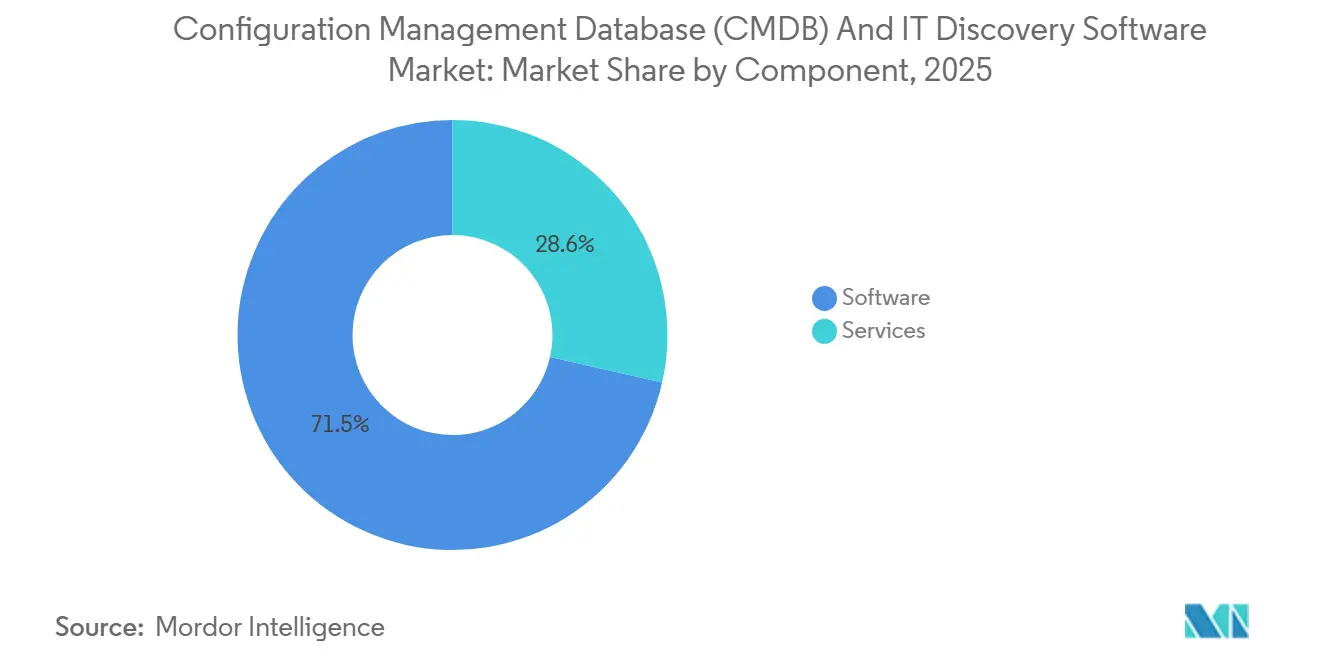
Services Growth Outpaces Software as Integration Complexity RisesServices revenue is expanding at a robust 14.92% annual growth rate, outpacing the overall Configuration Management Database (CMDB) and IT Discovery Software markets. This growth is driven by organizations increasingly relying on consultancies to address critical needs such as mapping legacy data to standardized schemas, reconciling duplicate records, and integrating discovery feeds across complex hybrid cloud environments. Managed CMDB-as-a-service offerings, which combine software licenses, infrastructure, and ongoing stewardship, are gaining traction among resource-constrained buyers who seek comprehensive solutions. While software still accounted for 71.45% of the projected 2025 income, the growing reliance on recurring services is now a key factor influencing platform renewal decisions, further solidifying vendor lock-in strategies.
Additionally, professional services are leveraging the increasing demand for integrations to deliver more value-added solutions. For instance, BMC Helix’s agentic AI initiates Microsoft Teams swarming sessions directly from incident records, seamlessly embedding CMDB (Configuration Management Database) context into collaboration workflows. This capability enhances operational efficiency and improves incident resolution times. Furthermore, vendors are adopting innovative pricing strategies, such as outcome-based pricing models tied directly to CMDB accuracy metrics. These models transfer performance risks to the providers, incentivizing them to deliver higher-quality services while simultaneously enabling them to stand out in an increasingly competitive market landscape. By aligning pricing with measurable outcomes, vendors not only mitigate risks for their clients but also reinforce their value proposition in the market.


By Deployment Mode:
Cloud Dominates Growth as Hybrid Architectures Bridge Legacy ConstraintsCloud implementations accounted for 46.83% of the Configuration Management Database (CMDB) and IT Discovery Software market share in 2025, with projections indicating a 15.12% growth rate through 2031. These implementations are increasingly preferred for their ability to scale elastically during periods of high demand, such as during migrations or mergers and acquisitions (M&A) surges, while also relieving organizations of the burden of patching and upgrading systems. Hybrid deployment models are gaining traction among regulated entities, as they allow sensitive data to remain in on-premises repositories while leveraging cloud discovery capabilities for public workloads. However, on-premises installations, while still prevalent in sectors like defense and intelligence, are gradually losing market share in comparison to cloud-based solutions.
ServiceNow’s FedRAMP High authorization and the introduction of its Autonomous Workforce solution highlight the growing demand for secure SaaS CMDBs within the federal sector. Similarly, the European Union Agency for Cybersecurity (ENISA) has issued guidance on cloud processing with safeguards, which is driving the adoption of hybrid cloud models across Europe. Buyers now expect multi-cloud discovery capabilities that seamlessly integrate across platforms such as AWS, Azure, Google Cloud, and private stacks. This expectation is reducing tolerance for vendor lock-in, as organizations prioritize flexibility and interoperability in their IT ecosystems.
By Organization Size:
SMEs Embrace Cloud-Native CMDB to Bypass Legacy ComplexityLarge enterprises generated 47.32% of 2025 revenue, reflecting sprawling estates that require sophisticated federation and advanced configuration management solutions. These organizations often manage complex IT infrastructures, requiring robust tools to ensure seamless operations and compliance. Small and medium enterprises (SMEs) are growing at 14.67% annually, driven by the adoption of SaaS CMDBs, which eliminate the need for significant capital expenses and reduce reliance on specialized IT personnel. The 2024 acquisition of Device42 by Freshworks integrated continuous discovery capabilities into a comprehensive ITSM package, specifically targeting the needs of SMEs and enabling them to streamline their IT operations effectively.[3]Freshworks, “Freshworks Completes Acquisition of Device42,”
Consumer-grade interfaces, mobile applications, chatbots, and visual topology maps are simplifying user experiences and reducing the time required for onboarding and training. Despite these advancements, SMEs continue to face challenges related to skills shortages in configuration governance, leading to increased demand for AI-assisted data curation and managed services. As pricing models become more flexible and align with the operational budgets of smaller organizations, the Configuration Management Database (CMDB) and IT Discovery Software market is expanding beyond its traditional focus on large enterprises, creating opportunities for broader adoption across a wider range of business sizes.
By Application:
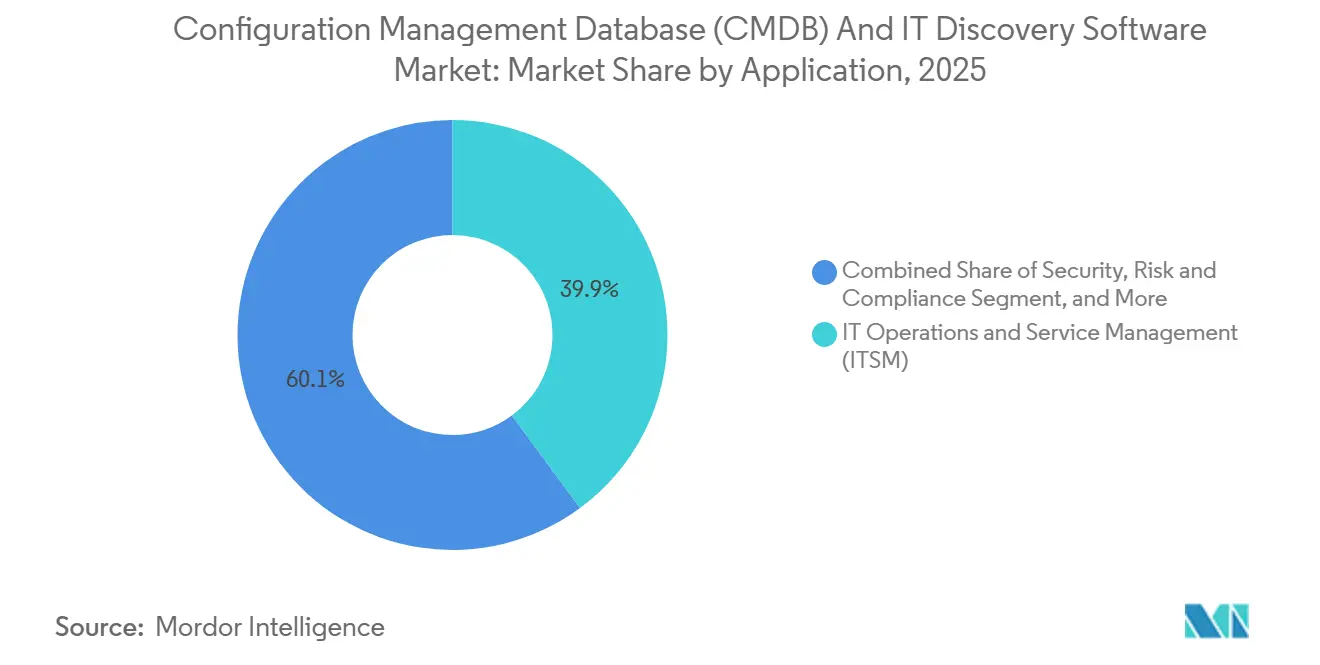
Security and Compliance Surge as Zero-Trust Architectures Demand Real-Time PostureIT operations accounted for 39.89% of the total spend in 2025, maintaining its position as a dominant segment. However, security and compliance are emerging as the fastest-growing areas, with a compound annual growth rate (CAGR) of 15.52%. This growth is driven by the increasing adoption of zero-trust security models, which require accurate and up-to-date asset data. For instance, Armis’ agentless discovery technology for unmanaged and IoT devices now integrates directly with ServiceNow’s CMDB. This integration enables security teams to correlate identified vulnerabilities with relevant business contexts, enhancing their ability to prioritize and address risks effectively. Additionally, CMDB audit trails are increasingly being used to demonstrate compliance with regulatory frameworks such as the Digital Operational Resilience Act (DORA).
Key workflows, including asset management, change management, and incident management, rely heavily on CMDB dependency graphs. These graphs help quantify the potential impact of changes or incidents (commonly referred to as the blast radius) and facilitate automated remediation processes. Furthermore, predictive analytics capabilities in CMDB solutions are being leveraged to identify components likely to fail, enabling organizations to implement proactive fixes. This approach significantly reduces the mean time to resolution (MTTR) for IT issues. As cybersecurity oversight becomes a priority at the board level, spending in the Configuration Management Database (CMDB) and IT Discovery Software market is increasingly shifting toward advanced modules. These modules combine risk analytics with real-time posture assessments to address the growing demand for solutions that enhance both security and operational efficiency.

By Industry Vertical:
Healthcare Leads Growth as Medical-Device Tracking Mandates IntensifyBanking, financial services, and insurance retained 24.37% of 2025 revenue, anchored by stringent operational-resilience rules. This sector continues to prioritize compliance with evolving regulations, driving investments in CMDB and IT discovery solutions to ensure operational continuity and risk mitigation. Healthcare and life sciences, however, are forecast to expand at 16.12% annually, fueled by increasing regulatory scrutiny and the need for enhanced asset visibility. For instance, U.S. FDA scrutiny of software bills of materials for connected devices forces hospitals to inventory every infusion pump and imaging scanner to ensure compliance and patient safety. ServiceNow’s partnership with Siemens Healthineers illustrates vertical-specific CMDB extensions that combine telemetry with workflows, enabling healthcare providers to streamline operations and maintain regulatory adherence.
Manufacturing leverages CMDBs to map operational technology assets and support predictive maintenance, thereby minimizing downtime and optimizing production processes. Similarly, energy and utilities track distributed resources, such as smart meters, to enhance grid reliability and operational efficiency. Government agencies are increasingly adopting CMDBs to meet zero-trust deadlines and ensure secure, efficient IT operations. Retail chains, on the other hand, rely on accurate asset data to maintain seamless omnichannel commerce, particularly during peak periods when system availability is critical. Industry-tailored data models are becoming a decisive purchasing factor across the Configuration Management Database (CMDB) and IT Discovery Software market, as organizations across sectors seek solutions that address their unique operational and compliance needs.
Geography Analysis
North America Configuration Management Database (CMDB) and IT Discovery Software Market
North America captured 38.23% of 2025 revenue due to early ITIL adoption, stringent regulatory requirements, and a high concentration of vendors in the region. In the United States, banks are expediting the implementation of CMDB solutions to comply with Federal Reserve mandates for maintaining comprehensive asset inventories. Meanwhile, Canada’s public sector is actively upgrading its asset management systems to enhance the security and efficiency of its digital government platforms. In Mexico, manufacturers focused on exports are increasingly leveraging CMDBs to manage and monitor their operational technology estates effectively, ensuring compliance with international trade standards and operational efficiency.
APAC Configuration Management Database (CMDB) and IT Discovery Software Market
Asia-Pacific is the fastest-growing region, with a 15.36% CAGR. India’s digital-government push mandates asset visibility across ministries, while Japan couples CMDB data with industrial IoT analytics to optimize plant uptime. China emphasizes sovereign technology stacks, spurring domestic CMDB offerings that comply with data-localization rules. South Korea’s mobile-first workforce demands CMDB interfaces optimized for field technicians. Regional diversity drives uptake of hybrid architectures that balance cloud scale with residency compliance.
EMEA and South America Configuration Management Database (CMDB) and IT Discovery Software Market
DORA and NIS2 shape Europe’s market. Banks and critical infrastructure operators must maintain real-time inventories and dependency maps, which are driving demand for immutable audit trails.[4]European Central Bank, “ICT Risk Management Expectations,” ECB.EUROPA.EU The United Kingdom, Germany, and France lead adoption, supported by mature manufacturing and finance sectors. South America, the Middle East, and Africa remain nascent but accelerating as Brazil tightens bank cybersecurity rules and Gulf nations deploy smart-city infrastructure that relies on automated discovery. As these regions mature, the Configuration Management Database (CMDB) and IT Discovery Software market will see localized partnerships emerge to navigate regulatory nuance.

Competitive Landscape
The Configuration Management Database (CMDB) and IT Discovery Software market exhibits moderate concentration. ServiceNow, BMC, and IBM hold significant positions through integrated ITSM suites, yet a long tail of specialists and open-source alternatives tempers pricing power. ServiceNow’s acquisitions of Moveworks and Armis in 2025 and 2026 have significantly expanded its capabilities, enabling it to delve deeper into conversational AI and unmanaged device discovery. Similarly, IBM’s USD 11 billion purchase of Confluent has enhanced its portfolio by incorporating event streaming, which seamlessly feeds live data into CMDBs, improving real-time data management and operational efficiency.
Mid-tier vendors face increasing pressure to either scale rapidly or carve out niche specializations. Lansweeper and Device42, for instance, focus on agentless architectures and user-friendly interfaces, which have become key differentiators in the market. Device42’s integration into Freshworks’ ITSM platform has further strengthened its appeal to small and medium-sized enterprises (SMEs), offering them a more comprehensive IT management solution. The market is witnessing a shift in differentiation strategies, moving away from merely offering broad discovery-protocol coverage to emphasizing AI-driven insights, industry-specific schemas, and robust ecosystem integrations. These integrations seamlessly incorporate CMDB data into workflows for FinOps, ESG, and security, providing added value to end users. Vendors that can demonstrate compliance with stringent standards such as ISO 27001 or FedRAMP are increasingly securing preferred-vendor status, particularly in highly regulated industries.
Despite these advancements, the market still holds significant untapped opportunities. Areas such as operational technology discovery, medical device intelligence, and lightweight CMDBs designed for resource-constrained buyers remain underdeveloped. These gaps present opportunities for innovative solutions tailored to address the unique challenges of these segments. Furthermore, collaborations between niche solution providers and hyperscale platforms are expected to continue, driving the evolution of the Configuration Management Database (CMDB) and IT Discovery Software markets toward a more unified IT Service Management (ITSM) ecosystem. This ongoing trend highlights the growing demand for integrated systems that not only streamline IT operations but also enhance overall organizational efficiency and adaptability in an increasingly complex IT landscape.
Configuration Management Database (CMDB) And IT Discovery Software Industry Leaders
ServiceNow, Inc.
BMC Software, Inc.
IBM Corporation
OpenText Corporation
Broadcom, Inc.
- *Disclaimer: Major Players sorted in no particular order
Configuration Management Database (CMDB) And IT Discovery Software Market Companies Covered in this Report
- ServiceNow, Inc.
- BMC Software, Inc.
- International Business Machines Corporation
- OpenText Corporation
- Broadcom Inc.
- Ivanti, Inc.
- Flexera Software LLC
- Device42, Inc.
- SolarWinds Corporation
- Zoho Corporation Pvt. Ltd. (ManageEngine)
- Atlassian Corporation
- Freshworks Inc.
- Cherwell Software, LLC
- USU Software AG
- Matrix42 AG
- Snow Software AB
- Lansweeper NV
- SysAid Ltd.
- Quest Software Inc.
- Cloudaware Inc.
- Armis Security, Inc.
- Spiceworks, Inc.

Recent Industry Developments in Configuration Management Database (CMDB) And IT Discovery Software Market
- March 2026: IBM Corporation completed its USD 11 billion acquisition of Confluent, bringing Apache Kafka streaming into IBM’s automation portfolio to support real-time CMDB updates.
- March 2026: ServiceNow introduced government-focused Autonomous Workforce Level 1 IT Service Desk AI Specialist and EmployeeWorks, both FedRAMP-authorized for U.S. public-sector deployment.
- February 2026: ServiceNow launched Autonomous Workforce, orchestrating specialized AI agents to execute complete IT support tasks using CMDB context to cut resolution times by 99%.
- December 2025: ServiceNow closed its USD 2.85 billion Moveworks acquisition, adding conversational AI that lets employees query CMDB data in natural language.


Global Configuration Management Database (CMDB) And IT Discovery Software Market Report Scope
The Configuration Management Database (CMDB) and IT Discovery Software Market comprises software solutions and associated services that enable organizations to identify, track, manage, and maintain visibility of IT assets, configurations, and dependencies across dynamic IT environments. These solutions provide a centralized system of record and intelligence for infrastructure components, applications, and services, supporting efficient IT operations, governance, and decision-making.
The Configuration Management Database (CMDB) and IT Discovery Software Market Report is Segmented by Component (Software, and Services (Consulting and Advisory, Integration and Deployment, and Support and Maintenance)), Deployment Mode (On-Premises, Cloud, and Hybrid), Organization Size (Large Enterprises, Small and Medium Enterprises), Application (IT Operations, Security and Compliance, Asset Management, Change and Incident Management, and Other Applications), Industry Vertical (BFSI, IT and Telecommunications, Healthcare and Life Sciences, Manufacturing, Government and Public Sector, Retail and Consumer Goods, Energy and Utilities, and Other Industry Verticals), and Geography (North America, South America, Europe, Asia-Pacific, and Middle East and Africa). The Market Forecasts are Provided in Terms of Value (USD).
| Software | |
| Services | Consulting and Advisory |
| Integration and Deployment | |
| Support and Maintenance |
| On-Premises |
| Cloud |
| Hybrid |
| Large Enterprises |
| Small and Medium Enterprises |
| IT Operations and Service Management (ITSM) |
| Security, Risk and Compliance |
| Asset and Configuration Management |
| Other Applications |
| BFSI |
| IT and Telecom |
| Healthcare and Life Sciences |
| Manufacturing |
| Government and Public Sector |
| Retail and Consumer Goods |
| Energy and Utilities |
| Other Industry Verticals |
| North America | United States | |
| Canada | ||
| Mexico | ||
| South America | Brazil | |
| Argentina | ||
| Rest of South America | ||
| Europe | United Kingdom | |
| Germany | ||
| France | ||
| Italy | ||
| Spain | ||
| Rest of Europe | ||
| Asia-Pacific | China | |
| Japan | ||
| India | ||
| South Korea | ||
| Rest of Asia-Pacific | ||
| Middle East and Africa | Middle East | United Arab Emirates |
| Saudi Arabia | ||
| Rest of Middle East | ||
| Africa | South Africa | |
| Egypt | ||
| Rest of Africa | ||
| By Component | Software | ||
| Services | Consulting and Advisory | ||
| Integration and Deployment | |||
| Support and Maintenance | |||
| By Deployment Mode | On-Premises | ||
| Cloud | |||
| Hybrid | |||
| By Organization Size | Large Enterprises | ||
| Small and Medium Enterprises | |||
| By Application | IT Operations and Service Management (ITSM) | ||
| Security, Risk and Compliance | |||
| Asset and Configuration Management | |||
| Other Applications | |||
| By Industry Vertical | BFSI | ||
| IT and Telecom | |||
| Healthcare and Life Sciences | |||
| Manufacturing | |||
| Government and Public Sector | |||
| Retail and Consumer Goods | |||
| Energy and Utilities | |||
| Other Industry Verticals | |||
| By Geography | North America | United States | |
| Canada | |||
| Mexico | |||
| South America | Brazil | ||
| Argentina | |||
| Rest of South America | |||
| Europe | United Kingdom | ||
| Germany | |||
| France | |||
| Italy | |||
| Spain | |||
| Rest of Europe | |||
| Asia-Pacific | China | ||
| Japan | |||
| India | |||
| South Korea | |||
| Rest of Asia-Pacific | |||
| Middle East and Africa | Middle East | United Arab Emirates | |
| Saudi Arabia | |||
| Rest of Middle East | |||
| Africa | South Africa | ||
| Egypt | |||
| Rest of Africa | |||


Key Questions Answered in the Report
What is the projected value of the Configuration Management Database (CMDB) and IT Discovery Software market by 2031?
The market is forecast to reach USD 11.78 billion by 2031, reflecting a 14.52% CAGR from 2026 to 2031.
Which deployment mode is expanding the fastest?
Cloud deployment is advancing at a 15.12% CAGR because SaaS CMDBs scale discovery across ephemeral workloads without capital expense.
Why is healthcare the fastest-growing vertical?
Hospitals must track connected medical devices and software bills of materials to meet FDA and cybersecurity mandates, driving a 16.12% CAGR in the vertical.
How are regulatory mandates affecting CMDB adoption?
Rules such as Europe's DORA and U.S. Federal Reserve guidance require real-time configuration audit trails, making accurate CMDBs a compliance necessity.
What differentiates leading vendors in this market?
Leadership now hinges on AI-driven dependency mapping, breadth of ecosystem integrations, and proof of compliance with standards like ISO 27001 and FedRAMP.
Page last updated on:





