
Electric Tooth Polisher Market Size and Share
Market Overview
| Study Period | 2019 - 2030 |
|---|---|
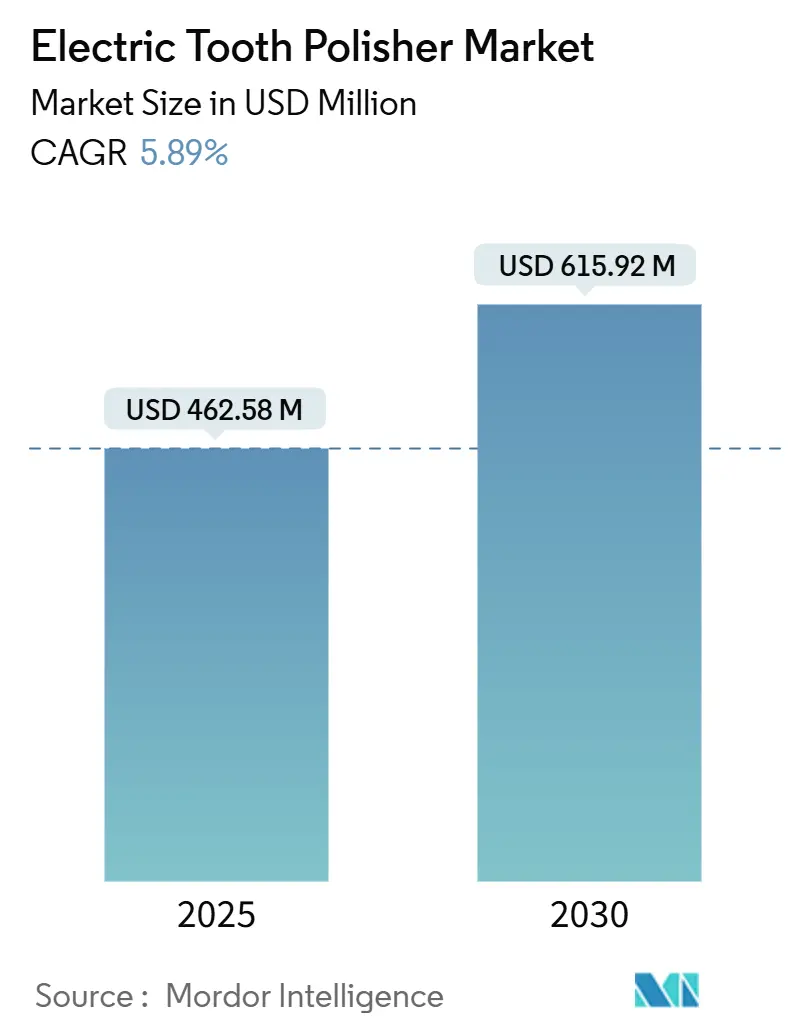
| Market Size (2025) | USD 462.58 Million |
| Market Size (2030) | USD 615.92 Million |
| Growth Rate (2025 - 2030) | 5.89 % |
| Fastest Growing Market | Asia Pacific |
| Largest Market | North America |
| Market Concentration | Medium |
Major Players *Disclaimer: Major Players sorted in no particular order Image © Mordor Intelligence. Reuse requires attribution under CC BY 4.0. | |
Electric Tooth Polisher Market Analysis by Mordor Intelligence
The electric tooth polisher market size reached USD 462.58 million in 2025 and is projected to attain USD 615.92 million by 2030, reflecting a 5.89% CAGR during the forecast period. Robust growth rests on an aging global population retaining natural teeth, accelerating ergonomic and cordless product innovation, rising cosmetic-aesthetic awareness, and the gradual roll-out of policy-backed preventive care packages across Asia-Pacific. Technology convergence has tightened the performance gap between cordless and corded devices, letting clinicians prioritize workflow flexibility without sacrificing torque. Corporate dental chains are standardizing equipment purchases, which, combined with IoT-enabled preventive maintenance, is nudging the industry toward outcome-based service contracts. Meanwhile, high-speed polishing systems and air-polishing units are gaining favor for advanced stain management and biofilm disruption, whereas sustainability rules in Europe are reshaping materials choices across the supply chain.
Key Report Takeaways
- By product type, cordless polishers held 43.72% of electric tooth polisher market share in 2024, while their segment is forecast to grow at an 8.78% CAGR to 2030.
- By technology, rotary handpiece polishers commanded 36.47% of the electric tooth polisher market size in 2024; air-polishing units are expected to expand at a 9.12% CAGR through 2030.
- By end user, dental clinics accounted for 61.28% of the electric tooth polisher market size in 2024, whereas home-care settings are poised to increase at a 7.48% CAGR to 2030.
- By speed range, low-speed systems below 5,000 RPM captured 52.34% of electric tooth polisher market share in 2024, and high-speed systems are projected to post an 8.36% CAGR.
- By distribution channel, direct sales represented 46.52% of the electric tooth polisher market size in 2024; online retail is set to advance at a 9.48% CAGR through 2030.
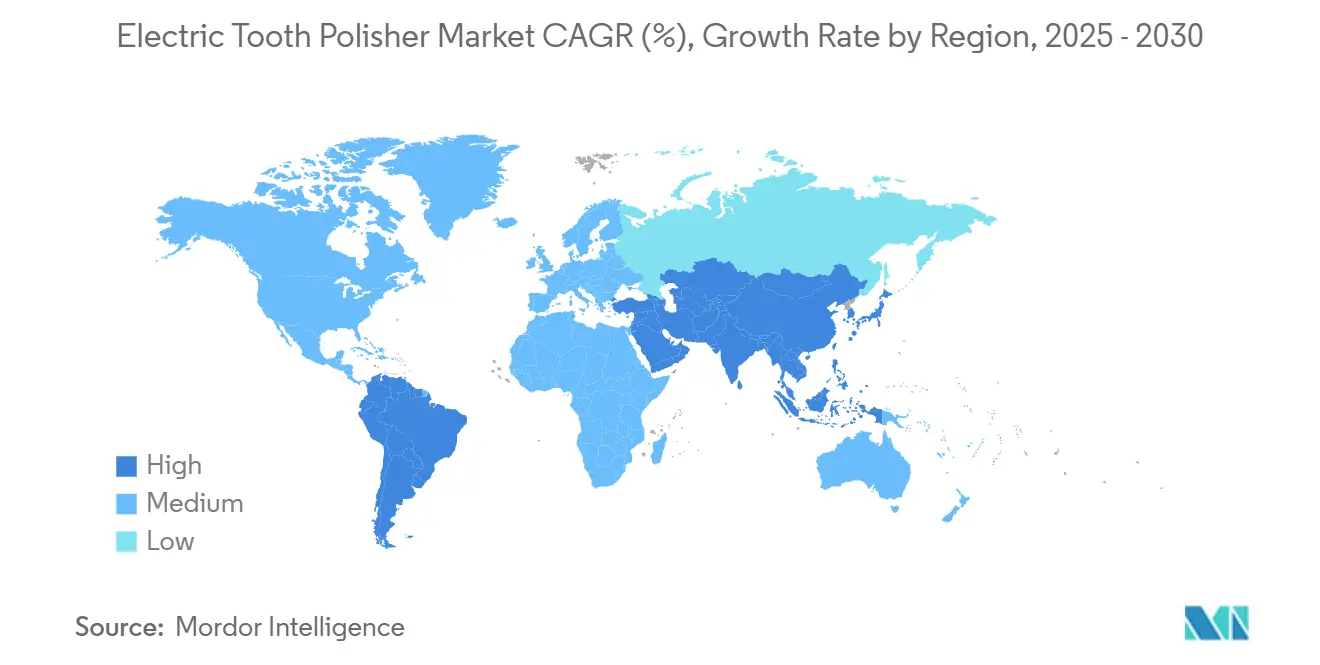
- By geography, North America led with a 37.56% electric tooth polisher market share in 2024, while Asia-Pacific is on track for an 8.03% CAGR to 2030.
Global Electric Tooth Polisher Market Trends and Insights
Drivers Impact Analysis*
| Driver | (~) % Impact on CAGR Forecast | Geographic Relevance | Impact Timeline |
|---|---|---|---|
| Aging population & rise in periodontal diseases | +1.2% | North America, Europe, global aging clusters | Long term (≥ 4 years) |
| Growth of cosmetic dentistry & aesthetic awareness | +0.9% | Urban North America, Europe, Asia-Pacific | Medium term (2-4 years) |
| Expansion of dental service chains & clinics | +0.8% | Core Asia-Pacific, spill-over to Middle East & Africa | Medium term (2-4 years) |
| Technological advances in cordless & ergonomic handpieces | +1.1% | Global | Short term (≤ 2 years) |
| Integration of IoT-enabled RPM telemetry | +0.6% | Early adopters in North America & EU | Long term (≥ 4 years) |
| Subsidized school-based prophylaxis programs in ASEAN | +0.4% | Philippines, Thailand, wider ASEAN | Medium term (2-4 years) |
| Source: Mordor Intelligence | |||
Aging Population & Rise in Periodontal Diseases
By 2050, 1.5 billion people aged ≥65 will require advanced prophylaxis, and they now keep more natural teeth than previous cohorts, increasing procedural complexity.[1] Electric polishers deliver gentler, programmable speeds that suit anticoagulant users and frail seniors, allowing hygienists to manage biofilm on aged enamel without exertion. The demographic wave assures stable replacement demand and underpins practice investments. Senior-focused insurance add-ons in the United States and Japan further support device penetration. Consequently, suppliers integrating ergonomic grips and low-noise motors are positioning their portfolios for long-horizon gains.
Growth of Cosmetic Dentistry & Aesthetic Awareness
Cosmetic procedures have shifted from luxury to mainstream clinical offerings, with patients expecting stain-free smiles that preserve veneers and composite inlays.[2] Variable-speed polishers with dedicated prophylaxis cups now target restorative-friendly polishing angles, reducing surface roughness on aesthetic materials. High-luster finishing pads paired with before-and-after imaging help dentists validate results, which feeds back into marketing narratives. Segment momentum is strongest in affluent urban centers where social media drives demand for instant visual outcomes. Training curricula increasingly intertwine prophylaxis with shade maintenance, pushing sales of modular polishing kits.
Expansion of Dental Service Chains & Clinics
Dental service organizations (DSOs) are scaling rapidly across China, India, and the Gulf, preferring turnkey equipment bundles that guarantee uptime across multi-clinic footprints. Their procurement teams favor polishers backed by remote diagnostic dashboards and centralized spare-parts logistics. Bulk tenders compress purchase cycles, rewarding manufacturers able to underwrite multiyear service-level agreements. DSOs’ standardized treatment protocols translate to predictable throughput, spurring adoption of cordless units that speed chairside turnover. The model also enlarges after-sales parts and consumables revenue, reinforcing lifetime account value.
Technological Advances in Cordless & Ergonomic Handpieces
Next-generation lithium-ion packs and brushless micromotors have erased the torque penalty historically associated with cordless tools. KaVo’s K-ERGOgrip reaches 50,000 RPM at 7 Ncm while fitting interchangeable sleeves that lower hand-arm strain. Faster chairside repositioning reduces session times, and absence of cords cuts cross-contamination risk by simplifying disinfection. Smart chargers now count coupled cycles, alerting staff when batteries approach end-of-life. These advances promote premium pricing but also shorten payback periods by increasing daily patient capacity.
Restraints Impact Analysis*
| Restraint | (~) % Impact on CAGR Forecast | Geographic Relevance | Impact Timeline |
|---|---|---|---|
| High capital cost vs. reimbursement gaps | -0.8% | Global, sharpest in emerging markets | Short term (≤ 2 years) |
| Shortage of trained hygienists in emerging markets | -0.6% | Asia-Pacific, Middle East & Africa, Latin America | Long term (≥ 4 years) |
| Supply-chain volatility in sodium-bicarbonate powders | -0.4% | Global | Medium term (2-4 years) |
| Eco-regulations phasing out single-use prophy angles | -0.3% | Europe, potential global spillover | Medium term (2-4 years) |
| Source: Mordor Intelligence | |||
High Capital Cost vs. Reimbursement Gaps
Current U.S. Medicare rules reimburse dental services only when linked to covered medical procedures, leaving many prophylaxis sessions uncompensated.[3] Practices in Brazil, Indonesia, and South Africa likewise face limited public coverage, forcing out-of-pocket payments that delay equipment upgrades. Capital outlays can exceed USD 4,000 per unit, with a three-year payback reliant on steady private-pay traffic. Manufacturers are countering with leasing schemes and revenue-share contracts, yet those financing options remain scarce outside tier-1 cities.
Shortage of Trained Hygienists in Emerging Markets
Many emerging economies lack accredited hygienist programs, compelling dentists to perform polishing themselves and inflating wage costs. Limited operator capacity discourages purchase of advanced multi-speed devices that require skill to maximize, dampening volume orders. Remote training webinars mitigate the gap but cannot substitute for hands-on mentoring. Unless governments expand allied dental education, penetration in peri-urban clinics will lag.
*Our forecasts treat driver/restraint impacts as directional, not additive. The impact forecasts reflect baseline growth, mix effects, and variable interactions.
Segment Analysis
By Product Type: Cordless Dominance Drives Innovation
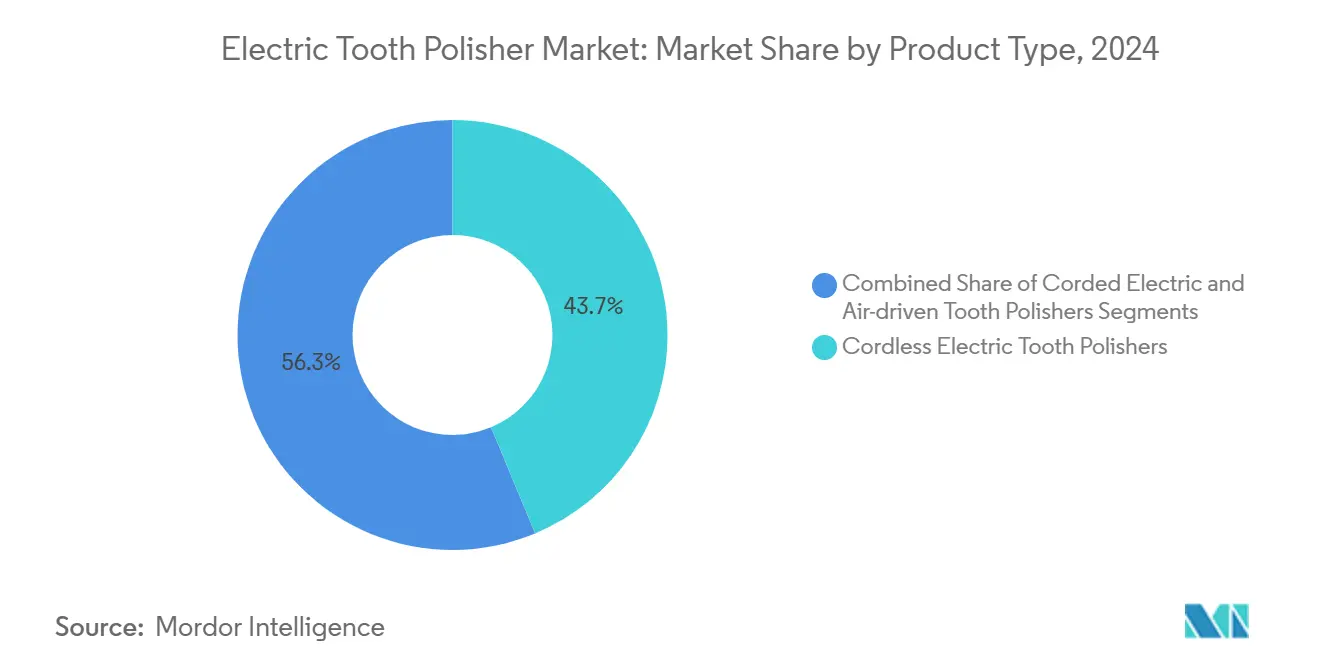
Cordless units held 43.72% of electric tooth polisher market share in 2024 and are forecast to grow at an 8.78% CAGR because battery advances now sustain continuous torque for 45 minutes, meeting most prophylaxis sessions. Corded models remain common in university settings where uninterrupted use across multiple operatories rewards wall-power reliability. Air-driven polishers cater to clinics leveraging existing compressor lines, though their noise and aerosol output restrict broader acceptance.
Hybrid devices pairing quick-release battery packs with optional power cords are emerging, giving practices flexibility to toggle between modes without duplicating inventory. Vendors bundle cordless systems with digital torque meters and auto-calibration features, raising average selling prices yet shortening set-up time. Practices switching from corded to cordless report average chair turnover gains of 12%, sharpening the commercial case.

By Technology: Air-Polishing Units Lead Innovation
Rotary handpiece polishers retained 36.47% of electric tooth polisher market size in 2024, benefiting from clinician familiarity and broad abrasive cup compatibility. Nonetheless, air-polishing units are forecast to achieve a 9.12% CAGR as they deliver efficient biofilm disruption with reduced dentin abrasion, making them ideal for orthodontic and implant maintenance.
The latest platforms integrate automatic powder-type recognition and pressure regulation, ensuring repeatable results while cutting powder consumption by 15%. Regulatory focus on aerosol control since the COVID-19 pandemic has accelerated the switch toward enclosed spray nozzles and HEPA-filtered evacuation, features more easily embedded in air-polishing housings than legacy rotary heads. Early adoption is most visible in academic centers conducting implant maintenance research.
By End User: Home-Care Emergence Reshapes Demand
Dental clinics generated 61.28% of electric tooth polisher market size in 2024, remaining the primary revenue engine. Hospitals use polishers for medically complex patients but comprise a smaller slice of the addressable universe.
Home-care units, however, are advancing at a 7.48% CAGR, propelled by retirees investing in between-visit maintenance and digitally savvy consumers comfortable purchasing professional-grade devices online. Manufacturers down-specify RPMs for safety and integrate pressure sensors that halt motion when excessive force is applied. This consumerization challenges traditional distributor margins yet expands total addressable volumes.
By Speed Range: High-Speed Systems Gain Momentum
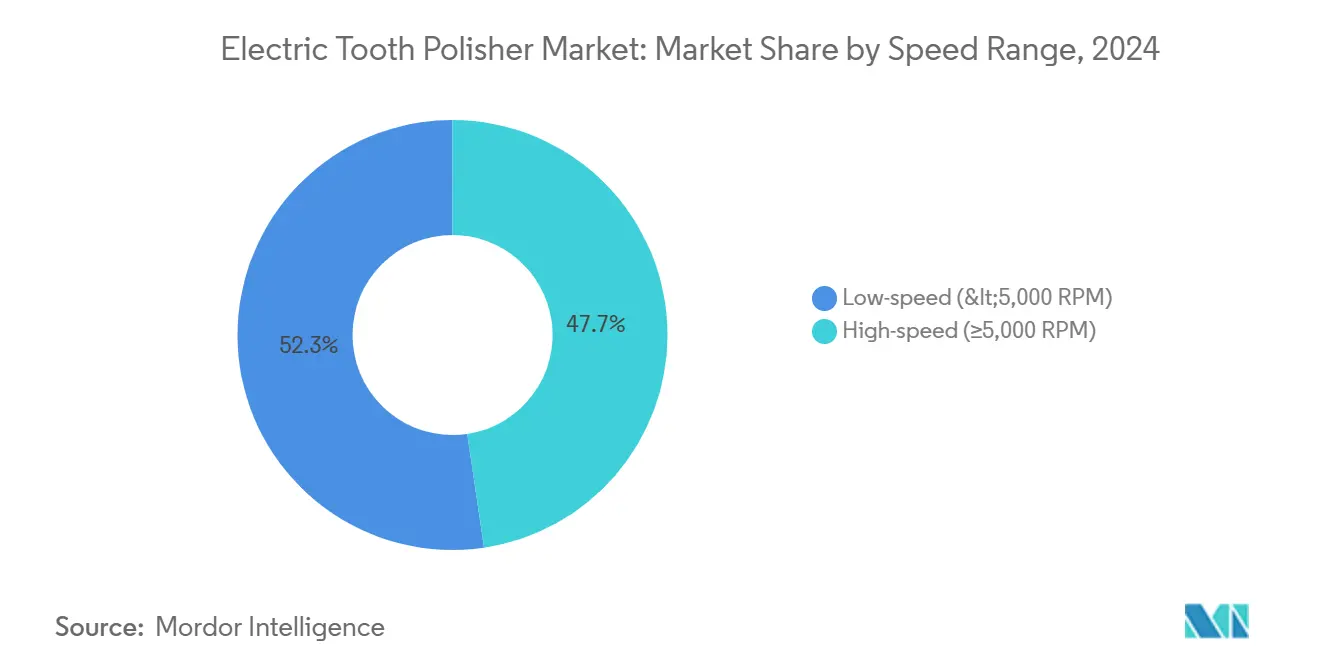
Low-speed polishers below 5,000 RPM still dominate procedural count, particularly for pediatric and geriatric prophylaxis, holding 52.34% of electric tooth polisher market share in 2024. High-speed devices (≥5,000 RPM) are growing at 8.36% CAGR as cosmetic cases demand rapid stain removal without multiple passes.
Manufacturers now incorporate closed-loop speed governors that maintain RPM under load, preventing burnishing and heat buildup. Clinics serving aesthetic patients report chair-time savings of 18% after upgrading to high-speed heads, translating into one extra appointment slot per day in multi-chair practices.
By Distribution Channel: Online Retail Transforms Access
Direct sales channels delivered 46.52% of electric tooth polisher market size in 2024 thanks to bundled service contracts and financing. Yet online retail is surging at 9.48% CAGR as smaller practices and individual hygienists seek transparent pricing and quick delivery.
E-commerce platforms list standardized SKUs such as prophylaxis cups and replacement O-rings, reducing the need for consultative selling. Distributors are pivoting to hybrid models that combine web ordering with local service depots. The shift also opens direct-to-consumer lanes for home-care devices, disrupting long-standing wholesaler relationships.
Geography Analysis
North America’s dominance originates from extensive hygienist workforces, preventive-care reimbursement, and rapid uptake of connected devices that support predictive maintenance. The United States is the single largest country market, where DSOs negotiate fleet-level service contracts ensuring 24-hour replacement on failure. Canada’s dental benefit expansion in 2025 added an estimated USD 1.2 billion (USD 1.2 billion) in prophylaxis-eligible spending, reinforcing steady equipment turnover.
Asia-Pacific is the global growth engine, adding more than 6,500 new dental clinics in 2024 alone. China’s tier-2 cities are shifting from extractions to prophylaxis, while India graduates 26,000 dentists per year, expanding procedure capacity. PhilHealth’s reimbursement of PHP 1,000 (USD 18) per patient annually is expected to cover 38 million Filipinos, pushing sales of compact, rugged polishers suitable for community settings. Japan and South Korea, with some of the world’s oldest populations, adopt low-vibration cordless tools to manage clinician fatigue.
Europe’s regulatory environment is tightening. MDR classification upgrades require fresh clinical evidence for handpiece renewals, and the Single-Use Plastics Directive is steering clinics toward reusable angles. Germany’s Fraunhofer-driven ergonomic research influences pan-European buying criteria, prioritizing grip variance and reduced noise. Post-Brexit United Kingdom retains CE-mark equivalence temporarily but signals an independent scheme by 2027, injecting uncertainty into the approval pipeline.
Competitive Landscape
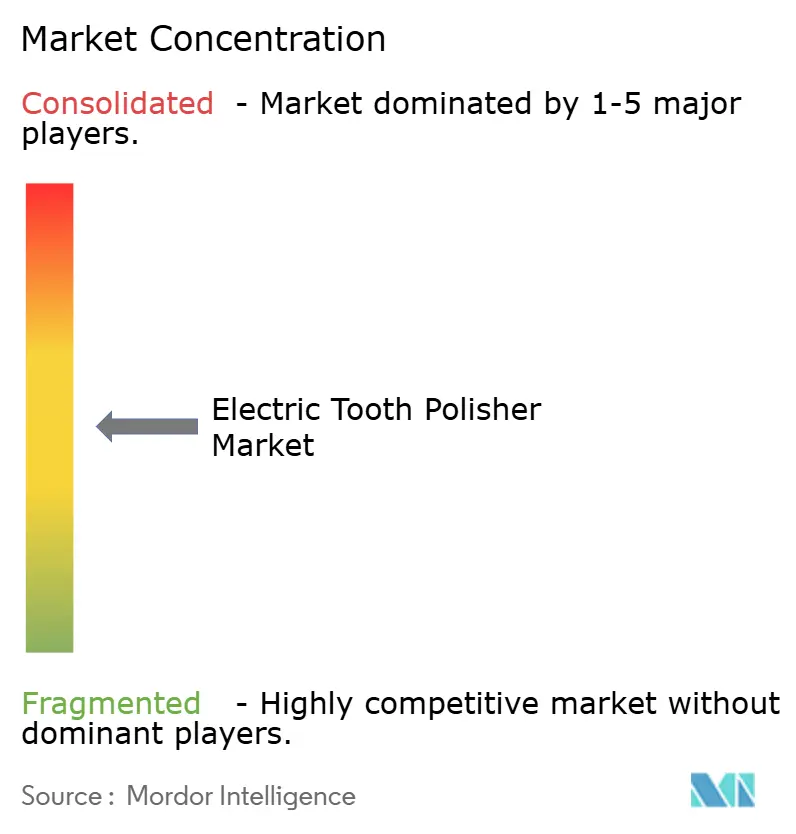
Market fragmentation is moderate, led by Dentsply Sirona, EMS Dental, KaVo Dental, Ultradent, and Ivoclar. Competitive focus centers on torque consistency, weight reduction, and digital connectivity more than price. Dentsply Sirona’s 2025 partnership with Egypt’s Alexandria University to equip 756 operatories ensures long-tail consumables supply. EMS Dental’s Guided Biofilm Therapy ecosystem locks clinics into proprietary powder formulations and smart nozzle chips, creating high switching costs.
KaVo’s K-ERGOgrip underscores the value of ergonomic R&D partnerships with research institutes, an area smaller firms struggle to match. Ultradent positions on sustainability, issuing a 2024 report outlining a 30% plastic reduction road map. Ivoclar leverages chairside CAD/CAM roots to cross-sell polishing attachments calibrated for ceramic restorations.
Emerging competitors target the fast-growing home-care niche, selling direct via e-commerce and social media. However, compliance with IEC 60601 electrical safety and MDR self-certification costs can erode margins. The market is likely to consolidate around brands combining device, consumable, and data-service revenue, further raising entry barriers for single-line producers.
Electric Tooth Polisher Industry Leaders
-
Dentsply Sirona
-
Young Innovations Inc.
-
Envista Holdings Corporation
-
Nakanishi Inc. (NSK)
-
EMS Dental
- *Disclaimer: Major Players sorted in no particular order
Recent Industry Developments
- March 2025: EMS Dental unveiled the GBT Machine at IDS 2025, featuring automatic handpiece recognition, cloud-based treatment monitoring, and a 30% cut in plastic through aluminum and tempered-glass components.
- November 2024: PhilHealth approved a PHP 1,000 annual preventive oral-care benefit per patient, covering routine prophylaxis, fluoride varnish, and sealants, effective Q2 2025.
- September 2024: Great Gums launched the Great Gums One and Great Gums Clinical Grade toothbrushes using patented bioelectric technology for enhanced plaque control
Global Electric Tooth Polisher Market Report Scope
| Cordless Electric Tooth Polishers |
| Corded Electric Tooth Polishers |
| Air-driven Tooth Polishers |
| Rotary Handpiece Polishers |
| Air Polishing Units |
| Ultrasonic Polishers |
| Laser-assisted Polishers |
| Dental Clinics |
| Hospitals |
| Ambulatory Surgical Centres |
| Home-care Settings |
| Low-speed (<5,000 RPM) |
| High-speed (≥5,000 RPM) |
| Direct Sales |
| Distributors / Dealers |
| Online Retail |
| North America | United States |
| Canada | |
| Mexico | |
| Europe | Germany |
| United Kingdom | |
| France | |
| Italy | |
| Spain | |
| Rest of Europe | |
| Asia-Pacific | China |
| Japan | |
| India | |
| Australia | |
| South Korea | |
| Rest of Asia-Pacific | |
| Middle East and Africa | GCC |
| South Africa | |
| Rest of Middle East and Africa | |
| South America | Brazil |
| Argentina | |
| Rest of South America |
| By Product Type | Cordless Electric Tooth Polishers | |
| Corded Electric Tooth Polishers | ||
| Air-driven Tooth Polishers | ||
| By Technology | Rotary Handpiece Polishers | |
| Air Polishing Units | ||
| Ultrasonic Polishers | ||
| Laser-assisted Polishers | ||
| By End User | Dental Clinics | |
| Hospitals | ||
| Ambulatory Surgical Centres | ||
| Home-care Settings | ||
| By Speed Range | Low-speed (<5,000 RPM) | |
| High-speed (≥5,000 RPM) | ||
| By Distribution Channel | Direct Sales | |
| Distributors / Dealers | ||
| Online Retail | ||
| By Geography | North America | United States |
| Canada | ||
| Mexico | ||
| Europe | Germany | |
| United Kingdom | ||
| France | ||
| Italy | ||
| Spain | ||
| Rest of Europe | ||
| Asia-Pacific | China | |
| Japan | ||
| India | ||
| Australia | ||
| South Korea | ||
| Rest of Asia-Pacific | ||
| Middle East and Africa | GCC | |
| South Africa | ||
| Rest of Middle East and Africa | ||
| South America | Brazil | |
| Argentina | ||
| Rest of South America | ||
Key Questions Answered in the Report
How large is the electric tooth polisher market in 2025?
The electric tooth polisher market size is valued at USD 462.58 million in 2025.
What is the expected growth rate through 2030?
The market is forecast to register a 5.89% CAGR between 2025 and 2030.
Which product segment grows fastest?
Cordless polishers are projected to expand at an 8.78% CAGR, driven by ergonomic and workflow benefits.
Why is Asia-Pacific the fastest-growing region?
Government-subsidized preventive programs and rising middle-class spending push Asia-Pacific toward an 8.03% CAGR.
How are IoT features changing device maintenance?
Connected polishers enable predictive servicing, lifting equipment uptime beyond 98% in early-adopting clinics.
What sustainability trends affect device design?
EU rules targeting single-use plastics are spurring development of reusable or bio-based prophy angles.