
Dye Sublimation Printers Market Size and Share
Market Overview
| Study Period | 2019 - 2030 |
|---|---|
| Market Size (2025) | USD 1.88 Billion |
| Market Size (2030) | USD 2.53 Billion |
| Growth Rate (2025 - 2030) | 6.12 % |
| Fastest Growing Market | Asia Pacific |
| Largest Market | Asia Pacific |
| Market Concentration | Medium |
Major Players *Disclaimer: Major Players sorted in no particular order Image © Mordor Intelligence. Reuse requires attribution under CC BY 4.0. | |
Dye Sublimation Printers Market Analysis by Mordor Intelligence
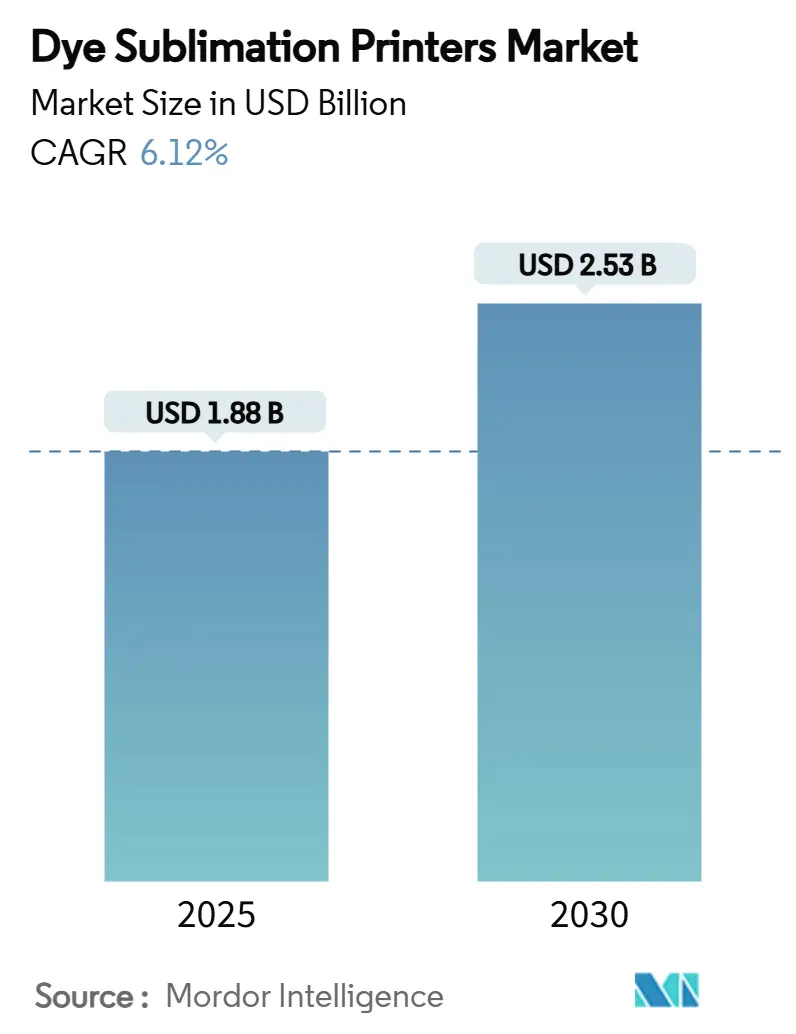
The dye sublimation printers market size stands at USD 1.88 billion in 2025 and will grow to USD 2.53 billion by 2030, reflecting a 6.12% CAGR. Steady migration from rotary-screen processes to digital production, surging customised sportswear demand, and the rise of e-commerce personalisation platforms underpin this expansion. Entry-level desktop units priced under USD 15,000 are lowering barriers for micro-businesses, while industrial producers adopt ever-wider devices that print fabric rolls up to 2 m. Rapid ink innovation, especially in fluorescent and water-based formulations, broadens application scope and reduces environmental loads. At the same time, sustainability regulations accelerate investment in recycled-polyester–compatible workflows, turning compliance into a commercial differentiator.
Key Report Takeaways
- By printer format, wide-format systems held 41.84% of the dye sublimation printers market share in 2024.
- By application, home-decor textiles are projected to grow at a 7.16% CAGR between 2025-2030.
- By ink type, water-based sublimation inks held 44.12% of the dye sublimation printers market share in 2024.
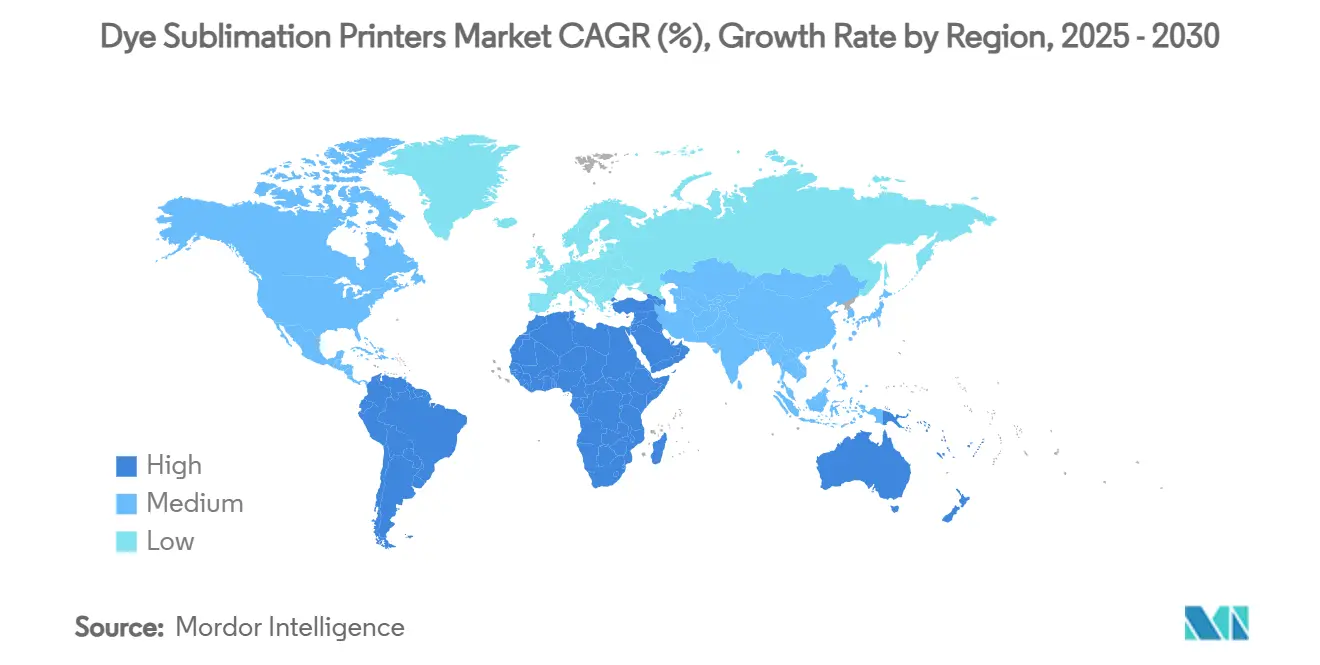
- By geography, the Asia-Pacific region is projected to grow at 7.13% CAGR between 2025-2030.
Note: Market size and forecast figures in this report are generated using Mordor Intelligence’s proprietary estimation framework, updated with the latest available data and insights as of January 2026.
Market Trends and Insights
Drivers Impact Analysis of Dye Sublimation Printers Market*
| Driver | % Impact on CAGR Forecast | Geographic Relevance | Impact Timeline |
|---|---|---|---|
| Surge in customised sportswear & athleisure demand | +1.8% | Global, with APAC and North America leading | Medium term (2-4 years) |
| Shift from rotary-screen to digital textile printing | +1.5% | Global, concentrated in manufacturing hubs | Long term (≥ 4 years) |
| Growth of on-demand e-commerce personalisation platforms | +1.2% | North America & EU, expanding to APAC | Short term (≤ 2 years) |
| Affordable desktop dye-sublimation models for micro-businesses | +0.9% | Global, with higher penetration in developed markets | Medium term (2-4 years) |
| Recycled-polyester adoption aligning with dye-sub compatibility | +0.7% | EU and North America regulatory-driven, APAC following | Long term (≥ 4 years) |
| Source: Mordor Intelligence | |||
Surge in Customised Sportswear and Athleisure Demand
Athleisure has blurred the lines between casual and performance apparel, prompting brands to shorten design cycles and release hyper-personalised collections. Dye sublimation enables vivid, all-over prints without compromising fabric breathability, aligning with consumer expectations for both style and function. Brands leverage the technology to produce limited drops in regional micro-factories, reducing inventory risk and boosting speed-to-market. Fitness-centric economies such as the United States, Japan, and Australia amplify this pattern. Equipment suppliers respond with faster roll-to-roll printers and colour-management software that handle frequent artwork changes[1].
Shift from Rotary-screen to Digital Textile Printing
Legacy rotary-screen lines struggle with high setup cost, water use, and design inflexibility. Digital dye sublimation eliminates screens, cuts water consumption, and supports economical runs of one, fitting the apparel sector’s move toward test-and-learn product launches. Manufacturers in China and Turkey now retrofit factories with hybrid lines combining automated cutting tables, colour-calibrated RIP software, and cloud analytics to track waste. Production teams need fewer skilled operators, which offsets rising labour rates. Machine builders bundle training and service contracts, anchoring long-term customer relationships.
Growth of On-demand E-commerce Personalization Platforms
E-commerce storefronts embed real-time design tools that feed print jobs directly to fulfilment hubs equipped with dye-sublimation lines. The just-in-time model eliminates finished-goods inventory, freeing cash and warehouse space. North American pioneers expand networks of decentralised print partners to cut delivery times to two days. As volumes scale, operators specify automated media-loading, continuous ink-supply systems, and API-connected quality dashboards. Printer OEMs that supply software development kits secure repeat consumables revenue.
Affordable Desktop Dye Sublimation Models for Micro-businesses
Entry-level units such as the Epson SureColor G6070, priced at USD 13,995, give entrepreneurs professional print quality without industrial infrastructure. Low-temperature platen presses paired with these printers let artisans create bespoke sports jerseys, mugs, and soft signage in small studio spaces. The desktop boom fuels community-level manufacturing, shortening supply chains and fostering local brand ecosystems. Component makers introduce compact bulk-ink tanks and self-maintenance printheads to minimise downtime.
Restraints Impact Analysis of Dye Sublimation Printers Market*
| Restraint | % Impact on CAGR Forecast | Geographic Relevance | Impact Timeline |
|---|---|---|---|
| High cap-ex & maintenance for industrial printers | -1.1% | Global, more pronounced in emerging markets | Medium term (2-4 years) |
| Environmental scrutiny of polyester waste streams | -0.8% | EU and North America regulatory-driven | Long term (≥ 4 years) |
| Volatile disperse-dye raw-material supply chain | -0.6% | Global, with APAC manufacturing concentration | Short term (≤ 2 years) |
| Source: Mordor Intelligence | |||
High Cap-ex and Maintenance for Industrial Printers
Industrial dye sublimation lines require investments exceeding USD 500,000, including heat fixers and automated take-up systems. Smaller converters struggle to secure financing, especially in regions where interest rates remain high. Even after purchase, preventive maintenance such as printhead alignment and nozzle cleaning demands skilled technicians. Epson’s USD 620 million printhead plant expansion highlights the capital intensity across the value chain[2]. Modular designs and predictive maintenance software are emerging, yet wholesale cost relief remains gradual.
Environmental Scrutiny of Polyester Waste Streams
Synthetic fibres shed microplastics during washing and disposal, prompting pending EU rules on fibre release filters and textile recycling targets. Compliance may require investments in closed-loop take-back schemes and dilution-proof ink chemistries. Research in Environmental Sciences Europe flags elevated ecological risk from polyester production and end-of-life handling[3]. Brands that cannot document waste mitigation face reputational damage, nudging them toward natural-fibre blends less suited to sublimation.
*Our forecasts treat driver/restraint impacts as directional, not additive. The impact forecasts reflect baseline growth, mix effects, and variable interactions.
Dye Sublimation Printers Market Segment Analysis
By Printer Format:
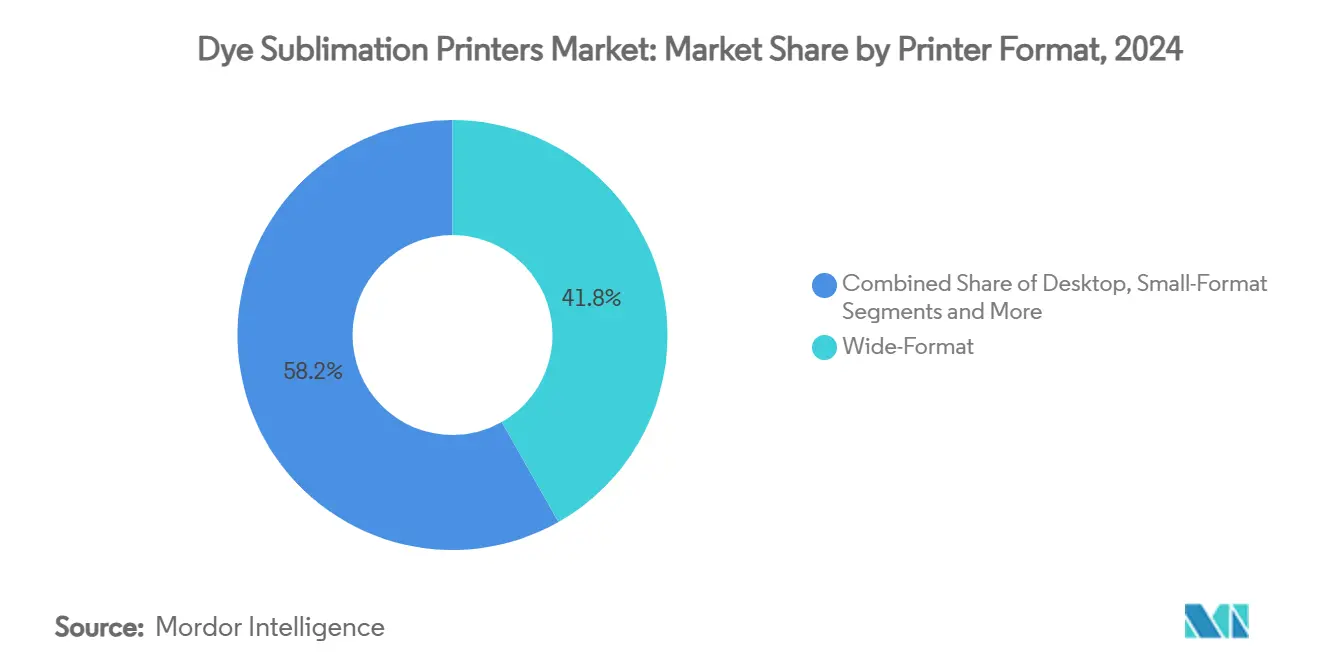
Desktop Models Democratize Production AccessDesktop units are growing at 7.04% CAGR, the fastest within the dye sublimation printers market. Wide-format machines nevertheless retain 41.84% market share in 2024 because high-volume fashion and soft-signage producers need roll widths above 1.6 m. Manufacturers bundle colour-calibration tools into desktop packages, easing novice onboarding. Simultaneously, industrial clients invest in wider, faster models that deliver sustained throughput above 1,600 sf ph, protecting critical lead-time advantages.
Epson, Mimaki, and Roland introduce portable bulk-ink pouches to reduce consumable cost per metre on small machines. The dye-sublimation printers market continues to encourage format pluralism: industrial setups integrate robotic roll changes and vision-guided inspection lines, while coffee-shop entrepreneurs run single-platen desktop rigs to personalise phone cases in minutes. This co-existence underscores how price-performance ratios rather than raw speed now dictate purchase decisions across tiers.

By Application:
Home-Decor Textiles Lead Growth InnovationApparel and fashion captured 47.38% of the dye sublimation printers market share in 2024, yet home-decor products will post a 7.16% CAGR through 2030. Interior stylists and consumers alike seek unique curtains, cushions, and wall coverings that reflect personal taste. Dye sublimation delivers photorealistic finishes on polyester velvet and faux-linen substrates without the odours associated with solvent inks. Furniture retailers pilot on-demand accent-pillow lines to cut seasonal markdown risk.
The dye sublimation printers market size for home-décor is expected to exceed USD 430 million by 2030, supported by e-commerce configurators that visualise custom prints in augmented reality. Soft signage, photographic panels, and rigid merchandise round out the application landscape, providing buffer revenue when apparel demand cycles pause. Cross-segment resilience has drawn investment funds to specialised fulfilment providers operating multi-application fleets.
By Ink Type:
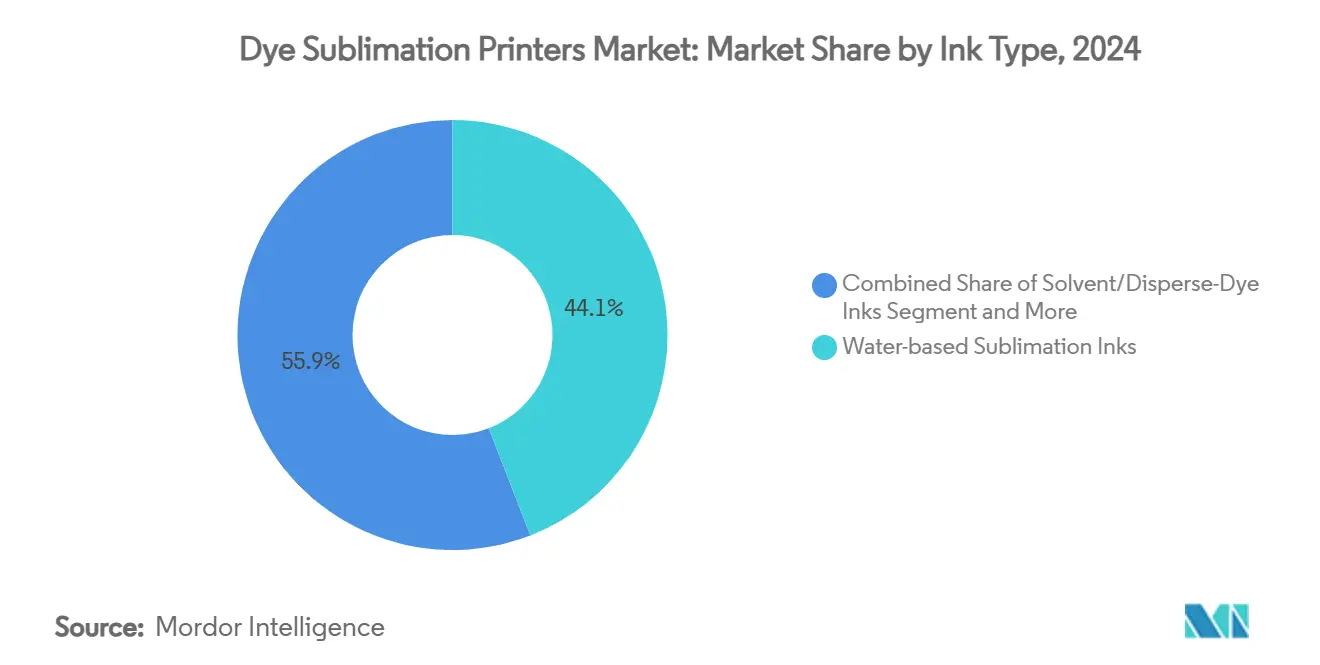
Fluorescent Inks Drive Specialty ApplicationsWater-based sublimation inks generated 44.12% of 2024 revenue, propelled by improved light-fastness and lower VOC emissions. Fluorescent formulations will expand 7.22% annually, appealing to safety-wear makers and brand merchandisers chasing high-impact colour. Ink vendors broaden ranges to include sublimation white undercoats, enabling prints on coloured media and unlocking new décor motifs. Solvent and disperse systems still serve niche industrial uses needing extreme scratch resistance.
Price volatility in petrochemical feedstocks has nudged buyers toward water-based alternatives that offer predictable cost and simplified workplace safety compliance. As a result, the dye-sublimation printers market increasingly rewards suppliers that tie ink supply to service contracts, ensuring both colour consistency and margin stability. Investment in R&D focuses on reducing transfer-paper cockling at high lay-downs, a lingering pain point on high-speed lines.
Geography Analysis
APAC Dye Sublimation Printers Market
Asia-Pacific retains the largest share at 38.45% in 2024 and will log a 7.13% CAGR until 2030. China leads absolute volume thanks to integrated yarn-to-garment clusters, yet India records the fastest sub-regional growth as export incentives converge with rising domestic consumption. Japanese entrant Kyocera unveiled a 2 m roll-to-roll printer in 2024, underscoring the region's engineering depth.
North America and Europe Dye Sublimation Printers Market
North America forms a mature yet dynamic market where C-suite emphasis is on automation and on-demand fulfilment rather than capacity expansion. Brands integrate printers with ERP platforms to automate Artwork-to-Order cycles. Europe mirrors this pattern but overlays stringent sustainability goals; regulatory pressure accelerates uptake of waterless processes and recycled-polyester workflows. Together, these two regions anchor roughly one-half of global high-value custom-apparel throughput.
MEA and South America Dye Sublimation Printers Market
South America, the Middle East, and Africa sit at earlier adoption phases but show outsized potential. Brazil leverages its established fashion chain to pilot sublimation-centric fast-fashion lines. Gulf Cooperation Council members subsidise industrial diversification, offering low-tariff zones for textile tech imports. Nigeria, Kenya, and South Africa witness entrepreneurial uptake of desktop rigs for local sports club merchandise. The dye sublimation printers market finds room to grow wherever digital design skills and entrepreneurial ecosystems intersect.
Competitive Landscape
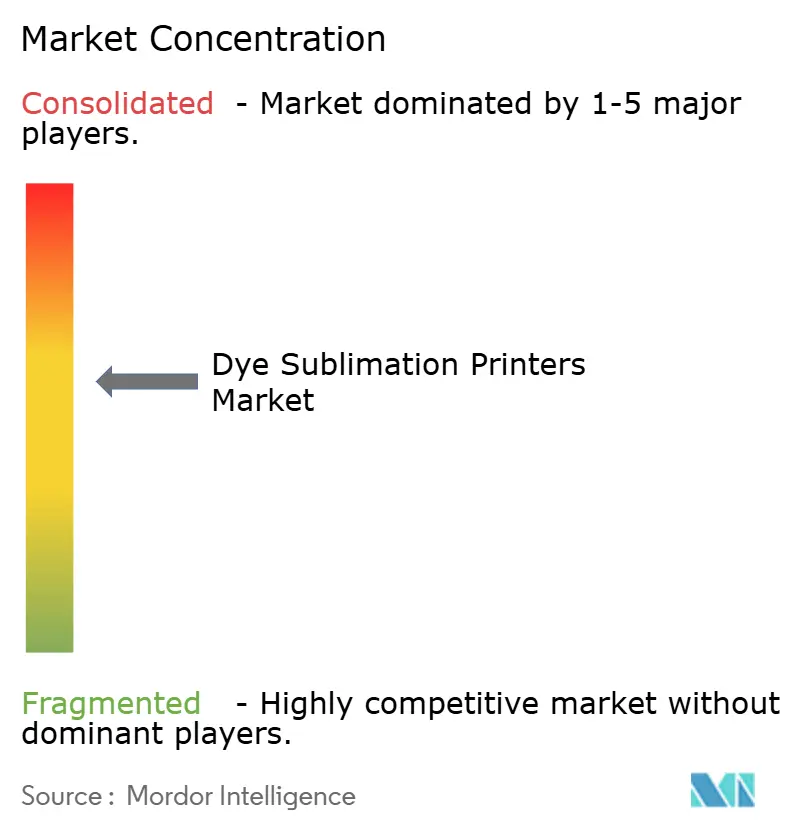
The dye sublimation printers market remains moderately fragmented, with the top five vendors controlling about 45% of global shipments. Seiko Epson Corp. leads by breadth of portfolio, from 24 in desktop to 76 in industrial roll-to-roll systems. HP Inc. positions its Stitch series on predictable running costs enabled by replaceable printhead architecture. Mimaki differentiates through eight-colour inksets that maximise gamut for photographic reproduction.
Strategic activity centres on vertical integration. Epson’s new printhead facility protects critical component supply and lowers time-to-market for custom nozzle designs. Kornit Digital pursues waterless single-pass platforms that marry sustainability claims with throughput, as shown in its Apollo launch[4]. Software firms embed colour-profile libraries into cloud RIP engines, locking in ink usage and raising switching costs.
Regional challengers emerge, such as India’s ColorJet, which bundles financing and in-country service to win against multinationals on total solution cost. Chinese OEMs target value buyers with aggressive pricing yet invest in head technology to erode performance gaps. Across tiers, vendors court fabrics suppliers and e-commerce integrators to create ecosystem lock-in, ensuring steady ink and media pull-through that sustains recurring revenue.
Dye Sublimation Printers Industry Leaders
-
Seiko Epson Corp.
-
HP Inc.
-
Canon Inc.
-
Brother Industries, Ltd.
-
Ricoh Company, Ltd.
- *Disclaimer: Major Players sorted in no particular order
Dye Sublimation Printers Market Companies Covered in this Report
- Seiko Epson Corp.
- HP Inc.
- Brother Industries, Ltd.
- Canon Inc.
- Ricoh Company, Ltd.
- Mimaki Engineering Co.
- Roland DG Corp.
- Sawgrass Technologies
- Mutoh Holdings
- Electronics For Imaging (EFI Reggiani)
- Durst Group
- Kornit Digital Limited
- DGI (Digital Graphics Inc.)
- Agfa-Gevaert N.V.
- Aeoon Technologies
Recent Industry Developments in Dye Sublimation Printers Market
- April 2025: Seiko Epson Corp. launched the SureColor P7370 and P9370 wide-format models for photography and fine art, doubling prior-generation speed.
- January 2025: Seiko Epson Corp. showcased the SureColor F6470H dye-sublimation printer at West Coast Art and Frame 2025, highlighting fast output for photographic panels.
- October 2024: Kornit Digital Limited announced Hybrid Digital’s adoption of the Kornit Apollo platform to accelerate online garment fulfilment.
- August 2024: Seiko Epson Corp. introduced the SureColor F9570 and F9570H 64-in printers, achieving 1,590 sf ph and targeting high-volume sports apparel and décor lines.
Global Dye Sublimation Printers Market Report Scope
| Desktop |
| Small-Format |
| Wide-Format |
| Industrial |
| Apparel and Fashion |
| Soft Signage and Banners |
| Home-Decor Textiles |
| Photographic and Event Printing |
| Rigid Merchandise (Mugs, Phone-cases, etc.) |
| Water-based Sublimation Inks |
| Solvent/Disperse-Dye Inks |
| High-Density (HD) Inks |
| Fluorescent Sublimation Inks |
| North America | United States | |
| Canada | ||
| Mexico | ||
| South America | Brazil | |
| Argentina | ||
| Rest of South America | ||
| Europe | Germany | |
| United Kingdom | ||
| France | ||
| Italy | ||
| Rest of Europe | ||
| Asia Pacific | China | |
| Japan | ||
| South Korea | ||
| India | ||
| Rest of Asia-Pacific | ||
| Middle East and Africa | Middle East | Saudi Arabia |
| United Arab Emirates | ||
| Turkey | ||
| Rest of Middle East | ||
| Africa | South Africa | |
| Nigeria | ||
| Egypt | ||
| Rest of Africa | ||
| By Printer Format | Desktop | ||
| Small-Format | |||
| Wide-Format | |||
| Industrial | |||
| By Application | Apparel and Fashion | ||
| Soft Signage and Banners | |||
| Home-Decor Textiles | |||
| Photographic and Event Printing | |||
| Rigid Merchandise (Mugs, Phone-cases, etc.) | |||
| By Ink Type | Water-based Sublimation Inks | ||
| Solvent/Disperse-Dye Inks | |||
| High-Density (HD) Inks | |||
| Fluorescent Sublimation Inks | |||
| By Geography | North America | United States | |
| Canada | |||
| Mexico | |||
| South America | Brazil | ||
| Argentina | |||
| Rest of South America | |||
| Europe | Germany | ||
| United Kingdom | |||
| France | |||
| Italy | |||
| Rest of Europe | |||
| Asia Pacific | China | ||
| Japan | |||
| South Korea | |||
| India | |||
| Rest of Asia-Pacific | |||
| Middle East and Africa | Middle East | Saudi Arabia | |
| United Arab Emirates | |||
| Turkey | |||
| Rest of Middle East | |||
| Africa | South Africa | ||
| Nigeria | |||
| Egypt | |||
| Rest of Africa | |||
Key Questions Answered in the Report
What is the current size of the dye sublimation printers market?
The dye-sublimation printers market size is USD 1.88 billion in 2025 and will reach USD 2.53 billion by 2030.
Which region leads the dye sublimation printers market in both size and growth?
Asia-Pacific leads with 38.45% revenue in 2024 and will grow at 7.13% CAGR through 2030.
Why are desktop dye sublimation printers gaining popularity?
Units under USD 15,000 provide professional output for small businesses, supporting localised custom production with a 7.04% CAGR.
Which application segment is growing fastest?
Home-decor textiles register a 7.16% CAGR due to consumer demand for personalised interiors.
How are sustainability pressures shaping market strategies?
Brands shift toward recycled polyester and waterless processes, and vendors innovate inks and equipment that meet stricter regulations while maintaining quality.
Who are the leading companies in the dye sublimation printers market?
Seiko Epson, HP, and Mimaki Engineering hold the largest share due to broad product portfolios and global service networks.