
Digital Asset Management Market Size and Share
Market Overview
| Study Period | 2020 - 2031 |
|---|---|
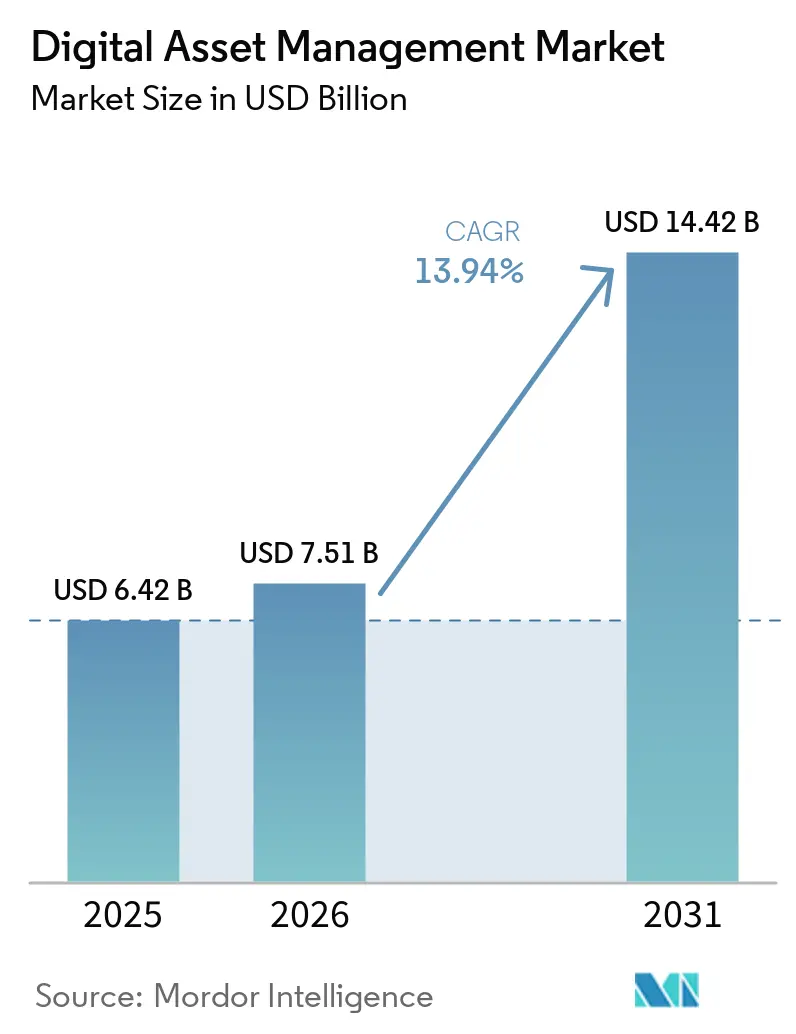
| Market Size (2026) | USD 7.51 Billion |
| Market Size (2031) | USD 14.42 Billion |
| Growth Rate (2026 - 2031) | 13.94 % |
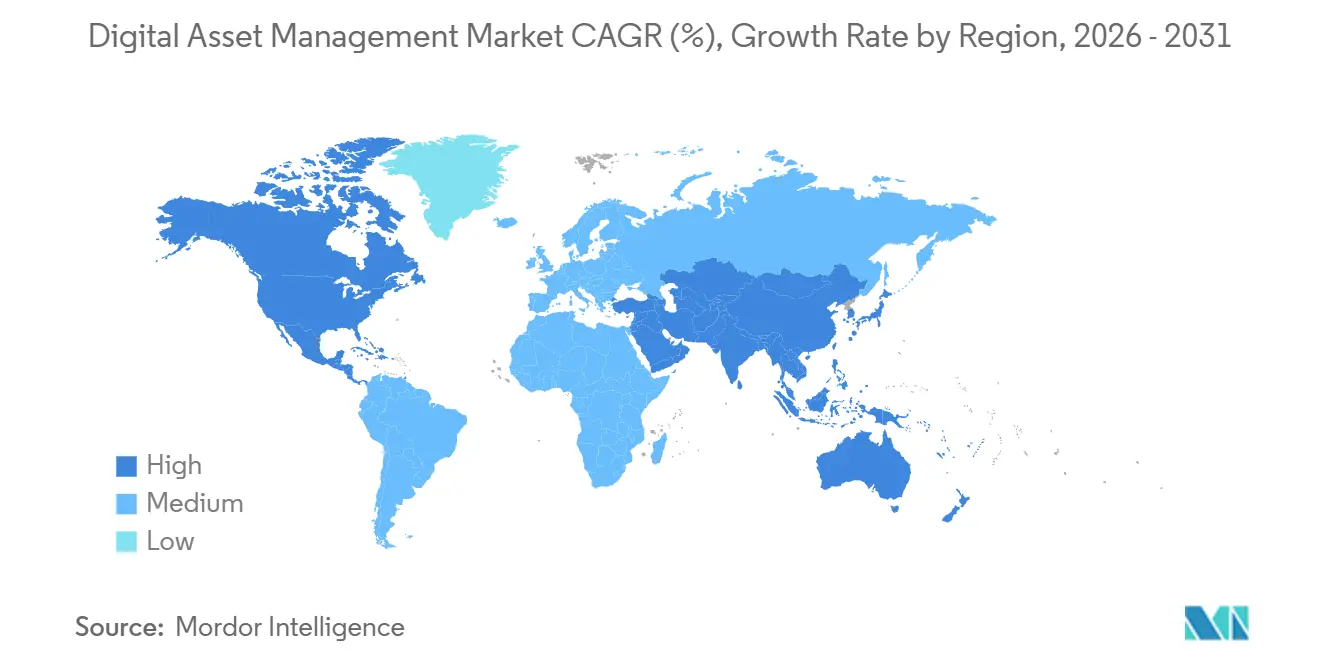
| Fastest Growing Market | Asia Pacific |
| Largest Market | North America |
| Market Concentration | Medium |
Major Players *Disclaimer: Major Players sorted in no particular order Image © Mordor Intelligence. Reuse requires attribution under CC BY 4.0. | |
Digital Asset Management Market Analysis by Mordor Intelligence
The digital asset management market size is projected to be USD 6.42 billion in 2025, USD 7.51 billion in 2026, and reach USD 14.42 billion by 2031, growing at a CAGR of 13.94% from 2026 to 2031. Accelerated content velocity in omnichannel commerce, the migration to cloud-native AI platforms, and tightening accessibility and data-sovereignty rules are reshaping vendor roadmaps. Vendors are shifting from storage-centric repositories toward orchestration layers that automate tagging, rights verification, and real-time asset syndication. Competitive dynamics intensified after Adobe’s purchase of Semrush and the Getty Images and Shutterstock merger, igniting a race to fuse DAM, SEO, and content intelligence. Generative AI, meanwhile, is becoming table stakes for enterprise clients that expect instant asset renditioning and semantic search.
Key Report Takeaways
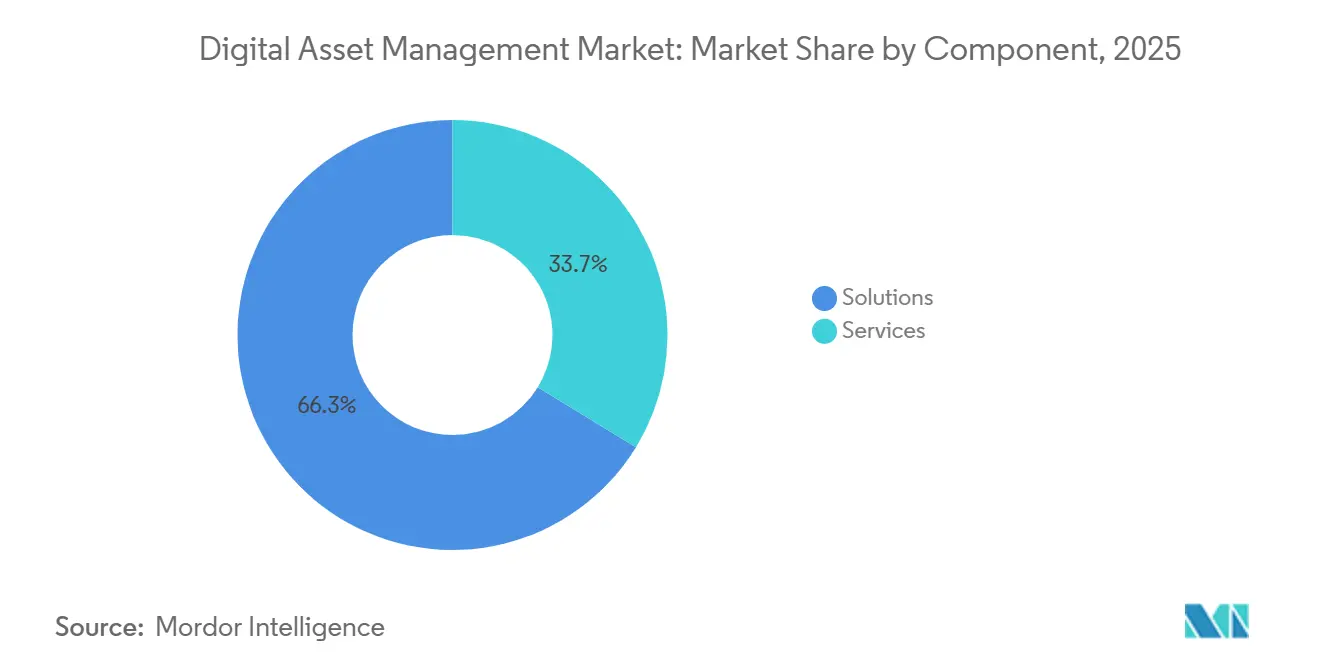
- By component, solutions led with 66.26% of the digital asset management market share in 2025, while services are advancing at a 14.33% CAGR through 2031.
- By deployment mode, on-premise installations held a 59.76% share in 2025, whereas cloud deployments are forecast to expand at a 14.29% CAGR to 2031.
- By organization size, large enterprises accounted for 62.98% of the digital asset management market in 2025, while Small and Medium Enterprises (SMEs) posted the fastest growth at a 14.01% CAGR.
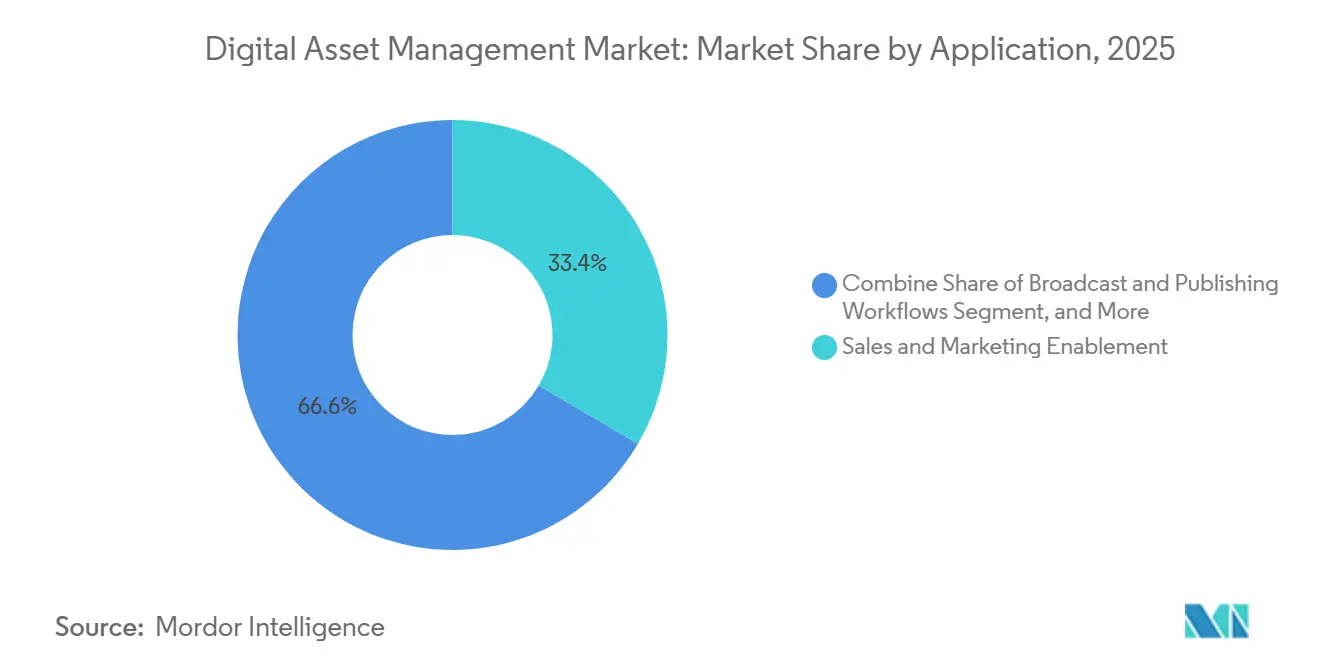
- By application, sales and marketing enablement commanded 33.43% revenue share in 2025; product and e-commerce management is projected to rise at a 14.89% CAGR through 2031.
- By end-user industry, media and entertainment held 32.12% share of the digital asset management market in 2025, while healthcare and life sciences are progressing at a 15.51% CAGR to 2031.
- By geography, North America accounted for a 36.27% share in 2025, whereas Asia-Pacific is set to grow at a 14.84% CAGR during 2026-2031.
Note: Market size and forecast figures in this report are generated using Mordor Intelligence’s proprietary estimation framework, updated with the latest available data and insights as of 2026.
Market Trends and Insights
Drivers Impact Analysis of Digital Asset Management Market*
| Driver | (~) % Impact on CAGR Forecast | Geographic Relevance | Impact Timeline |
|---|---|---|---|
| Growing Volume And Velocity Of Rich Media Assets In Omnichannel Commerce | +2.8% | Global, Early In North America And Europe | Medium Term (2–4 Years) |
| Rapid Shift To Cloud-Native AI-Enhanced DAM Platforms In North America | +2.5% | Primarily North America, Spreading To Europe And APAC | Short Term (≤2 Years) |
| Surging Demand For Personalized Video Streaming Assets In Asia-Pacific | +2.2% | APAC Core, Notably China, India, Japan, South Korea | Medium Term (2–4 Years) |
| Integration Of DAM With Headless CMS For Real-Time Content Syndication | +1.9% | Global, Led By Digital-First Firms In North America And Europe | Short Term (≤2 Years) |
| Regulatory Push For Accessibility (WCAG 2.2) Elevating Metadata Standards In Europe | +1.6% | Europe, With Multinationals Adopting Globally | Long Term (≥4 Years) |
| Emergence Of Generative-AI-Powered Auto-Tagging Reducing Time-To-Market | +2.1% | Highest Adoption In North America And Europe | Short Term (≤2 Years) |
| Source: Mordor Intelligence | |||
Growing Volume and Velocity of Rich Media Assets in Omnichannel Commerce
The growing adoption of digital commerce, video advertising, and AI-driven personalization is increasing the need for centralized management of high-volume digital assets. Gartner projects that 20% of digital commerce transactions will be executed through AI platforms by 2030, including AI-enabled checkout and agent-led transactions, increasing the importance of structured product information, accessible media libraries, and machine-readable content[1]. DAM platforms integrated with product information management (PIM) systems help enterprises centralize product imagery, videos, metadata, and usage rights while supporting consistent content distribution across e-commerce platforms, marketplaces, and social channels. This is strengthening demand for scalable asset libraries, automated content workflows, and API-enabled delivery, particularly among consumer goods and retail businesses.
Rapid Shift to Cloud-Native AI-Enhanced DAM Platforms in North America
Enterprises are increasingly migrating from legacy, on-premises digital asset repositories to cloud-native DAM platforms to improve scalability, accessibility, and integration with marketing technology systems. Bynder manages more than 175 million digital assets, representing 18 petabytes of customer data on Amazon Web Services (AWS), and reported 65% storage cost savings through Amazon S3 Intelligent-Tiering, demonstrating the operational benefits of scalable cloud infrastructure. Similarly, Boston Consulting Group expanded its Acquia DAM implementation to 12 business units and more than 22,000 active users by 2025, with a centralized repository containing over 270,000 assets[2]. AI-powered metadata tagging, semantic search, automated classification, and API-based integrations are further strengthening cloud DAM capabilities. Gartner's October 2026 Magic Quadrant for Digital Asset Management Platforms includes vendors such as Adobe, Aprimo, Bynder, Cloudinary and Orange Logic, reflecting the competitive focus on AI-enabled enterprise content management. These developments are supporting the transition towards subscription-based DAM platforms and reducing dependence on fragmented legacy infrastructure.
Surging Demand for Personalized Video Streaming Assets in Asia-Pacific
Growing enterprise investment in generative AI and digital content is accelerating demand for advanced media management capabilities across Asia-Pacific. According to Forrester's 2025 AI Adoption Across Regions research, 26% of Asia-Pacific enterprises had invested between USD 400,001 and USD 500,000 in generative AI, compared with 19% in North America and 17% in Europe; additionally, 33% of Asia-Pacific AI decision-makers identified their CEO as the primary owner of AI strategy. The expansion of regional AI infrastructure is further supporting this transition, with Yotta announcing an investment exceeding USD 2 billion to deploy 20,736 NVIDIA Blackwell Ultra GPUs at its Greater Noida data-center campus, with an initial deployment targeted for August 2026. Allianz's 2026 Risk Barometer also ranked AI as the second-largest business risk in Asia-Pacific, highlighting the growing importance of governance and responsible AI adoption[3]. As enterprises increase their use of personalized video, localized advertising, and AI-generated media, DAM platforms with automated video processing, metadata enrichment, content discovery, and digital rights management capabilities are becoming increasingly important for managing large and diverse media libraries.
Integration of DAM with Headless CMS for Real-Time Content Syndication
Integration of DAM platforms with headless content management systems (CMS) is enabling enterprises to distribute approved digital assets across websites, mobile applications, and e-commerce channels with greater speed and consistency. In November 2025, Cloudinary enhanced its integration with Contentful, enabling users to insert and filter images and videos, access media-editing capabilities, and search Cloudinary assets directly within the CMS environment. Similarly, Acquia DAM supports API-based integrations, instant asset search, and webhooks that notify connected applications of asset creation, modification, and deletion, facilitating event-driven content distribution. Wedia also provides Content Pickers within Adobe Creative Cloud and Microsoft Office applications, allowing users to access and reuse centrally managed assets without repeatedly downloading and uploading files. Meanwhile, Adobe's 2026 Middle East enterprise research found that 61% of surveyed organizations considered their cloud infrastructure very mature, while 54% described their technology stacks as only moderately effective at supporting business objectives, highlighting ongoing integration challenges[4]. These developments are transforming DAM platforms from centralized storage repositories into connected content orchestration systems that support real-time publishing, asset consistency, and omnichannel content delivery.
Restraints Impact Analysis of Digital Asset Management Market*
| Restraint | (~) % Impact on CAGR Forecast | Geographic Relevance | Impact Timeline |
|---|---|---|---|
| High Total Cost Of Ownership For Enterprise-Grade DAM Suites In SMEs | -1.8% | Global, Acute In South America, Africa, Southeast Asia | Medium Term (2–4 Years) |
| Data-Sovereignty And Residency Mandates Limiting Cross-Border Asset Storage | -2.1% | Europe First, Spreading To India, UAE, China, Nigeria | Long Term (≥4 Years) |
| Fragmented Legacy Repositories Hindering Seamless Migration | -1.5% | North America And Europe | Medium Term (2–4 Years) |
| Limited Skilled Workforce For AI-Based Metadata Governance | -1.2% | Global, Highest In Emerging Markets | Long Term (≥4 Years) |
| Source: Mordor Intelligence | |||
High Total Cost of Ownership for Enterprise-Grade DAM Suites in SMEs
Enterprise-grade digital asset management (DAM) platforms can create significant cost pressures for small and medium-sized enterprises (SMEs), particularly when implementation, storage, customization, integration, training, and ongoing administration are considered alongside subscription fees. Entry-level cloud solutions provide more accessible alternatives, with LightRocket offering subscriptions from USD 349 per month, including 1,000 users and 1 TB of storage, while AI capabilities such as automated image tagging, video transcription and visual similarity search are available through additional paid modules. ResourceSpace offers a Team Cloud package for start-ups and smaller organizations, including support, AI productivity tools for automated tagging and search, API access and single sign-on. However, larger deployments may still require additional investment in metadata standardization, user training, access controls, workflow configuration, and integration with existing enterprise systems. These implementation and governance requirements can increase the overall cost of ownership and pose adoption challenges for SMEs with limited IT budgets and limited dedicated digital content management resources.
Data-Sovereignty and Residency Mandates Limiting Cross-Border Asset Storage
The EU Digital Operational Resilience Act, Data Act, and Cloud Sovereignty Framework demand localized processing, forcing DAM vendors to deploy EU-only clusters and pursue SEAL certification.[5] Microsoft conceded it cannot fully shield EU data from U.S. CLOUD Act exposure, heightening client pressure for European hosting. Outside Europe, India’s Digital Personal Data Protection Act, China’s PIPL, and Nigeria’s 2023 laws create a patchwork of residency rules documented by DLA Piper. These mandates inflate infrastructure costs, delay global rollouts, and complicate the expansion of the digital asset management market.
*Our forecasts treat driver/restraint impacts as directional, not additive. The impact forecasts reflect baseline growth, mix effects, and variable interactions.
Digital Asset Management Market Segment Analysis
By Component:
Services Gain Traction amid Governance ComplexitySolutions accounted for 66.26% of the digital asset management market share in 2025, driven by investments in AI tagging engines, rights management modules, and workflow automation. However, services revenue is forecast to grow at a 14.33% CAGR through 2031 as enterprises address fragmented metadata, legacy system migration, and complex integrations. Demand for implementation, metadata standardization, taxonomy design, system integration, and user training is increasing as organizations consolidate digital repositories and introduce AI-enabled workflows.
Vendors are also incorporating AI model optimization, workflow customization, and continuous technical support into their service offerings. As DAM evolves from a centralized asset repository into an integrated content orchestration platform, professional services are becoming increasingly important for maintaining governance, compliance, and operational efficiency.


By Deployment Mode:
Cloud Rises despite On-Premise EntrenchmentOn-premise deployments accounted for 59.76% of the digital asset management market in 2025, as regulated industries continue to prioritize infrastructure control and data security. However, cloud deployments are projected to grow at a 14.29% CAGR through 2031, supported by subscription-based pricing, scalable storage, remote accessibility, and integration with AI-enabled content workflows. Bynder's cloud infrastructure on Amazon Web Services supports more than 175 million digital assets and 18 petabytes of customer data, demonstrating the scalability of cloud-based asset repositories.
Meanwhile, organizations handling sensitive information continue to consider private cloud and hybrid configurations to address security and data control requirements. Cloud-native platforms with regional hosting options and enterprise-grade governance are expected to attract additional deployments, although on-premises infrastructure will remain relevant for organizations with stringent internal-control requirements.
By Organization Size:
SMEs Accelerate on Consumption PricingLarge enterprises held 62.98% of the digital asset management market share in 2025, supported by extensive digital libraries, complex workflows, and dedicated content-management teams. However, SMEs represent the fastest-growing segment, with a projected 14.01% CAGR through 2031, as flexible cloud subscriptions and lower-cost platforms reduce initial adoption barriers. ResourceSpace offers a Team Cloud package with AI-assisted tagging, search, API access, and support for smaller organizations, while LightRocket offers subscriptions starting at USD 349 per month for 1,000 users and 1 TB of storage.
These platforms enable smaller businesses to centralize brand assets, manage permissions, and streamline content distribution without substantial infrastructure investments. Nevertheless, metadata management, staff training, and integration requirements remain cost considerations. Large enterprises continue to invest in regional governance, advanced security, enterprise integrations, and customized AI workflows, sustaining their dominance in spending.
By Application:
E-Commerce Management Outpaces Traditional Campaign WorkflowsSales and marketing enablement accounted for 33.43% of 2025 revenue, yet product and e-commerce management is forecast to outgrow every other use case at a 14.89% CAGR. The rise of atomic content, one master spawning locale-, channel-, and SKU-specific renditions, has tightened the bond between DAM and PIM. Retailers integrating both systems achieve 90% faster image delivery to digital storefronts and a 45% bump in video-driven sales. The digital asset management market for e-commerce also benefits from AI engines that automatically score images for compliance with marketplace guidelines, slashing listing rejections.
Traditional broadcast and publishing workflows still demand versioned transcodes, caption syncing, and archive retrieval, keeping media houses as anchor clients. Yet even broadcasters are re-skinning content for direct-to-consumer apps that mirror e-commerce personalization tactics, further bleeding the lines between campaign enablement and transactional content services.


By End-User Industry:
Healthcare and Life Sciences Emerge as Fastest MoverMedia and entertainment retained a 32.12% share of the digital asset management market in 2025, supported by extensive video libraries, production assets, content versioning, and distribution rights management. Healthcare and life sciences, however, are projected to grow at a 15.51% CAGR through 2031, driven by increasing requirements for centralized patient education materials, clinical imagery, physician training videos, and regulated marketing content. Jones Healthcare Group implemented MediaValet DAM to centralize digital assets across its North American, United Kingdom, and Spain offices, improving content access, collaboration, and security.
MediaValet also reported that 100% of its healthcare customers achieve ROI within one year, highlighting the potential benefits of specialized DAM deployments, although this is a vendor-reported outcome. BFSI, retail, consumer packaged goods, manufacturing, and government organizations are also adopting specialized DAM workflows to support regulatory documentation, product visualization, brand consistency, and controlled content distribution.
Geography Analysis
North America and Europe Digital Asset Management Market
North America accounted for 36.27% of the digital asset management market revenue in 2025, supported by early cloud adoption, enterprise technology spending, and increasing integration of DAM with marketing automation and e-commerce platforms. AI-powered metadata tagging, semantic search and automated content distribution are strengthening enterprise adoption. In Europe, DORA, the European Accessibility Act and the EU's 2026 Cloud Sovereignty Framework are increasing demand for secure asset storage, accessibility compliance and regional data controls. Microsoft's completion of its EU Data Boundary in February 2025 further highlights the growing emphasis on regional data residency.
APAC Digital Asset Management Market
Asia-Pacific is projected to grow at a 14.84% CAGR through 2031, driven by enterprise digitization, government-backed AI initiatives and expanding cloud infrastructure across China, India and Japan. India's data-center development pipeline reached 3,860 MW in September 2026, while Yotta announced an investment exceeding USD 2 billion in NVIDIA Blackwell infrastructure at Greater Noida. These investments are expanding regional computing capacity and supporting demand for AI-enabled DAM platforms offering multilingual metadata management, automated content classification, video processing, and personalized digital content delivery.
South America Digital Asset Management Market
South America is gradually emerging as a digital infrastructure hub, with Brazil accounting for approximately 41% of Latin America's data-center market. TikTok's announced investment exceeding BRL 200 billion in a data-center project at Ceará's Pecém Industrial and Port Complex is strengthening regional cloud infrastructure development. Brazil's REDATA incentive framework was also reinstated by Law 15,504/2026 in September 2026, supporting eligible data center investments. These developments are creating opportunities for DAM providers offering regional hosting, hybrid deployment, multilingual content management, and scalable digital asset distribution.
MEA Digital Asset Management Market
The Middle East and Africa show uneven but promising uptake. Gulf enterprises, rich in mature cloud stacks, seek API-ready DAM to bridge multilingual, culturally tuned content, whereas parts of Africa lean on mobile-first strategies as bandwidth expands. Government digitization programs and sovereign-cloud mandates should incrementally lift spending, but skills shortages and connectivity gaps will modulate pacing.
Competitive Landscape
Market Concentration
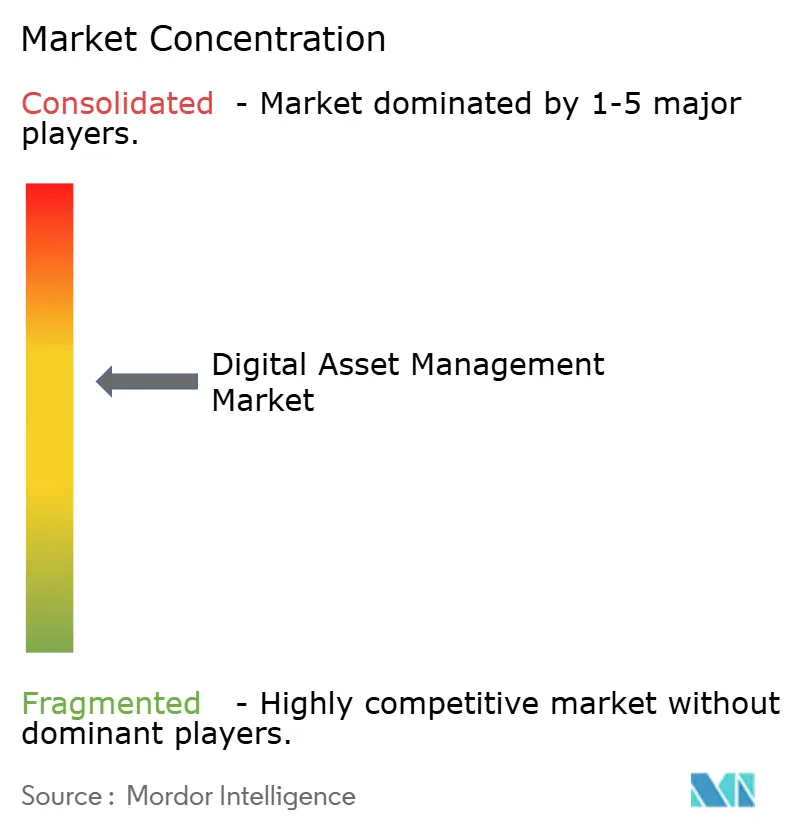
The digital asset management market remains consolidated, with competition intensifying as established providers such as Adobe, OpenText, Bynder and Aprimo defend their positions through integrated suites, workflow capabilities and extensive integration ecosystems. These vendors compete on enterprise scalability, content governance, automation and integration capabilities.
Adobe completed its approximately USD 1.87 billion acquisition of Semrush in April 2026, strengthening its brand visibility, search and AI-driven customer experience capabilities. However, the proposed USD 3.7 billion Getty Images-Shutterstock merger was terminated in July 2026, leaving both companies independent. Hyland introduced its Cloud Content Repository with an EU deployment option in August 2025, while Canto's XI launch in October 2025 added AI-enabled capabilities, including Library Assistant and Brand Studio.
Cloudinary was named a Leader in Gartner's 2026 Magic Quadrant for Digital Asset Management, reflecting the growing importance of cloud-native platforms and developer-oriented capabilities. Opportunities remain in human-validated AI metadata, headless CMS orchestration, digital rights management, and phased migration support, particularly for enterprises seeking stronger governance and lower implementation complexity.
Digital Asset Management Industry Leaders
-
Adobe Inc.
-
Canto Inc.
-
CELUM GmbH
-
Oracle Corporation
-
IBM Corp.
- *Disclaimer: Major Players sorted in no particular order
Digital Asset Management Market Companies Covered in this Report
- Adobe Inc.
- OpenText Corp.
- Bynder BV
- Aprimo LLC
- Oracle Corp.
- Cloudinary Ltd.
- IBM Corp.
- Canto Inc.
- Widen Enterprises (Acquia)
- CELUM GmbH
- MediaBeacon Inc.
- Nuxeo (Hyland)
- Extensis
- Digizuite A/S
- MediaValet Inc.
- Brandfolder (Smartsheet)
- Sitecore
- Northplains Systems
- Tenovos
- Amplifi.io
Recent Industry Developments in Digital Asset Management Market
- October 2026: Canto introduced Global Assistant, an agentic AI layer that identifies missing or incomplete brand and product content, supports bulk asset corrections, and automates the creation of distribution portals. The launch reflects the shift towards DAM platforms that actively manage content readiness rather than simply store and retrieve assets.
- September 2026: Aprimo launched Content Portfolio Management, extending asset discovery, deduplication, and governance to content stored outside traditional DAM repositories, including websites, file storage, and partner portals. Its agent-based framework supports metadata enrichment, quality assessment, and brand and legal compliance checks.
- September 2026: Canto launched its AI Bulk Update Assistant, Product Hub MCP, and AI Portals. These capabilities automate bulk asset updates, connect AI assistants to approved product information, and simplify the distribution of branded content through AI-assisted portal creation and asset curation.
- September 2026: Acquia DAM introduced an MCP server that connects its platform to AI assistants, including Claude and Microsoft Copilot. The integration enables users to search for, retrieve, and update digital assets, metadata, and tags via conversational prompts while retaining existing user-level access permissions.
Global Digital Asset Management Market Report Scope
The Digital Asset Management Market Report is Segmented by Component (Solutions, Services), Deployment Mode (On-Premise, Cloud), Organisation Size (SMEs, Large Enterprises), Application (Sales and Marketing Enablement, Broadcast and Publishing Workflows, Product and E-Commerce Management, Photography, Graphics and Design Repositories, Document and Knowledge Management), End-User Industry (Media and Entertainment, BFSI, Government and Public Sector, Healthcare and Life Sciences, Retail and CPG, Manufacturing, IT and Telecom, Rest of End-User Industry), and Geography (North America, South America, Europe, Asia-Pacific, Middle East, Africa). The Market Forecasts are Provided in Terms of Value (USD).
Segmentation Overview
| Solutions |
| Services |
| On-Premise |
| Cloud (SaaS) |
| Small and Medium Enterprises (SMEs) |
| Large Enterprises |
| Sales and Marketing Enablement |
| Broadcast and Publishing Workflows |
| Product and E-Commerce Management |
| Photography, Graphics and Design Repositories |
| Document and Knowledge Management |
| Media and Entertainment |
| BFSI |
| Government and Public Sector |
| Healthcare and Life Sciences |
| Retail and CPG |
| Manufacturing |
| IT and Telecom |
| Rest of End-User Industry |
| North America | United States |
| Canada | |
| Mexico | |
| South America | Brazil |
| Argentina | |
| Rest of South America | |
| Europe | United Kingdom |
| Germany | |
| France | |
| Spain | |
| Italy | |
| Rest of Europe | |
| Asia-Pacific | China |
| India | |
| Japan | |
| Australia | |
| South Korea | |
| Rest of Asia-Pacific | |
| Middle East | Saudi Arabia |
| United Arab Emirates | |
| Turkey | |
| Rest of Middle East | |
| Africa | South Africa |
| Kenya | |
| Rest of Africa |
| By Component | Solutions | |
| Services | ||
| By Deployment Mode | On-Premise | |
| Cloud (SaaS) | ||
| By Organisation Size | Small and Medium Enterprises (SMEs) | |
| Large Enterprises | ||
| By Application | Sales and Marketing Enablement | |
| Broadcast and Publishing Workflows | ||
| Product and E-Commerce Management | ||
| Photography, Graphics and Design Repositories | ||
| Document and Knowledge Management | ||
| By End-User Industry | Media and Entertainment | |
| BFSI | ||
| Government and Public Sector | ||
| Healthcare and Life Sciences | ||
| Retail and CPG | ||
| Manufacturing | ||
| IT and Telecom | ||
| Rest of End-User Industry | ||
| By Geography | North America | United States |
| Canada | ||
| Mexico | ||
| South America | Brazil | |
| Argentina | ||
| Rest of South America | ||
| Europe | United Kingdom | |
| Germany | ||
| France | ||
| Spain | ||
| Italy | ||
| Rest of Europe | ||
| Asia-Pacific | China | |
| India | ||
| Japan | ||
| Australia | ||
| South Korea | ||
| Rest of Asia-Pacific | ||
| Middle East | Saudi Arabia | |
| United Arab Emirates | ||
| Turkey | ||
| Rest of Middle East | ||
| Africa | South Africa | |
| Kenya | ||
| Rest of Africa | ||
Key Questions Answered in the Report
What is the projected value of the digital asset management market by 2031?
The market is expected to reach USD 14.42 billion by 2031.
Which deployment model is growing fastest?
Cloud-based deployments are forecast to rise at a 14.29% CAGR between 2026 and 2031.
Which application segment shows the highest growth?
Product and e-commerce management is advancing at a 14.89% CAGR through 2031.
Why are services revenue rising faster than software in DAM?
Enterprises need implementation, metadata migration, and governance expertise, driving services at a 14.33% CAGR.
Which region offers the strongest growth outlook for DAM?
Asia-Pacific leads with a projected 14.84% CAGR to 2031, backed by sovereign AI initiatives and hyperscale data-center builds.
What is the primary barrier for SMEs adopting DAM?
High total cost of ownership, including governance staffing, remains the chief obstacle.