
Dental Healing Caps Market Size and Share
Market Overview
| Study Period | 2019 - 2030 |
|---|---|
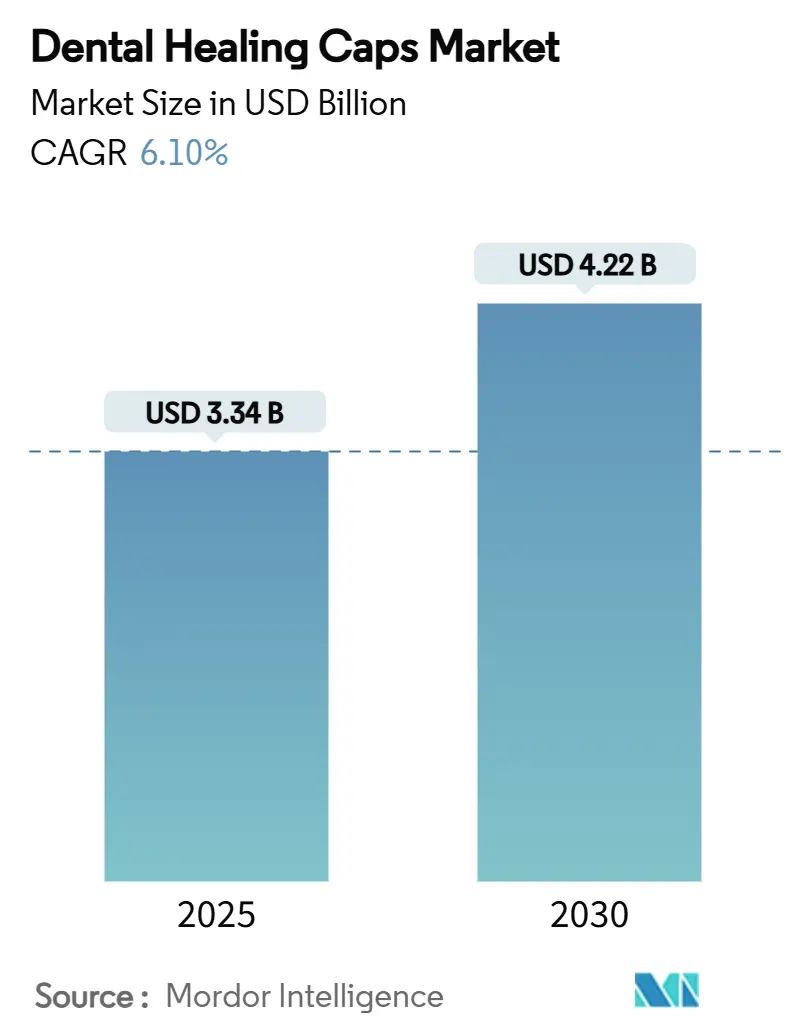
| Market Size (2025) | USD 3.34 Billion |
| Market Size (2030) | USD 4.22 Billion |
| Growth Rate (2025 - 2030) | 6.10 % |
| Fastest Growing Market | Asia Pacific |
| Largest Market | Europe |
| Market Concentration | Medium |
Major Players *Disclaimer: Major Players sorted in no particular order Image © Mordor Intelligence. Reuse requires attribution under CC BY 4.0. | |
Dental Healing Caps Market Analysis by Mordor Intelligence
The global dental healing caps market size stood at USD 3.34 billion in 2025 and is forecast to reach USD 4.22 billion by 2030, expanding at a 6.1% CAGR during 2025-2030. Titanium’s continued success anchors present demand, yet practitioners are steadily pivoting toward material diversification that lowers peri-implantitis risk while preserving biocompatibility. Custom CAD/CAM workflows shorten chair time, driving adoption of individualized emergence profiles that improve soft-tissue architecture. Europe’s reimbursement support sustains procedure volumes, whereas Asia Pacific’s dental-tourism boom accelerates volume growth and intensifies price competition. Competitive intensity now hinges on the fusion of AI-guided design platforms with traditional manufacturing competence as clinicians demand seamless integration across diagnostic, design, and production stages.
Key Report Takeaways
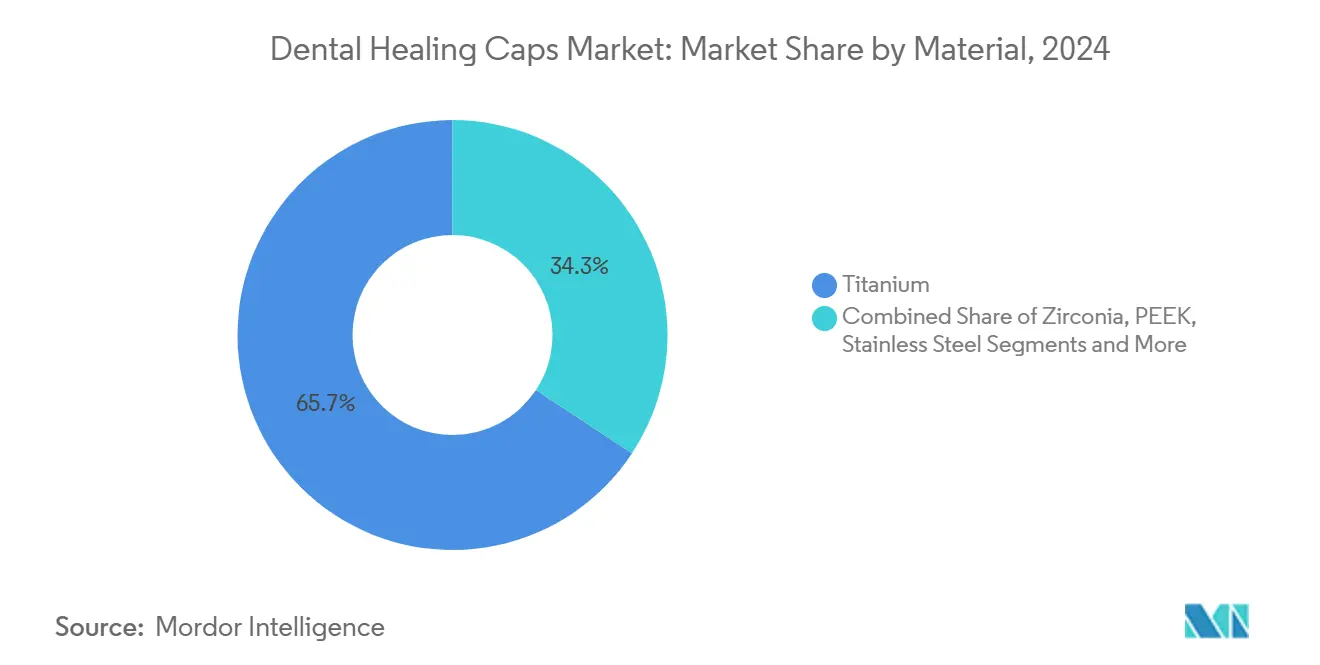
- By material, titanium accounted for a 65.8% share of the Dental healing caps market size in 2024, while PEEK is advancing at an 11.3% CAGR through 2030.
- By product type, standard healing abutments held 47.9% of the Dental healing caps market share in 2024; custom-milled caps are projected to expand at a 13.1% CAGR to 2030.
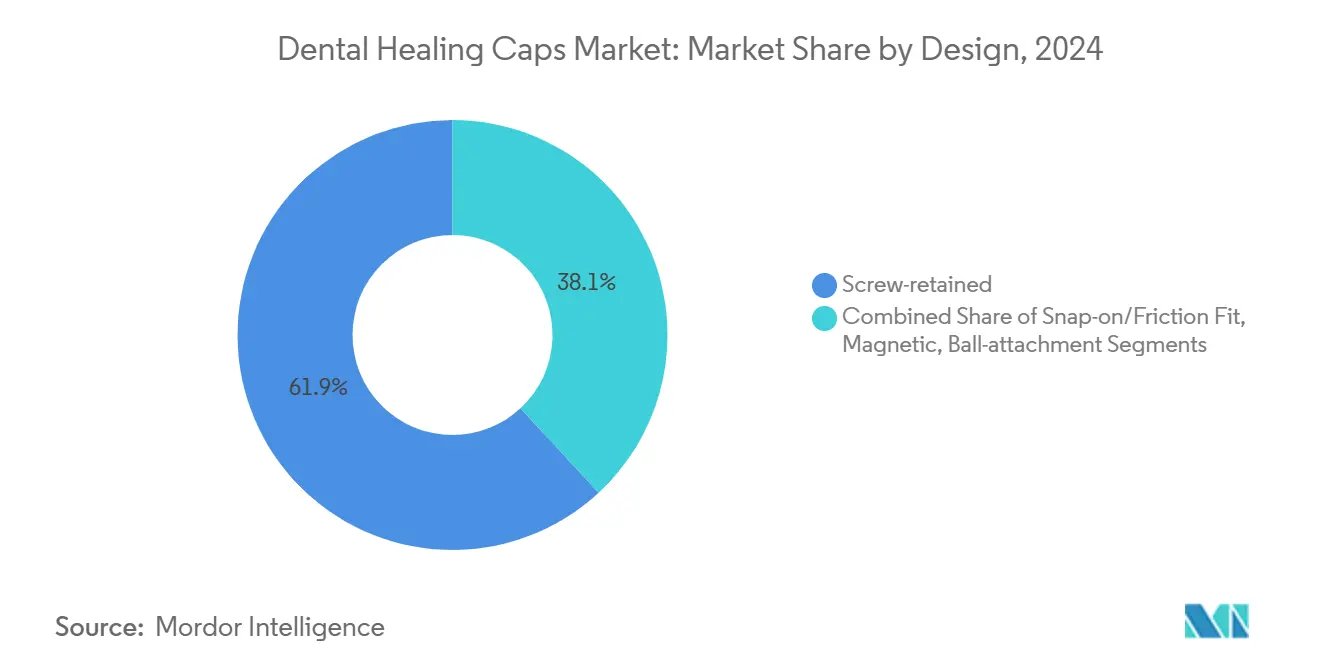
- By design, screw-retained options commanded 61.9% share of the Dental healing caps market size in 2024 and magnetic systems are growing at a 14.1% CAGR through 2030.
- By application, single-tooth implantology generated 48.8% revenue in 2024 whereas immediate loading cases are rising at an 11.8% CAGR to 2030.
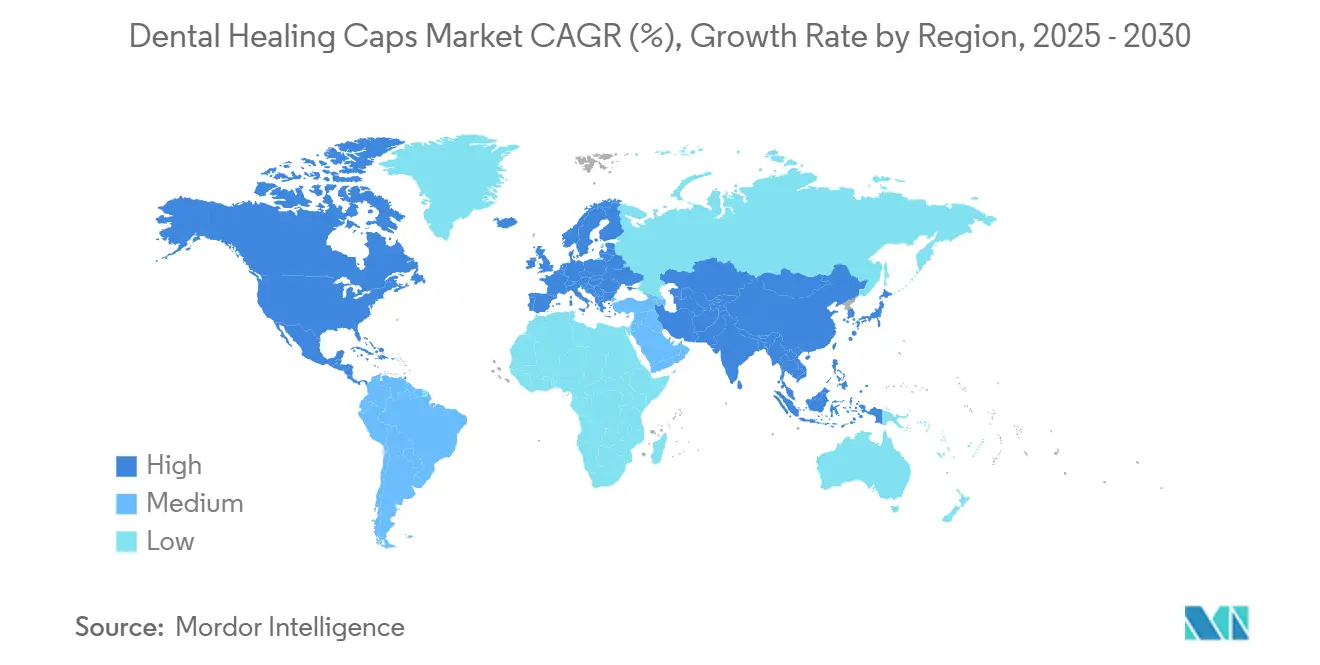
- By geography, Europe led with 35.2% of the Dental healing caps market share in 2024; Asia Pacific is recording the fastest 8.4% CAGR for 2025-2030.
Note: Market size and forecast figures in this report are generated using Mordor Intelligence’s proprietary estimation framework, updated with the latest available data and insights as of January 2026.
Market Trends and Insights
Drivers Impact Analysis of Dental Healing Caps Market*
| Driver | (~) % Impact on CAGR Forecast | Geographic Relevance | Impact Timeline |
|---|---|---|---|
| Titanium-based implants remain the clinical gold standard | +1.20% | Global, strongest in North America & Europe | Long term (≥ 4 years) |
| Accelerating replacement rate for single-tooth loss in 35-54 age group | +1.80% | Global, concentrated in developed markets | Medium term (2-4 years) |
| Insurer reimbursement expansion for implant-supported crowns | +0.90% | North America & Europe, selective APAC | Medium term (2-4 years) |
| Emerging preference for PEEK healing caps to curb peri-implantitis | +1.10% | Global, early adoption in Europe & North America | Long term (≥ 4 years) |
| In-office digital dentistry workflows cut chair time | +0.70% | Global, fastest uptake in developed markets | Short term (≤ 2 years) |
| AI-guided custom healing-cap design platforms | +0.30% | North America & Europe, expanding to APAC | Medium term (2-4 years) |
| Source: Mordor Intelligence | |||
Titanium-Based Implants Remain the Clinical “Gold Standard
Titanium enjoys near-universal acceptance because its surface chemistry supports rapid osseointegration and long-term mechanical reliability. Clinicians value the 98.2% survival rates documented for immediate loading, yet titanium’s gray shade can shine through thin gingiva in the esthetic zone. As patient expectations rise, practitioners increasingly evaluate zirconia and PEEK alternatives that remove discoloration risk. Interest in Korean esthetic dentistry shows how color considerations sway decision-making, with 70% of surveyed Japanese patients seeking metal-free solutions overseas. Although performance data keeps titanium entrenched, the shift toward whiter biomaterials signals a gradual erosion of its dominance.
Accelerating Replacement Rate for Single-Tooth Loss in 35–54 Age Group
Adults aged 35-54 increasingly treat single-tooth loss as preventive healthcare. Digital workflows enable full-arch rehabilitation in three appointments, aligning with this cohort’s time constraints.[1]Panos Papaspyridakos, “Complete Digital Workflow for Mandibular Full-Arch Implant Rehabilitation in 3 Appointments,” Journal of Prosthodontics, onlinelibrary.wiley.comImmediate placement shortens healing from 4-6 months to 48-72 hours, spurring demand for healing caps that guide tissue maturation under functional load. Higher disposable income and aesthetic awareness accelerate the adoption of custom CAP solutions that replicate natural emergence profiles. As early intervention becomes mainstream, healing cap utilization rises proportionally.
Insurer Reimbursement Expansion for Implant-Supported Crowns in Developed Countries
Medicare Advantage and private payers now cover 40-50% of implant costs, moving implants from elective to reimbursable therapy. New CDT codes D6080 and D6081 embed implant maintenance in standard care, stimulating procedure volume. Coverage caps that typically allow one implant per year intensify demand for efficient protocols where a single surgical event delivers durable results. Healing caps that minimize follow-up visits, therefore gain favor among dentists and insurers.
Emerging Preference for PEEK Healing Caps to Curb Peri-Implantitis
Modified PEEK resists biofilm accumulation and offers a bone-like elastic modulus that mitigates stress shielding.[2]Zhangyu Ma, “Biologically Modified Polyether Ether Ketone as Dental Implant Material,” Frontiers in Bioengineering and Biotechnology, fbioe.org Although the initial inflammatory response is stronger than that of titanium, surface sulfonation and antimicrobial loading accelerate soft-tissue adaptation. Radiolucency improves postoperative imaging, and natural color eliminates gray show-through in the esthetic zone. These properties shift practitioner focus from mechanical strength to biological harmony, fostering PEEK adoption in anterior indications.
Restraints Impact Analysis of Dental Healing Caps Market*
| Restraint | (~) % Impact on CAGR Forecast | Geographic Relevance | Impact Timeline |
|---|---|---|---|
| High failure risk in smokers & diabetics raising medico-legal costs | -1.40% | Global, highest impact in litigious markets | Medium term (2-4 years) |
| Price pressure from generic ISO-compatible healing caps in Asia | -0.80% | APAC core, spill-over to global markets | Short term (≤ 2 years) |
| Stringent MDR documentation slowing CE renewals | -0.60% | Europe with regulatory spillover | Medium term (2-4 years) |
| Limited torque tolerance for zirconia caps hindering adoption | -0.40% | Global, concentrated in esthetic applications | Long term (≥ 4 years) |
| Source: Mordor Intelligence | |||
High Failure Risk in Smokers & Diabetics Raising Medico-Legal Costs
Smokers consuming 20+ cigarettes daily face 2.45-fold higher implant failure, while bruxism raises odds 4.68 times. Diabetes adds metabolic complexity that mandates surface micro-modifications to achieve reliable osseointegration. Unsatisfactory outcomes in high-risk cohorts inflate malpractice premiums and spur defensive protocols. Clinicians respond by specifying premium healing cap materials and extended monitoring, yet these steps increase treatment cost without guarantee of full risk mitigation.
Price Pressure from Generic ISO-Compatible Healing Caps in Asia
Chinese and Korean manufacturers supply ISO-compatible caps at 40-60% lower prices than Western brands. Dental-tourism hubs bundle these components into competitively priced full-package treatments, shifting global procurement patterns. Premium suppliers must now justify price premiums by adding digital services, proprietary coatings, or AI-enabled design rather than relying on legacy brand equity.
*Our forecasts treat driver/restraint impacts as directional, not additive. The impact forecasts reflect baseline growth, mix effects, and variable interactions.
Dental Healing Caps Market Segment Analysis
By Material:
Momentum Shifts Toward High-Performance PolymersTitanium remains the volume leader based on its 65.8% 2024 share, but PEEK’s 11.3% CAGR underscores growing acceptance of polymer solutions that combine bone-mimetic elasticity with biofilm resistance. Zirconia fulfills esthetic demands, though torque constraints temper its utility in high-load sites. Stainless steel lingers only in provisional roles due to corrosion risks.
The Dental healing caps market is increasingly segmented along biological-compatibility lines. Customized PEEK caps achieve higher functional scores and reduce patient discomfort during crown placement.[3]Mario Beretta, “Peri-Implant Soft Tissue Conditioning by Means of Customized Healing Abutment,” Materials, mdpi.com Radiolucent imaging supports proactive peri-implant monitoring, helping clinicians intervene early if tissue inflammation emerges. These performance vectors together facilitate PEEK’s penetration in anterior and thin-gingiva indications.



By Product Type:
Customization Redefines Tissue ManagementStandard healing abutments still occupied 47.9% of revenue in 2024, yet custom-milled caps are setting the growth pace at 13.1% CAGR. Single-visit CAD/CAM milling makes individualized emergence profiles economical for routine cases.
Encode Emergence Abutments merge healing, scanning, and impression functions, reducing inventory and clinical steps. As digital literacy rises, dentists shift toward patient-specific designs that pre-shape peri-implant mucosa, cut soft-tissue sculpting time, and advance esthetic predictability. The Dental Healing Caps industry increasingly rewards suppliers offering frictionless digital design-to-manufacture pipelines.
By Design:
Magnetic Attachments Gain Traction in Esthetic ZonesScrew-retained designs delivered 61.9% share in 2024 thanks to familiarity and robust hold. However, magnetic systems exhibit a 14.1% CAGR, praised for eliminating torque risks and easing atraumatic retrieval.
Snap-on and friction-fit options find niches where screw-access is difficult, yet magnets excel in zirconia and immediate-load scenarios requiring multiple post-surgical interventions. Designers now optimize magnet strength to balance retention with ergonomic removal, creating differentiated value propositions that justify premium pricing within the Dental healing caps market.
By Application:
Immediate Loading Expands Clinical IndicationsSingle-tooth implants generated 48.8% of 2024 revenue, but immediate loading procedures are advancing at 11.8% CAGR by leveraging improved surface technologies and digital planning.
BLX and TLX implant platforms combine high primary stability with compatible healing caps that withstand functional load within 72 hours, enabling chair-time compression without aesthetic compromise. Full-arch and multi-unit cases increasingly utilize stackable guides that integrate implant placement and previsualization, magnifying demand for caps engineered to guide soft tissues under immediate occlusal forces.
Geography Analysis
Europe Dental Healing Caps Market
Europe’s established reimbursement policies and rigorous clinical protocols granted it a 35.2% share of the Dental healing caps market in 2024. Regional surgeons prioritize long-term outcome evidence, favoring titanium and premium customized solutions. Adoption of AI-guided chairside planning is accelerating, but MDR compliance costs threaten smaller suppliers, nudging clinicians toward established brands with robust post-market surveillance.
APAC Dental Healing Caps Market
Asia Pacific projects the fastest 8.4% CAGR through 2030, propelled by a burgeoning middle class, widespread smartphone usage, and competitive pricing from local manufacturers. Korean aesthetic clinics attract cross-border patients from Japan as well as Southeast Asia, bundling cost-efficient ISO-compatible healing caps into package deals. Local producers exploit scale to flood global distributors with inexpensive components, exerting deflationary pressure on list prices worldwide.
North America, LATAM and MEA Dental Healing Caps Market
North America benefits from insurer uptake of implant coverage and widespread digital dentistry infrastructure. Immediate loading protocols resonate with productivity-minded patients, lifting per-capita demand. Latin American and Middle East & Africa markets remain cost sensitive yet exhibit growing interest in digital workflows for multi-unit restorations. Vendors targeting these regions succeed by balancing robust performance claims with value-oriented price points.

Competitive Landscape
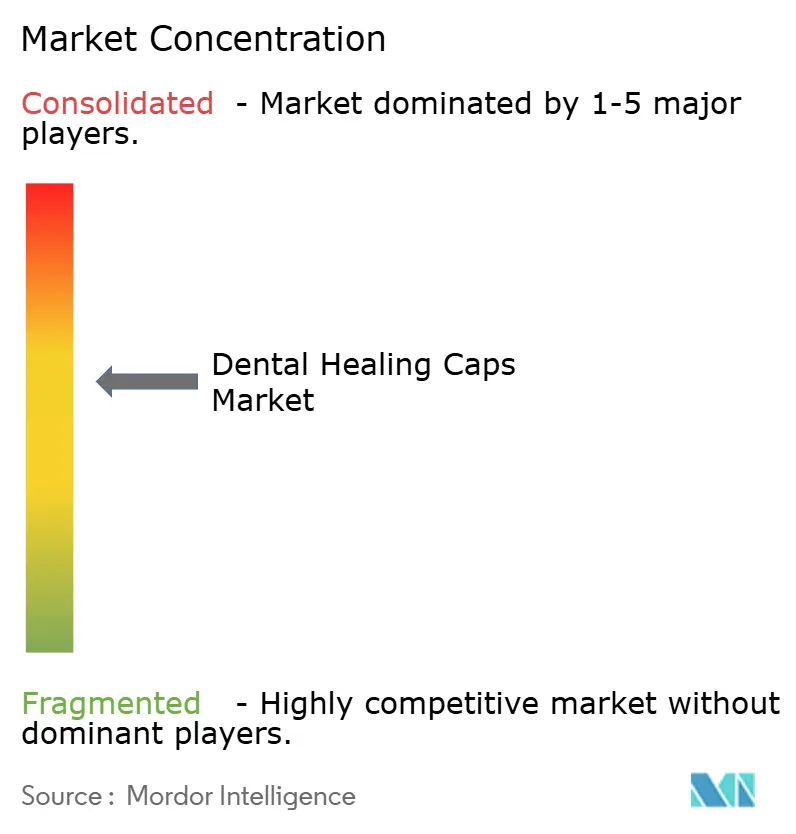
The Dental healing caps market demonstrates moderate fragmentation. Straumann, Nobel Biocare, and Dentsply Sirona sustain leadership via proprietary surfaces, vertically integrated digital ecosystems, and continuous clinical validation. Zimmer Biomet and BioHorizons emphasize training and broad platform compatibility to capture mid-tier practitioners. Chinese and Korean entrants utilize ISO standards and low labor costs to undercut premium pricing by up to 60%.
Strategic alliances increasingly link AI start-ups with implant majors. VideaHealth’s diagnostic AI now feeds design parameters directly into vVARDIS’ preventive workflows, illustrating convergence across diagnostic, preventive, and restorative silos. Established players react by embedding machine-learning modules into proprietary CAD platforms to defend ecosystem stickiness.
Portfolio breadth, digital integration, and material science expertise form the competitive triad. Companies excelling at all three dimensions capture wallet share even in price-sensitive regions, while single-focus manufacturers risk marginalization. The anticipated wave of consolidation will likely revolve around digital-first firms acquiring specialized material innovators to deliver all-in-one chairside solutions.
Dental Healing Caps Industry Leaders
Institut Straumann AG
Envista (Nobel Biocare)
Dentsply Sirona
Zimmer Biomet (ZimVie)
BioHorizons (Henry Schein)
- *Disclaimer: Major Players sorted in no particular order
Dental Healing Caps Market Companies Covered in this Report
- Straumann Group
- Envista Holdings (Nobel Biocare)
- Dentsply Sirona
- Zimmer Biomet (ZimVie)
- BioHorizons (Henry Schein)
- Osstem Implant
- GC Corporation
- MIS Implants (Dentsply)
- Megagen Implant
- Dentium Co., Ltd.
- Bicon
- Keystone Dental
- Neoss Ltd.
- Thommen Medical
- Southern Implants
- B&B Dental Srl
- Sweden & Martina
- BEGO Bremer Goldschlägerei.
- Bio-Implant
- BlueSkyBio

Recent Industry Developments in Dental Healing Caps Market
- April 2025: Straumann published a maxillary molar case study using TLX implants with immediate previsualization, confirming 5-year success for single-tooth immediate loading.
- February 2025: VideaHealth partnered with vVARDIS to embed AI-based preventive dentistry in cap design workflows
- October 2024: ZimVie’s Encode 3-in-1 abutments gained multi-unit adoption by trimming patient visits.


Global Dental Healing Caps Market Report Scope
| Titanium |
| Zirconia |
| PEEK |
| Stainless Steel |
| Others (Resin, Polymer Blends) |
| Standard Healing Abutments |
| Wide-platform Healing Abutments |
| Narrow-platform Healing Abutments |
| Angulated / Multi-unit Caps |
| Custom Milled Caps |
| Screw-retained |
| Snap-on / Friction Fit |
| Magnetic |
| Ball-attachment |
| Other Designs |
| Single-tooth Implantology |
| Multi-unit / Bridge Procedures |
| Full-arch Restorations |
| Immediate Loading Cases |
| Pediatric & Special-need Dentistry |
| North America | United States |
| Canada | |
| Mexico | |
| Europe | Germany |
| United Kingdom | |
| France | |
| Italy | |
| Spain | |
| Rest of Europe | |
| APAC | China |
| Japan | |
| India | |
| South Korea | |
| Australia | |
| Rest of APAC | |
| Middle East & Africa | GCC |
| South Africa | |
| Rest of Middle East & Africa | |
| South America | Brazil |
| Argentina | |
| Rest of South America |
| By Material | Titanium | |
| Zirconia | ||
| PEEK | ||
| Stainless Steel | ||
| Others (Resin, Polymer Blends) | ||
| By Product Type | Standard Healing Abutments | |
| Wide-platform Healing Abutments | ||
| Narrow-platform Healing Abutments | ||
| Angulated / Multi-unit Caps | ||
| Custom Milled Caps | ||
| By Design | Screw-retained | |
| Snap-on / Friction Fit | ||
| Magnetic | ||
| Ball-attachment | ||
| Other Designs | ||
| By Application | Single-tooth Implantology | |
| Multi-unit / Bridge Procedures | ||
| Full-arch Restorations | ||
| Immediate Loading Cases | ||
| Pediatric & Special-need Dentistry | ||
| By Geography | North America | United States |
| Canada | ||
| Mexico | ||
| Europe | Germany | |
| United Kingdom | ||
| France | ||
| Italy | ||
| Spain | ||
| Rest of Europe | ||
| APAC | China | |
| Japan | ||
| India | ||
| South Korea | ||
| Australia | ||
| Rest of APAC | ||
| Middle East & Africa | GCC | |
| South Africa | ||
| Rest of Middle East & Africa | ||
| South America | Brazil | |
| Argentina | ||
| Rest of South America | ||


Key Questions Answered in the Report
What is the projected global value of the Dental healing caps market in 2030?
Global revenue is expected to reach USD 4.22 billion by 2030, supported by a 6.1% CAGR between 2025 and 2030.
Which material segment is growing fastest for healing caps?
PEEK is expanding at an 11.3% CAGR thanks to biofilm resistance, bone-mimetic elasticity, and esthetic neutrality.
How are custom-milled healing caps influencing treatment workflows?
CAD/CAM custom caps pre-shape peri-implant soft tissue, cut chair visits, and are advancing at a 13.1% CAGR.
Why are magnetic attachment systems attracting attention?
They prevent torque-induced zirconia fractures and simplify atraumatic cap retrieval, growing at a 14.1% CAGR.
Which region represents the fastest growth opportunity?
Asia Pacific leads with an 8.4% CAGR driven by dental tourism and cost-competitive local manufacturing.
How does insurer reimbursement affect demand?
New CDT codes and broader coverage shift implants from elective to reimbursable care, increasing procedure volume and healing cap utilization.
Page last updated on:





