
Dental Crowns And Bridges Market Size and Share
Market Overview
| Study Period | 2020 - 2031 |
|---|---|
| Market Size (2026) | USD 4.56 Billion |
| Market Size (2031) | USD 6.75 Billion |
| Growth Rate (2026 - 2031) | 8.14 % |
| Fastest Growing Market | Asia-Pacific |
| Largest Market | North America |
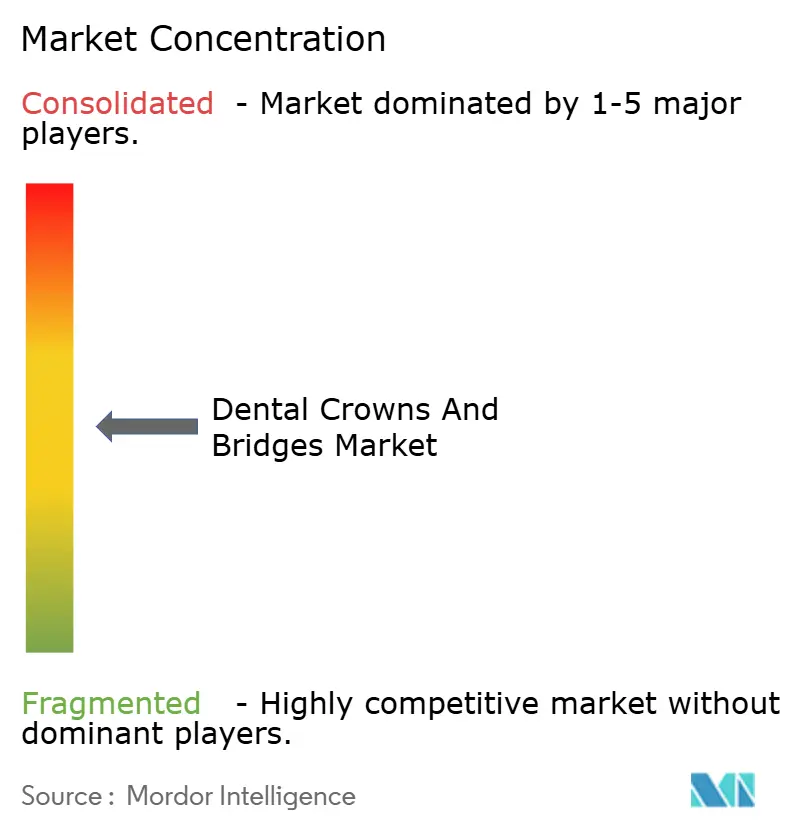
| Market Concentration | Medium |
Major Players *Disclaimer: Major Players sorted in no particular order Image © Mordor Intelligence. Reuse requires attribution under CC BY 4.0. | |
Dental Crowns And Bridges Market Analysis by Mordor Intelligence
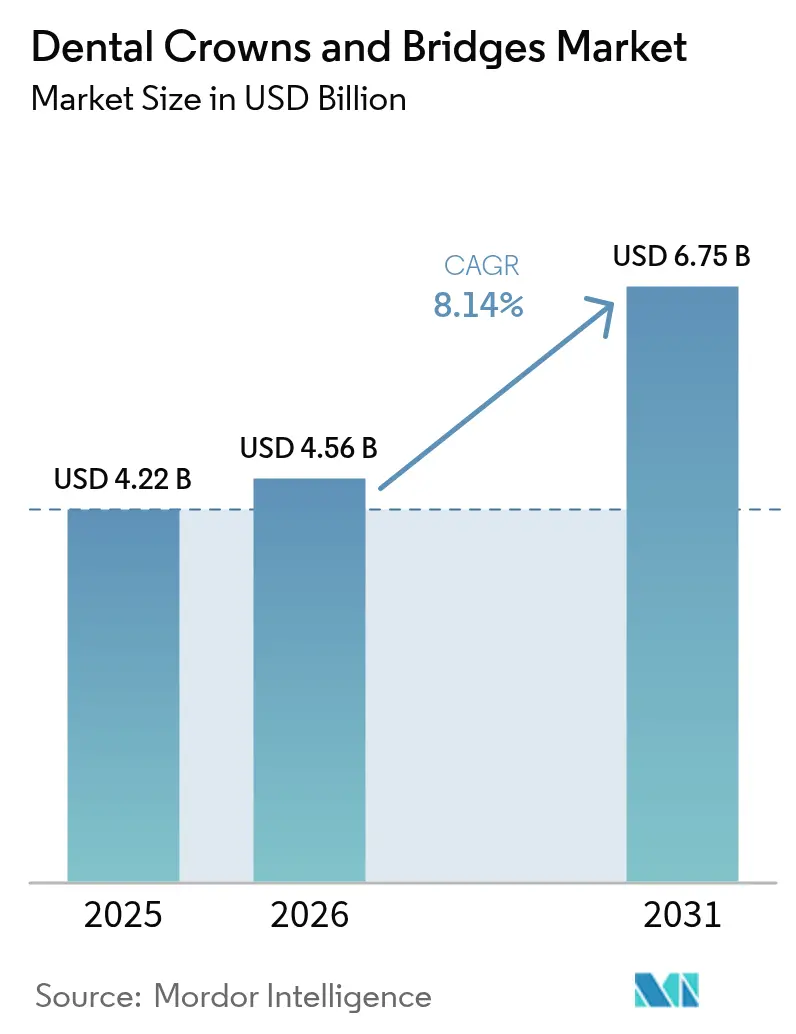
The dental crowns and bridges market size was valued at USD 4.22 billion in 2025 and estimated to grow from USD 4.56 billion in 2026 to reach USD 6.75 billion by 2031, at a CAGR of 8.14% during the forecast period (2026-2031). An aging global population, a steady rise in edentulism, and continuing advances in chair-side digital workflows keep demand on an upward track. Zirconia restorations dominate current case volumes, while lithium-disilicate and multilayer ceramics push the aesthetic frontier. CAD/CAM production reduces laboratory bottlenecks and supports same-day treatment models that shorten chair time. Growing dental‐tourism corridors in Asia and Latin America add price flexibility, yet reimbursement gaps in many markets still restrain household uptake. Competitive intensity remains moderate as global implant and materials suppliers scale regional manufacturing to cut freight risk and shorten lead times.
Key Report Takeaways
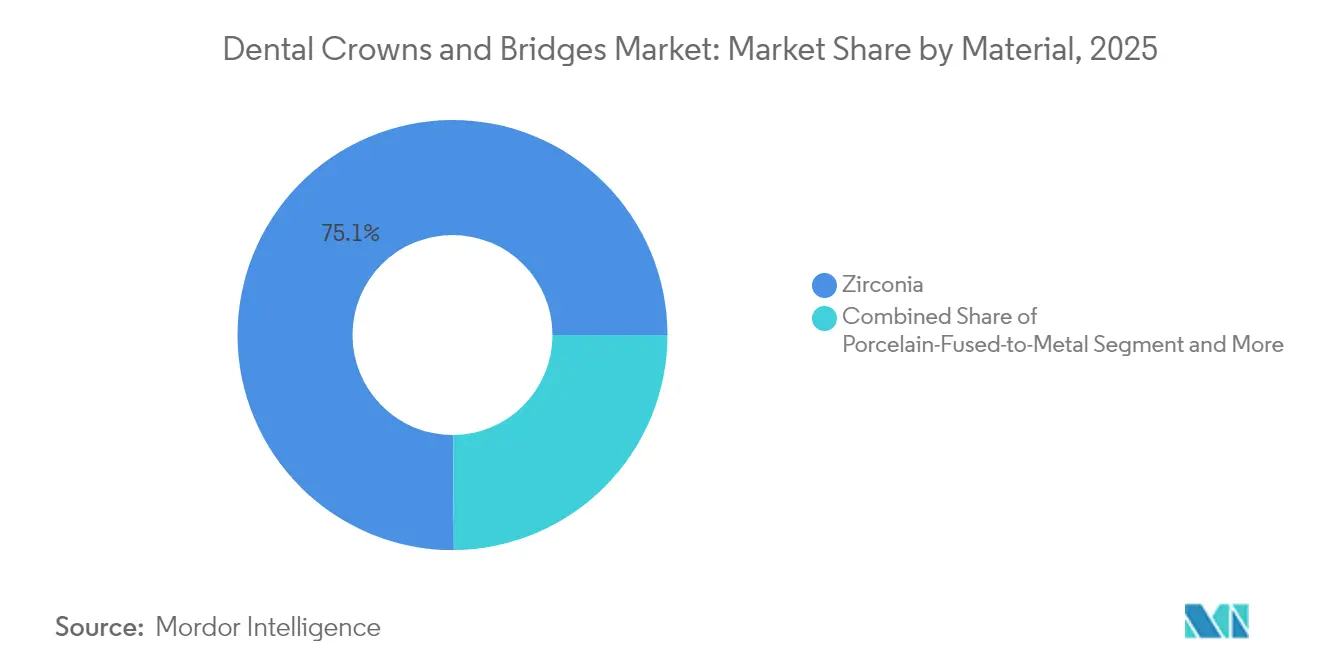
- By material, zirconia captured 75.10% of dental crowns and bridges market share in 2025; all-ceramic materials are forecast to expand at an 11.02% CAGR to 2031.
- By product, crowns led with 65.00% revenue share in 2025, while bridges are projected to advance at a 9.04% CAGR through 2031.
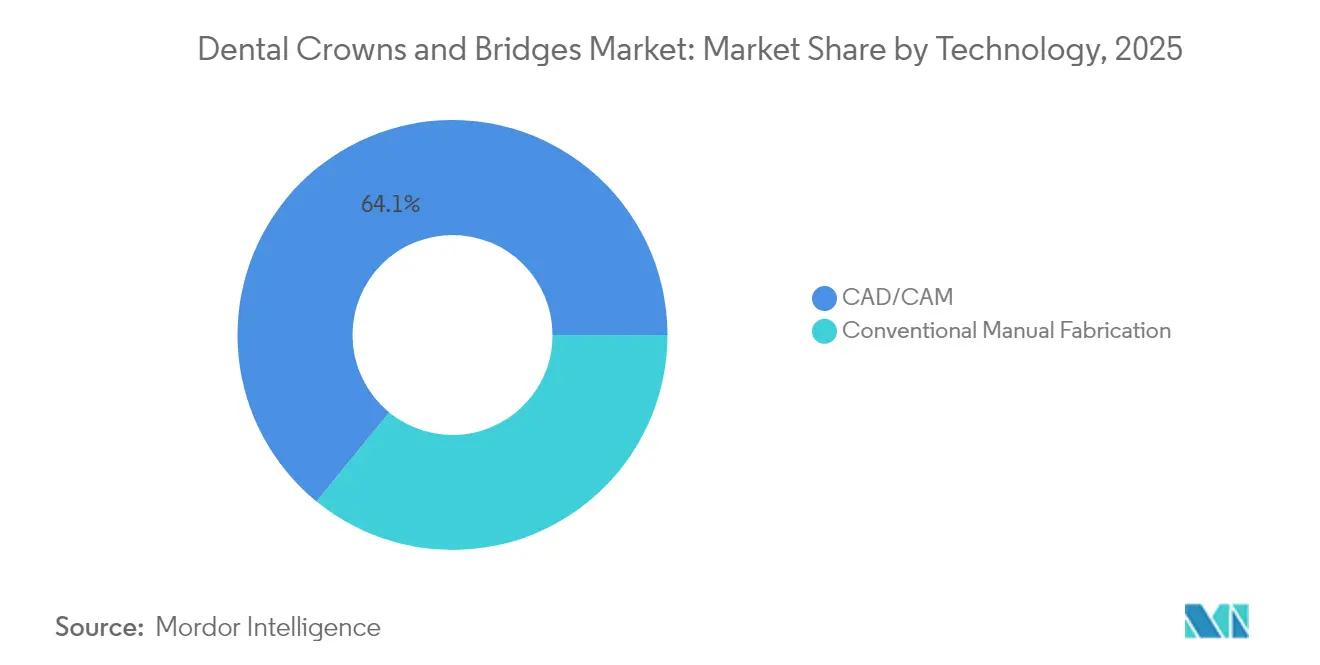
- By technology, CAD/CAM systems held 64.10% share of the dental crowns and bridges market size in 2025 and are set to grow at a 9.98% CAGR over the forecast period.
- By end user, dental clinics controlled 57.20% share in 2025; laboratories record the highest projected CAGR at 9.08% to 2031.
- By geography, North America accounted for 38.40% of dental crowns and bridges market share in 2025, whereas Asia-Pacific is expected to clock a 9.39% CAGR to 2031.
Note: Market size and forecast figures in this report are generated using Mordor Intelligence’s proprietary estimation framework, updated with the latest available data and insights as of 2026.
Market Trends and Insights
Drivers Impact Analysis of Dental Crowns And Bridges Market*
| Driver | (~) % Impact on CAGR Forecast | Geographic Relevance | Impact Timeline |
|---|---|---|---|
| Edentulism and tooth-decay prevalence | +2.1% | North America, Europe, global ageing clusters | Long term (≥ 4 years) |
| CAD/CAM and 3-D printing adoption | +1.8% | North America, Asia-Pacific | Medium term (2–4 years) |
| Aesthetic demand for cosmetic dentistry | +1.5% | Developed markets | Short term (≤ 2 years) |
| Shift to full-arch zirconia | +1.2% | North America, Europe, emerging Asia | Medium term (2–4 years) |
| Chair-side milling in tourism hubs | +0.9% | Asia-Pacific, Latin America | Medium term (2–4 years) |
| AI-enabled intra-oral scanning | +0.8% | Developed markets, global rollout | Long term (≥ 4 years) |
| Source: Mordor Intelligence | |||
Prevalence of Edentulism & Tooth Decay in Ageing Populations
Longer life expectancy raises the volume of partial and full tooth loss, especially among lower-income seniors. Untreated caries rates approach 99% in specific older cohorts, while edentulism spans from 4.9% in the United States to 21.7% in select Canadian communities[1]Rakhee Patel, “Healthy Ageing and Oral Health: Priority, Policy and Public Health,” Nature, nature.com. Predictable replacement cycles for aging restorations add recurrent revenue on top of first-time treatments. A widening rural-urban divide in oral health fuels demand for value-engineered crown systems and community outreach programs. Public-health agencies increasingly link oral function to overall healthy-aging objectives, strengthening policy support for restorative interventions.
Accelerating CAD/CAM & 3-D Printing Adoption in Laboratories
Laboratory digitization cuts turnaround times and reduces remakes because digital files eliminate many manual variables. AI-assisted design software automates connector sizing and margin placement, letting technicians focus on complex custom work. Improved sintering ovens and hybrid milling-printing setups bring single-visit prosthetics into mainstream practice, easing inventory constraints and sharpening competitive differentiation. Investment outlays for scanners and five-axis mills remain high, yet volume growth improves payback periods and justifies further capital expenditure. Regional dental-tech clusters, such as those emerging in Shenzhen and Bengaluru, help laboratories access skilled staff and equipment service networks.
Rising Aesthetic Demand for Cosmetic Dentistry
Video conferencing platforms heightened self-perception of dental esthetics, nudging patients toward ceramic restorations that mimic natural translucency. Digital-smile-design software frames treatment expectations with predictive mock-ups, increasing case acceptance rates and opening premium pricing tiers. Lithium-disilicate veneers and mono-lithic zirconia crowns meet color-matching standards demanded by high-income demographics. Practices market “micro-esthetic” corrections, including line-angle recontouring, to younger cohorts, broadening the addressable base for all-ceramic crown units. As procedures remain largely elective, instalment financing and loyalty subscription plans gain traction in urban clinics.
Shift to Full-Arch Zirconia Driving Laboratory Throughput
Full-arch zirconia prostheses show 92.86% prosthetic success and 95.35% implant success over mid-term follow-up, with 78.57% patient satisfaction[2]Vincenzo Marchio, “Retrospective Analysis of Full-Arch Zirconia Rehabilitations on Dental Implants,” Applied Sciences, mdpi.com. Laboratories benefit from higher revenue per case and better equipment utilization when processing multi-unit frameworks. Implant manufacturers bundle prosthetic components, deepening vertical integration around digital-surgery guides and restorative solutions. Training courses on screw-retained full-arch protocols expand as clinicians target faster loading schedules. Lower chipping rates of multilayer zirconia reduce maintenance claims, strengthening clinical confidence in long-span work.
Restraints Impact Analysis of Dental Crowns And Bridges Market*
| Restraint | (~) % Impact on CAGR Forecast | Geographic Relevance | Impact Timeline |
|---|---|---|---|
| High procedure cost and weak reimbursement | -1.4% | Emerging markets, selected high-income segments | Short term (≤ 2 years) |
| Limited clinician awareness in emerging zones | -0.8% | Asia-Pacific, Latin America, Middle East-Africa | Medium term (2–4 years) |
| Stricter disposal rules on metallic waste | -0.6% | Europe, North America | Long term (≥ 4 years) |
| Zirconia-powder supply volatility | -0.7% | Global | Short term (≤ 2 years) |
| Source: Mordor Intelligence | |||
High Procedure Cost & Weak Reimbursement
Even in mature economies, private dental insurance pays about 50% of a medically necessary crown while cosmetic indications usually get no support[3]Delta Dental Plans Association, “2024 State of America’s Oral Health Report,” deltadental.com. The out-of-pocket hurdle pushes middle-income patients toward overseas clinics that price single crowns at USD 560 versus USD 1,729 in the United States, according to cross-border-care data. Domestic providers respond with savings plans and bundled implant-crown packages, yet price sensitivity remains acute in the younger workforce. Government schemes focus on emergency extractions rather than restorative work, slowing public-sector demand growth.
Zirconia-Powder Supply Volatility & Price Spikes
Dental-grade zirconia powder production sits with a limited set of processors that rely on energy-intensive sintering steps. Deviations in firing temperature alter translucency by measurable Delta E values, making quality control strict. Spot shortages during energy-price surges lifted global zirconia prices and squeezed laboratory gross margins. Larger suppliers hedge through multi-year contracts, but small labs carry higher inventory costs in response to supply swings. Alternative high-translucency alumina and resin hybrid materials enter catalogues, yet clinical adoption remains cautious.
*Our forecasts treat driver/restraint impacts as directional, not additive. The impact forecasts reflect baseline growth, mix effects, and variable interactions.
Dental Crowns And Bridges Market Segment Analysis
By Material:
Zirconia Dominance Drives Premium PositioningZirconia held 75.10% of dental crowns and bridges market share in 2025 due to its fracture toughness and shade adaptability. All-ceramic systems post the fastest 11.02% CAGR because lithium-disilicate ingots achieve enamel-like translucency in anterior zones. The dental crowns and bridges market depends on multilayer blocks that mimic dentine-to-enamel gradients, allowing laboratories to reduce staining steps and improve workflow efficiency. PFMs still serve cost-sensitive cases where insurers reimburse metal alloys more readily. Metal-free options, however, continue to cannibalize PFM demand as unit prices fall with milling-center scale economies.
Patient-specific choices override one-size solutions; 98% of dentists prefer zirconia in posterior crowns versus 61% in anteriors. High-translucency variants entering the pipeline blur the anterior-posterior divide and could lift zirconia’s penetration even further. Research into doped-zirconia stabilizers promises color stability without strength loss, catering to premium bridgework. Regulatory agencies emphasize material traceability, encouraging suppliers to invest in QR-coded batch tracking. Such safeguards build practitioner confidence and sustain the dental crowns and bridges market trajectory across developed and emerging economies.



By Product:
Crown Leadership Faces Bridge AccelerationCrowns led revenue with a 65.00% share in 2025, supported by broad indications from single-tooth fractures to root-canal restorations. The dental crowns and bridges market size for crowns segment is forecast to grow alongside rising molar endodontic therapy volumes. Bridges, however, show a faster 9.04% CAGR as implant-supported full-arch frameworks spread beyond specialist centers. Fixed-bridge prevalence reaches 17% among adults aged 75+, presenting an aging-related replacement cycle.
Income bands shape product mix. Higher-income households report 38% crown prevalence compared with 28% in lower-income tiers. This gap fuels innovation in value-engineered composite bridges designed for public clinic budgets. Hybrid screw-retained solutions combine the hygiene benefits of individual crowns with the stability of fixed bridges, improving periodontal outcomes. Such advances support sustained expansion of the broader dental crowns and bridges market through improved clinician confidence and patient satisfaction scores.
By Technology:
CAD/CAM Transformation AcceleratesCAD/CAM systems accounted for 64.10% of total placements in 2025 and are advancing at 9.98% CAGR as intra-oral scanners replace conventional impressions. Practices with dual milling units recorded up to 145% productivity gains, shortening delivery time to a single session for simple posterior crowns. AI-driven margin detection improves fit and reduces adjustment appointments, enhancing chair utilization. Manual techniques remain relevant for highly customized veneering and combination cases but are gradually confined to boutique laboratories.
Digital adoption improves consistency and creates cloud-based file libraries that simplify long-term maintenance. Secondary restorations need only updated scans, cutting diagnostic steps and reinforcing patient loyalty. Materials science aligns with software progress as multi-physics simulation informs connector design for long-span bridges. The wider dental crowns and bridges market benefits from standardization that lowers remakes, builds patient trust, and boosts case volumes per clinic.
By End User:
Clinic Consolidation Meets Laboratory SpecializationDental clinics captured 57.20% revenue in 2025 owing to direct patient relationships and expanding DSO networks that optimize procurement. The dental crowns and bridges market size for laboratories is on track for strong 9.08% CAGR because complex zirconia bridge frameworks and high-volume print jobs suit centralized production. Hospitals contribute low but steady restorative demand linked to trauma and oncology reconstruction.
Laboratories evolve toward digital “super-centers” offering AI design, implant planning, and fully sintered zirconia delivery within 48 hours. Chair-side mills compete for single units, yet laboratories retain full-arch dominance by bundling prosthesis design with implant surgical guides. As DSOs grow, preferred-laboratory agreements stabilize throughput and anchor investment in advanced five-axis machinery. This interdependence anchors the growth of the dental crowns and bridges market while helping both parties spread capital costs.
Geography Analysis
North America Dental Crowns and Bridges Market
North America remained the largest regional contributor with 38.40% share in 2025. High insurance penetration and established laboratory–practice integration support premium zirconia workflow adoption. Same-day dentistry is quickly moving from differentiator to baseline service, sustaining unit growth. Policy debate on Medicare dental benefits could unlock additional volumes but timing remains uncertain.
Europe Dental Crowns and Bridges Market
Europe presents balanced expansion as universal healthcare amplifies functional restorations across aging populations. Environmental regulations accelerate the shift from PFM to metal-free ceramics, incentivizing laboratories to pivot portfolios toward zirconia. Pan-European recall guidelines recommend crown replacement at defined wear thresholds, stabilizing refurbishment demand and cushioning cyclical downturns.
APAC Dental Crowns and Bridges Market
Asia-Pacific is the fastest-growing cluster at 9.39% CAGR, driven by rising middle-class disposable income and the draw of dental-tourism hubs offering up to 40% cost savings to international patients. The dental crowns and bridges market benefits from China’s implant resurgence and Vietnam’s emergence as an English-friendly treatment center. Government investments in public–private dental college tie-ups improve clinician availability and speed technology diffusion. Currency depreciation in Indonesia and Thailand further supports inbound patient flows seeking value treatments.
South America and MEA Dental Crowns and Bridges Market
South America experiences uneven progress; Brazil’s public-sector programs focus on preventive measures whereas private clinics capture affluent demand for zirconia crowns. The dental crowns and bridges market in the region still faces supply volatility and training gaps that elevate prosthesis-remake rates in smaller centers. Middle East and Africa are nascent but promising. Gulf Cooperation Council states host state-of-the-art clinics targeting medical tourists, while Northern Africa promotes French-language care for European travelers. Local material distribution networks mature, lowering lead times for custom abutments and multi-layer blocks. Continued investment in hygienist education will be essential to unlock full market potential across the region.


Competitive Landscape
Global suppliers of implants, milling machinery, and CAD software set the competitive tempo. Straumann Group reported 11.2% organic growth in Q3 2024, supported by expanded digital offerings and strong Chinese implant demand. Focused acquisitions integrate intra-oral scanner lines and AI-planning tools into comprehensive chair-side ecosystems. Ivoclar combines zirconia discs with proprietary furnaces to ensure material–equipment synergy, raising switching costs for laboratories.
Mid-sized regional players differentiate on service responsiveness and localized training. German and Japanese milling-center networks provide overnight crown delivery to metropolitan clinics, balancing quality with quick turnaround. North American DSOs negotiate bulk-buy contracts that favor suppliers able to guarantee consistent lot quality and timely replenishment.
Emerging entrants foreground software innovation rather than traditional manufacturing. Cloud-based design platforms leverage machine learning to automate anatomic contouring. Subscription models lower entry barriers for small laboratories, distributing R&D costs across user bases. Sustainable-material research adds another vector of differentiation as laboratories in Scandinavia and Canada adopt recycling loops for leftover zirconia discs.
Dental Crowns And Bridges Industry Leaders
Dentsply Sirona
ZimVie Inc.
Ivoclar Vivadent
Solventum Corporation
Envista (Nobel Biocare)
- *Disclaimer: Major Players sorted in no particular order
Dental Crowns And Bridges Market Companies Covered in this Report
- Dentsply Sirona
- Solventum Corporation
- Straumann Group
- Envista (Nobel Biocare)
- ZimVie
- Ivoclar Vivadent
- Henry Schein
- Patterson Companies
- Ultradent Products
- CAMLOG Biotechnologies
- Avinent Implant System
- Bicon
- Glidewell Dental
- Osstem Implant
- Coltene Holding
- Planmeca
- Kuraray Noritake Dental
- GC Corporation
- Shofu Inc.

Market Opportunities and Future Outlook
Chairside fabrication is moving beyond provisional restorations into permanent ceramics, which creates room for more single-visit crowns and shorter-turnaround bridges in clinics that traditionally depended on external laboratories. In 2026, SprintRay received US FDA clearance to 3D print porcelain crowns, and SHINING 3D Dental introduced the Ceramix-Nano chairside printer with an integrated print-to-cure workflow. These developments reinforce in-office permanent restoration pathways that combine intra-oral scanning with AI-assisted design, and they broaden the addressable base for CAD/CAM-driven placements, currently 64.10% of total restorations in 2025, by reducing cycle time and widening eligible materials and indications.
Laboratory and milling-center opportunities remain tied to faster zirconia processing and local supply strategies that help labs manage throughput and lead times. In 2026, Ivoclar launched IPS e.max Zirconia with reduced sintering times for up to three-unit bridges, while Glidewell expanded next-day service to include BruxZir Esthetic crowns and bridges, maintaining competitive pressure around speed and consistency for high-volume zirconia cases, which account for 75.10% market share in 2025. On the supply side, Henry Schein (Zahn Dental) launched multi-layer zirconia discs for laboratory workflows, supporting regional sourcing and batch consistency as smaller labs handle zirconia input volatility and price swings.
Recent Industry Developments in Dental Crowns And Bridges Market
- May 2026: Ivoclar launched IPS e.max Zirconia, extending its all-ceramic offering across indications from veneers to wide-span bridges. The company positioned the product around shade accuracy and workflow efficiency, supporting broader substitution toward metal-free restorations and helping laboratories standardize materials for high-volume CAD/CAM production.
- April 2025: ZimVie announced the US launch of its Immediate Molar Implant System, designed to streamline extraction and support wide-diameter implants for molar restoration. The system strengthens the implant-to-prosthetic pathway, which can raise downstream demand for implant-supported crowns and multi-unit bridges configured for posterior load conditions.
- July 2024: ZimVie announced FDA 510(k) clearance and the US launch of its GenTek restorative components portfolio, including Ti-Bases, pre-milled abutment blanks, and scan bodies for CAD/CAM restorations. Open, compatible restorative components improve digital case acceptance and reduce friction for laboratories and clinics integrating scan-to-design workflows for crowns and bridges.


Dental Crowns And Bridges Market Report Scope and Research Methodology
Market Definition and Coverage
This market covers the value of fixed dental restorations where crowns restore damaged teeth and bridges replace missing teeth, including products and related lab or chairside fabrication used to deliver the final restoration.
Scope exclusions: We exclude removable dentures and partials, temporary veneers, inlays and onlays, and orthodontic aligners.
Segments Covered in This Report
- By Material
- Zirconia
- Porcelain-Fused-to-Metal (PFM)
- All-Ceramic (Lithium-disilicate, Feldspathic)
- Metals & Alloys (Gold, Titanium, Co-Cr)
- Others (Resin, Hybrid, Composite)
- By Product
- Crowns
- Bridges (3-unit, 4-unit, Maryland, Cantilever)
- By Technology
- CAD/CAM
- Conventional Manual Fabrication
- By End User
- Dental Clinics & Chains
- Hospitals
- Dental Laboratories
- Geography
- North America
- United States
- Canada
- Mexico
- Europe
- Germany
- United Kingdom
- France
- Italy
- Spain
- Rest of Europe
- Asia-Pacific
- China
- Japan
- India
- South Korea
- Australia
- Rest of Asia-Pacific
- Middle East and Africa
- GCC
- South Africa
- Rest of Middle East and Africa
- South America
- Brazil
- Argentina
- Rest of South America
- North America
Data Sources, Market Sizing, and Validation
Desk Research
Desk work starts with building the procedure and spend context that supports crowns and bridges demand in each major geography. We refer to public oral health surveillance and treatment patterns from sources such as the World Health Organization, the US CDC Oral Health program, and national health ministries that publish dental utilization and disease prevalence.
To ground the supply side, we review trade and production signals using sources such as UN Comtrade, national customs dashboards, and medical device regulator databases (such as US FDA listings and the European public device registration information where available). We also use peer reviewed dentistry journals to understand material shifts (zirconia and ceramics versus metal based options), digital dentistry adoption, and typical replacement cycles that influence volumes. Company filings, investor presentations, and reputable dental association publications are used to sanity check ASP direction and channel mix, and a paid subscription for company financials and patent databases is used selectively to confirm product focus and innovation cadence. The sources mentioned above are illustrative and not exhaustive, and we also refer to other public references for data collection, validation, and clarification.
Primary Interviews and Surveys
Primary work is used to pressure test the model assumptions that do not show up cleanly in public datasets, especially pricing behavior and mix shift by material and fabrication workflow. We speak with a spread of stakeholders such as dental labs, dental clinics, distributors, and industry experts across APAC, EMEA, and the Americas so the demand pool, utilization trends, and ASP steps can be reconciled before final sign off.
Distribution of primary research fieldwork respondents
| Company type | Respondent position | Region |
|---|---|---|
| Top tier: 35% | CXOs: 12% | APAC: 43% |
| Mid tier: 51% | Functional/Unit leaders: 41% | EMEA: 34% |
| Smaller Players: 14% | Managers: 47% | Americas: 23% |
Market-Sizing & Forecasting
The core model is built from a top-down demand pool, where oral disease prevalence, dental visit rates, and restoration procedure rates are used to reconstruct the likely annual volume of crowns and bridges, which is then converted into value using ASPs by material and workflow. Once the total is formed, it is checked with selective bottom-up approximations such as sampled lab throughput by geography, channel discussions on unit volumes, and a simple ASP times volume roll up for key patient cohorts.
A few practical inputs that matter in this market are tracked carefully, including the share shift toward zirconia and full ceramic restorations, chairside CAD/CAM penetration versus lab fabrication, typical number of units per bridge case, replacement and redo rates, and reimbursement or out-of-pocket mix that changes realized pricing. Where bottom-up signals are incomplete (for example, small labs with limited disclosure), we fill gaps using ratio based expansion from interviewed sample coverage, followed by a recheck against procedure totals so the model does not over count.
For forecasting, we use scenario analysis supported by variable level expectations from practitioners, then build yearly paths for procedure growth, digital workflow adoption, and material mix, and finally apply a measured ASP progression curve by region. The forecast is kept consistent with realistic constraints such as dentist capacity, lab turnaround capability, and expected affordability in each region, and then the growth path is revisited until it matches on-the-ground feedback.
Data Validation & Update Cycle
Validation is handled through repeated variance checks across three angles, which are procedure volumes, material and workflow mix, and resulting ASP outcomes by region. When a region shows an unusual jump, we re-check the underlying drivers, re-read the supporting secondary sources, and then re-contact domain respondents if the gap cannot be explained by policy, pricing, or mix changes.
Before numbers are finalized, outputs are compared with independent signals such as dental utilization trends, device and material trade movement, and disclosed category commentary from leading industry participants, and then reviewed internally in multiple steps. Reports are refreshed annually, with interim updates when a material event changes pricing, utilization, or currency translation materially. Right before delivery, a final pass is done so clients receive the most current view available at that time.
Mordor Intelligence's Dental Crowns and Bridges Market Estimate Compared With Other Published Estimates
Published market sizes for dental crowns and bridges can look far apart because the counted basket is not always the same, and the timing behind prices and currency conversion is often handled differently. Another common reason is that some estimates lean heavily on a single data series, while others blend procedure volumes with mix and pricing checks.
The spread is usually driven by what is treated as in-scope value, such as whether lab service revenue is bundled with product value, and whether implant supported abutment related crown work is counted. Differences also come from ASP logic, where some models keep prices flat across years, even though material mix (zirconia and ceramics) and digital workflows can move the realized price per unit. Exchange-rate timing and the refresh rhythm for procedure and price assumptions also matter. Here, the model refresh cadence applied by Mordor Intelligence keeps the 2026 value tied to the same period used for the key utilization and ASP inputs.
Benchmark comparison
| Source | Market Size | Gaps in Research Methodology |
|---|---|---|
| Mordor Intelligence | USD 4.56 B (2026) | |
| Industry Data Publisher A | USD 4.21 B (2024) | This figure is anchored to an earlier year and may not carry forward later-year ASP progression linked to zirconia and ceramic mix gains, which can hold down the value when compared on a 2026 basis. |
| Press Release Digest B | USD 4.87 B (2025) | The scope appears to blend crowns and bridges with adjacent restorative procedure revenue, and the midpoint can move higher if chairside and lab pricing are not validated separately by region. |
Taken together, the table suggests that timing, scope, and how ASPs are stepped forward explain most of the difference. When the assumptions are kept explicit and are checked against procedure signals and field feedback, the resulting total stays easier to reconcile and repeat in the next annual refresh.


Key Questions Answered in the Report
What is the current value of the dental crowns and bridges market?
The dental crowns and bridges market size reached USD 4.56 billion in 2026 and is projected to grow at an 8.14% CAGR to USD 6.75 billion by 2031.
Which material dominates dental restorations today?
Zirconia leads with 75.10% market share because it combines high strength with natural tooth-like esthetics.
Why is Asia-Pacific the fastest-growing regional market?
Rising middle-class income, improving clinic infrastructure, and competitive dental-tourism pricing push Asia-Pacific growth to a 9.39% CAGR.
How are digital technologies shaping restorative workflows?
CAD/CAM systems and intra-oral scanners enable same-day crowns, cut manual error, and currently account for 64.10% of all restorations placed.
What restrains wider patient uptake of restorative dentistry?
High out-of-pocket costs and limited insurance coverage remain the primary barriers, especially for cosmetic indications.
Page last updated on:





