
Brazil AI-powered Energy Management Software Market Size and Share
Market Overview
| Study Period | 2020 - 2031 |
|---|---|
| Forecast Data Period | 2026 - 2031 |
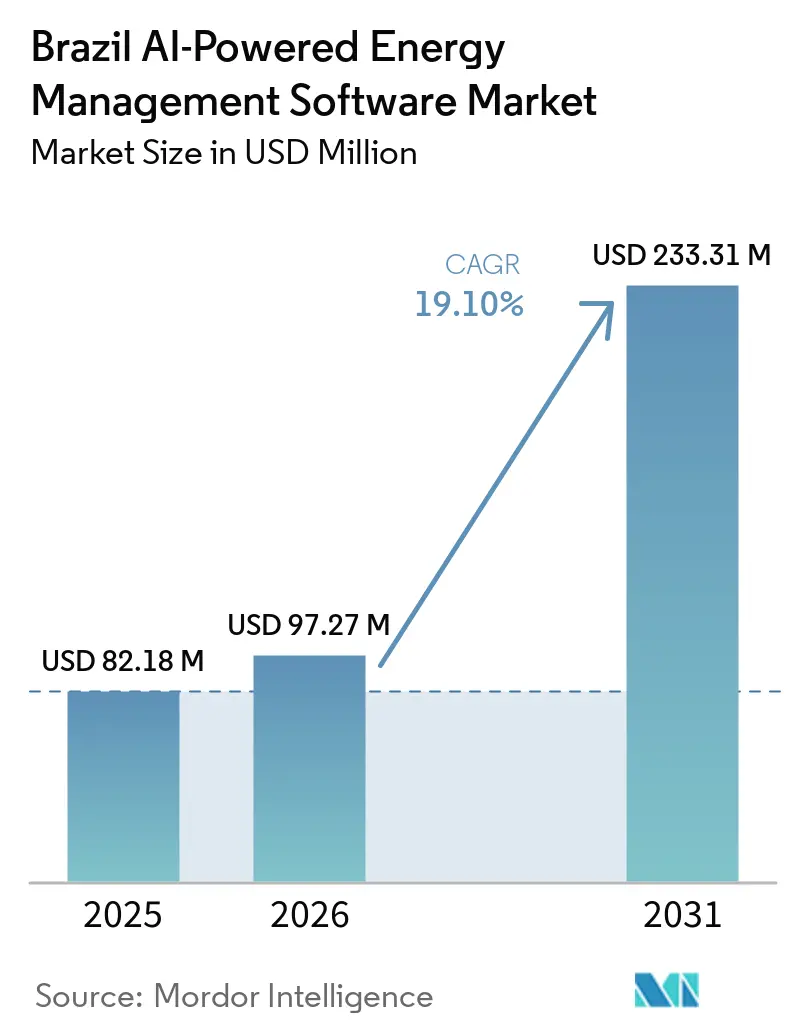
| Base Year Market Size (2025) | USD 82.18 Million |
| Market Size (2026) | USD 97.27 Million |
| Market Size (2031) | USD 233.31 Million |
| Growth Rate (2026 - 2031) | 19.10 % |
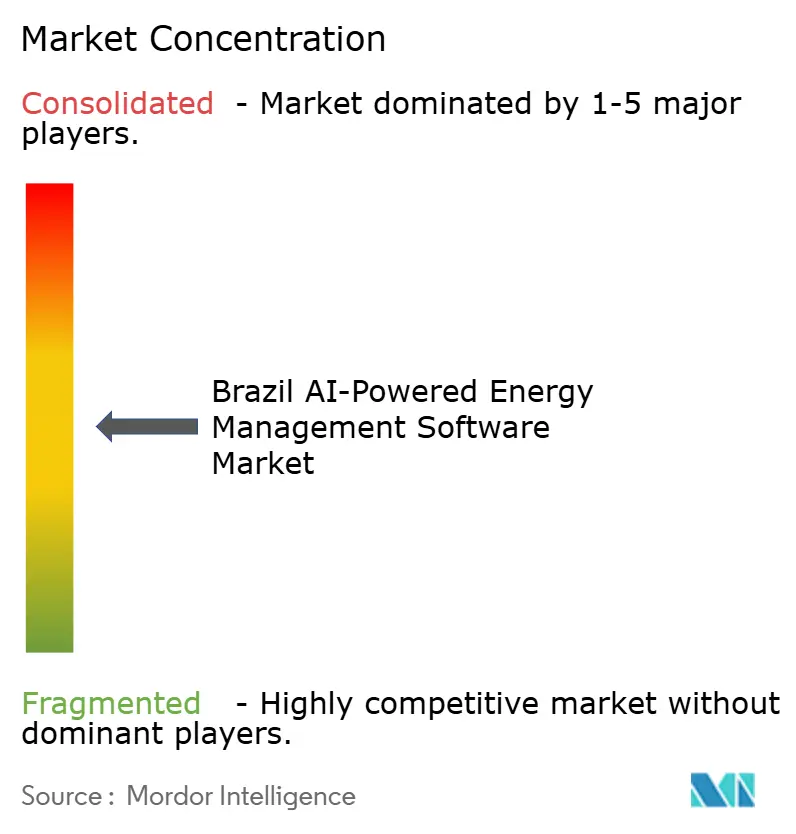
| Market Concentration | Medium |
Major Players *Disclaimer: Major Players sorted in no particular order Image © Mordor Intelligence. Reuse requires attribution under CC BY 4.0. | |
Brazil AI-powered Energy Management Software Market Analysis by Mordor Intelligence
The Brazil AI-powered Energy Management Software Market size is expected to grow from USD 82.18 million in 2025 to USD 97.27 million in 2026 and is forecast to reach USD 233.11 million by 2031 at 19.10% CAGR over 2026-2031. Growth is tied to grid modernization, the rise in distributed solar capacity, and stronger demand from enterprises that need real-time load visibility and faster operating decisions. As renewable variability grows across the power system, AI software is becoming more important for dispatch quality, forecasting accuracy, and day-to-day grid stability. The market is also benefiting from a broader digital base, including smart metering, cloud analytics, and more connected utility and industrial assets. Utilities still account for a large share of demand, but industrial facilities and commercial operators are expanding their use of these platforms as energy costs, reliability needs, and reporting requirements become harder to manage through manual processes alone. Competition is being shaped by installed relationships, integration capability, and the ability to work through cybersecurity and legacy system constraints without disrupting live operations.
Key Report Takeaways
- By component, software held 66.22% of the Brazil AI-powered Energy Management Software Market share in 2025, while services are projected to expand at a 20.12% CAGR through 2031.
- By deployment mode, cloud-based accounted for 56.14% of revenue in 2025, while hybrid deployment is projected to grow at a 20.23% CAGR through 2031.
- By application, energy consumption and demand optimization captured 24.18% of the market in 2025, while renewable energy forecasting and integration are projected to expand at a 20.34% CAGR through 2031.
- By end user, utilities held 35.11% share of the Brazil AI-powered Energy Management Software Market in 2025, while industrial facilities are projected to record the highest CAGR at 20.45% through 2031.
Note: Market size and forecast figures in this report are generated using Mordor Intelligence’s proprietary estimation framework, updated with the latest available data and insights as of January 2026.
Brazil AI-powered Energy Management Software Market Trends and Insights
Drivers Impact Analysis*
| Driver | (~) % Impact on CAGR Forecast | Geographic Relevance | Impact Timeline |
|---|---|---|---|
| Rising Grid Modernization and Digital Dispatch Programs | +3.8% | National, with stronger gains in São Paulo, Minas Gerais, and Rio de Janeiro | Short term (≤ 2 years) |
| Demand For Real-Time Load Optimization Across Commercial and Industrial Sites | +3.2% | Southeast and South industrial corridors | Medium term (2-4 years) |
| Utility Interest in AI-Enabled Forecasting for Distributed Energy Resources | +3.0% | National, with faster adoption in the Northeast and South | Medium term (2-4 years) |
| Cloud Migration for Multi-Site Energy Analytics and Reporting | +2.5% | National, with early gains in São Paulo and Rio de Janeiro | Short term (≤ 2 years) |
| Compliance Pressure Around Smart Metering, Auditability, and Reporting | +2.2% | National | Medium term (2-4 years) |
| Growing Use of Edge AI for Site-Level Fault Detection and Control | +1.8% | Industrial corridors and utility distribution networks | Medium term (2-4 years) |
| Source: Mordor Intelligence | |||
Rising Grid Modernization and Digital Dispatch Programs In Brazil
Brazil’s power system is undergoing a broad modernization cycle, creating a direct opening for the Brazil AI-powered Energy Management Software Market. Cemig invested more than BRL 100 million, USD 17.5 million, in its ADMS rollout, which supports real-time monitoring and smarter integration of distributed renewable assets across Minas Gerais.[1] The broader shift is also visible in the move toward more active distribution system operations, where distribution companies will need better visibility, control, and coordination tools than legacy systems can provide. That operating model makes digital dispatch, DER orchestration, and predictive analytics part of core utility planning rather than optional upgrades. The Brazil AI-powered Energy Management Software Market is therefore gaining from infrastructure programs that now treat software as part of network performance, resilience, and renewable integration. Utilities that digitize at the control layer also create follow-on demand for forecasting, reporting, and optimization applications across connected assets.
Demand For Real-Time Load Optimization across Commercial and Industrial Sites
The Brazil AI-powered Energy Management Software Market is also being driven by industrial and commercial users seeking continuous visibility into load patterns rather than periodic efficiency reviews. Brazil’s discussion of industrial efficiency has shifted toward digital tools, with sector analysis showing that faster adoption of sensors, automation, and analytics can meaningfully boost performance beyond gains from slower modernization cycles.[2] The commercial case is becoming clearer as operators use these systems for demand control, maintenance scheduling, and faster response to plant anomalies. UMOE Bioenergy’s AI-IoT deployment cut more than 850 hours of downtime and reduced intervention time by 85%, while also saving BRL 200,000 for each avoided incident. As Brazil opens more space for competitive electricity procurement, energy software is also becoming more useful as a decision-making tool for buyers looking to improve consumption patterns and respond more quickly to price signals. That combination of cost control, operational continuity, and trading flexibility supports wider adoption across the Brazilian AI-powered energy management software market.
Utility Interest in AI-Enabled Forecasting for Distributed Energy Resources
The Brazil AI-powered Energy Management Software Market is benefiting from the country’s faster renewable buildout, which is making power forecasting harder and more important. Brazil’s distributed micro and mini generation base is expected to rise from 45 GW in 2025 to 67.5 GW by 2030, which will expand both grid complexity and the value of software that can more accurately predict localized production patterns.[3] PSR Energy reported that at least 20% of potential clean energy output was curtailed in 2025, even while thermal generation was still used to support peak demand, underscoring the need for better AI-led forecasting and dispatch support. ONS also improved photovoltaic estimation and forecasting models by incorporating distributed generation data into system planning. Eletrobras then expanded C3 AI Grid Intelligence across its transmission network after a pilot stage, demonstrating that large utility contracts can validate these tools at scale and drive the broader Brazilian AI-powered energy management software market forward. The more renewable capacity Brazil adds, the stronger the need becomes for software that can reduce curtailment, improve balancing, and support faster operational decisions.
Cloud Migration for Multi-Site Energy Analytics and Reporting
Cloud migration is creating another clear growth channel for the Brazil AI-powered Energy Management Software Market, especially for operators managing many sites who want a single reporting layer. Eneva partnered with Accenture and Google Cloud to move its infrastructure to Google Cloud and connect operating, exploration, and production data to improve asset management and maintenance scheduling.[4] Matrix Energia also adopted SAP Analytics Cloud to consolidate energy planning, financial projections, and energy balance monitoring into one platform, replacing fragmented tools with a more unified workflow. These moves matter because they show that cloud adoption is no longer limited to basic infrastructure migration. The Brazil AI-powered Energy Management Software Market is increasingly tied to platforms that combine analytics, forecasting, and automated reporting in one environment. That trend is especially relevant as utilities, traders, and distributed system operators need faster portfolio views across many assets and geographies.
Restraints Impact Analysis*
| Restraint | (~) % Impact on CAGR Forecast | Geographic Relevance | Impact Timeline |
|---|---|---|---|
| High Integration Complexity With Legacy OT and IT Environments | -2.1% | National | Long term (≥ 4 years) |
| Limited Interoperability Across Metering, SCADA, and Building Systems | -1.7% | National, with heavier concentration in the Southeast | Medium term (2-4 years) |
| Cybersecurity and Data Sovereignty Concerns For Critical Energy Assets | -1.0% | National | Short term (≤ 2 years) to Long term (≥ 4 years) |
| Payback Uncertainty for Smaller Sites with Low Load Density | -0.5% | National | Short term (≤ 2 years) to Medium term (2-4 years) |
| Source: Mordor Intelligence | |||
High Integration Complexity with Legacy OT and IT Environments
Legacy operational technology remains a major brake on the Brazil AI-powered Energy Management Software Market because many utilities and industrial operators still run mixed environments that were not designed for connected analytics. Petrobras is a clear example of that complexity, with distributed OT environments that required stronger identity, segmentation, and access controls than traditional tools could consistently provide. The broader risk picture also worsened in 2025, when ransomware targeting energy and utilities rose by 80% from the prior year, largely because older infrastructure and IT-OT convergence expanded the attack surface. Computer Weekly Brazil cited incident data showing that weak OT visibility can extend breach containment from 5 days to 42 days, and that risk can make some operators slower to connect more systems to AI platforms. The Brazil AI-powered Energy Management Software Market will therefore continue to face longer implementation cycles, where cybersecurity remediation must move in parallel with analytics deployment. This is especially relevant for mid-tier users who want modernization benefits but do not yet have the internal teams to manage both integration and cyber hardening at the same pace.
Limited Interoperability Across Metering, SCADA, and Building Systems
The Brazil AI-powered Energy Management Software Market also faces a slower rollout, where meters, SCADA layers, and building systems do not exchange data smoothly. Interoperability testing across smart building technologies in Brazil showed that energy management systems and building management systems achieved only 75–85% success rates, with HVAC interfaces accounting for the main bottlenecks. Open Energy discussions in Brazil also raised concerns about fragmented data access standards, diverse metering systems, and cybersecurity rules that are still not fully consolidated. The result is a hidden cost layer for integrators that need to normalize data from many vendors before analytics platforms can work at full value. The Brazil AI-powered Energy Management Software Market is therefore moving faster where digital infrastructure is denser, and standards are clearer, and slower where system fragmentation still shapes project economics. Until interoperability rules mature further, deployment speed will remain uneven across utilities, commercial sites, and industrial portfolios.
*Our forecasts treat driver/restraint impacts as directional, not additive. The impact forecasts reflect baseline growth, mix effects, and variable interactions.
Segment Analysis
By Component: Software Anchors Revenue While Services Scale Rapidly
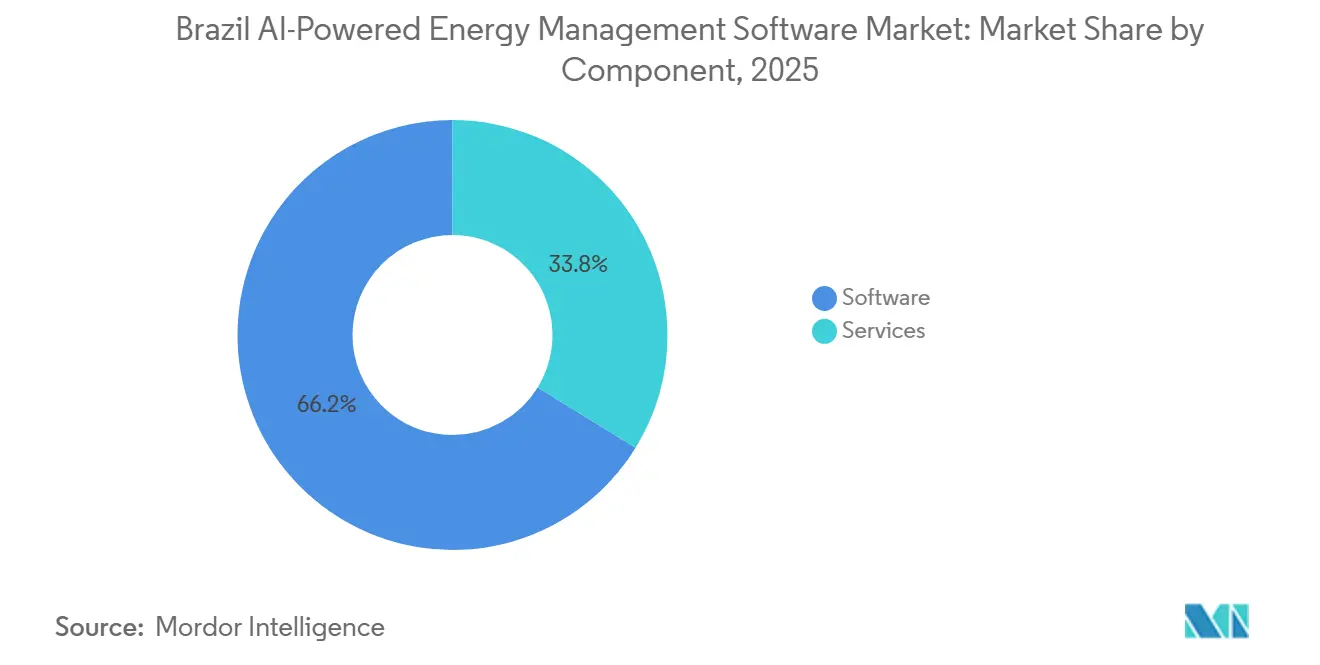
Software accounted for 66.22% of the Brazil AI-powered Energy Management Software Market size in 2025, making it the largest component segment by revenue. That position reflects the large installed base of licensed and SaaS platforms used by utilities, industrial operators, and commercial portfolios that already need dispatch, monitoring, and reporting tools. Schneider Electric’s EcoStruxure and Siemens’ Digital Grid offerings remain visible in utility and infrastructure accounts, which supports the view that platform depth and installed relationships still matter in this segment. The Brazil AI-powered Energy Management Software Market continues to favor software-first procurement, with clients seeking core functionality that can be layered across multiple sites.
This lead in software revenue does not reduce the importance of services, because services are projected to expand at a 20.12% CAGR from 2026 to 2031 and will stay closely tied to adoption quality. The reason is practical rather than abstract, since utilities and large facilities often need data normalization, model tuning, cybersecurity review, and live system integration before the platform can create value at scale. Bidgely’s acquisition of Grid4C in March 2025 showed how vendors are expanding their offerings beyond software licenses into predictive forecasting and broader utility workflows. The Brazil AI-powered energy management software industry is therefore moving toward delivery models where service capability is part of competitive strength, not a secondary add-on. Vendors that can combine software with implementation and ongoing optimization are better positioned to serve mid-tier operators without large internal digital teams.
By Deployment Mode: Hybrid Architecture Gains Ground Over Pure Cloud
Cloud-based deployment accounted for 56.14% of revenue in 2025, making it the largest deployment model in the Brazil AI-powered Energy Management Software Market. Utilities and commercial operators have favored cloud for its easier scalability, centralized updates, and stronger fit with multi-site reporting. That preference also matches the broader move toward cloud-native analytics environments in the Brazilian energy system. The segment is especially relevant for operators who want a single view across many assets and need faster coordination among energy planning, forecasting, and financial reporting.
Hybrid deployment is still projected to be the fastest-growing model, with a 20.23% CAGR from 2026 to 2031, because many operators do not want to rely entirely on either pure cloud or pure on-premises setups. Sensitive control logic for substations and SCADA-linked functions often remains on site, while forecasting, analytics, and reporting can move to cloud layers that are easier to scale. This structure also aligns with the cybersecurity concerns that continue to shape the Brazil AI-powered Energy Management Software Market, particularly for users who need stronger separation between control-critical operations and external networks. On-premises deployment, therefore, remains relevant in plants where response time matters directly to output quality and process stability. The Brazil AI-powered energy management software industry is increasingly settling into a practical split architecture, where cloud supports flexibility and data reach, and local systems protect latency-sensitive operations and tighter control requirements.
By Application: Demand Optimization Leads, Renewable Forecasting Accelerates
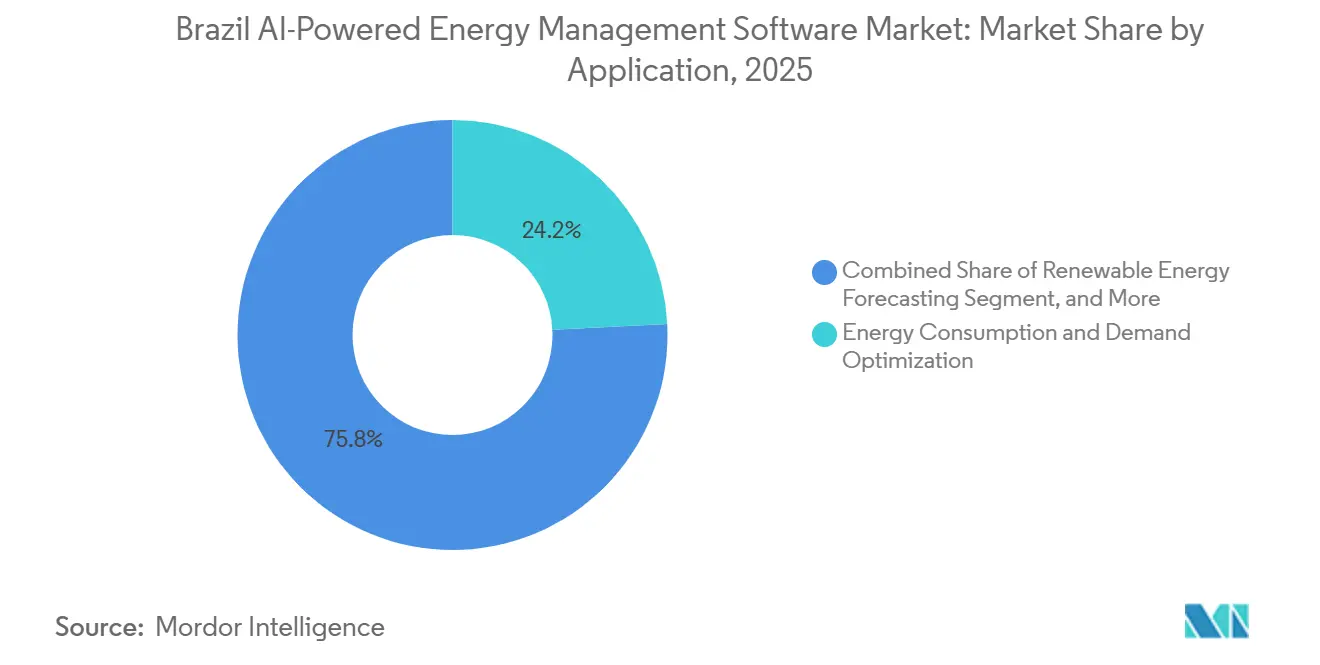
Energy consumption and demand optimization led applications with 24.18% share in 2025, showing that the most immediate value in the Brazil AI-powered Energy Management Software Market still comes from controlling costs and smoothing load. This application is easier for many buyers to justify because the return is visible in demand charges, operating continuity, and better use of existing assets. It also fits Brazil’s industrial base, where energy-intensive activities need tighter control over consumption patterns. The segment therefore stays central even as newer applications gain attention.
Renewable energy forecasting and integration is projected to record the fastest growth at a 20.34% CAGR through 2031, reflecting the operational strain created by a faster renewable buildout. PSR Energy’s finding that at least 20% of potential clean energy output was curtailed in 2025 gives this segment a strong operating rationale, because better forecasting can help reduce mismatch between available renewable supply and system dispatch. Smart grid and DER management are also gaining relevance as utilities renew concession frameworks and modernize control layers. Asset performance and predictive maintenance add another growth track, as seen in the Alumar project, where edge intelligence is used to read high-frequency electrical signals and flag anomalies earlier in aluminum reduction cells. The Brazil AI-powered Energy Management Software Market is also seeing early movement in energy trading and market intelligence, especially as power buyers need faster responses to shifting contract options and more dynamic electricity portfolios.

By End User: Utilities Lead Share, Industrial Facilities Expand Fastest
Utilities held a 35.11% share of the Brazil AI-powered Energy Management Software Market in 2025, making them the largest end-user group. This leadership reflects the scale of grid monitoring, distributed energy coordination, and fault management needs that only utilities face across large networks. Utility demand is also supported by smart-grid spending, digital dispatch priorities, and the need to integrate more renewable capacity without losing reliability. The Brazil AI-powered Energy Management Software Market still depends heavily on utilities as anchor customers because their deployments can validate platforms at a national or multi-state level.
Industrial facilities are projected to grow at a 20.45% CAGR through 2031, making them the fastest-expanding end-user segment. That growth is tied to sectors such as steel, aluminum, cement, and agribusiness, where operators are balancing high electricity exposure with stronger pressure to improve uptime and reduce waste. UMOE Bioenergy’s maintenance results illustrate this pattern, since the company used AI monitoring to reduce downtime meaningfully and lower response time on critical assets. Commercial buildings are also becoming increasingly relevant, with Diel Energia deploying its Celsius 360 IoT platform across 55 Grupo SBF stores to automate climate control and optimize energy use. Residential demand remains lower due to lower load density and longer payback periods, which slow adoption, but smart-meter rollout and market liberalization are likely to expand future use cases for the Brazilian AI-powered energy management software market.
Geography Analysis
The Brazil AI-powered Energy Management Software Market remains centered in the Southeast, where São Paulo, Minas Gerais, Rio de Janeiro, and Espírito Santo combine the country’s deepest industrial load, commercial real estate base, and utility infrastructure. This region continues to function as the main demand center because utilities, data infrastructure, and large energy users are more concentrated there than in the rest of the country. Cemig’s ADMS investment in Minas Gerais and the broader utility digitalization activity in São Paulo support that leadership. The Southeast also benefits from a stronger pipeline for demand management and asset performance use cases across automotive, mining, steel, and other power-intensive industries. As a result, the Brazil AI-powered Energy Management Software Market size remains most concentrated in the Southeast, even without a published regional revenue split.
The Northeast is developing fastest for renewable integration and forecasting applications in the Brazil AI-powered Energy Management Software Market. Bahia, Ceará, Pernambuco, and Rio Grande do Norte host a dense concentration of wind and solar assets, and that raises the value of forecasting tools that can support output planning and maintenance decisions. The Babilônia Wind Farm example showed how AI-driven monitoring helped prevent 9,629 MWh of losses by identifying 28 operational anomalies during the monitoring period. Enel Brasil’s BRL 96 million (USD 16.6 million) public efficiency call across São Paulo, Rio de Janeiro, and Ceará also widened the near-term procurement path for solutions that can connect distributed generation and storage assets more effectively. Honeywell’s role in Acelen Renewables’ sustainable aviation fuel project in Bahia further shows that AI-enabled control and safety systems are becoming part of the region’s larger clean energy and fuels infrastructure buildout.
The South and the Center-West are becoming more relevant to the Brazil AI-powered Energy Management Software Market through industrial and agribusiness use cases. Manufacturing clusters in Paraná, Santa Catarina, and Rio Grande do Sul are driving greater interest in predictive maintenance and load optimization, while the Center-West is creating demand for irrigation and agricultural processing loads. The North remains a smaller addressable area, but isolated systems there create a specific use case for microgrid control and diesel displacement optimization. Across regions, the uneven smart-meter rollout still shapes timing, meaning the Brazil AI-powered Energy Management Software Market share for near-term deployments remains tilted toward states with denser digital infrastructure and faster regulatory progress.
Competitive Landscape
The Brazil AI-powered Energy Management Software Market is moderately fragmented, with global automation and software groups competing alongside AI-focused specialists and regional providers. Schneider Electric, Siemens, Honeywell, ABB, IBM, and Johnson Controls continue to benefit from established utility and industrial relationships, giving them an edge in larger, more complex accounts. At the same time, specialist vendors are gaining traction where buyers want faster deployment, sharper forecasting, or more tailored solutions. The market is therefore defined by a mix of installed-base strength and use-case specialization, keeping competitive pressure active across utilities, industrial facilities, and emerging commercial building opportunities.
Several strategic moves in 2025 and 2026 highlight how vendors are deepening their positions. Schneider Electric signed a memorandum of understanding with Stefanini IHM in April 2026 around software-defined automation in Brazil, signaling a stronger push toward open architectures. CPFL Energia and Siemens Smart Infrastructure formalized a project to replace 1.6 million conventional meters with smart meters by 2029, reinforcing Siemens’ role in digital utility infrastructure. Honeywell launched its Ionic Modular All-in-One battery energy storage system in September 2025, combining storage and AI-based control for commercial and industrial users. These moves show that leading companies are bundling automation, storage, and control capabilities to widen account value.
Specialist AI providers are also reshaping the market by proving performance at scale through anchor contracts. C3.ai’s expansion with Eletrobras from pilot to broader transmission deployment exemplifies this approach. Bidgely’s acquisition of Grid4C broadened its reach from customer analytics into grid-side forecasting and DER optimization. White space remains strongest in commercial buildings and residential applications, where smart-meter growth and more open data access could reshape adoption. This leaves room for both large incumbents and niche AI players, especially where buyers prioritize quicker deployment, lower integration burden, and more tailored analytics.
Brazil AI-powered Energy Management Software Industry Leaders
-
Schneider Electric SE
-
Siemens AG
-
Honeywell International Inc.
-
International Business Machines Corporation
-
ABB Ltd
- *Disclaimer: Major Players sorted in no particular order
Recent Industry Developments
- June 2026: Honeywell announced the supply of its modular Ecofining process technology and integrated Experion PKS control and safety systems for Acelen Renewables' greenfield sustainable aviation fuel and renewable diesel facility in Bahia, Brazil. The contract extends Honeywell's AI-enabled process management into Brazil's nascent renewable fuels sector, combining production optimization with real-time data-driven operational insights.
- May 2026: ONS reported that its deployment of the AVEVA PI System saved 221 GWh of energy and USD 11.4 million in year-one operational costs by automating energy dispatch and prioritizing clean energy dispatch in the National Interconnected System. The system integrated with proprietary GERIN and SINapse tools to optimize real-time grid management at national scale.
- August 2025: Eletrobras selected C3 AI to scale its C3 AI Grid Intelligence solution across all transmission assets under the Eletro.ia program, following a successful 2024 pilot across 10 substations. The deployment achieves fault detection and resolution in under 10 seconds and also uses C3 Generative AI to streamline operational reporting at South America's largest power utility.
- July 2025: The AI-powered Thermovision system developed by Unicamp researchers in partnership with CPFL Energia was licensed to Kasco Tecnologia, a Unicamp spin-off. The technology uses AI, computer vision, and thermal cameras in standard vehicles to autonomously detect thermal anomalies in overhead power distribution networks at 30 km/h, meeting ANEEL reliability and continuity requirements.
Brazil AI-powered Energy Management Software Market Report Scope
The Brazil AI-powered Energy Management Software Market refers to platforms and services that leverage artificial intelligence to optimize energy consumption, enhance asset performance, and enable smarter grid and distributed energy resource (DER) management. These solutions provide advanced capabilities such as predictive maintenance, renewable energy forecasting, demand-side optimization, and market intelligence for energy trading and pricing.
The Brazil AI-powered Energy Management Software Market report is segmented by Component (Software, and Services), Deployment Mode (Cloud-Based, On-Premises, and Hybrid), Application (Energy Consumption and Demand Optimization, Asset Performance and Predictive Maintenance, Smart Grid and Distributed Energy Resource (DER) Management, Renewable Energy Forecasting and Integration, and Energy Trading, Pricing and Market Intelligence), and End User (Utilities, Commercial Buildings, Industrial Facilities, and Residential Buildings). The Market Forecasts are Provided in Terms of Value (USD).
| Software |
| Services |
| Cloud-Based |
| On-Premises |
| Hybrid |
| Energy Consumption and Demand Optimization |
| Asset Performance and Predictive Maintenance |
| Smart Grid and Distributed Energy Resource (DER) Management |
| Renewable Energy Forecasting and Integration |
| Energy Trading, Pricing and Market Intelligence |
| Utilities |
| Commercial Buildings |
| Industrial Facilities |
| Residential Buildings |
| By Component | Software |
| Services | |
| By Deployment Mode | Cloud-Based |
| On-Premises | |
| Hybrid | |
| By Application | Energy Consumption and Demand Optimization |
| Asset Performance and Predictive Maintenance | |
| Smart Grid and Distributed Energy Resource (DER) Management | |
| Renewable Energy Forecasting and Integration | |
| Energy Trading, Pricing and Market Intelligence | |
| By End User | Utilities |
| Commercial Buildings | |
| Industrial Facilities | |
| Residential Buildings |
Key Questions Answered in the Report
What is the 2026 value of the Brazil AI-powered energy management software space?
It reached USD 97.27 million in 2026 and is forecast to rise to USD 233.11 million by 2031 at a 19.10% CAGR.
What is driving adoption in Brazil the most?
Grid modernization, rising distributed solar capacity, demand for real-time load optimization, and the need for better renewable forecasting are the main growth factors.
Which component leads revenue in this space?
Software led with 66.22% share in 2025, supported by platform licensing and SaaS deployments across utilities and large industrial users.
Which deployment model is growing the fastest in Brazil?
Hybrid deployment is projected to expand at a 20.23% CAGR through 2031 because many users want cloud analytics while keeping sensitive control functions on site.
Which application is expanding the fastest?
Renewable energy forecasting and integration is projected to grow at a 20.34% CAGR through 2031, driven by curtailment risk and rising renewable complexity.
Which end-user group offers the strongest growth outlook?
Industrial facilities are projected to post the highest CAGR at 20.45% through 2031 as energy-intensive operators seek better uptime, load control, and maintenance planning.