
Beauty Salon Market Size and Share
Market Overview
| Study Period | 2021 - 2031 |
|---|---|
| Market Size (2026) | USD 257.61 Billion |
| Market Size (2031) | USD 389.04 Billion |
| Growth Rate (2026 - 2031) | 8.59 % |
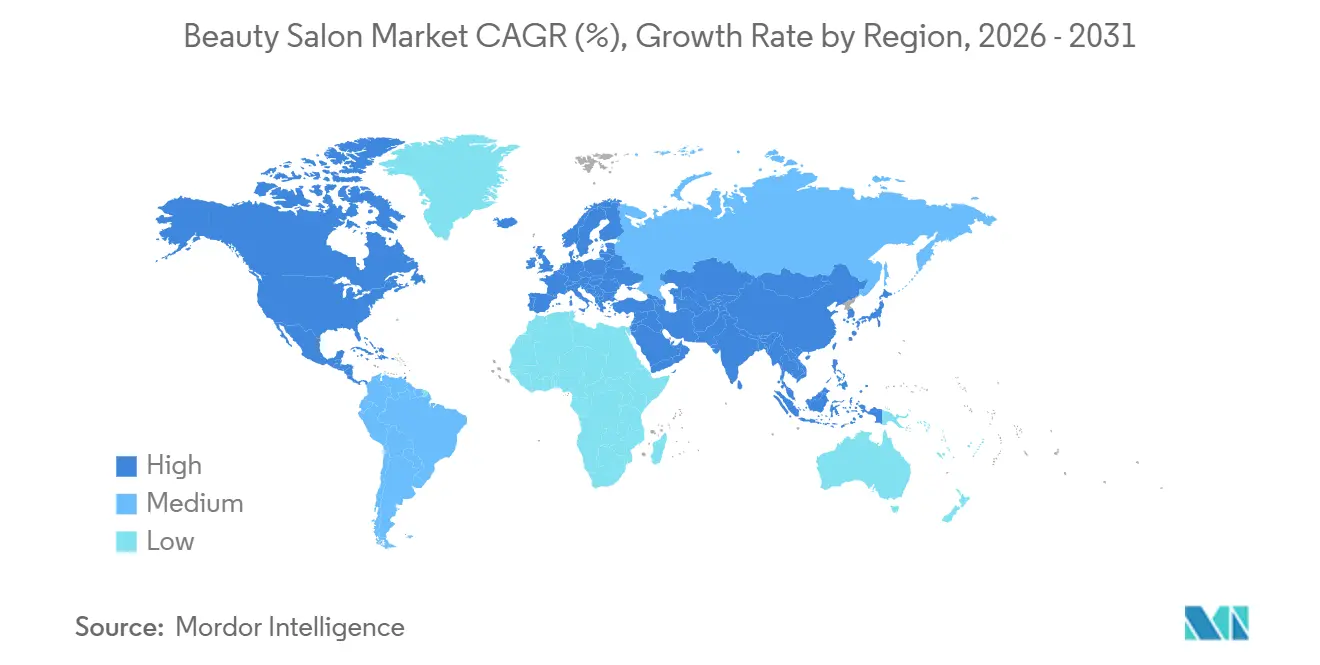
| Fastest Growing Market | Asia-Pacific |
| Largest Market | North America |
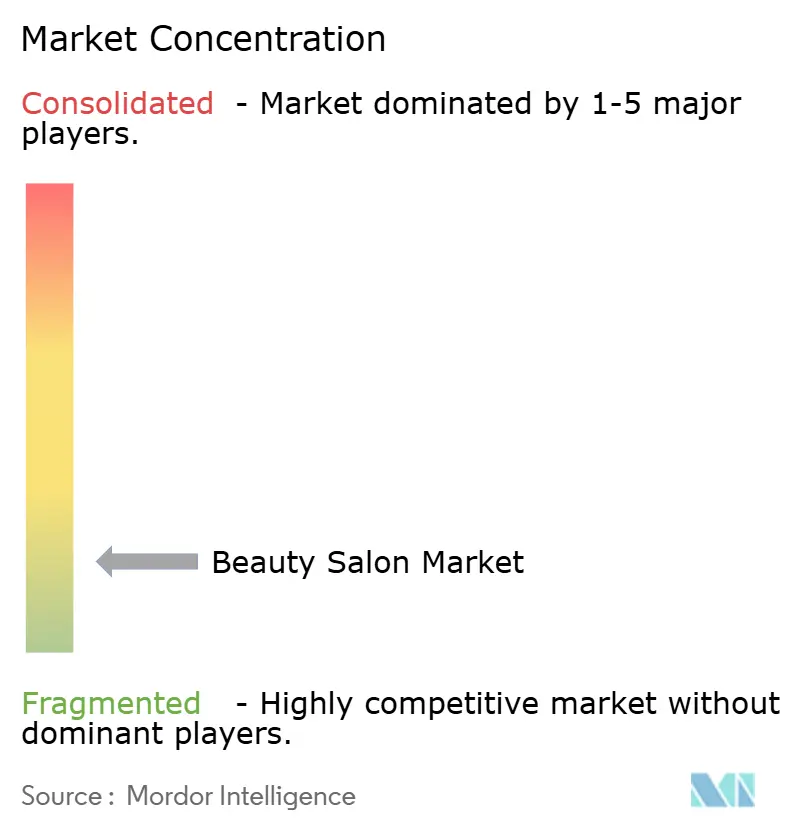
| Market Concentration | Low |
Major Players *Disclaimer: Major Players sorted in no particular order Image © Mordor Intelligence. Reuse requires attribution under CC BY 4.0. | |
Beauty Salon Market Analysis by Mordor Intelligence
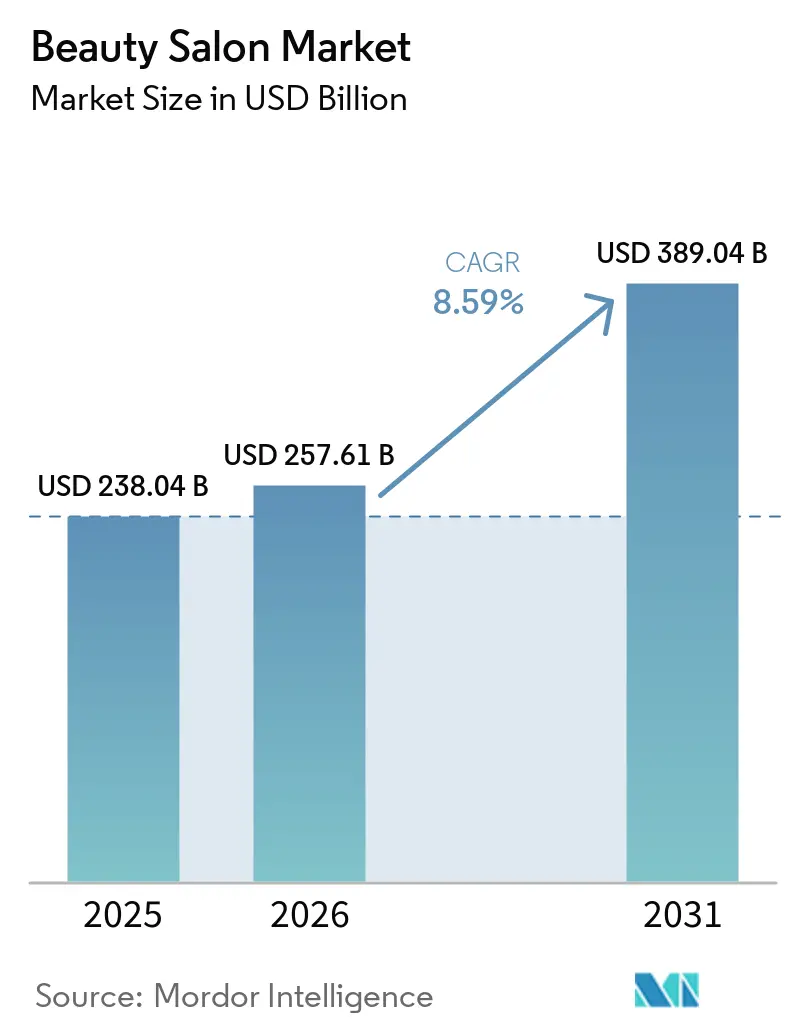
The beauty salon market size is expected to grow from USD 238.0 billion in 2025 to USD 257.6 billion in 2026 and is forecast to reach USD 389.0 billion by 2031 at 8.6% CAGR over 2026-2031. The beauty salon market is holding up well because professional grooming is still treated as a routine expense even when household budgets are under pressure. Demand is also being widened by rising disposable incomes in Asia and Latin America, where first-time salon users are entering the category, while mature markets are seeing higher spend per visit through more premium treatments. The beauty salon market is also benefiting from the shift toward scalp, skin, and wellness-linked services, which gives salons more ways to increase ticket size from existing clients. Technology is improving the operating model, as digital booking, AI-led scheduling, and customer data tools help salons convert missed demand into confirmed appointments and better inventory control. The main checks on the beauty salon market remain labor constraints, compliance costs, and the rise of at-home beauty alternatives, but these factors are slowing expansion rather than changing the long-term direction of demand.
Key Report Takeaways
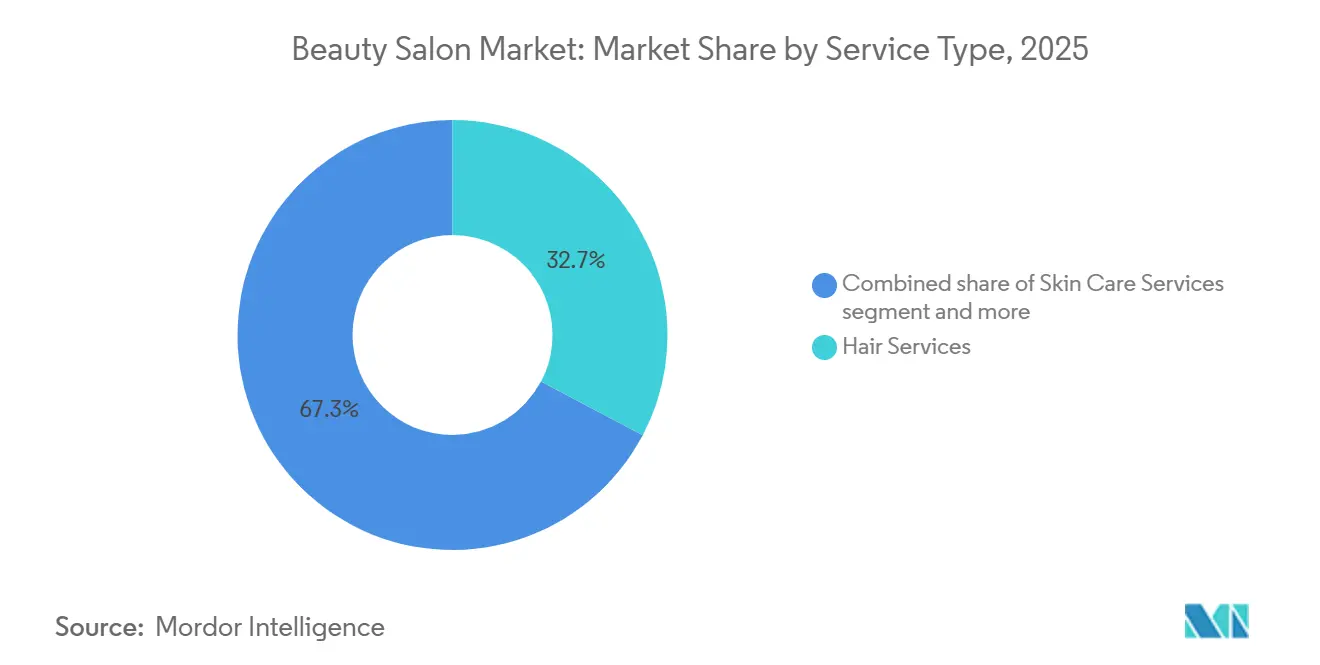
- By service type, hair services held 32.7% of the beauty salon market share in 2025, while skin care is forecast to grow at the fastest 9.5% CAGR through 2031.
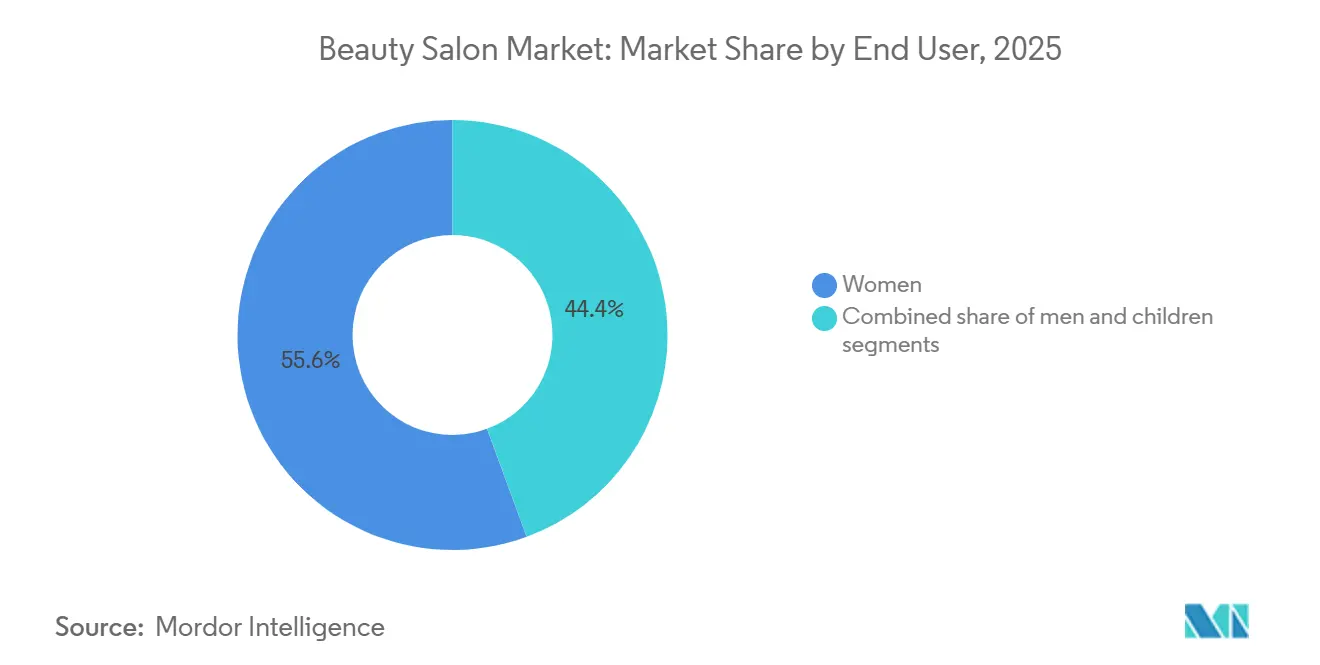
- By end user, women accounted for 55.6% of the beauty salon market size in 2025, while men are projected to record the highest 9.1% CAGR through 2031.
- By business model, independent salons represented 59.1% of the beauty salon market in 2025, while franchise chains are set to expand at the fastest 10.5% CAGR through 2031.
- By geography, North America captured 39.4% of the beauty salon market in 2025, while Asia-Pacific is expected to post the fastest 10.4% CAGR through 2031.
Note: Market size and forecast figures in this report are generated using Mordor Intelligence’s proprietary estimation framework, updated with the latest available data and insights as of January 2026.
Market Trends and Insights
Drivers Impact Analysis of Beauty Salon Market*
| Driver | (~) % Impact on CAGR Forecast | Geographic Relevance | Impact Timeline |
|---|---|---|---|
| Rising Disposable Income and Premium Grooming Spend | +2.1% | Global; concentrated in the Asia-Pacific emerging markets and the North America premium tier | Medium term (2–4 years) |
| Growing Male Grooming Participation | +1.3% | Global; early gains in North America, and the Asia-Pacific | Medium term (2–4 years) |
| Expansion of Organized Salon Chains and Franchise Models | +1.2% | Global; concentrated in the Asia-Pacific and Latin America | Long term (≥ 4 years) |
| AI-Enabled Booking, Marketing, and Inventory Optimization | +0.9% | Global; early-adopting markets in North America and Europe | Short to medium term (1–3 years) |
| Premiumization Through Wellness, Skin, and Scalp Services | +1.5% | Global; strongest uplift in the Asia-Pacific and North America premium urban markets | Medium term (2–4 years) |
| Social Media-Driven Service Discovery and Trend Cycles | +1.0% | Global; concentrated in markets with high smartphone and TikTok penetration | Short term (≤ 2 years) |
| Source: Mordor Intelligence | |||
AI-enabled booking, marketing, and inventory optimization
In the beauty salon sector, artificial intelligence has evolved from a mere novelty to an operational essential. On September 30, 2025, Zenoti, an AI-driven management platform, unveiled the industry's inaugural AI Workforce[1]Source: Zenoti, “AI Workforce Launch Announcement,” Zenoti, zenoti.com. This suite of specialized agents, trained on insights from over 30,000 businesses spanning 50 countries, manages tasks like reception, lead scoring, personalized marketing, and dispute resolution. Annually processing USD 10 billion, Zenoti has facilitated an impressive USD 1.5 billion in incremental revenue for its clients. Beyond mere efficiency gains, AI-driven receptionist systems are turning what were once missed calls, often seen as permanent revenue losses, into confirmed bookings. This shift not only boosts revenue but does so without necessitating additional capital investments in floor space. Meanwhile, in France, leading booking platform Planity reported a 22% surge in digital appointment volumes from 2023 to 2025. Notably, 68% of salon appointments in the country are now booked digitally. Furthermore, with the US FDA's Modernization of Cosmetics Regulation Act (MoCRA) coming into effect in 2022, salon operators are increasingly digitizing client records and product usage data[2]Source: U.S. Food and Drug Administration, “Modernization of Cosmetics Regulation Act,” U.S. Food and Drug Administration, fda.gov. This move, driven by the need to meet adverse-event reporting obligations, is inadvertently speeding up technology adoption across salon operations.
Growing male grooming participation
Growing male grooming participation is emerging as a significant growth driver for the global beauty salon market, as men increasingly view grooming, skincare, haircare, beard styling, and wellness treatments as essential aspects of personal appearance and professional confidence. Industry associations and market studies indicate a sustained rise in spending on male grooming products and services, with the global men’s grooming market expanding rapidly and benefiting from changing social norms, influencer culture, and greater awareness of self-care among younger consumers. In India, the India Brand Equity Foundation (IBEF) notes that the men’s grooming segment is outpacing several personal care categories due to expanding consumer adoption and increasing product penetration. This shift is directly increasing salon footfall, encouraging salons to introduce dedicated men’s grooming packages, premium barbering services, scalp treatments, and skincare offerings. Recent product developments further reinforce this trend; in 2025, several brands expanded into adjacent grooming categories, while in 2026, KT Professional launched the “KT Men” range tailored for male consumers, and Gillette introduced its “Body + Intimate” grooming lineup targeting specialized male grooming needs. Such innovations are expanding consumer awareness, driving service demand, and supporting revenue growth across the global beauty salon ecosystem.
Premiumization through wellness, skin, and scalp services
Salon operators are increasingly expanding beyond traditional haircutting and grooming services by integrating wellness-focused and scalp-health treatments into their offerings, significantly increasing customer engagement and revenue per visit. This trend is driven by growing consumer awareness of hair thinning, scalp sensitivity, hair loss prevention, and overall hair wellness. As a result, the scalp-care category became one of the fastest-growing segments in the professional beauty industry in 2025, reflecting the convergence of dermatological science and self-care routines. Supporting this trend, Kenvue introduced Neutrogena Hair Restore and OGX ProGrowth + Peptide in November 2025, making clinically inspired scalp-care solutions more accessible to mainstream consumers. Retailers such as Ulta Beauty have also responded by creating dedicated scalp-care sections, highlighting rising demand. For salons, this creates a valuable upselling pathway, allowing customers to progress from basic grooming services to scalp diagnostics, specialized treatments, and recurring purchases of professional at-home maintenance products.
Social media-driven service discovery and trend cycles
Social media has overtaken word-of-mouth as the top channel for beauty salons to attract new clients, reshaping the competitive landscape between franchise chains and independent operators. In 2026, TikTok's #HairTok hashtag racked up a staggering 100 billion views, with trending haircuts and color techniques leading to a surge in bookings just days after going viral[3]Source: TikTok, “#HairTok Platform Activity,” TikTok, tiktok.com . A deeper insight reveals a leveling of the playing field: TikTok's algorithm highlights high-quality transformation content, regardless of follower count. This means a talented independent stylist in a smaller market can achieve the same organic visibility as a national franchise. Such dynamics challenge the traditional marketing dominance of larger operators and bolster the resilience of independent salons against fragmentation. The ramifications are evident in appointment bookings: when a hair color trend gains traction, demand for related services can soar within 48–72 hours. This surge puts immense pressure on salon management systems, hastening the adoption of real-time availability technologies.
Restraints Impact Analysis of Beauty Salon Market*
| Restraint | (~) % Impact on CAGR Forecast | Geographic Relevance | Impact Timeline |
|---|---|---|---|
| Rise of Sophisticated At-Home Alternatives | -1.8% | Global; concentrated in North America and Europe, where device penetration is highest | Medium term (2–4 years) |
| Licensed Stylist Shortages and High Staff Turnover | -1.5% | Concentrated in North America and Europe; emerging in the Asia-Pacific metro markets | Medium to long term (2–5 years) |
| Hygiene, Safety, and Chemical Compliance Cost Burden | -0.7% | North America, Europe, and increasingly the Asia-Pacific following China NMPA updates | Medium term (2–4 years) |
| Demand Volatility in Lower-Frequency, Discretionary Services | -0.9% | Global; acute in lower-income segments of Europe and South America | Short term (≤ 2 years) |
| Source: Mordor Intelligence | |||
Rise of sophisticated at-home alternatives
The rise of sophisticated at-home beauty alternatives is increasingly restraining growth in the global beauty salon market by reducing consumers’ dependence on professional salon visits for routine grooming, skincare, and haircare treatments. Advances in beauty technology have enabled consumers to access salon-like results from the comfort of their homes through LED therapy masks, laser hair-removal devices, microcurrent tools, and smart hair-styling equipment. Industry sources indicate that the home-use beauty device segment is expanding rapidly, driven by convenience, affordability, personalization, and growing digital commerce penetration. The beauty devices market is projected to grow strongly through the coming decade, reflecting rising consumer adoption of DIY beauty solutions. In 2025, premium at-home devices such as CurrentBody’s upgraded LED Light Therapy Mask gained widespread popularity, offering clinically supported skin-rejuvenation benefits that compete with professional facial treatments. In 2026, innovation accelerated further with launches such as L’Oréal’s light-based hair straightening and LED skincare technologies, while industry reports highlighted growing demand for advanced home-use beauty devices. The increasing effectiveness of these solutions is encouraging consumers to extend the interval between salon appointments, limiting service frequency and revenue opportunities for salon operators.
Licensed stylist shortages and high staff turnover
Licensed stylist shortages and high staff turnover are restraining the global beauty salon market by limiting service capacity, increasing labor costs, and reducing the consistency of customer experiences. According to the U.S. Bureau of Labor Statistics, employment demand for barbers, hairstylists, and cosmetologists is expected to remain strong through the decade, reflecting ongoing workforce supply challenges across the personal care industry. As experienced professionals leave the sector due to burnout, flexible employment preferences, and competition from independent or freelance work models, salon operators face difficulties maintaining appointment availability and service quality. Industry associations such as the Professional Beauty Association have highlighted workforce development and talent retention as critical concerns affecting salon performance. These staffing constraints also increase recruitment, onboarding, and training expenses, placing pressure on profitability. In response, companies have introduced solutions aimed at improving stylist productivity and retention. In 2025, L'Oréal Professionnel expanded AI-powered consultation and training tools to help salons support newer stylists and improve service consistency. In 2026, several salon technology providers enhanced digital workforce-management platforms that automate scheduling, performance tracking, and client management, helping operators cope with labor shortages. Despite these innovations, persistent difficulties in attracting and retaining licensed professionals continue to constrain salon expansion, reduce appointment capacity, and limit revenue growth across the global beauty salon market.
*Our forecasts treat driver/restraint impacts as directional, not additive. The impact forecasts reflect baseline growth, mix effects, and variable interactions.
Beauty Salon Market Segment Analysis
By Service Type:
Skin Care Redefines the Revenue CeilingSkin care services are now the fastest-growing segment in the beauty salon industry, projected to expand at a CAGR of 9.46% through 2031, significantly outpacing the overall market growth. This surge highlights a notable shift in consumer behavior: treatments once exclusive to medispa settings, such as chemical peels, LED facials, microdermabrasion, and scalp wellness protocols, are now becoming staples in mainstream salon offerings. In 2025, the scalp category saw notable growth, spurred by the introduction of clinical-grade product lines at accessible price points, enhancing consumer awareness of these treatments. Salons emphasizing scalp services as a premium experience, bolstered by ingredient education and tangible results, have enjoyed revenue boosts from their existing clientele, all without incurring substantial costs for attracting new clients.
Hair services, accounting for 32.71% of the market share in 2025, remain the bedrock of the segment. This dominance is fueled by the category's frequent visits and the essential nature of basic cuts and color maintenance. Nail services, while consistently popular, face growth challenges due to the emergence of professional-quality at-home gel manicure kits, especially among younger consumers. Makeup services continue to thrive, particularly in event-driven and bridal scenarios, where premium pricing for destination events and weddings leads to higher ticket values. Other services, including waxing, lash extensions, and threading, are gaining traction, especially with specialist operators like European Wax Center. With over 1,020 locations and a recent USD 640 million take-private transaction, the move underscores institutional confidence in these specialized service categories.



By End User:
Men's Migration to Full-Service Salons Creates Cross-Sell UpsideWomen retained a 55.62% share of the global beauty salon end-user market in 2025, supported by higher spending on haircare, coloring, skincare, nail services, and wellness treatments. Government and industry sources, including the Professional Beauty Association, highlight that women remain the primary consumers of professional beauty services due to established grooming routines and demand for specialized treatments. Product innovation continues to reinforce salon visits; in 2025, L'Oréal Professionnel expanded premium hair-color solutions, while in 2026, leading beauty brands introduced advanced scalp-care and personalized hair-treatment ranges, strengthening women’s reliance on professional salon expertise.
Men’s end-user participation is structurally accelerating, with a forecast CAGR of 9.11% through 2031, making it the fastest-growing segment in the global beauty salon market. Rising awareness of skincare, beard grooming, scalp health, and professional appearance is expanding salon usage among male consumers. Industry observations and India’s grooming sector trends reported by the India Brand Equity Foundation indicate growing acceptance of male grooming products and services. Supporting this trend, Gillette expanded its Body + Intimate grooming range in 2026, while leading brands increased investments in male-specific skincare and haircare solutions during 2025, encouraging greater salon engagement, premium grooming adoption, and higher spending on professional services.
By Business Model:
Franchise Chains Narrow the Technology Gap with IndependentsIn 2025, independent salons commanded a dominant 59.13% share of the business model market. Their success is attributed to strong stylist-client relationships, tailored local services, and adaptable pricing. Social media, especially platforms like TikTok and Instagram, has empowered individual practitioners. A single stylist can generate client bookings through high-quality transformation content, matching the marketing reach of a national franchise. Yet, a widening operational gap emerges between these independents and organized chains. This gap spans areas like technology adoption, loyalty programs, and inventory management, exposing a vulnerability in the mid-tier of the independent segment.
Franchise chains are projected to outpace all other business models in growth through 2031. Their success is driven by tech-enhanced operations, universal loyalty programs, and a recession-proof stance. Value-tier chains, catering to clients every four to six weeks, remain resilient even in economic downturns. Great Clips, boasting 4,441 locations in the US and Canada, stands as the world's largest hair salon franchise. In 2026, it not only achieved global sales of around USD 1.75 billion but also secured the #40 spot on Entrepreneur's Franchise 500 list. Meanwhile, Regis Corporation's salons, buoyed by a +9.6% same-store sales growth in Q3 fiscal 2026, showcased a notable rebound post their December 2024 acquisition of 300 salons from Alline. The franchise model's foray into APAC markets, where branded services resonate with trust and quality for newcomers, solidifies the growth narrative for organized chains.
Geography Analysis
North America Beauty Salon Market
North America held 39.4% of the beauty salon market in 2025, giving the region the largest beauty salon market share on a geographic basis. The region combines high per-capita grooming spend, dense franchise infrastructure, and strong consumer acceptance of digital booking and loyalty tools. The United States remains the main anchor through large branded networks such as Great Clips and Regis, which support scale, scheduling efficiency, and broad consumer reach. Ulta Beauty’s ongoing experiential expansion also points to a closer link between beauty retail and salon services as a premium growth format. Canada and Mexico add further support to the beauty salon market, with Mexico benefiting from urban middle-class expansion and rising organized chain presence in major cities.
APAC Beauty Salon Market
Asia-Pacific is forecast to record the fastest growth in the beauty salon market, with a 10.4% CAGR through 2031. India remains a key volume driver because of its large youth population, wider female workforce participation, and strong occasion-led demand tied to weddings and grooming culture. Organized brands are helping formalize the market there, with Lakme Salon and TONI&GUY India extending reach across major cities and premium locations. Japan is contributing from the premium end, and inbound beauty tourism is expected to rise sharply by 2030. China also supports the beauty salon market as premium operators regain traction following earlier closures and a slower offline recovery period.
EMEA and South America Beauty Salon Market
Europe, South America, the Middle East, and Africa form a mixed growth corridor for the beauty salon market. Europe combines mature service habits with selective premium demand, while South America benefits from a strong beauty culture but remains more exposed to consumer spending swings. In the Middle East, institutional interest is becoming more visible through branded expansion and premium retail-service formats, including Ulta Beauty’s regional entry activity. Together, these regions widen the opportunity base for the beauty salon market, but they also require more local adaptation in pricing, format, and service mix than North America or Japan.

Competitive Landscape
The beauty salon market remains highly fragmented overall, even though a visible franchise tier competes at scale in selected service formats and regions. Competitive positioning now depends less on basic service availability and more on booking convenience, breadth of treatment, customer retention systems, and digital visibility. Large operators such as Great Clips, Sport Clips, Regis brands, Fantastic Sams, and Supercuts still compete on consistency, price clarity, and broad location coverage. Independent salons defend their place in the beauty salon market through personalization, local reputation, and creator-style content that connects directly with niche demand. This creates a two-speed structure, where scale helps at the branded end, and service distinctiveness helps at the independent end.
Several strategic moves show how the beauty salon market is evolving. Regis Corporation’s integration of the Alline salon portfolio and its 9.6% same-store sales growth in Q3 fiscal 2026 point to the value of operating discipline and acquisition-led repositioning. European Wax Center’s May 2026 take-private transaction at an enterprise value of USD 640 million also shows continued investor confidence in specialist beauty service formats with repeat demand and recognizable brand equity. Great Clips continues to strengthen its scale advantage through remote check-in and digital convenience, which supports repeat traffic and stronger schedule utilization across a very large system.
New competition is also expanding the boundary of the beauty salon market, rather than only contesting share inside traditional salons. Floyd’s 99 has continued to build a hybrid premium haircut position, while technology-led service models are pushing beauty care closer to the consumer through on-demand and home-service formats. In India, Urban Company’s FY26 revenue growth showed that platform-led delivery can influence how consumers compare convenience, trust, and service quality across channels. At the premium end, product science is becoming more important, and salons using professional-grade lines are likely to reference new safety and quality frameworks such as NSF/ANSI 527 as treatment credibility becomes part of competitive positioning. The beauty salon market is therefore competitive, not because a few firms dominate it, but because many formats are trying to define the next standard of value.
Beauty Salon Industry Leaders
Great Clips, Inc.
Regis Corporation
Ulta Beauty, Inc.
Sport Clips, Inc.
Fantastic Sams Holding Corp.
- *Disclaimer: Major Players sorted in no particular order
Beauty Salon Market Companies Covered in this Report
- Great Clips, Inc.
- Regis Corporation
- Ulta Beauty, Inc.
- Sport Clips, Inc.
- Fantastic Sams Holding Corp.
- Drybar Holdings, LLC
- The Lash Lounge
- Supercuts
- Floyd’s 99 Barbershop
- Toni and Guy
- Dessange International
- Jean Louis David SAS
- Lakme Salon
- Jawed Habib Hair and Beauty Ltd.
- Enrich Hair and Skin Solutions Pvt. Ltd.
- Naturals Salon and Spa Pvt. Ltd.
- Tommy Gun’s Original Barbershop
- Urban Company
- Sola Salon Studios
- European Wax Center, Inc.

Recent Industry Developments in Beauty Salon Market
- March 2026: Ulta Beauty opened its UAE flagship at Mall of the Emirates and confirmed subsequent openings at Dubai Mall and Red Sea Mall in Jeddah as part of its Middle East expansion in partnership with Alshaya Group. These represented the brand's first international salon and retail footprint outside North America and Kuwait.
- January 2026: Reliance Consumer Products Ltd (the FMCG arm of Reliance Industries) acquired global rights to premium haircare products of Toni & Guy, along with Brylcreem, Badedas, and Matey brand portfolios, signaling emerging-market conglomerates' intent to control global beauty brand licensing.
- November 2025: Ulta Beauty opened its first-ever international store in Kuwait in partnership with Alshaya Group, marking the brand's formal entry into international markets after 35 years of US-only operations.


Global Beauty Salon Market Report Scope
A beauty salon is a brick-and-mortar commercial establishment that offers cosmetic, hygienic, and wellness treatments for the hair, face, skin, and nails. The global beauty salon market is segmented by service type, end user, business model, and geography. By service type, the market is segmented into hair services, skin care services, nail services, makeup services, and other service types. By end user, the market is segmented into men, women, and children. By business model, the market is segmented into independent salons and franchise chains. By geography, the market is segmented into North America, Europe, Asia-Pacific, South America, and the Middle East and Africa. The Market Forecasts are Provided in Terms of Value (USD).
| Hair Services |
| Skin Care Services |
| Nail Services |
| Makeup Services |
| Other Service Types |
| Men |
| Women |
| Children |
| Independent Salons |
| Franchise Chains |
| North America | United States |
| Canada | |
| Mexico | |
| Rest of North America | |
| Europe | United Kingdom |
| Germany | |
| France | |
| Italy | |
| Spain | |
| Sweden | |
| Belgium | |
| Poland | |
| Netherlands | |
| Rest of Europe | |
| Asia-Pacific | China |
| Japan | |
| India | |
| Thailand | |
| Singapore | |
| Indonesia | |
| South Korea | |
| Australia | |
| Rest of Asia-Pacific | |
| South America | Brazil |
| Argentina | |
| Colombia | |
| Peru | |
| Chile | |
| Rest of South America | |
| Middle East and Africa | United Arab Emirates |
| South Africa | |
| Saudi Arabia | |
| Nigeria | |
| Egypt | |
| Morocco | |
| Turkey | |
| Rest of Middle East and Africa |
| Service Type | Hair Services | |
| Skin Care Services | ||
| Nail Services | ||
| Makeup Services | ||
| Other Service Types | ||
| End User | Men | |
| Women | ||
| Children | ||
| Business Model | Independent Salons | |
| Franchise Chains | ||
| Geography | North America | United States |
| Canada | ||
| Mexico | ||
| Rest of North America | ||
| Europe | United Kingdom | |
| Germany | ||
| France | ||
| Italy | ||
| Spain | ||
| Sweden | ||
| Belgium | ||
| Poland | ||
| Netherlands | ||
| Rest of Europe | ||
| Asia-Pacific | China | |
| Japan | ||
| India | ||
| Thailand | ||
| Singapore | ||
| Indonesia | ||
| South Korea | ||
| Australia | ||
| Rest of Asia-Pacific | ||
| South America | Brazil | |
| Argentina | ||
| Colombia | ||
| Peru | ||
| Chile | ||
| Rest of South America | ||
| Middle East and Africa | United Arab Emirates | |
| South Africa | ||
| Saudi Arabia | ||
| Nigeria | ||
| Egypt | ||
| Morocco | ||
| Turkey | ||
| Rest of Middle East and Africa | ||


Key Questions Answered in the Report
What is the current size of the beauty salon market?
The beauty salon services market reached USD 238.0 billion in 2025 and stands at USD 257.6 billion in 2026. It is forecast to reach USD 389.0 billion by 2031 at an 8.6% CAGR over 2026-2031.
Which region leads the demand for beauty salon today?
North America led with 39.4% share in 2025. The region benefits from high grooming spend, a strong franchise base, and broad adoption of digital booking and loyalty tools.
Which region is expected to grow the fastest through 2031?
Asia-Pacific is expected to grow the fastest at a 10.4% CAGR through 2031. India, China, Southeast Asia, and Japan are supporting this momentum through rising salon adoption and premium service demand.
Which service category is growing the fastest in salons?
Skin care is the fastest-growing category, with a projected 9.5% CAGR through 2031. Growth is being supported by treatment-led services such as facials, scalp care, and other wellness-linked formats.
Page last updated on:


 Your data is secure and never sold or shared.


