
Market Overview
| Study Period | 2021 - 2031 |
|---|---|
| Forecast Data Period | 2026 - 2031 |
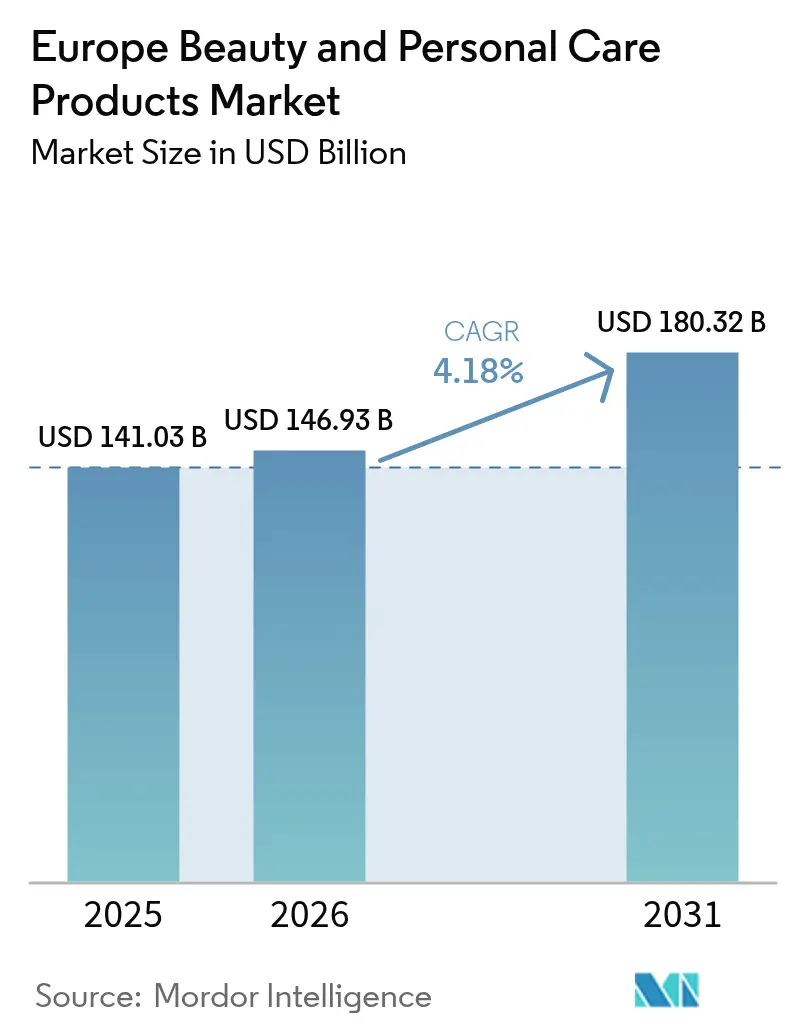
| Base Year Market Size (2025) | USD 141.03 Billion |
| Market Size (2026) | USD 146.93 Billion |
| Market Size (2031) | USD 180.32 Billion |
| Growth Rate (2026 - 2031) | 4.18 % |
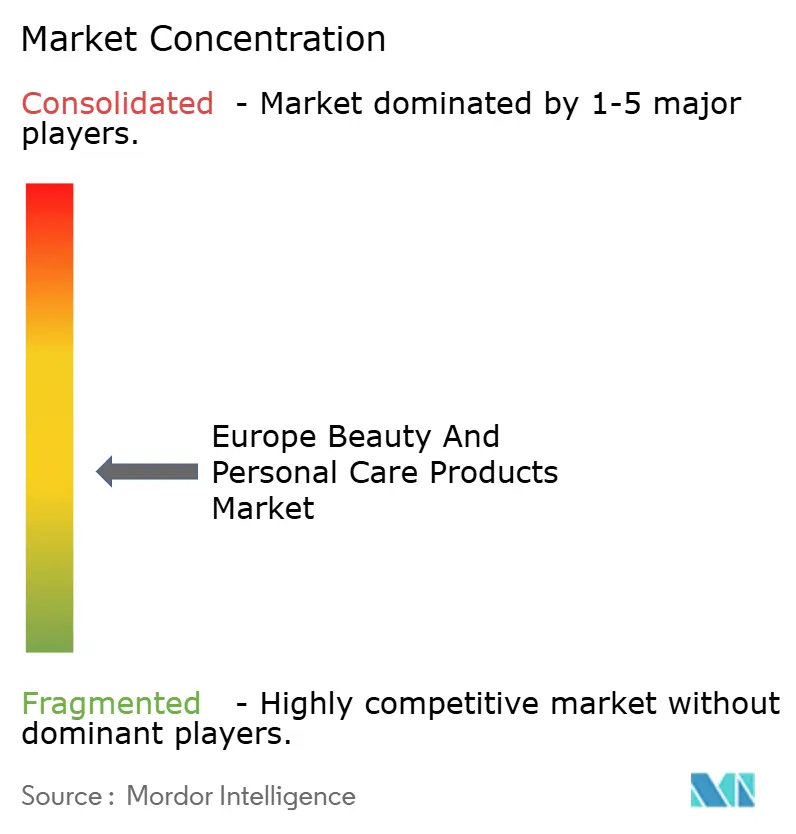
| Market Concentration | Medium |
Major Players
*Disclaimer: Major Players sorted in no particular order Image © Mordor Intelligence. Reuse requires attribution under CC BY 4.0. |
|
Europe Beauty And Personal Care Products Market Analysis by Mordor Intelligence
The Europe beauty and personal care products market size is expected to grow from USD 141.03 billion in 2025 to USD 146.93 billion in 2026 and is forecast to reach USD 180.32 billion by 2031 at 4.18% CAGR over 2026-2031. As online retail leverages data-driven personalization to boost margins, trends like premiumisation, natural-ingredient reformulations, and stringent sustainability laws are redefining value creation. Germany commands a substantial 15.83% share of the revenue pie, driven by its strong consumer base, robust infrastructure, and established market players. The United Kingdom also reflects its evolving market dynamics, increased focus on innovation, and adaptation to post-Brexit challenges. With a microplastics ban set to roll out by 2029, clean-label claims are gaining traction, steering brands towards vegetable-oil-based actives and promoting refillable packaging to meet consumer demand for sustainable and eco-friendly solutions. Annual losses of EUR 3 billion from counterfeits are significantly eroding consumer trust, prompting industry players to adopt advanced technologies like blockchain tagging and QR-based tracking[1]Source: European Union Intellectual Property Office,"Economic impact of counterfeiting in the clothing, cosmetics, and toy sectors in the EU", euipo.europa.eu. These measures aim to enhance supply chain transparency, ensure product authenticity, and rebuild consumer confidence in the market.
Key Report Takeaways
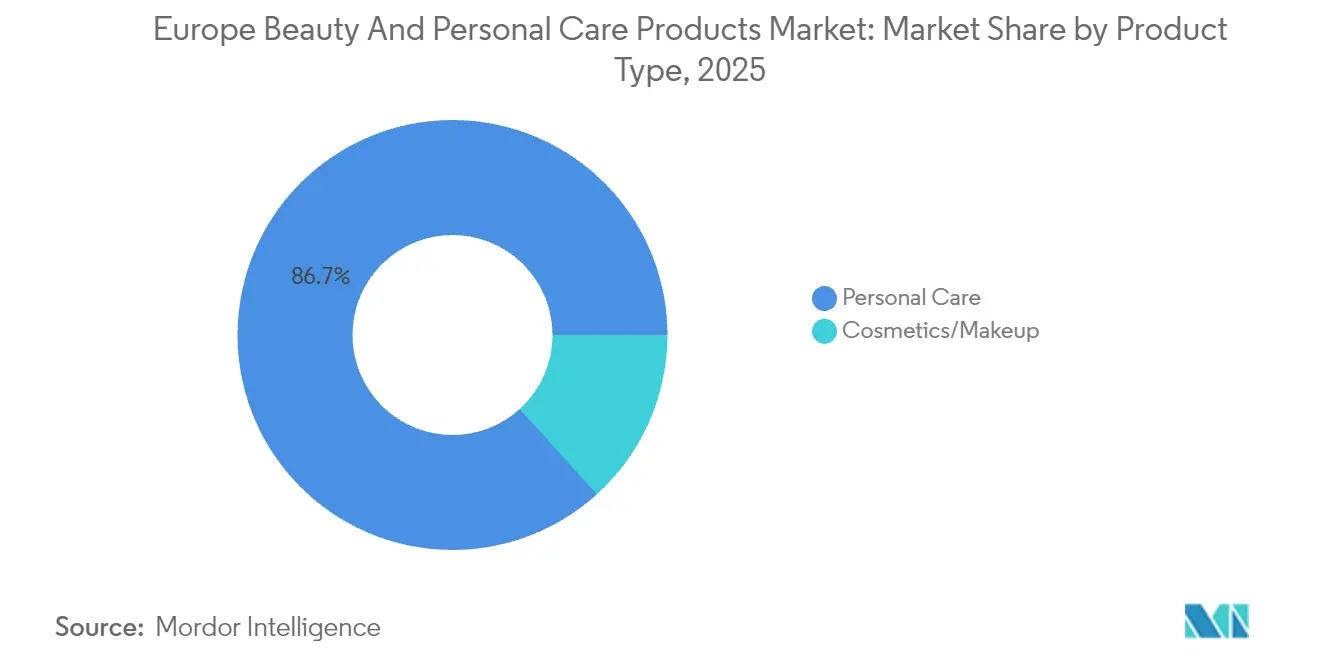
- By product type, personal care led the Europe beauty and personal care market with 86.72% share in 2025, whereas cosmetic products are set to post a 5.07% CAGR through 2031.
- By category, the mass segment captured 66.20% revenue in 2025, while premium products are projected to grow at a 5.03% CAGR between 2026-2031.
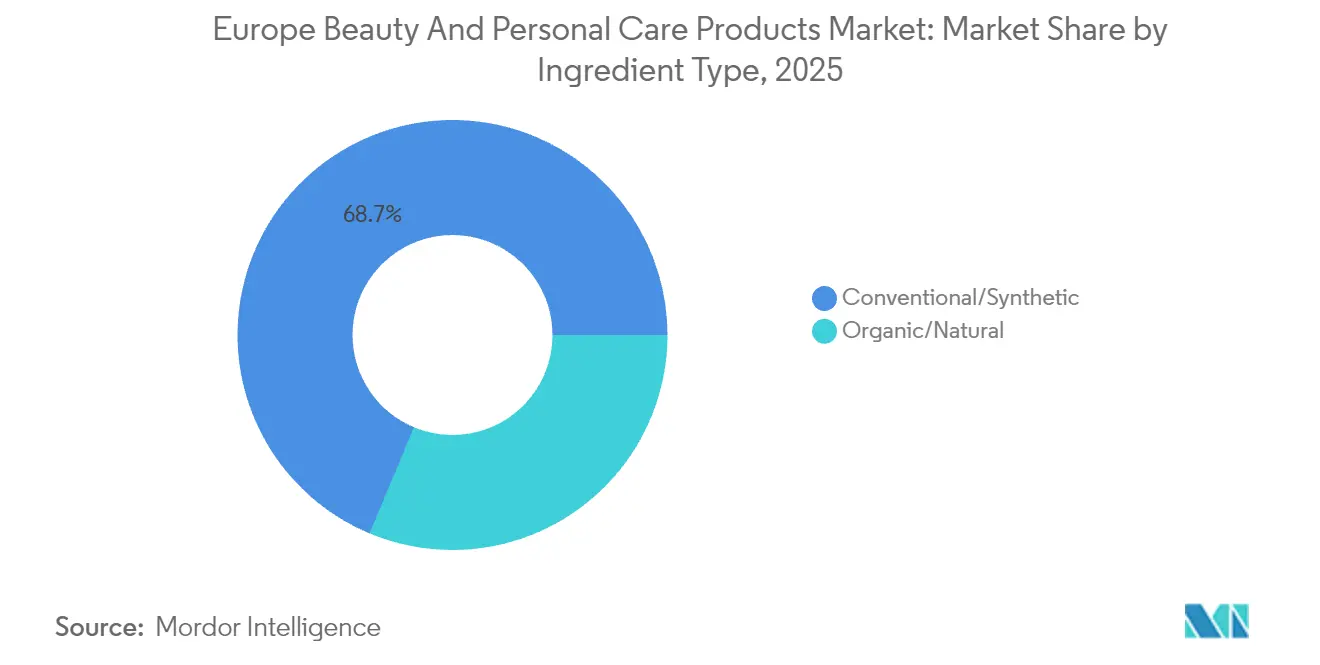
- By ingredient, conventional formulations retained 68.70% share in 2025 whereas natural and organic products are forecast to register a 5.74% CAGR to 2031.
- By distribution, pharmacies/drug stores accounted for 30.12% of 2025 sales, while online retail is on track for a 5.54% CAGR in the same horizon.
- By geography, Germany commanded 15.70% of the 2025 Europe beauty and personal care market share; the Poland represents the fastest-growing major market with a 6.93% CAGR expected to 2031.
Note: Market size and forecast figures in this report are generated using Mordor Intelligence’s proprietary estimation framework, updated with the latest available data and insights as of 2026.
Market Trends and Insights
Drivers Impact Analysis of Europe Beauty And Personal Care Products Market*
| Driver | (~) % Impact on CAGR Forecast | Geographic Relevance | Impact Timeline |
|---|---|---|---|
| Premiumisation outpacing mass-market growth | +1.2% | Western core; spreading East | Medium term (2-4 years) |
| Surge in online D2C and marketplaces | +0.8% | EU-wide; strongest Netherlands, Ireland, Denmark | Short term (≤2 years) |
| Preference for clean and microbiome formulas | +0.7% | Germany, France, Netherlands | Medium term (2-4 years) |
| Age-inclusive “skinification” of hair-care | +0.6% | Germany, United Kingdom, France | Long term (≥4 years) |
| AI-powered hyper-personalisation | +0.5% | United Kingdom, Germany, Netherlands | Medium term (2-4 years) |
| Oral-care awareness | +0.4% | Northern Europe | Long term (≥4 years) |
| Source: Mordor Intelligence | |||
Premiumization outpacing mass-market growth
In Europe, premium beauty and personal care lines are outpacing the overall market growth nearly twofold. Consumers now view high-performance formulations as everyday essentials rather than mere indulgences, driven by a growing preference for products that deliver tangible results. Products with dermatological validation and wellness-oriented claims command a higher price, as they align with the increasing consumer focus on health and self-care. This trend is exemplified by Beiersdorf's record sales of EUR 9.9 billion in 2024, largely fueled by innovations in its Eucerin skincare line, which combines scientific research with advanced formulations. Major multinationals are shifting their focus and capital towards prestige portfolios to capitalize on this demand. A case in point is Unilever's acquisition of Dr. Squatch, coupled with its ambition to elevate the premium segment's contribution to the group's turnover to 50%. Furthermore, brand equity, bolstered by clinical data and unique delivery systems, remains robust even amidst the prevailing cost-of-living challenges, as consumers prioritize quality and efficacy over cost.
Surge in online D2C and marketplaces
In 2024, 77% of EU residents shopped online, with cosmetics accounting for 20% of those purchases[2]Source: Eurostat,"Online shopping in the EU keeps growing", ec.europa.eu. The Netherlands leads with a 94% penetration rate, highlighting the country's swift embrace of digital beauty trends driven by high internet penetration, advanced e-commerce infrastructure, and consumer preference for convenience. Direct-to-consumer (D2C) platforms empower brands to gather zero-party data, such as customer preferences, purchase behavior, and feedback, enabling them to adjust product assortments on the fly, launch targeted marketing campaigns, and maintain gross margins that were once surrendered to brick-and-mortar retailers. Additionally, AI-driven shade-matching and virtual try-on features not only minimize returns by helping customers make more accurate selections but also enhance the overall shopping experience. These tools build consumer confidence in online purchases, ultimately driving higher sales conversions, fostering brand loyalty, and positioning brands to better compete in an increasingly digital marketplace.
Preference for clean and microbiome-friendly formulations
Starting February 2025, new restrictions on nano forms of copper, silver, gold, and platinum are prompting a significant shift towards botanicals and bio-ferments as alternative solutions. These restrictions are driving innovation in ingredient sourcing, formulation strategies, and product development within the beauty industry. In 2024, Europe accounted for 48% of global imports of vegetable and essential oils for beauty applications, bolstering a strong raw-material ecosystem that supports this transition[3]Source: Centre for the Promotion of Imports from developing countries", What is the demand for natural ingredients for cosmetics on the European market?", www.cbi.eu. This robust supply chain enables manufacturers to explore diverse natural ingredients and create sustainable formulations. Brands are increasingly blending natural profiles with clinically validated efficacy to meet consumer demands for both safety and performance. Additionally, emerging probiotic actives are playing a pivotal role in bridging narratives of skin health and immunity, offering multifunctional benefits that align with evolving consumer preferences and the growing focus on holistic wellness.
Age-inclusive “skinification” of hair-care
As Europe's population ages, the focus is shifting from mere color maintenance to ensuring scalp barrier integrity and nourishing hair follicles. This demographic shift has driven demand for advanced hair care solutions that address both aesthetic and health-related concerns. L’Oréal's foray into bioprinted skin models underscores the evolving testing protocols that meld skin science with hair-care assertions, enabling more precise and effective product development. These bioprinted models allow for innovative testing methods, reducing reliance on traditional approaches and accelerating the development of targeted solutions. In Germany and the UK, premium scalp serums, now touting ingredients like niacinamide and ceramides, are beginning to rival the positioning of their facial serum counterparts. These products not only promise enhanced scalp health but also command a premium price, reflecting their perceived value, efficacy, and alignment with consumer preferences for high-quality, multifunctional formulations.
Restraints Impact Analysis of Europe Beauty And Personal Care Products Market*
| Restraint | (~) % Impact on CAGR Forecast | Geographic Relevance | Impact Timeline |
|---|---|---|---|
| Counterfeit and grey-market channels | -0.6% | France, Italy, Romania most affected | Short term (≤ 2 years) |
| Retailer private-label price pressure | -0.5% | Western Europe supermarket chains | Medium term (2-4 years) |
| Fragmented eco-label regulations | -0.4% | EU-wide implementation challenges | Long term (≥ 4 years) |
| High manufacturing costs and raw material expenses | -0.3% | Manufacturing hubs: Germany, France, Italy | Short term (≤ 2 years) |
| Source: Mordor Intelligence | |||
Counterfeit and grey-market channels
In 2023, EU customs confiscated 152 million counterfeit items, collectively valued at a staggering EUR 3.4 billion. Notably, beauty and personal care products ranked among the top five categories affected, highlighting the vulnerability of this market to counterfeit activities. France bore a significant brunt, witnessing an EUR 800 million dip in legitimate cosmetics turnover. This substantial loss has not only impacted the nation's economy but also eroded consumer confidence in e-commerce platforms, where product authentication processes remain inadequate and opaque. The prevalence of counterfeit goods in online marketplaces has made it increasingly difficult for consumers to distinguish genuine products from fake ones, further exacerbating the issue. Furthermore, premium stock-keeping units (SKUs) have become prime targets for counterfeiters due to their higher profit margins, jeopardizing brand equity, inflating warranty expenses, and forcing companies to allocate additional resources to combat counterfeiting activities.
Retailer private-label price pressure
Recent retail disclosures reveal that leading supermarket groups are expanding their own-label lines, often pricing them 30-40% lower than national brands. This shift is driven by the growing consumer demand for affordable yet quality alternatives, allowing supermarkets to strengthen their competitive positioning and capture greater market share. These own-label products often offer comparable quality to national brands, making them increasingly attractive to cost-conscious consumers. To justify their premium pricing, established players are turning to patented actives, enhanced packaging experiences, and loyalty program benefits, which aim to create a distinct value proposition and retain customer loyalty. Alternatively, some are shifting towards private-label manufacturing to safeguard their sales volume, diversify their revenue streams, and adapt to the evolving market dynamics.
*Our forecasts treat driver/restraint impacts as directional, not additive. The impact forecasts reflect baseline growth, mix effects, and variable interactions.
Europe Beauty And Personal Care Products Market Segment Analysis
By Product Type:
Personal-Care Stability Anchors GrowthIn 2025, personal care dominated Europe's beauty and personal care landscape, accounting for 86.72% of total sales. This segment maintained a forward CAGR, demonstrating resilience as hygiene staples remain non-discretionary even during economic slowdowns. Within personal care, skin care emerged as the largest subcategory, valued at EUR 27.7 billion, fueled by rising demand for anti-aging solutions, treatments for hyperpigmentation, and products supporting barrier repair. Hair care followed closely, generating EUR 16.8 billion in revenue, supported by innovations such as scalp serums and sulfate-free cleansing bars. Oral care also benefited from a growing preventive-health mindset, further reinforcing personal care’s dominance. Mass-priced bath and shower products continued to secure steady baseline volumes, while sustainable packaging formats like refillable pouches and solid bars helped improve margins without sacrificing accessibility.
Within cosmetics, the segment recorded the fastest CAGR of 5.07%, driven by strong consumer demand for makeup and color cosmetics innovations. This growth reflects rising interest in premium formulations, multifunctional products, and inclusive shade ranges catering to diverse skin tones. Fragrance lines and color cosmetics benefited from trend-driven launches, social media influence, and increased digital engagement, further accelerating adoption. The momentum is also supported by targeted innovations in skincare-infused makeup and long-lasting formulations, creating opportunities for brands to capture value while meeting evolving consumer preferences.



By Category:
Premium Momentum Reshapes Value MixIn 2025, mass beauty and personal care products dominated the European market, accounting for 66.20% of total turnover. These offerings cater to a broad consumer base with accessible price points while maintaining strong quality standards, ensuring they remain staples in daily routines. Mass skin care, hair care, and bath and shower products continued to secure steady volumes, driven by demand for essential hygiene and grooming solutions. Brands are increasingly leveraging value packs, multi-use products, and sustainable packaging formats such as refillable pouches and solid bars to combine affordability with functionality.
Despite their already significant presence, premium products are set to be the market's fastest-growing segment, boasting a projected CAGR of 5.03% through 2031. This growth trajectory positions premium lines to account for half of all incremental industry revenue during this period, underscoring their pivotal role in market expansion. This surge is driven by consumers opting for performance-driven formulations and long-term benefits in essential skin care, even as they navigate cost-of-living challenges. While shoppers economize in certain beauty categories, they remain committed to high-efficacy premium skin-care items. Furthermore, luxury fragrance refill initiatives not only resonate with sustainability trends but also fortify brand loyalty, fostering an emotional bond that fuels growth. As mass-market segments wane either due to cautious spending or a shift to upgraded supermarket options, premium's innovation-led approach positions it for a swift ascent, outpacing all other market segments.
By Ingredient Type:
Natural Adoption AcceleratesIn 2025, conventional beauty and personal care formulations dominated the European market, securing a 68.70% share. These time-honored products, deeply woven into consumer routines, benefit from their widespread availability, competitive pricing, and consistent performance across categories. Even in the face of increasing regulatory scrutiny, such as the restrictions on cyclic silicones D5 and D6 and heightened oversight on microplastic content, conventional formats have maintained their lead, especially in high-performance sectors like color cosmetics. Synthetic pigments play a crucial role, ensuring stability, vibrancy, and longevity, which keeps them favored in performance-centric areas. Instead of complete overhauls, many mass and premium brands are opting for minor formulation adjustments, enabling compliance without compromising on texture or shelf life. This blend of market familiarity, proven effectiveness, and gradual adaptation solidifies the position of conventional formulas in the industry, even as regulations and consumer preferences evolve.
Natural and organic SKUs are emerging as the fastest-growing segment, with projections indicating a 5.74% CAGR in Europe's beauty and personal care market. This growth surge is largely attributed to regulatory shifts, especially the phaseouts of certain silicones and stricter microplastic regulations, which are hastening the move towards greener ingredients. There's a rising demand for plant-based actives like bakuchiol, squalane, and tremella mushroom, bolstered by advancements in green-chemistry processing that ensure a scalable and high-quality supply. Skincare leads this trend, especially as leave-on products face heightened ingredient scrutiny and consumers increasingly seek safer, sustainable options. Regulatory initiatives, such as Directive 2024/825, which mandates verifiable eco claims, have positioned certification bodies like COSMOS and NATRUE as pivotal players in ensuring transparency and trust. With consumer priorities shifting towards environmental responsibility and clean-label principles, natural and organic products are set to outpace the broader category growth.
By Distribution Channel:
Online Takes Structural LeadIn 2025, pharmacies and drug stores solidified their status as Europe's premier distribution channel for beauty and personal care, clinching a 30.12% market share. Their stronghold is deeply rooted in consumer trust, especially in dermatology-sensitive categories, where recommendations from pharmacists hold considerable sway. These establishments shine in high-credibility areas like dermocosmetics, therapeutic skincare, and other health-related beauty products. Even with the surge of e-commerce, pharmacies have carved out a niche, offering in-person consultations, tailored product selections, and expert advice, a level of service that online platforms struggle to match. Additionally, their role as a convenient one-stop destination for both prescriptions and over-the-counter beauty items boosts shopper frequency. As they adapt to the digital age with services like e-prescriptions and click-and-collect, pharmacies are steadfastly banking on their clinical credibility to uphold their leading position.
Online retail is poised to emerge as the quickest-growing channel for beauty and personal care, forecasting a robust 5.54% CAGR through 2031. This momentum is fueled by innovations like virtual consultations, mirroring in-store assistance, and same-day delivery, which bridge the convenience divide with brick-and-mortar outlets. Streamlined cross-border logistics have simplified access to international brands, propelling cosmetics to the forefront of e-commerce. Countries like The Netherlands and Ireland showcase a mature digital beauty landscape, while burgeoning online markets such as Romania and Hungary present untapped growth opportunities. The rise of social commerce, highlighted by livestreaming events, influencer-driven product launches, and direct-to-cart shopping during interactive sessions, is further propelling this trend. Moreover, subscription-based replenishment models are cementing customer loyalty, ensuring online retail's rapid ascent is matched by sustained revenue streams.
Geography Analysis
Germany Beauty and Personal Care Products Market
Germany, with a 15.70% share of Europe's beauty and personal care market in 2025, enjoys advantages like high per-capita spending, a leading stance on chemical safety regulations, and a consumer base that prioritizes proven efficacy. Domestic players, notably Beiersdorf, are channeling research and development into niches like sensitive skin and hyperpigmentation, bolstering premium sales. The country's focus on innovation and sustainability further strengthens its position in the market, as consumers increasingly demand eco-friendly and scientifically backed products.
Poland Beauty and Personal Care Products Market
Poland is emerging as the fastest-growing market in Europe, with a projected CAGR of 6.93% through 2031. Rapid increases in disposable incomes, widespread e-commerce adoption, and heightened consumer awareness are fueling demand for both mass and mass-premium products. Local consumers are increasingly seeking quality solutions at accessible price points, providing opportunities for brands to capture market share through tailored offerings and digital-first strategies.
Broader European Markets
France, Italy, and Spain continue to shape the landscape through category specialization: France leads in luxury fragrances, Italy leverages its artisan heritage in color cosmetics, and Spain’s sunny climate supports strong sales of UV-protection products. Eastern Europe, led by Poland, represents a strategic growth frontier, with evolving retail infrastructure and online channels amplifying market potential. The combination of rising consumer sophistication and improved access to diverse products underscores the region’s attractiveness for both established and emerging beauty and personal care brands.
Regulatory Landscape
Europe beauty and personal care products are primarily governed by Regulation (EC) No 1223/2009, with ongoing annex updates that affect permissible ingredient use, labeling requirements, and safety substantiation across the region. In 2026, the European Commission amended multiple annexes through Commission Regulation (EU) 2026/78 (effective 1 May 2026), updating provisions tied to substances classified as carcinogenic, mutagenic, or toxic for reproduction (CMRs). This keeps pressure on manufacturers and brand owners to maintain continuously updated Product Information Files (PIFs).
Regulatory change also accelerated in April 2026 with Commission Regulation (EU) 2026/909 (published 28 April 2026), which amended Annexes II, III, V, and VI of Regulation (EC) No 1223/2009. The update includes a prohibition for Triphenyl Phosphate and revises restrictions for multiple substances, including Benzyl Salicylate, Aluminium compounds, and Citral. Separately, in June 2026, European Parliament and Council negotiators reached a political agreement on an omnibus simplification package covering cosmetics, CLP-linked provisions, and related labeling rules, with an emphasis on reducing administrative burden while tightening timelines around hazardous substances. The combined direction raises the pace of compliance work and increases the value of regulatory affairs capabilities.
Competitive Landscape
The European beauty market showcases a moderate concentration, highlighting a competitive landscape where established multinationals vie with emerging niche players and aggressive private label expansions. L’Oréal, leveraging end-to-end integration and AI-driven demand sensing, boasts a commanding 19.8% operating margin. Unilever's 4.1% growth in its Q1 2025 Beauty and Wellbeing segment underscores the success of its premium strategy. Meanwhile, Beiersdorf, with its skin-science reputation, secures prime shelf space, even as pharmacy chains tighten their assortments.
There's a burgeoning demand for age-inclusive beauty products and microbiome-friendly formulations, presenting white-space opportunities. Disruptors are capitalizing on these gaps, utilizing direct-to-consumer models to sidestep traditional retail channels. Technology adoption stands out as a pivotal competitive edge. L'Oréal's ventures into bioprinted skin development and AI-generated marketing content via CREAITECH underscore how strategic innovation investments can carve out market advantages.
Incumbents are differentiating themselves through tech investments: L’Oréal's trials with bioprinted skin aim for cruelty-free efficacy validation, while Unilever delves into blockchain for ingredient traceability. The surge of private-labels in grocery channels is pushing prices down, nudging mass-segment leaders to either upscale their offerings or provide ready-to-use formulations to retailers. With the enforcement of microplastics bans and restrictions on nano-metals, consolidation in the industry seems imminent, favoring firms equipped with robust formulation pipelines and adept regulatory affairs teams.
Europe Beauty And Personal Care Products Industry Leaders
-
L'Oréal S.A.
-
Procter & Gamble Co
-
Unilever PLC
-
Beiersdorf AG
-
Estée Lauder Companies Inc.
- *Disclaimer: Major Players sorted in no particular order
Europe Beauty And Personal Care Products Market Companies Covered in this Report
- L'Oreal S.A.
- Unilever PLC
- The Procter & Gamble Co.
- Estee Lauder Companies Inc.
- Beiersdorf AG
- Shiseido Co. Ltd.
- Natura & Co.
- Colgate-Palmolive Co.
- Coty Inc.
- Henkel AG & Co. KGaA
- LVMH Mot Hennessy Louis Vuitton SE
- Johnson & Johnson Consumer Health
- KAO Corp.
- L'Occitane International SA
- Puig SL
- Oriflame Holding AG
- Wella Professionals
- Interparfums SA
- Amway Corp
- Groupe Clarins
Read Analysis of Europe Beauty And Personal Care Products Companies

Market Opportunities and Future Outlook
Reformulation and claims substantiation are opening whitespace for ingredient suppliers and finished-goods brands that can respond quickly to the updated annex restrictions. The April 2026 updates under Regulation (EU) 2026/909, within the broader framework of the EU Cosmetics Regulation (EC) No 1223/2009, increase demand for compliant fragrance and functional alternatives. Where restrictions overlap with common fragrance allergens such as citral and with ingredient usage across hair color and personal care, this supports differentiated portfolios in premium and dermocosmetic adjacencies, where efficacy validation and safety narratives carry pricing power.
Industrial capacity additions in France point to where companies are building capability for higher-value segments under tighter sustainability expectations. In May 2026, Pierre Fabre announced a EUR 50 million investment to double production capacity at its Avene plant to 200 million units by 2029, while Chanel opened a new 30,000-square-meter fragrance manufacturing facility in Venette in June 2026, with capacity of 50 million bottles annually following a EUR 150 million investment. In parallel, the June 2026 political agreement to expand digital labeling options under the EU simplification package creates space for brands and retailers to standardize compliant, cross-border product information delivery, while solution providers can support digital labeling, traceability, and packaging-related data workflows as labeling and sustainability requirements intensify.
Recent Industry Developments in Europe Beauty And Personal Care Products Market
- July 2026: L'Oréal entered into a 50-year exclusive worldwide beauty license with Kering for the Gucci brand, covering the development, creation, and distribution of fragrance and beauty products, with effect from July 1, 2027. The agreement strengthens long-horizon visibility for prestige beauty pipelines and can shift competitive positioning in European fragrance and selective channels through a major luxury house partnership.
- June 2026: L'Oréal launched the third edition of its global #JoinTheRefillMovement campaign, spanning 4 divisions, 18 brands, and 28 products, backed by refill manufacturing capabilities in Gauchy, Aulnay, Burgos, and Vichy. Scaling refill programs across multiple brands supports compliance-ready packaging strategies and helps normalize refill formats across European retail and D2C touchpoints.
- May 2024: Mono Skincare reintroduced a line of water-soluble, natural face care products, including a cleanser, makeup remover, scrub, toner, night serum, and moisturizing lotion. The relaunch adds competitive pressure in clean-label skin care by pairing natural positioning with routine-based regimen building suited to online discovery and pharmacy-adjacent distribution.


Europe Beauty And Personal Care Products Market Report Scope and Research Methodology
Market Definition and Coverage
For this study, the market covers the value of beauty and personal care products sold across Europe, spanning cosmetics/makeup and everyday personal care items that consumers buy for hygiene, grooming, and appearance.
Scope exclusions: We exclude beauty services and procedures, along with medical or prescription-led treatments that sit outside consumer beauty and personal care products.
Segments Covered in This Report
-
By Product Type
-
Personal Care
-
Hair Care
- Shampoo
- Conditioner
- Hair Colorant
- Hair Styling Products
- Others
-
Skin Care
- Facial Care Products
- Body Care Products
- Lip and Nail Care Products
-
Bath and Shower
- Shower Gels
- Soaps
- Others
-
Oral Care
- Toothbrush
- Toothpaste
- Mouthwashes and Rinses
- Others
- Men's Grooming Products
- Deodorants and Antiperspirants
- Perfumes and Fragrances
-
Hair Care
-
Cosmetics/Makeup Products
- Facial Cosmetics
- Eye Cosmetics
- Lip and Nail Makeup Products
-
Personal Care
-
Category
- Premium Products
- Mass Products
-
Ingredient Type
- Natural and Organic
- Conventional/Synthetic
-
Distribution Channel
- Supermarkets/Hypermarkets
- Pharmacies/Drug Stores
- Online Retail Stores
- Other Channels
-
By Geography
-
Europe
- Germany
- United Kingdom
- France
- Italy
- Spain
- Russia
- Netherlands
- Poland
- Belgium
- Sweden
- Rest of Europe
-
Europe
Data Sources, Market Sizing, and Validation
Desk Research
Desk research was used to build the base fact set on demand and trade flows, and to map what is happening in the channel mix across Europe. We relied on public, non-paywalled sources such as Eurostat for household spend and retail trade indicators, UN Comtrade for import and export trends, national statistics offices for price and consumption signals, and industry association publications such as Cosmetics Europe for category-level context.
In parallel, we reviewed company annual reports, investor presentations, and official press releases to understand shifts in brand mix, premium versus mass momentum, and distribution expansion across key countries. A paid subscription for company financials and another for news and financials were also used to speed up cross-checks on reported Europe exposure and the timing of major launches. The desk sources listed above are not exhaustive, and additional public references were used for data collection, validation, and clarification during the work.
Primary Interviews and Surveys
Primary work focused on interviews and short surveys with manufacturers, distributors, and retail-facing professionals who track category movement across Europe. We used these inputs to confirm how product revenue is counted, to sense-check price ladder shifts, and to validate country differences in online penetration, pharmacy channel strength, and premiumization.
Distribution of primary research fieldwork respondents
| Company type | Respondent position |
|---|---|
| Top tier: 27% | CXOs: 15% |
| Mid tier: 55% | Functional/Unit leaders: 39% |
| Smaller Players: 18% | Managers: 46% |
Market-Sizing & Forecasting
Sizing was built using a top-down approach where consumption and retail trade indicators were reconstructed by country and then rolled up to Europe, followed by category splits that reflect how products are purchased and priced. The totals were then checked with selective bottom-up approximations, mainly using sampled price bands multiplied by observed volumes in key channels, plus supplier and distributor feedback on share ranges.
Inputs that materially shaped the model included inflation and category price progression, premium versus mass mix changes, online share of beauty sales, pharmacy and drugstore channel importance by market, and import dependence signals that affect availability and pricing. Forecasts were formed using scenario analysis supported by short-run trend smoothing, then adjusted using expert expectations on normalization of price growth, continued premiumization, and channel shifts. Where a country-level data series had gaps, proxy indicators from similar markets were used, and the assumption was re-tested in interviews before being carried into the Europe roll-up.
Data Validation & Update Cycle
Outputs were checked through multiple steps so the numbers do not move just because one input changed. We compared market totals against independent signals such as retail sales indicators, trade movement, and commentary from large players covering Europe, and then investigated any outliers at the country level before sign-off.
A second analyst review was used to challenge scope, conversion rates, and how price effects were separated from real demand. Reports are refreshed annually, and interim updates are triggered when a material event shifts category pricing, channel access, or cross-border supply. Before delivery, a final pass is completed so the latest public data and interview learnings are reflected.
Mordor Intelligence's Europe Beauty and Personal Care Products Market Market Size Compared Against Other Published Estimates
Published market sizes for Europe beauty and personal care often do not line up, even when they use the same year. The counted revenue point and the included scope can shift between publishers.
Retail sales signals and association-led category totals are useful external checks, and those evidence points are tied into Mordor Intelligence's 2025 estimate by keeping the scope to product value across Europe and aligning category coverage to what is actually sold through core consumer channels.
Benchmark comparison
| Source | Market Size | Gaps in Research Methodology |
|---|---|---|
| Mordor Intelligence | USD 141.03 B (2025) | |
| Industry Association A | USD 115.00 B (2024) | This figure is based on retail sales in Europe for cosmetics and personal care, which can sit below a broader product-market value view because coverage and timing depend on retail reporting scope and currency conversion at that point in time. |
| Global Consultancy B | USD 96.40 B (2025) | The scope indicated for Europe cosmetics and personal care uses a narrower definition and may mix in services as a separate line, which tends to change what is counted as product revenue and can compress the comparable market value. |
The spread in the table is mainly explained by two choices that must be made consistently: whether the measure is retail sales or total product market value, and how tightly the product boundaries are set around cosmetics plus personal care. By keeping the inputs traceable to country demand indicators, channel structure, and repeatable price assumptions, the final total stays practical to validate and easier to update each year.


Key Questions Answered in the Report
How large is the Europe beauty and personal care market in 2026?
It is valued at USD 146.93 billion, with a 4.18% CAGR projected to 2031.
Which product category is growing fastest in Europe?
Premium beauty is expanding at a 5.03% CAGR owing to consumer trade-ups into clinically validated skincare.
What is the leading distribution channel for European beauty sales?
Pharmacies remain largest, but online retail is seeing the quickest growth at 5.54% CAGR.
Which European country holds the biggest beauty market share?
Germany leads with 15.70% share thanks to high consumer spending and product safety focus.
Page last updated on:


 Your data is secure and never sold or shared.


