
Asset-Backed Securities Market Size and Share
Market Overview
| Study Period | 2020 - 2031 |
|---|---|
| Market Size (2026) | USD 2.61 Trillion |
| Market Size (2031) | USD 3.47 Trillion |
| Growth Rate (2026 - 2031) | 5.86 % |
| Fastest Growing Market | Asia-Pacific |
| Largest Market | North America |
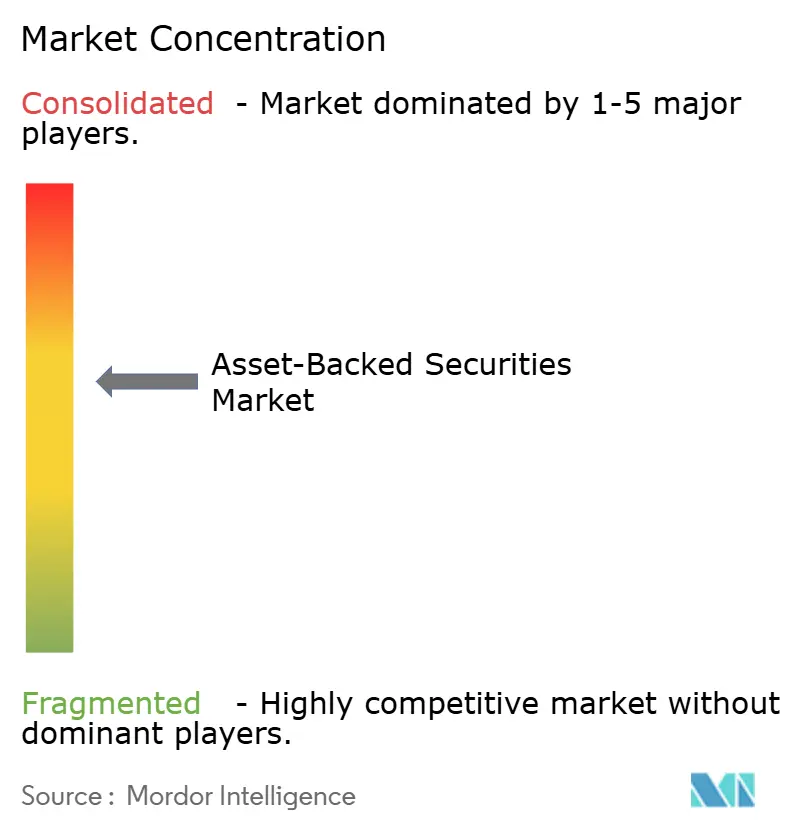
| Market Concentration | Medium |
Major Players *Disclaimer: Major Players sorted in no particular order Image © Mordor Intelligence. Reuse requires attribution under CC BY 4.0. | |
Asset-Backed Securities Market Analysis by Mordor Intelligence
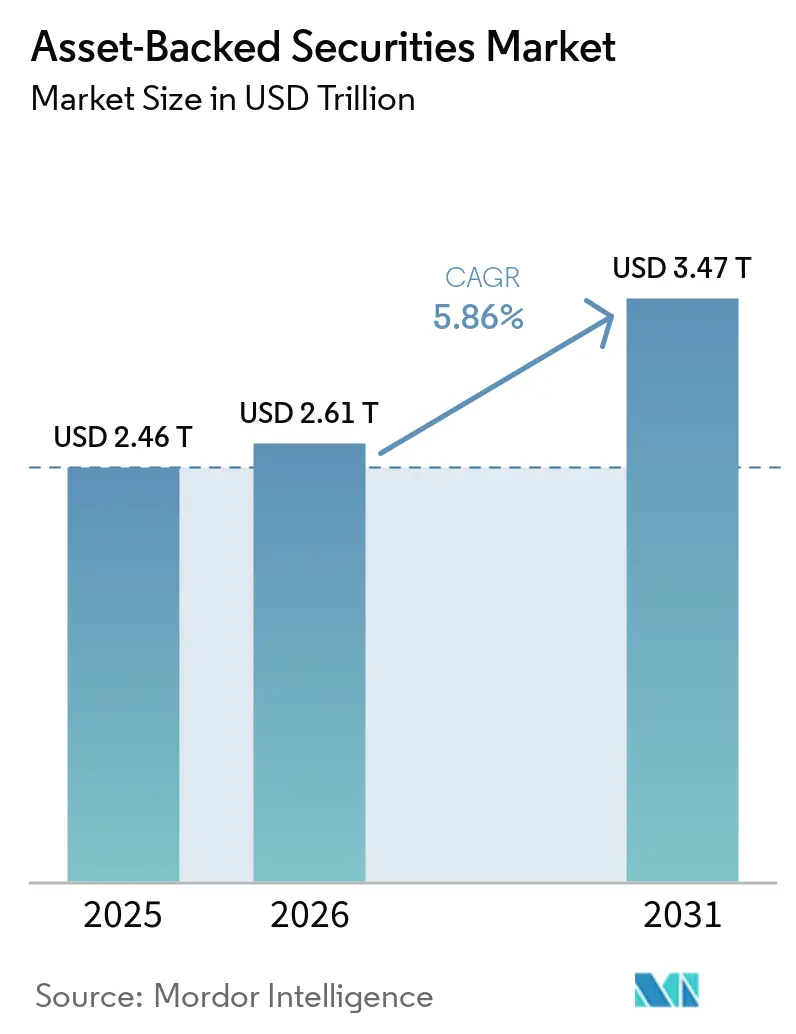
The Asset-Backed Securities Market size is expected to increase from USD 2.46 trillion in 2025 to USD 2.61 trillion in 2026 and reach USD 3.47 trillion by 2031, growing at a CAGR of 5.86% over 2026-2031.
The asset-backed securities market is being supported by steady institutional demand for yield-oriented fixed-income instruments, a broader range of securitizable collateral, and more efficient origination and pooling processes. The asset-backed securities market is also moving beyond traditional consumer receivables, with infrastructure-linked pools such as data center cash flows gaining more visibility in issuance pipelines. ABS issuers’ net financial asset acquisitions rose from USD 129.3 billion in 2024 to USD 194.0 billion in 2025, which supports the view that capital deployment into structured vehicles remained strong entering 2026. The asset-backed securities market remains led by North America due to deep liquidity, durable special-purpose vehicle frameworks, and established issuer programs, while Asia-Pacific is expanding faster on the back of broader origination activity. Competition in the asset-backed securities market is also shifting, as large bank dealers retain distribution strength while specialty finance platforms and AI-enabled non-bank originators scale issuance in newer collateral categories.
Key Report Takeaways
- By underlying asset, auto loan and lease ABS captured 36.57% of the asset-backed securities market share in 2025, while other or niche ABS is projected to grow at 8.89% CAGR through 2031.
- By issuer type, bank-sponsored and financial institution-led transactions accounted for 57.42% of the asset-backed securities market size in 2025, while specialty finance and non-bank lenders are projected to grow at 7.92% CAGR through 2031.
- By geography, North America captured 68.79% of the asset-backed securities market share in 2025, while Asia-Pacific is projected to grow at 8.47% CAGR through 2031.
Note: Market size and forecast figures in this report are generated using Mordor Intelligence’s proprietary estimation framework, updated with the latest available data and insights as of January 2026.
Market Trends and Insights
Drivers Impact Analysis of Asset-Backed Securities Market*
| Driver | (~) % Impact on CAGR Forecast | Geographic Relevance | Impact Timeline |
|---|---|---|---|
| Robust Investor Demand for Yield and Diversification | +1.8% | Global, concentrated in North America and Europe | Short term (≤ 2 years) |
| Growth in Non-Bank Lending Pipelines | +1.5% | Global, with Asia-Pacific and North America as core markets and spillover to Middle East and Africa | Medium term (2-4 years) |
| Expansion of Green and Sustainable Securitization | +0.8% | North America, Europe, with early gains in Asia-Pacific | Long term (≥ 4 years) |
| Issuance Migration Into Data Center and Infrastructure-Linked Collateral | +1.2% | North America, with early gains in Europe and Australia | Medium term (2-4 years) |
| Capital Diversification and Funding Optimization Across Jurisdictions | +0.9% | Global, strongest in cross-border active jurisdictions including the EU, the United Kingdom, and the United States | Medium term (2-4 years) |
| Automation of Underwriting, Pooling, and Investor Reporting Workflows | +0.7% | Global, with Asia-Pacific emerging | Long term (≥ 4 years) |
| Source: Mordor Intelligence | |||
Robust Investor Demand for Yield and Diversification
The asset-backed securities market continued to benefit from institutional demand as investors sought spread income beyond conventional government and corporate fixed-income instruments. February 2026 ABS issuance reached USD 36.9 billion, well above the prior three-year February average of USD 23.8 billion, indicating that investor demand absorbed supply despite seasonal constraints. Demand was broad across subprime auto, personal loans, solar ABS, aircraft loan and lease pools, and digital infrastructure, which reduced reliance on any single collateral segment. The Federal Reserve’s Flow of Funds data also showed that ABS issuers’ net financial asset acquisitions climbed from USD 129.3 billion in 2024 to USD 194.0 billion in 2025, pointing to deeper and more persistent capital allocation into structured credit vehicles[1]. This demand profile has helped keep spreads tight on investment-grade tranches and has reinforced the place of the asset-backed securities market in liability-matched portfolios. A wider investor base, now including insurance general accounts and sovereign investors, should keep the asset-backed securities market supported, even if individual collateral categories experience periods of uneven performance.
Growth in Non-Bank Lending Pipelines
The asset-backed securities market is drawing more collateral from non-bank originators because these lenders lack deposit funding and must rely more heavily on capital markets execution to scale. India’s securitization market reached INR 2.55 lakh crore, or approximately USD 30.6 billion, in FY2026, and NBFC originations rose 30% year over year, which offset a sharp decline in bank-led originations. In Australia, non-bank lenders also strengthened their role, with 42 public ABS deals totaling AUD 23.1 billion (USD 15.48 billion) in 2025, up from 38 deals totaling AUD 18.5 billion (USD 12.40 billion) in 2024. In the United States, unsecured consumer loan ABS issuance reached a record USD 25.6 billion in 2025, up 54% from USD 16.6 billion in 2024, reflecting the growing role of fintech and marketplace lenders in generating securitizable loan pools[2]. This expansion matters for the asset-backed securities market because it not only increases issuance volume but also widens the collateral base and brings in issuers that operate outside traditional bank origination channels.
Expansion of Green and Sustainable Securitization
The asset-backed securities market is also widening through green and sustainability-linked structures that now extend beyond renewable energy receivables into digital and battery-related infrastructure. Combined data center ABS and CMBS issuance reached USD 26 billion in 2025, more than 10 times the 2020 level, underscoring how quickly labeled infrastructure pools entered structured finance channels. Switch completed its fifth ABS issuance since 2024 in April 2026 and raised USD 768 million in AAA-rated Series 2026-1 notes, bringing its total ABS issuance since 2024 to approximately USD 4.2 billion under its Green Financing Framework[3]. Mirattery, the battery asset operator for NIO Inc., also issued a new green ABS tranche in June 2026 under a CNY 3 billion, or approximately USD 443 million, shelf registration, which broadened the use of securitization in the electric vehicle ecosystem. As these structures expand, collateral eligibility is becoming more closely tied to asset performance standards such as energy efficiency and battery certification, which should strengthen pool quality over time and help the asset-backed securities market attract a broader range of ESG-focused capital.
Issuance Migration Into Data Center and Infrastructure-Linked Collateral
The asset-backed securities market is seeing one of its clearest shifts in the growing use of data center and infrastructure-linked collateral. Data center and fiber network ABS combined for USD 7.4 billion in United States issuance in the first two months of 2026, more than double the USD 3.2 billion recorded in the same period of 2025, and full-year issuance is projected to exceed USD 40 billion. The use of master trust structures allows issuers to add new data center collateral over time without launching new transactions, reducing marginal issuance costs and supporting repeat program growth. This collateral also behaves differently from consumer pools because the cash flows are tied to long-term tenant contracts rather than household repayment cycles. Switch stated that 84% of revenue in its securitized pool came from investment-grade customers, which supports the view that this niche can act as a higher-quality structured credit alternative within the asset-backed securities market. The same pattern is now visible in music royalties and aviation structures, where recurring contracted cash flows are being isolated and priced more efficiently in public ABS markets.
Restraints Impact Analysis of Asset-Backed Securities Market*
| Restraint | (~) % Impact on CAGR Forecast | Geographic Relevance | Impact Timeline |
|---|---|---|---|
| Higher Regulatory Complexity Across Cross-Border Structures | -0.5% | EU, North America cross-border, Global | Medium term (2-4 years) |
| Credit Deterioration in Subprime Consumer Collateral | -0.4% | North America, with spillover to Europe | Short term (≤ 2 years) |
| SPV, Reporting, and Governance Complexity in Multi-Jurisdiction Issuance | -0.3% | Global, concentrated in cross-border active jurisdictions | Long term (≥ 4 years) |
| Spread Volatility from Geopolitical and Rate-Shock Risk | -0.3% | Global | Short term (≤ 2 years) |
| Source: Mordor Intelligence | |||
Higher Regulatory Complexity Across Cross-Border Structures
The asset-backed securities market faces a significant restraint due to the growing complexity of cross-border compliance and reporting rules. The SEC’s 2025 concept release on ABS disclosures sought market input on expanded asset-level disclosures for registered ABS, which signaled that compliance expectations may rise further for public transactions[4]. In Europe, the June 2025 proposal to amend the EU Securitization Regulation introduced reporting requirements that increase the burden on non-EU originators seeking European capital, especially when transactions must align with EU-prescribed templates. This matters because smaller or first-time issuers usually lack the reporting infrastructure that larger sponsors already maintain, which can raise structuring costs and narrow investor access. Over time, supervisory clarity may improve market consistency, but in the medium term, the asset-backed securities market is likely to see higher friction for cross-border deals than for domestic issuances.
Credit Deterioration in Subprime Consumer Collateral
The asset-backed securities market also faces pressure from weaker credit performance in subprime consumer collateral, especially in auto ABS. Fitch reported that the 60-day subprime auto delinquency index reached 6.90% in January 2026, the highest level in more than 30 years of tracking, while annualized net losses reached 9.63% at the end of 2025. The IMF’s October 2025 United States ABS Monitor also showed that 30-day-plus subprime auto delinquencies rose to 16% as of September 2025, while prime auto performance remained far lower at 1.9%. The pressure is not limited to delinquency levels because older vehicle collateral can push loss severity higher even if defaults stabilize. The Federal Reserve noted that auto loan delinquency rates resumed their upward trend in the third quarter of 2025, suggesting that collateral selection and vintage quality will remain central to performance differences across the asset-backed securities market.
*Our forecasts treat driver/restraint impacts as directional, not additive. The impact forecasts reflect baseline growth, mix effects, and variable interactions.
Asset-Backed Securities Market Segment Analysis
By Underlying Asset:
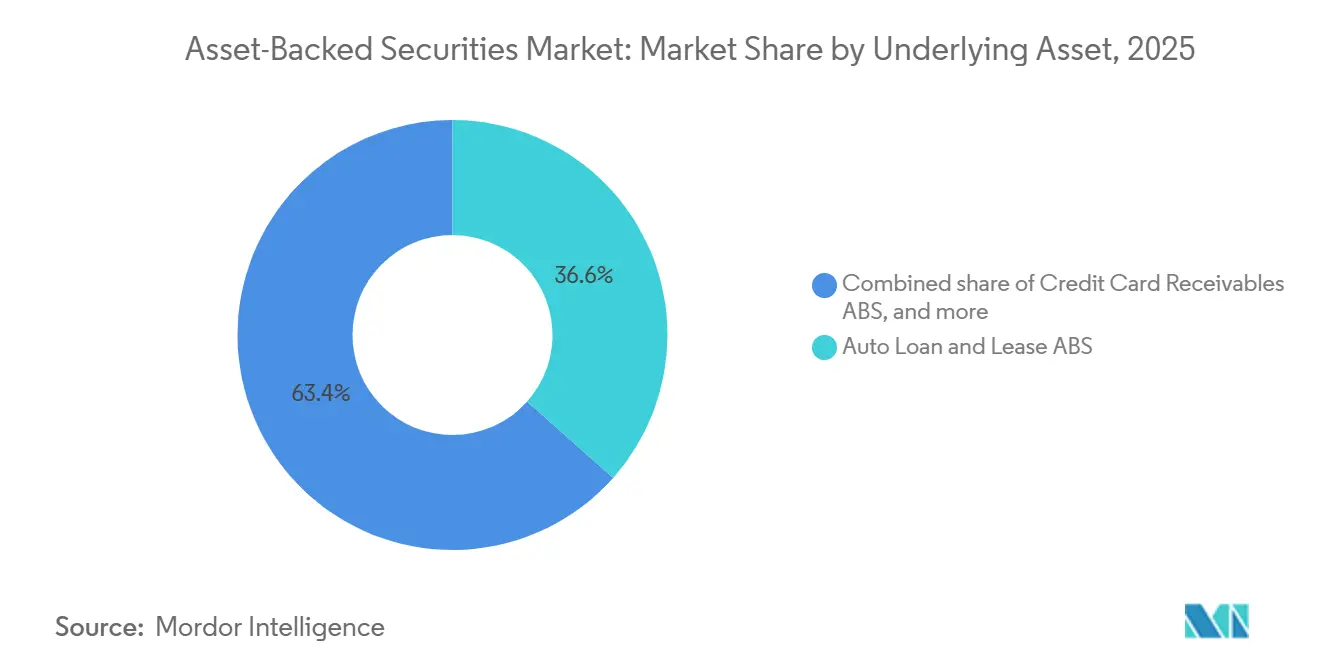
Auto ABS Anchors Market, Niche Collateral AcceleratesAuto loan and lease ABS accounted for 36.57% of the asset-backed securities market in 2025, reflecting its deep origination base, liquid secondary trading, and broad investor familiarity with collateral performance across prime and subprime tiers. Toyota Motor Credit, Ford Motor Credit, and Ally Financial continued to support this leadership through repeat issuance programs, and Ally returned with a USD 1.1 billion prime auto ABS backed by 59,907 receivables during 2025 and 2026 issuance activity. Credit card ABS faced a temporary pause in early 2026 after the proposed 10% APR cap created uncertainty, but Synchrony Financial returned with a USD 500 million transaction in March 2026, indicating that issuer access remained intact after the brief interruption. Student loan ABS continued to face policy-related constraints amid uncertainty around federal loan programs, while equipment lease and loan ABS remained important for mid-market manufacturing and technology lessors seeking capital-efficient funding. Consumer and personal loan ABS recorded especially strong momentum in 2025, with unsecured consumer loan ABS issuance rising to a record USD 25.6 billion, up 54% from 2024, underscoring the growing role of fintech-originated receivables in the asset-backed securities industry.
Other or niche ABS is projected to grow at 8.89% CAGR from 2026 to 2031, making it the fastest-growing underlying asset segment in the asset-backed securities market. This category includes data center receivables, aircraft leases, music royalties, and franchise loans, all of which are benefiting from stronger investor acceptance of contracted and recurring cash flow structures. Data center and fiber network ABS reached USD 7.4 billion in the United States issuance in the first two months of 2026 alone, which indicated that infrastructure pools are moving into a more programmatic part of the asset-backed securities industry. Apollo’s USD 1.765 billion Concord music catalog ABS in July 2025 and its USD 500 million Chord Music Partners transaction in April 2026 showed that royalty-backed structures are no longer isolated deals and are being placed with stronger investor conviction. Aviation-linked ABS also became more repeatable, as Apollo affiliate PK AirFinance completed USD 2 billion in cumulative aircraft loan ABS issuance between July 2024 and May 2025, which helped lower execution risk for investors evaluating non-traditional collateral.

By Issuer Type:
Banks Retain Scale Advantage While Non-Banks AccelerateBank-sponsored and financial institution-led transactions accounted for 57.42% of the asset-backed securities market in 2025, keeping banks in the leading position by issuer type. That lead was supported by deep investor relationships, stronger balance sheet credibility, and better ability to structure credit enhancements that satisfy rating agency and investor requirements at competitive cost. Captive finance companies remained an important middle layer in the asset-backed securities market, especially in auto ABS, where automotive subsidiaries such as Toyota Motor Credit and Ford Motor Credit continued to issue through well-established trust programs. The broader corporate originator category also expanded into niche areas, including franchise loan structures, utility receivables, and subscription-linked cash flow pools. This issuer mix shows that the asset-backed securities market still relies heavily on institutions with durable capital-market access, even as new origination channels continue to broaden the field.
Specialty finance and non-bank lenders are projected to grow at 7.92% CAGR from 2026 to 2031, making them the fastest-growing issuer category in the asset-backed securities market. Their expansion is tied to a simple funding reality, since lenders without deposits must securitize to scale and often move faster than banks in newer collateral pools. Pagaya Technologies closed approximately USD 3 billion in personal loan ABS transactions year to date through May 2026 across 4 deals, each of which was upsized above the initial target and supported by a network of more than 165 institutional investors. The growth path for this issuer group is also supported by the expanding interest of the United States credit unions in securitization, which points to a broader base of future non-bank sponsors across consumer, auto, and small-business lending. Over the forecast period, the asset-backed securities market is likely to see banks defend core categories while non-banks expand more quickly in receivables tied to AI-enabled lending, royalty streams, EV battery assets, and digital infrastructure.
Geography Analysis
The Americas Asset-Backed Securities Market
North America accounted for 68.79% of the asset-backed securities market in 2025, maintaining its position as the clear regional leader. The region’s scale rests on the deep United States securitization infrastructure, a mature investor base, durable disclosure norms, and long-standing legal precedent on bankruptcy-remote special-purpose vehicles. Kroll Bond Rating Agency projected United States ABS new issuance at approximately USD 385.2 billion in 2026, up 5% from 2025, indicating that the asset-backed securities market in the region still has volume momentum. Canada continued to contribute institutional-quality auto and residential collateral, while Mexico and South America remained earlier-stage ABS markets outside a deeper Brazilian domestic framework. A further advantage for North America is execution speed, as AI-enabled platforms are shortening the time between origination and issuance and reinforcing the region’s leadership in the asset-backed securities market.
Europe Asset-Backed Securities Market
Europe remained active in 2025 and 2026, with issuance moving above post-global financial crisis records and the region working to narrow its long-standing gap with the United States. Regulatory reform was central to that effort, as the June 2025 amendment proposal to the EU Securitization Regulation sought to streamline due diligence and simplify parts of the STS framework for market participants. This direction matters because the asset-backed securities market in Europe has historically been constrained as much by process burden as by investor appetite. Spain was one of the more active national markets during 2025 and 2026, and new transactions from auto lenders in Poland and Islamic finance originators in the United Kingdom widened collateral diversity. Data center securitization also began to gain traction in Europe following earlier United Kingdom and German transactions, signaling broader convergence between digital infrastructure funding and the asset-backed securities market.
APAC and MEA Asset-Backed Securities Market
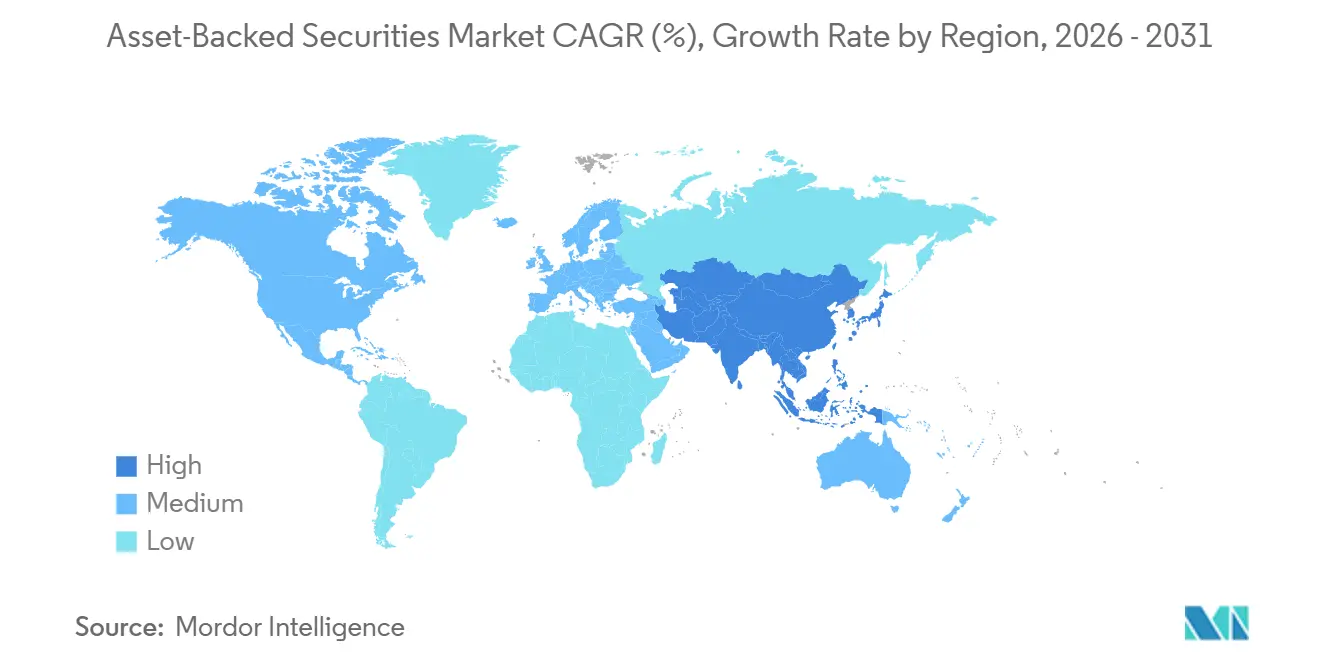
Asia-Pacific is projected to grow at 8.47% CAGR from 2026 to 2031, making it the fastest-growing regional segment in the asset-backed securities market. China recorded 2,435 new asset securitization transactions in 2025 with total issuance of CNY 2.33 trillion, while corporate ABS remained the dominant structure in the market’s product mix. India’s FY2026 securitization volume reached approximately USD 30.6 billion, and the originator base expanded to more than 190 participants, which showed that market depth is improving alongside scale. Australia is also becoming more important, with non-banks representing the majority of issuers, and total public issuance is expected to remain in the AUD 75 billion to AUD 80 billion range in 2026, while the country is also poised for its first data center securitization. Middle East and Africa remained at an earlier stage, but transactions such as Senelec’s 2025 utility receivables securitization in Senegal showed that the asset-backed securities market is gradually extending into frontier jurisdictions through more bespoke structures.
Competitive Landscape
The asset-backed securities market has a two-tier competitive structure, with a concentrated upper tier of large bank dealers and a broader lower tier of specialty originators, alternative asset managers, and AI-enabled platforms. Large banks such as JPMorgan Chase, Goldman Sachs, Citigroup, Bank of America, and Barclays continue to hold an advantage in structuring scale, investor access, and balance sheet support. That strength keeps them central to the pricing and distribution process across large benchmark transactions in the asset-backed securities market. At the same time, the competitive field is widening because specialist firms are developing origination-to-securitization capabilities in collateral pools that banks did not build at the same pace. This has created more room for competition in aviation, music royalties, data center finance, consumer fintech receivables, and other parts of the asset-backed securities market.
Technology has become one of the clearest competitive differentiators in the asset-backed securities market. Pagaya Technologies uses an AI-based underwriting platform that connects directly with originator loan decision systems, which allows faster pooling and more efficient capital markets execution across personal loans, auto, and point-of-sale finance. Pagaya closed an upsized USD 800 million AAA-rated personal loan ABS in May 2026 and reported nearly USD 38 billion in total issuance since 2018 across 89 ABS transactions, highlighting how repeatable issuance has become for AI-enabled non-bank platforms. Apollo also introduced AMAPS in 2026, a structured credit product backed by higher-quality assets and lower leverage than conventional CLOs, in an effort to define a new institutional structured credit category. These moves show that competition in the asset-backed securities market is no longer based only on origination volume, since operating infrastructure, underwriting models, and product design now shape who can scale efficiently.
Strategic execution in niche collateral is also reshaping the asset-backed securities market. Apollo’s Capital Solutions platform extended securitization across aviation, music catalog rights, and infrastructure-linked cash flows, and the April 2026 Chord Music Partners deal was priced at a record-tight 160 basis point spread for music royalty ABS. Switch built a repeat issuance model in data center ABS, with its April 2026 transaction marking the company’s fifth issuance since 2024 and taking cumulative issuance to approximately USD 4.2 billion. These examples show that leadership in the asset-backed securities market is becoming more specialized, with strong programs built around stable collateral access and repeat execution rather than only dealer scale. Even so, the upper tier remains influential because large banks still control much of the investor distribution network and continue to anchor the broad competitive structure of the asset-backed securities market.
Asset-Backed Securities Industry Leaders
-
JPMorgan Chase and Co.
-
Citigroup Inc.
-
Bank of America Corporation
-
Wells Fargo and Company
-
Goldman Sachs Group, Inc.
- *Disclaimer: Major Players sorted in no particular order
Asset-Backed Securities Market Companies Covered in this Report
- JPMorgan Chase and Co.
- Citigroup Inc.
- Bank of America Corporation
- Wells Fargo and Company
- Goldman Sachs Group, Inc.
- Morgan Stanley
- Barclays PLC
- Deutsche Bank AG
- BNP Paribas SA
- UBS Group AG
- BlackRock, Inc.
- PIMCO
- Apollo Global Management, Inc.
- KKR and Co. Inc.
- PAGAYA TECHNOLOGIES LTD.
- Synchrony Financial
- Toyota Motor Credit Corporation
- Ford Motor Credit Company LLC
- Ally Financial Inc.
- American Express Company
Recent Industry Developments in Asset-Backed Securities Market
- June 2026: Mirattery, the battery asset operator for NIO Inc., issued a new green ABS tranche on the Shenzhen Stock Exchange under a CNY 3 billion (approximately USD 443 million) shelf registration, the first shelf-registered green sci-tech power battery ABS on the exchange, opening a new collateral category in China's EV infrastructure securitization ecosystem.
- May 2026: Pagaya Technologies closed PAID-2026-3, an upsized USD 800 million AAA-rated personal loan ABS with 33 investors, bringing year-to-date personal loan ABS issuance to approximately USD 3 billion. Total issuance since 2018 reached nearly USD 38 billion across 89 ABS transactions, the highest programmatic cumulative total among non-bank personal loan ABS issuers.
- May 2026: Apollo Global Management launched AMAPS (Apollo Multi-Asset Prime Securities), a structured credit vehicle backed by higher-quality assets with lower leverage than conventional CLOs, positioning itself as a new institutional product category targeting sovereign wealth funds, third-party insurers, and large institutional allocators.
- April 2026: Apollo Global Management priced USD 500 million in music royalty ABS (Canon Music Issuer Trust, Series 2026-1) for Chord Music Partners, rated A by S&P Global Ratings and Kroll Bond Rating Agency, at the tightest-ever pricing for music royalty ABS at 160 basis points spread, demonstrating the maturation of niche intellectual property collateral as a programmatic ABS asset class.
Global Asset-Backed Securities Market Report Scope
Segmentation Overview
| Auto Loan and Lease ABS |
| Credit Card Receivables ABS |
| Student Loan ABS |
| Equipment Lease and Loan ABS |
| Consumer / Personal Loan ABS |
| SME / Commercial Business Loan ABS |
| Other / Niche ABS (e.g., Aircraft Leases, Franchise Loans, Royalty-Backed, Data Center Receivables, etc.) |
| Bank-Sponsored / Financial Institutions |
| Captive Finance Companies |
| Specialty Finance / Non-Bank Lenders |
| Other (e.g., Corporate Originators) |
| North America | United States |
| Canada | |
| Mexico | |
| South America | Brazil |
| Argentina | |
| Rest of South America | |
| Europe | United Kingdom |
| Germany | |
| France | |
| Italy | |
| Spain | |
| Rest of Europe | |
| Asia-Pacific | India |
| China | |
| Japan | |
| Australia | |
| South Korea | |
| South East Asia (Singapore, Malaysia, Thailand, Indonesia, Vietnam, and Philippines) | |
| Rest of Asia-Pacific | |
| Middle East and Africa | United Arab Emirates |
| Saudi Arabia | |
| South Africa | |
| Nigeria | |
| Rest of Middle East and Africa |
| By Underlying Asset | Auto Loan and Lease ABS | |
| Credit Card Receivables ABS | ||
| Student Loan ABS | ||
| Equipment Lease and Loan ABS | ||
| Consumer / Personal Loan ABS | ||
| SME / Commercial Business Loan ABS | ||
| Other / Niche ABS (e.g., Aircraft Leases, Franchise Loans, Royalty-Backed, Data Center Receivables, etc.) | ||
| By Issuer Type | Bank-Sponsored / Financial Institutions | |
| Captive Finance Companies | ||
| Specialty Finance / Non-Bank Lenders | ||
| Other (e.g., Corporate Originators) | ||
| By Geography | North America | United States |
| Canada | ||
| Mexico | ||
| South America | Brazil | |
| Argentina | ||
| Rest of South America | ||
| Europe | United Kingdom | |
| Germany | ||
| France | ||
| Italy | ||
| Spain | ||
| Rest of Europe | ||
| Asia-Pacific | India | |
| China | ||
| Japan | ||
| Australia | ||
| South Korea | ||
| South East Asia (Singapore, Malaysia, Thailand, Indonesia, Vietnam, and Philippines) | ||
| Rest of Asia-Pacific | ||
| Middle East and Africa | United Arab Emirates | |
| Saudi Arabia | ||
| South Africa | ||
| Nigeria | ||
| Rest of Middle East and Africa | ||
Key Questions Answered in the Report
What is the 2026 size of the asset-backed securities space?
The asset-backed securities market stands at USD 2.61 trillion in 2026 and is projected to reach USD 3.47 trillion by 2031 at a 5.86% CAGR.
Which underlying asset category leads issuance?
Auto loan and lease ABS led with 36.57% share in 2025, supported by deep issuer programs and strong investor familiarity with collateral performance.
Which issuer group is growing the fastest?
Specialty finance and non-bank lenders are the fastest-growing issuer group, with a projected 7.92% CAGR from 2026 to 2031.
Which region leads global activity?
North America led with 68.79% share in 2025 because of deep liquidity, established legal structures, and repeat issuance programs.
Which region is expanding the fastest through 2031?
Asia-Pacific is projected to grow at 8.47% CAGR through 2031, supported by expanding securitization activity in China, India, and Australia.
What is driving newer ABS collateral categories?
Growth is coming from data centers, music royalties, aviation finance, and EV-linked assets, where recurring or contracted cash flows are proving easier to securitize at scale.