
AI Resume Screening and Matching Market Size and Share
Market Overview
| Study Period | 2020 - 2031 |
|---|---|
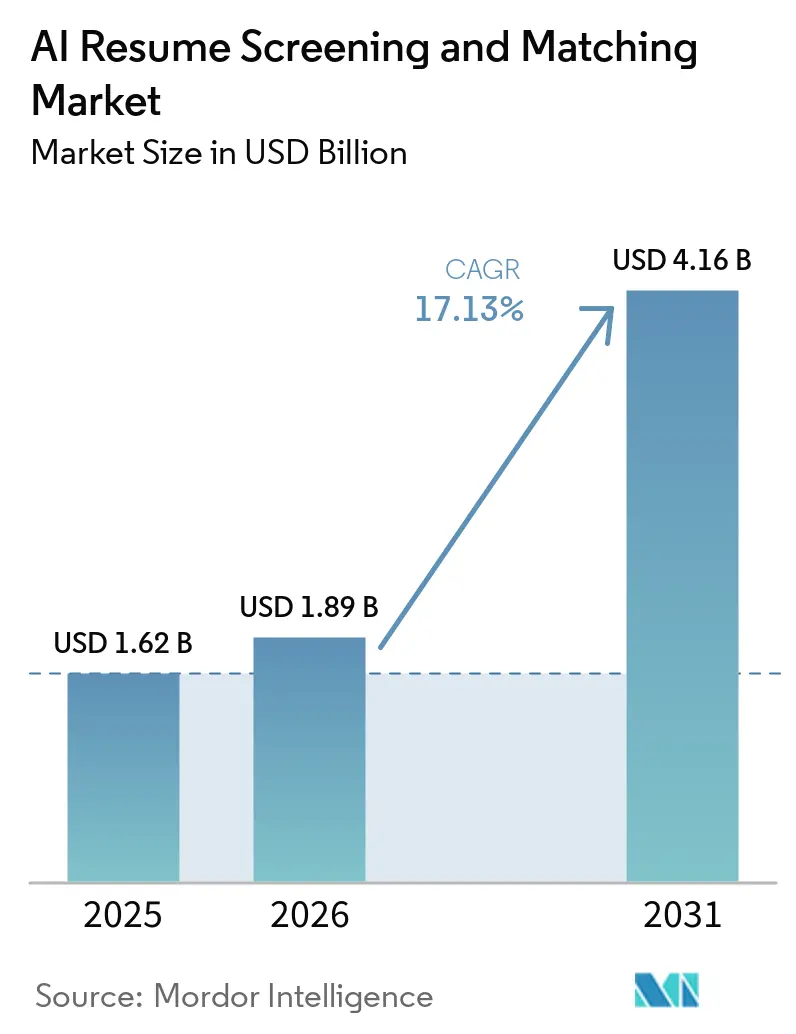
| Market Size (2026) | USD 1.89 Billion |
| Market Size (2031) | USD 4.16 Billion |
| Growth Rate (2026 - 2031) | 17.13 % |
| Fastest Growing Market | Asia-Pacific |
| Largest Market | North America |
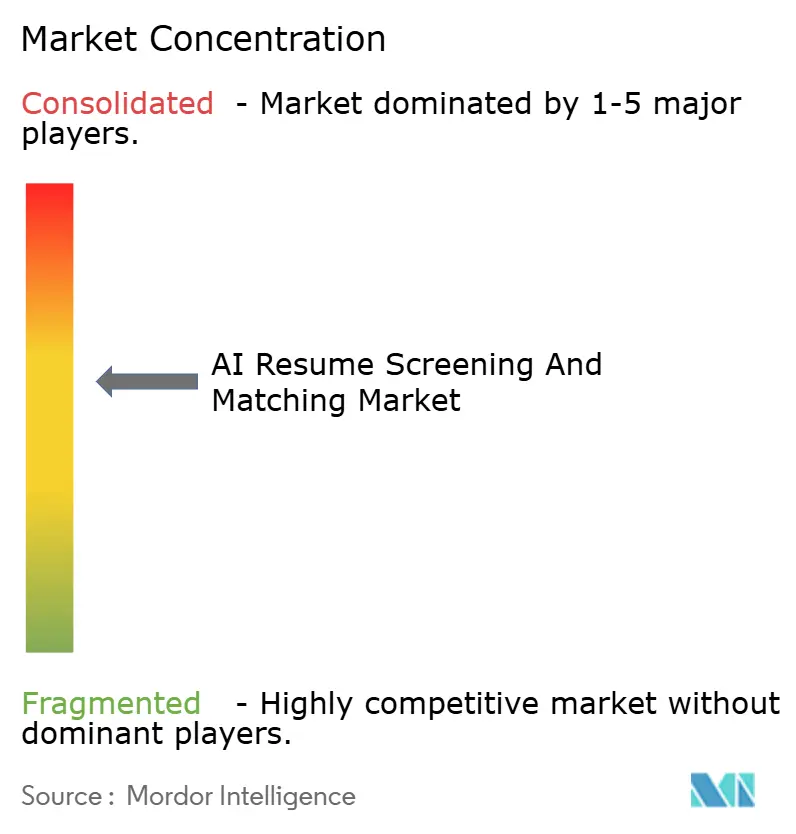
| Market Concentration | Medium |
Major Players *Disclaimer: Major Players sorted in no particular order Image © Mordor Intelligence. Reuse requires attribution under CC BY 4.0. | |
AI Resume Screening and Matching Market Analysis by Mordor Intelligence
The AI resume screening and matching market size is expected to grow from USD 1.62 billion in 2025 to USD 1.89 billion in 2026 and is forecast to reach USD 4.16 billion by 2031 at a 17.13% CAGR over 2026-2031. Rising application volumes, shrinking hire rates, and widening skills gaps are driving wholesale adoption of algorithmic screening that condenses recruiter workload and improves candidate discovery. Software still dominates value creation, yet services are scaling faster because enterprises need integration support, bias audits, and change-management guidance to extract tangible returns. Cloud deployment is accelerating as ISO 27001 and SOC 2 credentials ease residency concerns, while SMEs are closing the adoption gap thanks to subscription pricing under USD 150 per month. Vendor consolidation continues, but white-space remains in fraud detection and in internal mobility that re-engages past applicants and current staff.
Key Report Takeaways
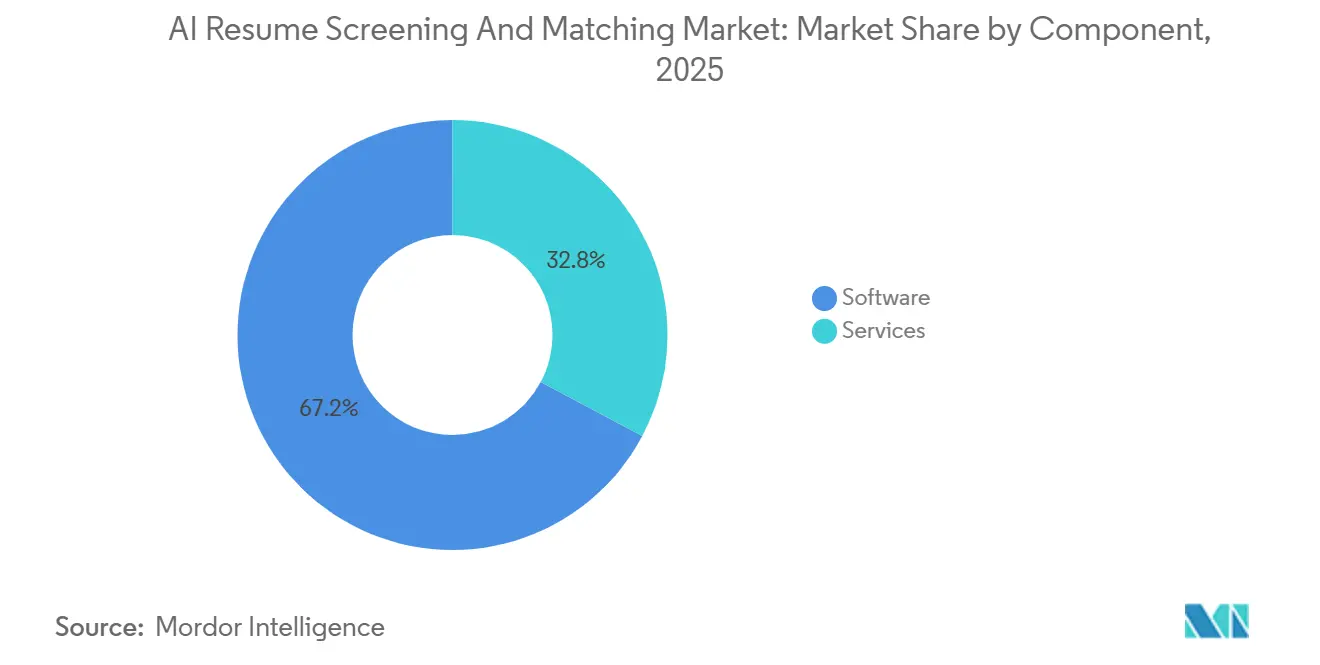
- By component, software led with 67.21% of AI resume screening and matching market share in 2025, while services are projected to register the fastest 19.04% CAGR through 2031.
- By deployment model, on-premises retained 59.88% share in 2025, whereas cloud solutions are forecast to expand at a 20.02% CAGR to 2031.
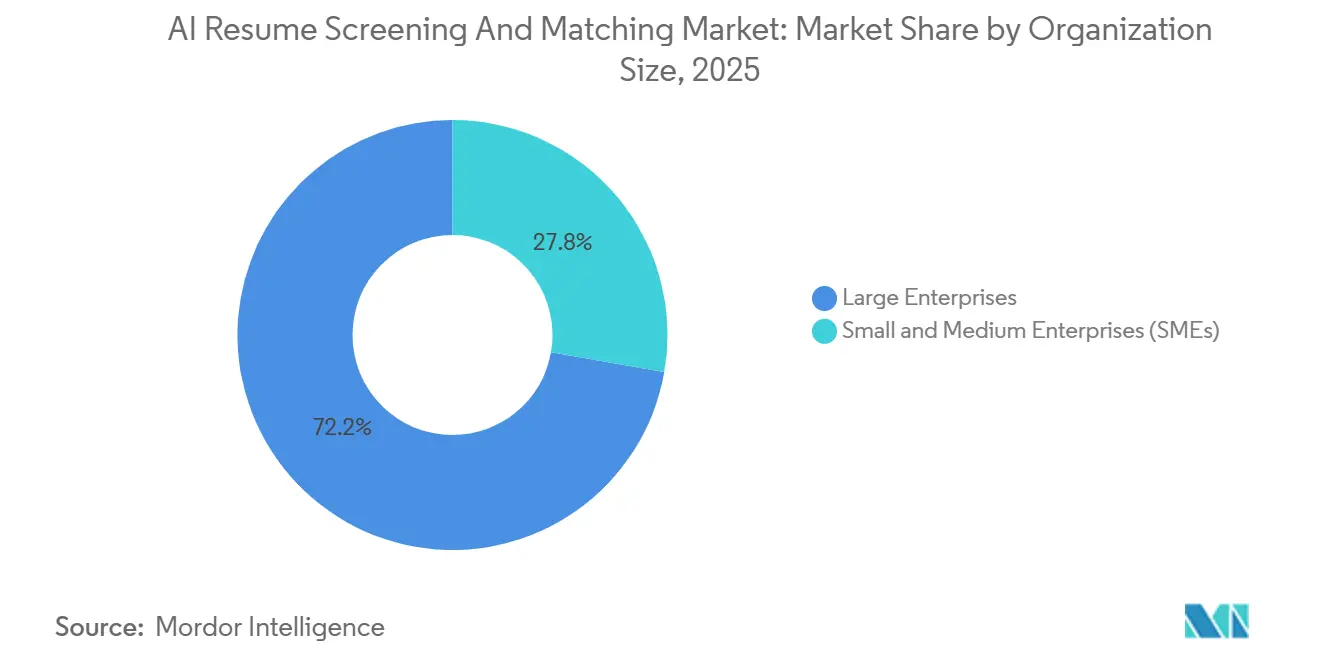
- By organization size, large enterprises accounted for 72.24% share in 2025, while small and medium enterprises are set to grow at a 19.55% CAGR.
- By end-use industry, information technology and telecom held 34.44% of revenue in 2025, and healthcare and life sciences are poised for an 18.24% CAGR.
- By geography, North America captured 36.61% share in 2025, but Asia-Pacific is projected to advance at an 18.77% CAGR.
Note: Market size and forecast figures in this report are generated using Mordor Intelligence’s proprietary estimation framework, updated with the latest available data and insights as of January 2026.
Global AI Resume Screening and Matching Market Trends and Insights
Drivers Impact Analysis*
| Driver | (~) % Impact on CAGR Forecast | Geographic Relevance | Impact Timeline |
|---|---|---|---|
| Accelerating Volume of Online Job Applications | +4.2% | Global, acute in North America and Europe | Short term (≤ 2 years) |
| Tightening Time-to-Hire Pressures in Competitive Labor Markets | +3.8% | Global, focused on IT/Telecom and Healthcare | Medium term (2-4 years) |
| Growing Availability of Pre-Trained Large Language Models | +3.5% | North America, Europe, Asia-Pacific | Medium term (2-4 years) |
| Rising Compliance Requirements for Fair-Hiring Regulations | +2.1% | Europe, United States | Long term (≥ 4 years) |
| Integration of Skills-Based Talent Intelligence Platforms | +1.9% | North America, Europe, early Asia-Pacific | Long term (≥ 4 years) |
| Adoption of AI-Driven Internal Mobility Programs | +1.7% | Global, led by large enterprises | Long term (≥ 4 years) |
| Source: Mordor Intelligence | |||
Accelerating Volume of Online Job Applications
Application volumes nearly doubled between 2021 and 2025, yet completed hires slipped as recruiter capacity lagged demand. Candidates increasingly submit AI-generated resumes, degrading signal quality and compelling employers to deploy semantic search that delivers up to 89% qualified-candidate discovery versus sub-50% for keyword filters. Recruiters that replaced manual screening with AI reported five-fold speed gains and 40% greater requisition capacity, though workflow bottlenecks now center on compensation alignment and approval cycles.[1]Gem, “How to Use AI in Recruiting: 10 Ideas,” gem.com Employers are increasingly investing in advanced recruitment technologies to address these challenges.
Tightening Time-to-Hire Pressures in Competitive Labor Markets
AI-native platforms compressed average time-to-fill to 14 days, half the traditional median, by automating scheduling, credential checks, and shift matching. Technical recruiters using AI search are 56% more likely to place talent within 20 days, giving early adopters a first-mover advantage. Internal mobility platforms that surface historical applicants and employees for new roles enable 40% faster fills and lower sourcing costs, with 44% of 2024 hires drawn from existing candidate databases rather than external pipelines.
Growing Availability of Pre-Trained Large Language Models
OpenAI, Claude, and Gemini have lowered the entry barrier for natural-language parsing and ranking, enabling multilingual resume extraction and skills inference that keyword systems miss. Yet governance maturity trails technical capability, only one-fifth of published bias mitigations have been field-tested, so employers still keep humans in the decision loop to satisfy regulators. Organizations are advised to treat LLMs as assistants that prioritize recruiter attention rather than autonomous decision-makers, maintaining human review for final selections and rejections to satisfy Equal Employment Opportunity Commission standards and emerging state-level audit requirements.
Rising Compliance Requirements for Fair-Hiring Regulations
The EU AI Act classifies CV-sorting tools as high-risk systems subject to bias audits and documentation, with penalties up to EUR 35 million (USD 39.55 million). Four U.S. states now impose divergent audit or disclosure mandates, forcing vendors to embed logging and bias-testing modules to avoid liability. The Mobley v. Workday litigation signals that vendor liability theories are gaining judicial traction, prompting enterprises to demand contractual indemnities, bias-audit deliverables, and audit rights in procurement agreements.
Restraints Impact Analysis*
| Restraint | (~) % Impact on CAGR Forecast | Geographic Relevance | Impact Timeline |
|---|---|---|---|
| Algorithmic Bias and Disparate Impact Litigation Risks | -2.3% | Global, acute in United States and Europe | Short term (≤ 2 years) |
| Data-Privacy Restrictions Limiting Candidate Data Use | -1.8% | Europe, United States, Middle East | Medium term (2-4 years) |
| Low AI Readiness Among Small Recruiting Teams | -1.4% | Global, concentrated in SMEs | Medium term (2-4 years) |
| Budget Freezes Amid Macroeconomic Slowdowns | -1.1% | Global, cyclical in North America and Europe | Short term (≤ 2 years) |
| Source: Mordor Intelligence | |||
Algorithmic Bias and Disparate Impact Litigation Risks
Only 26% of applicants trust AI to assess them fairly, and high-profile cases such as Mobley v. Workday have expanded plaintiffs’ theories of liability to vendors themselves, raising implementation costs and slowing adoption. Enterprises are implementing structural mitigations, anonymizing candidate names and demographic attributes before AI processing, conducting third-party fairness audits, and maintaining human-in-the-loop review for all final decisions. Yet these controls add cost and latency that partially offset efficiency gains, and regulatory fragmentation requires multi-jurisdictional compliance programs that smaller vendors struggle to sustain.
Data-Privacy Restrictions Limiting Candidate Data Use
GDPR’s Article 22 and the California Consumer Privacy Act restrict automated decision-making and data retention, compelling vendors to adopt federated learning and differential privacy, which remain technically nascent. Candidate consent steps can also increase drop-off, aggravating hiring funnels. The European Union AI Act requires high-risk systems to use high-quality datasets that minimize the risk of discriminatory outcomes. Middle East markets face stringent data-residency requirements, with organizations in Saudi Arabia and the United Arab Emirates required to deploy on-premises or in-region cloud solutions, which increase infrastructure costs.
*Our forecasts treat driver/restraint impacts as directional, not additive. The impact forecasts reflect baseline growth, mix effects, and variable interactions.
Segment Analysis
By Component: Services Expand as Integration Demands Intensify
Software commanded 67.21% of 2025 revenue in the AI resume screening and matching market, led by parsing engines that extract structured fields from unstructured documents and matching engines that scan 800 million-plus profiles for contextual fit. These tools shorten initial screening by 5 times and sustain recruiter bandwidth growth of 40% since 2021. The services segment, implementation, training, and managed screening, is forecast for a 19.04% CAGR and now packages ISO 27001-certified workflows that deliver 150+ monthly candidate evaluations with human oversight. Organizations select services to navigate bias audits and multi-system integrations that pure software cannot solve.
While software remains the backbone, buyers increasingly bundle consulting that redesigns workflows and embeds change-management playbooks. Recruitment process outsourcing partners claim 20-30% operating-expense savings by blending automation with bilingual analyst teams, yet 88% of HR leaders still report unrealized value, signaling that the AI resume screening and matching industry needs stronger focus on adoption maturity.


By Deployment Model: Cloud Adoption Accelerates Under Compliance Guardrails
On-premises installations maintained 59.88% share in 2025, favored by finance, healthcare, and Middle East clients that require localized data stewardship. These environments produce audit-ready logs and integrate with legacy HR information systems through custom APIs. Cloud deployment of AI resume screening and matching market solutions, however, is projected to grow at 20.02% as ISO 27001 and SOC 2 Type II certifications satisfy chief information security officers.
Cloud platforms push real-time feature releases, usage-based pricing, and more than 120 applicant-tracking connectors that SMEs value. Hybrid models are spreading, keeping personally identifiable information on-premises while allowing anonymized learning in vendor clouds, balancing sovereignty against constant algorithm updates.
By Organization Size: SMEs Narrow the Digital Divide
Large enterprises generated 72.24% of 2025 spending in the AI resume screening and matching market, leveraging budgets above USD 50,000 per year and demanding single sign-on, role-based controls, and global compliance dashboards. They also ask vendors for contractual bias indemnities and quarterly fairness reports.
SMEs, forecast for 19.55% CAGR, embrace off-the-shelf subscriptions under USD 150 per month that integrate in under two weeks and reclaim 50% of sourcing time. OECD surveys show 61% of SMEs already run at least one AI tool, but 39% report limited cybersecurity readiness, presenting cross-sell opportunities for bundled security add-ons.
By End-Use Industry: Healthcare Surges on Credentialing Complexity
Information technology and telecom accounted for 34.44% of 2025 revenue, exploiting skills graphs that map TensorFlow know-how to deep-learning roles and automate internal mobility pathways. Recruiters cite 25-35% cycle-time reduction through interview-day orchestration bots.
Healthcare and life sciences are projected to grow at an 18.24% CAGR on the back of license verification, exclusion checks, and multi-state scheduling challenges. Providers using conversational AI have cut interview-arrangement time by 97%, and time-to-hire by 75%, evidencing a strong fit between compliance-heavy workflows and automated screening.[2]Paradox, “AI Recruiting for the Healthcare Industry,” paradox.aiThe adoption of such technologies is expected to further streamline operations in the forecast period.
Geography Analysis
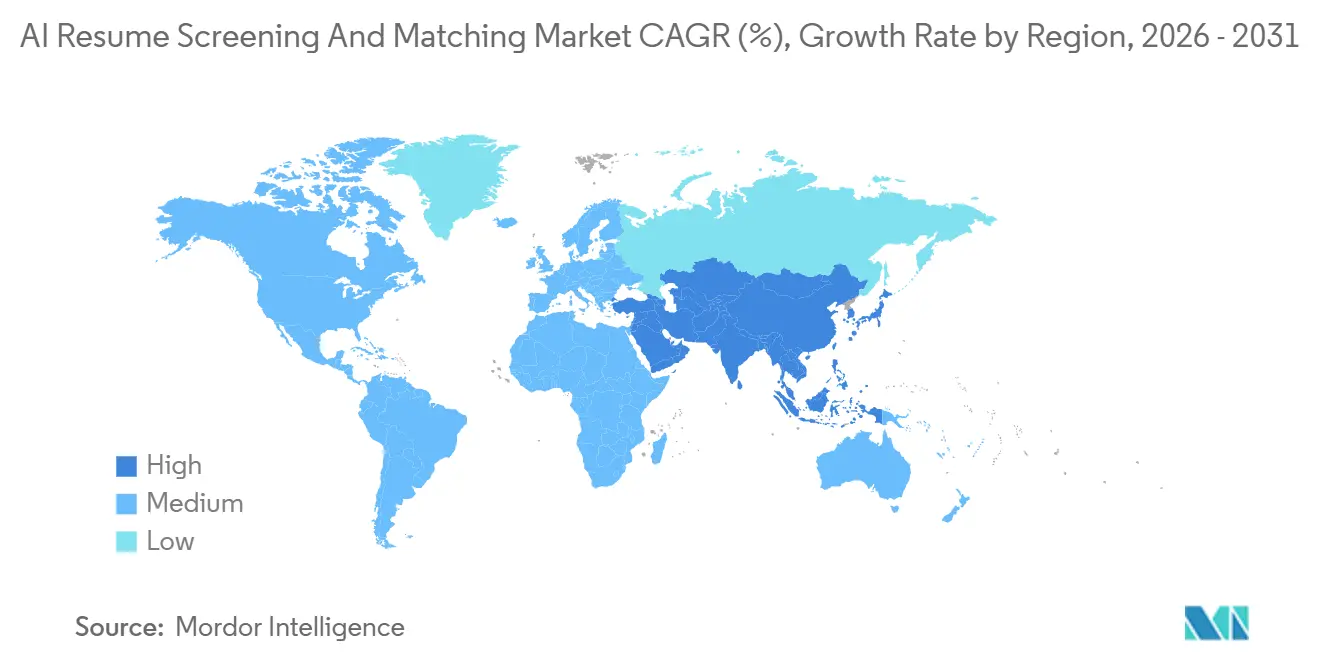
North America captured 36.61% of AI resume screening and matching market revenue in 2025, buoyed by early-stage venture funding and high application volumes. However, fragmented state rules now require multi-jurisdictional bias audits and candidate notices, prompting vendors to build configurable compliance engines. Canada and Mexico trail the United States but are scaling adoption through bilingual parsing that supports English-French and English-Spanish workflows.
Europe contributed roughly 25-28% of 2025 demand. The EU AI Act, enforceable from August 2026, mandates dataset documentation and human review, pushing enterprises to adopt audit dashboards and maintain six-month log retention. GDPR’s limits on special-category data oblige vendors to infer fairness without direct demographic fields, a still-evolving practice.[3]European Commission, “Regulatory Framework for AI,” europa.eu Eastern markets lag Western peers, yet Italy and Spain are accelerating cloud uptake under youth-employment initiatives, while Russia leans on domestic platforms insulated by sanctions.
Asia-Pacific is set to post an 18.77% CAGR, led by India’s outsourcing hubs, China’s manufacturing recruitment, and Japan’s succession-planning needs tied to an aging workforce. A May 2026 Hangzhou ruling restricted terminations tied solely to AI automation, signaling regulatory intent to balance efficiency with job security. South Korea, Australia, and the Middle East are moving to hybrid deployments to navigate strict data-residency laws yet still achieve 60-75% hiring-time reductions, whereas South America and Africa remain nascent adoption zones hindered by infrastructure gaps.

Competitive Landscape
Consolidation intensified as Bullhorn acquired Textkernel in June 2024 and Workday purchased Paradox in October 2025, embedding parsing, matching, and conversational AI inside core human capital suites. Phenom’s February 2026 acquisition of Be Applied underscored the shift toward skills-first assessments. Between 2020 and 2025, chatbots AllyO, Mya, Ideal, and Wade and Wendy were absorbed by larger platforms, highlighting feature commoditization.
Vendors sort into three archetypes: enterprise specialists such as HireVue and iCIMS targeting companies with 2,500-plus staff; full-platform suites like Eightfold and Gem bundling sourcing, screening, and scheduling for USD 100-500 monthly; and niche tools such as XOR and Talview that focus on high-volume frontline or proctored interviewing. Technical differentiation centers on semantic-search accuracy, 81-89% qualified-candidate recall, database scale exceeding 800 million profiles, and governance maturity that includes third-party fairness audits.
White-space remains in fraud detection, with models flagging 5-10% of submissions for fabricated credentials or AI-written cover letters, and in internal mobility where 62% of 2025 hires were filled internally but tooling is still immature. Customers cite 30-50% tech-stack savings when consolidating onto one platform, favoring well-capitalized players that offer bias indemnities and continuous compliance updates.
AI Resume Screening and Matching Industry Leaders
HireVue Inc.
Eightfold AI, Inc.
iCIMS Inc.
Phenom People, Inc.
Harver B.V.
- *Disclaimer: Major Players sorted in no particular order

Recent Industry Developments
- April 2026: Wilson selected Oleeo’s AI-first platform to modernize global recruiting strategies. This aims to streamline and enhance the recruitment process, ensuring efficiency and effectiveness in attracting top talent worldwide.
- March 2026: Oleeo unveiled a capability-validation screening model tested across 100 organizations. This model aims to streamline the recruitment process by assessing candidates' skills and qualifications more effectively.
- March 2026: Eightfold AI created a Customer Growth Organization and introduced the AI Growth Partner role. This initiative aims to enhance customer engagement and drive business growth by leveraging AI-driven solutions tailored to meet client needs.
- October 2025: Workday acquired Paradox, bringing 32 million annual interview-scheduling transactions in-house. This acquisition is expected to streamline recruitment processes and improve efficiency by consolidating scheduling capabilities within Workday's ecosystem.


Global AI Resume Screening and Matching Market Report Scope
The AI Resume Screening and Matching Market utilizes artificial intelligence and natural language processing to automatically parse resumes, assess qualifications, and align candidates with job requirements. These tools not only cut down manual screening time but also enhance the accuracy of shortlists and minimize repetitive hiring tasks. With integrations into ATS/HCM systems, many of these tools are now leveraging generative AI for crafting summaries, insights, and candidate fit scores. The market's growth is spurred by high application volumes, an overwhelmed recruitment landscape, and a pressing need for data-driven talent filtering.
The AI Resume Screening and Matching Market Report is Segmented by Component (Software, and Services), Deployment Model (On-Premises, and Cloud-Based), Organization Size (Small and Medium Enterprises [SMEs], and Large Enterprises), End-Use Industry (Information Technology and Telecom, Banking Financial Services and Insurance, Healthcare and Life Sciences, Retail and E-Commerce, Manufacturing, and Other End-Use Industries), and Geography (North America, South America, Europe, Asia-Pacific, Middle East, and Africa). The Market Forecasts are Provided in Terms of Value (USD).
| Software | Resume Parsing Engines |
| Candidate Matching Engines | |
| Screening and Ranking Tools | |
| Talent Intelligence / Skills Graph Platforms | |
| Other Software | |
| Services | Implementation and Integration Services |
| Training and Support Services | |
| Managed / Outsourced Screening Services |
| On-Premises |
| Cloud-Based |
| Small and Medium Enterprises (SMEs) |
| Large Enterprises |
| Information Technology and Telecom |
| Banking, Financial Services and Insurance |
| Healthcare and Life Sciences |
| Retail and E-Commerce |
| Manufacturing |
| Other End-Use Industries |
| North America | United States |
| Canada | |
| Mexico | |
| South America | Brazil |
| Argentina | |
| Rest of South America | |
| Europe | Germany |
| United Kingdom | |
| France | |
| Italy | |
| Spain | |
| Russia | |
| Rest of Europe | |
| Asia-Pacific | China |
| Japan | |
| India | |
| South Korea | |
| Australia and New Zealand | |
| Rest of Asia-Pacific | |
| Middle East | Saudi Arabia |
| United Arab Emirates | |
| Turkey | |
| Rest of Middle East | |
| Africa | South Africa |
| Nigeria | |
| Rest of Africa |
| By Component | Software | Resume Parsing Engines |
| Candidate Matching Engines | ||
| Screening and Ranking Tools | ||
| Talent Intelligence / Skills Graph Platforms | ||
| Other Software | ||
| Services | Implementation and Integration Services | |
| Training and Support Services | ||
| Managed / Outsourced Screening Services | ||
| By Deployment Model | On-Premises | |
| Cloud-Based | ||
| By Organization Size | Small and Medium Enterprises (SMEs) | |
| Large Enterprises | ||
| By End-Use Industry | Information Technology and Telecom | |
| Banking, Financial Services and Insurance | ||
| Healthcare and Life Sciences | ||
| Retail and E-Commerce | ||
| Manufacturing | ||
| Other End-Use Industries | ||
| By Geography | North America | United States |
| Canada | ||
| Mexico | ||
| South America | Brazil | |
| Argentina | ||
| Rest of South America | ||
| Europe | Germany | |
| United Kingdom | ||
| France | ||
| Italy | ||
| Spain | ||
| Russia | ||
| Rest of Europe | ||
| Asia-Pacific | China | |
| Japan | ||
| India | ||
| South Korea | ||
| Australia and New Zealand | ||
| Rest of Asia-Pacific | ||
| Middle East | Saudi Arabia | |
| United Arab Emirates | ||
| Turkey | ||
| Rest of Middle East | ||
| Africa | South Africa | |
| Nigeria | ||
| Rest of Africa | ||


Key Questions Answered in the Report
What is the current AI resume screening and matching market size and how fast is it growing?
The AI resume screening and matching market size reached USD 1.62 billion in 2025 and is projected to grow to USD 4.16 billion by 2031 at a 17.13% CAGR (Mordor Intelligence).
Which segment is expanding fastest within the market?
Services are set to grow at a 19.04% CAGR because enterprises need integration, bias auditing, and managed-screening expertise (Mordor Intelligence).
Why are SMEs adopting AI resume screening tools?
Subscription pricing under USD 150 per month and plug-and-play cloud integrations allow SMEs to shorten sourcing time by 50% without large IT projects.
What regulations most affect AI-based resume screening in Europe?
The EU AI Act classifies CV-sorting tools as high-risk systems that must undergo bias testing, human oversight, and extensive documentation, with penalties up to EUR 35 million.
How does AI reduce time-to-hire for healthcare providers?
Conversational AI automates scheduling, license checks, and shift matching, cutting interview-arrangement time by 97% and time-to-hire by 75% in multi-facility systems.
Page last updated on:


 Your data is secure and never sold or shared.


