
Skills-Based Hiring Platform Market Size and Share
Market Overview
| Study Period | 2020 - 2031 |
|---|---|
| Market Size (2026) | USD 4.05 Billion |
| Market Size (2031) | USD 9.04 Billion |
| Growth Rate (2026 - 2031) | 17.41 % |
| Fastest Growing Market | Asia-Pacific |
| Largest Market | North America |
| Market Concentration | Medium |
Major Players *Disclaimer: Major Players sorted in no particular order Image © Mordor Intelligence. Reuse requires attribution under CC BY 4.0. | |
Skills-Based Hiring Platform Market Analysis by Mordor Intelligence
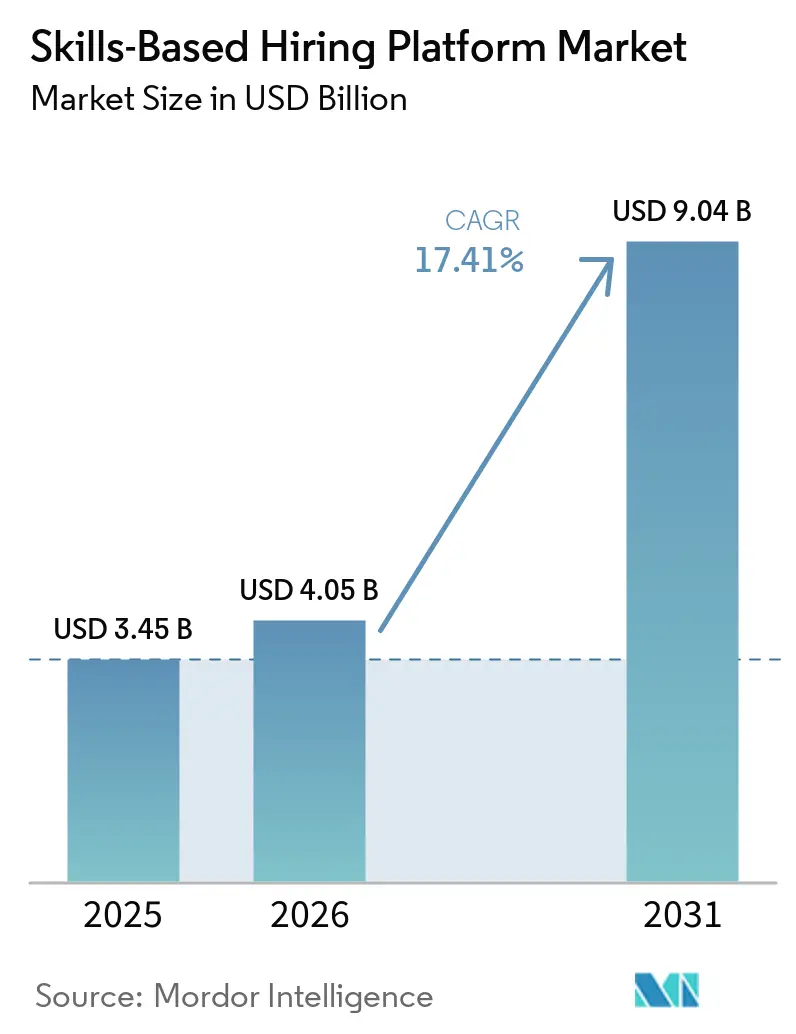
The skills-based hiring platform market size was valued at USD 3.45 billion in 2025 and estimated to grow from USD 4.05 billion in 2026 to reach USD 9.04 billion by 2031, at a CAGR of 17.4% during the forecast period (2026-2031). Widespread replacement of credential screens with competency validation, transparency mandates for algorithmic hiring tools, and global diffusion of government skills taxonomies are lifting platform demand. Enterprises also view the technology as a hedge against accelerated reskilling cycles triggered by artificial intelligence, so they are expanding assessment budgets despite broader software rationalization. Consolidation is under way as larger vendors buy specialty providers to bundle behavioral science, bias audit dashboards, and lifecycle talent decisioning. At the same time, white-space niches, healthcare clinical skills, precision trades, and financial-services compliance knowledge, remain under-served, supporting healthy new-entrant dynamics that keep the skills-based hiring platform market firmly in growth mode.
Key Report Takeaways
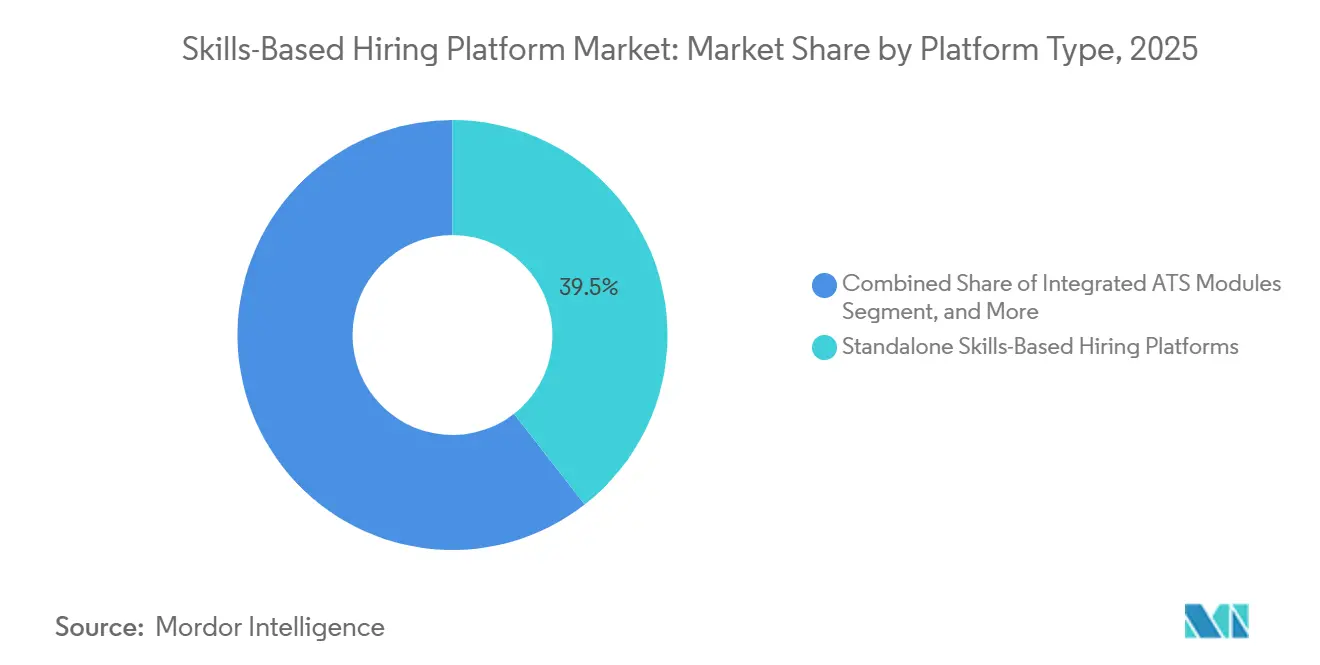
- By platform type, standalone offerings held 39.45% of the skills-based hiring platform market share in 2025, while gamified assessment platforms are advancing at a 19.34% CAGR to 2031.
- By deployment mode, on-premises solutions commanded 67.14% revenue in 2025, whereas cloud-based systems are projected to rise at a 20.04% CAGR through 2031.
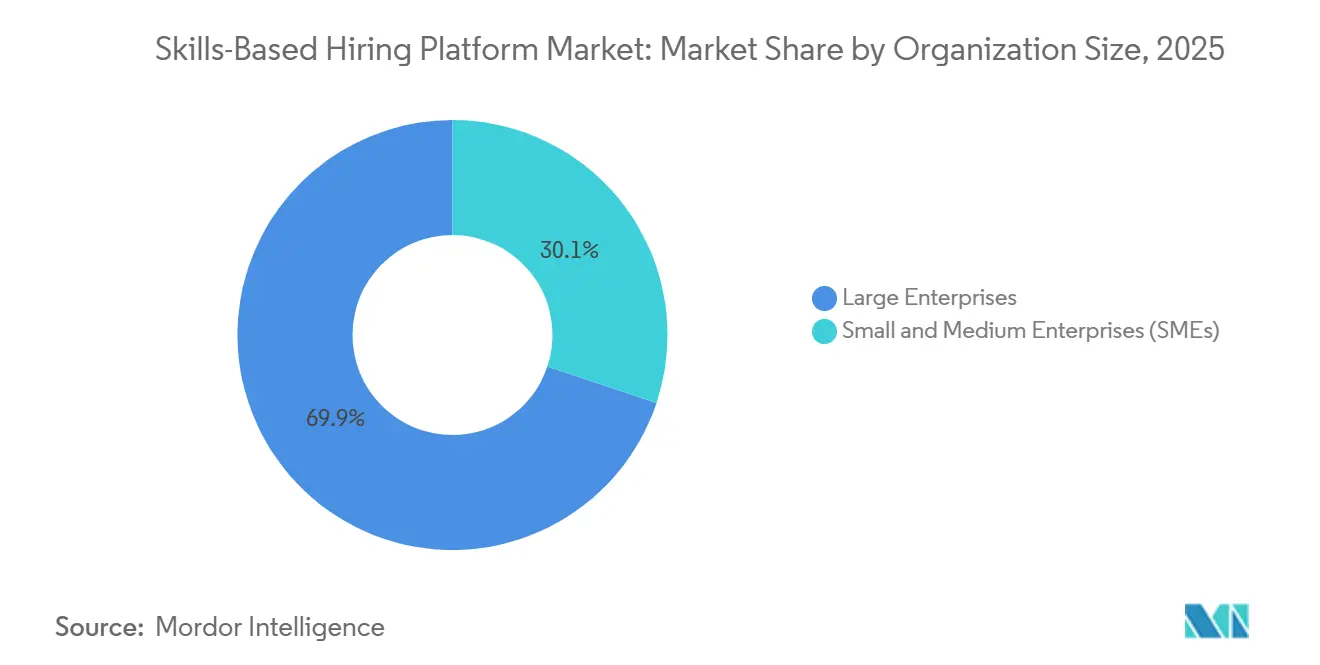
- By organization size, large enterprises generated 69.88% of 2025 spending, but small and medium enterprises are scaling usage at a 19.71% CAGR on the back of usage-based pricing and low-code onboarding.
- By end-use industry, IT and telecom led with 28.31% of 2025 demand, yet retail and e-commerce usage is forecast to climb at an 18.66% CAGR to 2031.
- By geography, North America accounted for 36.76% of global revenue in 2025, while Asia-Pacific is set to expand at an 18.91% CAGR over the forecast horizon.
Note: Market size and forecast figures in this report are generated using Mordor Intelligence’s proprietary estimation framework, updated with the latest available data and insights as of January 2026.
Global Skills-Based Hiring Platform Market Trends and Insights
Drivers Impact Analysis*
| Driver | (~) % Impact on CAGR Forecast | Geographic Relevance | Impact Timeline |
|---|---|---|---|
| Shift Toward Competency-Based Recruitment to Reduce Bias | +4.2% | Global, led by North America and European Union | Medium term (2-4 years) |
| Integration of AI and Analytics to Enhance Talent Matching | +3.8% | Global, strongest in North America, EU, and Asia-Pacific hubs | Short term (≤ 2 years) |
| Growing Adoption of Remote Hiring Practices Post-Pandemic | +2.9% | Global, with highest uptake in North America and Europe | Short term (≤ 2 years) |
| Increasing Demand for Faster Time-to-Hire Metrics | +2.5% | Global, most acute in North America and Asia-Pacific | Medium term (2-4 years) |
| Emerging Government Skills Taxonomies Driving Platform Standardization | +1.8% | North America, India, EU member states | Long term (≥ 4 years) |
| Rise of Micro-Credential Verification Via Blockchain | +1.1% | Global, early pilots across EU and North America | Long term (≥ 4 years) |
| Source: Mordor Intelligence | |||
Shift Toward Competency-Based Recruitment to Reduce Bias
Twenty-seven percent of employers removed bachelor’s-degree requirements from job postings in 2025, up sharply from 2020, confirming that credential screens are being replaced by validated assessments. Washington State’s Executive Order 24-04 created a public-sector template for competency hiring and has already been echoed by other U.S. states. Platforms embedding bias dashboards and adverse-impact calculators now win regulated-sector contracts where compliance risk is greatest.
Integration of AI And Analytics to Enhance Talent Matching
New York City Local Law 144, Illinois HB 3773, and the soon-to-be-enforced EU AI Act impose bias-audit and disclosure mandates on automated hiring, driving vendors to add real-time explainability modules.[1]European Commission, “EU AI Act,” ec.europa.euMcKinsey’s 2026 “State of Organizations” survey shows firms using human-centric AI are 1.6 times more likely to hit ROI targets, reinforcing the payoff from compliant analytics. Well-capitalized providers absorb these costs and widen product gaps via real-time assessment generation, reinforcing competitive moats even as smaller peers struggle to clear compliance hurdles.
Growing Adoption of Remote Hiring Practices Post-Pandemic
Sixty-eight percent of enterprises conducted fully remote hiring for at least some positions in 2025, versus 32% in 2019, and time-zone flexibility ranked among the top three benefits for HR leaders. Companies deploying skills-based assessments cut median time-to-hire by 12 days compared with résumé-only workflows. Online assessments compensate for the loss of face-to-face cues and provide richer skill analytics.
Increasing Demand for Faster Time-to-Hire Metrics
Chronic scarcity in AI, cybersecurity, and renewable-energy roles means slow offers translate directly into lost talent. Skills platforms parallelize screening and automatically rank candidates, letting hiring managers issue offers sooner and cut wage-premium leakage. Vendors that refresh content libraries continuously to mirror emerging competencies win favor because they minimize lag between job-market evolution and assessment relevance.
Restraints Impact Analysis*
| Restraint | (~) % Impact on CAGR Forecast | Geographic Relevance | Impact Timeline |
|---|---|---|---|
| Limited Integration with Legacy HRIS and ATS Systems | -2.1% | Global, particularly North America and Europe | Short term (≤ 2 years) |
| Data Privacy and Compliance Challenges Under Global Regulations | -1.8% | EU, North America, Asia-Pacific | Medium term (2-4 years) |
| Skepticism from Hiring Managers Lacking Assessment Literacy | -1.3% | Global, amplified in SMEs and non-tech sectors | Medium term (2-4 years) |
| Shortage of High-Quality Skill Assessment Content in Niche Domains | -0.9% | Global, especially healthcare, manufacturing, emerging tech | Long term (≥ 4 years) |
| Source: Mordor Intelligence | |||
Limited Integration with Legacy HRIS and ATS Systems
Most human-resource information systems were built around résumé files, not normalized skill profiles, so data-model misalignment inflates implementation timelines and pushes total cost of ownership higher. Buyers either fund bespoke connectors or accept fragmented workflows, delaying adoption among cost-sensitive mid-market firms. Vendors offering turnkey integrations and middleware that translate skills ontologies into legacy field structures mitigate this drag and accelerate revenue conversion.
Data Privacy and Compliance Challenges Under Global Regulations
Cognitive scores, personality traits, and video recordings are classed as sensitive data under GDPR, CCPA, and sector-specific statutes. Enforcement against automated decision systems is rising, fines are climbing, and regulators demand explicit candidate consent plus algorithmic transparency. Maintaining audit logs, localized storage, and cross-border transfer safeguards now consumes a double-digit share of vendor operating budgets, reinforcing scale advantages for incumbents with mature governance teams.
*Our forecasts treat driver/restraint impacts as directional, not additive. The impact forecasts reflect baseline growth, mix effects, and variable interactions.
Segment Analysis
By Platform Type: Engagement-Focused Gamification Gains Share
Standalone systems accounted for 39.45% of the skills-based hiring platform market share in 2025, yet gamified assessment platforms are growing at a 19.34% CAGR as employers seek higher completion rates and richer behavioral insight.[2]Harver, “Harver Acquires Pymetrics,” harver.com The Future of Jobs 2025 report ranks creative thinking, resilience, and curiosity among the fastest-rising skills, traits better measured through interactive scenarios than static surveys.
Skill-assessment API vendors let enterprises embed tests into proprietary portals, but they off-load accessibility and localization burdens onto buyers, a trade-off some mid-market HR teams underestimate. IMF research shows that firms advertising new-economy skills tend to be younger and more innovative, implying a correlation between technical maturity and API adoption.



By Deployment Mode: Cloud Momentum Accelerates
In 2025, on-premises deployments commanded a 67.14% market share, predominantly in regulated sectors where compliance and data security concerns drive adoption. However, cloud subscriptions are experiencing significant growth, with an annual increase exceeding 20%. This growth is fueled by vendors establishing regional data centers to address latency and regulatory requirements, as well as offering advanced security features like bring-your-own-key encryption.
Cloud HR tool adoption among firms with fewer than 50 employees rose from 2020, showcasing the growing preference for cloud-based solutions. Hybrid models, which retain data locally while leveraging vendor clouds for computation, are gaining traction due to their ability to balance data sovereignty with scalability. However, cost comparisons increasingly favor full SaaS solutions, putting pressure on traditional on-premises providers to innovate or risk losing market share.
By Organization Size: SMEs Benefit From Usage-Based Pricing
In 2025, large enterprises dominated the revenue landscape, claiming 69.88% of the total. However, SMEs are carving out a significant niche, boasting a robust 19.71% CAGR. This surge can be attributed to the rise of freemium offerings and pay-per-completion billing models, lower entry barriers, and the offer of cost-effective solutions. Freemium offerings allow SMEs to access basic features at no cost, enabling them to test solutions before committing to paid plans, while pay-per-completion models ensure they only pay for completed tasks, optimizing their budgets.
Furthermore, the significance of real-time talent orchestration is linked to a 1.6× enhancement in AI ROI. Real-time talent orchestration enables businesses to dynamically allocate resources and manage workflows, ensuring optimal efficiency and productivity. Thanks to streamlined onboarding processes that simplify and expedite implementation, mid-market firms are increasingly harnessing this capability.
By End-Use Industry: Retail And E-Commerce Catch Up
While the IT and telecom sectors lead in adoption rates with 28.31% in 2025, retail and e-commerce are swiftly narrowing the gap, boasting an impressive annual growth rate of 18.66%. This momentum, driven by rising hourly hiring volumes, underscores the demand for scalable and efficient HR solutions. Retail and e-commerce businesses are increasingly relying on HR technologies to manage high-volume, short-term hiring needs, ensuring they can scale operations during peak periods.
Conversely, the healthcare and manufacturing sectors find themselves underserved, primarily due to a scarcity of domain-specific libraries and tools. This shortfall offers a lucrative opportunity for niche content providers to craft bespoke solutions tailored to these industries' distinct needs. For instance, healthcare requires tools that comply with strict regulatory standards, while manufacturing demands solutions that integrate seamlessly with existing production workflows.
Geography Analysis
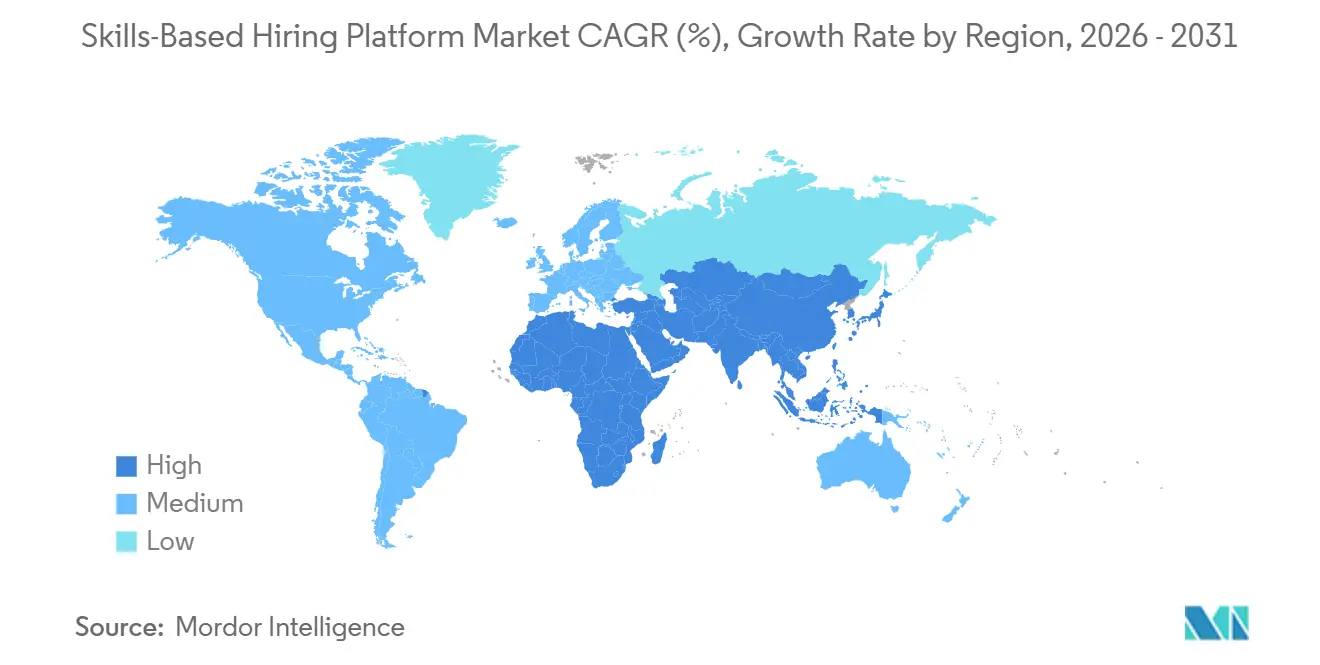
North America delivered 36.76% of global revenue in 2025, propelled by New York City’s audit law and a dense venture-capital ecosystem driving rapid product cycles.[3]New York City Commission on Human Rights, “Local Law 144,” nyc.gov Local mandates on bias audits are prompting upgrades across platforms. These audits ensure that platforms operate without inherent biases, fostering fairness and inclusivity in their operations. Simultaneously, a robust venture-capital landscape is fueling technological advancements with global repercussions. This ecosystem not only provides funding but also nurtures startups and established firms to push the boundaries of innovation. Europe's rigorous data protection measures, alongside the impending AI Act, elevate compliance challenges.
The AI Act introduces stringent guidelines for AI deployment, ensuring transparency, accountability, and ethical usage. However, these hurdles also establish a benchmark, filtering out less-invested players and promoting a competitive environment focused on quality. Asia-Pacific, charting the fastest growth trajectory, is set to expand at an 18.91% CAGR through 2031. This surge is driven by India's alignment with the National Skills Qualifications Framework, which standardizes skill development and enhances workforce readiness. Japan's policies addressing its aging workforce aim to integrate technology and reskilling initiatives to maintain productivity.
While South America, the Middle East, and Africa lag behind, they're rapidly closing the gap. Innovations like offline-capable assessments and streamlined web clients are helping them navigate infrastructural challenges. Offline-capable assessments enable functionality in areas with limited internet access, while lighter web clients ensure accessibility on low-bandwidth networks. The strategic placement of regional data centers, diverse language item banks, and adherence to government-standard competency mapping will play pivotal roles in determining vendor success across these burgeoning markets.

Competitive Landscape
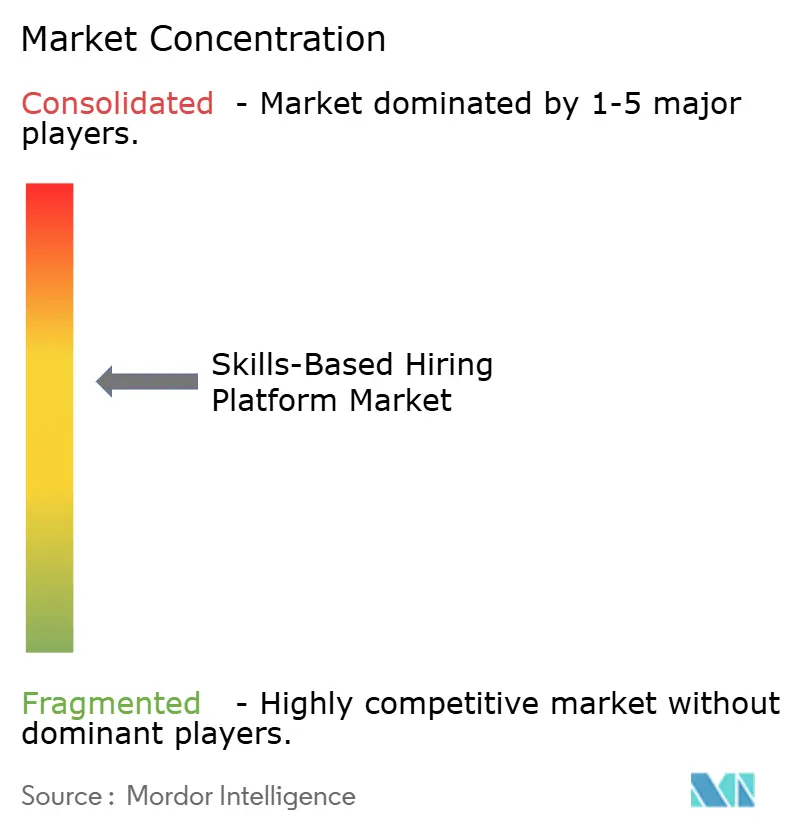
The skills-based hiring platform market exhibits moderate concentration: roughly 55-60% of 2025 revenue accrued to the top 20 vendors. Leaders compete along three dimensions, assessment breadth, workflow integration, and go-to-market reach. Harver’s purchase of Pymetrics blended industrial-organizational psychology with neuroscience-based soft-skill measurement, illustrating a consolidation play that shortcuts multi-year R&D cycles.
Niche players are carving out strongholds in areas like regulatory exams for finance and clinical-skills validation for healthcare, where off-the-shelf libraries fall short. These players focus on specialized areas where the depth of content and expertise is critical, allowing them to establish defensible positions. Open-source skill ontologies, which provide publicly available frameworks for skills mapping, pose a challenge to proprietary intellectual property by reducing the reliance on closed systems.
As open-source skill ontologies encroach upon core intellectual property defenses, established players are adopting strategies to maintain their competitive edge. They are increasingly leveraging ecosystem partnerships to expand their reach and capabilities, implementing accelerators to streamline deployment processes, and investing in customer success programs. These initiatives aim to provide added value by seamlessly connecting assessment insights with critical workflows, including learning, employee retention, and mobility processes.
Skills-Based Hiring Platform Industry Leaders
HireVue Inc.
Eightfold AI Inc.
HackerRank Inc.
TestGorilla B.V.
Codility Ltd.
- *Disclaimer: Major Players sorted in no particular order

Recent Industry Developments
- March 2026: The World Economic Forum highlighted that 39% of workers’ core skills will shift by 2030, reinforcing platform demand for continuously updated assessments.
- February 2026: Deloitte reported organizations that orchestrate real-time talent were 1.6 times likelier to beat AI ROI targets, underscoring the commercial case for skills-centric hiring.
- January 2026: The International Monetary Fund found 1 in 10 advanced-economy job ads list a brand-new skill absent from 2010 taxonomies, documenting rapid competency obsolescence.
- June 2025: Minnesota’s Consumer Privacy Act took effect, extending consent and transparency mandates to employment contexts.


Global Skills-Based Hiring Platform Market Report Scope
Digital solutions in the Skills‑Based Hiring Platform Market assess, match, and rank candidates based on validated skills and competencies, moving away from traditional qualifications. Utilizing assessments, job simulations, and AI-driven matching, these platforms aim to reduce hiring bias and enhance job success predictions. Employers harness these tools to broaden their talent pools, streamline the screening process, and bolster workforce readiness. The market's growth is propelled by talent shortages, a heightened emphasis on equitable hiring, and a shift towards skills-first HR strategies.
The Skills-Based Hiring Platform Market Report is Segmented by Platform Type (Standalone Skills-Based Hiring Platforms, Integrated ATS Modules, Skill Assessment API Providers, Gamified Assessment Platforms, and Other Platform Types), Deployment Mode (Cloud-Based, and On-Premises), Organization Size (Small and Medium Enterprises [SMEs], and Large Enterprises), End-Use Industry (IT and Telecom, BFSI, Healthcare, Manufacturing, Retail and E-Commerce, Government, and Other End-Use Industries), and Geography (North America, South America, Europe, Asia-Pacific, Middle East, and Africa). The Market Forecasts are Provided in Terms of Value (USD).
| Standalone Skills-Based Hiring Platforms |
| Integrated ATS Modules |
| Skill Assessment API Providers |
| Gamified Assessment Platforms |
| Other Platform Types |
| Cloud-Based |
| On-Premises |
| Small and Medium Enterprises (SMEs) |
| Large Enterprises |
| IT and Telecom |
| BFSI |
| Healthcare |
| Manufacturing |
| Retail and E-Commerce |
| Government |
| Other End-Use Industries |
| North America | United States |
| Canada | |
| Mexico | |
| South America | Brazil |
| Argentina | |
| Rest of South America | |
| Europe | Germany |
| United Kingdom | |
| France | |
| Italy | |
| Spain | |
| Russia | |
| Rest of Europe | |
| Asia-Pacific | China |
| India | |
| Japan | |
| South Korea | |
| Australia and New Zealand | |
| Rest of Asia-Pacific | |
| Middle East | Saudi Arabia |
| United Arab Emirates | |
| Turkey | |
| Rest of Middle East | |
| Africa | South Africa |
| Nigeria | |
| Rest of Africa |
| By Platform Type | Standalone Skills-Based Hiring Platforms | |
| Integrated ATS Modules | ||
| Skill Assessment API Providers | ||
| Gamified Assessment Platforms | ||
| Other Platform Types | ||
| By Deployment Mode | Cloud-Based | |
| On-Premises | ||
| By Organization Size | Small and Medium Enterprises (SMEs) | |
| Large Enterprises | ||
| By End-Use Industry | IT and Telecom | |
| BFSI | ||
| Healthcare | ||
| Manufacturing | ||
| Retail and E-Commerce | ||
| Government | ||
| Other End-Use Industries | ||
| By Geography | North America | United States |
| Canada | ||
| Mexico | ||
| South America | Brazil | |
| Argentina | ||
| Rest of South America | ||
| Europe | Germany | |
| United Kingdom | ||
| France | ||
| Italy | ||
| Spain | ||
| Russia | ||
| Rest of Europe | ||
| Asia-Pacific | China | |
| India | ||
| Japan | ||
| South Korea | ||
| Australia and New Zealand | ||
| Rest of Asia-Pacific | ||
| Middle East | Saudi Arabia | |
| United Arab Emirates | ||
| Turkey | ||
| Rest of Middle East | ||
| Africa | South Africa | |
| Nigeria | ||
| Rest of Africa | ||


Key Questions Answered in the Report
What is the current skills-based hiring platform market size and how fast is it growing?
The market stood at USD 3.45 billion in 2025 and is projected to reach USD 9.04 billion by 2031, expanding at a 17.4% CAGR (Mordor Intelligence).
Which platform type is expanding the quickest?
Gamified assessment platforms are on track for a 19.34% CAGR through 2031, the fastest among all platform categories (Mordor Intelligence).
Why are small and medium enterprises adopting these platforms so rapidly?
Usage-based pricing, cloud deployment, and one-week onboarding lower entry barriers, driving SME uptake at a 19.71% CAGR (Mordor Intelligence).
What regulations most influence vendor product roadmaps in North America and Europe?
New York City Local Law 144, multiple U.S. state privacy laws, GDPR, and the upcoming EU AI Act all impose bias-audit, transparency, and data-handling obligations.
How concentrated is vendor market share?
The top 20 providers held roughly 55-60% of 2025 revenue, indicating moderate concentration (Mordor Intelligence).
Page last updated on:


 Your data is secure and never sold or shared.


