
AI-powered Talent Analytics Market Size and Share
Market Overview
| Study Period | 2020 - 2031 |
|---|---|
| Market Size (2026) | USD 2.19 Billion |
| Market Size (2031) | USD 3.98 Billion |
| Growth Rate (2026 - 2031) | 12.71 % |
| Fastest Growing Market | Asia-Pacific |
| Largest Market | North America |
| Market Concentration | Medium |
Major Players *Disclaimer: Major Players sorted in no particular order Image © Mordor Intelligence. Reuse requires attribution under CC BY 4.0. | |
AI-powered Talent Analytics Market Analysis by Mordor Intelligence
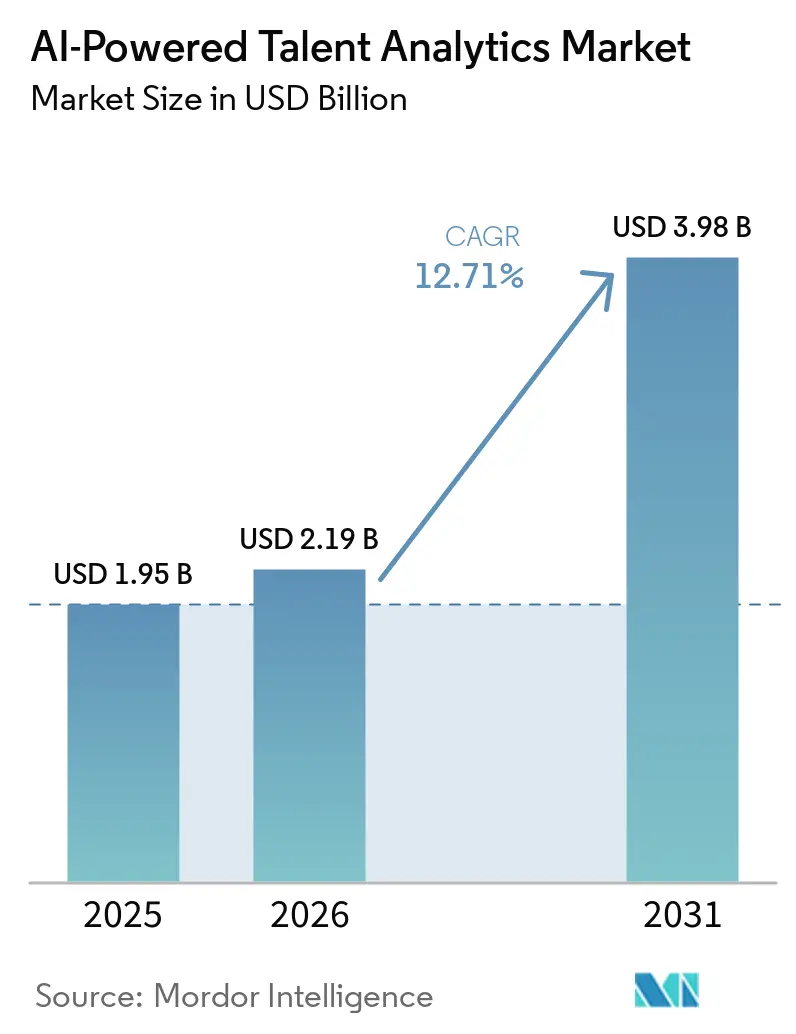
The AI-powered Talent Analytics Market size is expected to grow from USD 1.95 billion in 2025 to USD 2.19 billion in 2026 and is forecast to reach USD 3.98 billion by 2031 at 12.71% CAGR over 2026-2031. Enterprises are replacing reactive headcount tracking with predictive capability modeling to ensure that workforce investments mirror business priorities. Generative AI tools now update skills ontologies in near real time, turning previously static job descriptions into living taxonomies that capture emerging competencies. Predictive analytics still dominates spend, yet prescriptive systems that recommend retention or reskilling actions are winning new contracts as buyers push for outcome-oriented insights. Cloud adoption simplifies data unification across HR, finance, and customer platforms, while hybrid architectures safeguard data sovereignty for highly regulated sectors. Competitive intensity is rising as human capital management suites embed analytics that once required specialist vendors.
Key Report Takeaways
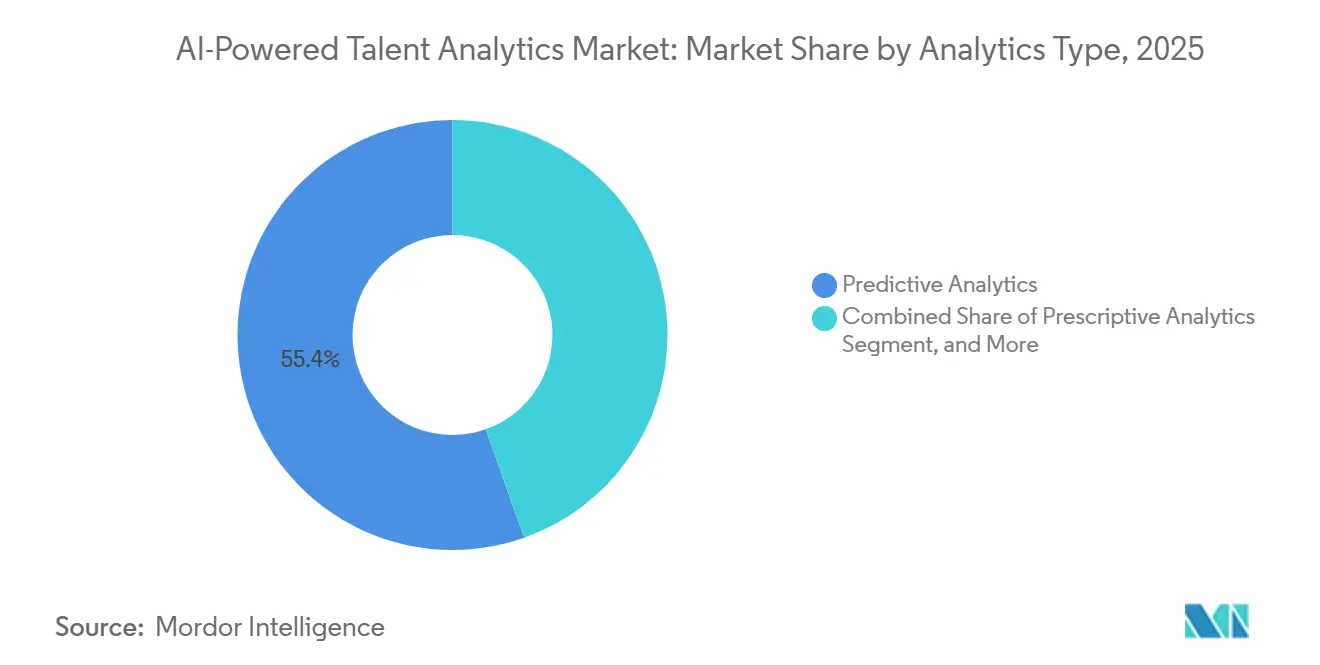
- By analytics type, predictive analytics led with 55.41% of the AI-powered Talent Analytics Market share in 2025, while prescriptive analytics is projected to expand at a 14.67% CAGR through 2031.
- By deployment model, cloud delivery accounted for 66.78% revenue share in 2025, and hybrid deployment is advancing at a 15.09% CAGR during the same period.
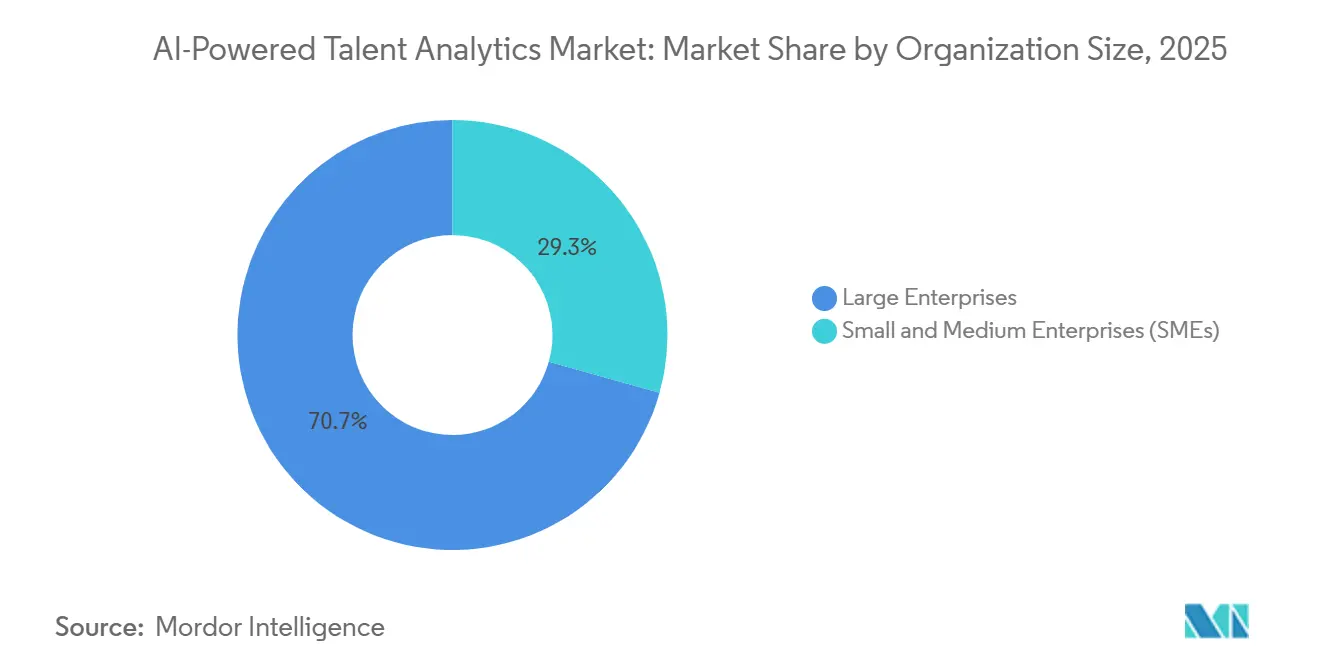
- By organization size, large enterprises contributed 70.67% of 2025 revenue, whereas small and medium enterprises are growing at a 15.46% CAGR thanks to consumption-based pricing.
- By end-use industry, IT and telecommunications held 24.16% share in 2025, but healthcare and life sciences is on course for a 13.89% CAGR as labor shortages intensify.
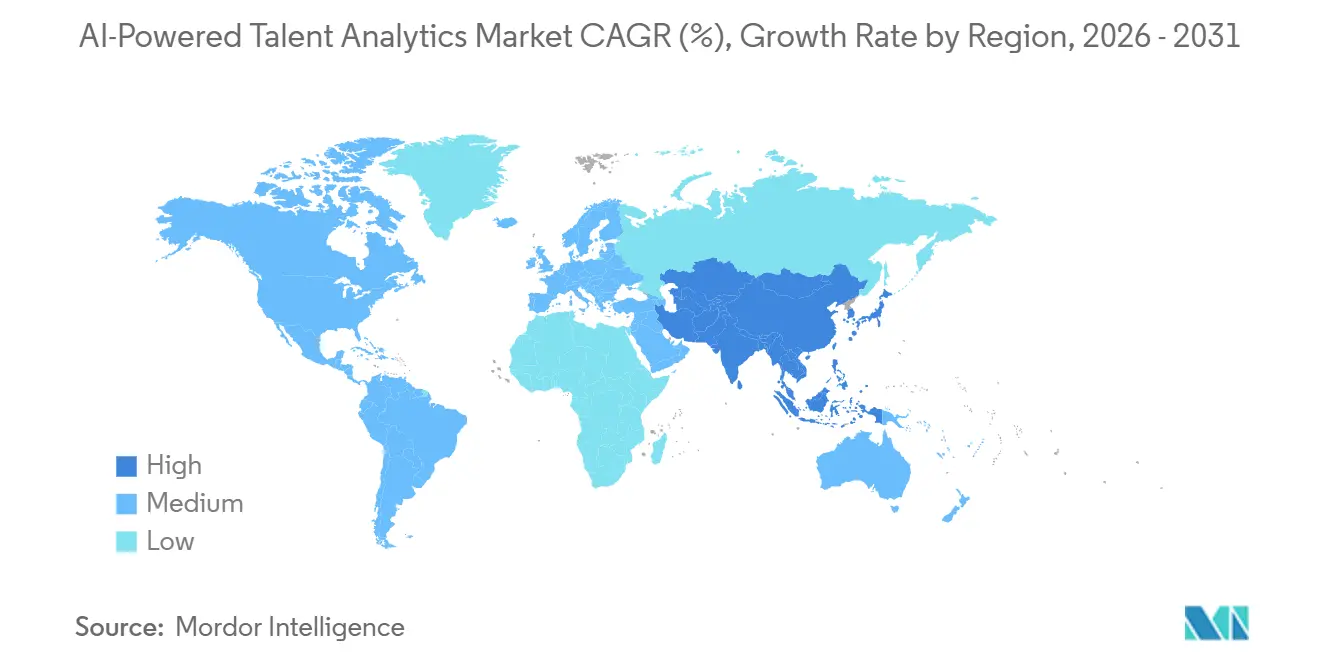
- By geography, North America captured 36.88% share in 2025, and Asia-Pacific is the fastest-growing region with a 14.05% CAGR through 2031.
Note: Market size and forecast figures in this report are generated using Mordor Intelligence’s proprietary estimation framework, updated with the latest available data and insights as of January 2026.
Market Trends and Insights
Drivers Impact Analysis of AI-powered Talent Analytics Market*
| Driver | (~) % Impact on CAGR Forecast | Geographic Relevance | Impact Timeline |
|---|---|---|---|
| Integration of Generative AI for Skills Mapping | +3.2% | Global with early strength in North America and Western Europe | Short term (≤ 2 years) |
| Rapid Adoption of Cloud-Based HR Suites | +2.8% | Global, strongest in North America, Asia-Pacific, Western Europe | Medium term (2-4 years) |
| Growing Emphasis on Workforce Diversity Metrics | +2.1% | North America and European Union with spillover to Asia-Pacific | Medium term (2-4 years) |
| Shift Toward Data-Driven Reskilling Programs | +1.9% | Global with enterprise focus in North America, Europe, and China | Long term (≥ 4 years) |
| Expansion of Remote-First Hiring Models | +1.6% | Global, fastest in technology and professional services | Short term (≤ 2 years) |
| Increased Regulatory Focus on Fair-Use AI in HR | +1.3% | European Union and North America with emerging Asia-Pacific frameworks | Long term (≥ 4 years) |
| Source: Mordor Intelligence | |||
Integration of Generative AI for Skills Mapping
Generative AI rewrites the way companies catalog competencies by extracting skills from project documents, peer reviews, and learning transcripts, then matching them to open roles in minutes. SAP’s People Intelligence, launched in October 2025, uses large language models to refresh internal skills graphs weeks after new technologies enter the market, eliminating the 12- to 18-month lag typical of manual taxonomy updates.[1]SAP Newsroom, “SAP Unveils People Intelligence to Transform Workforce Insights,” news.sap.com Coursera recorded a 234% jump in generative AI course enrollments during 2025, showing how quickly novel capabilities flow into the labor pool. Organizations that pilot these tools reduce manual HR workloads by roughly 40% and spot workforce gaps early, allowing learning budgets to target the highest-value skills.
Rapid Adoption of Cloud-Based HR Suites
Unified cloud platforms break the data silos that previously limited workforce modeling accuracy. Workday Data Cloud, introduced in September 2025, connects Databricks, Snowflake, and Salesforce without duplicating storage, enabling HR teams to blend performance, finance, and customer data in one view. Oracle Cloud HCM displays attrition risk and succession readiness directly inside manager dashboards, shrinking the insight-to-action window. Smaller companies access comparable benchmarks through ADP DataCloud, which aggregates anonymized payroll and workforce records from thousands of clients. Frequent cloud updates also push new regulatory features instantly, keeping deployments compliant without costly on-premises upgrades.
Growing Emphasis on Workforce Diversity Metrics
Disclosure mandates are turning diversity analytics into a financial priority. United States listed firms report board and workforce composition under Securities and Exchange Commission and NASDAQ rules, requiring granular tracking from applicant pools to leadership pipelines. Europe’s Corporate Sustainability Reporting Directive now compels similar transparency, prompting vendors to embed pay-equity alarms and intersectional dashboards. SAP People Intelligence surfaces compensation gaps by demographic cohort so managers can act before audit findings trigger investor backlash.
Shift Toward Data-Driven Reskilling Programs
Enterprises now measure reskilling returns with the same rigor once reserved for capital projects. Amazon’s Upskilling 2025, Walmart’s Live Better U, and Accenture’s LearnVantage each crossed the USD 1 billion investment mark, aiming to redeploy existing staff into growth roles. Analytics platforms link course completions to promotion rates and retention, letting finance chiefs validate continued spend even during economic slowdowns. Vendors that automate skill assessments and recommend targeted learning paths are gaining traction among companies that lack dedicated people-analytics teams.
Restraints Impact Analysis of AI-powered Talent Analytics Market*
| Restraint | (~) % Impact on CAGR Forecast | Geographic Relevance | Impact Timeline |
|---|---|---|---|
| Data Privacy and Compliance Complexities | -1.8% | Global, most acute in European Union, California, China, and India | Medium term (2-4 years) |
| Algorithmic Bias and Audit Requirements | -1.5% | North America and European Union with emerging Asia-Pacific mandates | Short term (≤ 2 years) |
| Integration Challenges With Legacy HRIS | -1.2% | Global, especially large enterprises with multi-decade systems | Long term (≥ 4 years) |
| Limited Analytics Talent In HR Departments | -0.9% | Global, strongest in small and medium enterprises and emerging markets | Long term (≥ 4 years) |
| Source: Mordor Intelligence | |||
Data Privacy And Compliance Complexities
Divergent consent rules force vendors to localize data and maintain region-specific product variants. India’s Digital Personal Data Protection Act can fine violators up to INR 250 crore (USD 30 million) for misuse of biometrics. China’s Personal Information Protection Law requires domestic storage of employee records and government security reviews for cross-border transfers. European Union GDPR Article 22 restricts fully automated hiring decisions, obligating human oversight. Providers such as InCountry host Oracle HCM data in country-specific facilities to satisfy these statutes.
Algorithmic Bias And Audit Requirements
New York City’s Local Law 144 obliges independent audits of automated hiring tools and publication of selection rates by race and gender. The U.S. Equal Employment Opportunity Commission clarified in 2024 that employers remain liable if AI choices create a disparate impact, even unintentionally. Europe’s AI Act classifies recruitment systems as high risk, demanding conformity assessments and detailed technical documentation. Vendors now invest in explainable models that reveal key drivers, yet transparency can lower predictive accuracy and expose algorithms to gaming.
*Our forecasts treat driver/restraint impacts as directional, not additive. The impact forecasts reflect baseline growth, mix effects, and variable interactions.
AI-powered Talent Analytics Market Segment Analysis
By Analytics Type:
Prescriptive Capabilities Move Center StagePrescriptive tools are advancing at 14.67% CAGR, eclipsing overall AI-powered Talent Analytics Market growth. Predictive platforms commanded 55.41% share in 2025, showing their maturity in churn forecasts and workforce demand planning. Yet once accuracy levels converge, the differentiator becomes whether the engine can suggest a retention bonus, an upskilling course, or a succession plan. IBM credits prescriptive recommendations for USD 300 million in annual turnover savings, and Unilever cut time-to-hire by 75% after adopting interview sequence optimizers. Descriptive dashboards remain vital for compliance but function as feeders that supply clean data to the higher-value layers. Diagnostic analytics span root-cause analysis of engagement dips and diversity gaps, forming the bridge between hindsight and foresight.
Enterprises increasingly bundle multiple analytics types within one subscription to avoid tool sprawl. The AI-powered Talent Analytics Market size allocated to prescriptive modules is projected to outpace descriptive spend by 2028 as boardrooms demand quantified ROI. Vendors that fail to add recommendation engines risk relegation to commodity status. Those that integrate sentiment and network analysis gain an edge by surfacing burnout signals and informal influencers that traditional HR metrics miss.



By Deployment Model:
Hybrid Strategies Gain Regulatory FavorCloud delivery retained 66.78% revenue share in 2025 thanks to lower upfront costs and seamless upgrades. Even so, hybrid architectures are expanding at 15.09% CAGR as enterprises route sensitive data to in-country servers while using public-cloud compute for heavy analytics workloads. The AI-powered Talent Analytics Market size attributed to hybrid solutions is accelerating in jurisdictions with strict data localization mandates such as China, Russia, and the Middle East. AWS European Sovereign Cloud exemplifies offerings that physically separate operations to satisfy EU regulators.
Hybrid users accept higher infrastructure spend in return for compliance assurance and latency benefits for real-time dashboards. Providers partner with specialists like InCountry for data residency, embedding localization into implementation templates. The balance may tilt further toward hybrid as more governments emulate India’s consent-centric regime and California’s employee data rights.
By Organization Size:
Barriers Fall For Small And Medium EnterprisesLarge enterprises delivered 70.67% of 2025 revenue, reflecting deeper pockets and dedicated analytics teams. Yet small and medium enterprises are climbing at a 15.46% CAGR, the fastest among size cohorts, as subscription pricing knocks down cost hurdles. Embedded dashboards within payroll or HR suites mean buyers no longer negotiate a second contract, lowering procurement friction. Research shows human resource information systems raise productivity by 29% and decision accuracy by 20% within small firms, validating spend to CFOs who prize quick payback.
Limited data science skills remain the top roadblock, not license cost. Vendors that offer guided analytics or fully managed insights stand to capture disproportionately high share. As more SMEs adopt, the AI-powered Talent Analytics Market share of large enterprises will dilute slightly, although absolute spend will still rise given their scale.
By End-Use Industry:
Healthcare Adopts Under Workforce DuressIT and telecommunications held 24.16% income in 2025, driven by chronic engineering and cybersecurity churn. Nevertheless, healthcare and life sciences are growing fastest at 13.89% CAGR, pressured by physician and nurse shortfalls forecast to persist beyond 2038. Predictive staffing models help hospitals cut left-without-being-seen rates and curb overtime. The AI-powered Talent Analytics Market size within healthcare is projected to surpass retail spend before the end of the decade as reimbursement models increasingly tie staffing efficiency to quality scores.
Banking, manufacturing, and retail continue steady adoption focused on compliance roles, maintenance scheduling, and seasonal labor optimization. Government remains slower due to budget cycles and legacy systems, though knowledge-transfer analytics gain urgency as retirement waves loom.
Geography Analysis
North America AI-powered Talent Analytics Market
North America commanded 36.88% share in 2025, sustained by early algorithmic hiring uptake and mandatory workforce disclosures. Bias audit laws such as New York City’s Local Law 144 increase compliance spend but also legitimize advanced analytics among risk-averse boards. Canada’s provincial privacy statutes and Mexico’s nearshoring surge both add incremental demand, yet small businesses across the region still lag because of skills shortages and budget discipline.
APAC AI-powered Talent Analytics Market
Asia-Pacific is the fastest growing at 14.05% CAGR through 2031. A 2024 IDC survey found 43% of enterprises plan to raise AI budgets by over 20% during the next year.[2]SAS, “SAS-IDC Study Reveals AI Adoption Challenges in Asia-Pacific,” sas.com Skills gaps of 29-41% across major industries create fertile ground for diagnostic and prescriptive platforms. India’s data-protection fines and China’s localization rules push many buyers toward hybrid deployments. Japan focuses on succession analytics to counter aging workforces, while Australia and South Korea emphasize diversity reporting aligned with emerging legislation.
EMEA and South America AI-powered Talent Analytics Market
Europe grapples with the strictest rulebook. The AI Act labels recruitment tools high risk, compelling conformity assessments. Vendors disabled emotion recognition features to comply with the Act’s outright ban in employment contexts. Germany and France invest heavily in pay-equity dashboards to align with the Corporate Sustainability Reporting Directive. South America grows unevenly, led by Brazil, where multinationals deploy cloud analytics bundled with regional data centers. The Middle East, notably Saudi Arabia and the United Arab Emirates, incorporates workforce analytics into national diversification agendas. Africa remains nascent, concentrated in South Africa and Nigeria where multinationals and large domestic banks pilot skills-forecasting tools.

Competitive Landscape
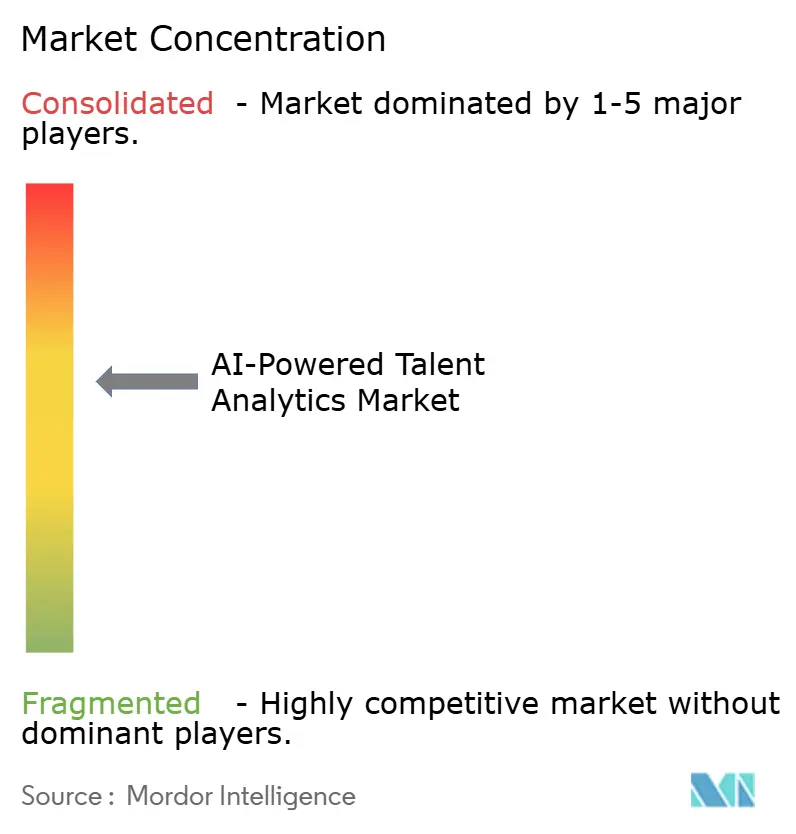
Competition is moderately fragmented. Suite vendors SAP, Workday, and Oracle embed analytics directly into core HR modules, shrinking the total addressable market for standalone players. Specialists such as Visier and Eightfold AI counter with deeper prescriptive algorithms, faster skills-graph updates, and richer visualization.
Eightfold AI’s May 2026 integration with Oracle Fusion Cloud Recruiting shows that partnerships can extend reach without full acquisition.[3]Eightfold AI, “Eightfold AI and Oracle Announce Integration,” eightfold.ai Investment continues to flow: Visier attracted USD 154 million in Series F funding in 2024 to accelerate prescriptive features. SAP unveiled People Intelligence inside SuccessFactors in 2025, signaling the incumbent strategy of building rather than buying.
White-space persists in frontline manufacturing scheduling, where real-time skills matching is underpenetrated. Vendors pursuing explainable AI to satisfy EU conformity checks may gain a regulatory moat. However, rising compliance costs and feature parity will intensify consolidation, nudging the AI-powered talent analytics industry toward higher concentration by 2031.
AI-powered Talent Analytics Industry Leaders
SAP SE
Oracle Corporation
Workday Inc.
Automatic Data Processing Inc.
UKG Inc.
- *Disclaimer: Major Players sorted in no particular order
AI-powered Talent Analytics Market Companies Covered in this Report
- International Business Machines Corporation
- Microsoft Corporation
- SAP SE
- Oracle Corporation
- Workday Inc.
- Cornerstone OnDemand Inc.
- Automatic Data Processing Inc.
- Ceridian HCM Holding Inc.
- Visier Inc.
- Degreed Inc.
- Eightfold AI Inc.
- Gloat Inc.
- Beamery Inc.
- Phenom People Inc.
- HireVue Inc.
- Retrain.ai Inc.
- SeekOut Inc.
- Entelo Inc.
- Paylocity Holding Corporation
- UKG Inc.

Recent Industry Developments in AI-powered Talent Analytics Market
- May 2026: Eightfold AI integrated its talent intelligence suite with Oracle Fusion Cloud Recruiting to embed skills matching and diversity analytics directly within Oracle recruiting workflows.
- April 2026: SAP delivered SuccessFactors 1H 2026 with agentic AI that auto-generates reskilling plans and highlights pay disparities across demographic groups.
- October 2025: SAP launched People Intelligence, a generative AI module inside SuccessFactors that updates skills ontologies in weeks instead of annual cycles.
- October 2025: Eightfold AI partnered with S and P Global to deploy skills-based hiring and succession analytics for 35,000 employees.


Global AI-powered Talent Analytics Market Report Scope
The AI-powered Talent Analytics Market leverages artificial intelligence and machine learning to scrutinize workforce data, yielding predictive and prescriptive insights. These tools inform decisions related to hiring, performance, engagement, retention, skill enhancement, and workforce planning. By interpreting both structured and unstructured data, AI models forecast behaviors and fine-tune HR interventions. The market comprises standalone AI analytics engines and analytics features embedded within HCM systems.
The AI-powered Talent Analytics Market Report is Segmented by Analytics Type (Descriptive Analytics, Diagnostic Analytics, Predictive Analytics, Prescriptive Analytics, and Other Analytics Types), Deployment Model (On-Premises, Cloud, and Hybrid), Organization Size (Large Enterprises, and Small and Medium Enterprises [SMEs]), End-Use Industry (IT and Telecommunications, Banking, Financial Services and Insurance [BFSI], Healthcare and Life Sciences, Retail and E-commerce, Manufacturing, Government and Public Sector, and Other End-Use Industries), and Geography (North America, South America, Europe, Asia-Pacific, Middle East, and Africa). The Market Forecasts are Provided in Terms of Value (USD).
| Descriptive Analytics |
| Diagnostic Analytics |
| Predictive Analytics |
| Prescriptive Analytics |
| Other Analytics Types |
| On-Premises |
| Cloud |
| Hybrid |
| Large Enterprises |
| Small and Medium Enterprises (SMEs) |
| IT and Telecommunications |
| Banking, Financial Services and Insurance (BFSI) |
| Healthcare and Life Sciences |
| Retail and E-commerce |
| Manufacturing |
| Government and Public Sector |
| Other End-Use Industries |
| North America | United States |
| Canada | |
| Mexico | |
| Rest of North America | |
| South America | Brazil |
| Argentina | |
| Rest of South America | |
| Europe | Germany |
| United Kingdom | |
| France | |
| Italy | |
| Spain | |
| Russia | |
| Rest of Europe | |
| Asia-Pacific | China |
| India | |
| Japan | |
| South Korea | |
| Australia | |
| Rest of Asia-Pacific | |
| Middle East | Saudi Arabia |
| United Arab Emirates | |
| Turkey | |
| Rest of Middle East | |
| Africa | South Africa |
| Nigeria | |
| Rest of Africa |
| By Analytics Type | Descriptive Analytics | |
| Diagnostic Analytics | ||
| Predictive Analytics | ||
| Prescriptive Analytics | ||
| Other Analytics Types | ||
| By Deployment Model | On-Premises | |
| Cloud | ||
| Hybrid | ||
| By Organization Size | Large Enterprises | |
| Small and Medium Enterprises (SMEs) | ||
| By End-Use Industry | IT and Telecommunications | |
| Banking, Financial Services and Insurance (BFSI) | ||
| Healthcare and Life Sciences | ||
| Retail and E-commerce | ||
| Manufacturing | ||
| Government and Public Sector | ||
| Other End-Use Industries | ||
| By Geography | North America | United States |
| Canada | ||
| Mexico | ||
| Rest of North America | ||
| South America | Brazil | |
| Argentina | ||
| Rest of South America | ||
| Europe | Germany | |
| United Kingdom | ||
| France | ||
| Italy | ||
| Spain | ||
| Russia | ||
| Rest of Europe | ||
| Asia-Pacific | China | |
| India | ||
| Japan | ||
| South Korea | ||
| Australia | ||
| Rest of Asia-Pacific | ||
| Middle East | Saudi Arabia | |
| United Arab Emirates | ||
| Turkey | ||
| Rest of Middle East | ||
| Africa | South Africa | |
| Nigeria | ||
| Rest of Africa | ||


Key Questions Answered in the Report
What is the current AI-powered Talent Analytics Market size and how fast is it growing?
The market reached USD 2.19 billion in 2026 and is projected to climb to USD 3.98 billion by 2031, recording a 12.71% CAGR over 2026-2031 according to Mordor Intelligence.
Which analytics type is expanding fastest through 2031?
Prescriptive analytics leads growth at a 14.67% CAGR because enterprises now demand actionable recommendations rather than probability scores.
Why are small and medium enterprises adopting talent analytics more quickly?
Consumption-based pricing, embedded dashboards inside existing HR software, and managed insights services reduce cost and skills barriers, driving 15.46% CAGR among SMEs.
How are privacy regulations influencing deployment choices?
Strict data-residency and consent laws in the European Union, China, and India are steering many organizations toward hybrid architectures that store personal data locally while processing analytics in the cloud.
Which industry vertical is projected to add the most new spending by 2031?
Healthcare and life sciences, propelled by alarming physician and nurse shortages, is forecast to outpace all other sectors with a 13.89% CAGR.
Page last updated on:


 Your data is secure and never sold or shared.


