
AI-Driven Vulnerability Management and Risk-Based Exposure Prioritization Market Size and Share
Market Overview
| Study Period | 2020 - 2031 |
|---|---|
| Market Size (2026) | USD 10.37 Billion |
| Market Size (2031) | USD 31.74 Billion |
| Growth Rate (2026 - 2031) | 25.07 % |
| Fastest Growing Market | Asia-Pacific |
| Largest Market | North America |
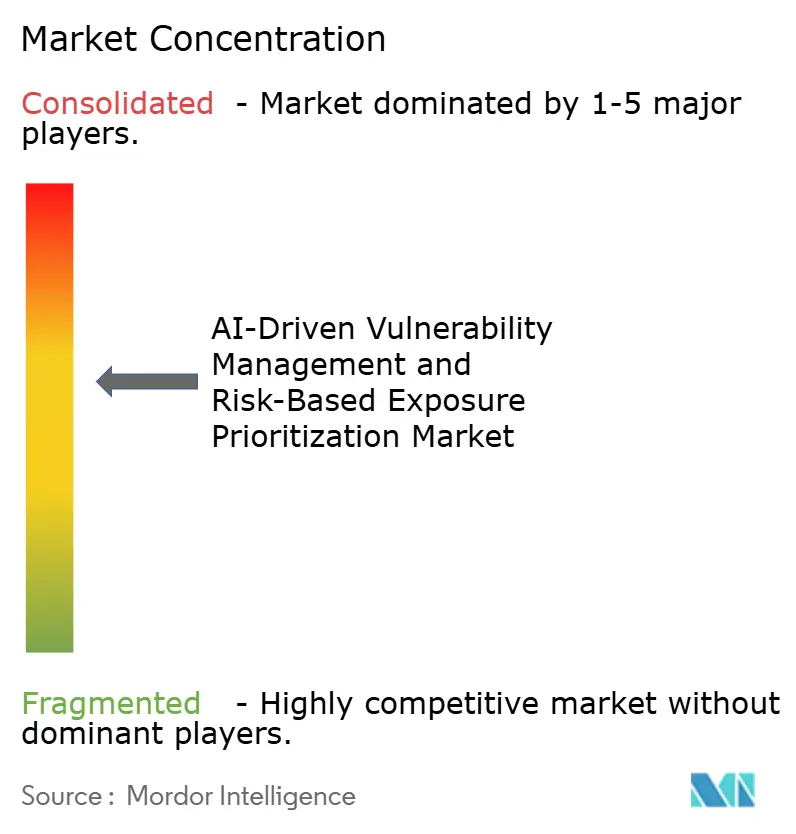
| Market Concentration | Medium |
Major Players *Disclaimer: Major Players sorted in no particular order Image © Mordor Intelligence. Reuse requires attribution under CC BY 4.0. | |
AI-Driven Vulnerability Management and Risk-Based Exposure Prioritization Market Analysis by Mordor Intelligence
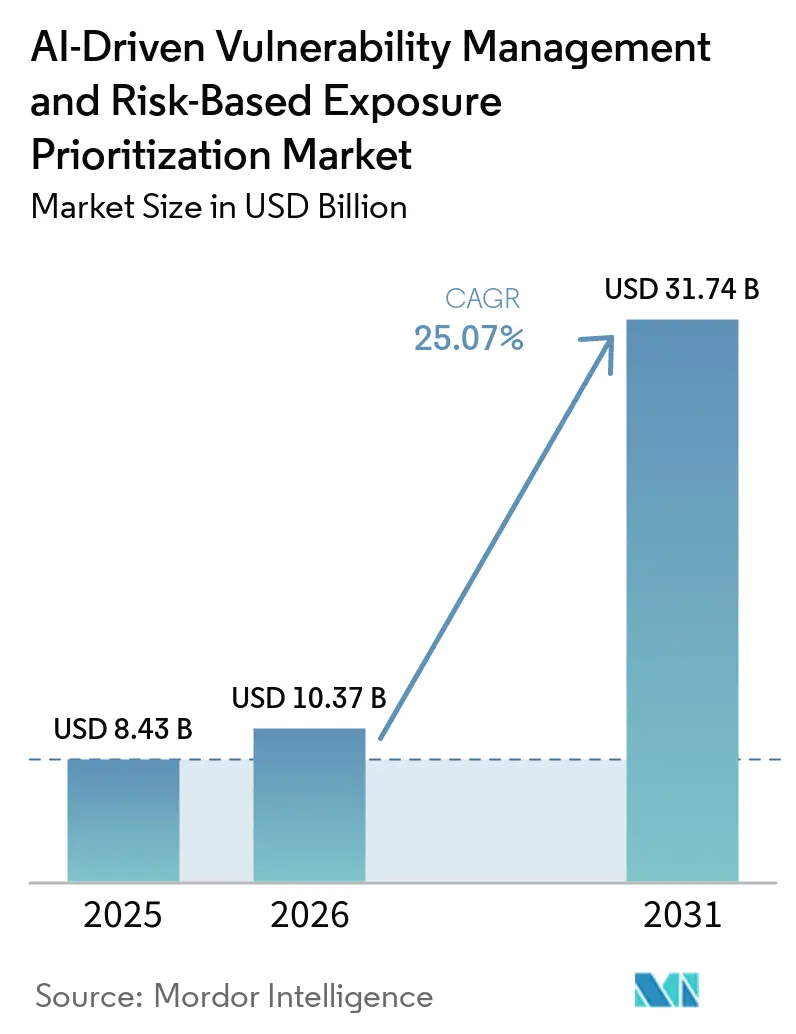
The AI-driven vulnerability management and risk-based exposure prioritization market size is expected to grow from USD 8.43 billion in 2025 to USD 10.37 billion in 2026 and is forecast to reach USD 31.74 billion by 2031 at 25.07% CAGR over 2026-2031. Growth is supported by the move away from periodic vulnerability scanning toward continuous exposure monitoring that can handle rapidly changing cloud, API, and hybrid environments. Regulatory pressure is also making vulnerability governance more formal, especially as incident disclosure, third-party software oversight, and documented remediation workflows are now closer to board and audit review. Buyers are also favoring platforms that integrate discovery, prioritization, validation, and remediation into a single workflow, pushing the AI-driven vulnerability management and risk-based exposure prioritization market toward broader exposure management suites rather than standalone scanning tools. Product design is also shifting as vendors build around evidence-backed exploitability, workflow automation, and hybrid deployment flexibility rather than raw finding volume alone. This leaves room for growth in managed services, healthcare, SME adoption, and supply chain risk management as organizations seek faster action with fewer internal security resources.
Key Report Takeaways
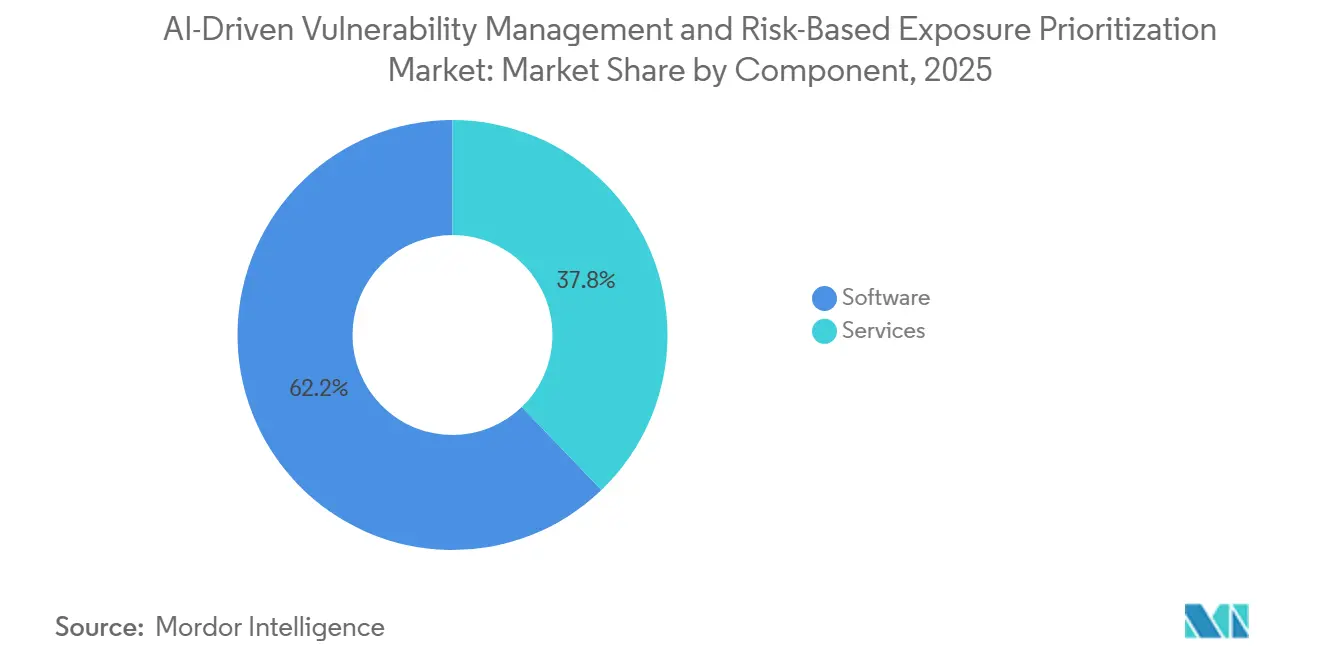
- By component, software held 62.18% share in 2025, while services are projected to expand at a 26.14% CAGR through 2031.
- By application, vulnerability discovery and assessment led with 21.12% share in 2025, while AI-driven risk prioritization is projected to expand at a 26.25% CAGR through 2031.
- By deployment, cloud held 55.09% of the AI-driven vulnerability management and risk-based exposure prioritization market share in 2025, while hybrid deployment is projected to grow at a 26.36% CAGR through 2031.
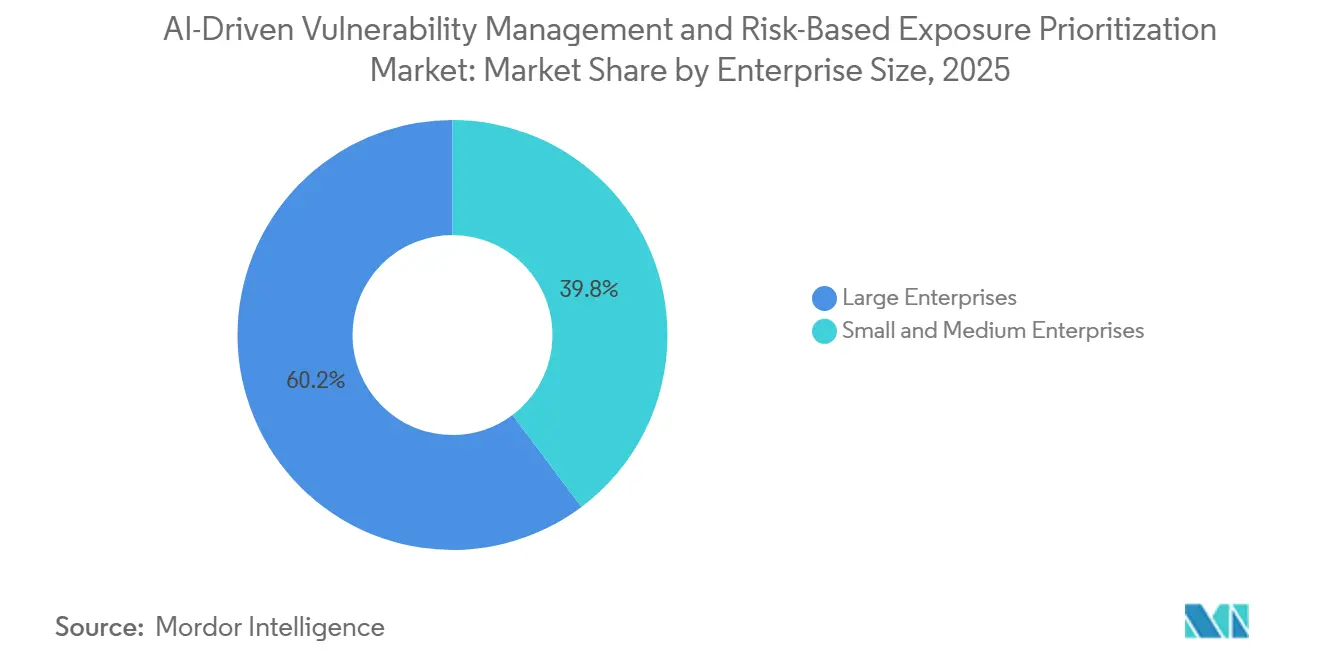
- By enterprise size, large enterprises accounted for 60.24% of the market share in 2025, while small and medium enterprises are projected to expand at a 26.47% CAGR through 2031.
- By end-user industry, BFSI held 17.19% share in 2025, while healthcare and life sciences are projected to advance at a 26.58% CAGR through 2031.
- By geography, North America led with 33.14% share in 2025, while Asia-Pacific is projected to record the fastest growth at a 26.69% CAGR through 2031.
Note: Market size and forecast figures in this report are generated using Mordor Intelligence’s proprietary estimation framework, updated with the latest available data and insights as of January 2026.
Market Trends and Insights
Drivers Impact Analysis of AI-Driven Vulnerability Management and Risk-Based Exposure Prioritization Market*
| Driver | (~) % Impact on CAGR Forecast | Geographic Relevance | Impact Timeline |
|---|---|---|---|
| Rising Exploitable Vulnerability Volume Across Hybrid Environments | +5.0% | Global, with peak concentration in North America and Europe | Short term (≤ 2 years) |
| Shift to Context-Aware Risk Prioritization | +4.5% | Global, with fastest adoption in North America and Asia-Pacific | Medium term (2-4 years) |
| Expansion of Cloud-Native, Container, and API Attack Surfaces | +4.2% | Global, with spillover to Middle East and Africa and South America through cloud-first adoption | Short term (≤ 2 years) |
| Third-Party Software and Supply Chain Governance Pressure | +3.8% | North America and Europe, with spillover to core Asia-Pacific markets | Medium term (2-4 years) |
| Security Team Consolidation Around Exposure Platforms | +3.5% | Global, strongest in enterprises managing 50+ security tools | Medium term (2-4 years) |
| Automation Demand for Faster Remediation and Lower Analyst Fatigue | +3.0% | Global, with highest momentum in mid-market IT and telecom environments | Short term (≤ 2 years) |
| Source: Mordor Intelligence | |||
Rising Volume of Exploitable Vulnerabilities Across Hybrid Environments
Security teams are facing a much shorter window between disclosure and real-world exploitation, which makes slower scan-and-patch cycles less effective. The AI-driven vulnerability management and risk-based exposure prioritization market is benefiting from this change because buyers now need systems that can reprioritize exposures as threat conditions shift across on-premises assets, cloud workloads, and connected infrastructure. The problem is larger in hybrid estates because each environment produces different forms of telemetry and carries different business criticality, which makes a single severity score less useful. The gap between public exploitation signals and actual attacker activity has also made organizations less comfortable waiting for a small set of confirmed alerts before taking action, thereby increasing demand for broader, evidence-led prioritization models. Vendors that can unify asset context, exploit signals, and remediation status in one workflow are better aligned with what security teams now need. This pressure is keeping the AI-driven vulnerability management and risk-based exposure prioritization market on a strong adoption path across large regulated enterprises and cloud-heavy buyers.[1]
Shift From CVSS-Based Sorting to Context-Aware Risk Prioritization
Static CVSS scoring no longer reflects how real attacks unfold in live environments, especially when medium-scored issues remain exploitable. This is pushing the AI-driven vulnerability management and risk-based exposure prioritization market toward models that combine severity, exploit likelihood, asset criticality, and actual remediation status into a single score. Vendors are also showing that large remediation queues can be narrowed sharply when exploit validation is added before action is assigned to operations teams. That matters because most organizations do not have the staff to treat every critical finding as equally urgent, and that labor constraint is now shaping buying behavior. Standards and guidance also support this shift by emphasizing risk-based prioritization in cloud-native and hybrid settings. As a result, the AI-driven vulnerability management and risk-based exposure prioritization market is moving from alert accumulation to evidence-based decision support.[2]
Expansion of Cloud-Native, Container, and API Attack Surfaces
Cloud-native systems are making exposure management more difficult because workloads are short-lived, permissions change frequently, and network exposure is not fixed. That dynamic supports the AI-driven vulnerability management and risk-based exposure prioritization market because runtime context matters more when APIs, containers, and Kubernetes assets are continuously changing. API security is also becoming more central as organizations recognize that undocumented and inactive endpoints can sit outside normal asset inventories. Containerized development adds another layer, as each image and deployment cycle can introduce a new vulnerability footprint, even when the asset exists for only a limited period. This is one reason AI-driven risk prioritization is the fastest-growing application area in the broader market: these environments require continuous signal processing rather than periodic review. The direction of standards is reinforcing this demand by treating API protection in cloud-native systems as a distinct discipline with its own protection requirements.[3]
Third-Party Software Risk and Software Supply Chain Governance Pressure
Supplier software exposure is becoming harder to separate from internal cyber risk, especially in regulated sectors that depend on large vendor ecosystems. That supports the AI-driven vulnerability management and risk-based exposure prioritization market, as buyers want tools that can connect upstream component risk, software dependencies, and audit evidence in a single workflow. Financial services show this clearly: critical-severity supplier vulnerabilities rose sharply in 2025, increasing pressure to track external software risk with the same discipline used for internal assets. The compliance side is also strengthening as NIS2 and the EU ICT Supply Chain Security Toolbox push organizations to document supplier risk controls, security assessments, and follow-up actions. This is driving demand for platforms that can ingest software bills of materials, map CVEs to dependencies, and display remediation status in a format auditors can review. Scanner-only products are weaker in this area, which creates room for broader exposure management platforms to win share.[4]
Restraints Impact Analysis of AI-Driven Vulnerability Management and Risk-Based Exposure Prioritization Market*
| Restraint | (~) % Impact on CAGR Forecast | Geographic Relevance | Impact Timeline |
|---|---|---|---|
| Limited Asset Context and Incomplete Telemetry | -2.0% | Global, most acute in fragmented legacy estates and mixed OT and IT environments | Medium term (2-4 years) |
| Integration Friction With Legacy ITSM, CMDB, and Patch Workflows | -1.5% | Global, with highest friction in large enterprises using pre-2020 ITSM deployments | Medium term (2-4 years) |
| Budget Scrutiny for Mid-Market Buyers and Tool Rationalization Delays | -1.0% | North America and Europe mid-market, with selective impact in Asia-Pacific SMBs | Short term (≤ 2 years) |
| Data Privacy, Residency, and Model Governance Concerns | -0.8% | Europe, Asia-Pacific, and public sector organizations in Middle East and Africa | Long term (≥ 4 years) |
| Source: Mordor Intelligence | |||
Limited Asset Context and Incomplete Telemetry Reducing Model Accuracy
The main technical limit on AI-driven prioritization is still incomplete data rather than weak algorithms. Asset records built for service management often lack the context needed for live security decisions, such as whether a system is internet-facing, whether a compensating control exists, or whether the asset carries regulated data. The problem is more severe in mixed IT, OT, and IoT environments where passive devices and hard-to-instrument systems create visibility gaps. Those gaps matter because the AI-driven vulnerability management and risk-based exposure prioritization market depends on accurate inputs to rank risk correctly and win the trust of operations teams. Metadata quality also suffers when public enrichment backlogs leave new vulnerabilities without the context fields that many scoring systems rely on. Vendors are improving this with agentless discovery and broader data connectors, but the visibility gap still slows adoption in heterogeneous estates.
Integration Friction With Legacy ITSM, CMDB, and Patch Workflows
Risk scoring only creates value when it flows into the systems that approve, assign, and close remediation work. Many buyers still struggle here because the AI-driven vulnerability management and risk-based exposure prioritization market must integrate with long-standing ticketing, change control, and patch processes that were not designed for real-time security signals. Security and operations teams also lose confidence when status data falls out of sync across scanners, ITSM tools, and patching platforms. This slows return on investment because the benefit of better prioritization is reduced when workflow execution remains manual or inconsistent. The challenge is visible in enterprise patch management, where full autonomy is still rare and coordination between prioritization and remediation remains a major pain point. Vendors that add embedded ticketing, validation, and patch orchestration are better placed to reduce this friction and support broader deployment.
*Our forecasts treat driver/restraint impacts as directional, not additive. The impact forecasts reflect baseline growth, mix effects, and variable interactions.
AI-Driven Vulnerability Management and Risk-Based Exposure Prioritization Market Segment Analysis
By Component:
Software Leads While Services Gain From Staffing PressureSoftware held 62.18% of the AI-driven vulnerability management and risk-based exposure prioritization market share in 2025, reflecting the strong preference of enterprise buyers for SaaS-delivered platforms over traditional on-premises tools. Continuous product updates, cloud delivery, and integrated threat feeds made software the default choice for organizations that wanted current detection and prioritization logic without version lag. Software also fits well with broader exposure management strategies because it could sit closer to cloud assets, API environments, and centralized reporting layers. In this part of the AI-driven vulnerability management and risk-based exposure prioritization market, vendors benefited from demand for platforms that integrate discovery, validation, scoring, and workflow handoff in a single system. That made software not just the delivery model with the largest share, but also the core operating layer through which most organizations now manage exposure data.
Services are projected to expand at a 26.14% CAGR through 2031, and that pace reflects operating pressure inside security teams rather than a lack of confidence in the technology itself. Many organizations still do not have enough staff to run continuous exposure programs at scale, so managed and professional services are filling the gap around tuning, workflow design, remediation coordination, and compliance support. This is especially relevant in the AI-driven vulnerability management and risk-based exposure prioritization industry for smaller buyers and regulated mid-size organizations that need strong process discipline but cannot support large internal teams. Advisory work is also rising because vulnerability governance now overlaps more directly with audit, risk, and board reporting expectations. The result is a dual structure where software remains the anchor, while services grow faster because buyers want outcomes and operational coverage, not just another security console.
By Application:
AI-Led Prioritization Changes How Teams Use Exposure DataVulnerability discovery and assessment accounted for the largest share at 21.12% in 2025, indicating that asset enumeration and basic identification remain the entry point for most customer programs. Organizations cannot prioritize what they do not know exists, so discovery remains the first operating layer across cloud, OT, IoT, and enterprise IT estates. This part of the AI-driven vulnerability management and risk-based exposure prioritization market is supported by the continued growth in asset diversity, which keeps inventory depth and continuous scanning highly relevant. Buyers also treat discovery as the foundation for later-stage functions such as exploit validation, remediation routing, and compliance evidence. That is why the largest application segment still sits upstream in the workflow even as customers ask for more advanced prioritization logic.
AI-driven risk prioritization is projected to grow at the fastest pace, with a 26.25% CAGR through 2031, indicating a shift in where customers now see the biggest operational bottleneck. The issue is no longer only finding exposures, but deciding which ones matter first in a way that matches real exploitability and business impact. Evidence from production environments has also shown that many exposures do not create viable attack paths to critical assets, so customers are placing greater value on contextual validation and attack-path-aware ranking. In the AI-driven vulnerability management and risk-based exposure prioritization market, this favors tools that reduce noise, shorten queues, and let teams spend effort where remediation will change the risk picture. Exposure management and validation, attack surface management, and remediation intelligence all benefit from this shift because each helps translate raw findings into practical action.
By Deployment:
Cloud Stays Largest While Hybrid Becomes More ImportantCloud deployment captured 55.09% of the market in 2025, confirming that the AI-driven vulnerability management and risk-based exposure prioritization market remains closely tied to SaaS security delivery. Buyers favored cloud because it simplified rollout, scaled more easily, and supported faster updates across large distributed environments. Cloud also fits the need for centralized dashboards, shared policy logic, and quicker integration with modern security stacks. For many enterprises, cloud deployment reduced maintenance burden and shortened the path from procurement to live operation. That made it the leading model for organizations seeking rapid adoption and broad visibility across evolving digital estates.
Hybrid deployment is projected to expand at a 26.36% CAGR through 2031 because many buyers cannot place all telemetry, processing, or data flows into a single public cloud model. Regulated environments still need local control over certain asset classes, and OT-heavy organizations often have infrastructure limits that slow full cloud migration. The AI-driven vulnerability management and risk-based exposure prioritization market size for hybrid environments is therefore being shaped by practical governance needs as much as by technical preference. Buyers want consistent scoring and reporting, even when discovery happens on-premises and analytics or reporting layers sit in the cloud. This creates a product requirement for vendors to maintain risk accuracy across both local and cloud-managed telemetry streams.
By Enterprise Size:
Large Enterprises Still Lead While SMEs AccelerateLarge enterprises held a 60.24% share in 2025, consistent with their earlier investment in formal vulnerability programs, larger cyber budgets, and more mature governance requirements. These organizations were also more likely to operate broad hybrid estates, third-party software ecosystems, and audit-heavy remediation processes that require specialized platforms. In the AI-driven vulnerability management and risk-based exposure prioritization market, large enterprises therefore remained the main installed base for platform-scale deployments and multi-workflow integrations. They also had the strongest need for consolidation, since managing too many point tools created cost, workflow, and visibility problems. This made large enterprises the primary demand center for unified exposure management platforms.
Small and medium enterprises are projected to grow at a 26.47% CAGR through 2031, which marks a clear broadening of the buyer base. The change is being supported by lower entry barriers in cloud delivery, preconfigured prioritization workflows, and a compliance environment that no longer treats vulnerability management as optional for smaller firms. NIST guidance for small business cybersecurity also reinforces the expectation that repeatable and documented monitoring practices should extend beyond large corporate settings. In the AI-driven vulnerability management and risk-based exposure prioritization industry, this is opening space for lighter deployment models and service-backed offerings that do not require dedicated internal analysts. The growth pattern suggests that SMEs are moving from occasional buyers to a more durable demand pool within the category.
By End-User Industry:
BFSI Holds the Lead While Healthcare Moves FasterBFSI held the largest end-user share at 17.19% in 2025, reflecting the close ties between financial institutions and formal vulnerability management and remediation obligations. The sector works under overlapping requirements around payment security, digital resilience, third-party oversight, and documented control testing. This makes the AI-driven vulnerability management and risk-based exposure prioritization market especially relevant in BFSI because risk ranking needs to support both day-to-day security operations and audit-ready governance. Supplier risk is also more visible in financial services, which increases demand for dependency mapping and tracking external software exposure. As a result, BFSI remained the strongest vertical by share and one of the most demanding customer groups in terms of workflow maturity.
Healthcare and life sciences are projected to expand at a 26.58% CAGR through 2031, driven by the very high cost of cyber incidents and the need to protect clinical operations, sensitive data, and connected medical environments. Spending patterns in the sector show greater focus on AI, cloud security, and threat management, which aligns with the broader movement toward continuous exposure discovery and prioritization. In the AI-driven vulnerability management and risk-based exposure prioritization market, healthcare buyers are increasingly looking for earlier intervention rather than only post-incident response. Information technology and telecom, retail and e-commerce, industrial manufacturing, and government each add their own demand patterns through software supply chain risk, payment compliance, OT exposure, and public-sector security mandates. That mix keeps sector demand broad, but healthcare is the segment moving fastest, while BFSI remains the largest today.
Geography Analysis
North America AI-Driven Vulnerability Management and Risk-Based Exposure Prioritization Market
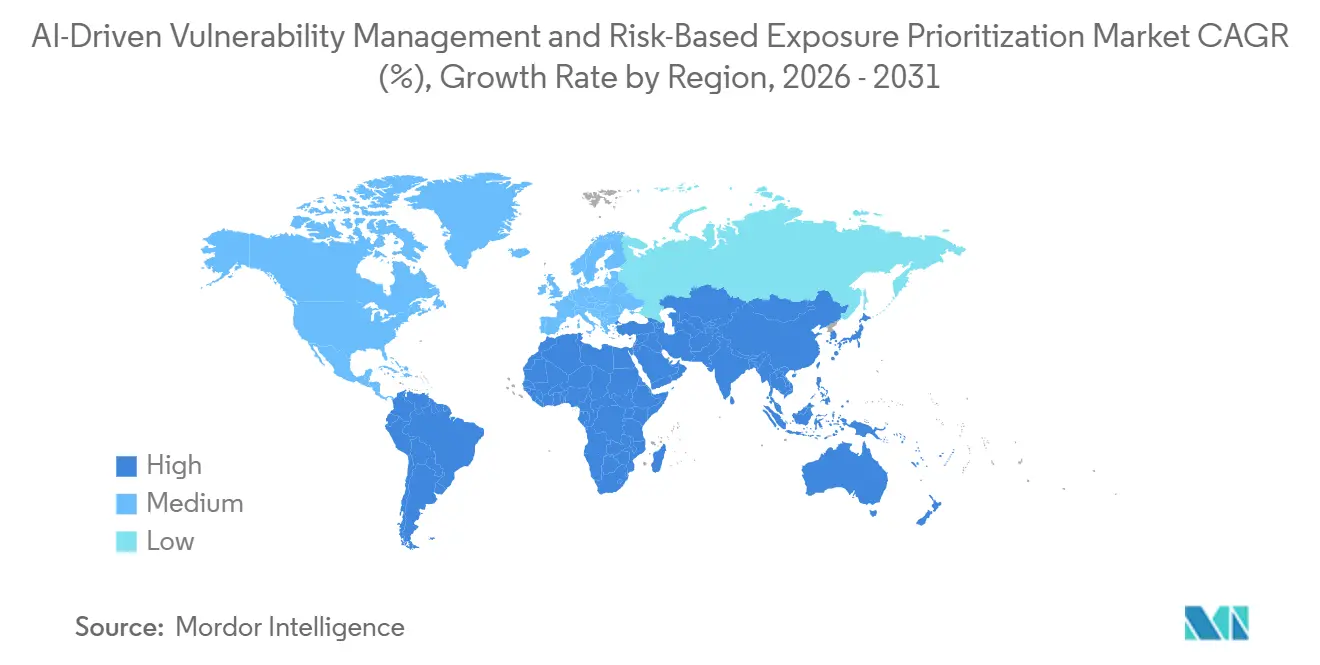
North America held 33.14% of the AI-driven vulnerability management and risk-based exposure prioritization market in 2025, maintaining its leading regional position. The region benefits from strong enterprise security spending, large installed bases of major vendors, and a regulatory environment that pushes cyber risk closer to board oversight. U.S. disclosure expectations and federal security directives have helped make continuous vulnerability governance a mainstream operational requirement rather than a niche security function. This has supported earlier adoption of exposure management platforms across BFSI, healthcare, and public-sector organizations. Canada also adds demand through regulated financial services and enterprise modernization, while Mexico supports growth through cloud security investment tied to digital infrastructure expansion.
Europe AI-Driven Vulnerability Management and Risk-Based Exposure Prioritization Market
Europe remained the second-largest regional market, and its position was closely tied to NIS2 enforcement and the broader push toward documented supply chain controls. The region is especially important for the AI-driven vulnerability management and risk-based exposure prioritization market because compliance requirements are no longer limited to incident reporting and now extend to supplier oversight, governance processes, and security measure validation. Germany, the United Kingdom, and France continue to anchor regional demand, with manufacturing and public-sector procurement playing significant roles. The EU ICT Supply Chain Security Toolbox also adds practical weight to third-party software risk management, supporting demand for platforms that can provide evidence rather than just scan results.
APAC, South America and MEA AI-Driven Vulnerability Management and Risk-Based Exposure Prioritization Market
Asia-Pacific is projected to grow at a 26.69% CAGR through 2031, making it the fastest-expanding region in the AI-driven vulnerability management and risk-based exposure prioritization market. India, Japan, Australia, and South Korea are the main high-momentum countries in this regional story. Patch timing requirements, critical infrastructure compliance, and stronger public-private coordination are all helping move buyers toward automated and continuous remediation models. The region also has a strong mix of cloud growth and regulatory diversity, making hybrid-ready platforms more attractive. China supports domestic adoption through tiered protection and regular vulnerability control requirements, while South America, the Middle East, and Africa are creating new demand pools through cloud-first digital transformation and greater alignment with U.S. and European cyber practices. Brazil, Saudi Arabia, and the UAE stand out as the more active procurement markets within those emerging regions.
Competitive Landscape
The AI-driven vulnerability management and risk-based exposure prioritization market showed a moderately consolidated structure at the top tier, where Tenable, Qualys, Rapid7, Microsoft, Palo Alto Networks, and CrowdStrike remained the most visible enterprise-scale competitors. Their position came from broad installed bases, strong brand recognition, and the ability to combine exposure functions with adjacent security workflows. At the same time, the market still had a meaningful mid-tier of specialized vendors such as Nucleus Security, Brinqa, XM Cyber, and Armis that competed on prioritization depth, asset coverage, and workflow fit. This kept the category competitive even though large platforms led the discussion. It also meant that differentiation was shifting from raw scan volume to validation quality, automation depth, and coverage across cloud, code, identity, and infrastructure assets.
One clear pattern was platform expansion through acquisitions and partnerships. Tenable’s January 2025 acquisition of Vulcan Cyber added third-party data ingestion, intelligent ticketing, and automated remediation routing to the Tenable One platform. CrowdStrike’s Project QuiltWorks, launched in April 2026, widened the competitive field by linking the company with Accenture, EY, IBM, Kroll, and OpenAI around AI-era vulnerability assessment and remediation. These moves showed that the AI-driven vulnerability management and risk-based exposure prioritization market was moving toward coalition-based ecosystems and broad operating platforms rather than isolated tools.
Another strong differentiator was the use of frontier AI in live product and internal code security workflows. Qualys launched Agent Val in March 2026 to validate exploitability and narrow remediation queues to a smaller set of evidence-backed priorities. Microsoft and Palo Alto Networks also used advanced AI models against their own codebases, reinforcing the view that vendors now need to test themselves with the same class of tooling that attackers may use. White space remained in OT and IoT coverage, lighter mid-market deployment models, and governance controls for AI scoring engines themselves. Those gaps matter because buyers are increasingly asking not only how a risk score is generated, but also whether it is explainable, auditable, and aligned with local data-handling requirements.
AI-Driven Vulnerability Management and Risk-Based Exposure Prioritization Industry Leaders
-
Tenable Holdings, Inc.
-
Qualys, Inc.
-
Rapid7, Inc.
-
Microsoft Corporation
-
Cisco Systems, Inc.
- *Disclaimer: Major Players sorted in no particular order
AI-Driven Vulnerability Management and Risk-Based Exposure Prioritization Market Companies Covered in this Report
- Tenable Holdings, Inc.
- Qualys, Inc.
- Rapid7, Inc.
- Microsoft Corporation
- Palo Alto Networks, Inc.
- Cisco Systems, Inc.
- CrowdStrike, Inc.
- Broadcom Inc.
- Fortinet, Inc.
- IBM Corporation
- Ivanti, Inc.
- Fortra, LLC
- LevelBlue
- Check Point Software Technologies Ltd.
- BeyondTrust Corporation
- Absolute Software Corporation
- Nucleus Security, Inc.
- Brinqa, Inc.
- XM Cyber Ltd.
- Armis, Inc.
Recent Industry Developments in AI-Driven Vulnerability Management and Risk-Based Exposure Prioritization Market
- June 2026: Qualys launched peer-to-peer (P2P) patch distribution within its Cloud Agent for Windows 6.5, enabling endpoints to distribute patch artifacts directly to one another and cutting patch propagation times by up to 92% while reducing WAN bandwidth consumption by more than 99%. This architecture eliminated the centralized distribution bottleneck that had historically kept mean-time-to-remediation elevated in large distributed enterprises.
- April 2026: CrowdStrike launched Project QuiltWorks, an industry-wide coalition including Accenture, EY, IBM Cybersecurity Services, Kroll, and OpenAI, designed to assess, prioritize, and remediate the escalating wave of vulnerabilities being discovered in production code by frontier AI models. The initiative introduced board-level risk reporting and adversary-informed prioritization services, marking a pivot toward AI-era continuous resilience programs.
- April 2026: CrowdStrike integrated Anthropic's Claude Opus 4.7 across its Falcon platform, applying the model to AI-powered vulnerability discovery and remediation workflows within Falcon Exposure Management. The integration positioned CrowdStrike as the first major exposure management vendor to embed a frontier AI model at the platform layer rather than as an add-on module.
- March 2026: Qualys launched Agent Val within its Enterprise TruRisk Management platform, introducing the industry's first agentic AI system for safe exploit validation and autonomous remediation. Agent Val used TruConfirm technology to prove exploitability in-environment, dynamically rerank TruRisk scores, and select optimal remediation paths, reducing a list of 60,000 critical findings to 15 evidence-backed priorities.
Global AI-Driven Vulnerability Management and Risk-Based Exposure Prioritization Market Report Scope
The AI-Driven Vulnerability Management and Risk-Based Exposure Prioritization market focuses on platforms and services that use artificial intelligence to identify, assess, and prioritize vulnerabilities across enterprise IT and OT environments. These solutions enhance traditional vulnerability scanning by applying AI-driven analytics to evaluate risk severity, validate exposures, and automate remediation strategies. Core applications include vulnerability discovery, risk prioritization, exposure validation, attack surface management, and remediation intelligence. The market is fueled by the growing complexity of enterprise ecosystems, the rising volume of vulnerabilities, and the need for proactive, risk-based cybersecurity approaches. Industries such as BFSI, healthcare, government, IT, and manufacturing are adopting these solutions to strengthen resilience, ensure compliance, and minimize exposure to evolving threats. Its primary goal is to enable organizations to build adaptive, intelligence-driven security infrastructures that effectively prioritize risks, reduce operational overhead, and safeguard digital assets against sophisticated cyberattacks.
The AI-Driven Vulnerability Management and Risk-Based Exposure Prioritization market report is segmented by Component (Software, and Services), Application (Vulnerability Discovery and Assessment, AI-Driven Risk Prioritization, Exposure Management and Validation, Attack Surface Management, Remediation Intelligence and Automation), Deployment (Cloud, On-Premises, and Hybrid), Enterprise Size (Large Enterprises, and Small and Medium Enterprises), End-user Industry (BFSI, Healthcare and Life Sciences, Information Technology and Telecom, Retail and E-commerce, Industrial Manufacturing, Government and Public Sector, and Other End-user Industries), and Geography (North America, South America, Europe, Asia-Pacific, Middle East, and Africa). The Market Forecasts are Provided in Terms of Value (USD).
Segmentation Overview
| Software |
| Services |
| Vulnerability Discovery and Assessment |
| AI-Driven Risk Prioritization |
| Exposure Management and Validation |
| Attack Surface Management |
| Remediation Intelligence and Automation |
| Cloud |
| On-Premises |
| Hybrid |
| Large Enterprises |
| Small and Medium Enterprises |
| BFSI |
| Healthcare and Life Sciences |
| Information Technology and Telecom |
| Retail and E-commerce |
| Industrial Manufacturing |
| Government and Public Sector |
| Other End-user Industries |
| North America | United States | |
| Canada | ||
| Mexico | ||
| South America | Brazil | |
| Argentina | ||
| Rest of South America | ||
| Europe | Germany | |
| United Kingdom | ||
| France | ||
| Italy | ||
| Spain | ||
| Russia | ||
| Rest of Europe | ||
| Asia-Pacific | China | |
| India | ||
| Japan | ||
| South Korea | ||
| Australia | ||
| Rest of Asia-Pacific | ||
| Middle East and Africa | Middle East | Saudi Arabia |
| United Arab Emirates | ||
| Rest of Middle East | ||
| Africa | South Africa | |
| Nigeria | ||
| Rest of Africa | ||
| By Component | Software | ||
| Services | |||
| By Application | Vulnerability Discovery and Assessment | ||
| AI-Driven Risk Prioritization | |||
| Exposure Management and Validation | |||
| Attack Surface Management | |||
| Remediation Intelligence and Automation | |||
| By Deployment | Cloud | ||
| On-Premises | |||
| Hybrid | |||
| By Enterprise Size | Large Enterprises | ||
| Small and Medium Enterprises | |||
| By End-user Industry | BFSI | ||
| Healthcare and Life Sciences | |||
| Information Technology and Telecom | |||
| Retail and E-commerce | |||
| Industrial Manufacturing | |||
| Government and Public Sector | |||
| Other End-user Industries | |||
| By Geography | North America | United States | |
| Canada | |||
| Mexico | |||
| South America | Brazil | ||
| Argentina | |||
| Rest of South America | |||
| Europe | Germany | ||
| United Kingdom | |||
| France | |||
| Italy | |||
| Spain | |||
| Russia | |||
| Rest of Europe | |||
| Asia-Pacific | China | ||
| India | |||
| Japan | |||
| South Korea | |||
| Australia | |||
| Rest of Asia-Pacific | |||
| Middle East and Africa | Middle East | Saudi Arabia | |
| United Arab Emirates | |||
| Rest of Middle East | |||
| Africa | South Africa | ||
| Nigeria | |||
| Rest of Africa | |||
Key Questions Answered in the Report
What is the size outlook for the AI-driven vulnerability management and risk-based exposure prioritization sector?
It stood at USD 8.43 billion in 2025, rises to USD 10.37 billion in 2026, and is forecast to reach USD 31.74 billion by 2031 at a 25.07% CAGR.
Which region leads this space today?
North America led with a 33.14% share in 2025, supported by strong enterprise demand, vendor concentration, and formal cyber governance requirements.
Which region is expanding the fastest through 2031?
Asia-Pacific is projected to grow the fastest at a 26.69% CAGR through 2031, helped by patch compliance pressure and rising critical infrastructure security programs.
Which deployment model is most common?
Cloud was the largest deployment model with 55.09% share in 2025 because buyers favored SaaS delivery, central visibility, and faster rollout.
Which buyer group is growing the fastest?
Small and medium enterprises are projected to record the highest enterprise-size growth at a 26.47% CAGR as cloud delivery and compliance needs widen the buyer base.
Which end-user sector matters most right now?
BFSI held the largest vertical share at 17.19% in 2025, while healthcare and life sciences is the fastest-growing vertical at a 26.58% CAGR through 2031.