
Size and Share of ABF Substrate Market For GPUs
Market Overview
| Study Period | 2020 - 2031 |
|---|---|
| Market Size (2026) | USD 4.16 Billion |
| Market Size (2031) | USD 8.89 Billion |
| Growth Rate (2026 - 2031) | 16.40 % |
| Fastest Growing Market | Asia-Pacific |
| Largest Market | North America |
| Market Concentration | High |
Major Players *Disclaimer: Major Players sorted in no particular order Image © Mordor Intelligence. Reuse requires attribution under CC BY 4.0. | |
Analysis of ABF Substrate Market For GPUs by Mordor Intelligence
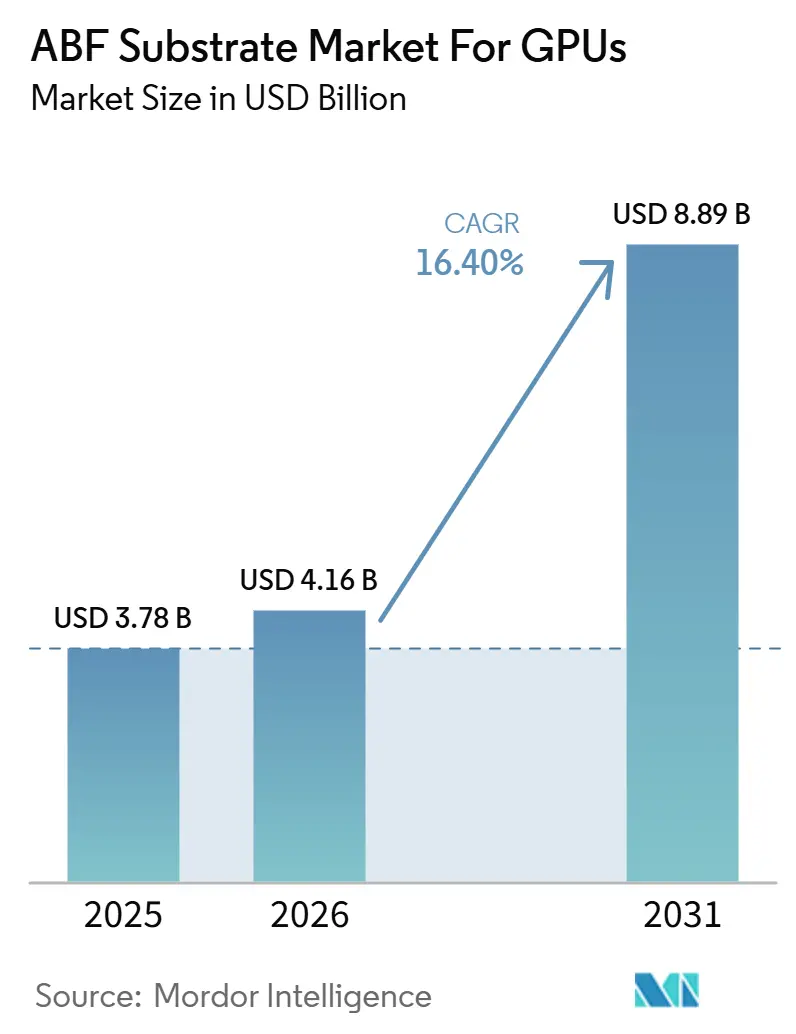
The ABF substrate market for GPUs size is expected to grow from USD 3.78 billion in 2025 to USD 4.16 billion in 2026 and is forecast to reach USD 8.89 billion by 2031 at 16.40% CAGR over 2026-2031. The ABF substrate market for GPUs is being pushed by AI data center buildouts, faster GPU refresh cycles, and wider use of chiplet-based multi-die packaging, which together keep substrate demand tied to both rising unit volumes and rising content per device. The ABF substrate market for GPUs is also being shaped by a shift in the substrate’s role, because signal integrity, power delivery, and thermal control now sit much closer to substrate design limits than they did in earlier GPU cycles. NVIDIA Vera Rubin entering full production in 2026 raises the technical requirement for suppliers, because larger package footprints, tighter dimensional control, and higher build-up layer counts become standard rather than exceptional conditions for winning leading GPU programs. The ABF substrate market for GPUs remains concentrated around a small group of qualified suppliers, and long qualification cycles continue to protect incumbents even as capacity additions move forward under customer-backed funding models. Material concentration remains the main structural risk, because ABF film supply is tightly held and emerging glass core programs, while unlikely to displace ABF in GPU packaging before 2029, are already creating a longer-range competitive pressure on future substrate road maps.
Key Report Takeaways
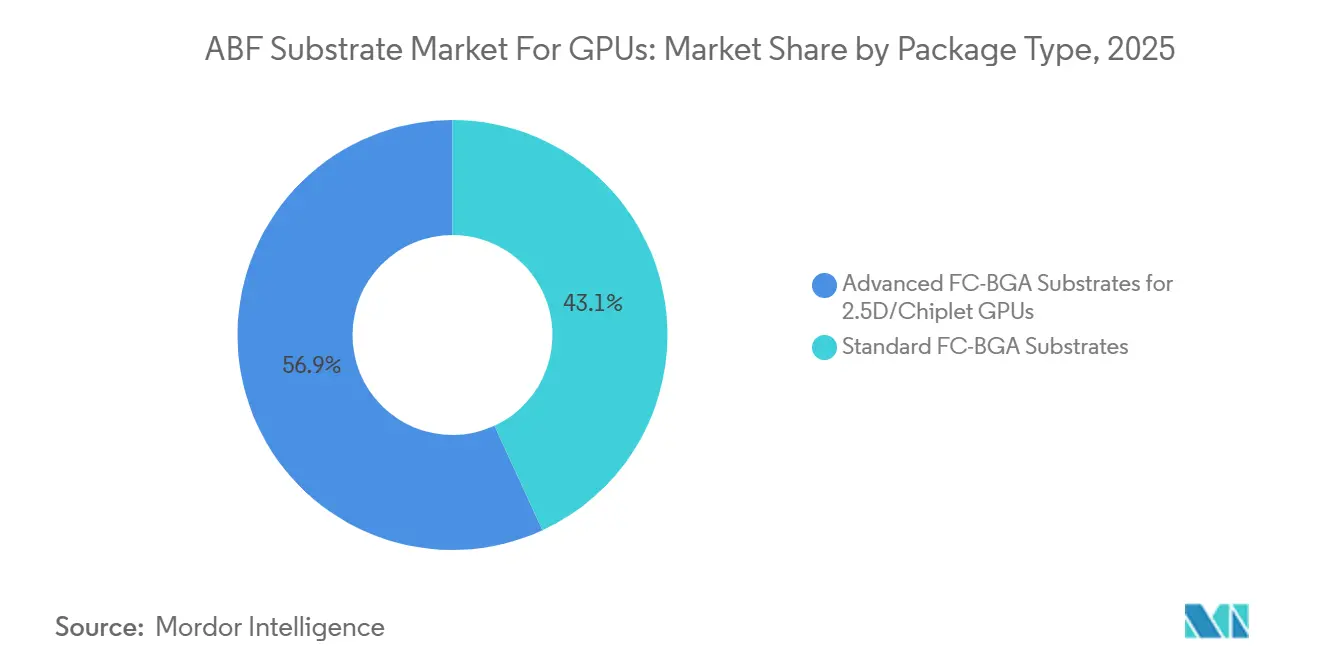
- By package type, advanced FC-BGA substrates for 2.5D and chiplet GPUs led with 56.88% revenue share of the ABF substrate market for GPUs in 2025, and the same package category is projected to grow at 16.99% annually through 2031.
- By layer count, above 16 layers led with 54.59% revenue share of the ABF substrate market for GPUs in 2025, and the same package category is projected to grow at 16.76% annually through 2031.
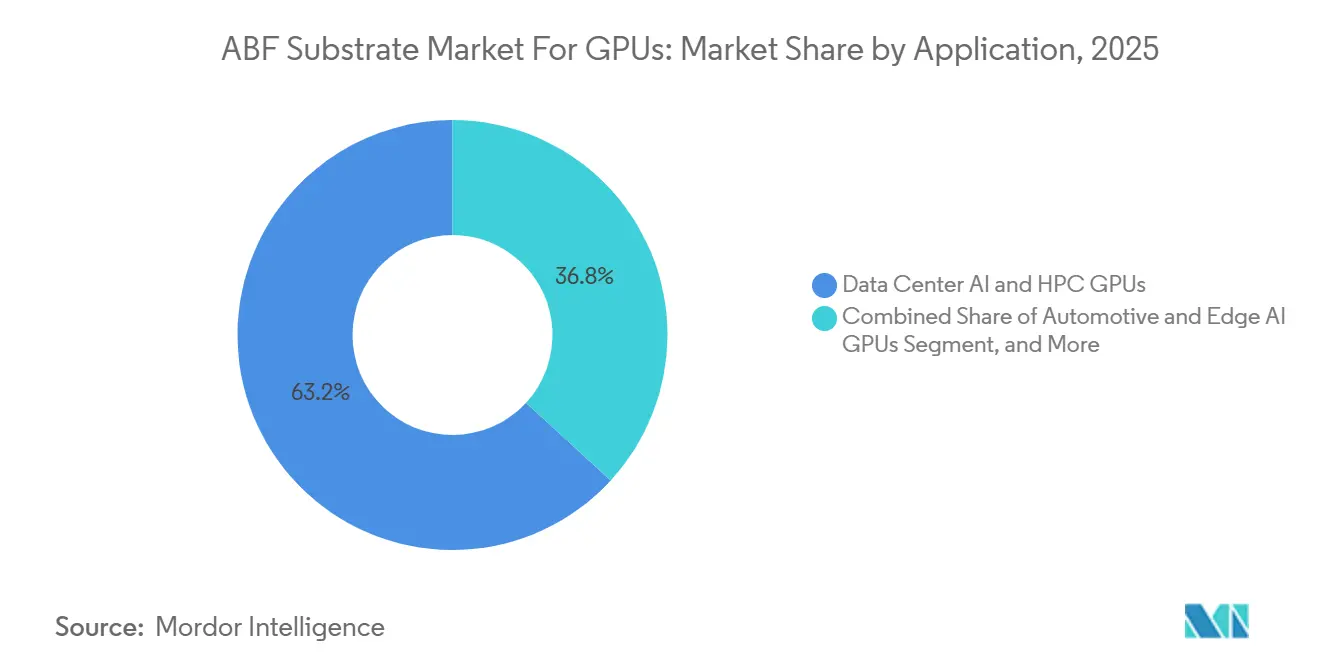
- By application, data center AI and HPC GPUs held 63.17% of segment revenue in 2025, while automotive and edge AI GPUs are projected to grow at 17.11% annually through 2031.
- By end use, cloud, hyperscale, enterprise data centers, and HPC represented 64.21% of revenue in 2025, while automotive and ADAS or autonomous compute is projected to advance at 17.26% annually through 2031.
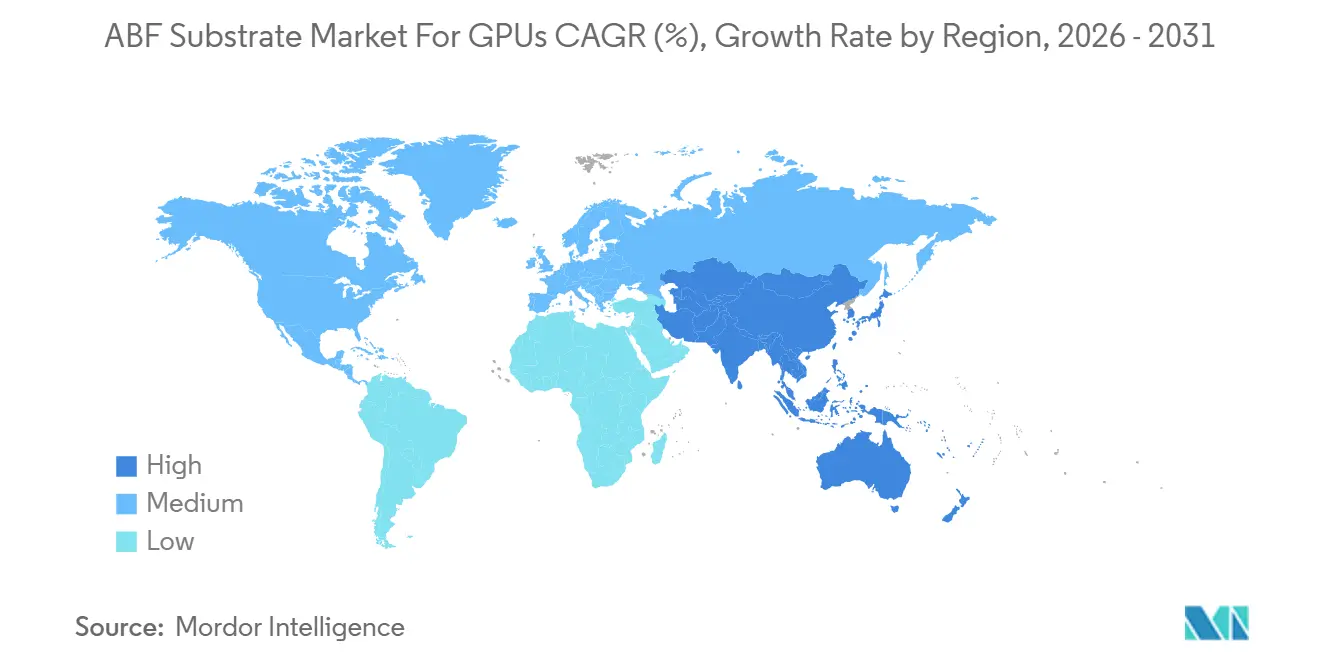
- By geography, North America accounted for 39.24% of revenue in 2025, while Asia-Pacific is projected to record the fastest regional CAGR at 17.22% through 2031 in the ABF substrate market for GPUs.
Note: Market size and forecast figures in this report are generated using Mordor Intelligence’s proprietary estimation framework, updated with the latest available data and insights as of January 2026.
Market Trends and Insights
Drivers Impact Analysis of ABF Substrate Market For GPUs*
| Driver | (~) % Impact on CAGR Forecast | Geographic Relevance | Impact Timeline |
|---|---|---|---|
| AI GPU Package Complexity Raising ABF Content per Device | +4.8% | Global, with concentrated procurement demand in North America and production intensity in Asia-Pacific | Short term (≤ 2 years) |
| Chiplet and Multi-Die Architectures Expanding Substrate Area | +3.9% | Global, concentrated in Taiwan, Japan, and South Korea production hubs | Medium term (2-4 years) |
| Hyperscaler and OEM Long-Term Supply Agreements De-Risking Capacity | +2.8% | Global, anchored in Asia-Pacific production clusters, with demand originating in North America and Europe | Medium term (2-4 years) |
| Advanced AI Server Refresh Cycles Increasing High-Layer FC-BGA Demand | +2.3% | North America and Europe demand centers, Asia-Pacific manufacturing base | Short term (≤ 2 years) |
| Capacity Expansion by Leading Substrate Makers Pulling Forward Supply | +1.8% | Asia-Pacific core, with spillover to Europe via AT&S operations in Malaysia and Austria | Medium term (2-4 years) |
| Domestic Packaging Subsidies Accelerating Regional Capacity Buildouts | +1.4% | North America, Japan, and India | Long term (≥ 4 years) |
| Source: Mordor Intelligence | |||
AI GPU Package Complexity Is Raising ABF Content per Device
Each new GPU generation uses more substrate area than the one before it, so the ABF substrate market for GPUs is expanding through content growth as well as shipment growth. The draft notes that NVIDIA H100 needed 12 or more ABF layers in a package above 120 x 120 mm, while Blackwell B200 pushed packaging complexity further with CoWoS-L and a package footprint above 800 mm², showing how advanced AI accelerators keep moving toward larger and denser package structures.[1] NVIDIA also confirmed that Vera Rubin entered full production in June 2026, and that step lifts the technical baseline again for suppliers serving the ABF substrate market for GPUs because Rubin brings more demanding package rules into a production setting rather than a future design discussion.[2] The same draft states that hyperscalers installed more than 1.2 million AI accelerator units in 2025, each using 4 to 6 FC-BGA substrates at power draw above 700 watts, which means thermal and electrical demands are rising at the same time as unit demand. In the ABF substrate market for GPUs, this creates a structural multiplier because every new high-end accelerator consumes more advanced substrate content than earlier compute platforms did. That is why the demand pull in the ABF substrate market for GPUs is not tied only to headline GPU volume, but also to the steady increase in substrate content per device.
Chiplet and Multi-Die Architectures Are Expanding Substrate Area
Chiplet design has moved into the center of AI compute packaging, and that shift keeps the ABF substrate market for GPUs focused on larger substrate bodies and more complex routing rules. The draft cites ISSCC 2025 for a scalable heterogeneous 2.5D system across 20 chiplets, and that example shows how multi-die integration depends on advanced substrates that can carry more interconnect density across wider package areas.[3] Intel’s Foveros and EMIB packaging platforms also reinforce this direction, because both rely on advanced substrate structures as the electrical and mechanical base for heterogeneous integration in leading compute packages. The practical effect for the ABF substrate market for GPUs is that substrate lines below the top layer-count threshold are pushed away from the best AI programs even if they remain relevant for lower-tier products. The draft also notes AMD’s qualification of a 2.5D panel-based Elevated Fanout Bridge interconnect with PTI in May 2026, which adds another route through which advanced packaging can continue to raise substrate area and layer needs. In the ABF substrate market for GPUs, chiplet adoption therefore changes the minimum acceptable specification for suppliers rather than simply lifting performance at the top end.
Hyperscaler and OEM Long-Term Supply Agreements Are De-Risking Capacity
The ABF substrate market for GPUs is increasingly supported by long-term supply agreements that reduce expansion risk for incumbents and tie future capacity to named customer demand. The draft states that Unimicron reported 7-year LTAs in 2026, and it also states that AT&S secured EUR 1.5 billion (USD 1.71 billion) to EUR 2.0 billion (USD 2.28 billion) in customer-financed investments for its Kulim, Malaysia facility from AMD and a second leading technology company, which directly raised AT&S guidance for FY2026/27. That financing structure matters because the ABF substrate market for GPUs has very high capital intensity and long qualification windows, so committed off-take lowers the risk attached to early expansion decisions. It also deepens the advantage of incumbents, because suppliers that already hold customer qualifications can add funded capacity before new entrants complete even a first qualification cycle. In practical terms, the ABF substrate market for GPUs is moving away from short-cycle speculative expansion and toward a model where customer relationships determine who can scale first. This leaves late entrants at a disadvantage because they face both the qualification barrier and the lack of committed financing that current leaders are already using to move capacity forward.
Advanced AI Server Refresh Cycles Are Increasing High-Layer FC-BGA Demand
The ABF substrate market for GPUs is being tightened by faster AI server refresh cycles, because the time between successive demand peaks has shortened while substrate complexity keeps increasing. NVIDIA confirmed Vera Rubin production in June 2026, with Microsoft set to deploy Vera Rubin NVL72 rack-scale systems and CoreWeave also integrating Rubin-based systems from H2 2026, which points to another major high-end demand wave entering the market without a long gap after the prior cycle. The draft also states that ABF substrate average selling prices rose from USD 65 per unit in 2024 to USD 82 in 2025, showing that tighter supply and higher technical content were already feeding into price realization before Rubin volumes reached full scale. As annual architecture launches replace longer product gaps, the ABF substrate market for GPUs faces less time to absorb the next package complexity jump or rebuild inventory between cycles. The draft also broadens the demand base beyond NVIDIA alone by pointing to Google TPU, AWS Trainium, and Meta ASIC demand revisions in 2026, which means the shortage pattern is no longer tied to a single vendor program. That leaves the ABF substrate market for GPUs exposed to overlapping demand ramps from several AI compute platforms at the same time.
Restraints Impact Analysis of ABF Substrate Market For GPUs*
| Restraint | (~) % Impact on CAGR Forecast | Geographic Relevance | Impact Timeline |
|---|---|---|---|
| Extreme Capital Intensity Limiting New Entrants | -0.9% | Global, most pronounced in regions without government subsidy support | Long term (≥ 4 years) |
| Yield Loss at High Layer Counts Delaying Commercial Ramp-Up | -0.5% | Asia-Pacific core, especially Japan, Taiwan, and South Korea production hubs | Medium term (2-4 years) |
| Concentration in ABF Film and Critical Inputs Creating Supply Bottlenecks | -0.3% | Global, with acute impact on Asia-Pacific substrate production | Short term (≤ 2 years) |
| Alternative Substrate Technologies Eroding Long-Term Share in Select Applications | -0.2% | North America and Europe, where glass core substrate development is more active | Long term (≥ 4 years) |
| Source: Mordor Intelligence | |||
Extreme Capital Intensity Limits New Entrants
A commercial FC-BGA plant at 50,000 panels per month needs USD 800 million to USD 1 billion and a 30 to 36 month qualification period before revenue begins, so the ABF substrate market for GPUs remains difficult for new entrants to penetrate. The draft also states that above-14-layer production involves more than 60 sequential manufacturing steps and only 75 to 80% cumulative panel yields, which means a meaningful portion of output is lost before shipment and early ramp economics stay weak. Qualification standards and reliability protocols extend this problem because testing requirements add months between physical build-out and commercial revenue. The draft links this barrier to the fact that 2024 and 2025 capacity additions came from incumbent brownfield sites rather than greenfield challengers, reinforcing the position of established suppliers. U.S. policy support has started to address this through the National Advanced Packaging Manufacturing Program, with the Department of Commerce finalizing USD 1.4 billion in awards in 2025, including USD 300 million for advanced substrate and materials research, but the draft makes clear that research support does not equal immediate high-volume qualified ABF capacity. In the ABF substrate market for GPUs, capital access alone therefore does not solve entry barriers because qualification time, yield learning, and customer trust still determine when new capacity becomes usable.
Yield Loss at High Layer Counts Delays Commercial Ramp-Up
Yield is a direct commercial restraint in the ABF substrate market for GPUs because above-20-layer production behaves very differently from the 8-to-16-layer products that dominated earlier cycles. Every added build-up layer brings another lamination, cure, laser-drill, and electroplating step, and the draft states that microvia reliability testing for 30-plus-layer flows can extend 6 to 9 months beyond physical line completion. That creates a 12 to 18 month gap between announced capital spending and usable qualified supply, so capacity headlines can overstate near-term relief in the ABF substrate market for GPUs. The draft also notes that Ajinomoto Fine-Techno planned an ABF film price increase of up to 30% for Q3 2026, which worsens margin pressure during the yield-improvement phase for new lines. The result is that technically advanced growth categories in the ABF substrate market for GPUs can remain supply-constrained even while capex announcements appear large. That is why suppliers with proven high-layer yields still hold a stronger competitive position than their nominal installed capacity alone might suggest.
*Our forecasts treat driver/restraint impacts as directional, not additive. The impact forecasts reflect baseline growth, mix effects, and variable interactions.
ABF Substrate Market For GPUs Segment Analysis
By Package Type:
Advanced FC-BGA Substrates Reshape GPU Supply EconomicsAdvanced FC-BGA substrates for 2.5D and chiplet GPUs held 56.88% of the ABF substrate market size in 2025, and the same package group remained the fastest-growing type through 2031 as leading AI platforms standardized on more demanding package formats. In the ABF substrate market for GPUs, this segment has moved into the center of value creation because large-body packages, tighter routing tolerance, and higher build-up layer counts are now basic requirements for top AI accelerator programs rather than optional performance upgrades. Standard FC-BGA still serves consumer and lower-tier professional GPUs, where cost per layer and lead time remain more important than the highest possible performance envelope. That said, the draft makes clear that the addressable space for standard formats is narrowing as even midrange AI inference products begin to adopt advanced packaging to support higher memory bandwidth and more complex routing paths.
The ABF substrate industry also faces a customer lock-in effect inside this segment because once a line is qualified for a specific chiplet rule set, switching becomes slow and expensive. The draft states that requalification usually takes 18 to 24 months, which gives incumbents a durable pricing and relationship advantage that the share figure alone does not fully show. AMD’s qualification of a panel-based Elevated Fanout Bridge interconnect with PTI in May 2026 reinforces the same direction, because ecosystem development keeps pointing toward advanced package structures rather than back to simpler substrate formats. Compliance demands under advanced substrate reliability standards also keep raising the technical floor, so the ABF substrate market for GPUs rewards suppliers that can combine process stability, customer trust, and volume discipline in high-end FC-BGA lines. For that reason, package type in the ABF substrate market for GPUs is not only a product grouping, but also a useful marker of which suppliers sit closest to the most defensible and best-funded demand streams.
By Layer Count:
Ultra-High Layer Density Becomes the AI GPU Production StandardAbove-16-layer substrates are projected to grow at 16.76% annually through 2031, making this the clearest expansion tier in the ABF substrate market for GPUs as routing density keeps outpacing what simpler stacks can support. The draft notes that Hopper, Blackwell, and Vera Rubin all pushed layer requirements higher, which shows that this is a continuing design direction rather than a one-cycle response to temporary AI demand pressure. The 9-to-16-layer range remained the production backbone for mid-tier AI GPUs, consumer gaming, and workstation products in 2025 because those products still balance complexity against cost and thermal limits. Up-to-8-layer products stayed relevant at the entry end, but the draft also shows that this part of the mix remains under margin pressure as manufacturers steer capacity and engineering attention toward higher-value layer configurations.
This segmentation also acts as a proxy for competitive depth in the ABF substrate market for GPUs because high-layer output depends on yield discipline across more than 60 process steps. The draft states that 20-plus-layer production typically delivers only 75 to 80% panel yields, which means scrap remains high and ramp difficulty becomes part of the pricing structure for the segment. Ibiden’s JPY 500 billion (USD 3.08 billion) investment plan for FY2026 through FY2028, centered on the Gama and Ono plants, was directed at high-performance IC package substrates and signals where leading suppliers expect the deepest value concentration to remain. In the ABF substrate industry, the ability to qualify and produce above-16-layer and 20-plus-layer flows at acceptable yields separates suppliers with true AI-grade positioning from those serving only adjacent or lower-complexity programs. That is why layer count in the ABF substrate market for GPUs does more than describe structure complexity, it also shows which part of the market carries the most defensible customer relationships and the strongest pricing power.
By Application:
Data Center AI Leads Demand, Automotive and Edge AI AccelerateData center AI and HPC GPUs accounted for 63.17% of ABF substrate market share in 2025, which confirms that hyperscaler and large enterprise compute programs remain the main revenue anchor for the ABF substrate market for GPUs. This application segment needs the most demanding substrate specification, including large-body formats, above-16-layer build-up, and power delivery networks capable of handling package draw above 700 watts. Consumer and gaming GPUs still contribute important shipment volume, but the draft shows that they deliver lower per-unit substrate revenue because package bodies are smaller and layer counts are lower. Professional visualization and workstation GPUs occupy a steadier middle position, where AI-assisted workflows keep increasing product complexity without matching the infrastructure-driven intensity of data center demand.
Automotive and edge AI GPUs are projected to advance at 17.11% annually through 2031, and that makes them the fastest-growing application in the ABF substrate market for GPUs. The draft links that growth to ADAS requirements and centralized vehicle compute architectures, which increasingly demand GPU-class processing power in packaging formats that must also meet automotive reliability thresholds. NVIDIA DRIVE Thor is used in the draft as a clear example because it combines advanced packaging requirements with standards such as ISO 26262 and AEC-Q104, which raises qualification expectations for suppliers serving this use case. In the ABF substrate market for GPUs, that combination of data-center-like routing needs and automotive-grade reliability creates a narrower supplier field than pure consumer or workstation applications. It also means application growth is not spread evenly, because the strongest expansion comes from categories that require both advanced packaging content and stricter end-market certification.

By End Use:
Cloud Infrastructure Anchors Revenue, Autonomous Compute Builds the Next Growth PoolCloud, hyperscale, enterprise data centers, and HPC represented 64.21% of ABF substrate market share in 2025, and that concentration reflects how strongly the ABF substrate market for GPUs depends on a small set of large buyers. The draft points to operators such as Microsoft, Google, Amazon, and Meta as the financial backbone of current substrate expansion because these buyers support multi-year procurement visibility and, in some cases, long-term supply commitments that change the economics of capacity planning. This end-use group also benefits from the fastest product turnover at the top end of compute, which keeps demand for advanced substrates firm across successive AI platform launches. PCs, gaming systems, and workstations remain important by volume, but the draft makes clear that they are growing more slowly because consumer GPU complexity has not escalated at the same pace as data center GPU complexity.
Automotive and ADAS or autonomous compute is projected to grow at 17.26% annually through 2031, and the draft presents it as the fastest-growing end-use category in the ABF substrate market for GPUs. That growth comes from software-defined vehicle architectures that increasingly centralize compute and move packaging needs closer to data-center-class standards, even though the final deployment environment is far harsher. Telecom, industrial, and edge AI systems form a fourth emerging cluster, where lower layer counts and smaller package bodies may still be acceptable, but deployment growth is beginning to create meaningful incremental substrate demand. The ABF substrate market for GPUs therefore shows a clear split between current revenue concentration in cloud infrastructure and future incremental growth from automotive and distributed edge compute. Compliance is especially important in automotive and telecom because environmental and operator-specific testing extend qualification timelines and reinforce supplier selection discipline over multiple product cycles.
Geography Analysis
North America ABF Substrate Market for GPUs
North America accounted for 39.24% of the ABF substrate market for GPUs in 2025, making it the largest regional sub-segment. The region leads mainly through demand generation rather than manufacturing capacity, driven by hyperscale cloud providers, AI accelerator developers, and major GPU companies that shape procurement and long-term substrate investment decisions. Government initiatives to strengthen advanced semiconductor packaging and substrate capabilities have also increased investment in domestic supply chain resilience. While commercial ABF substrate manufacturing remains limited compared with Asia, North America continues to shape market direction through technology leadership, AI infrastructure deployment, and policy support.
APAC ABF Substrate Market for GPUs
Asia-Pacific is projected to be the fastest-growing regional market, expanding at a 17.22% CAGR during 2026-2031. The region remains the global manufacturing hub for ABF substrates, supported by leading suppliers in Japan, Taiwan, and South Korea with strong expertise in high-layer FC-BGA substrate production. Investments in advanced substrate capacity, AI server applications, and next-generation packaging technologies are helping manufacturers meet rising demand for AI GPUs and high-performance computing processors. Strong semiconductor ecosystems, proximity to major foundries and OSAT providers, and sustained capital expenditure on advanced packaging infrastructure are expected to drive growth over the forecast period.
EMEA and South America ABF Substrate Market for GPUs
Europe holds a strategic but smaller position in the market through specialized substrate manufacturers and technology partnerships. Regional companies continue to expand advanced substrate capabilities for AI and high-performance computing applications, although much of their manufacturing growth is being deployed through facilities in Asia to remain close to semiconductor production ecosystems. As a result, Europe contributes mainly through technology development and supplier diversification rather than large-scale production capacity. South America and the Middle East and Africa remain relatively small markets for ABF substrates used in GPUs. Demand in these regions is largely driven by imports of AI servers, enterprise computing systems, and data center infrastructure, with limited local substrate manufacturing. Their market contribution is expected to remain modest throughout the forecast period, while growth will mainly follow broader adoption of AI computing and digital infrastructure investments.
Competitive Landscape
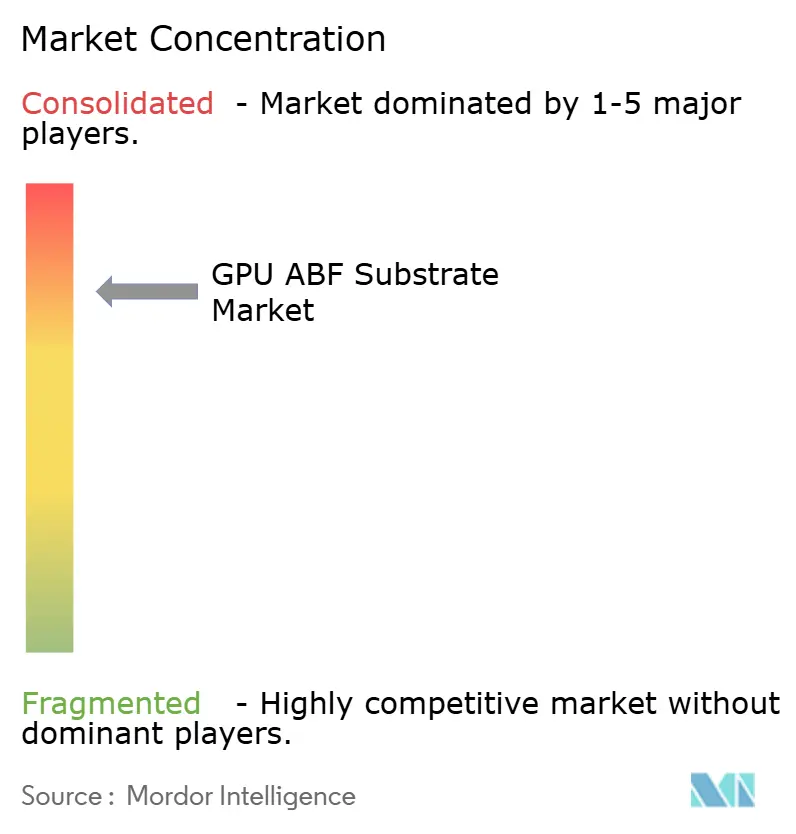
The ABF substrate market for GPUs remains structurally oligopolistic because a small group of vertically integrated incumbents control most commercially qualified AI-grade advanced substrate capacity. The draft identifies Ibiden, Unimicron Technology, Samsung Electro-Mechanics, and AT&S as the main leaders, and it ties their position to long qualification cycles of 18 to 30 months that prevent rapid supplier substitution once a program moves into production. In the ABF substrate market for GPUs, this means competitive standing depends less on announced ambition and more on proven yields, customer trust, and the ability to meet high-layer technical requirements at scale. The result is a market where capacity additions matter, but only when they are attached to lines that customers have already qualified or are willing to fund toward qualification. That is why leadership in the ABF substrate market for GPUs remains more stable than it would in a less specialized electronics component category.
Ibiden’s JPY 500 billion (USD 3.08 billion) capital investment plan for FY2026 through FY2028 is one of the clearest strategic moves in the current cycle, because it is directed at high-performance IC package substrates and strengthens the company’s position in the highest-layer AI server substrate tier. AT&S made another important move by expanding Kulim under customer-financed agreements, which turns future supply into a more visible and less speculative growth stream than a traditional capex model would allow. The draft also highlights that competitive strategy in the ABF substrate market for GPUs is converging around long-term agreements with hyperscalers and chip designers, because customer funding now helps determine who can add qualified capacity soon enough to capture the next AI platform wave. This financing approach deepens incumbent advantages because it joins technical qualification, capacity reservation, and capital support into one relationship. New entrants face a harder path because they must secure technology credibility and customer commitment before their first large-scale line becomes economically viable.
A second competitive layer is forming around future package technologies that could alter substrate specifications over time. Intel’s January 2026 demonstration of EMIB packaging with a glass core substrate at NEPCON Japan shows that alternative substrate architectures are moving from lab concept toward an early commercialization path, even if the draft does not expect material ABF displacement in GPU packaging before 2029. The draft also notes that Chinese players such as Shennan Circuits, Zhen Ding Technology Holding, and DSBJ are expanding their ABF substrate footprints through domestic AI chip programs, although access to the most advanced NVIDIA and AMD GPU programs remains constrained. Patent activity around fine-line mSAP routing and microvia reliability since 2024 further reinforces the technology moat held by Japanese and Taiwanese incumbents, because replication requires both process knowledge and long-cycle learning at commercial scale. In the ABF substrate market for GPUs, competition is therefore active, but the terms of competition still favor suppliers that already combine high-layer capability, long customer history, and balance sheet support for multi-year expansion.
Leaders of ABF Substrate Market For GPUs
-
Ibiden Co., Ltd.
-
Unimicron Technology Corp.
-
Nan Ya Printed Circuit Board Corporation
-
Shinko Electric Industries Co., Ltd.
-
AT&S Austria Technologie and Systemtechnik Aktiengesellschaft
- *Disclaimer: Major Players sorted in no particular order
ABF Substrate Market For GPUs Companies Covered in this Report
- Ibiden Co., Ltd.
- Unimicron Technology Corp.
- Nan Ya Printed Circuit Board Corporation
- Shinko Electric Industries Co., Ltd.
- AT&S Austria Technologie and Systemtechnik Aktiengesellschaft
- Kinsus Interconnect Technology Corp.
- Samsung Electro-Mechanics Co., Ltd.
- LG Innotek Co., Ltd.
- TTM Technologies, Inc.
- Shennan Circuits Co., Ltd.
- Zhen Ding Technology Holding Limited
- DSBJ Co., Ltd.
- Isu Petasys Co., Ltd.
- Meiko Electronics Co., Ltd.
- Wus Printed Circuit Co., Ltd.
- Tripod Technology Corp.
- Daeduck Electronics Co., Ltd.
- Toppan Inc.
- Nanya PCB Corporation
- Ajinomoto Co., Inc.
Recent Industry Developments in ABF Substrate Market For GPUs
- June 2026: AT&S expanded its Kulim, Malaysia manufacturing site based on agreements with AMD and a second leading technology company, committing EUR 1.5 billion to EUR 2.0 billion (USD 1.71 billion to USD 2.28 billion) in CAPEX for FY2026/27. AT&S raised its constant-currency revenue growth guidance for FY2026/27 to 45-55%, reflecting the scale of committed long-term customer demand for high-end IC substrates used in AI and HPC applications.
- May 2026: AT&S announced a separate capacity expansion at its Chongqing, China facility to accommodate growing demand from a key AI substrate customer, with investment in the high double-digit million euro range financed through long-term customer agreements. A positive EBIT impact in the high double-digit million euro range is expected in FY2026/27.
- February 2026: Ibiden Co., Ltd. announced a JPY 500 billion (USD 3.08 billion) capital investment plan for IC package substrate expansion over FY2026 through FY2028, with JPY 220 billion (USD 1.35 billion) allocated to the Gama Plant (Cell6) as the first phase. Mass production is scheduled to commence from FY2027, targeting AI server and high-performance server substrate demand.
- January 2026: Intel debuted a sample integrating EMIB packaging with a glass core substrate at NEPCON Japan in Tokyo, demonstrating a 10-2-10 thick glass core structure for a 78 x 77 mm package and marking a decisive step toward commercialization of glass core substrates as an alternative to organic ABF for advanced AI packaging.
Scope of Report on ABF Substrate Market For GPUs
The ABF Substrate Market for GPUs refers to the market for Ajinomoto Build-up Film-based semiconductor substrates used to package high-performance GPU chips. These substrates provide the dense wiring, electrical insulation, and thermal stability needed to connect GPU dies with memory and other package components.
The ABF Substrate Market for GPUs Report is Segmented by Package Type (Standard FC-BGA, Advanced FC-BGA for 2.5D/Chiplet GPUs), Layer Count (Up to 8, 9 to 16, and Above 16 Layers), Application (Data Center AI and HPC, Consumer and Gaming, Professional Visualization and Workstation, and Automotive and Edge AI GPUs), End Use (Cloud and Hyperscale/HPC, PCs and Gaming Systems, and Workstations, Automotive and ADAS/Autonomous Compute, and Telecom, Industrial, and Edge AI Systems), and Geography (North America, Europe, Asia-Pacific, South America, and Middle East and Africa). The Market Forecasts are Provided in Terms of Value (USD).
Segmentation Overview
| Standard FC-BGA Substrates |
| Advanced FC-BGA Substrates for 2.5D/Chiplet GPUs |
| Up to 8 Layers |
| 9 to 16 Layers |
| Above 16 Layers |
| Data Center AI and HPC GPUs |
| Consumer and Gaming GPUs |
| Professional Visualization and Workstation GPUs |
| Automotive and Edge AI GPUs |
| Cloud, Hyperscale, Enterprise Data Centers, and HPC |
| PCs, Gaming Systems, and Workstations |
| Automotive and ADAS/Autonomous Compute |
| Telecom, Industrial, and Edge AI Systems |
| North America | United States |
| Canada | |
| Mexico | |
| Europe | Germany |
| United Kingdom | |
| France | |
| Italy | |
| Rest of Europe | |
| Asia-Pacific | China |
| Japan | |
| South Korea | |
| India | |
| Southeast Asia | |
| Rest of Asia-Pacific | |
| South America | |
| Middle East and Africa |
| By Package Type | Standard FC-BGA Substrates | |
| Advanced FC-BGA Substrates for 2.5D/Chiplet GPUs | ||
| By Layer Count | Up to 8 Layers | |
| 9 to 16 Layers | ||
| Above 16 Layers | ||
| By Application | Data Center AI and HPC GPUs | |
| Consumer and Gaming GPUs | ||
| Professional Visualization and Workstation GPUs | ||
| Automotive and Edge AI GPUs | ||
| By End Use | Cloud, Hyperscale, Enterprise Data Centers, and HPC | |
| PCs, Gaming Systems, and Workstations | ||
| Automotive and ADAS/Autonomous Compute | ||
| Telecom, Industrial, and Edge AI Systems | ||
| By Geography | North America | United States |
| Canada | ||
| Mexico | ||
| Europe | Germany | |
| United Kingdom | ||
| France | ||
| Italy | ||
| Rest of Europe | ||
| Asia-Pacific | China | |
| Japan | ||
| South Korea | ||
| India | ||
| Southeast Asia | ||
| Rest of Asia-Pacific | ||
| South America | ||
| Middle East and Africa | ||
Key Questions Answered in the Report
What is the ABF substrate market for GPUs size in 2026 and how fast is it growing?
The ABF substrate market for GPUs stands at USD 4.16 billion in 2026 and is forecast to reach USD 8.89 billion by 2031 at a 16.40% CAGR over 2026-2031.
Which package type leads GPU substrate demand today?
Advanced FC-BGA substrates for 2.5D and chiplet GPUs led with 56.88% of revenue in 2025, reflecting the shift toward larger, denser, and higher-layer AI package formats.
Why are high-layer ABF substrates becoming more important for GPU packaging?
Above-16-layer substrates are projected to grow at 16.76% annually through 2031 because newer AI GPU architectures need more routing density, stronger power delivery, and tighter thermal control.
Which application drives the largest share of demand?
Data center AI and HPC GPUs accounted for 63.17% of application revenue in 2025, supported by hyperscaler procurement and the technical requirements of large AI accelerator packages.
What region dominates global supply and demand?
North America held 39.24% of revenue in 2025 and Asia-Pacific is projected to grow at 17.22% CAGR through 2031, supported by deep manufacturing capacity in Japan, Taiwan, and South Korea.
What is the next major growth area beyond cloud AI infrastructure?
Automotive and edge AI GPUs, along with automotive and ADAS or autonomous compute end use, are the fastest-growing categories, advancing at 17.11% and 17.26% annually through 2031.