
Recreational Boating Market Size and Share
Market Overview
| Study Period | 2019 - 2031 |
|---|---|
| Market Size (2026) | USD 30.80 Billion |
| Market Size (2031) | USD 37.64 Billion |
| Growth Rate (2026 - 2031) | 5.10 % |
| Fastest Growing Market | Asia-Pacific |
| Largest Market | North America |
| Market Concentration | Medium |
Major Players *Disclaimer: Major Players sorted in no particular order Image © Mordor Intelligence. Reuse requires attribution under CC BY 4.0. | |
Recreational Boating Market Analysis by Mordor Intelligence
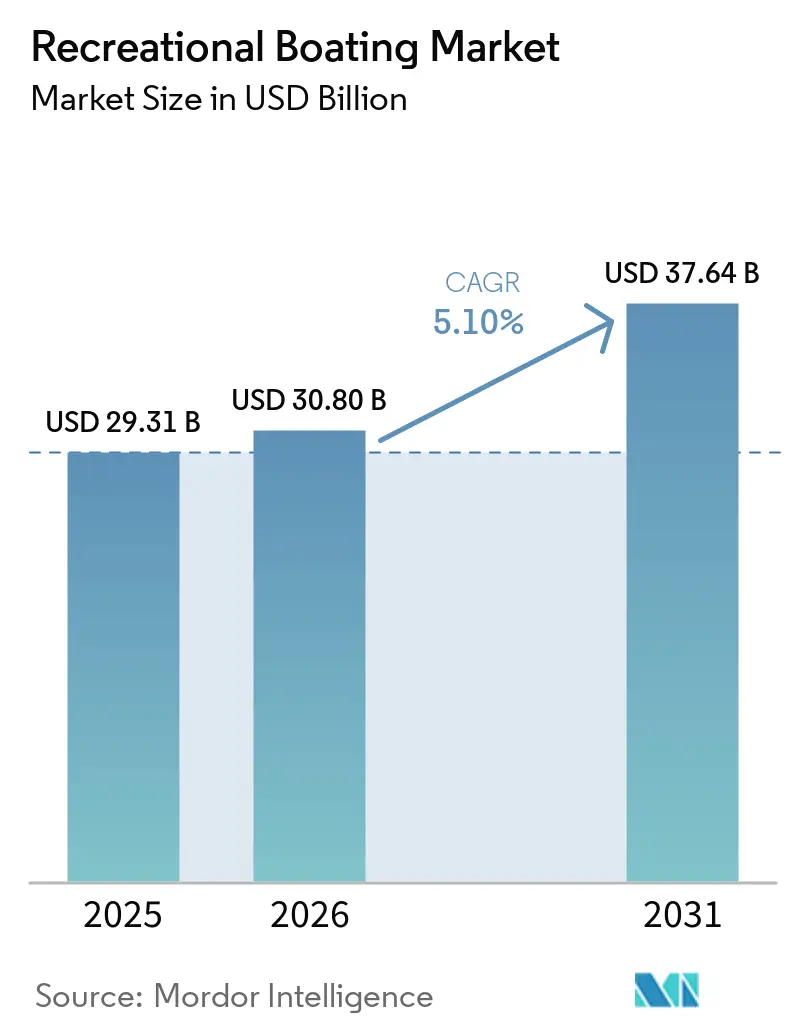
The recreational boating market size was valued at USD 29.31 billion in 2025 and is expected to grow from USD 30.80 billion in 2026 to reach USD 37.64 billion by 2031, at a CAGR of 5.10% during the forecast period (2026-2031). The sector continues to attract outdoor-oriented consumers even amid inflationary pressures, supported by rising participation in watersports, affluent buyers moving up to larger yachts, and the rapid expansion of marina infrastructure in Asia. Digital direct-to-consumer channels are accelerating vessel turnover, particularly among 20–50-ft craft, while experience-based access models, such as boat clubs, are converting first-time users into long-term customers. Manufacturers are countering raw-material cost inflation by shifting toward advanced composites and recyclable hull technologies, and they are investing in connected-boat systems to suit younger, tech-savvy owners.
Key Report Takeaways
- By boat type, outboard powerboats led with 43.11% of recreational boating market share in 2025, while personal watercraft are projected to expand at a 7.45% CAGR through 2031.
- By hull material, fiberglass/GRP accounted for 64.12% of the recreational boating market in 2025; advanced composites are growing fastest, at a 10.46% CAGR through 2031.
- By length, craft under 20 ft captured 57.04% of the recreational boating market share in 2025, whereas vessels over 50 ft are positioned for an 8.35% CAGR between 2026 and 2031.
- By power source, internal-combustion engines dominated, with a 91.22% share of the recreational boating market in 2025, yet electric/hybrid propulsion will advance at an 11.52% CAGR through 2031.
- By activity/application, watersports held 39.45% of the recreational boating market in 2025, while cruising and coastal tourism are forecast to expand at 9.13% CAGR through 2031.
- By distribution channel, dealer showrooms retained 88.15% of the recreational boating market share in 2025; online direct-to-consumer outlets will grow fastest, at a 13.12% CAGR through 2031.
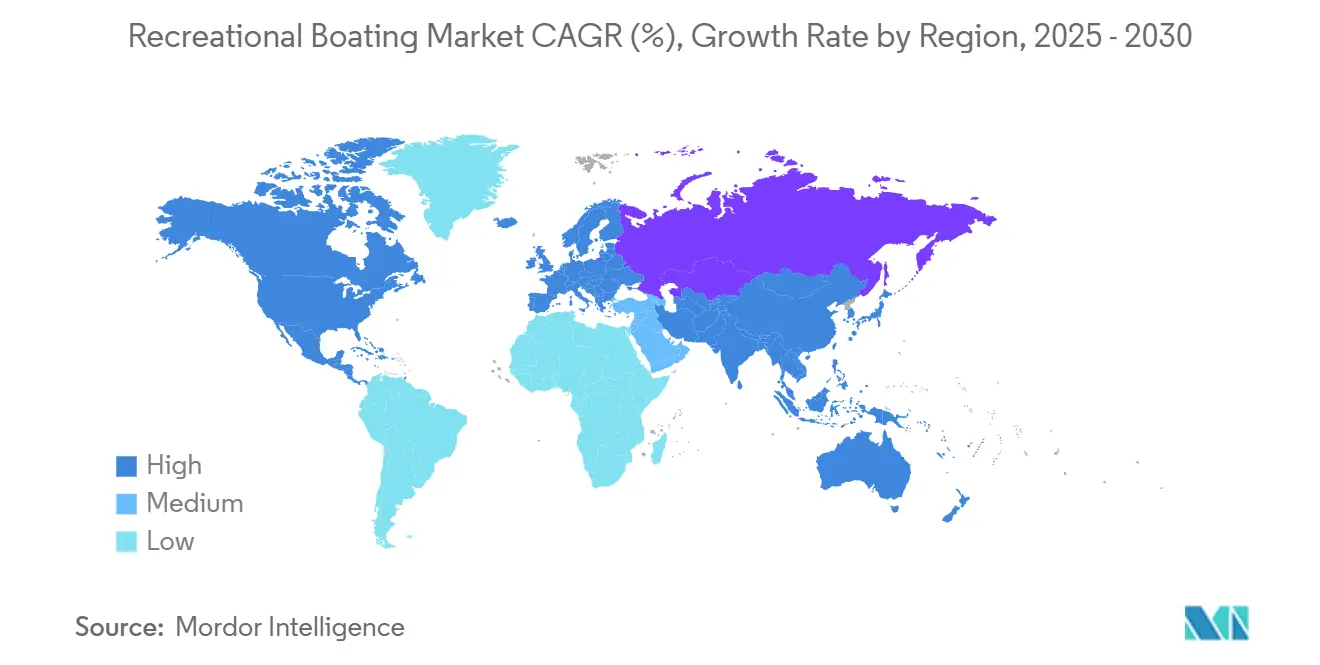
- By geography, North America led with 48.33% of the recreational boating market share in 2025, while Asia-Pacific is the fastest-growing region at a 9.78% CAGR through 2031.
Note: Market size and forecast figures in this report are generated using Mordor Intelligence’s proprietary estimation framework, updated with the latest available data and insights as of January 2026.
Market Trends and Insights
Drivers Impact Analysis of Recreational Boating Market*
| Driver | (~) % Impact on CAGR Forecast | Geographic Relevance | Impact Timeline |
|---|---|---|---|
| Participation in Watersports in North America | +1.2% | North America, with spillover effects in Europe | Medium term (2-4 years) |
| Rise of Boat-Club & Fractional Ownership Models | +1.1% | North America, with early adoption in Europe | Short term (≤ 2 years) |
| Government Marina Expansion Programs | +0.9% | Asia, primarily China's coastal provinces | Long term (≥ 4 years) |
| High-Net-Worth Individual Wealth Expansion | +0.8% | Europe, the Middle East, with an emerging impact in Asia | Medium term (2-4 years) |
| Eco-Tourism Driving Demand for Electric Cruisers | +0.6% | Nordics, Alpine regions, with growing relevance in North America | Medium term (2-4 years) |
| Digital Dealer Platforms Shortening Sales Cycles | +0.5% | Oceania, with growing adoption in North America and Europe | Short term (≤ 2 years) |
| Source: Mordor Intelligence | |||
Growing Participation in Watersports Fueled by Millennial & Gen-Z Demographics in North America
North American watersports participation has risen 15% since 2021, bringing a younger, experience-first cohort into the recreational boating market. Many of these consumers prefer flexible access rather than full ownership, prompting OEMs to redesign vessels around modular seating, integrated infotainment, and smartphone-based telematics. Brunswick Corporation’s connected-boat ecosystem exemplifies the pivot toward intuitive interfaces that align with digital lifestyles. Manufacturers that package technology with hassle-free maintenance options are capturing loyalty and lengthening replacement cycles.[1]
Rise of Boat-Club & Fractional Ownership Models Increasing First-Time Buyer Conversions in the United States & Canada
Freedom Boat Club crossed 90,000 members in 2024, offering subscription access to more than 400 fleets. Entry fees of USD 2,400–11,000 plus monthly dues of USD 130–400 lower the financial hurdle and eliminate storage worries. OEMs benefit because members who sample multiple models often transition into full ownership, expanding instead of cannibalizing sales. Digital booking apps, predictive maintenance, and remote training tools add stickiness to the model and reinforce ecosystem growth [2].
High-Net-Worth Individual Wealth Expansion Accelerating Yacht Purchases in Europe & the Middle East
The super-yacht category accounted for a major share of the yacht market revenue in 2025, with Europe contributing a significant share. Wealth creation across financial services, energy, and crypto assets is increasing custom-built backlogs at shipyards in Italy, the Netherlands, and Turkey. Dubai’s efforts to position itself as a super-yacht hub have resulted in longer marina waitlists and premium berth pricing. Builders are responding by developing hybrid-propulsion flagships that comply with tightening emission standards while offering extended cruising ranges.
Eco-Tourism Push Driving Demand for Small Electric Cruisers in Nordic & Alpine Lakes
Electric and hybrid drivetrains are gaining approval in Nordic and Alpine lakes, subject to strict emission caps. Norwegian start-up Evoy offers plug-and-play outboards rated at 60 knots, targeting commercial tour operators and private users seeking silent cruising. European yards are scaling recyclable composite hulls from Arkema’s Elium resin and ExoTechnologies’ Danu material, trimming lifecycle emissions and facilitating circular end-of-life processes.
Restraints Impact Analysis of Recreational Boating Market*
| Restraint | (~) % Impact on CAGR Forecast | Geographic Relevance | Impact Timeline |
|---|---|---|---|
| Inflation-Linked Surge in Fiberglass & Resin Prices | -0.7% | Global, with heightened impact in North America and Europe | Short term (≤ 2 years) |
| Lengthy Coastal Permit Lead-Times | -0.5% | Mediterranean Europe, with similar constraints in parts of Asia | Medium term (2-4 years) |
| Premium Hardening for Vessels Less than 50 ft | -0.4% | Caribbean, Gulf of Mexico, with spillover to Florida and the Eastern Seaboard | Medium term (2-4 years) |
| Emission Restrictions on Alpine & Scandinavian Lakes | -0.3% | Alpine and Scandinavian regions, with a growing impact in North America | Long term (≥ 4 years) |
| Source: Mordor Intelligence | |||
Inflation-Linked Surge in Fiberglass & Resin Prices Compressing OEM Margins
Surges in fiberglass and resin prices have compressed OEM gross margins significantly since 2023. Hull segment leaders are therefore trialing alternative lay-ups, adopting closed-mold infusion, and negotiating multi-year supply contracts to stabilize costs. Some yards are accelerating the switch to thermoplastic composites that support automated recycling.
Lengthy Coastal Permit Lead-Times for New Marina Slips in Mediterranean Hot-Spots
Coastal-permit lead times of 18–36 months in Mediterranean hotspots have lifted berthing fees 15–25% since 2023. The scarcity discourages new owners of 40–60-ft cruisers who fear a lack of slips. Charter operators facing the same shortage are extending vessel rotations rather than enlarging fleets, constraining replacement demand.
*Our forecasts treat driver/restraint impacts as directional, not additive. The impact forecasts reflect baseline growth, mix effects, and variable interactions.
Recreational Boating Market Segment Analysis
By Boat Type:
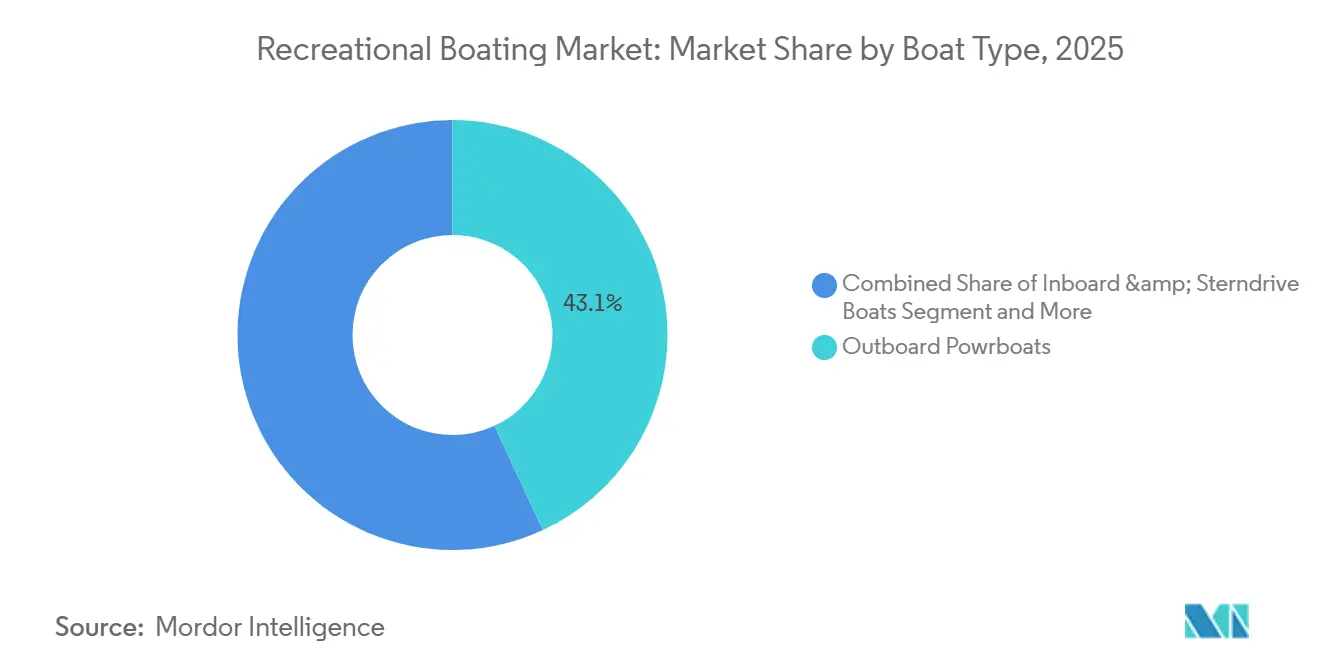
Versatile Outboards Retain Lead While PWCs Gather SpeedOutboard models account for 43.11% of 2025 revenue, reflecting their ease of transport, shallow-draft versatility, and continuous powertrain innovation. Mercury Marine’s top-end V12 Verado exemplifies performance advances with steerable gear cases and two-speed transmissions that enhance fuel efficiency. Personal watercraft, however, are on course for the fastest expansion at a 7.45% CAGR during the forecast period (2026-2031), buoyed by younger riders seeking affordable thrills and compact storage. Manufacturers have responded with entry-level sit-down PWCs under USD 10,000, often bundled with smartphone-tied safety geofencing.
Vessel rental fleets across Florida, the Mediterranean, and Southeast Asia are adding high-seat PWCs fitted with ride-by-wire throttle calibrations and simplified docking modes. As a result, the recreational boating market increasingly captures first-time watersports consumers who later migrate to outboard bowriders or day cruisers for family outings, preserving the broader ownership pipeline.

By Hull Material:
Fiberglass Dominates But Advanced Composites AccelerateFiberglass/GRP accounts for 64.12% of the market in 2025, driven by its cost-effectiveness and widespread familiarity among OEMs. Closed-mold vacuum infusion has further reduced styrene emissions and rework times, reinforcing its role in high-volume runabouts and pontoon decks. Although expensive, advanced carbon-Kevlar composites are gaining traction in performance catamarans and racing monohulls that require weight reduction and corrosion resistance. Advanced composites are projected to grow at a 10.46% CAGR during the forecast period (2026-2031), supported by aviation-driven resin advancements and the availability of prepreg formats suitable for semi-custom series.
European boatyards are showcasing prototypes built with Arkema’s Elium thermoplastic resin, which enables the in-factory recycling of offcuts. This capability reduces waste disposal costs and supports circular economy targets. Consequently, the recreational boating market size for composite hulls is projected to reach a significant value by 2031, as production becomes more automated and economies of scale improve. In parallel, natural-fiber composites derived from flax and hemp are experiencing significant growth, supported by consumer demand for plant-based alternatives and favorable life-cycle assessments.
By Length:
Under-20 Ft Craft Lead Volumes, Luxury Over-50 Ft Yachts Drive ValueBoats under 20 ft accounted for 57.04% of the market in 2025, supported by the convenience of trailering and low mooring costs. Aluminum fishing skiffs, ski-and-wake runabouts, and entry-level bowriders dominate this segment, benefiting from the strong lake culture in North America. However, vessels above 50 ft are expected to register an 8.35% CAGR through 2031, driven by charter fleet expansion and growing preferences for multigenerational cruising. These yachts feature stabilizer fins, integrated infotainment systems, and hybrid generator sets that comply with port emission requirements.
The 20–50 ft segment remains a key demand category, with digital dealer platforms reducing lead times. Buyers can configure layouts, select powertrains, and arrange financing online before confirming sea trials at regional hubs. This streamlined process shortens decision-making cycles and increases inventory turnover, creating incremental growth opportunities for the recreational boating market.
By Power Source:
ICE Still Rules But Electrification Gains MomentumInternal-combustion engines claimed 91.22% of 2025 revenue, underpinned by dense fueling networks and a vast aftermarket ecosystem. Advancements in direct injection, variable-valve timing, and joystick docking keep gasoline and diesel reliable. Even so, electric and hybrid solutions will grow at a 11.52% CAGR during the forecast period (2026-2031), aligning with zero-emission zones and silent-cruising requirements. Volvo Penta’s parallel-hybrid IPS system enables operators to maneuver in the harbor on battery power and switch to diesel for passages.[3]
Lithium iron phosphate battery packs now incorporate active thermal management systems, improving cycle life and safety under marine load profiles. Fast-charging pontoons across Swiss and Norwegian lakes reduce range anxiety among day-trippers. As regulatory requirements and consumer preferences converge, the recreational boating market for electric propulsion is projected to narrow the gap with internal combustion engine (ICE) propulsion by 2031.
By Activity/Application:
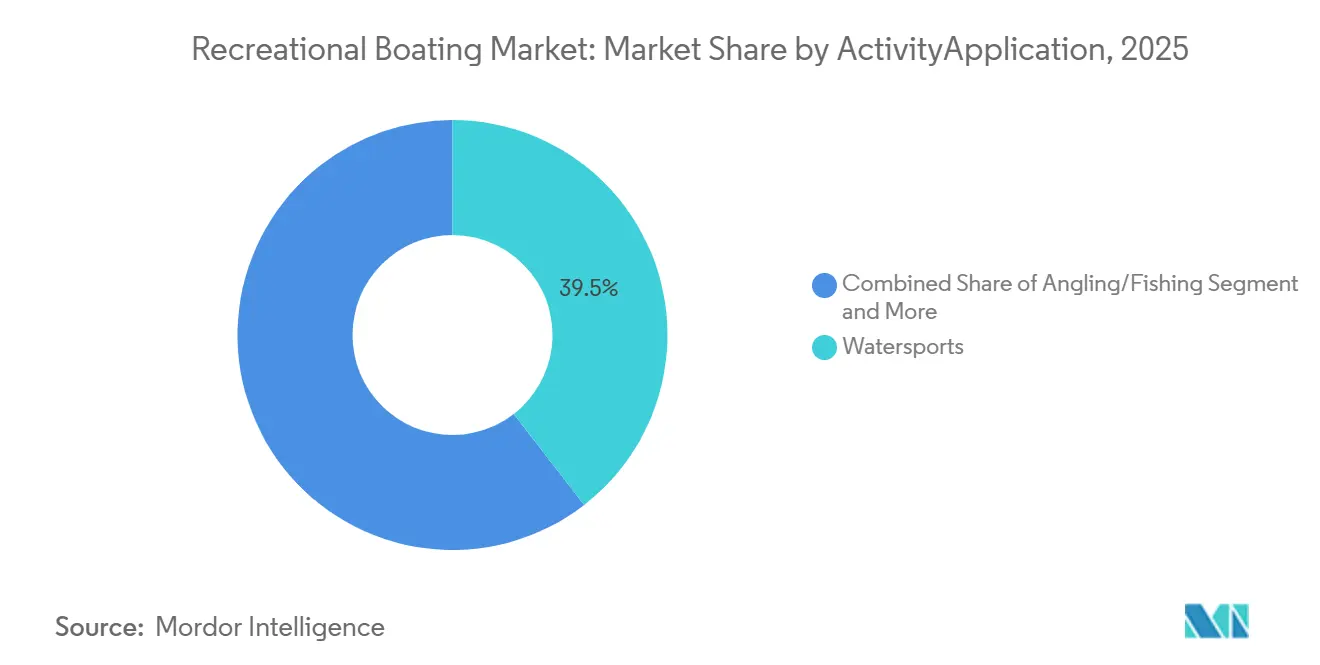
Cruising And Coastal Tourism Outpace Legacy WatersportsWatersports accounted for the largest share, at 39.45%, in 2025, with wake-surf boats and tow towers remaining staples on lakes in the United States and Australia. However, cruising and coastal tourism are projected to outpace other applications, recording a CAGR of 9.13% during the forecast period (2026-2031). Destination marinas, boutique island resorts, and themed charters are driving this growth. Operators are ordering purpose-built day-cruise catamarans with expansive deck lounges, solar rooftops, and storage for snorkel gear to meet demand for experiential travel.
Fishing continues to drive sales of aluminum center-console boats and deep-V hulls, supported by tournament circuits and conservation-backed stocking programs. At the same time, on-water hospitality packages that combine fine dining, diving, and guided excursions are diversifying revenue streams for charter fleets, supporting broader growth in the recreational boating market.
By Distribution Channel:
Digital Disruption Complements Traditional DealershipsDealer showrooms accounted for 88.15% in 2025, by offering personal consultations, service bays, and certified pre-owned trade-ins. Yet online direct-to-consumer marketplaces will expand at a 13.12% CAGR, mirroring broader e-commerce adoption. Platforms like Rightboat.com, TheYachtMarket, and OEM-run configurators provide transparent pricing, build-and-price modules, and video walk-arounds, leading many purchasers to commit before their first physical viewing.
Dealers are adopting omnichannel tactics: inventory feeds auto-populate web portals, while CRM systems like Stantia streamline lead nurturing and post-sale maintenance scheduling. Consequently, the recreational boating market is evolving toward seamless, hybrid shopping journeys in which virtual offers and live demo experiences reinforce one another.
Geography Analysis
North America Recreational Boating Market
North America dominated with a 47.10% in 2024, strong lake and coastal cultures, well-established marina networks, and widespread financing options underpin steady 5.10% CAGR to 2030. Boat-club memberships and fractional ownership continue to expand, bringing younger households into boating and boosting replacement demand for 20–35 ft multipurpose craft. OEMs are therefore deploying certified pre-owned channels to keep inventory flowing and maintain brand affinity.
APAC Recreational Boating Market
Asia Pacific is the fastest-growing region, projected at 9.50% CAGR between 2025 and 2030. Government-sponsored marina rollouts in China’s Hainan Free Trade Port, coupled with tax incentives on yacht imports, are nurturing a nascent leisure fleet. Urban millennials in coastal megacities view boating as a lifestyle symbol, fueling sales of 25–40 ft cabin cruisers fit for weekend island hops. India, Indonesia, and Vietnam are beginning to replicate similar infrastructure initiatives, adding incremental upside to the recreational boating market.
Europe, Middle East and Oceania Recreational Boating Market
Europe remains a heavyweight in the luxury yacht segment, with Italian, Dutch, and French yards supplying global super-yacht demand. Despite moderate 5.20% CAGR, the region benefits from affluent tourism along the Côte d’Azur, Balearics, and Adriatic. Regulatory emphasis on low-emission propulsion is accelerating hybrid retrofits and electric tender uptake. The Middle East is set for 6.8% CAGR, powered by waterfront mega-projects in the United Arab Emirates and Saudi Arabia’s Red Sea developments, while the Caribbean advances 6.20% despite rising insurance premiums. Oceania enjoys a consistent 5.30% CAGR, supported by high per-capita boat ownership in Australia and a digitally savvy buyer base in New Zealand. Digital dealerships cut the average sales cycle for 20–50 ft vessels, cementing the region’s role as an early adopter of online marine retail.
Mordor Intelligence provides coverage of the recreational boating market across other key regional markets, including Europe, each with their regulatory frameworks and demand patterns.
Competitive Landscape
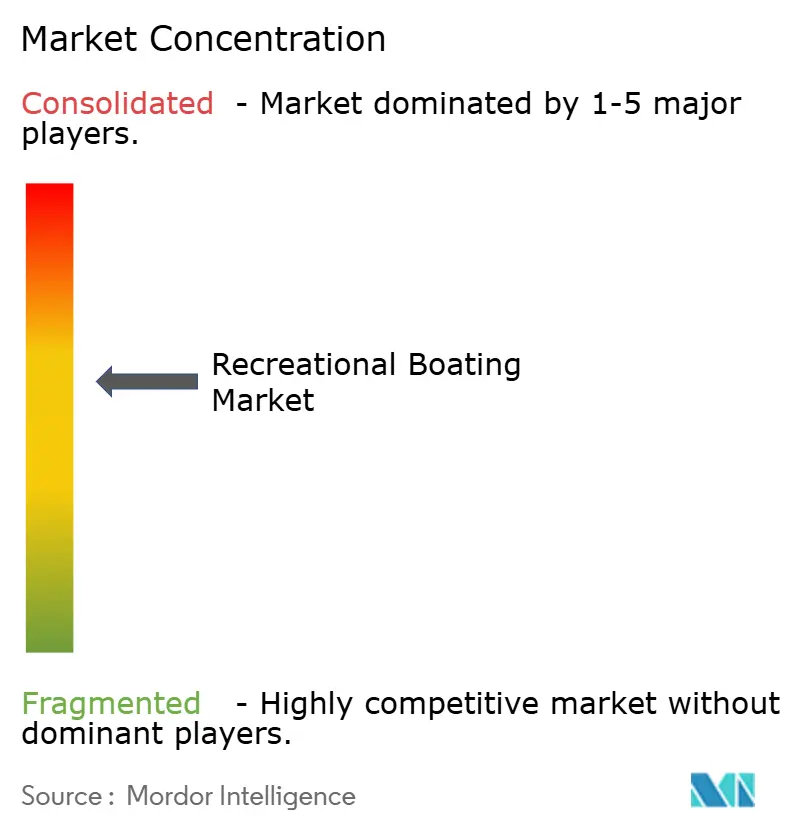
The sector is moderately fragmented. Brunswick Corporation, Groupe Beneteau, and Azimut-Benetti Group are the key players, while dozens of regional brands fill the balance. Brunswick leverages its Mercury Marine propulsion dominance and cross-sells through a network of more than 300 Freedom Boat Club locations. Sea Ray recorded a rise year-on-year, helped by the brand’s digitally configurable SLX lineup.
Groupe Beneteau is focusing on operational efficiency after integrating the Starfisher shipyard, expanding modular production, and seeking cost synergy across sail and power divisions. Sales softened in 2024 as European consumers deferred discretionary outlays; nonetheless, order books show a shift toward 35–45 ft hybrid models. Azimut-Benetti continues to lead the over-24 m luxury bracket. Its Azimut Fly 72 clinched the Miami Innovation Award 2025 for weight-optimized carbon superstructure and advanced interior air-quality systems. The firm’s collaboration with Volvo Penta underscores its commitment to hybrid propulsion.
Emerging disruptors include Evoy, Arc Boats, and Candela, each focusing on high-performance electric powertrains and hydrofoil efficiency. Their innovations are filtering into OEM partnerships, setting new benchmarks for acceleration, runtime, and maintenance simplicity. Marketplaces such as Boats Group and Rightboat are reshaping buyer behavior; a study by the former found that a large share of purchasers were first-timers, highlighting the platforms’ role in broadening the recreational boating market.
Recreational Boating Industry Leaders
-
Brunswick Corporation
-
Groupe Beneteau
-
Azimut Benetti Group
-
Ferretti Group
-
Malibu Boats Inc.
- *Disclaimer: Major Players sorted in no particular order
Recreational Boating Market Companies Covered in this Report
- Brunswick Corporation
- Groupe Beneteau
- Azimut-Benetti Group
- Ferretti Group
- Malibu Boats Inc.
- Sunseeker International Ltd.
- Princess Yachts Ltd.
- MasterCraft Boat Holdings Inc.
- Polaris Inc.
- Marine Products Corporation
- Bavaria Yachtbau GmbH
- Tracker Marine (White River Marine Group)
- Hobie Cat Company
- Sportsman Boats Manufacturing Inc.
- Catalina Yachts
- HanseYachts AG
- X-Yachts A/S
- Alubat Alumarine
- Yamaha Motor Co., Ltd. (PWC Division)
- Walker Bay Boats
Recent Industry Developments in Recreational Boating Market
- September 2026: MIRAVA, a smart recreational boat startup, raised EUR 4.2 million (USD 5 million) in angel funding as it transitioned from three years of product development to small-batch production and customer deliveries. The funding will support continued product and software development, as well as the next phase of manufacturing and delivery.
- September 2026: NAVAN Boats, Brunswick Corporation's exploration boat brand, unveiled the all-new C38 at the Cannes Yachting Festival, held from September 8-13, 2026. Built around NAVAN's signature T-Step Hull design and engineered across the brand's dual-continent manufacturing footprint, the C38 was designed for owners seeking to explore beyond familiar waters with confidence, comfort, and distinctive style.
- August 2026: Sea-Doo introduced its 2027 personal watercraft lineup, featuring the new Rotax 1630 ACE 350 hp engine, its most powerful factory-produced engine. The limited-edition Sea-Doo RXP-X Senna 350 honored racing legend Ayrton Senna.
- August 2026: Next Yacht Group launched the first 30.4-meter Maiora M|30 motor yacht ahead of its debut at the Cannes Yachting Festival. The launch also marked the inauguration of Maiora's new M Collection, with the owner and the owner's family attending the occasion.
Global Recreational Boating Market Report Scope
The scope includes segmentation by Boat Type (Inboard & Sterndrive Boats, Outboard Powerboats, Personal Watercraft (PWC), Sailboats, Yachts (30-120 ft), and Inflatable & RIB Boats), Hull Material (Fiberglass / GRP, Aluminum, Wood, Steel and Composites (Carbon, Kevlar)), Length (Less than 20 ft, 20-50 ft, and Greater than 50 ft), Power Source (IC Engine, Electric/Hybrid, and Sail Propelled), Activity / Application (Watersports, Angling / Fishing, Cruising & Coastal Tourism, and Dive & Charter Operations), Distribution Channel (Dealer / Showroom (OEM) and Online Direct-to-Consumer) and Geography (North America, South America, Europe, Asia-Pacific, and the Middle East and Africa). The Market Forecasts are Provided in Terms of Value (USD) and Volume (Units).
Segmentation Overview
| Inboard & Sterndrive Boats |
| Outboard Powerboats |
| Personal Watercraft (PWC) |
| Sailboats |
| Yachts (30-120 ft) |
| Inflatable & RIB Boats |
| Fiberglass / GRP |
| Aluminum |
| Wood |
| Steel |
| Composites (Carbon, Kevlar) |
| Less than 20 ft |
| 20-50 ft |
| Greater than 50 ft |
| Internal-Combustion Engine |
| Electric / Hybrid |
| Sail-Propelled |
| Watersports |
| Angling / Fishing |
| Cruising & Coastal Tourism |
| Dive & Charter Operations |
| Dealer / Showroom (OEM) |
| Online Direct-to-Consumer |
| North America | United States |
| Canada | |
| Caribbeans | |
| Rest of North America | |
| South America | Brazil |
| Argentina | |
| Rest of South America | |
| Asia-Pacific | China |
| Japan | |
| India | |
| Australia | |
| South Korea | |
| Southeast Asia | |
| Rest of Asia Pacific | |
| Europe | Germany |
| United Kingdom | |
| France | |
| Italy | |
| Spain | |
| Netherlands | |
| Rest of Europe | |
| Middle East and Africa | Saudi Arabia |
| United Arab Emirates | |
| Qatar | |
| Turkey | |
| Rest of Middle East and Africa |
| By Boat Type | Inboard & Sterndrive Boats | |
| Outboard Powerboats | ||
| Personal Watercraft (PWC) | ||
| Sailboats | ||
| Yachts (30-120 ft) | ||
| Inflatable & RIB Boats | ||
| By Hull Material | Fiberglass / GRP | |
| Aluminum | ||
| Wood | ||
| Steel | ||
| Composites (Carbon, Kevlar) | ||
| By Length | Less than 20 ft | |
| 20-50 ft | ||
| Greater than 50 ft | ||
| By Power Source | Internal-Combustion Engine | |
| Electric / Hybrid | ||
| Sail-Propelled | ||
| By Activity / Application | Watersports | |
| Angling / Fishing | ||
| Cruising & Coastal Tourism | ||
| Dive & Charter Operations | ||
| By Distribution Channel | Dealer / Showroom (OEM) | |
| Online Direct-to-Consumer | ||
| By Geography | North America | United States |
| Canada | ||
| Caribbeans | ||
| Rest of North America | ||
| South America | Brazil | |
| Argentina | ||
| Rest of South America | ||
| Asia-Pacific | China | |
| Japan | ||
| India | ||
| Australia | ||
| South Korea | ||
| Southeast Asia | ||
| Rest of Asia Pacific | ||
| Europe | Germany | |
| United Kingdom | ||
| France | ||
| Italy | ||
| Spain | ||
| Netherlands | ||
| Rest of Europe | ||
| Middle East and Africa | Saudi Arabia | |
| United Arab Emirates | ||
| Qatar | ||
| Turkey | ||
| Rest of Middle East and Africa | ||
Key Questions Answered in the Report
What is the current size of the recreational boating market?
The market was valued at USD 30.80 billion in 2025 and is on track to reach USD 37.64 billion by 2031, reflecting a 5.10% CAGR.
Which region is expanding fastest in recreational boating?
Asia-Pacific is projected to grow at 9.78% CAGR through 2031 due to new marina construction in China and rising disposable incomes across the region.
How are boat clubs influencing buying behavior?
Subscription models such as Freedom Boat Club expose members to multiple vessel types, converting many first-time users into owners and boosting overall demand.
What technology trends are shaping future boat purchases?
Key trends include hybrid-electric propulsion, connected-boat telematics, and digital direct-to-consumer sales platforms that streamline configuration and financing.
Which vessel segment shows the quickest growth?
Personal watercraft are set for a 7.45% CAGR between 2026 and 2031, driven by affordability, ease of storage, and strong appeal among younger riders.
How are raw-material costs affecting manufacturers?
Inflation in fiberglass and resin prices has compressed OEM margins by up to 5% since 2023, prompting greater use of recyclable composites and long-term supplier contracts.