
Market Overview
| Study Period | 2020 - 2031 |
|---|---|
| Market Size (2026) | USD 9.76 Billion |
| Market Size (2031) | USD 12.04 Billion |
| Growth Rate (2026 - 2031) | 4.29 % |
| Fastest Growing Market | Asia Pacific |
| Largest Market | North America |
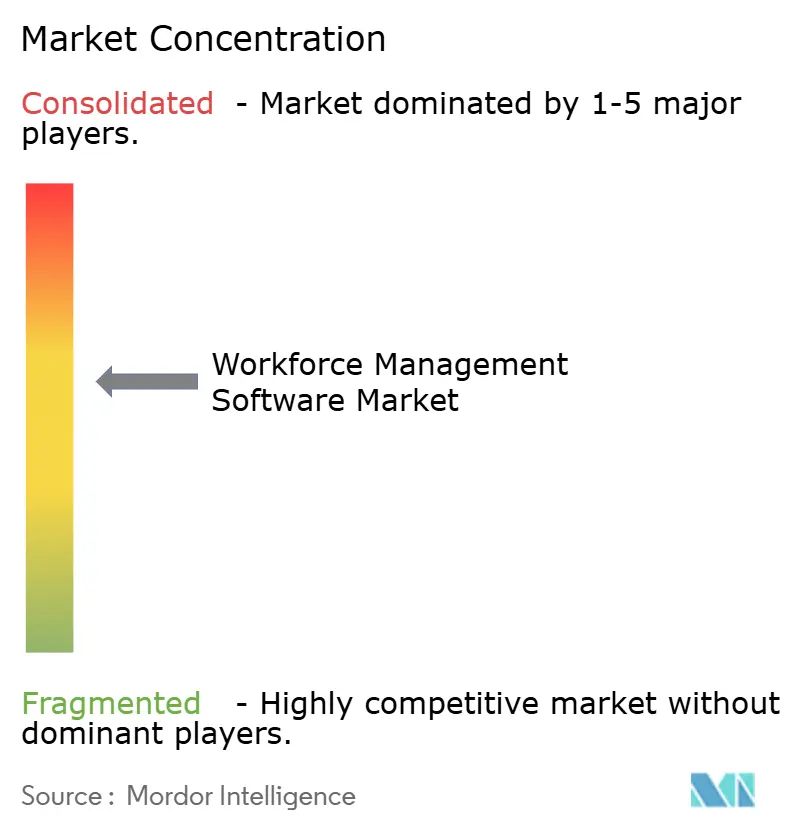
| Market Concentration | Medium |
Major Players *Disclaimer: Major Players sorted in no particular order Image © Mordor Intelligence. Reuse requires attribution under CC BY 4.0. | |
Workforce Management Software Market Analysis by Mordor Intelligence
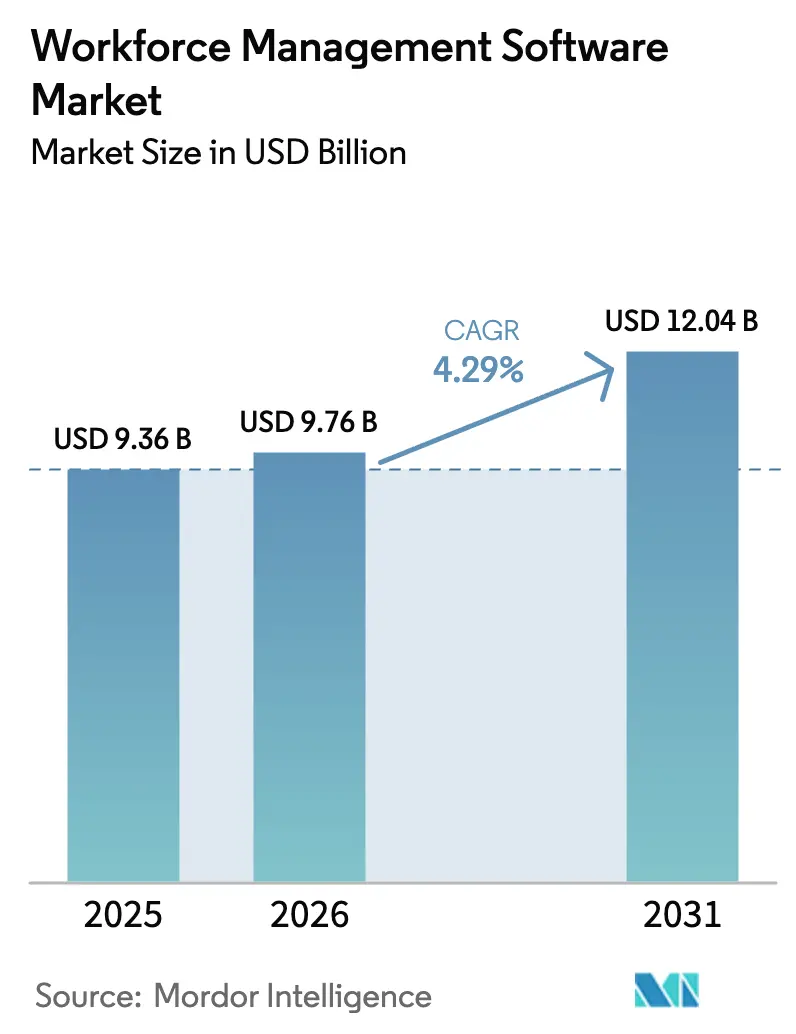
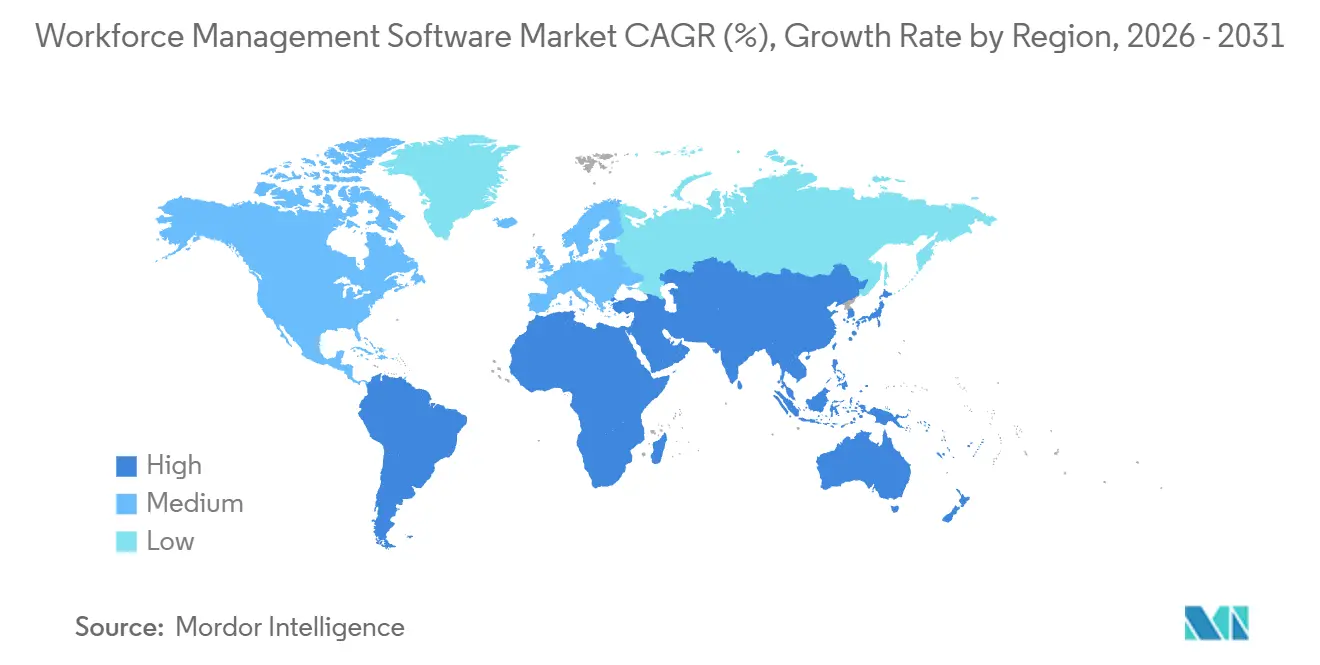
The Workforce Management Software Market size is expected to increase from USD 9.36 billion in 2025 to USD 9.76 billion in 2026 and reach USD 12.04 billion by 2031, growing at a CAGR of 4.29% over 2026-2031. Uptake of generative AI copilots, real-time payroll-tax engines, and mobile-first applications is reshaping labor operations, turning a formerly back-office tool into a compliance and risk-mitigation platform. Vendors are embedding audit-ready analytics to meet regulations such as Australia’s Single Touch Payroll Phase 3 and France’s Article L1222-4, helping enterprises avoid monetary penalties.[1]Australian Taxation Office, “Compliance Report 2024,” ato.gov.au Cloud migration also accelerates as organizations seek to eliminate hardware outlays and reduce upgrade cycles, with cloud deployments already accounting for 63.81% of overall revenue in 2025. Regionally, North America leads in share, but Asia Pacific records the fastest expansion, benefiting from mobile workforce management penetration in Southeast Asian retail and Gulf Cooperation Council healthcare staffing initiatives.
Key Report Takeaways
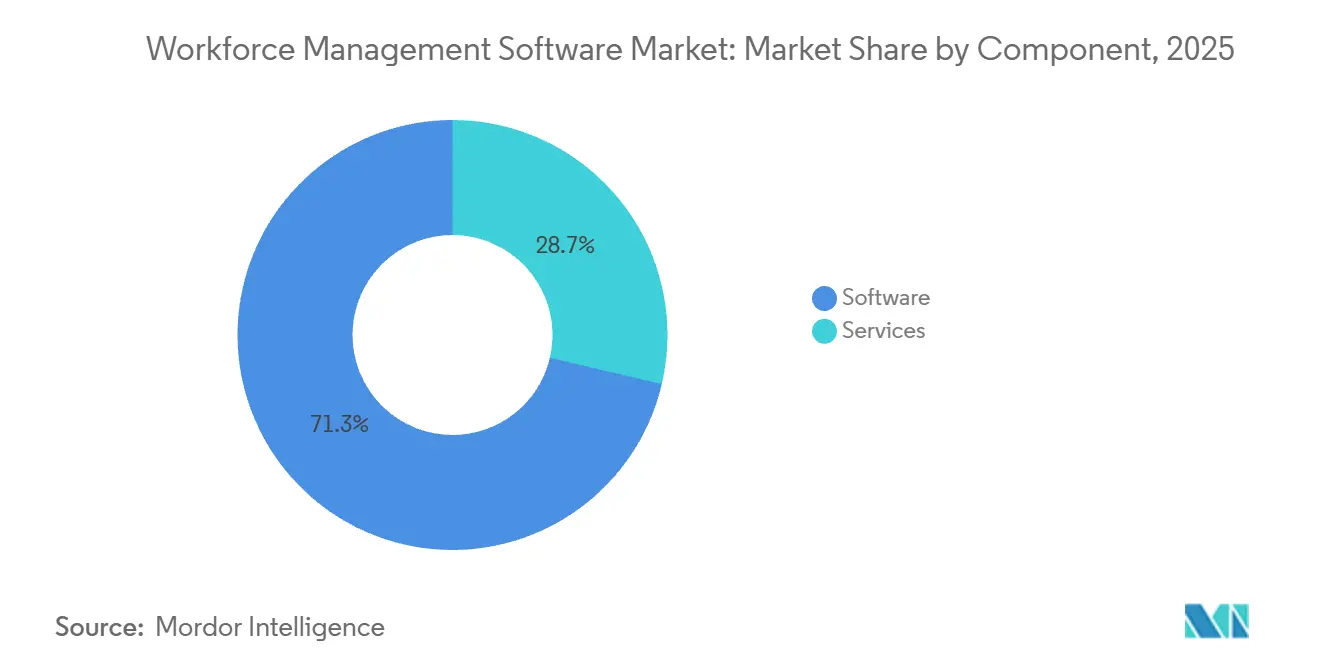
- By component, software retained a 71.34% revenue share in 2025; services are advancing at a 5.61% CAGR due to stronger demand for AI-tuning support.
- By software type, Time and Attendance Management held 29.63% of the revenue in 2025; Workforce Analytics is expected to compound at a 6.81% CAGR through 2031.
- By deployment mode, cloud held 63.81% of the workforce management software market share in 2025 and is projected to expand at a 5.94% CAGR through 2031.
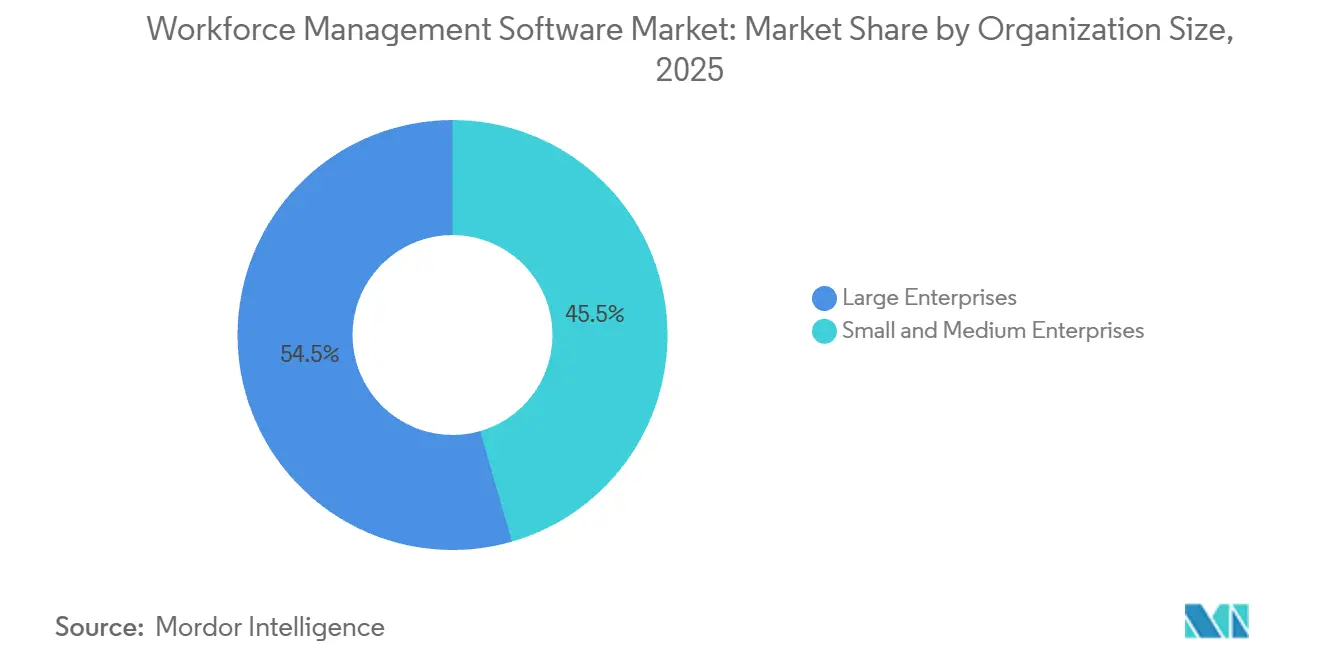
- By organization size, Large enterprises contributed 54.46% of revenue in 2025, whereas small and medium enterprises are scaling adoption at a 6.44% CAGR through 2031.
- By end-use industry, healthcare posted the highest growth trajectory at a 5.46% CAGR, while consumer goods and retail commanded 18.73% of the workforce management software market size in 2025.
- By geography, North America led with 38.91% of the workforce management software market size in 2025; Asia Pacific is forecast to climb at a 6.17% CAGR to 2031.
Note: Market size and forecast figures in this report are generated using Mordor Intelligence’s proprietary estimation framework, updated with the latest available data and insights as of January 2026.
Market Trends and Insights
Drivers Impact Analysis of Workforce Management Software Market*
| Driver | (~) % Impact on CAGR Forecast | Geographic Relevance | Impact Timeline |
|---|---|---|---|
| AI-Driven Labor Forecasting Pilots Accelerate Adoption in EU Shift-Based Industries | +0.8% | Europe (Germany, France, Netherlands, Nordics) | Medium term (2-4 years) |
| Mobile-First WFM Penetration in Southeast Asian Multi-Site Retail Chains | +0.6% | Southeast Asia (Indonesia, Thailand, Vietnam, Philippines, Malaysia) | Short term (≤ 2 years) |
| GCC Healthcare Staffing Shortages Spur Cloud-Based WFM Investments | +0.5% | Middle East (UAE, Saudi Arabia, Qatar, Kuwait) | Medium term (2-4 years) |
| Real-Time Payroll Tax Reporting Mandates in Australia and New Zealand | +0.7% | Australia and New Zealand | Short term (≤ 2 years) |
| Biometric Time and Attendance to Curb Payroll Fraud in South American Logistics Hubs | +0.4% | South America (Brazil, Argentina, Chile, Colombia) | Medium term (2-4 years) |
| Adoption of Generative AI Copilots for Frontline Scheduling Optimization | +0.9% | Global, led by North America and Western Europe | Long term (≥ 4 years) |
| Source: Mordor Intelligence | |||
AI-Driven Labor Forecasting Pilots Accelerate Adoption in EU Shift-Based Industries
European manufacturers and logistics operators utilize machine-learning models that ingest point-of-sale and weather data to enhance hourly labor forecasts by 15-20% compared to static templates.[2]SAP SE, “Digital Manufacturing Survey 2024,” sap.com Workday’s Skills Intelligence feature matches certifications to shift requirements, reducing dependence on temporary agencies. EU Platform Work Directive provisions require algorithmic transparency, pushing vendors to build auditable scheduling trails. Deloitte’s 2024 survey found that 68% of shift-based employers in Germany, France, and the Netherlands plan to pilot AI forecasting by the end of 2025, up from 42% in 2023. SAP and ATOSS respond by bundling predictive scheduling compliant with works council rights. Competitive pressure now outweighs transparency concerns, accelerating the roll-out of solutions.
Mobile-First WFM Penetration in Southeast Asian Multi-Site Retail Chains
Retailers with 50-500 stores across Indonesia, Thailand, and Vietnam are abandoning desktop systems for smartphone apps that enable managers to approve leave and broadcast callouts in minutes. Telkomsel cited 47% growth in enterprise mobile data in 2024, driven by workforce applications. Boston Consulting Group reported that schedule-change cycle times fell from 48 hours to under 4 hours among adopters, improving responsiveness during Ramadan and Lunar New Year. The ASEAN Digital Economy Framework reduces cross-border compliance costs, while 72% of regional CEOs rank workforce productivity as the top operational priority. Deputy and Roubler localize Bahasa Indonesia and Thai, integrate with payroll providers, and undercut legacy vendors on price.
GCC Healthcare Staffing Shortages Spur Cloud-Based WFM Investments
Saudi Arabia aims for 3.5 hospital beds per 1,000 residents by 2030; however, staff supply lags, so ministries are mandating nurse-rostering platforms that can dynamically reallocate clinicians. Philips’ 2024 Future Health Index revealed that 64% of Saudi hospital administrators identified scheduling inefficiencies as a key driver of burnout. Deloitte projected a 250,000-worker shortfall across GCC healthcare by 2030. AI-driven tools that consider skill, acuity, and ratio rules now create compliant rosters in under 10 minutes. Oracle ME’s 2025 Abu Dhabi cloud region eases sovereignty worries, and UKG and Workday partner with local integrators to tap a USD 200-300 million addressable market.
Real-Time Payroll Tax Reporting Mandates in Australia and New Zealand
Australia’s Single Touch Payroll Phase 3 enforces one-day reporting of superannuation contributions, exposing errors instantly. MYOB found that 89% of small businesses with standalone time clocks faced compliance incidents, compared to 23% using integrated suites. The Australian Taxation Office recovered AUD 1.2 billion (USD 0.8 billion) in unpaid liabilities during 2024 audits. New Zealand’s 2025 PAYE updates mirror these rules, creating a trans-Tasman corridor favoring dual-country vendors. Workday’s Adaptive Planning module now forecasts daily accruals, enhancing cash reserve planning. Oracle and ADP added auto-filing modules that shrink reliance on third-party bureaus.
Restraints Impact Analysis of Workforce Management Software Market*
| Restraint | (~) % Impact on CAGR Forecast | Geographic Relevance | Impact Timeline |
|---|---|---|---|
| Legacy MES/ERP Integration Costs among German Mittelstand Manufacturers | -0.5% | Germany, Central Europe | Medium term (2-4 years) |
| China’s Data Residency Rules Limiting Foreign SaaS WFM Deployments | -0.6% | China | Long term (≥ 4 years) |
| Unreliable Broadband Infrastructure Hindering Cloud Adoption in Sub-Saharan Africa | -0.3% | Sub-Saharan Africa (ex-South Africa) | Long term (≥ 4 years) |
| French Union Pushback Against Algorithmic Shift Scheduling | -0.2% | France, Belgium, Luxembourg | Medium term (2-4 years) |
| Source: Mordor Intelligence | |||
Legacy MES/ERP Integration Costs among German Mittelstand Manufacturers
Many German firms still run Siemens SIMATIC or SAP ECC from early 2000s vintages that lack modern APIs, incurring EUR 200,000-500,000 (USD 225,000-565,000) in integration bills and 12-18 month timelines.[2] SAP’s 2024 survey noted 62% of sub-1,000-employee manufacturers remain on-premise. Rockwell Automation reported that 47% cited integration complexity as the key barrier, over cost and security. VDMA found Mittelstand IT budgets average just 3.2% of revenue, limiting large-scale digital projects. Pre-built connectors help, but often require customization, which sustains manual data transfer and slows cloud migration.
China’s Data Residency Rules Limiting Foreign SaaS WFM Deployments
Revised 2024 cross-border data rules force employers to store attendance and leave data on mainland servers, compelling multinationals to deploy separate China-only environments or select domestic vendors. Security assessments for transfers last 60-90 days and cost USD 50,000-100,000 annually, boosting total ownership. Oracle, SAP, and Workday now operate China data centers yet feature gaps persist because AI training on Chinese data is restricted. Dual systems inflate licensing costs and hinder global analytics, trimming near-term market growth potential.
*Our forecasts treat driver/restraint impacts as directional, not additive. The impact forecasts reflect baseline growth, mix effects, and variable interactions.
Workforce Management Software Market Segment Analysis
By Component:
Services Gain as AI Customization Demands SurgeSoftware represented 71.34% of revenue in 2025, primarily driven by multi-year subscriptions that bundle scheduling, time and attendance, and analytics services. Services, however, are growing 130 basis points faster at a 5.61% CAGR because enterprises need outside experts to fine-tune generative AI features. PwC found 67% of organizations deploying AI in HR required consulting to set guardrails and train staff. Large integrators capitalize on this gap, earning USD 1-2 million in services for every USD 0.5 million in software deals. Managed services now command a 20% premium, allowing mid-size hospitals to outsource compliance monitoring.
Software growth remains solid as vendors offer 10-15% discounts on three-year agreements, stabilizing annual recurring revenue. The workforce management software market size for services is on a higher trajectory as AI spreads beyond pilots, ensuring consultant pipelines remain full. Vendors hedge churn risk by stitching services into renewal discussions, locking customers into broader ecosystems.


By Software Type:
Analytics Modules Capture Budget as CHRO Influence GrowsTime and attendance accounted for a 29.63% share in 2025, driven by payroll statutes; however, analytics led to growth at a 6.81% CAGR through 2031. McKinsey estimated predictive models cut voluntary turnover 18%, saving USD 3-5 million for a 1,000-employee firm. As 71% of CHROs now report directly to CEOs, board-level visibility drives increased analytics spending. Scheduling software grows roughly in line with the workforce management software market, aided by AI pattern recognition. Fatigue-risk tools are being adopted from aviation into mining and utilities, reflecting broader safety mandates.
The workforce management software market share for analytics is expected to increase as predictive dashboards become a table stake in CFO presentations. Vendors differentiate themselves by incorporating external signals, such as weather and social media, into forecasts that help justify overtime budgets.
By Deployment Mode:
Cloud Dominance Solidifies Despite Sovereignty ConcernsCloud deployment accounted for 63.81% of revenue in 2025 and is expanding at a 5.94% CAGR as firms avoid hardware depreciation and maintenance staffing costs. On-premise solutions remain viable for defense, finance, and public agencies due to strict sovereignty laws. Hybrid approaches emerge where attendance data resides on local servers, while scheduling logic remains in the cloud; however, latency issues impede real-time reporting. Microsoft’s Azure Stack HCI enables vendors to deliver a cloud-like user experience with residency compliance.
The workforce management software market size differential between cloud and on-premise solutions widens annually, with SMEs favoring simple subscription models over the USD 200,000 five-year ownership costs associated with in-house servers. Vendors promote “evergreen” upgrades, ensuring clients always run the latest compliance rules without disruptive downtime.
By Organization Size:
SMEs Embrace Tiered Pricing as Vendors Democratize AccessLarge enterprises held 54.46% of the spend in 2025, but SMEs are the growth engine, with a 6.44% CAGR. Deputy’s freemium tier for up to five employees and a USD 4.50 per-user premium plan exemplifies low entry barriers. 7shifts reported that 68% of its 2024 sign-ups had fewer than 50 staff members, up from 52% two years earlier. Wage inflation averaging 5% motivates even small retailers with 20 employees to automate scheduling.
Feature expectations diverge: large firms require role-based controls and Okta integration, whereas micro-businesses prioritize a mobile setup within one hour. The workforce management software market continues to fragment along these lines, with horizontal suites serving enterprises, while vertical newcomers pursue niche segments.
By End-Use Industry:
Healthcare Leads Growth as Staffing Crises IntensifyRetail and consumer goods retained an 18.73% stake in 2025, reflecting the presence of dense hourly workforces and seasonal peaks. Healthcare clocks the fastest 5.46% CAGR, fueled by nursing shortages. The American Hospital Association identified a 100,000-nurse gap, resulting in 18% of hospitals diverting emergency patients monthly. The Advisory Board found that 79% of chief nursing officers plan to boost their workforce technology budgets for 2025.
Banking firms adopt solutions to track hybrid workers, while manufacturing requires a tight linkage with execution systems to align labor and production. Logistics operators deploy biometric time clocks to curb buddy punching, resulting in a 5-8% reduction in labor costs, according to Inter-American Development Bank data. Collectively, energy, utilities, and automotive represent a quarter of revenue, each governed by unique safety and union rules that cloud vendors are customizing into templated rule packs.
Geography Analysis
North America Workforce Management Software Market
North America accounted for 38.91% of the 2025 revenue, driven by early adoption of cloud human capital management and stringent record-keeping laws. Market maturity tempers growth to 3.8% CAGR, yet replacement cycles spur AI upgrades. Mexico’s USD 36 billion near-shoring inflows in 2024 boost bilingual solution demand and profit-sharing compliance.[3]Mexican Ministry of Economy, “FDI Report 2024,” gob.mx Canada’s provincial overtime rules drive niches for region-specific absence trackers.
Europe Workforce Management Software Market
Europe contributed about 28% and shows mixed dynamics. The U.K.’s 2024 Employment Rights Bill accelerates retail conversions, while Germany’s works council approvals slow full-stack rollouts. Southern Europe outpaces continental averages at 5.2% CAGR as tourism rebounds. Nordic countries, with their generous leave policies, require sophisticated absence management modules that global suites have historically lacked.
APAC Workforce Management Software Market
The Asia Pacific is the fastest-growing territory, with a 6.17% CAGR. India’s 5.4 million IT-services workforce relies on solutions that combine project billing and state-wise compliance. Japan’s projected 6.4 million labor deficit by 2030 drives the need for AI scheduling among aging staff. South Korea’s 52-hour cap enforces precise time tracking, benefiting vendors integrated with biometric clocks. Australia and New Zealand see tailwinds from payroll-tax mandates that expose compliance gaps in spreadsheet-driven environments.
South America and MEA Workforce Management Software Market
South America, the Middle East and Africa comprise roughly 15% of revenue but expand at 5.5-6% CAGR. Brazil’s tougher fraud penalties spur biometric adoption, while GCC healthcare bed targets create a USD 300 million opportunity for roster optimization. Sub-Saharan Africa adoption centers on South Africa, Kenya, and Nigeria where mobile-money pay runs circumvent limited banking access. Poor broadband outside capitals means offline-first design is non-negotiable.

Regulatory Landscape
Workforce management software is being shaped by a tightening set of rules around automated decision-making, worker transparency, and auditability. In the European Union, the EU AI Act (Regulation 2024/1689) classifies certain employment and worker-management AI uses as high-risk, with obligations taking effect from August 2026 for providers and deployers. These obligations include conformity assessment, human oversight, and worker information requirements.
At the same time, the United States continues to see oversight and clarification activity, including an April 2026 U.S. Department of Labor Notice of Proposed Rulemaking on joint employer status under the Fair Labor Standards Act. That, in turn, affects how employers document time, scheduling control, and labor allocation across contractors and franchises. At the state and city level, governance for automated employment decision tools adds another compliance layer that WFM vendors increasingly reflect through policy controls and audit trails. New York City Local Law 144 continues enforcement of bias audit and transparency requirements for automated employment decision tools, while California SB-7 (2025-2026 session) proposes written notice and related controls for Automated Decision Systems used in employment decisions such as discipline or termination. Taken together, these developments are reinforcing demand for explainable scheduling logic, role-based access, and tamper-evident reporting across time, attendance, and analytics modules.
Value Chain Analysis
The value chain begins with infrastructure and enablement layers (cloud hosting, identity and access management, and data security controls) that support SaaS delivery and audit-ready operations. Core WFM vendors then develop the application layer (time capture, scheduling, leave, and workforce analytics) and increasingly add AI orchestration, compliance rule packs, and integrations into HCM/ERP, payroll, and other sector systems. Implementation partners and system integrators configure overtime, premiums, union constraints, and local statutory leave, connect to biometrics and mobile devices, and manage change for frontline adoption.
On the downstream side, distribution occurs through direct enterprise sales for suites, app-led product-led growth for SMEs, and vertical channels for regulated end users such as healthcare and public sector organizations. Consolidation and capability tuck-ins are compressing parts of the chain to improve time-to-value, as shown by ORTEC acquiring TOBA HR Solutions (July 2026) to deepen healthcare WFM delivery in Belgium and Luxembourg, and Paylocity acquiring Aidora (July 2026) to add AI-native leave compliance automation. Product cadence is also becoming a tighter link in the chain, with vendors shipping frequent compliance and AI feature updates, such as Legion Technologies Spring 2026 release and WorkJam adding an autonomous AI layer aimed at shifting from static scheduling toward real-time operational decisioning.
Competitive Landscape
The top five suppliers, Oracle, SAP, Workday, UKG, and ADP, hold 45-50% market share, signaling moderate concentration. Oracle and SAP embed workforce management to raise suite stickiness, while UKG and Ceridian defend depth via verticalized features.
Generative AI remains the fiercest battleground; Workday filed 12 scheduling patents and UKG eight natural-language patents in 2024. Strategic themes include acquiring biometric hardware, building in-country data centers to satisfy sovereignty mandates, and targeting micro-businesses with USD 50-per-month bundles.
Vertical insurgents flourish. 7shifts corners the restaurant market, Deputy dominates the hospitality industry, and Skedulo specializes in field service. Technology moats hinge on ingesting unstructured data, weather, and social sentiment to sharpen demand forecasts. Private-equity backing fuels consolidation as UKG absorbs Workforce Software and Ceridian aligns with Microsoft Copilot integrations. Large enterprise suites utilize workforce modules as beachheads to cross-sell ERP, squeezing pure-play vendors to differentiate on usability and time-to-value.
Workforce Management Software Industry Leaders
ActiveOps PLC
NICE Ltd.
Infor Group
Oracle Corporation
UKG Inc.
- *Disclaimer: Major Players sorted in no particular order
Workforce Management Software Market Companies Covered in this Report
- ActiveOps PLC
- NICE Ltd.
- Infor Group
- Oracle Corporation
- UKG Inc.
- SAP SE
- ADP LLC
- Blue Yonder Group, Inc. (Panasonic)
- IBM Corporation
- Workday Inc.
- Reflexis Systems Inc. (Zebra)
- SISQUAL Workforce Management, Lda
- ServiceMax Inc.
- Atoss Software AG
- Mitrefinch Ltd (Advanced)
- Deputy Group Pty Ltd
- 7shifts Employee Scheduling Software Inc.
- Sage Group plc
- Roubler Australia Pty Ltd
- tamigo ApS
- Verint Systems Inc.
- ClickSoftware (Salesforce Field Service)
- Ceridian HCM Holding Inc.
- Humanity (TCP Software)

Market Opportunities and Future Outlook
An immediate opportunity is expanding WFM beyond scheduling and time capture into AI-governed workforce execution that coordinates people, tasks, and AI agents with clearer control and accountability. NICE launched a Workforce Empowerment Suite (June 2026) to manage and govern hybrid workforces that include both human employees and AI agents, while UKG announced agentic orchestration enhancements and new intelligence capabilities in its workforce operating platform (June 2026). These moves create space for vendors to package human-oversight workflows, policy guardrails, and audit trails into daily manager consoles, rather than relying on separate HR or IT governance layers.
Compliance-driven modernization is also generating demand, with buyers targeting measurable reductions in administrative burden and audit exposure. The market already skews to SaaS, with cloud deployments at 63.81% of revenue in 2025, supporting programs to modernize infrastructure and standardize controls across multi-country workforces. Regulatory requirements for transparency and high-risk AI obligations in employment contexts, including EU AI Act obligations starting August 2026, are reinforcing opportunities for vendors and service partners that can deliver localization through jurisdiction-specific rule packs, provide explainability for algorithmic scheduling decisions, and connect WFM to payroll-tax reporting and leave compliance within a unified workflow.
Recent Industry Developments in Workforce Management Software Market
- July 2026: Paylocity acquired Aidora to add AI-native leave management capabilities into its platform. The deal strengthens automated handling of regulated leave processes and reduces manual casework for HR and managers, tightening Paylocity's end-to-end workflow across time, leave, and compliance.
- June 2026: NICE launched the Workforce Empowerment Suite to manage, govern, and support hybrid workforces that include both human employees and AI agents. The release broadens WFM from forecasting and scheduling into governance and orchestration, raising the bar for auditability, control, and cross-system integration.
- October 2025: Workday released Workday Illuminate, embedding generative AI across its suite and reporting major reductions in schedule creation time in pilot healthcare settings. This reinforced the competitive shift toward copilots and natural-language workflows as a core WFM differentiator rather than an add-on analytics feature.


Workforce Management Software Market Report Scope and Research Methodology
Market Definition and Coverage
This market covers workforce management software used by organizations to plan, schedule, track, and optimize labor, including time and attendance, scheduling, leave management, and workforce analytics, delivered through cloud or on-premise deployments.
Scope exclusions: We exclude payroll-only tools that do not have independent workforce scheduling, time tracking, or labor analytics capability.
Segments Covered in This Report
- By Component
- Software
- Services
- By Software Type
- Time and Attendance Management
- Workforce Scheduling
- Workforce Analytics
- Absence and Leave Management
- Fatigue and Task Management
- By Deployment Mode
- Cloud
- On-Premise
- By Organization Size
- Large Enterprises
- Small and Medium Enterprises
- By End-Use Industry
- BFSI
- Consumer Goods and Retail
- Automotive
- Energy and Utilities
- Healthcare
- Manufacturing
- IT and Telecommunications
- Logistics and Transportation
- Other End-Use Industries
- By Geography
- North America
- United States
- Canada
- Mexico
- South America
- Brazil
- Argentina
- Rest of South America
- Europe
- United Kingdom
- Germany
- France
- Spain
- Italy
- Rest of Europe
- Asia Pacific
- China
- India
- Japan
- Australia
- South Korea
- Rest of Asia Pacific
- Middle East and Africa
- Middle East
- Saudi Arabia
- United Arab Emirates
- Turkey
- Rest of Middle East
- Africa
- South Africa
- Kenya
- Rest of Africa
- Middle East
- North America
Data Sources, Market Sizing, and Validation
Desk Research
Desk research was used to set market boundaries and collect input indicators that can be checked year over year. We referenced public sources such as the US Bureau of Labor Statistics, Eurostat labor statistics, the OECD, World Bank datasets, and ILO publications to understand workforce structure, wage pressure, and shift-based employment intensity.
To translate the context into software demand signals, we also reviewed company filings and investor presentations, association materials and compliance guidance, and trusted tech press coverage on timekeeping, scheduling, and HR tech adoption. In parallel, we used paid subscriptions for company financials and intelligence, plus news and financials, to fill gaps on revenue mixes, subscription pricing direction, and M&A-driven scope changes. These desk sources are illustrative only, and many other public references and paid datasets were also consulted for data collection, cross-checking, and clarification.
Primary Interviews and Surveys
Primary work was carried out through expert interviews and structured surveys with software providers, implementation and advisory partners, and buyer-side users such as HR operations, workforce planning, and payroll adjacent teams. Since this is a global market, inputs were balanced across the Americas, EMEA, and APAC to test adoption patterns, module attach rates (for example, time and attendance plus scheduling), and typical contract terms.
These discussions helped us confirm what is counted as workforce management software in practice, resolve overlaps with broader HCM suites, and calibrate assumptions on cloud migration pace and services revenue tied to implementation and support.
Distribution of primary research fieldwork respondents
| Company type | Respondent position | Region |
|---|---|---|
| Top tier: 32% | CXOs: 13% | APAC: 41% |
| Mid tier: 52% | Functional/Unit leaders: 32% | EMEA: 34% |
| Smaller Players: 16% | Managers: 55% | Americas: 25% |
Market-Sizing & Forecasting
Sizing started with a top-down build that reconstructs addressable spend by linking workforce structure to likely WFM software usage, and then narrowing it through deployment and module adoption signals. To keep the totals realistic, we used selective bottom-up approximations as cross-checks, including sampled vendor revenue splits, channel and partner checks, and a simple price times user base sanity check for common subscription bands.
Key inputs used in the model include the share of shift-based and hourly workers, multi-site workforce prevalence, compliance intensity around timekeeping and breaks, cloud penetration in HR software stacks, and services attach rates for implementation and support. When data was missing for smaller geographies or niche industries, we filled gaps using proxy indicators (such as similar labor mix and digital adoption levels) and then revalidated the outputs through interviews.
For forecasting, we ran scenario analysis so growth stays tied to observable levers, mainly cloud migration speed, module expansion beyond time and attendance into analytics, and macro labor volatility. The scenarios were then aligned to expert expectations, and the final forecast was set where assumptions stayed consistent with recent buying behavior and renewal patterns.
Data Validation & Update Cycle
Outputs were checked against multiple independent signals, and large variances were flagged for rework before sign-off. We compared implied spending per employee against interview feedback, reviewed module mix trends for internal consistency, and ran currency and inflation sense checks so growth was not overstated by conversion timing.
Before publication, the model goes through a multi-step analyst review where assumptions, sources, and calculations are rechecked, followed by targeted re-contacts when an anomaly cannot be explained cleanly. The report is refreshed annually, and interim updates are made when material events occur, such as major pricing shifts, regulation changes, or large acquisitions. Right before delivery, a final pass is completed so clients receive the most current view available.
Mordor Intelligence's Workforce Management Software Market Market Size Versus Other Published Estimates
Published market sizes for workforce management software often do not match, even when the topic name looks identical. The differences usually come from how far the scope is stretched, which revenue lines are counted, and how quickly older pricing and adoption assumptions are refreshed.
Some published figures roll broader workforce management spend into the total, including wider HCM platform revenue or adjacent payroll-led bundles, and that pulls the number upward. For Mordor Intelligence, payroll-only tools are excluded unless there is independent time tracking, scheduling, or labor analytics functionality, and services are only counted when they are tied to WFM implementation and support.
Benchmark comparison
| Source | Market Size | Gaps in Research Methodology |
|---|---|---|
| Mordor Intelligence | USD 9.36 B (2025) | |
| Industry Publisher A | USD 11.60 B (2025) | Often groups broader workforce management with wider HCM suite revenue and adjacent categories like general HR platforms, which can inflate the same-year total when module boundaries are not separated. |
| Industry Publisher B | USD 9.80 B (2025) | Tends to include integrated suite revenue more generously and applies faster growth assumptions for pricing and cloud migrations, which can lift the base-year estimate and steepen the curve. |
The spread in the table is mainly explained by scope control and how suite revenue is treated, followed by how pricing and cloud transition are timed. By tying the estimate to clear module definitions, observable labor and adoption indicators, and repeatable validation checks, the final market size stays easier to reconcile and re-run when new inputs arrive.


Key Questions Answered in the Report
What is the workforce management software market size in 2026?
The market stands at USD 9.76 billion in 2026 and is projected to reach USD 12.04 billion by 2031.
How fast is the Asia Pacific region expanding?
Asia Pacific is forecast to grow at a 6.17% CAGR, the quickest among all regions, led by Southeast Asian retail adoption and mobile-first workforce management deployments.
Which deployment mode is leading adoption?
Cloud accounts for 63.81% of 2025 revenue and grows at a 5.94% CAGR, outpacing on-premise installations.
Why is healthcare the fastest-growing end-use segment?
Staffing shortages and regulatory nurse-patient ratios push hospitals to deploy AI-driven rostering platforms, driving a 5.46% CAGR through 2031.
What role does generative AI play in workforce management?
Generative AI copilots cut schedule creation time by up to 70%, interpret union rules, and surface compliance alerts, becoming the top value driver cited by HR leaders.
How concentrated is the competitive landscape?
The top five vendors hold about 45-50% market share, giving the market a moderate concentration score of 6.
Page last updated on:




