
Asparagus Market Size and Share
Asparagus Market Analysis by Mordor Intelligence
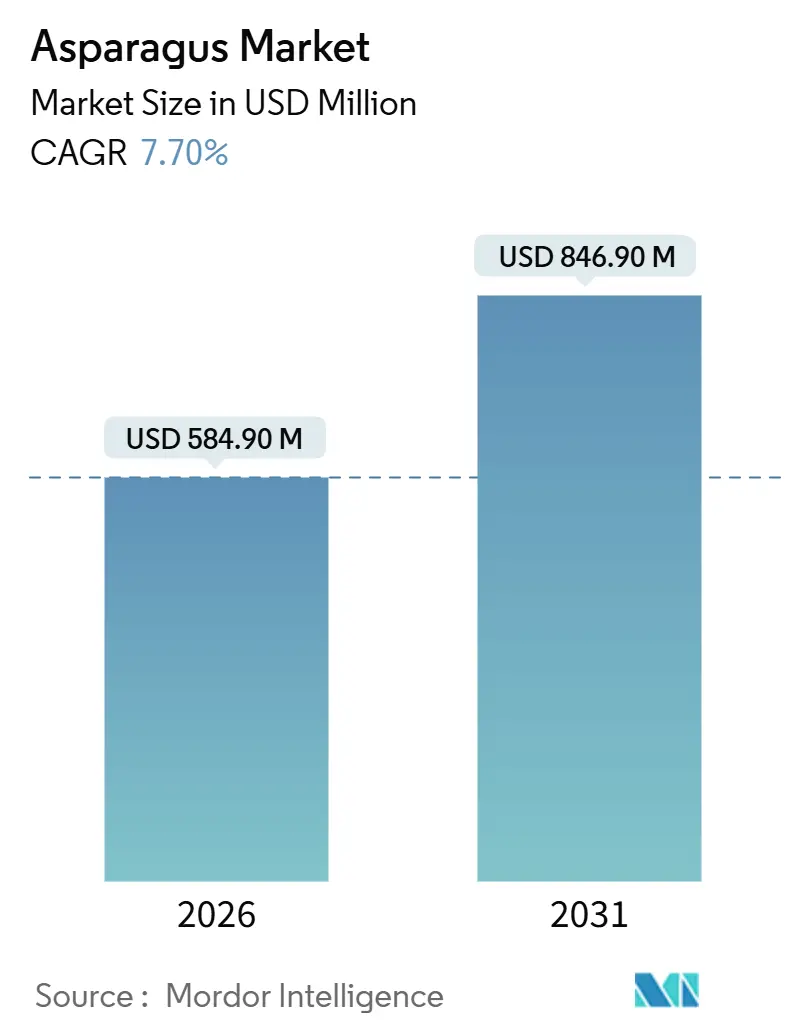
The asparagus market size reached USD 584.9 million in 2026 and is projected to increase to USD 846.9 million by 2031, representing a 7.7% CAGR between 2026 and 2031. Steady growth relies on health-driven diets, expanded cold chain coverage that ensures year-round supply, and precision practices that increase yields while reducing input costs. The Asia-Pacific region led consumption value with a 38% share in 2025, driven by rising incomes in China and persistent demand for premium vegetables in Japan and Australia. Organic acreage is outpacing conventional fields as retailers dedicate more shelf space to pesticide-free produce, while biotech research into heat- and disease-tolerant cultivars promises longer stand life. Conversely, acute labor shortages, volatile freight tariffs, and Fusarium outbreaks continue to inflate operating expenses, keeping margins tight for exporters and growers.
Key Report Takeaways
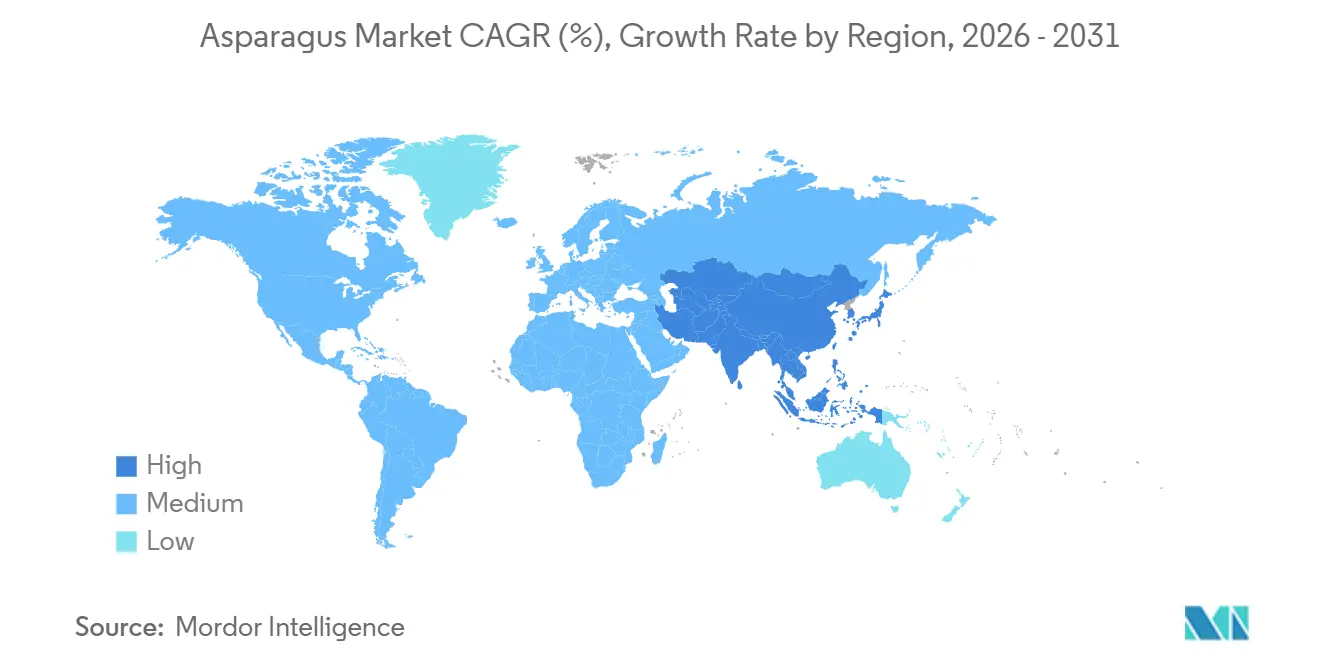
- By geography, the Asia-Pacific region captured 38% of the 2025 value, while the Middle East is forecast to expand at a 6.8% CAGR through 2031.
Note: Market size and forecast figures in this report are generated using Mordor Intelligence’s proprietary estimation framework, updated with the latest available data and insights as of January 2026.
Market Trends and Insights
Drivers Impact Analysis of Asparagus Market*
| Driver | (~) % Impact on CAGR Forecast | Geographic Relevance | Impact Timeline |
|---|---|---|---|
| Health-centric diets boost demand for nutrient-dense fresh vegetables | +0.8% | Global, strongest uptake in North America, Europe, urban Asia-Pacific | Medium term (2-4 years) |
| Premiumization of organic asparagus in high-income markets | +0.7% | North America and Europe, emerging in Japan and Australia | Medium term (2-4 years) |
| Year-round availability via counter-season exports and cold chain expansion | +0.6% | Global, notably Peru to North America and Europe, Mexico to United States | Short term (≤2 years) |
| Precision drip-fertigation and plasticulture lift farm yields | +0.5% | Peru, Mexico, California, Spain, China, Australia | Long term (≥4 years) |
| Carbon-credit revenue streams for perennial plantings | +0.4% | Europe, pilot efforts in North America and South America | Long term (≥4 years) |
| Clustered Regularly Interspaced Short Palindromic Repeats (CRISPR)-enabled breeding of heat and rust-tolerant cultivars | +0.3% | United States, Netherlands, Peru, rollout in all production hubs | Long term (≥4 years) |
| Source: Mordor Intelligence | |||
Health-Centric Diets Boost Demand for Nutrient-Dense Fresh Vegetables
Asparagus delivers 2.9 grams of fiber, 70 micrograms of folate, and 2.9 milligrams of vitamin E per 100-gram serving, positioning it as a nutrient-dense choice for consumers prioritizing cardiovascular health, prenatal nutrition, and digestive wellness[1]Source: USDA FoodData Central, “Asparagus Nutritional Profile,” fdc.nal.usda.gov. A 2024 consumer survey conducted by the Produce Marketing Association found that 36.7% of United States households purchased fresh asparagus during the year, up from 26% in 2023, with higher-income cohorts exhibiting purchase rates exceeding 50%. This income gradient highlights asparagus's role as a premium vegetable that benefits disproportionately from wage growth and increases in discretionary spending in developed markets. United States per capita availability declined from 2.0 pounds in 2022 to 1.5 pounds in 2023, yet this contraction reflects supply-side constraints rather than demand erosion, as terminal market prices remained firm despite lighter offerings.
Premiumization of Organic Asparagus in High-Income Markets
Organic asparagus commanded retail price premiums ranging from 7 to 36% across North American and European markets in 2025, with the spread narrowing as conventional prices rose more rapidly during the 2022-2024 inflationary cycle. Organic sales grew 7.4% annually over the past three years, while conventional volumes contracted by 2.9%, signaling a structural shift in consumer preference toward pesticide-free produce. Retailer mandates for organic SKUs have expanded shelf space, yet Peruvian organic exports to the United States remain blocked by methyl bromide fumigation requirements that strip organic certification. The Instituto Peruano del Espárrago y Hortalizas is collaborating with the National Service of Agri-Food Health and Quality (SENASA) to pilot modified-atmosphere treatments that could satisfy phytosanitary protocols without the need for fumigation, potentially unlocking USD 50 million in annual organic export value.
Year-Round Availability via Counter-Season Exports and Cold Chain Expansion
According to the ITC Trade Map, Peru and Mexico are significant exporters of asparagus, with Peru exporting USD 406,708 thousand in 2024 and Mexico exporting USD 328,300 thousand. These exports enable Northern Hemisphere retailers to maintain year-round SKUs. In July 2025, Maersk inaugurated a 17,500-square-meter cold storage hub in Olmos, Peru. This facility is designed to reduce post-harvest losses by 10% through rapid pre-cooling and controlled-atmosphere storage. It has a capacity to handle 15,000 pallets and is integrated with Peru's new Port of Chancay, which began operations in the fourth quarter of 2024. The port reduces transit time to Shanghai from 35 days to 25 days. Given asparagus's high respiration rate and a shelf life of 7 to 10 days at 32 to 35°F, uninterrupted cold chains are essential, making infrastructure investments critical for preserving margins.
Precision Drip-Fertigation and Plasticulture Lift Farm Yields
Drip irrigation systems reduce water consumption by 30 to 50% compared to flood irrigation, while fertigation improves nitrogen use efficiency by 20 to 30%, lowering input costs and reducing environmental runoff. Peruvian growers in the Ica and La Libertad regions were projected to adopt drip systems on approximately 70% of their asparagus acreage by 2024, supported by government subsidies under the Programa de Riego Tecnificado, which co-funds 50% of the installation costs. The United States Department of Agriculture's Environmental Quality Incentives Program awarded up to USD 450,000 in grants for irrigation system upgrades in New Mexico in 2024, reflecting the federal prioritization of water conservation in arid production zones. Yield improvements from precision agriculture range from 10 to 15% over conventional practices, yet adoption remains constrained by upfront capital requirements and limited technical assistance in smallholder regions.
Restraints Impact Analysis of Asparagus Market*
| Restraint | (~) % Impact on CAGR Forecast | Geographic Relevance | Impact Timeline |
|---|---|---|---|
| Acute harvest-season labor shortages drive up unit costs | -0.9% | United States, Mexico, Peru, Spain | Short term (≤2 years) |
| Volatile air-freight and refrigerated trucking tariffs squeeze margins | -0.7% | Global, notably Peru and Mexico to U.S. and Europe | Short term (≤2 years) |
| Soil-borne Fusarium and crown-rot outbreaks reduce stand life | -0.4% | Peru, California, Spain, Australia, China | Medium term (2-4 years) |
| Rising pesticide-residue audit failures due to retailer Maximum Residue Limit (MRL) tightening | -0.3% | Peru and Mexico exports to European Union and United States | Medium term (2-4 years) |
| Source: Mordor Intelligence | |||
Acute Harvest-Season Labor Shortages Drive Up Unit Costs
United States H-2A temporary agricultural visa certifications reached 378,000 in 2024, up from 310,000 in 2022, yet grower demand exceeded supply by an estimated 15% during peak asparagus harvest windows in California and Washington [2]Source: US Department of Labor, “H-2A Temporary Agricultural Program,” dol.gov. Adverse effect wage rates for H-2A workers rose 5 to 8% annually from 2022 to 2024, while California's statewide minimum wage increased to USD 16 per hour in 2024, compressing margins for labor-intensive crops like asparagus that require daily hand-picking over 8 to 12-week seasons. Mechanical harvesting remains commercially unviable for fresh-market asparagus due to the fragility of the spears and quality degradation, leaving growers dependent on manual labor. Mexico's asparagus sector competes with higher-paying berry and avocado operations for seasonal workers, thereby exacerbating shortages in the production zones of Sonora and Guanajuato.
Volatile Air-Freight and Refrigerated Trucking Tariffs Squeeze Margins
Refrigerated trucking costs in the United States rose 15 to 20% between 2022 and 2024, driven by diesel price volatility and a 10% shortfall in qualified commercial drivers. Air freight rates from Lima to Miami, the primary corridor for Peruvian asparagus, fluctuated between USD 2.50 and USD 4.20 per kilogram in 2024, as Red Sea shipping disruptions diverted cargo to air routes and tightened capacity. Drought conditions in the Panama Canal in 2023 and 2024 reduced daily vessel transits from 36 to 24, resulting in surcharges of USD 500 to USD 1,200 per container for refrigerated shipments and extending transit times by 5 to 7 days. Asparagus's 7 to 10-day shelf life limits ocean freight viability, forcing exporters to absorb air freight premiums that can represent 25 to 35% of landed cost.
*Our forecasts treat driver/restraint impacts as directional, not additive. The impact forecasts reflect baseline growth, mix effects, and variable interactions.
Geography Analysis
APAC Asparagus Market
The Asia-Pacific region captured 38% of the 2025 value, driven by rising disposable incomes in China, sustained premium vegetable demand in Japan, and the expansion of cold chain infrastructure in Australia, which enables year-round availability. China's asparagus imports increased by 15% annually from 2022 to 2024, primarily sourced from Peru and Mexico, as urbanization and Western dietary trends elevated consumption in tier-1 and tier-2 cities[3]Source: China Customs, “Asparagus Import Statistics,” customs.gov.cn. Japan remains the region's highest per capita consumer, at approximately 0.8 kilograms annually, with retail prices averaging USD 8 to USD 12 per kilogram, reflecting tight supply and consumer preference for thick-spear premium grades.
MEA Asparagus Market
The Middle East is forecast to expand at a 6.8% CAGR through 2031, the fastest pace globally, as food security policies prioritize diversified fresh-produce imports and cold chain networks expand in the United Arab Emirates and Saudi Arabia. According to the UAE Federal Competitiveness and Statistics Centre, asparagus imports to the United Arab Emirates reached 4,200 metric tons in 2024, sourced from Peru, Mexico, and Spain. Re-exports to neighboring Gulf Cooperation Council markets accounted for 30% of inbound volumes. Saudi Arabia's Vision 2030 agricultural diversification initiatives include subsidies for controlled-environment vegetable production, yet asparagus's perennial nature and water requirements limit domestic cultivation potential, sustaining import dependence.
The Americas and Europe Asparagus Market
North America constituted a significant market, with per capita availability of asparagus in the United States declining from 2.0 pounds in 2022 to 1.5 pounds in 2023. This decrease was primarily due to a 10.8% reduction in Peruvian export volumes by week 46 of 2024 and Mexico's reallocation of acreage toward higher-value crops. In Europe, Germany, Spain, and the United Kingdom represented the largest markets. These mature markets exhibited limited elasticity, while traditional practices, such as white asparagus consumption, experienced a generational decline. In South America, Peru and Argentina dominated the region, with domestic markets absorbing production surpluses during export off-seasons.


Regulatory Landscape
Cross-border asparagus trade is governed primarily by sanitary and phytosanitary (SPS) rules, with import eligibility tied to official, commodity-specific requirements and phytosanitary certification issued by national plant protection organizations. In the United States, USDA APHIS manages import requirements through the Agricultural Commodity Import Requirements (ACIR) database (which replaced the prior FAVIR system), while USDA AMS also shapes specifications for processed formats through grade standards.
Regulatory changes and notifications continue to affect market access and compliance costs. In December 2025, the European Commission published SPS notification G/SPS/N/EU/899, updating phytosanitary import requirements for fresh asparagus (Asparagus officinalis). Separately, trade facilitation and market-development tools remain in motion: USDA FAS opened FY 2026 funding opportunities in April 2025 for programs such as MAP, FMD, TASC, and EMP, which are used by industry groups to address non-tariff barriers and compliance needs in destination markets.
Value Chain Analysis
The asparagus value chain starts with genetics and inputs (seed and planting material, fertilizers, crop protection, irrigation systems), and then moves through perennial field production, harvest labor, pre-cooling, grading, packing, and onward logistics to retail, food service, and bulk export channels. Vertically integrated exporters in key origins, such as DanPer, Agrokasa, Camposol, and Sociedad Agricola Viru, coordinate farming, post-harvest handling, and export programs to reduce spoilage risk and meet retailer specifications, including third-party standards such as GlobalGAP and BRC.
Cold chain performance and transport mode are the main value-leakage points, given the product's short shelf life and the frequent reliance on air freight for fresh export volumes. Maersk opened a 17,500-square-meter cold storage hub in Olmos, Peru, in July 2025, designed to reduce post-harvest losses by 10% and integrated with Peru's Port of Chancay, which began operations in Q4 2024 and reduces transit time to Shanghai from 35 days to 25 days. On-farm constraints (labor availability and water costs) and phytosanitary compliance at destination markets (inspection, pest freedom, and commodity-specific import conditions) continue to shape origin competitiveness and buyer sourcing decisions.
Competitive Landscape
The fresh asparagus market comprises various players, including producers, importers, and exporters, who collectively supply asparagus. Peruvian companies such as DanPer, Agrokasa, Camposol, and Sociedad Agricola Viru maintain origin-based cold storage facilities and proprietary genetics, ensuring a consistent supply during production gaps in the Northern Hemisphere. Camposol began utilizing Peru’s Port of Chancay in late 2024, reducing shipping times to China by ten days and signaling a strategic focus on the Asian market. Altar Produce, managing 29,000 acres in Mexico, announced in May 2025 its diversification into Brussels sprouts and broccoli to mitigate labor-related risks.
Technology adoption has emerged as a significant differentiator in the market. Leading growers have invested in drip fertigation systems, reducing water usage by up to 50% and aligning with retailer sustainability requirements. Smaller operations face challenges in affording such upgrades. Compliance with standards like GlobalGAP and BRC adds USD 0.05–0.10 per pound to the landed cost, benefiting vertically integrated firms that can distribute these expenses across larger volumes. Opportunities exist in CRISPR-developed cultivars resistant to Fusarium and in modified-atmosphere treatments that eliminate the need for fumigation, potentially unlocking a USD 50 million organic market opportunity for Peru.
European market consolidation continued with Maf Roda Group's acquisition of German processor Strauss in April 2025, aimed at scaling value-added product formats. Camposol’s biotechnology division supplied one million proprietary fruit plants in 2024, indicating potential future developments in asparagus genetics. Moderate entry barriers persist, including stringent residue limits, high freight costs, and reliance on seasonal labor, which disadvantages smaller exporters. However, market fragmentation below the top-tier players provides opportunities for niche participants.
Market Opportunities and Future Outlook
Automation that reduces harvest labor exposure is a clear whitespace area, since labor remains the dominant cost center in asparagus production and hand-picking limits scalability for fresh-market spears. Near-term commercialization includes Lommers Tuinbouwmachines announcing in July 2025 the production of 20 asparagus harvesting robots for the 2026 season, alongside research progress such as the Technical University of Munich unveiling a prototype harvesting robot in March 2026, with reported operating speeds up to 1 meter per second on even terrain. Together, these developments point toward field navigation, selective harvesting, and integrated grading systems that can be adopted by specialized farms facing wage pressure.
Market access and product-format upgrades also offer actionable avenues as compliance and logistics tighten. Peru's organic export upside is constrained by fumigation-linked loss of organic status in the United States, which is driving the Instituto Peruano del Espárrago y Hortalizas and SENASA to pilot modified-atmosphere treatments as an alternative pathway aimed at preserving certification and targeting an estimated USD 50 million annual organic export value. On the supply side, new and expanded cold chain assets, including Maersk's Olmos hub and the Port of Chancay corridor, give exporters and importers more room to diversify destinations, particularly into Asia, where faster ocean routes can improve delivered quality for premium grades and reduce loss rates in transit.
Recent Industry Developments in Asparagus Market
- June 2026: Limgroup, TERIS, and A.M.A. partnered to distribute F1 hybrid asparagus genetics (alongside strawberry genetics) across Canada and the United States. The collaboration supports a more standardized supply of planting material and helps growers pursue more uniform performance and resilience in labor- and climate-constrained production systems.
- December 2025: Limgroup introduced the Ruralim asparagus variety for growers, positioned around yield potential and strong foliage. New commercial varieties can shift farm economics by improving stand performance and pack-out quality, which becomes more relevant as residue compliance and disease pressure tighten constraints.
- September 2024: Pacific Produce (Grupo Hame) confirmed plans to double asparagus output in Peru, supported by 250 hectares under crop and a USD 24 million water project. The expansion and water-security investment add exportable supply capacity and highlights irrigation infrastructure as a gating factor for growth in arid asparagus regions.


Asparagus Market Report Scope and Research Methodology
Market Definition and Coverage
For this methodology, the asparagus market means the value generated from the first commercial sale of asparagus spears sold as fresh, frozen, or canned across major producing and consuming countries and trade flows.
Scope exclusions: Value-added asparagus ingredients and derivative products (such as extracts, soups, or nutraceutical concentrates) are not counted.
Segments Covered in This Report
- By Geography
- North America
- United States
- Production Analysis (Area Harvested, Yield, and Production Volume)
- Consumption Analysis (Consumption Value and Volume)
- Import Market Analysis (Import Value, Volume, and Key Supplying Markets)
- Export Market Analysis (Export Value, Volume, and Key Destination Markets)
- Wholesale Price Trend Analysis and Forecast
- Regulatory Framework
- List of Key Players
- Logistic and Infrastructure
- Seasonality Analysis
- Canada
- Production Analysis (Area Harvested, Yield, and Production Volume)
- Consumption Analysis (Consumption Value and Volume)
- Import Market Analysis (Import Value, Volume, and Key Supplying Markets)
- Export Market Analysis (Export Value, Volume, and Key Destination Markets)
- Wholesale Price Trend Analysis and Forecast
- Regulatory Framework
- List of Key Players
- Logistic and Infrastructure
- Seasonality Analysis
- Mexico
- Production Analysis (Area Harvested, Yield, and Production Volume)
- Consumption Analysis (Consumption Value and Volume)
- Import Market Analysis (Import Value, Volume, and Key Supplying Markets)
- Export Market Analysis (Export Value, Volume, and Key Destination Markets)
- Wholesale Price Trend Analysis and Forecast
- Regulatory Framework
- List of Key Players
- Logistic and Infrastructure
- Seasonality Analysis
- United States
- Europe
- Germany
- Production Analysis (Area Harvested, Yield, and Production Volume)
- Consumption Analysis (Consumption Value and Volume)
- Import Market Analysis (Import Value, Volume, and Key Supplying Markets)
- Export Market Analysis (Export Value, Volume, and Key Destination Markets)
- Wholesale Price Trend Analysis and Forecast
- Regulatory Framework
- List of Key Players
- Logistic and Infrastructure
- Seasonality Analysis
- United Kingdom
- Production Analysis (Area Harvested, Yield, and Production Volume)
- Consumption Analysis (Consumption Value and Volume)
- Import Market Analysis (Import Value, Volume, and Key Supplying Markets)
- Export Market Analysis (Export Value, Volume, and Key Destination Markets)
- Wholesale Price Trend Analysis and Forecast
- Regulatory Framework
- List of Key Players
- Logistic and Infrastructure
- Seasonality Analysis
- Spain
- Production Analysis (Area Harvested, Yield, and Production Volume)
- Consumption Analysis (Consumption Value and Volume)
- Import Market Analysis (Import Value, Volume, and Key Supplying Markets)
- Export Market Analysis (Export Value, Volume, and Key Destination Markets)
- Wholesale Price Trend Analysis and Forecast
- Regulatory Framework
- List of Key Players
- Logistic and Infrastructure
- Seasonality Analysis
- Netherlands
- Production Analysis (Area Harvested, Yield, and Production Volume)
- Consumption Analysis (Consumption Value and Volume)
- Import Market Analysis (Import Value, Volume, and Key Supplying Markets)
- Export Market Analysis (Export Value, Volume, and Key Destination Markets)
- Wholesale Price Trend Analysis and Forecast
- Regulatory Framework
- List of Key Players
- Logistic and Infrastructure
- Seasonality Analysis
- France
- Production Analysis (Area Harvested, Yield, and Production Volume)
- Consumption Analysis (Consumption Value and Volume)
- Import Market Analysis (Import Value, Volume, and Key Supplying Markets)
- Export Market Analysis (Export Value, Volume, and Key Destination Markets)
- Wholesale Price Trend Analysis and Forecast
- Regulatory Framework
- List of Key Players
- Logistic and Infrastructure
- Seasonality Analysis
- Italy
- Production Analysis (Area Harvested, Yield, and Production Volume)
- Consumption Analysis (Consumption Value and Volume)
- Import Market Analysis (Import Value, Volume, and Key Supplying Markets)
- Export Market Analysis (Export Value, Volume, and Key Destination Markets)
- Wholesale Price Trend Analysis and Forecast
- Regulatory Framework
- List of Key Players
- Logistic and Infrastructure
- Seasonality Analysis
- Germany
- Asia-Pacific
- China
- Production Analysis (Area Harvested, Yield, and Production Volume)
- Consumption Analysis (Consumption Value and Volume)
- Import Market Analysis (Import Value, Volume, and Key Supplying Markets)
- Export Market Analysis (Export Value, Volume, and Key Destination Markets)
- Wholesale Price Trend Analysis and Forecast
- Regulatory Framework
- List of Key Players
- Logistic and Infrastructure
- Seasonality Analysis
- Japan
- Production Analysis (Area Harvested, Yield, and Production Volume)
- Consumption Analysis (Consumption Value and Volume)
- Import Market Analysis (Import Value, Volume, and Key Supplying Markets)
- Export Market Analysis (Export Value, Volume, and Key Destination Markets)
- Wholesale Price Trend Analysis and Forecast
- Regulatory Framework
- List of Key Players
- Logistic and Infrastructure
- Seasonality Analysis
- Australia
- Production Analysis (Area Harvested, Yield, and Production Volume)
- Consumption Analysis (Consumption Value and Volume)
- Import Market Analysis (Import Value, Volume, and Key Supplying Markets)
- Export Market Analysis (Export Value, Volume, and Key Destination Markets)
- Wholesale Price Trend Analysis and Forecast
- Regulatory Framework
- List of Key Players
- Logistic and Infrastructure
- Seasonality Analysis
- China
- South America
- Peru
- Production Analysis (Area Harvested, Yield, and Production Volume)
- Consumption Analysis (Consumption Value and Volume)
- Import Market Analysis (Import Value, Volume, and Key Supplying Markets)
- Export Market Analysis (Export Value, Volume, and Key Destination Markets)
- Wholesale Price Trend Analysis and Forecast
- Regulatory Framework
- List of Key Players
- Logistic and Infrastructure
- Seasonality Analysis
- Argentina
- Production Analysis (Area Harvested, Yield, and Production Volume)
- Consumption Analysis (Consumption Value and Volume)
- Import Market Analysis (Import Value, Volume, and Key Supplying Markets)
- Export Market Analysis (Export Value, Volume, and Key Destination Markets)
- Wholesale Price Trend Analysis and Forecast
- Regulatory Framework
- List of Key Players
- Logistic and Infrastructure
- Seasonality Analysis
- Peru
- Middle East
- United Arab Emirates
- Production Analysis (Area Harvested, Yield, and Production Volume)
- Consumption Analysis (Consumption Value and Volume)
- Import Market Analysis (Import Value, Volume, and Key Supplying Markets)
- Export Market Analysis (Export Value, Volume, and Key Destination Markets)
- Wholesale Price Trend Analysis and Forecast
- Regulatory Framework
- List of Key Players
- Logistic and Infrastructure
- Seasonality Analysis
- Saudi Arabia
- Production Analysis (Area Harvested, Yield, and Production Volume)
- Consumption Analysis (Consumption Value and Volume)
- Import Market Analysis (Import Value, Volume, and Key Supplying Markets)
- Export Market Analysis (Export Value, Volume, and Key Destination Markets)
- Wholesale Price Trend Analysis and Forecast
- Regulatory Framework
- List of Key Players
- Logistic and Infrastructure
- Seasonality Analysis
- United Arab Emirates
- Africa
- South Africa
- Production Analysis (Area Harvested, Yield, and Production Volume)
- Consumption Analysis (Consumption Value and Volume)
- Import Market Analysis (Import Value, Volume, and Key Supplying Markets)
- Export Market Analysis (Export Value, Volume, and Key Destination Markets)
- Wholesale Price Trend Analysis and Forecast
- Regulatory Framework
- List of Key Players
- Logistic and Infrastructure
- Seasonality Analysis
- South Africa
- North America
Data Sources, Market Sizing, and Validation
Desk Research
Desk work was used to set the market boundary, map supply and trade routes, and create a reliable set of starting ratios before we built the model. We reviewed public statistics and reference series, including FAOSTAT for production and harvested area, UN Comtrade for trade values and volumes, and USDA and Eurostat for agriculture and food supply indicators, plus national agriculture ministries for crop calendars and yield updates.
To make the numbers usable in one model, we standardized units and timing so price and volume signals did not get mixed across seasons, then we checked for obvious outliers in trade and production data. We also reviewed company filings, investor presentations, association pages, and reputable press coverage to track shifts in supply, logistics, and retail pricing. Where needed, we used paid subscriptions for company financials and intelligence, news and financials, and shipment-level import and export context, plus patent databases for light signal checks. The named sources here are illustrative only, and we used additional public references to cross-check, validate, and clarify data points.
Primary Interviews and Surveys
Primary work focused on validating volumes moving through export and domestic channels, typical price formation across seasons, and how often contracts reset in key importing markets. We spoke with growers, exporters, importers, wholesalers, retailers, and foodservice buyers across major producing regions and demand centers, then we revisited assumptions when responses indicated a clear variance in yield, packout, or realized pricing.
Distribution of primary research fieldwork respondents
| Company type | Respondent position | Region |
|---|---|---|
| Top tier: 30% | CXOs: 14% | APAC: 43% |
| Mid tier: 55% | Functional/Unit leaders: 37% | EMEA: 34% |
| Smaller Players: 15% | Managers: 49% | Americas: 23% |
Market-Sizing & Forecasting
For sizing, we used a top-down build where production and trade data reconstruct available supply, then we adjusted for domestic consumption patterns and observed export intensity by major origin countries. Because asparagus is seasonal and unit values move sharply, the model was run with year-specific volume splits, then valued using a blended price view that reflects export unit values and local market pricing.
To keep the totals realistic, we corroborated the result with selective bottom-up checks, including sampled exporter and importer throughput, wholesale channel checks, and price per kilogram times estimated marketed volumes in a few anchor countries. The most sensitive inputs were harvested area and yield trends, export volumes by origin, import demand concentration in large buyers, the share of fresh versus processed movements, and typical seasonal price lifts during peak windows. Where country-level visibility was limited, we filled gaps using proxy ratios from similar producing regions, then sanity-checked against trade totals and expert feedback.
Forecasts were produced using scenario analysis, where expected changes in planted area, yield recovery, logistics costs, and demand conditions were converted into volume and price paths. Those variable paths were reviewed with industry participants so the final outlook stayed aligned with how buyers and sellers approach contracting and planting decisions.
Data Validation & Update Cycle
Validation was done in steps so unusual outputs could be caught early, then explained or corrected before sign-off. We compared model totals against independent signals such as production direction, trade balances, and year-to-year price movements, then we revisited any sharp breaks that did not match reported season outcomes.
Before publication, assumptions and calculations are reviewed by another analyst, and primary contacts are re-engaged when a key variable shifts or when a large variance shows up in a core country. The report is refreshed annually, and interim updates are made when material events occur, such as major weather disruptions or trade policy changes. Immediately before delivery, a final pass is completed so clients receive the most current view available at that time.
Mordor Intelligence's Asparagus Market Sizing Compared With Other Published Estimates
Published market values for asparagus vary because some groups do not define the product forms the same way, and they also treat pricing and trade valuation differently. Timing adds another layer since seasonality can change volumes and unit values within a single year, which affects what gets counted.
The main gap comes from mixing farm-level value with downstream retail value, where Mordor Intelligence counts asparagus at the first commercial sale for fresh, frozen, and canned spears, rather than adding retail markups or value-added derivatives. Another driver is how import values are translated into market totals, since some estimates double count re-exports or use a single average price that misses peak-season lifts and origin shifts.
Benchmark comparison
| Source | Market Size | Gaps in Research Methodology |
|---|---|---|
| Mordor Intelligence | USD 584.90 M (2026) | |
| Trade Journal A | USD 26.00 B (2024) | Uses a broad value number that appears to reflect consumer spending or a wide farm-to-retail value chain, which can inflate totals versus first-sale valuation and may not separate fresh from processed movement consistently. |
| Regional Consultancy B | USD 30.06 B (2024) | Applies a multi-segment scope that likely folds in adjacent categories and downstream services, and it is not clear how trade re-exports, seasonal price swings, and currency timing are handled in the aggregation. |
The spread in the table is mainly explained by scope and valuation point, then by how trade values and seasonal pricing are translated into an annual market value. By keeping inclusions explicit and tying prices to observable trade and market signals, the estimate stays easier to replicate and to audit over time.


Key Questions Answered in the Report
How large is the fresh asparagus market in 2026?
The fresh asparagus market size reached USD 584.9 million in 2026 and is forecast to grow at a 7.70% CAGR toward 2031.
Which region consumed the most asparagus in 2025?
Asia-Pacific led with 38% of global consumption value, supported by rising Chinese imports and steady demand in Japan.
Why is organic asparagus growing faster than the conventional supply?
Retailer shelf mandates and consumer willingness to pay 7 to 36% premiums are pushing organic acreage to a projected 9.1% CAGR through 2031.
What is the impact of the 2025 United States tariff on Peruvian asparagus?
The 10% tariff took effect in April 2025 and is anticipated to raise United States retail prices 3-5% while redirecting some Peruvian volume to Europe and Asia.
Page last updated on:





