
Rapeseed Market Size and Share
Rapeseed Market Analysis by Mordor Intelligence
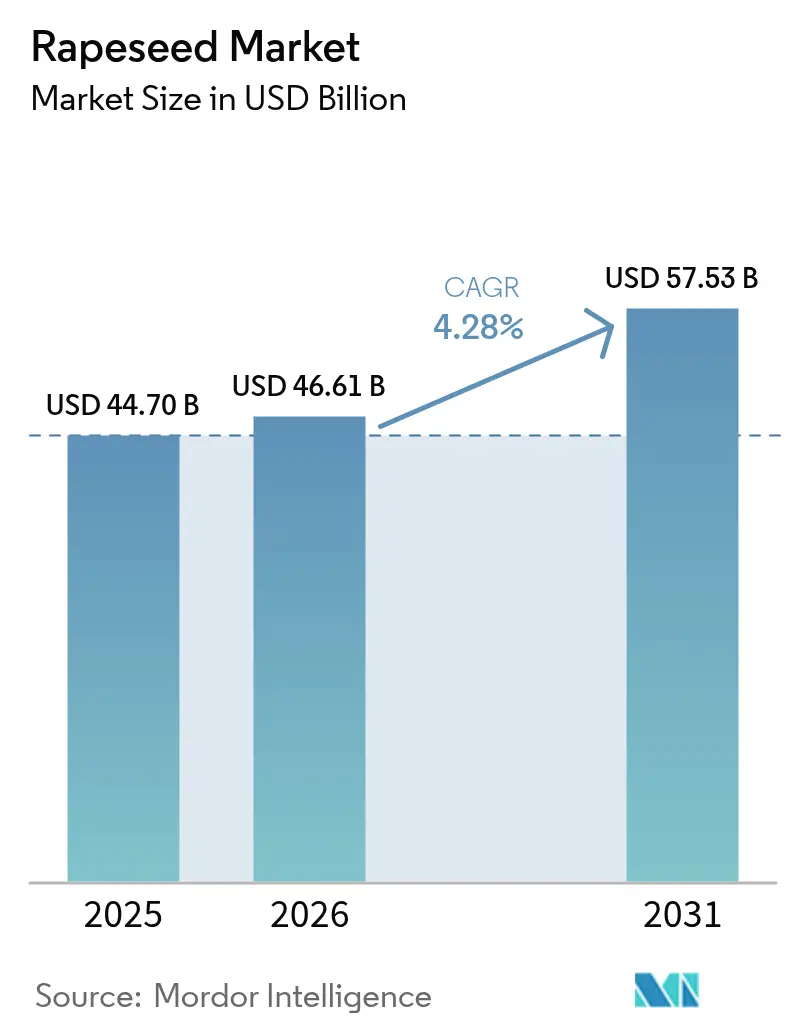
The rapeseed market size is expected to grow from USD 44.7 billion in 2025 to USD 46.61 billion in 2026 and is forecast to reach USD 57.53 billion by 2031 at 4.28% CAGR over 2026-2031. The market growth is primarily attributed to strengthening bio-fuel mandates across Europe and North America, increased incorporation in sustainable aviation fuel production, and the commodity's dual functionality as an oil and protein source. The implementation of Europe's Renewable Energy Directive III has intensified the demand for vegetable-oil feedstock. The United States' renewable diesel capacity, which exceeds 850,000 barrels of oil-equivalent per day in 2024, is projected to expand to 1.3 million barrels by 2035, subsequently impacting global supply dynamics. Market development is further supported by China's advancement in high-yield varieties and India's expansion of crushing capacity, particularly for protein meal production. Supply constraints stemming from climate variability in primary production regions continue to maintain robust price levels. The market structure is transforming strategic vertical integration initiatives by major agribusinesses and the incorporation of regenerative agriculture practices.
Key Report Takeaways
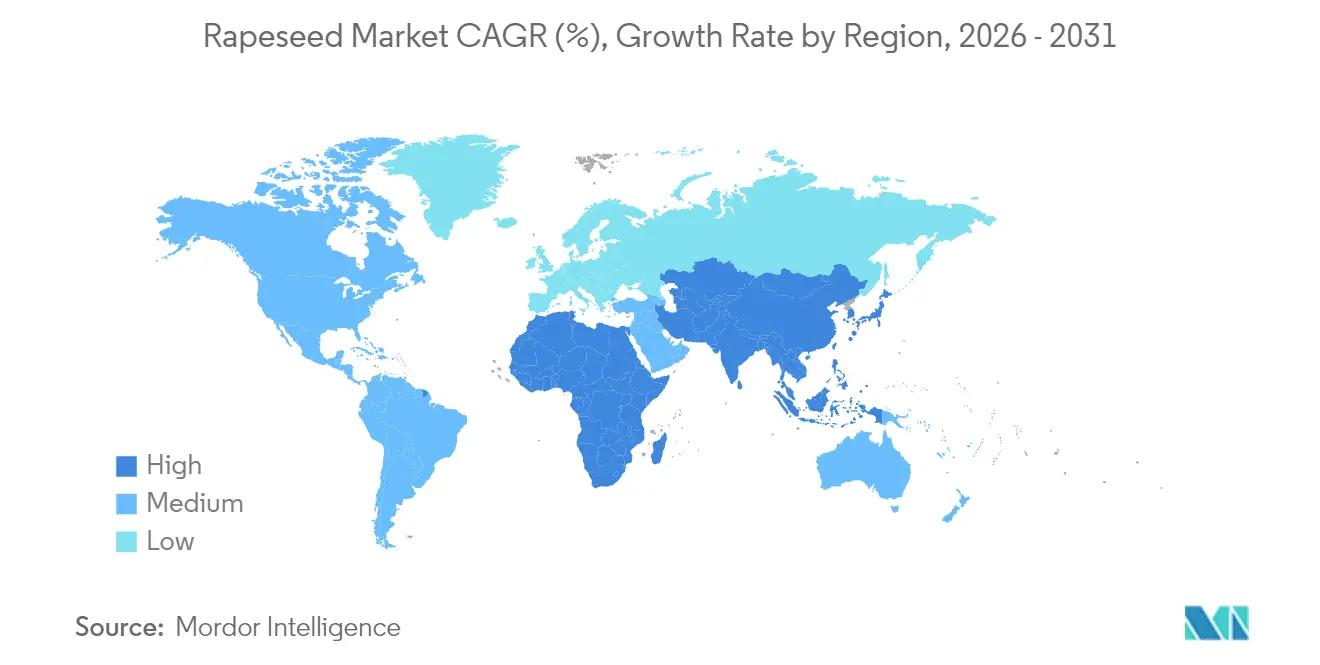
- By geography, Europe accounted for 34.85% of the rapeseed market share in 2025, and Asia-Pacific is registering the fastest growth at a 4.68% CAGR to 2031.
Note: Market size and forecast figures in this report are generated using Mordor Intelligence’s proprietary estimation framework, updated with the latest available data and insights as of 2026.
Market Trends and Insights
Drivers Impact Analysis of Rapeseed Market*
| Driver | (~) % Impact on CAGR Forecast | Geographic Relevance | Impact Timeline |
|---|---|---|---|
| Expansion of bio-fuel mandates | +1.2% | Global, strongest in Europe and North America | Medium term (2-4 years) |
| Rising demand for plant-based protein meal | +0.8% | Global, led by Asia-Pacific and Europe | Long term (≥ 4 years) |
| Favorable price spread versus other oilseed crops | +0.6% | Global, particularly Canada and Australia | Short term (≤ 2 years) |
| High-yield/lower erucic cultivar innovations | +0.5% | Global, early adoption in China and Europe | Long term (≥ 4 years) |
| Rapeseed oil as feedstock for sustainable aviation fuel | +0.4% | North America and Europe, expanding globally | Medium term (2-4 years) |
| Carbon-credit revenue from regenerative rotations | +0.3% | North America and Europe | Long term (≥ 4 years) |
| Source: Mordor Intelligence | |||
Expansion of Bio-fuel Mandates
Bio-fuel policy acceleration is driving significant demand in the rapeseed market. Europe's Renewable Energy Directive III mandates a 14.5% greenhouse-gas intensity reduction in transport fuels by 2030, compelling refiners to increase their low-carbon feedstock procurement. In the United States, renewable diesel projects are expanding capacity to 1.3 million barrels of oil-equivalent per day by 2035, resulting in record rapeseed oil imports. The implementation of Indonesia's B35 mandate and Brazil's B15 target further increases the global vegetable-oil deficit, supporting rapeseed prices. European hydrotreated vegetable-oil demand is projected to increase by more than 400,000 metric tons in 2025, with rapeseed oil accounting for nearly half of this volume. The imposition of anti-dumping duties on Chinese biodiesel reinforces rapeseed's importance in meeting renewable-fuel requirements.
Rising Demand for Plant-Based Protein Meal
Rapeseed meal consumption is increasing across livestock, aquaculture, and human-nutrition sectors as an alternative protein source to soybean. The EU-27 consumed 13.75 million metric tons and China 12.54 million metric tons in 2024, demonstrating the growing global adoption of rapeseed[1]U.S. Department of Agriculture, “Oilseeds: World Markets and Trade,” usda.gov. Danish research developments in glucosinolate removal have created a human-grade protein concentrate suitable for food ingredients. Research indicates that rapeseed protein's amino-acid profiles match soybean quality and provide superior benefits for non-ruminant animals. Through fermentation processes, antinutritional factors have been reduced, enabling 25% fishmeal replacement in salmon feed and reducing aquaculture production costs. The pharmaceutical industry's extraction of bioactive peptides from rapeseed meal has created additional revenue opportunities and strengthened market growth.
Favorable Price Spread Versus Other Oilseed Crops
Rapeseed traded at USD 576.4 (EUR 500) per metric ton ex-farm in 2024, representing 2.5 times the value of soft-wheat prices, which incentivized agricultural expansion despite agronomic considerations. The crop's dual-purpose economic structure through oil and meal production provides income diversification against single-use crop volatility. Winter rapeseed integration during fallow periods in cereal rotations generates supplementary revenue without impacting prime-season crop allocation, particularly beneficial in regions experiencing climate stress. United States rapeseed plantings surpassed 1 million hectares in 2024, driven by renewable-fuel premium support above historical price benchmarks. The European production deficit, combined with Ukrainian logistical constraints, maintains favorable market fundamentals, sustaining rapeseed price levels.
Rapeseed Oil as Feedstock for Sustainable Aviation Fuel
U.S. renewable-diesel facilities are projected to increase their sustainable aviation fuel (SAF) production capacity to 834.4 million gallons by 2026, representing a twelve-fold increase from 2023 levels.[2] University of Illinois, “Sustainable Aviation Fuel Feedstocks,” illinois.edu The hydro-processed esters and fatty acids (HEFA) pathway continues to be the primary production method, with rapeseed oil reducing life-cycle carbon intensity by 40-80% compared to conventional jet fuel. The European Union's mandatory SAF blending requirements of 2% by 2025 and 6% by 2030, combined with U.S. tax incentives, have established a premium market that encourages long-term feedstock supply agreements. Research indicates that rapeseed-based SAF demonstrates a global warming potential that is at least 1.05 times lower than conventional jet fuel when compared on an energy-equivalent basis. The integration of SAF and renewable-diesel production facilities enables manufacturers to adjust their output according to market conditions, increasing operational flexibility and strengthening the demand for rapeseed.
Restraints Impact Analysis of Rapeseed Market*
| Restraint | (~) % Impact on CAGR Forecast | Geographic Relevance | Impact Timeline |
|---|---|---|---|
| Climate-driven pest and disease volatility | -0.7% | Global, acute in Europe and Canada | Short term (≤ 2 years) |
| Acreage competition from other oilseed crops | -0.5% | Global, strongest in North America and Asia | Medium term (2-4 years) |
| Sustainability caps on biodiesel | -0.4% | Europe and North America | Medium term (2-4 years) |
| GMO-threshold trade-policy uncertainty | -0.3% | Global trade flows, Europe-centric | Long term (≥ 4 years) |
| Source: Mordor Intelligence | |||
Climate-Driven Pest and Disease Volatility
An increase of one degree Celsius in winter temperatures reduces UK rapeseed yields by 113 kg per hectare, resulting in USD 21.61 million (GBP 16 million) in annual losses for producers. Higher winter temperatures enable multiple generations of aphids, increasing virus transmission risk and pesticide expenditure, thereby reducing profit margins. Research demonstrates that the combination of elevated CO₂, heat, and ozone reduces omega-3 content by 45% and decreases oil yields by 58% in controlled trials, indicating potential quality deterioration under future climate conditions. The northward migration of pathogens, evidenced by clubroot detection beyond traditional boundaries in Scandinavia, necessitates enhanced biosecurity measures. While producers implement biological controls, resistant varieties, and precision monitoring to maintain yields, these measures increase operational complexity and costs, limiting rapeseed market expansion.
Acreage Competition from Other Oilseed Crops
The United States' soybean production, with 84.36 million harvested acres, significantly exceeds rapeseed cultivation and maintains profitability through established crushing facilities and export infrastructure. Palm oil maintains a competitive cost advantage in tropical regions, limiting rapeseed market penetration in price-sensitive segments, despite ongoing sustainability concerns. Brazil's soybean exports of 3.74 billion bushels in 2023 demonstrate the economies of scale that influence growers' crop selection. Agricultural models indicate North Dakota farmers transition to soybean cultivation when crush margins surpass rapeseed by USD 45 per metric ton. The combination of switching costs and operational learning requirements impedes rapeseed adoption in new regions, constraining market expansion opportunities.
*Our forecasts treat driver/restraint impacts as directional, not additive. The impact forecasts reflect baseline growth, mix effects, and variable interactions.
Geography Analysis
Europe and Oceania Rapeseed Market
Europe maintains a 34.85% share of the global rapeseed market in 2025 despite increasing import requirements due to weather-affected yields. France demonstrates acreage recovery, and Germany reports incremental area expansion, while reduced seed counts persist due to insufficient vernalization periods. The United Kingdom recorded a 12% decrease in output year-on-year due to flea beetle infestations, while demand remains consistent for biodiesel and culinary oil production. Ukraine increased export volumes to Europe despite logistical constraints, with Australia providing a supplementary supply, demonstrating Europe's strategic diversification of import sources. The region's hydrotreated vegetable oil production requirements will increase by 400,000 metric tons in 2025, sustaining crusher utilization and market stability.
APAC Rapeseed Market
Asia-Pacific holds the fastest growth rate at 4.68% CAGR through 2031 due to policy support and agronomic improvements. China's implementation of high-yield hybrids across 7 million hectares could increase domestic self-sufficiency by 14.5 percentage points, reducing edible oil import expenses. India's expanding poultry sector, growing at 9% annually, drives increased meal consumption. Australia strengthens its position through record rapeseed plantings and new crushing facilities near Perth, serving both domestic bio-fuel needs and export markets. Japan focuses on specialty oil production, including non-GMO food-service varieties, while South Korea imports rapeseed meal for aquaculture feed, creating diverse regional market opportunities.
The Americas Rapeseed Market
North America benefits from supportive policies and agricultural advantages. The United States reached 1 million hectares of rapeseed cultivation in 2024, with North Dakota contributing 830,000 hectares, supported by improved crop insurance and favorable pricing. Canadian processors crushed 5.93 million metric tons in 2024, producing 2.49 million metric tons of oil and 3.47 million metric tons of meal for export to Mexico, Japan, and the United States. New processing facilities in Kansas and Saskatchewan will add 1.5 million metric tons of crushing capacity, strengthening regional supply. South America maintains a limited market presence, with Argentina's production restricted by soybean prevalence, though Brazil's southern regions show potential through winter-rapeseed trials.


Regulatory Landscape
Rapeseed market regulation is shaped by renewable-fuel policies and market-access rules for food, feed, and crop inputs across major consuming blocs. In the European Union, Renewable Energy Directive III (RED III) remains a key policy anchor for transport-fuel decarbonization and vegetable-oil feedstock demand. The bloc has also updated food-ingredient permissions: Commission Implementing Regulation (EU) 2026/386 authorized placing defatted rapeseed powder on the market as a novel food (effective 15 March 2026), after earlier specification updates under Commission Implementing Regulation (EU) 2025/682.
Trade and biotech rules continue to affect global rapeseed flows. Canada announced a deal with China to lower tariffs on Canadian canola seed from 84% to 15% (effective 1 March 2026), which supports re-routing of export volumes. The EU tightened GMO-related access for certain events by revoking authorization for specific genetically modified oilseed rapes under Commission Implementing Decision (EU) 2026/315. In crop protection and varietal commercialization, Commission Implementing Regulation (EU) 2025/1879 renewed approval for rape seed oil as a low-risk active substance (effective 1 November 2025), and the United Kingdom applied updated DUS testing procedures for Winter Oilseed Rape and Fodder Rape for new candidates from March 2025.
Value Chain Analysis
The rapeseed value chain begins with seed genetics and input suppliers (hybrids, crop protection, agronomy services), moves through growers and primary elevators or collectors, and then to crushers that convert seed into oil and protein meal. Downstream demand splits across food oil markets, animal feed (rapeseed meal), and energy applications (renewable diesel and SAF feedstocks). In practice, the energy pull increasingly links rapeseed oil pricing and procurement to policy-driven biofuel margins.
Global trade and processing capacity shape flows between export-oriented origins and major importing and crushing hubs. Canada remains a central export supplier, while import demand is concentrated in large consuming markets and processing corridors, including the EU and China. Key bottlenecks and friction points include weather-driven yield variability, freight and logistics cost swings, and policy shocks that change routing and product form, such as seed versus oil and meal. For instance, Ukraine approved a 10% export duty on rapeseed (August 2025) to incentivize domestic processing, and shifting tariff actions affecting Canada-China canola products have pushed market participants toward diversified counterparties and more vertically aligned origination-to-crush-to-offtake models.
Market Opportunities and Future Outlook
Opportunities are emerging from policy-led demand channels, new ingredient approvals, and technology-enabled yield and quality improvements. In Europe, RED III-related feedstock pull and mandatory SAF blending requirements continue to elevate rapeseed oil within energy supply chains. The EU authorization for defatted rapeseed powder as a novel food (effective 15 March 2026) also creates a higher-value food-ingredient pathway beyond traditional crush outlets. In South Asia, government price support is providing a clearer commercial signal for acreage and procurement planning, with India raising the Minimum Support Price for rapeseed and mustard for the 2025/2026 season to Rs 5,990 per 100 kg.
Productivity and resilience programs create room for seed developers, growers, and crushers facing climate and disease volatility. The UK oilseeds sector signaled a 27% increase in rapeseed plantings for MY 2026/27, showing how domestic land-use and scheme changes can quickly affect local supply availability for crushers and importers. On technology, published breeding research shows genomic prediction model performance (over 90% accuracy for traits such as flowering time and seed weight in rapeseed), while CRISPR/Cas use is advancing for targeted trait improvement. Together, these developments align with the need to protect yield and oil quality under warmer winters and pest pressures already affecting producing regions.
Recent Industry Developments in Rapeseed Market
- February 2026: Avril, through its subsidiary Saipol, acquired the Champlor industrial facility in Verdun, France, which processes about 400,000 tonnes of rapeseed annually. The deal strengthens Saipol's control over regional crushing capacity in a key French rapeseed basin. It also supports tighter origination-to-processing integration for food and fuel demand centers.
- December 2025: Saipol reported that 200,000 tonnes of rapeseed and sunflower seeds were traced through the Empreinte by Saipol program, equating to 20% of its 1 million tonne traceability target for 2030. The milestone points to scaling identity-preserved, documented supply that can be used to meet customer sustainability requirements in edible oil and biofuel value chains.
- September 2024: Louis Dreyfus Company completed the acquisition of grains and oilseeds activities in Hungary and Poland, including the multi-seed facility in Bodaczow, Poland, which processes rapeseed and represents around 15% of Poland’s total rapeseed crush. The acquisition expands LDC's origination and processing footprint in Central Europe. It also increases optionality in sourcing and product flows across the regional crush network.


Rapeseed Market Report Scope and Research Methodology
Market Definition and Coverage
For this study, the market value is measured at the farm gate for rapeseed (canola), plus the first-stage value generated when harvested seed is crushed into crude oil and protein meal across all producing regions.
Scope exclusions: consumer-packaged refined oils, downstream biodiesel retail sales, and farm-saved or informal seed channels.
Segments Covered in This Report
- By Geography (Production Analysis (Volume), Consumption Analysis (Volume and Value), Import Analysis (Volume and Value), Export Analysis (Volume and Value), and Price Trend Analysis)
- North America
- United States
- Canada
- Mexico
- Europe
- Russia
- Germany
- United Kingdom
- Italy
- Spain
- France
- Poland
- Ukraine
- Asia-Pacific
- China
- India
- Japan
- Australia
- South America
- Brazil
- Argentina
- Middle East
- United Arab Emirates
- Turkey
- Iran
- Africa
- South Africa
- Egypt
- North America
Data Sources, Market Sizing, and Validation
Desk Research
Desk work starts with building the supply and demand frame for rapeseed seed and first-stage crushing output. We rely on public agriculture and trade statistics such as FAOSTAT, USDA PSD, Eurostat, and national agriculture ministries, and we cross-check these with customs trade databases for seeds, crude oil, and meal equivalents.
To keep downstream value out of the seed and crush layer, we also review sources such as International Grains Council style balance sheet releases, oilseed processing association publications, peer-reviewed agronomy and edible-oils journals for yield and oil-content ranges, and company annual reports and investor decks for capacity and utilization commentary. A paid subscription for shipment-level import and export records, company financials, and patent databases is used selectively to validate flow assumptions, crush expansion timing, and processing technology shifts. These desk sources are illustrative, and we also used other public documents and datasets for data collection, validation, and clarification.
Primary Interviews and Surveys
Primary work is used to sanity-check modeled crop volumes, regional pricing spreads, and the share of seed that is commercially crushed versus moved as seed. We speak with growers and cooperatives, elevators and traders, crushers and meal buyers, and also logistics and procurement roles. The goal is to confirm seasonality effects and practical conversion factors across APAC, EMEA, and the Americas.
Distribution of primary research fieldwork respondents
| Company type | Respondent position | Region |
|---|---|---|
| Top tier: 32% | CXOs: 18% | APAC: 49% |
| Mid tier: 49% | Functional/Unit leaders: 24% | EMEA: 31% |
| Smaller Players: 19% | Managers: 58% | Americas: 20% |
Market-Sizing & Forecasting
Sizing is built using a top-down approach where crop production, harvested area, and yield series are reconstructed by region, then filtered through the commercially marketed rapeseed pool and the share routed to crushing. The model then converts seed into oil and meal using typical extraction rates, and values each step using farm-gate prices and first-crush price realizations that match the same marketing year.
Several market fingerprints act as inputs, including planting intentions versus realized harvested area, weather-linked yield swings, crush capacity additions and utilization, export parity price movements, and the oilseed spread between seed and product values. To keep the forecast realistic, we use scenario analysis anchored on expected acreage response, policy signals around biofuels, and price elasticity feedback from interviews, then smooth near-term volatility with light time-series checks on historical price and production cycles. When bottom-up gaps appear, for example missing small-crusher volumes in a country, totals are adjusted using trade flow clues, capacity proxies, and interview-based shares rather than assuming full plant-level coverage.
Data Validation & Update Cycle
Outputs are checked against independent signals, including regional balance sheets, crush utilization narratives, and whether implied trade and stock changes stay within plausible ranges. When a variance looks too large, we trace the driver back to its source series, then re-test the related assumption with another desk reference or a re-contact in the same region.
Before sign-off, the model goes through a multi-step internal review so definition boundaries, units, and currency timing are consistent across the time series. The report is refreshed annually, and interim updates are made when material events occur such as major policy changes, sharp acreage shifts, or notable capacity disruptions. Before delivery, a final pass is completed so clients receive the most current view available.
Mordor Intelligence's Rapeseed Market Size Measured Against Other Published Estimates
Published rapeseed market values can look far apart because authors do not always count the same value layer, and because base years and price timing are not aligned. Differences also show up when some studies treat oil and meal as downstream consumer markets, while others keep the scope at farm-gate and first-stage crushing.
By tracking marketing-year production, crush conversion rates, and farm-gate versus first-crush price splits, Mordor Intelligence keeps the rapeseed scope anchored to seed and primary processing rather than mixing in refined retail oil margins or biodiesel end-sales, which reduces double counting when values are compared.
Benchmark comparison
| Source | Market Size | Gaps in Research Methodology |
|---|---|---|
| Mordor Intelligence | USD 46.61 B (2026) | |
| Industry Research Publisher A | USD 36.70 B (2022) | Uses an earlier base year and appears to lean toward an oil and by-products revenue view, which can exclude farm-gate seed value or apply different price points across the chain. |
| Global Consultancy B | USD 30.50 B (2024) | Likely applies a broader cultivation-to-derivatives narrative but reports a lower current-year value, which can happen when only selected commercial channels are counted or when currency and price timing assumptions are not aligned to the crop marketing year. |
The spread across the table mostly comes from scope boundaries and year alignment rather than arithmetic errors. When seed value and first-crush value are kept distinct, and when production and price timing are tied to the same marketing year, the total becomes easier to replicate and easier to reconcile with trade and capacity signals.


Key Questions Answered in the Report
What is the size of the rapeseed market in 2026?
The rapeseed market is valued at USD 46.61 billion in 2026 and is projected to reach USD 57.53 billion by 2031 at a 4.28% CAGR.
Which region holds the largest share of the rapeseed market?
Europe leads with 34.85% of global rapeseed market share, driven by strong bio-diesel demand and established crushing infrastructure.
Which forces are most responsible for rising rapeseed demand?
Tightening bio-fuel mandates, expanding sustainable-aviation-fuel capacity, and strong appetite for plant-based protein meal are the key demand drivers.
How do renewable-fuel policies shape rapeseed consumption?
Renewable diesel and SAF incentives are adding hundreds of thousands of metric tons of annual vegetable-oil demand, making energy use the fastest-growing outlet for rapeseed oil.
What climate-related challenges could hinder rapeseed supply?
Warmer winters, shifting pest life-cycles, and more frequent disease outbreaks can trim yields and raise production costs, introducing volatility to global supply.
Page last updated on:


 Your data is secure and never sold or shared.


