
Rice Market Analysis by Mordor Intelligence
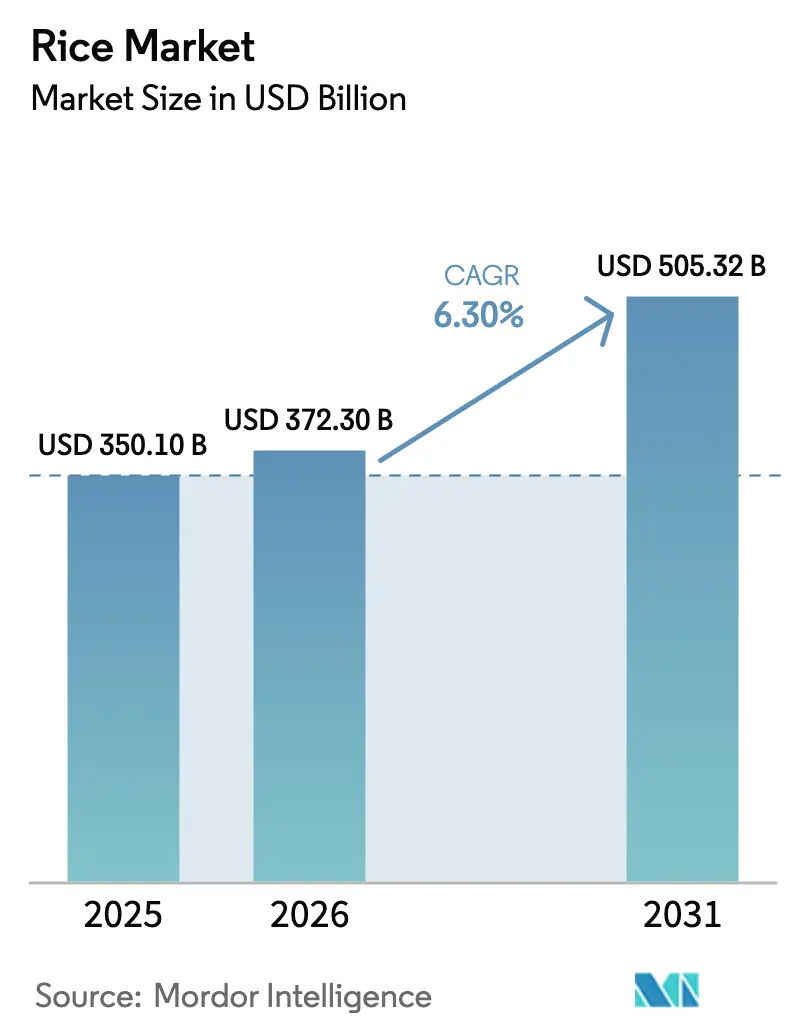
The rice market size was valued at USD 350.10 billion in 2025 and is estimated to grow from USD 372.30 billion in 2026 to USD 505.32 billion by 2031, registering a CAGR of 6.30% during the forecast period (2026–2031). The Asia–Pacific region maintains its leadership position through price-support policies, widespread adoption of hybrid seeds, and premiumization in urban centers. Africa is emerging as the fastest-growing demand hub as governments pursue import substitution while per-capita consumption rises. Carbon-credit monetization, blockchain-based traceability, and expanding industrial uses for broken rice collectively enhance revenue potential, even as water scarcity, labor shortages, and residue-limit compliance increase operating costs. Supply security remains fragile because export bans and climate shocks move prices sharply, motivating buyers to diversify sourcing and reward suppliers with resilient logistics and sustainability credentials.
Key Report Takeaways
- By geography, the Asia–Pacific region led with 56.8% of the rice market share in 2025, while Africa is projected to grow at a 6.8% CAGR through 2031.
Note: Market size and forecast figures in this report are generated using Mordor Intelligence’s proprietary estimation framework, updated with the latest available data and insights as of January 2026.
Global Rice Market Trends and Insights
Drivers Impact Analysis*
| Driver | (~) % Impact on CAGR Forecast | Geographic Relevance | Impact Timeline |
|---|---|---|---|
| Rising demand among urban middle-income consumers | +0.9% | Asia–Pacific core, spillover to Middle East and Africa | Medium term (2–4 years) |
| Government price-support and input subsidy programs | +1.2% | India, Thailand, Vietnam, and Philippines | Long term (≥ 4 years) |
| Adoption of hybrid and high-yield varieties | +1.1% | Asia–Pacific, South America, emerging in Sub-Saharan Africa | Long term (≥ 4 years) |
| Expanding broken-rice use in animal feed and brewing | +0.6% | Asia–Pacific and North America | Medium term (2–4 years) |
| Monetization of paddy-field methane credits | +0.5% | Vietnam, Thailand, and Philippines | Long term (≥ 4 years) |
| Blockchain-based rice traceability boosting export premiums | +0.4% | Vietnam and Thailand export corridors | Medium term (2–4 years) |
| Source: Mordor Intelligence | |||
Rising Demand among Urban Middle-Income Consumers
Premium long-grain, basmati, and jasmine command 20%–40% margins over standard milled rice as rising urban incomes shift preferences toward perceived quality and aroma. Basmati sales in India’s metropolitan supermarkets climbed year-on-year in 2024, while Thailand’s jasmine shipments to North America and Europe expanded in 2025[1]Source: Rice Market Information, " USDA Foreign Agricultural Service," fas.usda.gov. E-commerce accelerates this trend by easing home delivery and subscription models that build brand loyalty. Gulf states add incremental volume by catering to large expatriate populations that favor aromatic varieties. Because income elasticity remains high, volume growth is projected to persist even as mature economies flatten per-capita consumption.
Government Price-Support and Input Subsidy Programs
Minimum Support Price (MSP) frameworks, pledging schemes, and irrigation subsidies collectively stabilize farmer cash flows and encourage continued acreage despite volatile open-market rates. India lifted the MSP for common-grade paddy to INR 2,300 per quintal (USD 27.60 per quintal) for the 2024–2025 season and procured 52 million metric tons for the public distribution system[2]Source: Food Grain Bulletin, "Ministry of Consumer Affairs, Food and Public Distribution, India," dfpd.gov.in. Thailand’s modified pledging scheme ensures THB 15,000 per metric ton (USD 430 per metric ton) for white rice. Vietnam earmarked VND 12 trillion (USD 490 million) for irrigation upgrades. Although these outlays strain public budgets, they reduce the likelihood of abrupt supply contractions, underpinning steady 6.30% CAGR growth.
Adoption of Hybrid and High-Yield Varieties
Hybrid rice delivers 15%–25% yield gains over inbred cultivars, allowing producers to offset land and water constraints. China planted 16.5 million hectares of hybrid rice in 2024, equal to 47% of its total rice acreage. India’s National Food Security Mission distributed 1.2 million metric tons of certified hybrid seed in 2024, and the Philippines approved 12 drought-tolerant hybrids in 2025. Seed royalty revenues are rising for multinational input suppliers, yet adoption is tempered where farmers traditionally replant saved seed.
Expanding Broken-Rice Use in Animal Feed and Brewing
Feed formulators substitute broken rice to curb feed costs without sacrificing metabolizable energy, raising demand from integrators in Thailand and Vietnam. Charoen Pokphand Foods grew broken-rice purchases 22% in 2025 to displace 8% of corn in its poultry rations and achieved a 4% feed-cost saving[3]Source: CP Group, "Charoen Pokphand Foods Annual Report 2025," cpgroupglobal.com. Craft brewers in North America and Europe experiment with broken rice to produce lighter-bodied lagers, while Brazilian ethanol plants incorporate it during the sugarcane off-season. In Asia and South America, bioethanol facilities utilize broken rice as a primary source of carbohydrates to meet renewable fuel requirements, thereby expanding industrial demand in the rice market.
Restraints Impact Analysis*
| Restraint | (~) % Impact on CAGR Forecast | Geographic Relevance | Impact Timeline |
|---|---|---|---|
| Chronic water scarcity in major producing basins | -0.8% | Mekong Delta, Indo-Gangetic Plain, and emerging in Middle East | Long term (≥ 4 years) |
| Rising agriculture labor costs and rural out-migration | -0.6% | Asia–Pacific and South America | Medium term (2–4 years) |
| Tightening pesticide-residue limits | -0.4% | European Union and Japan enforcement corridors | Medium term (2–4 years) |
| Export bans by key suppliers | -0.5% | Originating in India, Vietnam, and Myanmar | Short term (≤ 2 years) |
| Source: Mordor Intelligence | |||
Chronic Water Scarcity in Major Producing Basins
Groundwater depletion and saltwater intrusion directly threaten the stability of yields. Vietnam’s Mekong Delta lost 120,000 hectares during the 2024 dry season, trimming winter-spring yields by 0.4 metric ton per hectare. India’s Punjab and Haryana record groundwater tables falling by 0.5 meters annually, prompting restrictions on planting. Reservoir levels in Thailand’s Chao Phraya basin hit 35% capacity in March 2025. Alternate Wetting and Drying (AWD) saves 25%–30% irrigation water, yet adoption remains below one-fifth of planted area because farmers fear yield penalties and lack extension support.
Rising Agriculture Labor Costs and Rural Out-Migration
Wage inflation raises the cost base and accelerates mechanization. The daily transplanting wage in Indian rice states reached INR 400 (USD 4.80) in 2025, 8% higher than in 2024. Thailand experienced a 6% wage increase as the construction and manufacturing sectors compete for labor. Vietnam’s Mekong Delta encountered a 12% harvest-time labor shortfall in 2025. Custom-hiring centers for transplanters and combine harvesters reduce per-hectare costs, but up-front machinery investments of USD 50,000–USD 100,000 limit access to larger farms and cooperatives.
*Our forecasts treat driver/restraint impacts as directional, not additive. The impact forecasts reflect baseline growth, mix effects, and variable interactions.
Geography Analysis
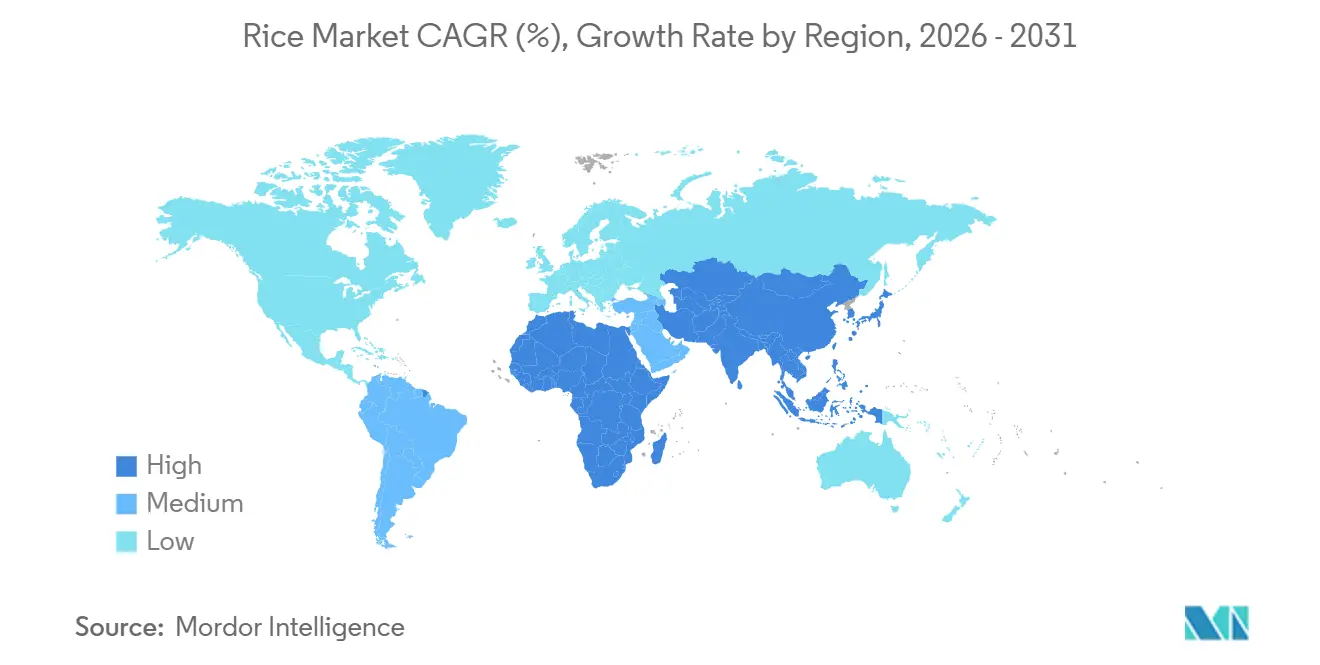
The Asia–Pacific region captured 56.8% of the rice market share in 2025, with production volumes exceeding demand and strong domestic consumption. Rising yields from the adoption of hybrid seeds and state procurement frameworks anchor the region’s output stability. China’s hybrid penetration reached 47% of the planted area, while India’s Minimum Support Price sustained acreage. Southeast Asia remains the key export theater, with Vietnam and Thailand shipping more than 15 million metric tons combined. Climate stress, particularly drought and salinity in the Mekong Delta, places a ceiling on future acreage expansion. The adoption of alternate wetting and drying, as well as blockchain traceability, continues to attract premium buyers in Europe and North America.
Africa, projected to grow at a CAGR of 6.8% during 2026–2031, represents the fastest-growing region, driven by increased government investment in irrigation infrastructure and hybrid seeds to reduce import dependence. Nigeria and Ghana remain significant importers, but anchor-borrower programs and continental free-trade integration aim to boost local milling capacity. North America, Europe, South America, and the Middle East together account for the residual share, each region characterized by either limited local production or differentiated demand for basmati, jasmine, and fortified products. The rice market size for Asia–Pacific is projected to expand through 2031, underlining the region’s continued dominance, while Africa’s rice market size is on track for double-digit growth in absolute value by the end of the decade.
Demand clusters vary across regions. Per-capita consumption exceeds 100 kilograms in Bangladesh, Vietnam, and Myanmar. It hovers near 70 kilograms in Sub-Saharan Africa, and averages below 15 kilograms in Europe. Premium segments such as basmati and jasmine find traction in urban Asian and Middle Eastern cities where aromatic preference drives repeat purchase. Broken rice, traditionally a byproduct, gains new value in North America where craft brewers seek cost-efficient adjuncts. Europe’s stringent residue limits filter supply toward exporters with robust laboratory infrastructure, while Africa’s import growth invites investment in port capacity and regional value chains.


Regulatory Landscape
Rice trade and farm economics remain closely shaped by government interventions across tariffs, quotas, and domestic support. In the European Union, Implementing Regulation (EU) 2026/527 adjusted the import duty for husked rice to EUR 30 per tonne, effective 6 March 2026, which directly affects landed costs for importers and exporter pricing into the bloc. The Philippines introduced a price-triggered rice import tariff adjustment mechanism in January 2026, linking quarterly tariff settings to international reference prices (including Vietnam 5% broken as a benchmark), adding a more responsive policy lever for balancing consumer inflation with producer protection.
At the multilateral level, rice continues to draw scrutiny under WTO disciplines, particularly around public stockholding and support programs. India invoked the WTO peace clause again in 2026 in connection with its public stockholding and farmer support for the 2024-25 period, highlighting ongoing friction between food security measures and subsidy limits. Trade remedies and import management tools also remain active, including Morocco notifying the WTO on 13 April 2026 about the initiation of a safeguard investigation on certain rice imports, and the United Kingdom administering rice import quota licensing through the Rural Payments Agency for the 2026 quota year (licenses valid 1 May 2026 to 31 December 2026).
Value Chain Analysis
The rice value chain covers input supply (seed, fertilizer, and crop protection), farm production, aggregation, milling (hulling, polishing, grading), and downstream packaging and distribution through wholesalers, modern retail, and e-commerce. Large agribusinesses such as Olam Agri and Wilmar International run integrated models across procurement, milling, ocean freight, and destination marketing, which helps them meet stricter buyer requirements for traceability and consistent quality. Smallholder production remains widespread across Asia and Africa, keeping aggregation and quality standardization (moisture control, head-rice yield, and residue compliance) central to competitiveness.
Operational bottlenecks increasingly show up in logistics and post-harvest handling rather than farm output alone. In 2026, shipping and routing disruptions extended transit times for exports from the Mekong Delta to global markets, while packaging availability (for example, polypropylene bags) and inland transport costs influenced delivered prices. Governments are also adding visibility and inventory tools to curb volatility, illustrated by Japan passing a rice supply stabilization bill in July 2026 that requires inventory reporting by food processors and sets a private-sector stockpiling framework, tightening the link between downstream demand signals and upstream supply planning.
Competitive Landscape
The rice market is fragmented, with agribusinesses such as Olam Agri and Wilmar International overseeing end-to-end chains that span farm procurement, milling, ocean freight, and destination marketing. This integration allows them to spread fixed costs and meet the stringent traceability rules demanded by European and North American buyers. Olam’s 2024 merger with Louis Dreyfus Company created a USD 40 billion revenue platform that pools origination hubs across Nigeria, Vietnam, and Thailand, and is projected to yield USD 200 million in annual logistics and procurement savings.
Regional specialists dominate premium basmati and jasmine segments. LT Foods and KRBL together capture approximately 40% of global basmati exports by leveraging their strong retail brands, India Gate and Daawat, and investing in blockchain systems that certify age, aroma, and pesticide compliance, enabling price premiums of 20%–30% in the Middle East and Europe. Thai millers focus on jasmine varieties, and their exporters now bundle Sustainable Rice Platform certificates with blockchain data to maintain market access under the European Union Deforestation Regulation. Competitive intensity is rising as new entrants adopt precision farming and direct-seeding technologies that trim input costs while meeting residue limits.
White-space opportunities revolve around fortified kernels for public food programs, low-glycemic offerings for health-conscious shoppers, and by-product valorization in rice bran oil and protein concentrates. India’s nationwide fortification mandate lifted demand for 15 million metric tons of premix in 2025, opening a USD 300 million ingredient market. SunRice capitalized on the wellness trend with its low-glycemic line that commands a 5% retail premium in Australia and export destinations. Patent filings on drought-tolerant and saline-resistant germplasm climbed in 2024, led by the International Rice Research Institute and national research partners, while e-commerce platforms such as BigBasket in India and Lazada in Thailand reported 25% year-on-year rice sales growth by bypassing wholesale channels and capturing retail margins.
Market Opportunities and Future Outlook
Investment in modern milling and post-harvest infrastructure is opening whitespace for higher-value, quality-led rice supply, especially where automated drying and packaging reduce losses and improve consistency for premium and export channels. In Vietnam, ThaiBinh Seed Group JSC began construction in April 2026 of a VND 1 trillion rice processing complex designed for 50,000 tons per year with automated, closed-loop drying, milling, and packaging, reflecting a move toward industrial-scale quality management. In the Philippines, the Department of Agriculture advanced a nationwide rollout program for mechanical drying systems in July 2026, targeting additional palay drying capacity per cropping cycle, which supports higher milling recovery and reduces weather-related quality degradation.
Seed system and climate resilience programs are also expanding demand for hybrid seed, mechanization services, and extension-linked inputs across emerging import-substitution markets, particularly in Africa. The African Development Bank and AfricaRice launched the USD 8.5 million REWARD-AfricaRice program in February 2026 across 14 West African countries to strengthen seed production, processing technologies, and climate-resilient practices through 2029, and South Korea reported in May 2026 that the K-Ricebelt project produced 6,365 tonnes of high-quality rice seeds in 2025 across seven African countries, exceeding its annual target. On the sustainability and efficiency track, Rice House Smart Agri expanded commercial deployment of AI-Green Rice technology across 180 hectares in Taiwan in June 2026 to optimize Alternate Wetting and Drying using AI-based analysis, reinforcing opportunities linked to water-saving cultivation, methane-reduction pathways, and differentiated low-carbon supply for buyers seeking traceability.
Recent Industry Developments
- July 2026: AgriCapture partnered with Isometric to certify and commercialize rice methane reduction credits from a multi-country Southeast Asia project. The collaboration strengthens measurement and verification infrastructure around rice carbon credits, enabling producers and supply-chain participants to monetize emissions reductions and support sustainability-linked procurement.
- September 2025: LT Foods Limited completed the acquisition of Dainty Foods, a Canadian rice brand, for CAD 80 million (USD 59 million). The deal expands LT Foods distribution in North America and is paired with plans for a 250,000-square-foot facility in the United States to serve the US market while maintaining the Windsor operation for Canada.
- April 2024: India increased the Minimum Support Price for common-grade paddy to INR 2,300 per quintal for the 2024-2025 season and maintained large-scale procurement for public distribution. The policy action anchored farmer pricing and availability for domestic channels, while also influencing exportable surplus and global price sensitivity during periods of trade restriction and climate stress.


Research Methodology Framework and Report Scope
Market Definition and Coverage
For this study, the rice market is defined as the value of rice sold for food use, covering paddy converted into edible rice (such as white, brown, and parboiled) and tracked through farm-gate to wholesale level across major producing and consuming countries.
Scope exclusions: We exclude rice-based snacks, rice-derived ingredients (such as syrups or protein), seed sales, and rice volumes primarily meant for feed or industrial starch.
Segmentation Overview
-
By Geography
-
North America
-
United States
- Production Analysis (Area Harvested, Yield, and Production Volume)
- Consumption Analysis (Consumption Value and Volume)
- Import Market Analysis (Import Value, Volume, and Key Supplying Markets)
- Export Market Analysis (Export Value, Volume, and Key Destination Markets)
- Wholesale Price Trend Analysis and Forecast
- Regulatory Framework
- List of Key Players
- Logistics and Infrastructure
- Seasonality Analysis
-
Canada
- Production Analysis (Area Harvested, Yield, and Production Volume)
- Consumption Analysis (Consumption Value and Volume)
- Import Market Analysis (Import Value, Volume, and Key Supplying Markets)
- Export Market Analysis (Export Value, Volume, and Key Destination Markets)
- Wholesale Price Trend Analysis and Forecast
- Regulatory Framework
- List of Key Players
- Logistics and Infrastructure
- Seasonality Analysis
-
Mexico
- Production Analysis (Area Harvested, Yield, and Production Volume)
- Consumption Analysis (Consumption Value and Volume)
- Import Market Analysis (Import Value, Volume, and Key Supplying Markets)
- Export Market Analysis (Export Value, Volume, and Key Destination Markets)
- Wholesale Price Trend Analysis and Forecast
- Regulatory Framework
- List of Key Players
- Logistics and Infrastructure
- Seasonality Analysis
-
United States
-
Europe
-
Russia
- Production Analysis (Area Harvested, Yield, and Production Volume)
- Consumption Analysis (Consumption Value and Volume)
- Import Market Analysis (Import Value, Volume, and Key Supplying Markets)
- Export Market Analysis (Export Value, Volume, and Key Destination Markets)
- Wholesale Price Trend Analysis and Forecast
- Regulatory Framework
- List of Key Players
- Logistics and Infrastructure
- Seasonality Analysis
-
Germany
- Production Analysis (Area Harvested, Yield, and Production Volume)
- Consumption Analysis (Consumption Value and Volume)
- Import Market Analysis (Import Value, Volume, and Key Supplying Markets)
- Export Market Analysis (Export Value, Volume, and Key Destination Markets)
- Wholesale Price Trend Analysis and Forecast
- Regulatory Framework
- List of Key Players
- Logistics and Infrastructure
- Seasonality Analysis
-
Italy
- Production Analysis (Area Harvested, Yield, and Production Volume)
- Consumption Analysis (Consumption Value and Volume)
- Import Market Analysis (Import Value, Volume, and Key Supplying Markets)
- Export Market Analysis (Export Value, Volume, and Key Destination Markets)
- Wholesale Price Trend Analysis and Forecast
- Regulatory Framework
- List of Key Players
- Logistics and Infrastructure
- Seasonality Analysis
-
Spain
- Production Analysis (Area Harvested, Yield, and Production Volume)
- Consumption Analysis (Consumption Value and Volume)
- Import Market Analysis (Import Value, Volume, and Key Supplying Markets)
- Export Market Analysis (Export Value, Volume, and Key Destination Markets)
- Wholesale Price Trend Analysis and Forecast
- Regulatory Framework
- List of Key Players
- Logistics and Infrastructure
- Seasonality Analysis
-
France
- Production Analysis (Area Harvested, Yield, and Production Volume)
- Consumption Analysis (Consumption Value and Volume)
- Import Market Analysis (Import Value, Volume, and Key Supplying Markets)
- Export Market Analysis (Export Value, Volume, and Key Destination Markets)
- Wholesale Price Trend Analysis and Forecast
- Regulatory Framework
- List of Key Players
- Logistics and Infrastructure
- Seasonality Analysis
-
Russia
-
Asia-Pacific
-
China
- Production Analysis (Area Harvested, Yield, and Production Volume)
- Consumption Analysis (Consumption Value and Volume)
- Import Market Analysis (Import Value, Volume, and Key Supplying Markets)
- Export Market Analysis (Export Value, Volume, and Key Destination Markets)
- Wholesale Price Trend Analysis and Forecast
- Regulatory Framework
- List of Key Players
- Logistics and Infrastructure
- Seasonality Analysis
-
India
- Production Analysis (Area Harvested, Yield, and Production Volume)
- Consumption Analysis (Consumption Value and Volume)
- Import Market Analysis (Import Value, Volume, and Key Supplying Markets)
- Export Market Analysis (Export Value, Volume, and Key Destination Markets)
- Wholesale Price Trend Analysis and Forecast
- Regulatory Framework
- List of Key Players
- Logistics and Infrastructure
- Seasonality Analysis
-
Bangladesh
- Production Analysis (Area Harvested, Yield, and Production Volume)
- Consumption Analysis (Consumption Value and Volume)
- Import Market Analysis (Import Value, Volume, and Key Supplying Markets)
- Export Market Analysis (Export Value, Volume, and Key Destination Markets)
- Wholesale Price Trend Analysis and Forecast
- Regulatory Framework
- List of Key Players
- Logistics and Infrastructure
- Seasonality Analysis
-
Indonesia
- Production Analysis (Area Harvested, Yield, and Production Volume)
- Consumption Analysis (Consumption Value and Volume)
- Import Market Analysis (Import Value, Volume, and Key Supplying Markets)
- Export Market Analysis (Export Value, Volume, and Key Destination Markets)
- Wholesale Price Trend Analysis and Forecast
- Regulatory Framework
- List of Key Players
- Logistics and Infrastructure
- Seasonality Analysis
-
Vietnam
- Production Analysis (Area Harvested, Yield, and Production Volume)
- Consumption Analysis (Consumption Value and Volume)
- Import Market Analysis (Import Value, Volume, and Key Supplying Markets)
- Export Market Analysis (Export Value, Volume, and Key Destination Markets)
- Wholesale Price Trend Analysis and Forecast
- Regulatory Framework
- List of Key Players
- Logistics and Infrastructure
- Seasonality Analysis
-
Philippines
- Production Analysis (Area Harvested, Yield, and Production Volume)
- Consumption Analysis (Consumption Value and Volume)
- Import Market Analysis (Import Value, Volume, and Key Supplying Markets)
- Export Market Analysis (Export Value, Volume, and Key Destination Markets)
- Wholesale Price Trend Analysis and Forecast
- Regulatory Framework
- List of Key Players
- Logistics and Infrastructure
- Seasonality Analysis
-
Cambodia
- Production Analysis (Area Harvested, Yield, and Production Volume)
- Consumption Analysis (Consumption Value and Volume)
- Import Market Analysis (Import Value, Volume, and Key Supplying Markets)
- Export Market Analysis (Export Value, Volume, and Key Destination Markets)
- Wholesale Price Trend Analysis and Forecast
- Regulatory Framework
- List of Key Players
- Logistics and Infrastructure
- Seasonality Analysis
-
Myanmar
- Production Analysis (Area Harvested, Yield, and Production Volume)
- Consumption Analysis (Consumption Value and Volume)
- Import Market Analysis (Import Value, Volume, and Key Supplying Markets)
- Export Market Analysis (Export Value, Volume, and Key Destination Markets)
- Wholesale Price Trend Analysis and Forecast
- Regulatory Framework
- List of Key Players
- Logistics and Infrastructure
- Seasonality Analysis
-
China
-
South America
-
Brazil
- Production Analysis (Area Harvested, Yield, and Production Volume)
- Consumption Analysis (Consumption Value and Volume)
- Import Market Analysis (Import Value, Volume, and Key Supplying Markets)
- Export Market Analysis (Export Value, Volume, and Key Destination Markets)
- Wholesale Price Trend Analysis and Forecast
- Regulatory Framework
- List of Key Players
- Logistics and Infrastructure
- Seasonality Analysis
-
Argentina
- Production Analysis (Area Harvested, Yield, and Production Volume)
- Consumption Analysis (Consumption Value and Volume)
- Import Market Analysis (Import Value, Volume, and Key Supplying Markets)
- Export Market Analysis (Export Value, Volume, and Key Destination Markets)
- Wholesale Price Trend Analysis and Forecast
- Regulatory Framework
- List of Key Players
- Logistics and Infrastructure
- Seasonality Analysis
-
Peru
- Production Analysis (Area Harvested, Yield, and Production Volume)
- Consumption Analysis (Consumption Value and Volume)
- Import Market Analysis (Import Value, Volume, and Key Supplying Markets)
- Export Market Analysis (Export Value, Volume, and Key Destination Markets)
- Wholesale Price Trend Analysis and Forecast
- Regulatory Framework
- List of Key Players
- Logistics and Infrastructure
- Seasonality Analysis
-
Colombia
- Production Analysis (Area Harvested, Yield, and Production Volume)
- Consumption Analysis (Consumption Value and Volume)
- Import Market Analysis (Import Value, Volume, and Key Supplying Markets)
- Export Market Analysis (Export Value, Volume, and Key Destination Markets)
- Wholesale Price Trend Analysis and Forecast
- Regulatory Framework
- List of Key Players
- Logistics and Infrastructure
- Seasonality Analysis
-
Brazil
-
Middle East
-
Iran
- Production Analysis (Area Harvested, Yield, and Production Volume)
- Consumption Analysis (Consumption Value and Volume)
- Import Market Analysis (Import Value, Volume, and Key Supplying Markets)
- Export Market Analysis (Export Value, Volume, and Key Destination Markets)
- Wholesale Price Trend Analysis and Forecast
- Regulatory Framework
- List of Key Players
- Logistics and Infrastructure
- Seasonality Analysis
-
United Arab Emirates
- Production Analysis (Area Harvested, Yield, and Production Volume)
- Consumption Analysis (Consumption Value and Volume)
- Import Market Analysis (Import Value, Volume, and Key Supplying Markets)
- Export Market Analysis (Export Value, Volume, and Key Destination Markets)
- Wholesale Price Trend Analysis and Forecast
- Regulatory Framework
- List of Key Players
- Logistics and Infrastructure
- Seasonality Analysis
-
Iran
-
Africa
-
Nigeria
- Production Analysis (Area Harvested, Yield, and Production Volume)
- Consumption Analysis (Consumption Value and Volume)
- Import Market Analysis (Import Value, Volume, and Key Supplying Markets)
- Export Market Analysis (Export Value, Volume, and Key Destination Markets)
- Wholesale Price Trend Analysis and Forecast
- Regulatory Framework
- List of Key Players
- Logistics and Infrastructure
- Seasonality Analysis
-
Kenya
- Production Analysis (Area Harvested, Yield, and Production Volume)
- Consumption Analysis (Consumption Value and Volume)
- Import Market Analysis (Import Value, Volume, and Key Supplying Markets)
- Export Market Analysis (Export Value, Volume, and Key Destination Markets)
- Wholesale Price Trend Analysis and Forecast
- Regulatory Framework
- List of Key Players
- Logistics and Infrastructure
- Seasonality Analysis
-
South Africa
- Production Analysis (Area Harvested, Yield, and Production Volume)
- Consumption Analysis (Consumption Value and Volume)
- Import Market Analysis (Import Value, Volume, and Key Supplying Markets)
- Export Market Analysis (Export Value, Volume, and Key Destination Markets)
- Wholesale Price Trend Analysis and Forecast
- Regulatory Framework
- List of Key Players
- Logistics and Infrastructure
- Seasonality Analysis
-
Nigeria
-
North America
Data Sources, Market Sizing, and Validation
Desk Research
Desk work starts with mapping supply, demand, and trade so the size model has a real-world anchor. We mainly relied on public agriculture and trade statistics such as FAOSTAT, USDA PSD, UN Comtrade, national agriculture ministries, and customs or port authority releases, which help us track production, imports, exports, and apparent consumption.
To convert volumes into value, pricing context was pulled from sources such as IMF commodity price series, official procurement or support price releases where available, and reputable press coverage of export tender prices. Company annual reports, investor presentations, and association websites were also used to understand milling rates, product mix shifts, and procurement behavior. In a few cases, paid subscriptions that track company financials, patents, and shipment-level trade flows were used to sanity-check public figures. These desk sources are not exhaustive, and we reviewed additional references to support data collection, validation, and clarification.
Primary Interviews and Surveys
Primary work was used to pressure-test the desk assumptions and fill gaps that are hard to resolve using statistics alone, especially around milling conversion, channel pricing, and regional mix. We spoke with a mix of growers, millers, traders, distributors, and large buyers, then revisited experts when price shocks or policy moves created unusual swings.
Because this is a global market, we validated inputs across key production and import corridors, so regional trade flows and price spreads could be reconciled to the same time window.
Distribution of primary research fieldwork respondents
| Company type | Respondent position | Region |
|---|---|---|
| Top tier: 27% | CXOs: 16% | APAC: 46% |
| Mid tier: 54% | Functional/Unit leaders: 38% | EMEA: 34% |
| Smaller Players: 19% | Managers: 46% | Americas: 20% |
Market-Sizing & Forecasting
Sizing is built using a top-down approach where production, imports, exports, and stock changes are reconstructed into an edible rice demand pool, which is then valued using observed wholesale price bands and conversion ratios from paddy to milled rice. The totals are then corroborated with selective bottom-up approximations, such as sampled country-level volumes multiplied by typical wholesale prices, plus channel checks from traders and large buyers.
A few inputs materially shape the model include paddy output and milling yields, import dependency by country, exportable surplus from major origins, wholesale price spreads between origins and destination markets, and policy indicators like procurement prices, export restrictions, and tariff changes. When a country has limited disclosed pricing, price proxies are created from nearby trade benchmarks and adjusted using interview-based discount or premium factors.
For the forecast, scenario analysis is used so demand and price can be flexed under different policy and weather conditions, followed by a base case that aligns with expert expectations on acreage, yield normalization, and trade policy stability. Where bottom-up evidence is thin, gaps are handled through regional peer comparisons and then re-checked against the implied per-capita consumption range before the final view is locked.
Data Validation & Update Cycle
Validation is done by comparing the modeled value totals against independent signals such as export unit values, reported procurement volumes, and major import tender activity, and then checking if the implied consumption direction matches the supply and trade story. Outliers are reviewed in multiple steps, starting with unit consistency checks, followed by currency timing checks, and then a final analyst review before sign-off.
The report is refreshed annually, and interim updates are triggered when material events occur, such as major export bans, sharp currency moves in key trade corridors, or large harvest shocks. Before delivery, we run a fresh pass on key inputs and assumptions so the published market size reflects the latest available data.
Mordor Intelligence's Rice Market Sizing Compared With Other Published Estimates
Published rice market values can differ even when the topic label looks the same, because the counted price point, processing stage, and year alignment are not consistent across publishers. The spread usually comes from whether the estimate is tied to wholesale transactions, includes retail markups, or mixes paddy and milled values in one number.
Some external estimates present milled rice value as a nominal wholesale revenue pool in a single year, and others provide a market value tied to a different base year and pricing cycle. In Mordor Intelligence, the rice total is modeled as edible rice value tracked from farm-gate through wholesale, and then rice-based ingredients, seed sales, and non-food uses are kept out so volumes and prices stay comparable across countries.
Benchmark comparison
| Source | Market Size | Gaps in Research Methodology |
|---|---|---|
| Mordor Intelligence | USD 350.10 B (2025) | |
| Industry Data Publisher A | USD 472.80 B (2024) | Uses a nominal wholesale revenue construct for producers and importers in 2024, which can diverge from constant-dollar modeling and from a 2025 time window when price levels and trade flows shift. |
| Global Research Firm B | USD 311.23 B (2024) | Reported number is anchored to a 2024 base year with limited clarity on whether it is paddy-equivalent, milled-only, or blended across channels, which can pull totals down when conversion yields and price points are not normalized. |
The table mainly shows that timing and price point choices drive a large part of the gap, and then scope rules decide the rest. When the same year, currency basis, and processing stage are aligned, the remaining difference typically comes down to whether non-food and ingredient adjacencies are counted. Those items were kept separate so the final total stays traceable to production, trade, and wholesale price signals.


Key Questions Answered in the Report
What is the projected size of the rice market by 2031?
The rice market is estimated at USD 372.30 billion in 2026 and is forecast to reach USD 505.32 billion by 2031, growing at a CAGR of 6.3% during the forecast period 2026–2031.
Which region dominates global demand?
Asia-Pacific commanded 56.8% of 2025 demand due to large production bases in China, India, and Southeast Asia.
Why is Africa considered a high-growth region?
Rising per-capita consumption and government-backed import-substitution programs are pushing Africa toward a 6.8% CAGR through 2031.
What role do sustainability initiatives play?
Alternate wetting and drying irrigation allows farmers to earn methane-reduction credits that add new revenue while satisfying corporate emission goals.
Page last updated on:


 Your data is secure and never sold or shared.


