
Von Willebrand Disease Treatment Market Size and Share
Market Overview
| Study Period | 2020 - 2031 |
|---|---|
| Market Size (2026) | USD 2.55 Billion |
| Market Size (2031) | USD 3.44 Billion |
| Growth Rate (2026 - 2031) | 6.15 % |
| Fastest Growing Market | Asia Pacific |
| Largest Market | North America |
| Market Concentration | Medium |
Major Players *Disclaimer: Major Players sorted in no particular order Image © Mordor Intelligence. Reuse requires attribution under CC BY 4.0. | |
Von Willebrand Disease Treatment Market Analysis by Mordor Intelligence
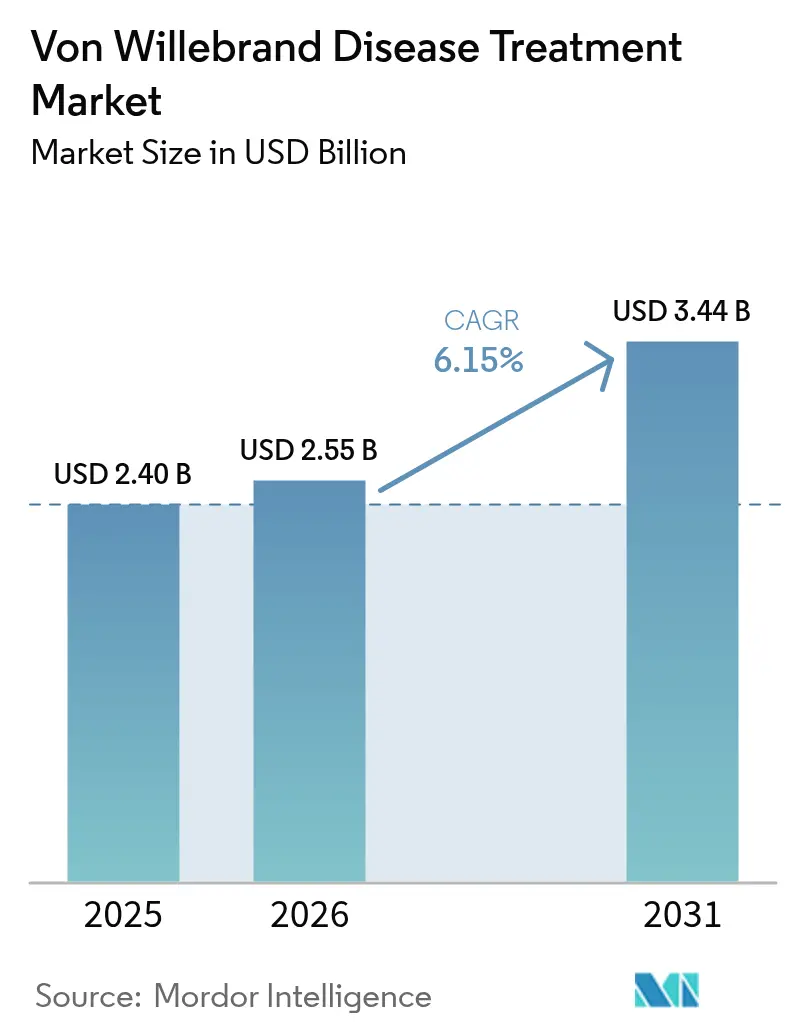
The Von Willebrand disease treatment market size was valued at USD 2.40 billion in 2025 and estimated to grow from USD 2.55 billion in 2026 to reach USD 3.44 billion by 2031, at a CAGR of 6.15% during the forecast period (2026-2031). Uptake of curative gene therapies, rapid adoption of AI-supported diagnostics, and payer acceptance of value-based reimbursement are accelerating revenue growth, while hospital formularies increasingly favor recombinant, pathogen-free concentrates over plasma-derived options. Expansion of federal patient-assistance schemes in North America, wider newborn genetic screening in Asia-Pacific, and fast-track review of subcutaneous desmopressin nano-formulations also deepen addressable demand. Gene therapies such as Pfizer’s BEQVEZ and CSL Behring’s HEMGENIX, both cleared in 2024–2025, create the prospect of one-time interventions that reduce lifelong factor consumption. Despite strong momentum, the Von Willebrand disease treatment market still contends with under-diagnosis in low-income geographies, high upfront gene-therapy costs, and temperature-sensitive supply chains for plasma products.
Key Report Takeaways
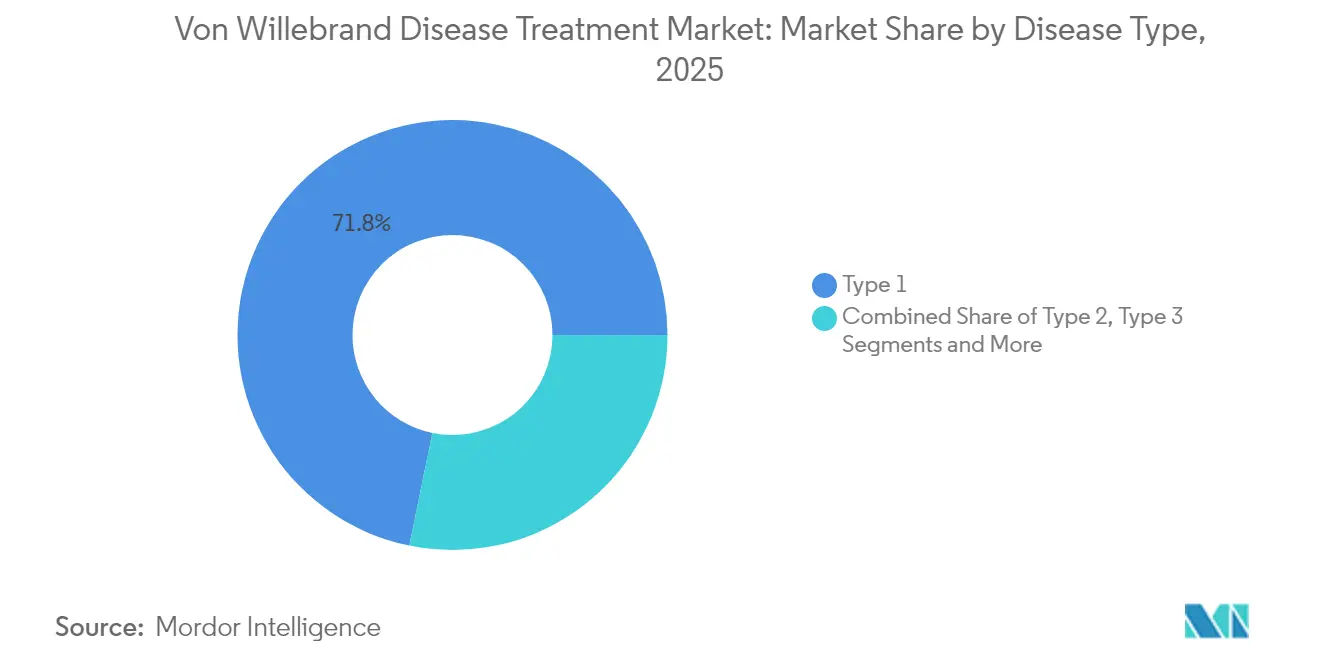
- By disease type, Type 1 held 71.78% of the Von Willebrand disease market share in 2025; Acquired VWD is forecast to grow at 10.78% CAGR to 2031.
- By treatment type, VWF/FVIII combination concentrates led with 46.02% revenue share in 2025; recombinant VWF-only concentrates are expanding at a 13.05% CAGR through 2031.
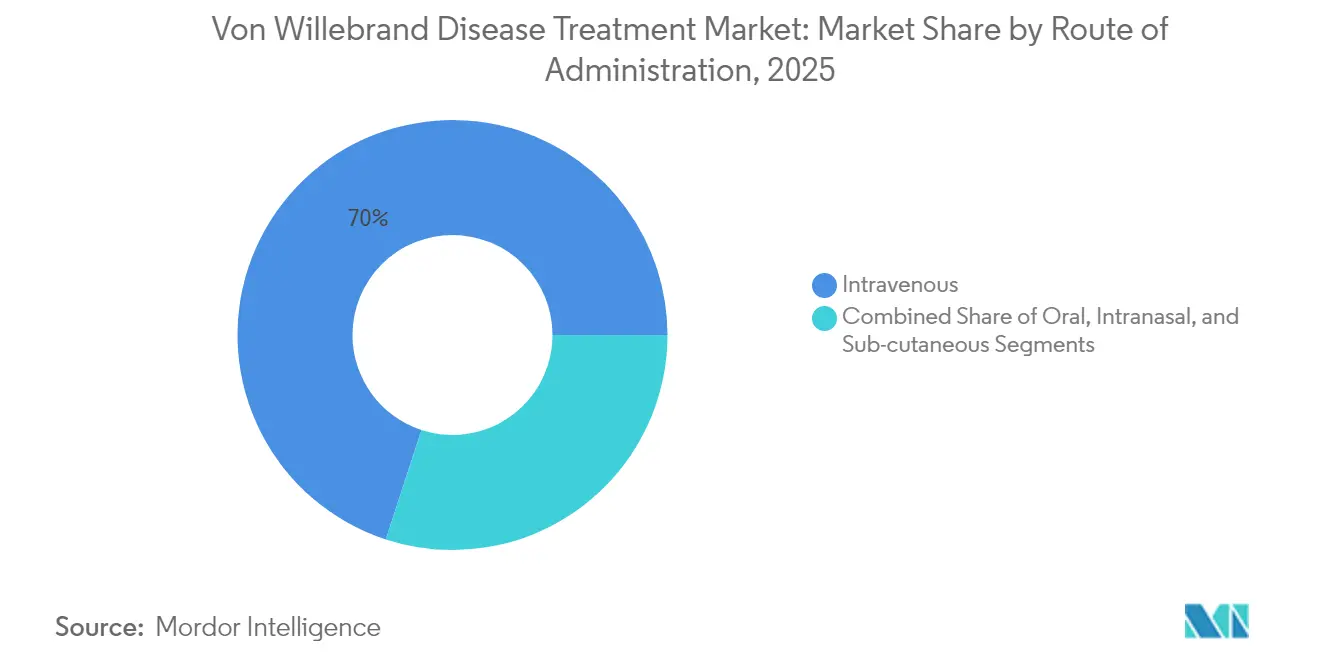
- By route of administration, intravenous therapy commanded 69.98% of the Von Willebrand disease market size in 2025, whereas subcutaneous delivery is rising at 12.78% CAGR to 2031.
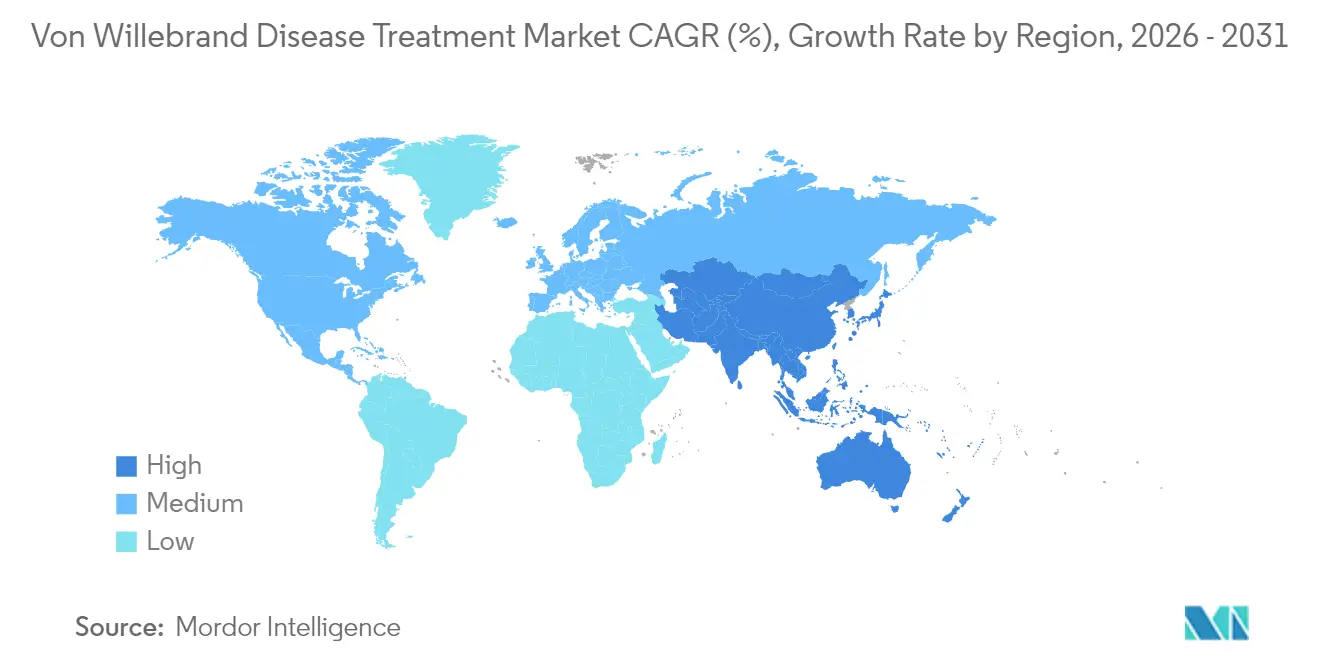
- By geography, North America accounted for 38.36% share in 2025; Asia-Pacific shows the fastest regional CAGR at 10.12% through 2031.
Note: Market size and forecast figures in this report are generated using Mordor Intelligence’s proprietary estimation framework, updated with the latest available data and insights as of 2026.
Market Trends and Insights
Drivers Impact Analysis of Von Willebrand Disease Treatment Market*
| Driver | (~) % Impact on CAGR Forecast | Geographic Relevance | Impact Timeline |
|---|---|---|---|
| Growing Patient-Assistance & Charitable-Access Schemes | +0.8% | Global, with concentration in North America & EU | Medium term (2-4 years) |
| Rising Diagnosis From Wider Prophylactic Genetic Screening | +1.2% | APAC core, spill-over to MEA | Long term (≥ 4 years) |
| Increasing Hospital Adoption Of Recombinant VWF-Only Concentrates | +0.9% | North America & EU, expanding to APAC | Short term (≤ 2 years) |
| FDA Fast-Track For Sub-Cutaneous DDAVP Nano-Formulations | +0.6% | Global regulatory harmonization | Medium term (2-4 years) |
| Surge In Pay-For-Performance Hemophilia Centers Bundling VWD Care | +0.7% | North America, pilot programs in EU | Short term (≤ 2 years) |
| AI-Enabled Bleeding-Risk Decision Engines Integrated In EHRs | +0.5% | North America & EU, selective APAC markets | Long term (≥ 4 years) |
| Source: Mordor Intelligence | |||
Growing Patient-Assistance & Charitable-Access Schemes
Federal funding for 141 Hemophilia Treatment Centers lets providers dispense discounted factor products under the 340B program, reducing out-of-pocket costs and improving adherence[1]National Bleeding Disorders Foundation, “Federal Programs for People with Bleeding Disorders,” bleeding.org. State action, such as California’s All Copays Count law, further lowers financial hurdles, while CMS has steadily raised the clotting-factor furnishing fee, ensuring predictable reimbursement. These measures make therapies accessible to underserved patients, sustaining demand across the Von Willebrand disease treatment market. Replication of this multi-stakeholder model in Europe and emerging economies is expected to widen global reach. Charitable foundations also finance prophylaxis for uninsured adults, boosting treatment volume.
Rising Diagnosis From Wider Prophylactic Genetic Screening
Countries adding dried-blood-spot biomarker panels to newborn screening achieve 95% detection accuracy for bleeding disorders that routine tests miss. Asia-Pacific health ministries are scaling similar programs, doubling the recognized VWD population in pilot provinces. Sweden’s inclusion of NT-proBNP and IL-1 RL1 biomarkers illustrates how early detection shifts identification to infancy, prompting timely intervention and enlarging the Von Willebrand disease treatment market. Together with ATHN’s natural-history registry, real-world outcome data now drives payer coverage for proactive treatments. The diagnostic surge builds a stable pipeline of patients requiring lifelong or curative therapies.
Increasing Hospital Adoption Of Recombinant VWF-Only Concentrates
Hospital formularies favor recombinant concentrates because they eliminate blood-borne pathogen risk and show superior multimeric composition recovery, especially in Type 2A cases. FDA expansion of wilate for universal prophylaxis and its 2025 orphan-drug exclusivity accelerate uptake[2]Octapharma USA, “FDA Grants Orphan Drug Exclusivity to wilate,” octapharma.com. Value-based contracts reward reduced emergency visits, so hospitals prioritize agents with 94% bleed-prevention efficacy. As bundled-payment models proliferate, recombinant products win preferred status, enlarging revenue within the Von Willebrand disease treatment market.
FDA Fast-Track For Sub-Cutaneous DDAVP Nano-Formulations
GC Biopharma’s GC1130A secured fast-track review in 2024, signaling regulator commitment to formulations that enhance dosing precision and patient acceptance. Subcutaneous nano-particles promise controlled release that reduces tachyphylaxis and lengthens dosing intervals. Pediatric acceptance rises because injections bypass the discomfort of nasal sprays, while pharmacokinetic modeling supports individualized regimens. When cleared, these assets will reduce hospital chair time and reinforce adherence, adding fresh momentum to the Von Willebrand disease treatment market.
Restraints Impact Analysis of Von Willebrand Disease Treatment Market*
| Restraint | (~) % Impact on CAGR Forecast | Geographic Relevance | Impact Timeline |
|---|---|---|---|
| Persistent Under-Diagnosis In Low-Income Geographies | -1.1% | Sub-Saharan Africa, South Asia, Latin America | Long term (≥ 4 years) |
| High Lifetime Therapy Cost Despite Biosimilar Entries | -0.8% | Global, acute in emerging markets | Medium term (2-4 years) |
| Limited Cold-Chain Capacity For Plasma-Derived Products In Africa | -0.4% | Sub-Saharan Africa, selective MEA markets | Medium term (2-4 years) |
| Regulatory Uncertainty Around Gene-Editing Trials For VWD | -0.3% | Global, regulatory harmonization pending | Long term (≥ 4 years) |
| Source: Mordor Intelligence | |||
Persistent Under-Diagnosis In Low-Income Geographies
Many developing countries identify fewer than 10% of expected cases, curbing demand growth for therapies. Limited laboratory capacity, scarce coagulation reagents, and low clinician awareness mean VWD symptoms are often misattributed to gynecological or infectious conditions. Investment priorities favor communicable diseases, delaying introduction of specialist diagnostics. International donor partnerships remain small-scale, so coverage gaps are unlikely to close quickly, weighing on the global Von Willebrand disease treatment market.
High Lifetime Therapy Cost Despite Biosimilar Entries
Gene therapies are priced at USD 3.5 million per dose in the United States, generating budget shock for payers despite long-term cost offsets. In Brazil, median annual expenditure for hemophilia A therapy exceeds USD 90,000 equivalent, indicating affordability concerns even in universal healthcare systems. Insurers impose step-therapy rules and prior authorizations that delay treatment initiation. Out-of-pocket requirements erode adherence and can lead to costly bleed-related complications, dampening uptake across the Von Willebrand disease treatment market.
*Our forecasts treat driver/restraint impacts as directional, not additive. The impact forecasts reflect baseline growth, mix effects, and variable interactions.
Von Willebrand Disease Treatment Market Segment Analysis
By Disease Type:
Type 1 Dominance Drives Market StabilityType 1 VWD generated 71.78% of global revenue in 2025, anchoring the Von Willebrand disease treatment market size for that year. Prevalent mild phenotypes rely on affordable desmopressin, sustaining predictable volumes. Acquired VWD, while smaller today, delivers the fastest expansion at 10.78% CAGR through 2031 as oncologists and cardiologists test patients pre-procedure. Type 2 sub-variants together add clinical complexity because they require concentrate prophylaxis; Type 2A cases especially benefit from recombinant VWF-only products that restore high-molecular-weight multimers, reducing annual bleed rate.
The severe but rare Type 3 cohort incurs disproportionate costs due to intensive factor infusions and orthopedic surgeries, highlighting reimbursement challenges in emerging economies. Long-term center experience shows persistent under-diagnosis across all types, prompting calls for registry expansion and payer support for genetic testing. Growing awareness of drug-induced VWD in aging populations further enlarges the Von Willebrand disease treatment market.



By Treatment Type:
Recombinant Innovation Challenges Traditional ConcentratesCombination VWF/FVIII concentrates retained 46.02% of revenue in 2025, reflecting broad clinical familiarity and dual factor coverage. Yet recombinant VWF-only lines are rising fast at 13.05% CAGR, signaling a decisive procurement shift. Hospitals seek pathogen-free products amid heightened pharmacovigilance, and value-based contracts incentivize bleed reduction, accelerating recombinant adoption in the Von Willebrand disease treatment market. Desmopressin remains key for Type 1 management, though nasal-spray adherence issues motivate investment in subcutaneous nano-formulations.
Antifibrinolytics such as tranexamic acid, alongside topical agents, provide adjunct control for mucosal bleeds. Curative gene therapies are emerging, following BEQVEZ proof-of-concept, and they could reset demand profiles by reducing recurrent concentrate use. Octapharma’s wilate prophylaxis label broadening forces competitors to demonstrate comparative efficacy, intensifying innovation within the Von Willebrand disease treatment market.
By Route of Administration:
Subcutaneous Innovation Transforms Patient ExperienceIntravenous infusion remained dominant with 69.98% share in 2025 because clinical protocols and infusion-center infrastructure are well established. However, subcutaneous delivery grows at 12.78% CAGR, reflecting demand for self-administration. Alhemo’s 2024 approval confirms daily subcutaneous prophylaxis can match IV efficacy, freeing patients from port-access hurdles. Intranasal DDAVP supports pediatric and mild cases, but variable absorption limits adult use. Oral antifibrinolytics remain supplemental, with research underway into oral desmopressin bio-enhancers that could further diversify options.
Patient-reported-outcome studies show higher satisfaction scores and lower missed-dose rates with subcutaneous regimens, implying a structural shift in the Von Willebrand disease treatment market. Controlled-release injections designed for weekly or monthly dosing aim to displace traditional IV prophylaxis in high-income geographies.
Geography Analysis
North America Von Willebrand Disease Treatment Market
North America contributed 38.36% of 2025 revenue, underpinned by 340B discounts and comprehensive treatment-center networks that guarantee product access. Gene therapy reimbursement frameworks emerge first in the United States, enabling earlier adoption and supporting premium pricing. Canada trails slightly due to provincial formulary reviews but benefits from centralized plasma procurement.
Europe Von Willebrand Disease Treatment Market
Europe exhibits high recombinant uptake as national payers demand virus-safe concentrates, yet stringent health-technology assessments delay some novel therapies. Western European markets negotiate risk-sharing deals for gene therapy, tying payment to sustained factor independence, which shapes purchasing dynamics in the Von Willebrand disease treatment market. Eastern Europe faces tighter budgets and slower diagnostic rollout, creating a two-tier landscape within the region.
APAC, South America and MEA Von Willebrand Disease Treatment Market
Asia-Pacific leads growth with a 10.12% CAGR through 2031 because regulators are streamlining review pathways and governments are investing in local manufacturing. China, India, and South-Korea expand newborn-screening panels and subsidize concentrate imports, driving double-digit volume gains. South America, notably Brazil, leverages centralized purchasing and clinical-protocol standardization to broaden access despite economic constraints. In contrast, Middle East and Africa progress is hampered by diagnostic and cold-chain deficits, although recombinant price declines could unlock latent demand later in the forecast.

Regulatory Landscape
Regulatory activity in von Willebrand disease (VWD) treatment centers on biologics oversight and label expansion for prophylaxis and pediatric use. In the United States, the FDA regulates VWD factor products under biologics pathways, and recent actions include the September 2025 FDA expansion for Takeda's VONVENDI to add routine prophylaxis in adults with Type 1 and Type 2 VWD and to broaden pediatric on-demand and perioperative use. This was followed by the July 2026 FDA approval expanding Octapharma's wilate prophylaxis indication to children younger than 6 years.
Across other major jurisdictions, regulators maintain stringent quality and comparability expectations for plasma-derived and recombinant products. In the European Union, clinical investigation of human plasma-derived VWF products is guided by EMA scientific guidance (CPMP/BPWG/220/02), supporting harmonized trial design and evidence requirements for prophylaxis claims. In Canada, VWD biologics fall under Health Canada's biologics controls, including lot release expectations for Schedule D products, reinforcing supply-chain documentation and batch-level compliance for imported and locally distributed therapies.
Competitive Landscape
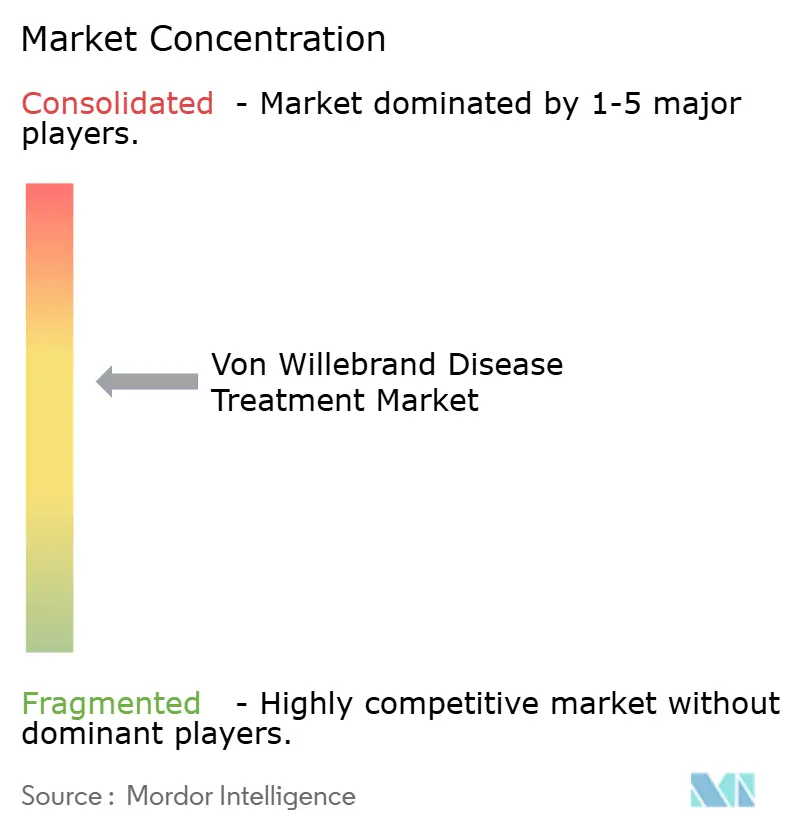
The Von Willebrand disease treatment market remains moderately consolidated, with CSL Behring, Takeda, and Octapharma controlling the bulk of plasma-derived concentrate supply. Their vertical integration from plasma collection to finished biologics ensures scale economies and supply security. Market entrants focus on recombinant innovation, subcutaneous delivery, and curative modalities to differentiate. CSL Behring expands beyond plasma through HEMGENIX gene therapy, while Sanofi uses RNA-interference candidate Qfitlia to address inhibitor populations.
Strategic alliances proliferate. Plasma leaders license AI-driven dosing software to embed value-based outcomes in sales pitches. Gene-therapy developers forge risk-sharing accords with U.S. Medicaid programs to expedite patient onboarding. Device makers collaborate with concentrate suppliers to co-package subcutaneous autoinjectors, simplifying home use. Competitive intensity therefore shifts from pure volume toward clinical-outcome differentiation, reshaping commercial models across the Von Willebrand disease treatment market.
White-space opportunities include diagnostic platforms for low-income regions, extended-half-life recombinant constructs, and cold-chain-free formulations. Barriers to entry encompass plasma-fractionation capital cost, complex biologic approvals, and payer hesitancy around high upfront gene-therapy prices. Nonetheless, innovation and partnership depth suggest gradual dilution of incumbent share, bringing heightened rivalry through 2030.
Von Willebrand Disease Treatment Industry Leaders
CSL Behring
Grifols, S.A.
Octapharma AG
Bio Products Laboratory Ltd.
Takeda (Shire)
- *Disclaimer: Major Players sorted in no particular order
Von Willebrand Disease Treatment Market Companies Covered in this Report
- CSL Behring
- Takeda (Shire)
- Octapharma
- Grifols
- Sanofi
- Pfizer
- Ferring Pharmaceuticals
- Bio Products Laboratory
- Bayer
- Novo Nordisk
- Kedrion Biopharma
- LFB Group
- ADMA Biologics
- CSL Vifor
- Aptevo Therapeutics
- Kamada Ltd
- Biotest

Market Opportunities and Future Outlook
Recent U.S. label expansions and exclusivity decisions create near-term whitespace in prophylaxis pathways, especially in pediatrics where practice patterns have been shaped by limited labeled options. The July 2026 FDA approval expanding wilate prophylaxis to children younger than 6 years supports age-specific dosing, home-infusion support, and treatment-center protocols. In parallel, the September 2025 prophylaxis expansion for VONVENDI supports broader routine prophylaxis adoption in Type 1 and Type 2 adults.
These regulatory steps also intensify competition around differentiated prophylaxis claims, including bleed reduction, convenience, and real-world outcomes. That environment creates space for manufacturers to pair products with adherence services and outcomes-based contracting where payers require evidence beyond on-demand control. Pipeline activity further broadens the opportunity set beyond factor replacement into non-factor prophylaxis and comorbidity-led programs that influence diagnosis and treatment initiation. In April 2026, the FDA granted Rare Pediatric Disease and Breakthrough Therapy designations to Star Therapeutics' VGA039 for VWD prophylaxis, signaling regulator openness to novel mechanisms and accelerating the competitive timeline for antibody-based options. Developers are also targeting heavy menstrual bleeding as an entry point for VWD care pathways, supported by trial and registry activity such as Alnylam's ALN-6400 HMBeacon Phase 2 program updates (June 2026) and Hemab Therapeutics presenting HMB-002 clinical data and introducing an HMB-focused program at ISTH 2026 (July 2026). Collectively, these moves point to opportunities to address under-treated patient segments through prophylaxis alternatives, women-focused care models, and simplified administration aligned with hemophilia center infrastructure.
Recent Industry Developments in Von Willebrand Disease Treatment Market
- July 2026: Octapharma USA received expanded FDA approval for wilate to be used as routine prophylaxis to reduce bleeding frequency in children younger than 6 years with von Willebrand disease. The younger-pediatric label expansion broadens the treatable prophylaxis population and strengthens Octapharma's competitive position in hospital formularies and hemophilia treatment centers focused on long-term bleed prevention.
- July 2026: Incyte Corporation completed the acquisition of Vega Therapeutics, Inc. (a subsidiary of Star Therapeutics LLC), adding VGA039, a monoclonal antibody program for von Willebrand disease prophylaxis, to its portfolio. The transaction brings additional capital and commercialization infrastructure behind a non-factor prophylaxis approach, increasing competitive pressure on incumbent concentrate-based regimens.
- September 2025: Regulators approved Takeda's supplemental BLA for VONVENDI to include routine prophylaxis for adults with Type 1 and Type 2 von Willebrand disease and to expand use in pediatric settings for on-demand and perioperative management. This broader indication enlarges the addressable prophylaxis pool and supports more standardized prophylactic protocols in U.S. hemophilia and bleeding-disorder centers.


Von Willebrand Disease Treatment Market Report Scope and Research Methodology
Market Definition and Coverage
This market covers the value of prescription therapies used to prevent or control bleeding in people diagnosed with von Willebrand disease, including products used in on-demand and preventive care across major healthcare settings.
Scope exclusions: Diagnostic testing, routine surgical hemostasis not linked to von Willebrand disease, and gene therapies still in clinical trials are excluded.
Segments Covered in This Report
- By Disease Type
- Type 1
- Type 2 (2A, 2B, 2M, 2N)
- Type 3
- Acquired VWD
- By Treatment Type
- Desmopressin (DDAVP)
- VWF/FVIII Combination Concentrates
- Recombinant VWF-only Concentrates
- Antifibrinolytics (e.g., Tranexamic Acid)
- Topical & Adjunctive Agents
- By Route of Administration
- Intravenous
- Intranasal
- Oral
- Sub-cutaneous
- Geography
- North America
- United States
- Canada
- Mexico
- Europe
- Germany
- United Kingdom
- France
- Italy
- Spain
- Rest of Europe
- Asia-Pacific
- China
- Japan
- India
- South Korea
- Australia
- Rest of Asia-Pacific
- Middle East and Africa
- GCC
- South Africa
- Rest of Middle East and Africa
- South America
- Brazil
- Argentina
- Rest of South America
- North America
Data Sources, Market Sizing, and Validation
Desk Research
Desk research starts with building the disease and treatment context so the model stays anchored to real patient pools and clinical practice. We leaned on non-paywalled sources such as the US Centers for Disease Control and Prevention, the US National Institutes of Health, the World Health Organization, and national health statistics portals to support broader healthcare spend and population baselines.
To shape treatment patterns and clinical definitions, we also reviewed sources such as peer reviewed hematology journals, clinical guideline summaries available publicly, and materials from international patient and clinician association groups that describe diagnosis and care pathways. For supply side checks, public company filings, investor presentations, and reputable press coverage help confirm product availability, therapy adoption signals, and major label updates. Where needed, paid database subscriptions were used for company financials, patent lookups, and selective import and export visibility for plasma derived products. These are illustrative examples, and we also used additional public materials for data collection, validation, and clarification.
Primary Interviews and Surveys
Primary inputs come from structured discussions with clinicians treating bleeding disorders, hospital and specialty pharmacy stakeholders, and commercial roles involved in therapy access and distribution. We use these discussions to confirm treated patient shares, typical product choices by disease type and severity, and practical pricing and reimbursement dynamics across key regions so assumptions can be corrected before the final sizing run.
Distribution of primary research fieldwork respondents
| Company type | Respondent position | Region |
|---|---|---|
| Top tier: 28% | CXOs: 15% | APAC: 47% |
| Mid tier: 53% | Functional/Unit leaders: 30% | EMEA: 29% |
| Smaller Players: 19% | Managers: 55% | Americas: 24% |
Market-Sizing & Forecasting
Our sizing logic uses a top-down build from prevalence to the treated cohort, translating epidemiology and diagnosis rates into treated patients and then into therapy value using utilization and pricing assumptions. We then pressure test the results with selective bottom-up approximations, such as sampled product level price points, channel checks on usage split across key therapies, and supplier revenue signals to adjust totals when gaps appear.
Key inputs that shape the model include diagnosed VWD prevalence by type, the share of patients receiving on-demand versus prophylaxis, factor concentrate and adjunct therapy use per bleeding episode, site of care mix (hospital, specialty clinic, and home use where applicable), and country level pricing and reimbursement patterns that drive net realized values. Forecasts are built using scenario analysis, where the base case is tied to expected diagnosis lift, guideline aligned prophylaxis adoption in higher risk cohorts, and therapy mix shifts between plasma derived and recombinant options. If a data point is thin in a smaller geography, we scale from comparable markets using population, diagnosis intensity, and access indicators, then recheck those assumptions with experts.
Data Validation & Update Cycle
Each major assumption is checked against at least two independent signals, then the full model is reviewed for outliers in growth, pricing, and treated patient movements that do not fit clinical reality. When a variance looks material, we recheck the underlying driver, revisit the input source, and recontact a relevant expert to confirm whether the change reflects real dynamics or a modeling artifact.
Before sign-off, an additional analyst review is done to confirm arithmetic integrity, year over year logic, and consistency with adjacent therapy markets. Reports are refreshed annually, and interim updates are triggered when material events occur, such as label changes, shortages, or reimbursement decisions. Right before delivery, a final pass is completed so the published numbers reflect the latest available information.
Mordor Intelligence's Von Willebrand Disease Treatment Market Estimate Compared With Other Published Estimates
Published market values for von Willebrand disease treatment often differ because the counted therapy set, the treated patient pool, and the timing of price and mix updates are not aligned across studies. Some sources present a narrower drug basket, and others broaden scope by mixing in adjacent bleeding disorder spend or non-therapy items, which can change the total quickly.
Diagnosis and treatment pattern signals from clinician inputs, along with public therapy availability cues, are used to keep Mordor Intelligence tied to prescription products actually used to control bleeding across Type 1, Type 2 subtypes, Type 3, and acquired cases. The largest spread usually comes from whether a publisher includes only factor concentrates or also counts adjunctive agents, and whether base year pricing is kept current through currency timing and net price adjustments.
Benchmark comparison
| Source | Market Size | Gaps in Research Methodology |
|---|---|---|
| Mordor Intelligence | USD 2.55 B (2026) | |
| Global Research House A | USD 0.62 B (2025) | Uses a much narrower revenue pool that appears to undercount combination concentrate and adjunct therapy value, and it also applies a different base year with limited clarity on net pricing versus list pricing conversion. |
| Healthcare Publisher B | USD 0.66 B (2024) | Anchors the model to an earlier base year and likely applies conservative treated patient assumptions across regions, which can compress totals when diagnosis lift and access improvements are not fully reflected. |
The table indicates that most differences can be traced back to what is included as treatment revenue and how quickly pricing, access, and diagnosis related assumptions are refreshed. By keeping inputs tied to treated cohorts and therapy use logic that can be rechecked, the final number stays transparent and repeatable for planning.


Key Questions Answered in the Report
What is the current size of the Von Willebrand disease treatment market?
The market reached USD 2.55 billion in 2026 and is projected to grow to USD 3.44 billion by 2031 at a 6.15% CAGR.
Which disease segment generates the largest revenue?
Type 1 VWD accounts for 71.78% of global revenue, reflecting its high prevalence and reliance on cost-effective desmopressin therapy.
How fast is the recombinant VWF-only concentrate segment growing?
Recombinant VWF-only products are expanding at a 13.05% CAGR, outpacing plasma-derived options due to safety and efficacy advantages.
Why is Asia-Pacific the fastest-growing regional market?
Government investment in screening and regulatory convergence initiatives produce a 10.12% CAGR, making Asia-Pacific the most dynamic region.
What role do gene therapies play in future growth?
Recently approved one-time treatments like BEQVEZ and HEMGENIX can reduce lifelong factor use, creating new revenue streams while reshaping payer economics.
Page last updated on:


 Your data is secure and never sold or shared.


