
Video Content Marketing Services Market Size and Share
Market Overview
| Study Period | 2020 - 2031 |
|---|---|
| Market Size (2026) | USD 15.42 Billion |
| Market Size (2031) | USD 25.18 Billion |
| Growth Rate (2026 - 2031) | 10.30 % |
| Fastest Growing Market | Asia-Pacific |
| Largest Market | North America |
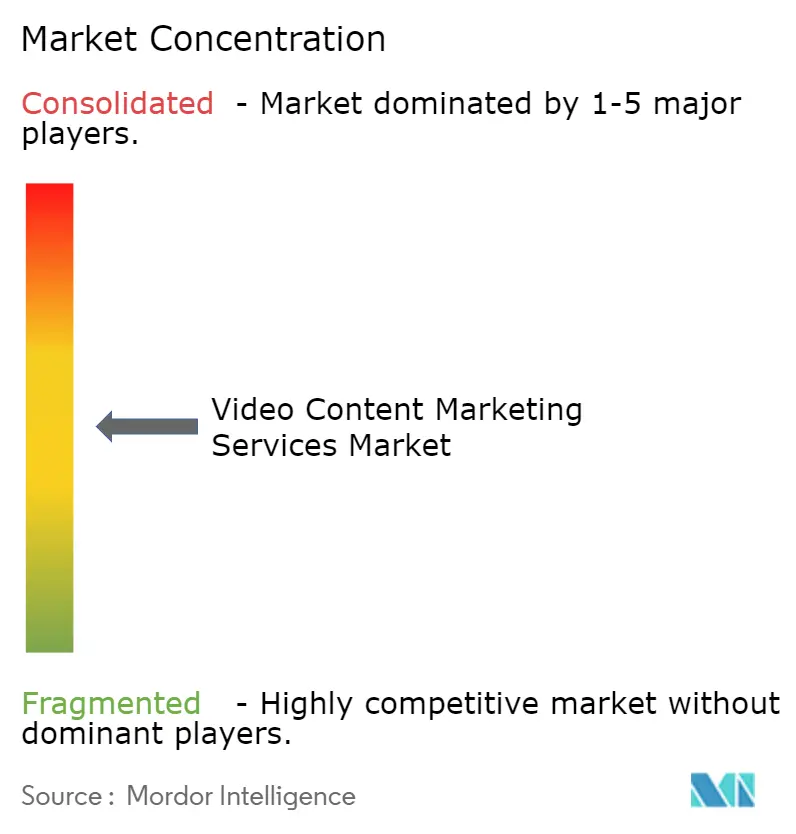
| Market Concentration | Medium |
Major Players *Disclaimer: Major Players sorted in no particular order Image © Mordor Intelligence. Reuse requires attribution under CC BY 4.0. | |
Video Content Marketing Services Market Analysis by Mordor Intelligence
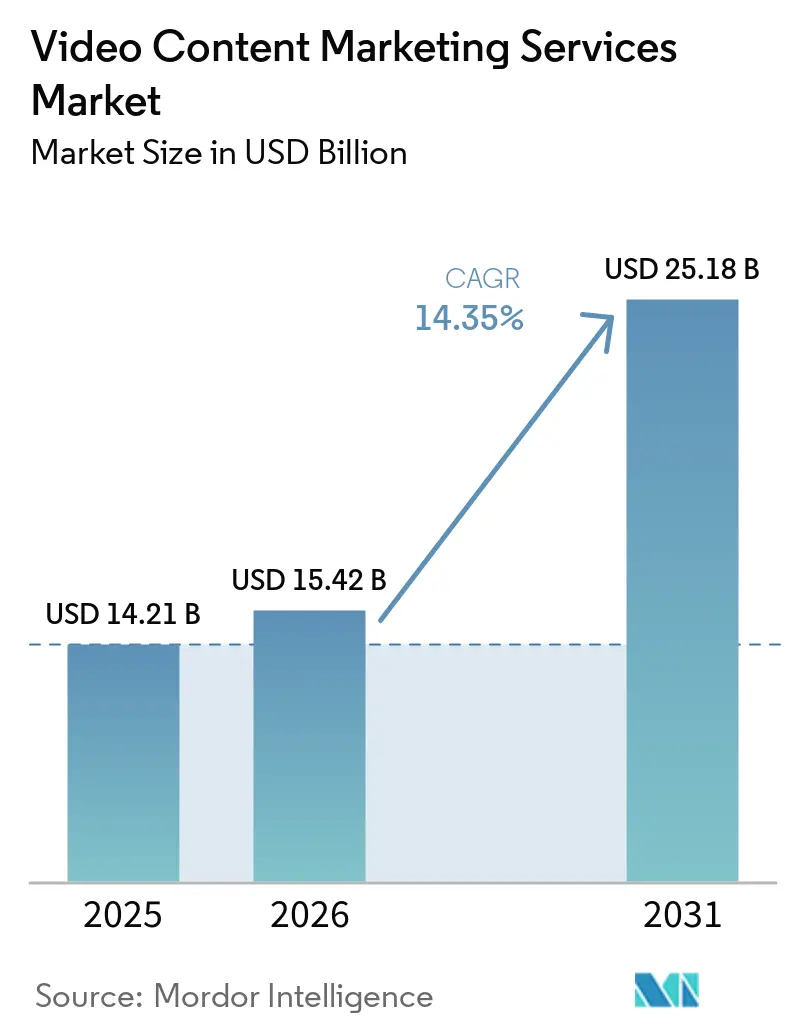
The Video Content Marketing Services Market size was valued at USD 14.21 billion in 2025 and estimated to grow from USD 15.42 billion in 2026 to reach USD 25.18 billion by 2031, at a CAGR of 10.30% during the forecast period (2026-2031). The video content marketing services market is expanding as companies move spending toward measurable content that supports discovery, education, and conversion across the buyer journey. AI-assisted production is reducing the time and cost required to create video versions, which increases the importance of campaign planning, scripting, distribution, and measurement. Short-form publishing, retail media, and B2B education are increasing the need for ongoing service contracts rather than isolated production assignments. Large agency groups are building integrated content and data capabilities, while specialist providers remain relevant where regulated subject matter, speed, and close brand alignment are most important. Persistent measurement gaps and new disclosure obligations for AI-generated content may add cost and complexity, especially for providers serving several markets.
Key Report Takeaways
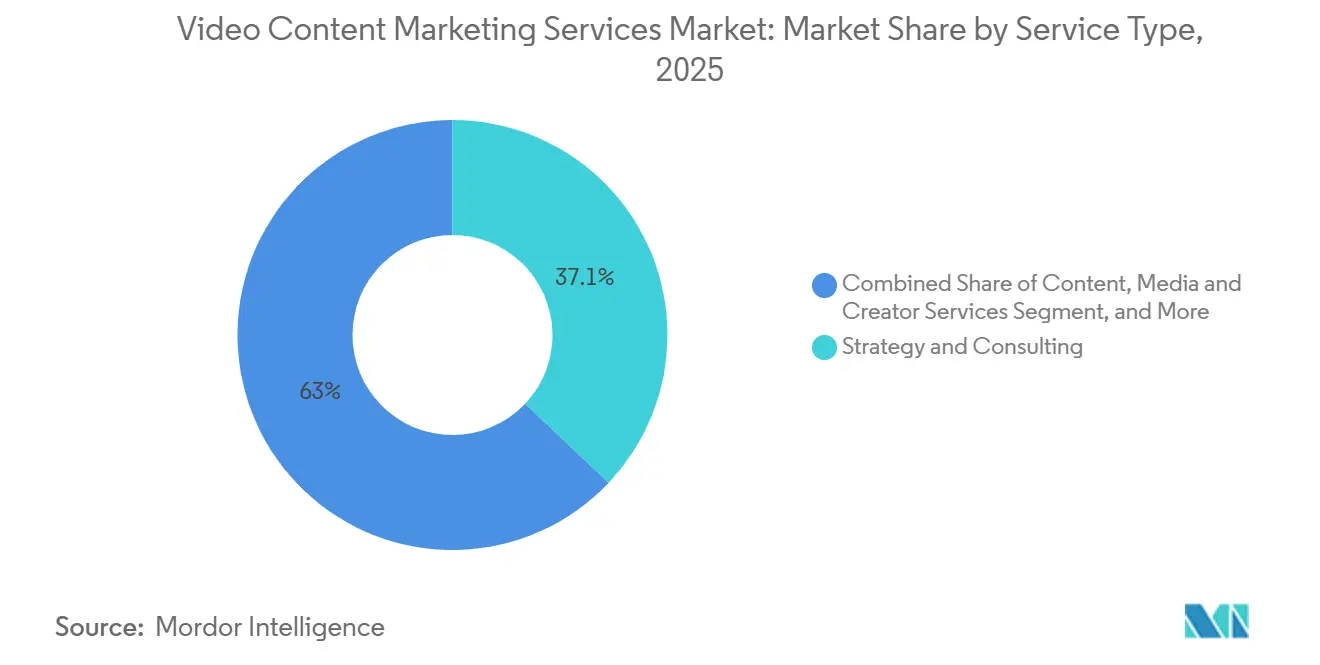
- By service type, Strategy and Consulting held 37.05% of the video content marketing services market share in 2025, while Animation and Motion Graphics is projected to expand at a 10.96% CAGR through 2031.
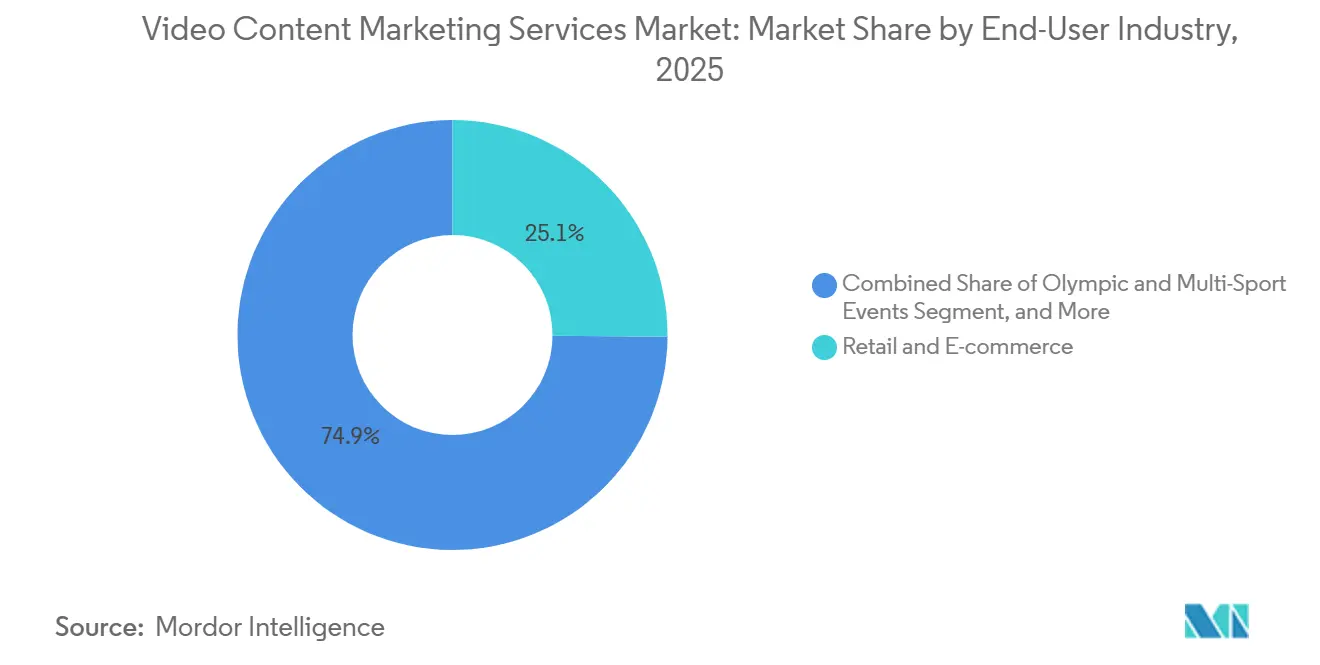
- By end-user industry, Retail and E-commerce held 25.13% of the video content marketing services market share in 2025, while IT and Telecom is projected to grow at a CAGR of 10.91% through 2031.
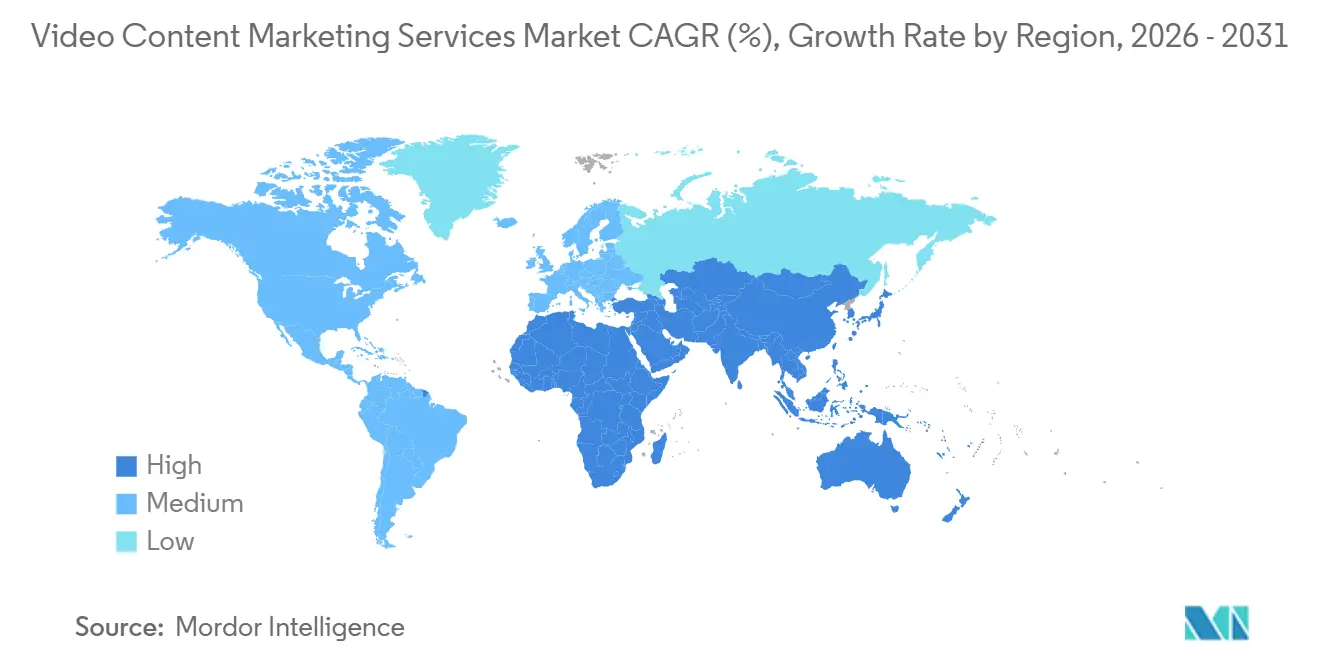
- By geography, North America held 38.04% of the video content marketing services market share in 2025, while Asia-Pacific is projected to grow at a 10.84% CAGR through 2031.
Note: Market size and forecast figures in this report are generated using Mordor Intelligence’s proprietary estimation framework, updated with the latest available data and insights as of January 2026.
Market Trends and Insights
Drivers Impact Analysis of Video Content Marketing Services Market*
| Driver | (~) % Impact on CAGR Forecast | Geographic Relevance | Impact Timeline |
|---|---|---|---|
| Growing Enterprise Demand for AI-Assisted Production and Versioning | +3.2% | Global, with the highest concentration in North America and Europe | Medium term (2-4 years) |
| Rising Short-Form Video Budget Reallocation | +2.5% | Global, led by North America with rapid growth in Asia-Pacific | Short term (≤ 2 years) |
| Growth of Shoppable Video and Retail Media Video Workflows | +1.8% | North America and Asia-Pacific, with expansion into Europe | Medium term (2-4 years) |
| Rising Adoption of Video for B2B Education, Product Demos, and Webinar Repurposing | +1.3% | North America and Europe, with growing adoption in Asia-Pacific | Medium term (2-4 years) |
| Expansion of Creator-Led and Employee-Led Video Campaigns | +0.8% | Global, with strong momentum in North America and Southeast Asia | Short term (≤ 2 years) |
| Acceleration of AI Dubbing and Multilingual Localization for Mid-Market Expansion | +0.6% | Asia-Pacific, South America, and the Middle East, with expansion into Europe | Long term (≥ 4 years) |
| Source: Mordor Intelligence | |||
Growing Enterprise Demand for AI-Assisted Production and Versioning
Generative AI is changing the cost and speed of video production, which is widening access to the video content marketing services market. In 2025, 50% of advertisers were already using generative AI for video creative.[1] Smaller brands can use these tools without maintaining production budgets above USD 20,000 each month. The lower production burden does not eliminate the need for external providers; planning, scripting, governance, and analytics become increasingly important as content volume rises. In February 2026, WPP and Adobe expanded their partnership to integrate Adobe Firefly Foundry into WPP Open for brand-consistent content creation at scale. The arrangement shows why providers in the video content marketing services market are investing in governed workflows rather than treating AI only as a production shortcut, since enterprise clients need repeatable controls for approved brand assets, source materials, and audience-specific variants.
Rising Short-Form Video Budget Reallocation
Short-form video is becoming a central format within enterprise channel planning and is supporting demand in the video content marketing services market. Nearly two-thirds of World Federation of Advertisers respondents expected to increase social media content production in 2025. Production spending accounted for 19% of overall marketing budgets, remaining below pre-pandemic levels. Higher publishing frequency creates a practical need for several opening versions, edits, captions, platform-specific aspect ratios, and formats within a campaign, because a message that performs in one feed may need a different opening, duration, or presentation in another. Providers are therefore being assessed on their ability to refresh creative quickly while maintaining consistent brand standards. This favors ongoing arrangements that join production with testing and distribution support across TikTok, YouTube Shorts, Instagram Reels, and other short-form channels, rather than a project that ends when the first set of files is delivered.
Growth of Shoppable Video and Retail Media Video Workflows
Retail media is creating a direct use case for video content marketing services because video can connect product discovery and purchase within the same experience. Retail media buyers have increased attention to video as product pages and retail networks require assets tailored to their own formats. Video on product pages can provide the motion and context that static images cannot provide when customers compare products. The format also increases the number of assets required because retailers and brands often use separate specifications, placements, campaign calendars, product information, and approval procedures, and each change may require an updated creative version. Retail and E-commerce companies are consequently moving more video work into always-on commerce workflows. This has made the video content marketing services market more relevant to teams that manage product launches, promotions, category pages, retail media activity, product updates, and the continuing need to keep creative aligned with live commerce campaigns.
Rising Adoption of Video for B2B Education, Product Demos, and Webinar Repurposing
B2B buyers increasingly use video to understand complex products before meeting a supplier, supporting the video content marketing services market. A webinar can be converted into shorter clips, social posts, paid assets, and nurture content, allowing the same source material to support several stages of demand generation. LinkedIn reported that creator-led in-stream video achieved a 130% higher completion rate and a 23% higher view rate than standard video ads. In 2026, ON24 reported that webinar conversion rates for patient education resources had doubled year over year through the first quarter. These results make expert-led and educational formats more important for healthcare, financial services, and B2B technology programs. Providers can differentiate when they help clients turn one long-form event into a managed content program with a clear distribution plan, a consistent expert message, and a set of assets designed for different stages of evaluation.
Restraints Impact Analysis of Video Content Marketing Services Market*
| Restraint | (~) % Impact on CAGR Forecast | Geographic Relevance | Impact Timeline |
|---|---|---|---|
| Persistent ROI Attribution Gaps Across Walled Gardens | -1.5% | Global, with the greatest pressure in North America and Europe | Short term (≤ 2 years) |
| High-Volume Creative Refresh Requirements Raising Delivery Complexity | -0.9% | Global, with the highest pressure in North America and Asia-Pacific | Medium term (2-4 years) |
| Tightening AI Disclosure and Synthetic Media Compliance Rules | -0.7% | Europe and North America, with expansion into Asia-Pacific | Medium term (2-4 years) |
| Platform Algorithm Volatility Reducing Predictability of Organic Reach | -0.6% | Global, with the greatest disruption to social-first video strategies | Short term (≤ 2 years) |
| Source: Mordor Intelligence | |||
Persistent ROI Attribution Gaps Across Walled Gardens
Digital video measurement remains fragmented because each platform applies its own conversion logic and does not fully reconcile results with those from other environments. This makes it harder to compare the value of video with channels that have direct click attribution. In 2025, DoubleVerify reported that 51% of marketers viewed audience-targeting verification as the most important third-party tool for improving media planning. Verification tools can improve planning, but they do not fully address questions about view-through conversion or duplicate reach. The constraint is important to the video content marketing services market because buyers may hesitate to expand programs when they cannot link engagement to revenue or pipeline. Providers that connect video activity with broader commercial outcomes can be better positioned than firms that supply creative output alone, because clients can assess the work against pipeline development, customer education, and revenue objectives rather than view counts alone.
High-Volume Creative Refresh Requirements Raising Delivery Complexity
Brands now publish video across social platforms, connected television, retail media, and owned channels simultaneously. Each environment has different file specifications, caption rules, placement requirements, and refresh cycles. This raises delivery complexity even where AI reduces the cost of creating an individual asset. Providers must maintain brand controls, platform compliance, versioning records, and approval processes while moving content quickly. Smaller studios without structured versioning systems can find it harder to qualify for large enterprise assignments. The video content marketing services market, therefore, rewards firms that combine creative capabilities with repeatable content operations, documented workflows, and the ability to manage approvals without slowing delivery.
*Our forecasts treat driver/restraint impacts as directional, not additive. The impact forecasts reflect baseline growth, mix effects, and variable interactions.
Video Content Marketing Services Market Segment Analysis
By Service Type:
Consulting Retains the Largest Position While Animation Leads GrowthStrategy and Consulting held 37.05% of the video content marketing services market share in 2025. Enterprise buyers increasingly treat video as an integrated marketing activity rather than a standalone production task, so they need to make decisions about audience, content purpose, channels, cadence, and measurement before production begins. This sustains demand for strategic governance even as AI tools speed up execution, while Content Ideation and Scripting remain important for content calendars, multi-format scripts, clear brand messages, and planned reuse of material across campaigns. Video SEO and Metadata Optimization also provide value because YouTube, LinkedIn, and connected television require different discoverability practices. The video content marketing services market size for Strategy and Consulting reflects the value placed on planning and coordination across large content programs.
Consulting providers help clients choose which stories to produce, decide how each asset supports media, owned channels, and sales activity, and define how performance data is reviewed after distribution. The role is more material when one campaign creates many versions for audiences and platforms, and strategy teams often direct the content framework and operating model while working with production specialists. Animation and Motion Graphics is projected to expand at a 10.96% CAGR through 2031, because it can explain regulated or complex subjects without talent, locations, or traditional live-action production. It lets companies update scenes, product details, and localized text without recreating an entire shoot, and is suited to explainers, onboarding material, compliance content, feature demonstrations, short clips, and longer educational assets. Distribution and Promotion services are also gaining importance because clients need systematic placement and syndication, while Other Service Types include interactive video configuration, accessibility, and connected television ad operations that are becoming more relevant as distribution expands beyond conventional social platforms.

By End-User Industry:
Retail and E-commerce Lead Demand While IT and Telecom Grow FastestRetail and E-commerce held 25.13% of the video content marketing services market share in 2025. Retailers use video to show product use, provide context, support shoppable experiences, and compete for attention within retail media networks where customers need movement, scale, and use cases before purchase. Retail teams need recurring assets for launches, promotions, product detail pages, and retail network placements, which creates steady demand rather than a single-campaign requirement. Media and Entertainment is the second-largest vertical and continues to drive demand for animated and live-action work as connected television platforms expand branded entertainment and promotional opportunities. The video content marketing services market size associated with Retail and E-commerce is supported by the need to adapt video to product categories, retailer requirements, and seasonal campaigns.
Teams often produce versions for product pages, sponsored placements, social media, and owned channels, giving providers a role in creative development and deployment. Retail media has strengthened the connection between content production and commerce execution, and the sector values performance feedback tied to product engagement and purchase activity. IT and Telecom is projected to grow at a 10.91% CAGR through 2031, the highest rate among end-user industries, as software companies use video for demand generation, product demonstrations, onboarding, and customer success communications. Short demonstrations can introduce a feature while longer educational material supports evaluation and implementation, and recurring product updates require technical offerings to be explained in accessible language for distributed sales teams. BFSI, Healthcare and Life Sciences, Education, Travel and Hospitality, and Automotive also use educational, compliance-sensitive, experiential, destination-led, connected television, and social commerce video programs, creating demand for providers with audience and regulatory knowledge, as well as the ability to translate a complex subject into accessible customer communications.
Geography Analysis
North America Video Content Marketing Services Market
North America held 38.04% of the video content marketing services market share in 2025. The region benefits from concentrated enterprise marketing budgets, a large software sector, and established holding-company networks with broad production capacity, while the United States accounts for the greatest regional demand. Canada has continued to build momentum in B2B technology video services, and Mexico is becoming more relevant as nearshore production capacity supports the United States brand work. Retail media and the need to deliver content across several digital environments are also shaping regional demand. Omnicom's November 2025 acquisition of Interpublic Group combined significant managed production capacity at the enterprise end, raising expectations for multi-market video mandates while leaving room for specialists with sector knowledge, faster cycles, or compliance-sensitive scripting.
APAC and Europe Video Content Marketing Services Market
Asia-Pacific is projected to grow at a 10.84% CAGR through 2031. Japan and Australia are extending established programs through connected television and AI-assisted production, while India and Indonesia are building managed video capabilities at enterprise scale. Regional markets require localization across languages, formats, and platforms, increasing the value of AI dubbing, local cultural understanding, localized content operations, and coordinated review processes to ensure a message remains suitable in each country. Europe held the second-largest regional share in 2025, with Germany, the United Kingdom, and France remaining production and brand strategy hubs, while Germany's automotive and industrial base supports high-value product and corporate video and the United Kingdom remains active in branded storytelling and animation.
EMEA and South America Video Content Marketing Services Market
European providers face close scrutiny of AI-generated content practices, making governance and documentation more important. South America is developing as both a nearshore production location and a localized video marketing market, with Brazil and Argentina leading regional activity and Colombia supporting regional AI production. The Middle East is increasing investment alongside digital economy programs in the United Arab Emirates and Saudi Arabia, while Africa is building creator-led ecosystems in South Africa, Nigeria, and Egypt as mobile-first video use rises. This broader mix gives regional and international providers opportunities where they can coordinate localization, local creative expectations, reliable delivery, and the approval requirements that arise when a single campaign serves several countries.
Competitive Landscape
The video content marketing services market has a split competitive structure, with consolidation at the enterprise end and a diverse supplier base across specialist production, technology, and creative services. The video content marketing services market, therefore, includes firms that compete on scale as well as those that compete on a defined creative or technical specialty. Global holding companies compete for enterprise managed-service mandates, while specialist studios, video technology platforms, and boutique agencies serve a broader client base. The largest groups are building AI-enabled production and data capabilities to protect enterprise relationships, and their advantage comes from coordinating strategy, content, media, and measurement across large portfolios. Smaller firms remain competitive where creative judgment, specialist knowledge, close client collaboration, and an understanding of a client's product or regulated subject matter outweigh scale. In February 2026, WPP and Adobe expanded their partnership to combine Adobe Firefly Foundry with WPP Open for brand-consistent content creation and marketing operations.
In April 2026, Omnicom expanded its Adobe partnership to develop an AI-powered operating model for clients across retail, financial services, pharmaceuticals, and automotive.[2] Publicis Groupe acquired AdgeAI in March 2026 to add predictive measurement and content intelligence to its production capability, showing that leading competitors seek to link production with performance measurement and workflow management. Adobe expanded its partner ecosystem in April 2026, including dentsu, Havas, Omnicom, Publicis, and WPP, to support customer experience orchestration. S4 Capital is repositioning Monks around an AI workforce that combines automated production, data-driven strategy, and optimized media to help clients manage content needs under budget pressure, while platform-led providers that combine hosting, engagement data, and content tools are also influencing the video content marketing services market.
Bending Spoons completed its USD 1.38 billion acquisition of Vimeo in November 2025 after acquiring Brightcove for USD 233 million in November 2024, creating a presence across enterprise video hosting, distribution, and AI-powered content management. Mid-market providers differentiate through vertical knowledge, proprietary measurement, or integration with sales and marketing platforms, especially when a client needs content activity to connect with existing revenue and customer systems. Kaltura completed its acquisition of PathFactory in April 2026 and combined AI video creation, content intelligence, and journey orchestration in its revenue engagement platform, while Vidyard expanded its Clari and Salesloft relationship to integrate video engagement signals into revenue workflows.[3] Wyzowl, Demo Duck, Lemonlight Media, and VeracityColab compete through creative quality and explainers, while commerce-integrated video for mid-market retailers and cross-platform attribution products remain open areas.
Video Content Marketing Services Industry Leaders
-
WPP plc
-
Publicis Groupe S.A.
-
Omnicom Group Inc.
-
Dentsu Group Inc.
-
Accenture plc
- *Disclaimer: Major Players sorted in no particular order
Video Content Marketing Services Market Companies Covered in this Report
- WPP plc
- Publicis Groupe S.A.
- Omnicom Group Inc.
- Dentsu Group Inc.
- Accenture plc
- S4 Capital plc
- Adobe Inc.
- Brightcove Inc.
- Kaltura, Inc.
- Vimeo.com, Inc.
- Vidyard Inc.
- Wistia, Inc.
- Lemonlight Media, Inc.
- Wyzowl Limited
- Demo Duck, LLC
- Epipheo, Inc.
- Yum Yum Videos LLC
- VeracityColab, LLC
- webdew, Inc.
Recent Industry Developments in Video Content Marketing Services Market
- June 2026: Adobe announced expanded partnerships at Cannes Lions 2026 with Accenture Song, Omnicom, Stagwell's Code and Theory, and WPP to deploy Adobe CX Enterprise at scale, including WPP's connected intelligence layer linking paid media spend to owned customer experience data. The standardization of major holding companies on a common content supply chain platform represents a structural shift in how enterprise video services are architected and governed.
- May 2026: Dentsu France and Criteo launched the first video campaign fully orchestrated via Criteo's Model Context Protocol, where AI agents directly managed media planning, activation, and optimization of short-form video for a major brand client, optimizing for Completed Views. The campaign established a clear measurement path from video delivery to commercial outcome within an autonomous workflow.
- April 2026: Omnicom expanded its global partnership with Adobe to co-develop an enterprise-grade AI Agentic Operating Model integrating Omni's 2.6 billion verified global IDs with Adobe Real-Time CDP, targeting 5 core use cases across retail, financial services, pharmaceuticals, and automotive verticals.
- April 2026: Kaltura completed its acquisition of PathFactory, creating an integrated Agentic Revenue Engagement Platform that combines AI video creation, content intelligence, and journey orchestration, and simultaneously launched an Avatar Video Production Studio. It also reported its first Q1 with positive operating cash flow, exceeding guidance on all key metrics.
Global Video Content Marketing Services Market Report Scope
The Video Content Marketing Services Market refers to the industry that provides specialized solutions and strategies for creating, distributing, and optimizing video content to promote brands, products, and services across digital platforms. This market includes services such as video production, editing, animation, live streaming, and performance analytics, all aimed at enhancing customer engagement, boosting online visibility, and driving conversions.
The Video Content Marketing Services Market Report is Segmented by Service Type (Strategy and Consulting, Content Ideation and Scripting, Animation and Motion Graphics, Video SEO and Metadata Optimization, Distribution and Promotion, and Other Service Types), End-User Industry (Retail and E-commerce, Media and Entertainment, IT and Telecom, BFSI, Healthcare and Life Sciences, Education, Travel and Hospitality, Automotive, and Other End-User Industries), and Geography (North America, South America, Europe, Asia-Pacific, Middle East, and Africa). The Market Forecasts are Provided in Terms of Value (USD).
Segmentation Overview
| Strategy and Consulting |
| Content Ideation and Scripting |
| Animation and Motion Graphics |
| Video SEO and Metadata Optimization |
| Distribution and Promotion |
| Other Service Types |
| Retail and E-commerce |
| Media and Entertainment |
| IT and Telecom |
| BFSI |
| Healthcare and Life Sciences |
| Education |
| Travel and Hospitality |
| Automotive |
| Other End-User Industries |
| North America | United States |
| Canada | |
| Mexico | |
| South America | Brazil |
| Argentina | |
| Chile | |
| Rest of South America | |
| Europe | Germany |
| United Kingdom | |
| France | |
| Italy | |
| Spain | |
| Rest of Europe | |
| Asia-Pacific | China |
| Japan | |
| India | |
| South Korea | |
| Australia | |
| Rest of Asia-Pacific | |
| Middle East | United Arab Emirates |
| Saudi Arabia | |
| Qatar | |
| Rest of Middle East | |
| Africa | South Africa |
| Egypt | |
| Nigeria | |
| Rest of Africa |
| By Service Type | Strategy and Consulting | |
| Content Ideation and Scripting | ||
| Animation and Motion Graphics | ||
| Video SEO and Metadata Optimization | ||
| Distribution and Promotion | ||
| Other Service Types | ||
| By End-User Industry | Retail and E-commerce | |
| Media and Entertainment | ||
| IT and Telecom | ||
| BFSI | ||
| Healthcare and Life Sciences | ||
| Education | ||
| Travel and Hospitality | ||
| Automotive | ||
| Other End-User Industries | ||
| By Geography | North America | United States |
| Canada | ||
| Mexico | ||
| South America | Brazil | |
| Argentina | ||
| Chile | ||
| Rest of South America | ||
| Europe | Germany | |
| United Kingdom | ||
| France | ||
| Italy | ||
| Spain | ||
| Rest of Europe | ||
| Asia-Pacific | China | |
| Japan | ||
| India | ||
| South Korea | ||
| Australia | ||
| Rest of Asia-Pacific | ||
| Middle East | United Arab Emirates | |
| Saudi Arabia | ||
| Qatar | ||
| Rest of Middle East | ||
| Africa | South Africa | |
| Egypt | ||
| Nigeria | ||
| Rest of Africa | ||
Key Questions Answered in the Report
What is the size of the video content marketing services market?
The video content marketing services market was valued at USD 14.21 billion in 2025 and is estimated at USD 15.42 billion in 2026. It is projected to reach USD 25.18 billion by 2031.
What is driving demand for video content marketing services?
AI-assisted production, short-form publishing, retail media video, and B2B education are increasing demand for recurring content programs.
Which service type leads video content marketing services?
Strategy and Consulting led with 37.05% share in 2025. Animation and Motion Graphics is projected to grow fastest at a 10.96% CAGR through 2031.
Which end-user sector uses these services most?
Retail and E-commerce led with 25.13% share in 2025 because video supports product understanding, shoppable experiences, and retail media activity.
Which region is expanding fastest for video marketing services?
Asia-Pacific is projected to grow at a 10.84% CAGR through 2031 as established and emerging markets expand managed video programs.
How are agencies changing their video service offerings?
Large agencies are combining AI content tools with planning, data, and measurement systems, while specialists compete through sector expertise and creative execution.