
Technology, Media and Telecom
5th MayAccelerating Additive Manufacturing Adoption in India
3 Min Read
The Content Marketing Market Report is Segmented by Component (Software, and Services), Platform (Blogging, Video, Infographics, Case Studies, and More), End-User Industry (Retail and E-Commerce, Banking Financial Services and Insurance, and More), and Geography (North America, South America, and More). The Market Forecasts are Provided in Terms of Value (USD).
Market Overview
| Study Period | 2019 - 2030 |
|---|---|
| Market Size (2025) | USD 524.73 Billion |
| Market Size (2030) | USD 989.84 Billion |
| Growth Rate (2025 - 2030) | 13.53 % CAGR |
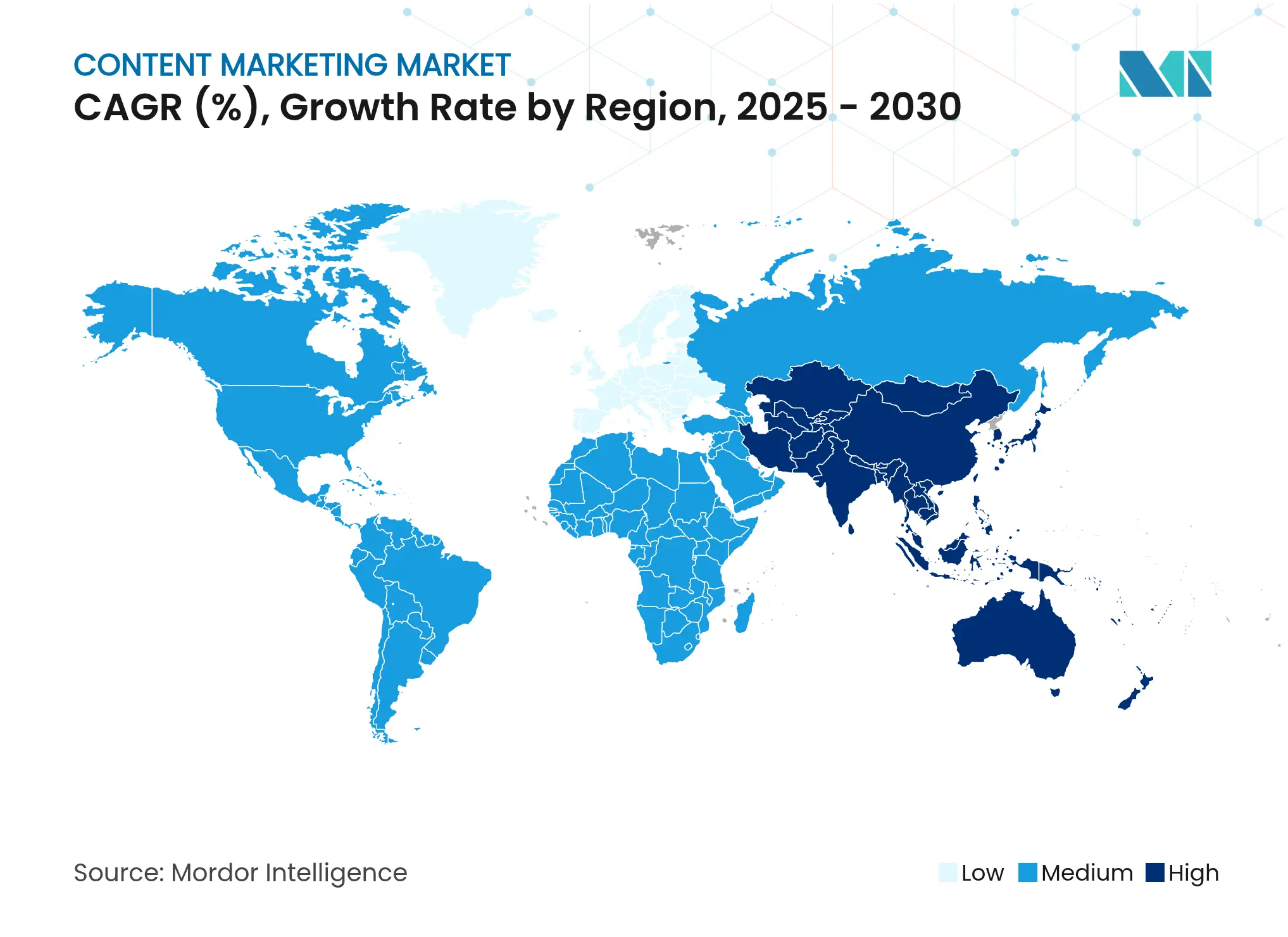
| Fastest Growing Market | Asia Pacific |
| Largest Market | North America |
| Market Concentration | Low |
Major Players *Disclaimer: Major Players sorted in no particular order. Image © Mordor Intelligence. Reuse requires attribution under CC BY 4.0. |
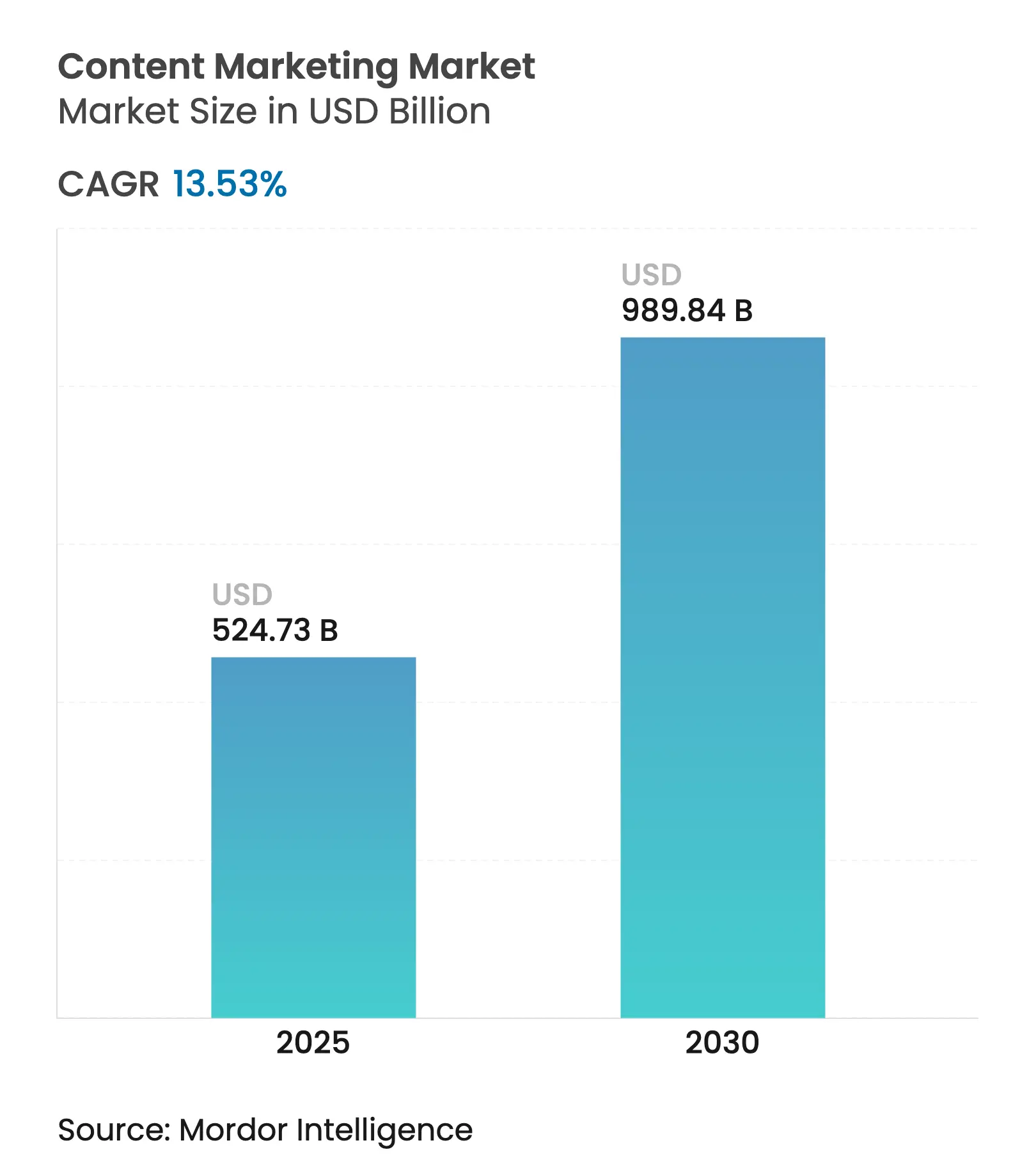

The content marketing market size reached USD 524.73 billion in 2025 and is projected to grow at a 13.53% CAGR, increasing the valuation to USD 989.84 billion by 2030. This growth trajectory reflects marketers’ urgency to build first-party audiences as third-party cookies disappear and paid media costs rise.[1] Generative AI is democratizing creative output, allowing mid-market firms to rival enterprise publishing velocity without proportional budget increases. Demand for video-led storytelling on social platforms is surging, lifting engagement metrics that consiare phased outstently outperform text-only formats. At the same time, CMOs are investing in analytics to link every asset to pipeline creation, tightening executive focus on measurable revenue contribution. Platform consolidation is accelerating as larger vendors buy niche AI and optimization tools to deliver one-stop workflows that reduce integration complexity.
Key Report Takeaways
Note: Market size and forecast figures in this report are generated using Mordor Intelligence's proprietary estimation framework, updated with the latest available data and insights as of 2026.
Drivers Impact Analysis
| Driver | (~) % Impact on CAGR Forecast | Geographic Relevance | Impact Timeline |
|---|---|---|---|
Generative AI enabling scalable content creation | +2.80% | Global, led by North America | Medium term (2-4 years) |
Surge in video-first social platforms | +2.50% | Global, led by Asia Pacific | Short term (≤ 2 years) |
Expansion of digital advertising budgets | +2.10% | Global, strongest in North America and Europe | Medium term (2-4 years) |
Shift to first-party data and personalization | +1.90% | Global, especially GDPR markets | Long term (≥ 4 years) |
Rise of zero-click search experiences | +1.70% | English-speaking markets | Medium term (2-4 years) |
Employer-generated content for talent branding | +1.40% | North America and Europe | Long term (≥ 4 years) |
| Source: Mordor Intelligence | |||
Generative AI Enabling Scalable Content Creation
Enterprise adoption of generative AI reached 73% in 2024, resulting in a 68% reduction in content production costs compared to legacy workflows. Lower barriers now allow mid-size firms to publish at an enterprise cadence, leveling competitive dynamics within the content marketing market. AI models also power real-time personalization, inserting context-relevant copy and imagery that reflect first-party behavioral signals. Headless CMS vendors have embedded AI assistants directly into editorial dashboards, trimming draft-to-publish cycles from weeks to hours. Marketers are appointing “prompt engineers” to safeguard brand voice, a human layer that preserves authenticity as audience detection tools become more adept at spotting synthetic prose.
Surge in Video-First Social Platforms
Short-form and live video now dominate reach algorithms, with B2B assets under 60 seconds earning 2.5 times more shares than long-form counterparts.[2] Live streams convert six times better than static posts, prompting 64% of enterprise marketers to integrate real-time video into lead-generation flows. Vertical formats optimized for mobile viewing require brands to produce multiple aspect-ratio versions per storyline, increasing asset volume per campaign. Video creation now accounts for 45% of content budgets, surpassing text-dominant allocations from prior years. As algorithms prioritize watch-time, brands are blending quick-hit clips with episodic series that nurture deeper affinity and binge behavior.
Expansion of Digital Advertising Budgets
Global digital ad spend climbed to USD 876 billion in 2024, but rising cost-per-click pushed many advertisers toward owned media strategies. Benchmarks show content campaigns yield three times more leads per dollar than paid ads, a disparity that convinced enterprises to raise content budgets by 34%. Attribution platforms that link content to pipeline velocity provided CMOs with fresh proof points when defending spend to finance teams. Nevertheless, the hiring market for experienced strategists tightened, resulting in a 31% increase in salaries and forcing trade-offs between staff and software.
Shift to First-Party Data and Personalization
With third-party cookies fading, 89% of marketers plan to roll out customer data platforms to consolidate first-party profiles in 2024. Dynamic modules within modern CMSs now swap headlines, imagery, and calls-to-action based on real-time behavioral and purchase history, increasing conversion rates by 2.3 times. Regulators across Europe and multiple U.S. states are continuing to strengthen privacy rules, accelerating the shift toward consent-based data capture. Brands that integrate preference centers within content hubs report 23% higher lifetime value as users willingly share context in exchange for relevance.
Restraints Impact Analysis
| Restraint | (~) % Impact on CAGR Forecast | Geographic Relevance | Impact Timeline |
|---|---|---|---|
Shortage of skilled content strategists | -1.80% | Global, acute in North America and Europe | Long term (≥ 4 years) |
Difficulty proving ROI to C-suite | -1.50% | Global, stronger in traditional industries | Medium term (2-4 years) |
Browser-level ad-blocking threatening reach | -1.20% | Developed markets | Short term (≤ 2 years) |
Increasing content saturation and fatigue | -0.90% | Oversaturated verticals worldwide | Long term (≥ 4 years) |
| Source: Mordor Intelligence | |||
Shortage of Skilled Content Strategists
A talent crunch emerged in 2024, with 68% of hiring managers citing difficulty in filling mid-level strategy roles. Cross-functional expertise in analytics, story architecture, and martech orchestration is scarce, driving compensation beyond historical norms. Many firms plug gaps with freelancers, but knowledge continuity risks erode long-term narrative coherence. Agencies report waitlists as brands scramble for external guidance, while universities lag in updating curricula to the hybrid art-and-science skill mix required.
Difficulty Proving ROI to C-suite
Seventy-one percent of CMOs still struggle to tie content directly to revenue milestones. The attribution dilemma intensifies for B2B companies with 6- to 18-month deal cycles, where multiple influencers consume assets asynchronously. Although multi-touch models and AI-driven intent scoring are improving clarity, many boards remain skeptical during economic slowdowns. Without crisp KPI alignment, content line items risk downsizing in favor of initiatives promising faster payback.
By Component: Software Integration Streamlines Workflows
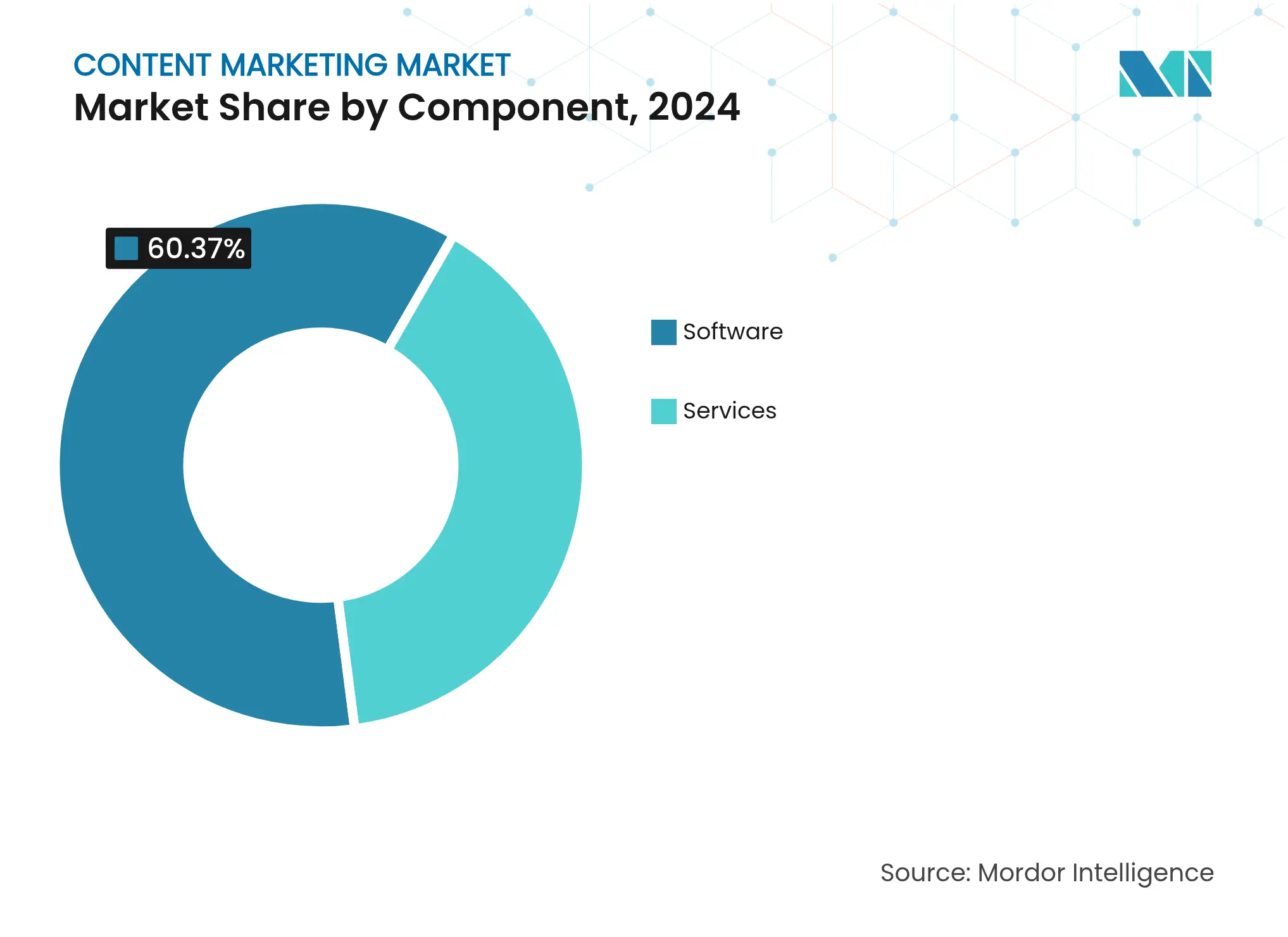
Software contributed 60.37% of the content marketing market share in 2024, underscoring brands’ dependence on unified platforms that stitch ideation, creation, and measurement into a single flow. Content management systems accounted for 35.48% of that spend, with headless architectures enabling omnichannel delivery minus the code rigidity of monolithic stacks. As AI creation assistants become table stakes, vendors are embedding generative engines and predictive scoring to surface high-impact topics. The analytics-and-dashboards niche is poised to clock a 15.19% CAGR, reflecting C-suite insistence on revenue-traceable storytelling.
Services maintained 39.63% of spend because many firms outsource complex editorial calendars and localization duties to agencies. Managed services alone are expanding at a 14.37% clip as organizations reallocate internal headcount to strategic governance. Together, these dynamics keep the content marketing market in a perpetual state of platform expansion, rewarding suite providers that consolidate disparate tools into modular hubs.
By Platform: Video Recasts Engagement Economics
Video secured 37.86% of 2024 revenue, validating its primacy inside the content marketing market. Streaming commerce, interactive webinars, and vertical shorts have transformed passive viewing into transaction-ready encounters. Podcasts, meanwhile, are marching at a 15.52% CAGR to 2030 as decision-makers multitask education during commutes. Blogs still anchor search visibility, yet they are evolving through multimedia embeds and schema optimization to stay algorithm-friendly.
Short-form clips under one minute now govern social feeds, driving brands to spin five-plus variants per concept for algorithmic resonance. E-books and whitepapers incorporate interactive layers and progressive reveal to combat scroll fatigue. Email newsletters leverage AI for personalized curations, doubling open rates compared with generic blasts. Each platform’s nuance obliges marketers to run a matrix of format adaptations, further enlarging the addressable software and services pool within the content marketing market size.
By End-user Industry: Healthcare Outpaces Traditional Leaders
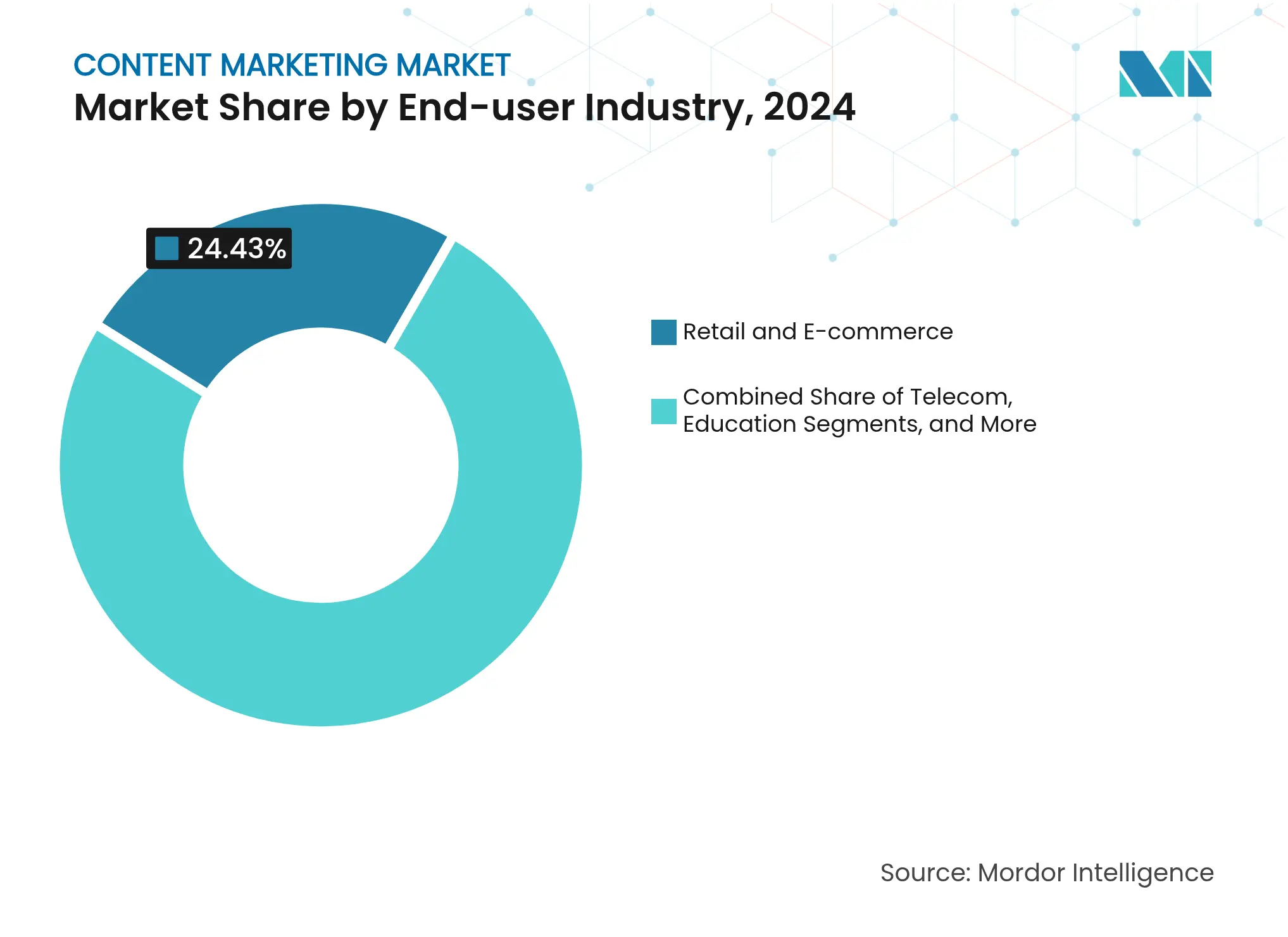
Retail and e-commerce preserved 24.43% of 2024 revenue by embedding shoppable galleries and user-generated reviews that convert 3.2 times better than banner ads. Yet healthcare is accelerating faster, charting a 14.81% CAGR through 2030 on the back of telehealth adoption and preventive care mandates.[3] Compliant content hubs explain treatment protocols, nurture trust, and reduce expensive readmissions, creating a tangible ROI loop that appeals to hospital finance chiefs.
Financial institutions raised content budgets 41% in 2024 to demystify complex products amid digital-first transformation. Media outlets confront saturation head-on by experimenting with gamified formats, while telecom providers publish 5G and IoT primers to solidify consultative positioning. Across every vertical, personalized storytelling grounded in first-party insights will define competitive edge inside the content marketing industry.
North America generated 40.83% of global revenue in 2024, thanks to mature martech stacks and early adoption of generative AI. United States marketers integrate CDPs, automation suites, and BI dashboards to attribute multi-touch journeys with granular precision. Canadian brands rely on privacy-forward frameworks that elevate content as a compliant alternative to cookie-based ads, thereby enhancing engagement while mitigating regulatory risk.
The Asia Pacific is the fastest-growing region, expected to expand at a 14.67% CAGR through 2030, driven by mobile-first consumption and seamless social-commerce workflows. Live-stream shopping, popularized in China’s super-app ecosystems, now influences 78% of regional retailers, merging entertainment with instant checkout. India’s manufacturers and banks grew content allocations 67% in 2024 to engage digitally native audiences, while Southeast Asia’s youthful demographics accelerate influencer-led micro-content.
Europe shows steady momentum under GDPR, which incentivizes brands to double down on owned channels and first-party personalization. United Kingdom companies lead the adoption of AI-infused attribution, equipping CMOs to secure boardroom support. German B2B exporters rely on research-rich whitepapers and technical webinars to nurture prospects through long sales cycles. Collectively, these regional contrasts illustrate why the content marketing market continues to globalize yet remain locally nuanced.
Market Concentration
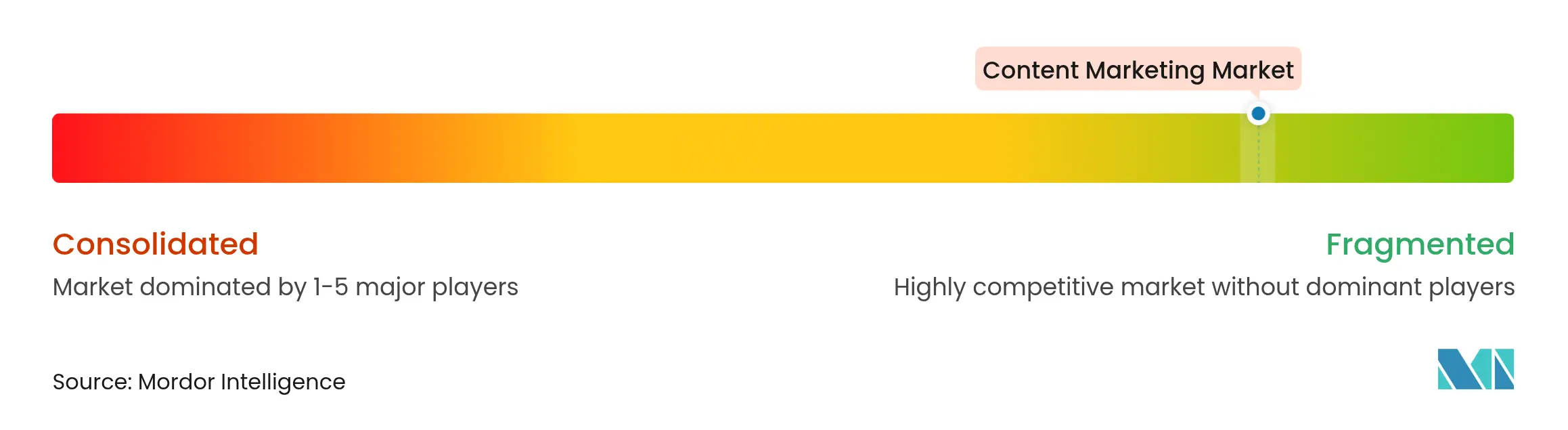
The vendor field is fragmented, with no player exceeding an 8% share of the content marketing market. Industry giants are now acquiring niche AI startups to assemble comprehensive, end-to-end solutions. Adobe’s USD 20 billion acquisition of Figma in 2024 combined design ideation with enterprise publishing, enabling creative teams to iterate and deploy assets within a single cloud. HubSpot’s USD 85 million pickup of Mindstream added advanced attribution that satisfies enterprise procurement teams demanding ROI transparency.
Vertical-centric challengers thrive where compliance barriers deter horizontal suites. Healthcare specialists bundle HIPAA workflows, while fintech contenders fold regulatory templates into CMS editors. Price competition remains muted because buyers prioritize time-to-value and measurable lift over license fees. As generative AI commoditizes baseline creation, differentiation will hinge on proprietary data models and embedded analytics that turn content into a predictive revenue engine. Consequently, the content marketing market rewards providers capable of marrying creation speed with demonstrable business impact.

*Disclaimer: Major Players sorted in no particular order
1. INTRODUCTION
2. RESEARCH METHODOLOGY
3. EXECUTIVE SUMMARY
4. MARKET LANDSCAPE
5. MARKET SIZE AND GROWTH FORECASTS (VALUE)
6. COMPETITIVE LANDSCAPE
7. MARKET OPPORTUNITIES AND FUTURE OUTLOOK
Content marketing is a strategic approach for creating and distributing valuable, relevant content that helps in attracting and maintaining a clear target audience as well as driving successful customer action to businesses and brands.
The global content marketing market is segmented by component (software and service), platform (blogging, videos, infographics, case studies, and other platforms), end-user industry (retail, BFSI, media and entertainment, telecom, and other end-user industries), and geography (North America, Europe, Asia Pacific, Latin America, and Middle East and Africa). The market sizes and forecasts are provided in terms of value (USD) for all the above segments.
| By Component Software | Content Creation Tools | ||
| Content Management Systems | |||
| Analytics and Dashboards | |||
| By Component Services | Professional Services | ||
| Managed Services | |||
| By Platform | Blogging | ||
| Video | |||
| Infographics | |||
| Case Studies | |||
| Podcasts | |||
| E-books and Whitepapers | |||
| Social Media Posts | |||
| Email Newsletters | |||
| Other Platforms | |||
| By End-user Industry | Retail and E-commerce | ||
| Banking, Financial Services and Insurance | |||
| Media and Entertainment | |||
| Telecom | |||
| Education | |||
| Healthcare | |||
| Travel and Hospitality | |||
| Other End-user Industries | |||
| By Geography | North America | United States | |
| Canada | |||
| Mexico | |||
| South America | Brazil | ||
| Argentina | |||
| Rest of South America | |||
| Europe | United Kingdom | ||
| Germany | |||
| France | |||
| Spain | |||
| Italy | |||
| Rest of Europe | |||
| Asia-Pacific | China | ||
| India | |||
| Japan | |||
| Australia | |||
| South Korea | |||
| Rest of Asia-Pacific | |||
| Middle East and Africa | Middle East | Saudi Arabia | |
| United Arab Emirates | |||
| Turkey | |||
| Rest of Middle East | |||
| Africa | South Africa | ||
| Kenya | |||
| Rest of Africa | |||
Accelerating Additive Manufacturing Adoption in India
3 Min Read
Pricing Strategy for Semiconductor Components
3 Min Read
Deep-Dive Analysis of Feed Probiotics Across Key Regions
5 Min Read
When decisions matter, industry leaders turn to our analysts. Let’s talk.

