
Vehicle Tracking System Market Size and Share
Market Overview
| Study Period | 2019 - 2030 |
|---|---|
| Market Size (2025) | USD 29.60 Billion |
| Market Size (2030) | USD 60 Billion |
| Growth Rate (2025 - 2030) | 15.18 % |
| Fastest Growing Market | Asia Pacific |
| Largest Market | North America |
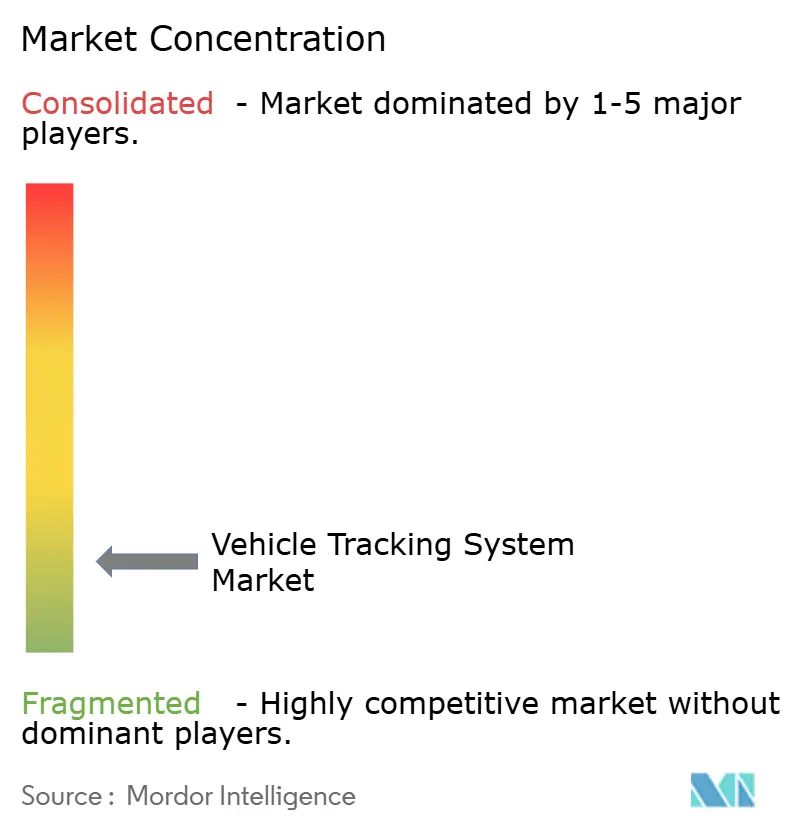
| Market Concentration | Low |
Major Players *Disclaimer: Major Players sorted in no particular order Image © Mordor Intelligence. Reuse requires attribution under CC BY 4.0. | |
Vehicle Tracking System Market Analysis by Mordor Intelligence
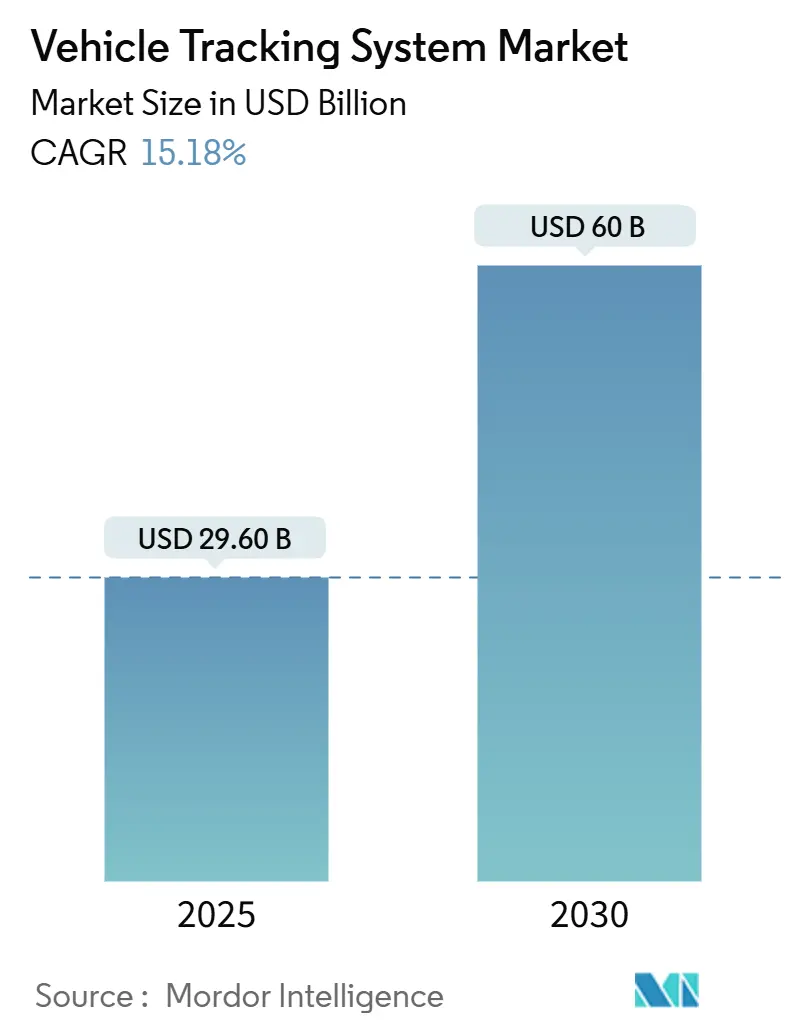
The Vehicle Tracking System Market size is estimated at USD 29.60 billion in 2025, and is expected to reach USD 60 billion by 2030, at a CAGR of 15.18% during the forecast period (2025-2030).
Heightened cross-border Electronic Logging Device (ELD) mandates, surging e-commerce fleets, and falling IoT/GNSS chipset prices are strengthening adoption of cloud-based platforms across mixed vehicle classes. Vendors are embedding edge-AI cameras that calculate driver risk scores in real time, helping fleet operators cut insurance outlays while improving accident metrics. Consolidation is accelerating: Platform Science’s USD 300 million purchase of Trimble’s telematics units in February 2025 expanded a plug-and-play “app store” that eliminates costly hardware swaps. North America keeps its first-mover advantage on account of early regulatory pressure, yet Asia-Pacific is adding the most new systems as commercial vehicle production and supportive digital-infrastructure policies converge. Persistent coverage gaps on rural highways, stricter GDPR litigation risk, and nation-state GNSS jamming continue to temper installation velocity in certain corridors.
Key Report Takeaways
- By component, hardware captured 58.2% of the vehicle tracking system market share in 2024 while services are projected to post a 16.4% CAGR through 2030.
- By vehicle type, light commercial vehicles held 55.1% share of the vehicle tracking system market size in 2024; off-highway vehicles are poised to expand at a 15.2% CAGR to 2030.
- By application, fleet management accounted for 70.2% revenue in 2024 and predictive maintenance is advancing at a 16.1% CAGR over the same horizon.
- By deployment, cloud platforms dominated with 62.3% share in 2024 and are forecast to grow at a 15.9% CAGR through 2030.
- By geography, North America commanded 36.8% share in 2024 whereas Asia Pacific is forecast to grow at a 15.8% CAGR through 2030.
Note: Market size and forecast figures in this report are generated using Mordor Intelligence’s proprietary estimation framework, updated with the latest available data and insights as of January 2026.
Market Trends and Insights
Drivers Impact Analysis of Vehicle Tracking System Market*
| Driver | (~) % Impact on CAGR Forecast | Geographic Relevance | Impact Timeline |
|---|---|---|---|
| Tightening cross-border ELD and e-log compliance mandates | +3.2% | North America, expanding to Europe | Short term (≤ 2 years) |
| Surge in e-commerce-driven last-mile fleets | +4.1% | Global, concentrated in urban centers | Medium term (2-4 years) |
| Falling IoT/GNSS chipset ASPs | +2.8% | Global manufacturing hubs | Medium term (2-4 years) |
| Expansion of integrated OEM-fitted telematics | +3.5% | North America, Europe, APAC core markets | Long term (≥ 4 years) |
| Edge-AI cameras enabling real-time driver scoring | +2.9% | Developed markets, expanding globally | Medium term (2-4 years) |
| Lithium-sulfur battery trackers for 90-day asset life | +1.7% | Global, emphasis on remote operations | Long term (≥ 4 years) |
| Source: Mordor Intelligence | |||
Tightening Cross-Border ELD and E-Log Compliance Mandates
California applied intrastate ELD mandates on 1 January 2024, removing grace periods and aligning state fleets with federal hours-of-service rules. [1]U.S. regulators are finalizing 2025 rules that add speed limiters and mandatory Automatic Emergency Braking on heavy trucks, extending ELD coverage to older vehicles. Canada’s regime mirrors U.S. logic but layers stricter third-party device certification, illustrating converging global norms that enlarge the install base. Operators report a 16% drop in fuel expense and a 22% slide in crash frequency once electronic logs are enforced, reinforcing the business case for continuous location reporting. Latin American authorities are reviewing similar models, signalling near-term spill-over demand for vehicle tracking systems across the region.
Surge in E-Commerce-Driven Last-Mile Fleets
Same-day delivery promises have multiplied urban van populations, incentivising route-planning engines that cut idle time and emissions. Real-time dashboards let dispatchers re-sequence stops based on traffic and customer availability, raising on-time-in-full scores and curbing overtime pay. Telematics providers now mix road, cycle-lane, and pedestrian-only data to direct two-wheeler couriers during peak congestion. Edge analytics housed inside the tracking gateway feeds customer apps with minute-level ETA updates, a feature 65% of shoppers rank as decisive for repeat purchases. Municipal authorities in Europe are drafting low-emission-zone standards that exempt certified electric vans, further tilting fleets toward connected platforms that certify compliance.
Falling IoT/GNSS Chipset Average Selling Prices
Dual-frequency GNSS modules that once cost USD 25 now trade near USD 10, enabling sub-meter accuracy even in canyons and dense cities. High-volume fabs in Taiwan and mainland China are scaling production of RF-front-end silicon that bars out-of-band interference, reducing the bill of materials for entry-level vehicle tracking devices. Component deflation lets suppliers bundle 4G Cat-M1 modems, Bluetooth, Wi-Fi, and inertial sensors in a single board under USD 35, widening the addressable market to cost-sensitive scooter fleets. Cheaper parts also make battery-powered asset tags viable for 90-day life cycles, useful in cross-dock and rental equipment monitoring. Vendors pass savings to customers via zero-CAPEX subscription packages that compress payback to under nine months.
Expansion of Integrated OEM-Fitted Telematics and Edge-AI Cameras
Automakers from Stellantis to Hyundai Translead now pre-wire vehicles so fleet managers can activate telematics remotely without aftermarket harnesses. Factory-installed gateways deliver over-the-air firmware and cybersecurity patches, satisfying insurers and regulators alike. Edge-AI dash cameras run neural models that detect drowsiness or handheld phone use inside the vehicle, issuing instant in-cab alerts proven to curb risky manoeuvres by 35% within 30 days. In tandem, OEM APIs supply odometer, battery health, and ADAS fault codes, feeding predictive maintenance algorithms that averts roadside breakdowns. These capabilities turn the vehicle tracking system market into a data-as-a-service ecosystem that appeals to finance, leasing, and insurance stakeholders.
Restraints Impact Analysis of Vehicle Tracking System Market*
| Restraint | (~) % Impact on CAGR Forecast | Geographic Relevance | Impact Timeline |
|---|---|---|---|
| Cellular "dead-zone" coverage gaps | -2.1% | Rural areas globally, developing markets | Medium term (2-4 years) |
| Data-privacy / GDPR litigation risk | -1.8% | Europe, expanding to global markets | Short term (≤ 2 years) |
| Volatile LEO-satellite bandwidth pricing | -1.3% | Remote operations, maritime applications | Long term (≥ 4 years) |
| Nation-state jamming / spoofing incidents | -2.4% | Conflict zones, border regions | Short term (≤ 2 years) |
| Source: Mordor Intelligence | |||
Cellular “Dead-Zone” Coverage Gaps
Signal surveys show 9% of U.S. highways cannot maintain a 30-minute call using 0.6-W devices, creating blind spots for lower-power tracking hardware. Remote mining and forestry routes amplify the problem because towers are sparse and spectrum is expensive. Low-Earth-Orbit constellations promise wider footprints yet demand beam-steering antennas, raising unit cost and vehicle-roof real estate. Some fleets deploy multi-IMSI SIMs and automatic network-scanning firmware to exploit any accessible carrier, but these measures raise data charges. Interim solutions such as 4 W signal boosters can lift RSSI values by up to 15 dB, though they add wiring complexity and draw extra current, influencing adoption and performance in the vehicle tracking system market.
Data-Privacy / GDPR Litigation Risk
EU regulators deem live location a special category of personal data, obliging fleets to secure explicit employee consent when monitoring outside work hours. The UK Information Commissioner’s Office requires clear signage and purpose limitation, while France’s CNIL levies fines up to EUR 20 million for non-compliant tracking. Fleet portals therefore embed “privacy locks” that mute coordinate uploads during personal use, forcing a delicate balance between oversight and autonomy. The automotive sector’s exposure intensified after several high-profile data leaks, prompting industry players to deploy on-device anonymization that hashes faces and licence plates before cloud transit. Compliance overhead raises total cost of ownership and lengthens sales cycles in privacy-sensitive verticals such as courier subcontracting.
*Our forecasts treat driver/restraint impacts as directional, not additive. The impact forecasts reflect baseline growth, mix effects, and variable interactions.
Vehicle Tracking System Market Segment Analysis
By Component:
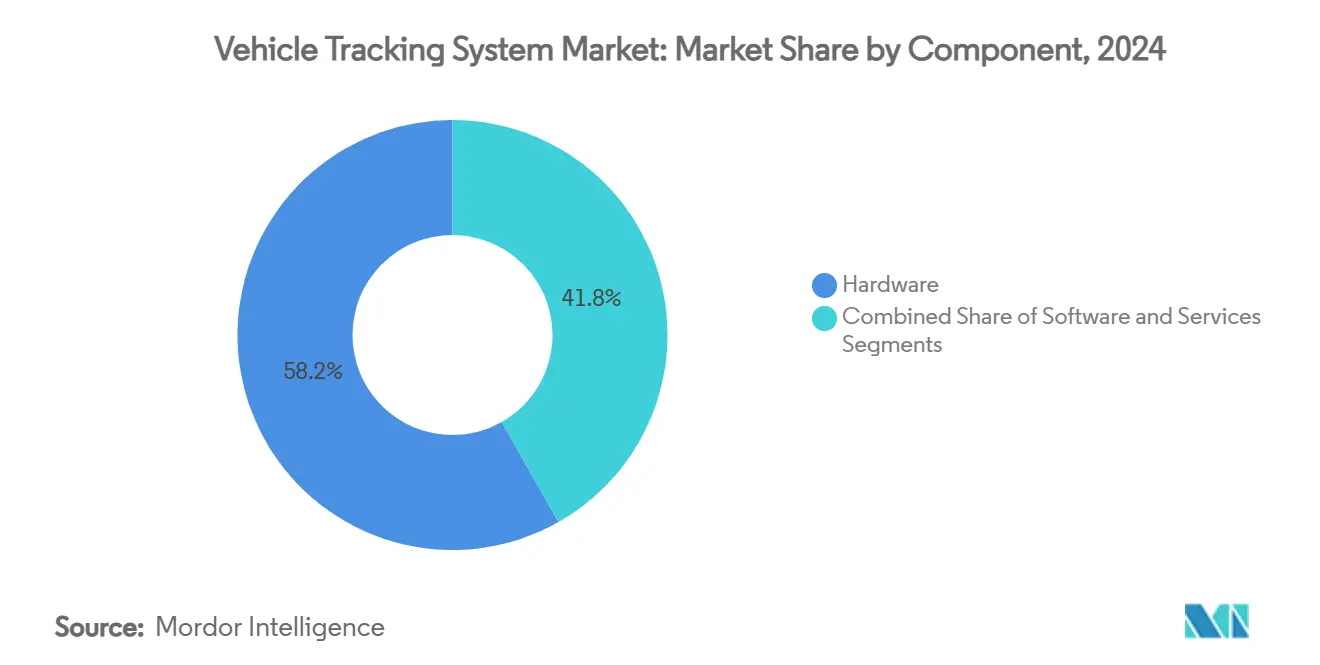
Hardware Dominance Meets Service InnovationHardware retained 58.2% share of the vehicle tracking system market in 2024 as every connected asset still needs a physical gateway, antenna, and sensor stack to acquire GNSS signals and transmit data. Mass-produced multi-constellation chipsets now handle GPS, GLONASS, Galileo, and BeiDou simultaneously, lifting position integrity in urban canyons and under dense foliage. Ruggedised enclosures protect electronics from vibration, salt, and fuel vapour, extending life cycles in harsh off-road environments. The steady march toward lower component costs sustains hardware demand, but the growth spotlight has shifted to services, the fastest-expanding line at 16.4% CAGR to 2030. Subscription platforms perform AI-driven video analysis, driver coaching, and carbon reporting, wrapping continuous updates into operating expenditure budgets.
A service-tailored go-to-market is recasting vendor revenue profiles from lumpy hardware shipments to reliable monthly recurring income. Cloud portals ingest billions of data points daily, surfacing predictive maintenance alerts that trim unscheduled downtime by double-digit percentages. White-label APIs let third-party developers slot asset data into ERPs, warehouse systems, and insurance underwriting engines, enhancing stickiness. Competitive advantage now hinges on data-science talent and integration depth rather than radio engineering alone. This pivot is drawing venture capital into analytics-first start-ups, intensifying the innovation tempo within the vehicle tracking system market.

By Vehicle Type:
Commercial Leadership with Off-Highway AccelerationLight commercial vehicles claimed the highest revenue slice at 55.1% in 2024 on the back of urban parcel delivery and field-service use cases. Scaling same-day fulfilment compels dispatchers to monitor van location, temperature zones, and door status using vehicle tracking systems to meet stringent customer promises. Heavy commercial trucks maintain strong uptake thanks to mandatory ELDs and growing demand for over-the-air maintenance scheduling among cross-border carriers. Passenger-car integration is climbing as OEMs embed telematics options for leasing firms and ride-sharing operators.[2]
Off-highway vehicles are charting the fastest trajectory, rising at 15.2% CAGR as mines, construction firms, and farms digitise assets that traditionally ran in isolation. Rugged trackers rated IP69K withstand extreme vibration and pressure-wash cycles, while mesh BLE tags map tool utilisation yards. Meanwhile, two-wheelers in South and Southeast Asia constitute a growing niche, with micro-credit lenders requiring immobilisers and geo-fences to secure collateral. This mosaic of requirements keeps R&D teams busy designing versatile form factors and multi-mode connectivity, reinforcing the complex opportunity mix inside the vehicle tracking system market.
By Application:
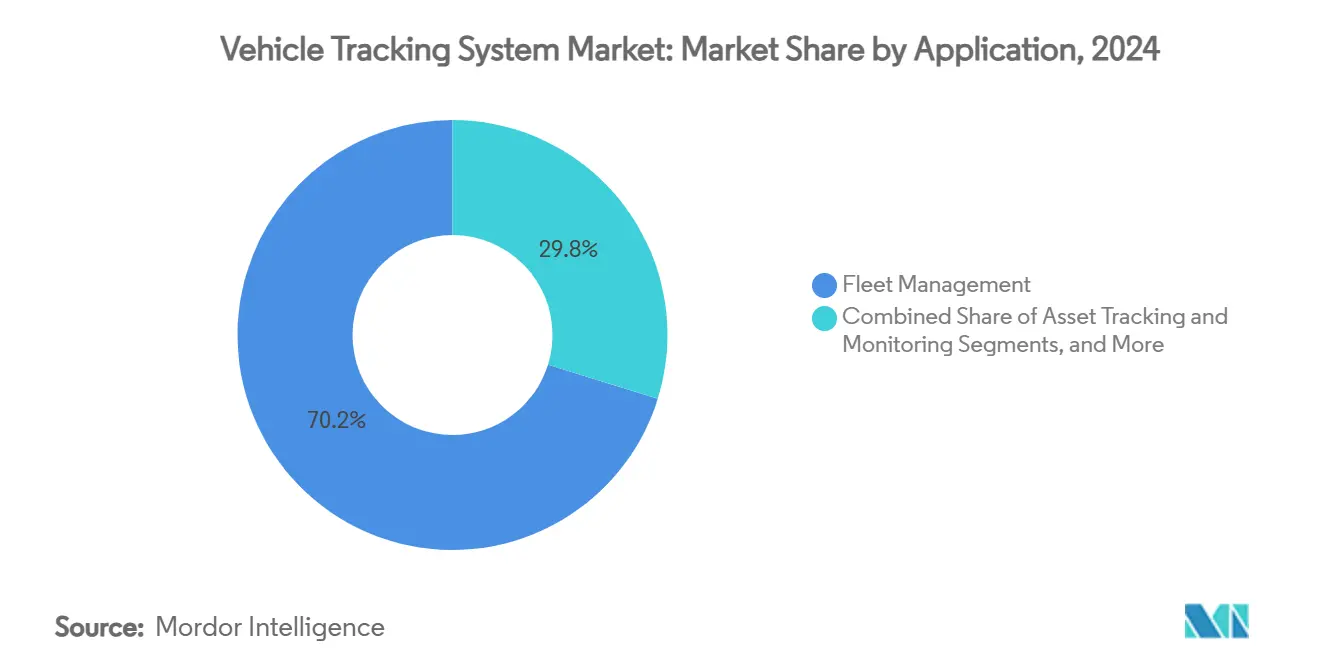
Fleet Management Supremacy with Predictive Maintenance SurgeFleet management continued to dominate with 70.2% revenue share in 2024, spanning route optimisation, fuel analytics, and driver performance scoring. Verizon Connect customers documented 24% lower fuel usage and 19% fewer crash-related costs after installing GPS devices. [3]Asset tracking extends visibility across trailers, containers, and mobile generators, ensuring balanced utilisation. Safety and security overlays layer AI video on top of telematics, spotting distracted driving and tailgating in near real time, strengthening the adoption of the vehicle tracking system market.
Predictive maintenance is the breakout segment, expected to post a 16.1% CAGR through 2030 as sensor fusion and machine learning foretell component failure. Vibration, coolant, and brake data feed algorithms that alert technicians weeks in advance, slashing unplanned downtime. Insurance telematics also gains ground with usage-based premiums that tie payout to behaviour rather than demographics. Cold-chain monitoring leverages 5G and NB-IoT to transmit temperature, humidity, and shock events, safeguarding food and pharmaceutical payloads. Collectively these use cases illustrate the expanding functional radius of the vehicle tracking system market.
By Deployment Type:
Cloud Dominance Across All MetricsCloud platforms owned 62.3% of deployments in 2024 and display the highest forward pace at 15.9% CAGR. Firms favour software-as-a-service because it eliminates capex and outsources cybersecurity, patching, and scalability headaches. Multitenant architectures permit frictionless feature rollouts, meaning every customer benefits instantly from algorithm upgrades. Application programming interfaces expose live fleet data to payroll, maintenance, and customer-service applications without local servers.
On-premise remains relevant in military, public safety, and highly regulated banking logistics where data residency is non-negotiable. Hybrid models cap sensitive data on site while externalising bulk analytics, easing the transition for enterprises with sunk hardware. Edge processing inside the gateway further blurs deployment lines by running vision and AI models locally, uploading only metadata to the cloud to conserve bandwidth. These dynamics entrench cloud as the default, reshaping vendor roadmaps and sales motions throughout the vehicle tracking system market.
Geography Analysis
North America Vehicle Tracking System Market
North America commanded 36.8% of 2024 revenue and houses the most mature ELD frameworks. Active fleet management subscriptions in the region are on track to climb from 17.4 million in 2023 to 30.5 million by 2028, reflecting entrenched regulatory pressure and tight shipper delivery windows. Data-rich service models resonate with U.S. shippers chasing granular cost transparency, while Canadian regulators enforce stricter third-party device certification that underpins premium pricing. Venture investment continues to coalesce around software-centric challengers, reinforcing the vehicle tracking system market leadership of North America.
APAC Vehicle Tracking System Market
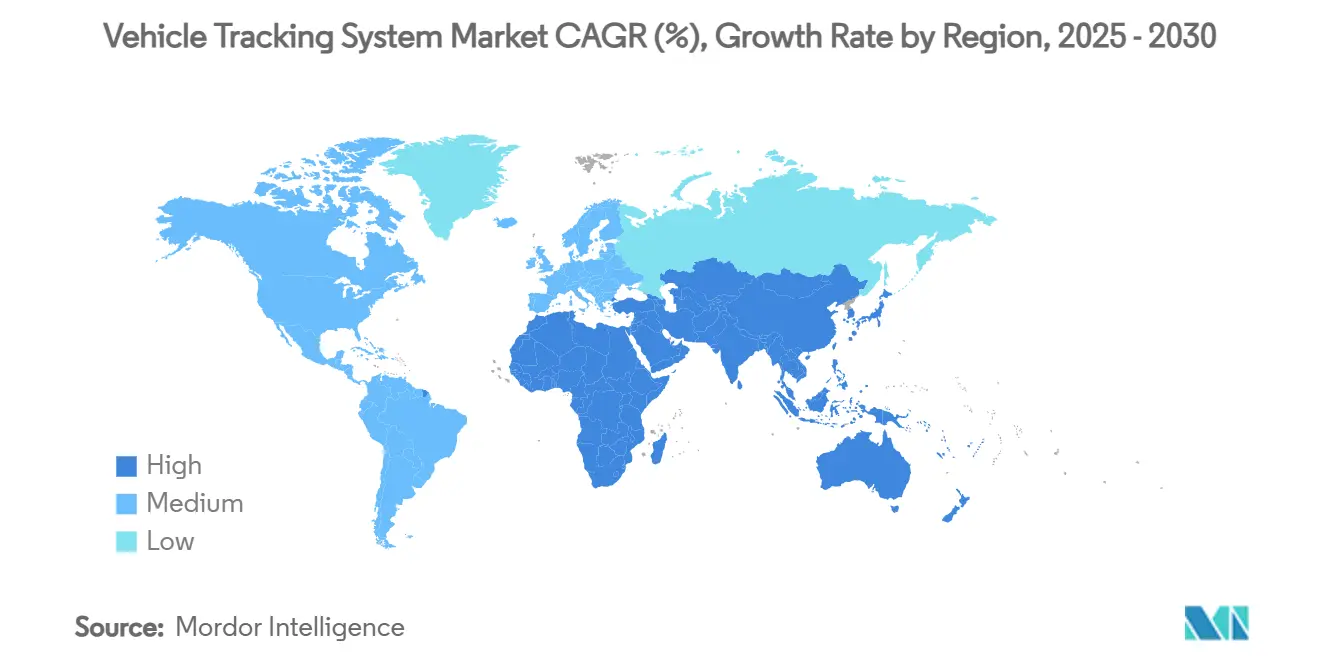
Asia-Pacific is the fastest-growing theatre with a 15.8% CAGR forecast, spurred by rapid urbanisation and government digital agendas. Southeast Asia’s installed base could hit 5.4 million units by 2028, thanks to e-commerce booms and supportive tax incentives for supply-chain modernisation. China deploys large-scale electric light-truck fleets that demand battery-health analytics, while India’s Ministry of Road Transport mandates AIS-140 compliant trackers on select passenger segments, ensuring continual inflow. Japanese OEMs embed telematics to meet ageing driver safety needs, propelling integrated services. Cloud adoption lags in some frontier economies, but leapfrogging via cellular-satellite hybrid connectivity is closing that gap.
EMEA and LATAM Vehicle Tracking System Market
Europe delivers steady growth as fleets juggle GDPR constraints with carbon-reduction targets. Operators adopt edge-anonymisation tools that strip personally identifiable imagery before upload, sidestepping legal exposure. OEM integration partnerships such as the Samsara–Stellantis tie-up give fleets immediate access to sensor feeds across multiple brands without fitting aftermarket hardware. Latin America and the Middle East & Africa remain emerging zones where regulatory clarity and connectivity investments will dictate adoption speed. Currency volatility poses an additional hurdle, prompting vendors to price predominantly in USD while offering flexible micro-service modules, expanding the reach of the vehicle tracking system market.
Competitive Landscape
The vehicle tracking system market exhibits moderate fragmentation: no single vendor controls more than one-fifth of global revenue. Strategic acquisitions are compressing the field as platforms seek scale, ecosystem breadth, and data moats. Platform Science’s USD 300 million acquisition of Trimble’s telematics units delivered a ready-made customer base and accelerated its “Virtual Vehicle” marketplace. Samsara differentiates via AI vision, with its drowsiness algorithm trained on 38 billion video minutes now available globally. Geotab leverages 157 OEM data partnerships covering 15,000 models to simplify mixed-fleet analytics, a factor valued by multinational shippers.
Technological innovation spans edge-AI chips, 5G NR, and lithium-sulfur batteries that extend tag life to 90 days for remote asset tracking. Companies funnel double-digit percentages of revenue into R&D to maintain lead times. Partnerships are critical: Hyundai Translead embeds Samsara’s HT LinkVue cameras for factory-level 360-degree trailer visibility, slashing retrofit labour. Barriers to entry are rising as incumbents accumulate petabytes of labelled sensor data that reinforce AI model accuracy. Still, niche players thrive in specialised verticals such as cold-chain or aviation ground support, evidencing a vibrant and contested landscape that sustains customer choice.
Vehicle Tracking System Industry Leaders
-
Verizon Connect
-
Geotab
-
Trimble Inc.
-
Webfleet (TomTom)
-
Samsara
- *Disclaimer: Major Players sorted in no particular order
Vehicle Tracking System Market Companies Covered in this Report
- Verizon Connect
- Geotab
- Trimble Inc.
- Webfleet (TomTom)
- Samsara
- CalAmp
- ORBCOMM
- ATandT Fleet Complete
- Gurtam
- Targa Telematics
- Spireon
- Fleet Complete
- Ituran
- MiX Telematics
- Omnitracs
- Teletrac Navman
- Inseego
- Radius Telematics
- GPS Insight
- Masternaut
Recent Industry Developments in Vehicle Tracking System Market
- January 2025: Platform Science finalised the USD 300 million acquisition of Trimble's transportation telematics units, adding USD 30 million in operating profit and granting Trimble a 32.5% equity stake.
- January 2025: Samsara broadened its collaboration with Stellantis via the Mobilisights platform, enabling post-2024 vehicles to transmit data without extra hardware.
- November 2024: Samsara launched Connected Training, Low Bridge Strike Alerting, and Electronic Brake Performance Monitoring, cutting safety incidents by 35% among pilot users.
- October 2024: Samsara’s AI drowsiness detection reached general availability after global beta testing, with fleets reporting zero fatigue-related crashes during the first 30 days.
Global Vehicle Tracking System Market Report Scope
Segmentation Overview
| Hardware |
| Software |
| Services |
| Passenger Cars |
| Light Commercial Vehicles |
| Heavy Commercial Vehicles |
| Two-Wheelers |
| Off-Highway Vehicles |
| Fleet Management |
| Asset Tracking and Monitoring |
| Safety and Security |
| Predictive Maintenance |
| Insurance Telematics |
| Cold-Chain Monitoring |
| On-Premise |
| Cloud |
| Hybrid |
| North America | United States | |
| Canada | ||
| Mexico | ||
| South America | Brazil | |
| Argentina | ||
| Rest of South America | ||
| Europe | Germany | |
| United Kingdom | ||
| France | ||
| Italy | ||
| Spain | ||
| Russia | ||
| Rest of Europe | ||
| Asia-Pacific | China | |
| Japan | ||
| India | ||
| South Korea | ||
| Australia and New Zealand | ||
| Southeast Asia | ||
| Rest of Asia-Pacific | ||
| Middle East and Africa | Middle East | United Arab Emirates |
| Saudi Arabia | ||
| Rest of Middle East | ||
| Africa | South Africa | |
| Nigeria | ||
| Rest of Africa | ||
| By Component | Hardware | ||
| Software | |||
| Services | |||
| By Vehicle Type | Passenger Cars | ||
| Light Commercial Vehicles | |||
| Heavy Commercial Vehicles | |||
| Two-Wheelers | |||
| Off-Highway Vehicles | |||
| By Application | Fleet Management | ||
| Asset Tracking and Monitoring | |||
| Safety and Security | |||
| Predictive Maintenance | |||
| Insurance Telematics | |||
| Cold-Chain Monitoring | |||
| By Deployment Type | On-Premise | ||
| Cloud | |||
| Hybrid | |||
| By Geography | North America | United States | |
| Canada | |||
| Mexico | |||
| South America | Brazil | ||
| Argentina | |||
| Rest of South America | |||
| Europe | Germany | ||
| United Kingdom | |||
| France | |||
| Italy | |||
| Spain | |||
| Russia | |||
| Rest of Europe | |||
| Asia-Pacific | China | ||
| Japan | |||
| India | |||
| South Korea | |||
| Australia and New Zealand | |||
| Southeast Asia | |||
| Rest of Asia-Pacific | |||
| Middle East and Africa | Middle East | United Arab Emirates | |
| Saudi Arabia | |||
| Rest of Middle East | |||
| Africa | South Africa | ||
| Nigeria | |||
| Rest of Africa | |||
Key Questions Answered in the Report
How big is the vehicle tracking system market in 2025?
The vehicle tracking system market size reached USD 29.60 billion in 2025 and is on track to hit USD 60.00 billion by 2030.
Which segment grows fastest between 2025 and 2030?
Predictive maintenance applications record the highest CAGR at 16.1%, reflecting rising demand for proactive repair scheduling.
What share do hardware components hold today?
Hardware accounts for 58.2% of 2024 revenue, underscoring continued demand for gateways, antennas, and sensors.
Why is Asia-Pacific seeing rapid adoption?
Commercial vehicle expansion, supportive government mandates, and OEM telematics integration collectively drive a 15.8% CAGR in the region.
How are regulatory mandates influencing purchases?
Cross-border ELD rules in North America and similar frameworks elsewhere compel fleets to install compliant trackers, lifting demand by an estimated 3.2% of overall CAGR