
GPS Tracking Device Market Size and Share
Market Overview
| Study Period | 2019 - 2030 |
|---|---|
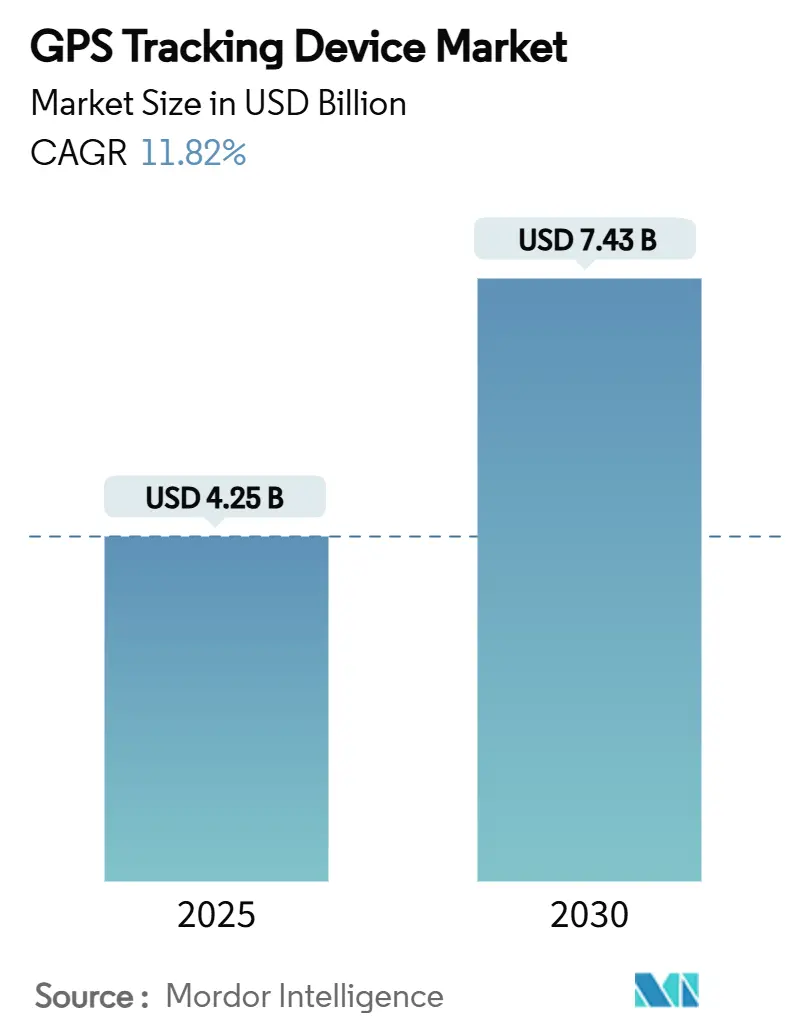
| Market Size (2025) | USD 4.25 Billion |
| Market Size (2030) | USD 7.43 Billion |
| Growth Rate (2025 - 2030) | 11.82 % |
| Fastest Growing Market | Asia Pacific |
| Largest Market | North America |
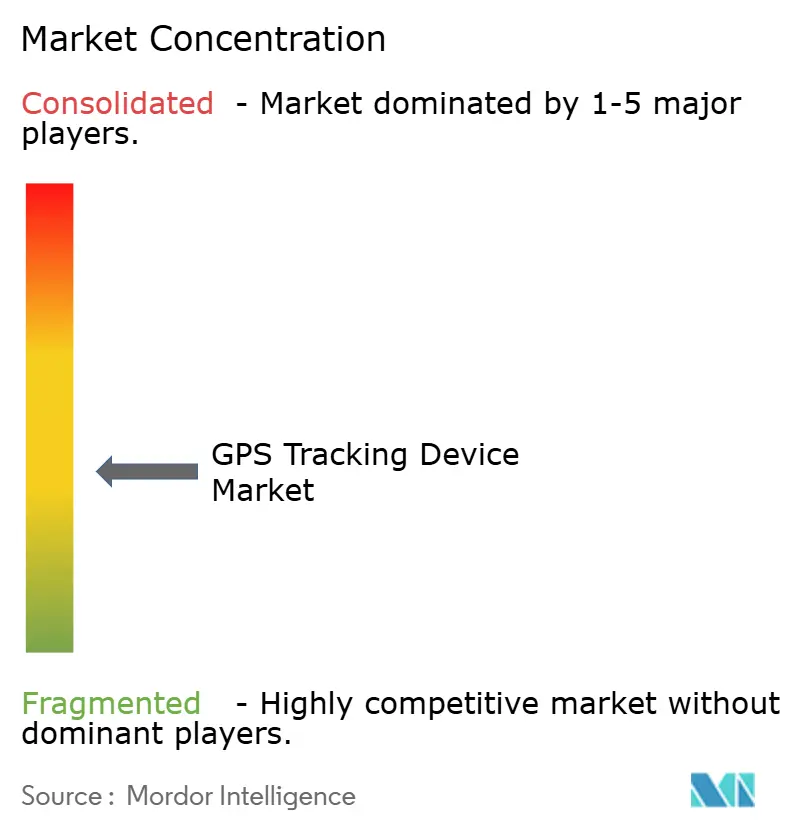
| Market Concentration | Medium |
Major Players *Disclaimer: Major Players sorted in no particular order Image © Mordor Intelligence. Reuse requires attribution under CC BY 4.0. | |
GPS Tracking Device Market Analysis by Mordor Intelligence
The GPS tracking device market size is valued at USD 4.25 billion in 2025 and is forecast to reach USD 7.43 billion by 2030, expanding at an 11.82% CAGR during the period. E-commerce fleet operators continue scaling their last-mile networks, and regulatory bodies in North America and Europe are mandating telematics for safety, compliance, and emissions reporting, anchoring steady device demand. Rapid cost declines in dual-frequency GNSS chipsets and low-power LPWAN modules are lowering entry barriers, enabling new business models across asset-heavy verticals. Competitive differentiation now centers on integrating anti-spoofing security, centimeter-level positioning, and predictive analytics rather than on basic hardware features. These factors collectively support a resilient growth path for the GPS tracking device market even amid macroeconomic uncertainty.
Key Report Takeaways
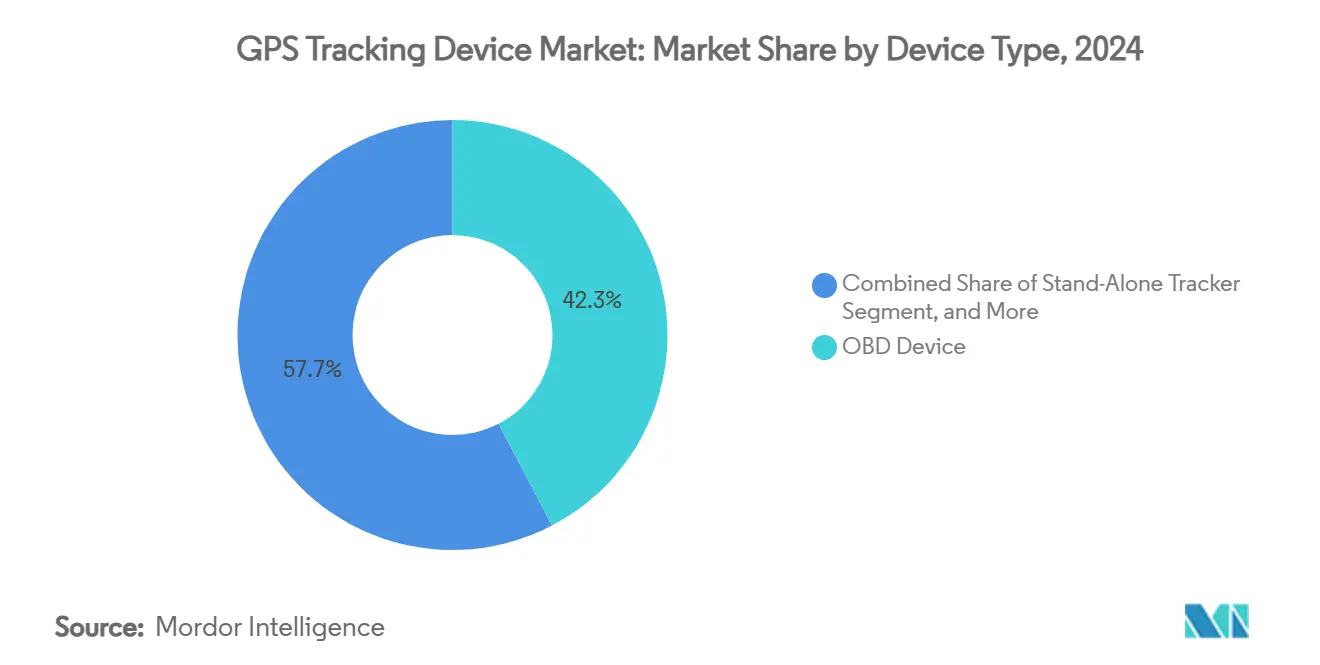
- By device type, OBD units held 42.34% of the GPS tracking device market share in 2024, while advanced smart trackers are projected to grow at 14.23% CAGR through 2030.
- By component, hardware commanded 62.39% share of the GPS tracking device market size in 2024, whereas software is set to expand at 15.98% CAGR during 2025-2030.
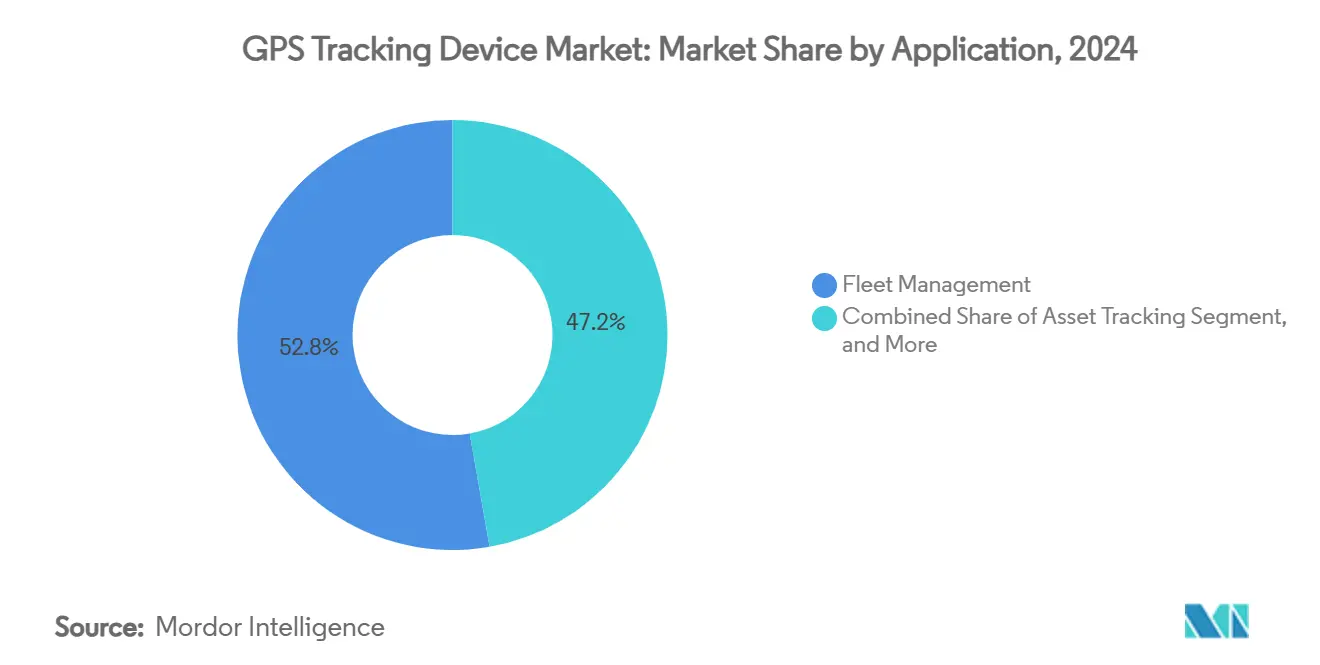
- By application, fleet management accounted for 52.76% share of the GPS tracking device market size in 2024; asset tracking is advancing at a 13.67% CAGR to 2030.
- By end-user, transportation and logistics captured 45.87% of GPS tracking device market demand in 2024, while construction and mining lead growth at 12.05% CAGR.
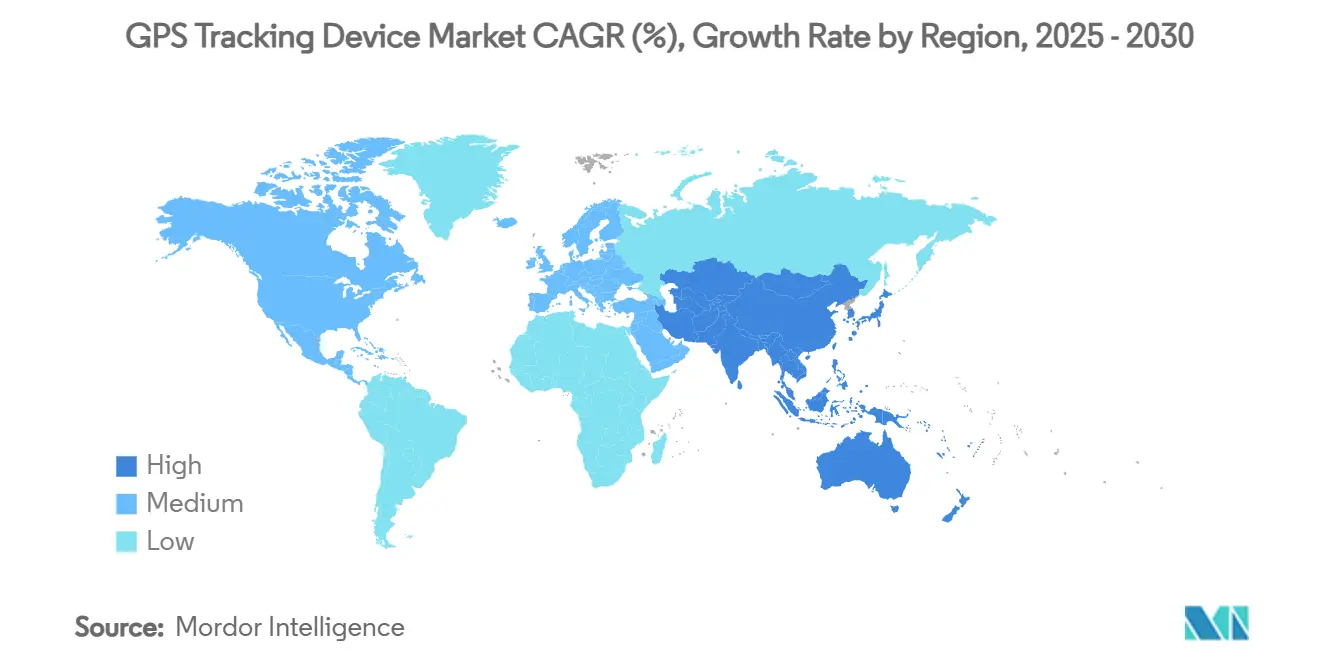
- By geography, North America led with 33.25% revenue share in 2024; Asia-Pacific is the fastest-growing region at 16.94% CAGR through 2030.
Note: Market size and forecast figures in this report are generated using Mordor Intelligence’s proprietary estimation framework, updated with the latest available data and insights as of January 2026.
Market Trends and Insights
Drivers Impact Analysis of GPS Tracking Device Market*
| Driver | (~) % Impact on CAGR Forecast | Geographic Relevance | Impact Timeline |
|---|---|---|---|
| Rapid expansion of e-commerce fleet operations | +2.5% | Global, with concentration in North America, Europe, and Asia-Pacific urban centers | Medium term (2-4 years) |
| Regulatory mandates on vehicle telematics and e-call systems | +1.8% | Europe leading, followed by North America and select Asia-Pacific markets | Long term (≥ 4 years) |
| Cost decline in GNSS chipsets and LPWAN modules | +1.2% | Global, with manufacturing advantages in Asia-Pacific | Short term (≤ 2 years) |
| Insurance industry shift to usage-based models | +0.9% | North America and Europe primary, expanding to emerging markets | Medium term (2-4 years) |
| Growing demand for wildlife anti-poaching collars | +0.7% | Africa, Asia-Pacific conservation areas, with research applications globally | Long term (≥ 4 years) |
| Rise of micro-GPS trackers for high-value micro-mobility assets | +0.6% | Urban centers globally, concentrated in Europe and North America | Short term (≤ 2 years) |
| Source: Mordor Intelligence | |||
Rapid Expansion of E-commerce Fleet Operations
Global parcel volumes and same-day delivery promises have forced last-mile networks to adopt real-time visibility platforms that merge GPS data with traffic analytics and weather feeds, trimming route costs by up to 15%.[1]Verizon Connect Team, “Top 6 Fleet Trends for 2025,” verizonconnect.com Multi-modal logistics—van, bike, drone—requires trackers that can transition seamlessly between LTE-M, NB-IoT, and terrestrial RF links without losing asset continuity. Cold-chain segments for groceries and pharmaceuticals rely on embedded temperature probes that trigger alerts when thresholds deviate, protecting brand equity and minimizing spoilage claims. Operators also demand AI engines that convert historical GNSS traces into dynamic dispatch schedules during peak seasons. The maturity of these integrations cements GPS tracking as core infrastructure within the e-commerce value chain rather than an optional add-on.
Regulatory Mandates on Vehicle Telematics and E-call Systems
The EU e-call regime now extends beyond crash alerts to encompass carbon-footprint reporting and advanced driver assistance logs, spurring pan-regional standardization of CAN-bus data access.[2]European Union, “Directive 2012/19/EU (WEEE),” eur-lex.europa.eu In the United States, expanded Electronic Logging Device rules effective 2025 will pull legacy trucks into compliance, potentially adding millions of new installations. Public-sector fleets follow the U.S. General Services Administration’s FedRAMP telematics blueprint that requires end-to-end encryption and third-party penetration tests.[3]U.S. General Services Administration, “GSA Fleet Telematics,” gsa.gov These policies create a non-cyclical revenue stream for solution providers and drive multi-region interoperability roadmaps across hardware and SaaS layers.
Cost Decline in GNSS Chipsets and LPWAN Modules
Dual-frequency receivers that once retailed above USD 80 are now below USD 15, delivering centimeter-level accuracy for precision agriculture and autonomous delivery robots. Mass-production clusters in Shenzhen and Incheon compress bill-of-materials costs while integrating multi-constellation support for GPS, Galileo, BeiDou, and GLONASS on a single die. Complementary LPWAN radios, notably NB-IoT and LoRaWAN, further reduce total cost of ownership by cutting monthly airtime fees by up to 70% in remote oil and gas deployments. These economics open the GPS tracking device market to small businesses and consumer pet trackers that historically lacked ROI.
Insurance Industry Shift to Usage-Based Models
Under telematics-driven policies, drivers who brake smoothly and avoid high-risk night routes receive discounted premiums, lowering claims frequency by nearly 40% among early adopters. Major carriers embed tamper-proof GPS modules that stream second-by-second G-force metrics, feeding actuarial engines that price risk dynamically. In commercial lines, coverage for hazmat fleets increasingly requires continuous GNSS reporting as a prerequisite for underwriting, converting insurance from a passive compensation product into an active risk-mitigation partnership.
Restraints Impact Analysis of GPS Tracking Device Market*
| Restraint | (~) % Impact on CAGR Forecast | Geographic Relevance | Impact Timeline |
|---|---|---|---|
| Data-privacy litigation risk in employee tracking | -1.1% | North America and Europe leading, expanding globally | Medium term (2-4 years) |
| Semiconductor supply-chain volatility | -0.8% | Global impact, with Asia-Pacific manufacturing concentration | Short term (≤ 2 years) |
| Illegal jamming/spoofing devices adoption | -0.6% | Global, with higher concentration in conflict zones and urban areas | Medium term (2-4 years) |
| Battery-disposal regulations for disposable trackers | -0.4% | Europe leading through WEEE directive, expanding to other developed markets | Long term (≥ 4 years) |
| Source: Mordor Intelligence | |||
Data-Privacy Litigation Risk in Employee Tracking
California’s proposed Location Privacy Act requires explicit opt-in consent and restricts geolocation retention windows, complicating nationwide rollout strategies for enterprise fleets. Parallel EEOC guidance warns employers about collecting biometric inferences via wearables, forcing legal, HR, and IT teams to rewrite data-governance playbooks. Multi-state carriers face patchwork rules that drive up compliance costs and delay expansion of telematics-linked safety programs.
Semiconductor Supply-Chain Volatility
GNSS RF front-ends rely on specialized gallium arsenide wafers produced by a handful of fabs; geopolitical shocks or facility shutdowns can triple lead times within weeks. To hedge, OEMs lock in 12-month buffer inventories, increasing working-capital needs and squeezing margins in price-sensitive consumer segments. Long-term, reshoring incentives in the United States and Europe may rebalance supply risks but will lift average selling prices during transition.
*Our forecasts treat driver/restraint impacts as directional, not additive. The impact forecasts reflect baseline growth, mix effects, and variable interactions.
GPS Tracking Device Market Segment Analysis
By Device Type:
Smart Trackers Drive InnovationIn 2024, OBD devices maintained dominance with a 42.34% share, largely because commercial fleets favor plug-and-play compliance solutions mandated by electronic logging regulations. The smart-tracker sub-category is surging at a 14.23% CAGR as enterprises seek integrated accelerometers, temperature probes, and edge AI that pre-empt equipment failures. Vendors are embedding RTK-enabled chipsets to achieve centimeter-grade accuracy, creating new use-cases in autonomous agricultural machinery and urban drone corridors.
The shift toward predictive maintenance positions smart trackers as the connective tissue of broader IoT ecosystems. Modular form factors allow field upgrades without full device swaps, extending hardware life cycles and reducing total cost of ownership. As firmware-over-the-air updates proliferate, software subscription revenues outpace hardware margins, reinforcing a service-led value proposition within the GPS tracking device market.



By Component:
Software Transformation AcceleratesHardware captured 62.39% of revenue in 2024, underscoring its status as foundational infrastructure for positioning, sensing, and connectivity. Nevertheless, software is forecast to compound at 15.98% CAGR, reflecting demand for cloud dashboards, machine-learning analytics, and open APIs that connect telematics data to ERP and TMS platforms. Advanced SaaS suites convert raw GNSS pings into driver risk scores, CO₂ emission dashboards, and predictive route plans, enabling C-suite decision-making aligned with ESG mandates.
In parallel, micro-services architectures permit rapid feature releases without hardware refreshes, locking customers into multi-year recurring contracts. System integrators bundle professional services-device provisioning, API integration, data-privacy audits-creating layered revenue streams that outlast hardware depreciation cycles. This software-centric pivot cements long-term platform stickiness within the GPS tracking device market.
By Application:
Asset Tracking Gains MomentumFleet management held 52.76% share in 2024, reflecting the segment’s maturity in route optimization, compliance, and fuel accountability. Asset tracking, however, is expanding at 13.67% CAGR as companies monitor everything from shipping containers to rental tools. Multi-sensor trackers combine vibration, tilt, and humidity readings, enabling real-time condition monitoring that unlocks insurance discounts and reduces theft losses.
Emerging sectors-including livestock monitoring and pharmaceutical cold-chains-demand low-power satellite links when cellular coverage lapses, broadening the application palette. Integrations with blockchain audit trails offer immutable proof-of-location, satisfying stringent chain-of-custody mandates for high-value goods. These capabilities augment the addressable scope of the GPS tracking device market across global trade lanes.
By End-user Vertical:
Construction and Mining Lead GrowthTransportation and logistics remained the largest buyer group with 45.87% of global demand in 2024 as regulatory compliance anchored telematics budgets. Meanwhile, construction and mining sites are scaling deployments at 12.05% CAGR to safeguard capital-intensive machinery in remote, theft-prone zones. Ruggedized trackers rated IP67 withstand dust, vibration, and extreme temperatures, feeding utilization dashboards that reveal idle equipment ready for redeployment.
Oil and gas operators overlay GPS data with gas-detector telemetry to enhance worker safety, while government agencies deploy encrypted units for mission-critical vehicle pools. Consumer adoption, although smaller in value, benefits from declining hardware costs as pet and personal trackers gain retail shelf space. Cross-vertical synergies, such as insurance-backed loss-prevention programs, further deepen penetration of the GPS tracking device market.
Geography Analysis
North America GPS Tracking Device Market
North America retained 33.25% share in 2024, propelled by stringent ELD mandates, usage-based insurance penetration, and heavy public-sector investment in telematics cybersecurity. Mature LTE and emerging 5G SA networks enable high-frequency ping rates essential for advanced driver-assistance analytics. Mexico’s near-shoring boom stimulates cross-border fleet integrations, elevating demand for bilingual dashboards and regional roaming SIMs.
APAC GPS Tracking Device Market
Asia-Pacific is the global growth engine with a 16.94% CAGR outlook. China’s dominance in GNSS module production compresses export prices and accelerates regional adoption. India’s national logistics portal now encourages GPS-verified milestone updates for freight rebates, prompting SMEs to install low-cost trackers. Japan and South Korea pilot V2X-linked location services inside smart-city corridors, showcasing 5G-assisted centimeter-level navigation for robo-taxis and automated forklifts.
Europe GPS Tracking Device Market
Europe maintains steady progression anchored by e-call extensions and environmental compliance frameworks. The WEEE directive motivates circular-design principles, pushing vendors toward recyclable enclosures and swappable battery packs. Eastern European logistics corridors connecting to Belt-and-Road rail routes adopt multi-constellation receivers to mitigate signal outages in mountainous terrain. Collectively these regional dynamics reinforce sustained global expansion of the GPS tracking device market.

Competitive Landscape
The market is moderately fragmented; top suppliers collectively hold an estimated 35-40% revenue, leaving room for specialized entrants. In November 2024, Powerfleet closed its USD 229 million purchase of MiX Telematics to gain scale in South Africa and Latin America while integrating MiX’s AI-driven driver safety algorithms into Powerfleet’s IoT stack. Garmin’s Auto-OEM division posted 24% YoY growth in 2024, reflecting automaker demand for embedded infotainment modules with onboard GNSS analytics.
Product strategies emphasize hardened security. Vendors such as TomTom license anti-spoofing patents that fuse inertial measurement with encrypted SBAS corrections, shielding fleets operating near GNSS-denied zones. Others invest in edge AI that executes geofence breach detection on-device, minimizing cloud dependency and latency. Industry participants also court vertical partnerships; Quectel’s launch of its LG580P module pairs with agriculture OEMs to offer plug-and-plant autonomy kits, illustrating ecosystem-based competition.
Private-equity activity remains robust as telematics recurring revenue appeals to infrastructure investors. However, liabilities surfaced when CalAmp filed for Chapter 11 in 2024, underscoring margin pressure on legacy hardware-centric models. Going forward, the ability to blend subscription software growth with secure, high-accuracy hardware will differentiate leaders within the GPS tracking device market.
GPS Tracking Device Industry Leaders
CalAmp Corp.
Sierra Wireless Inc.
TomTom International B.V.
ORBCOMM Inc.
Queclink Wireless Solutions Co., Ltd.
- *Disclaimer: Major Players sorted in no particular order
GPS Tracking Device Market Companies Covered in this Report
- CalAmp Corp.
- Sierra Wireless Inc.
- TomTom International B.V.
- ORBCOMM Inc.
- Queclink Wireless Solutions Co., Ltd.
- Jimi IoT Co., Ltd. (Concox)
- Teltonika Telematics UAB
- Geotab Inc.
- Trackimo LLC
- Shenzhen Coban Electronics Co., Ltd.
- Ruptela UAB
- Sensata Insights (SmartWitness)
- Positioning Universal Inc.
- Meitrack Group
- Laipac Technology Inc.
- Laird Connectivity LLC
- Garmin Ltd.
- Xirgo Technologies LLC
- Suntech International USA Inc.
- ATrack Technology Inc.

Recent Industry Developments in GPS Tracking Device Market
- March 2025: Quectel introduced the LG580P multi-band RTK GNSS module, delivering centimeter accuracy for autonomous vehicles and precision farming. The move positions Quectel to capture high-margin verticals that require sub-meter tracking and strengthens its middleware ecosystem partnership strategy .
- February 2025: California’s Assembly Bill 1355 (Location Privacy Act) proposed opt-in consent for geolocation data, prompting telematics vendors to accelerate privacy-by-design roadmaps and bolster in-device anonymization features to retain Californian enterprise clients.
- January 2025: The EEOC released wearable-technology guidance, signaling heightened regulatory oversight; vendors responded by issuing HR compliance toolkits and data-retention policy templates to safeguard enterprise adoption.
- November 2024: Powerfleet reported USD 77 million Q2 2025 revenue and USD 13.5 million synergy savings six months after acquiring MiX Telematics, validating its integration playbook and cross-selling expansion in the GPS tracking device market.


Global GPS Tracking Device Market Report Scope
| Stand-Alone Tracker |
| OBD Device |
| Advance/Smart Tracker |
| Hardware |
| Software |
| Services |
| Fleet Management |
| Asset Tracking |
| Personal and Pet |
| Marine and Aviation |
| Others (Law-Enforcement, Wildlife, Agriculture) |
| Transportation and Logistics |
| Construction and Mining |
| Oil and Gas |
| Government and Defense |
| Consumer |
| Other End-user Verticals |
| North America | United States | |
| Canada | ||
| Mexico | ||
| Europe | Germany | |
| United Kingdom | ||
| France | ||
| Italy | ||
| Spain | ||
| Russia | ||
| Rest of Europe | ||
| Asia-Pacific | China | |
| Japan | ||
| South Korea | ||
| India | ||
| Australia | ||
| Rest of Asia-Pacific | ||
| South America | Brazil | |
| Argentina | ||
| Chile | ||
| Colombia | ||
| Rest of South America | ||
| Middle East and Africa | Middle East | Saudi Arabia |
| United Arab Emirates | ||
| Turkey | ||
| Rest of Middle East | ||
| Africa | South Africa | |
| Nigeria | ||
| Kenya | ||
| Rest of Africa | ||
| By Device Type | Stand-Alone Tracker | ||
| OBD Device | |||
| Advance/Smart Tracker | |||
| By Component | Hardware | ||
| Software | |||
| Services | |||
| By Application | Fleet Management | ||
| Asset Tracking | |||
| Personal and Pet | |||
| Marine and Aviation | |||
| Others (Law-Enforcement, Wildlife, Agriculture) | |||
| By End-user Vertical | Transportation and Logistics | ||
| Construction and Mining | |||
| Oil and Gas | |||
| Government and Defense | |||
| Consumer | |||
| Other End-user Verticals | |||
| By Geography | North America | United States | |
| Canada | |||
| Mexico | |||
| Europe | Germany | ||
| United Kingdom | |||
| France | |||
| Italy | |||
| Spain | |||
| Russia | |||
| Rest of Europe | |||
| Asia-Pacific | China | ||
| Japan | |||
| South Korea | |||
| India | |||
| Australia | |||
| Rest of Asia-Pacific | |||
| South America | Brazil | ||
| Argentina | |||
| Chile | |||
| Colombia | |||
| Rest of South America | |||
| Middle East and Africa | Middle East | Saudi Arabia | |
| United Arab Emirates | |||
| Turkey | |||
| Rest of Middle East | |||
| Africa | South Africa | ||
| Nigeria | |||
| Kenya | |||
| Rest of Africa | |||


Key Questions Answered in the Report
What is the current size of the GPS tracking device market?
The GPS tracking device market size stands at USD 4.25 billion in 2025 and is projected to hit USD 7.43 billion by 2030.
Which region grows the fastest in GPS tracking adoption?
Asia-Pacific leads with a forecast 16.94% CAGR to 2030, propelled by industrial digitization and low-cost hardware manufacturing.
What segment dominates the market today?
Fleet management applications account for 52.76% of global revenue owing to regulatory compliance and route-optimization imperatives.
How are smart trackers different from traditional OBD devices?
Smart trackers integrate multi-sensor arrays and edge AI, enabling predictive maintenance and centimeter-level accuracy, whereas traditional OBD devices focus on basic vehicle diagnostics and location reporting.
What is driving insurance companies toward GPS-enabled policies?
Usage-based insurance leverages real-time driving data to tailor premiums, reducing claims costs and rewarding safe behavior, thus incentivizing carriers to mandate GPS telematics.
Why are insurers embracing GPS-enabled usage-based policies?
Real-time driving data lets insurers tailor premiums and curb claims, turning GPS tracking into a prerequisite for coverage in high-risk or commercial fleets.
Page last updated on:





