
Vehicle Recycling Market Size and Share
Market Overview
| Study Period | 2019 - 2031 |
|---|---|
| Market Size (2026) | USD 131.98 Billion |
| Market Size (2031) | USD 243.06 Billion |
| Growth Rate (2026 - 2031) | 12.99 % |
| Fastest Growing Market | Asia Pacific |
| Largest Market | North America |
| Market Concentration | Medium |
Major Players *Disclaimer: Major Players sorted in no particular order Image © Mordor Intelligence. Reuse requires attribution under CC BY 4.0. | |
Vehicle Recycling Market Analysis by Mordor Intelligence
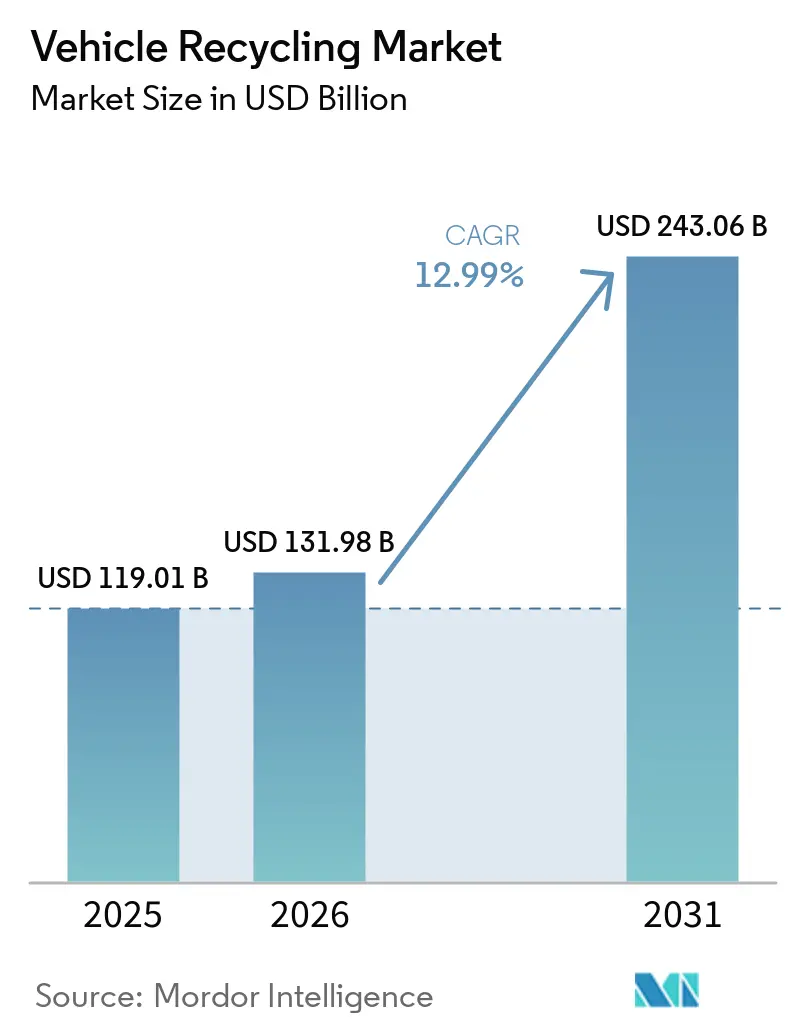
The Vehicle Recycling Market size was valued at USD 119.01 billion in 2025 and estimated to grow from USD 131.98 billion in 2026 to reach USD 243.06 billion by 2031, at a CAGR of 12.99% during the forecast period (2026-2031). As tightening end-of-life vehicle (ELV) directives come into play and OEMs commit to closed-loop sourcing, certified dismantlers are seeing their margins rise. In March 2026, copper scrap prices highlighted a price gap that benefits secondary feedstock, with aluminum scrap showing similar trends in 2025. While passenger cars led in terms of volume in 2025, commercial fleets are increasingly adopting electrified drivetrains. This shift is expanding the streams of high-voltage batteries, which necessitate specialized depollution. Parts turnover is accelerating due to automated digital auctions. At the same time, vertical integration—from collection to secondary smelting—is granting larger players advantages in cost and traceability. However, capital remains a significant hurdle in emerging regions. Here, informal yards continue to undercut formal operators on vehicle buy-in prices.
Key Report Takeaways
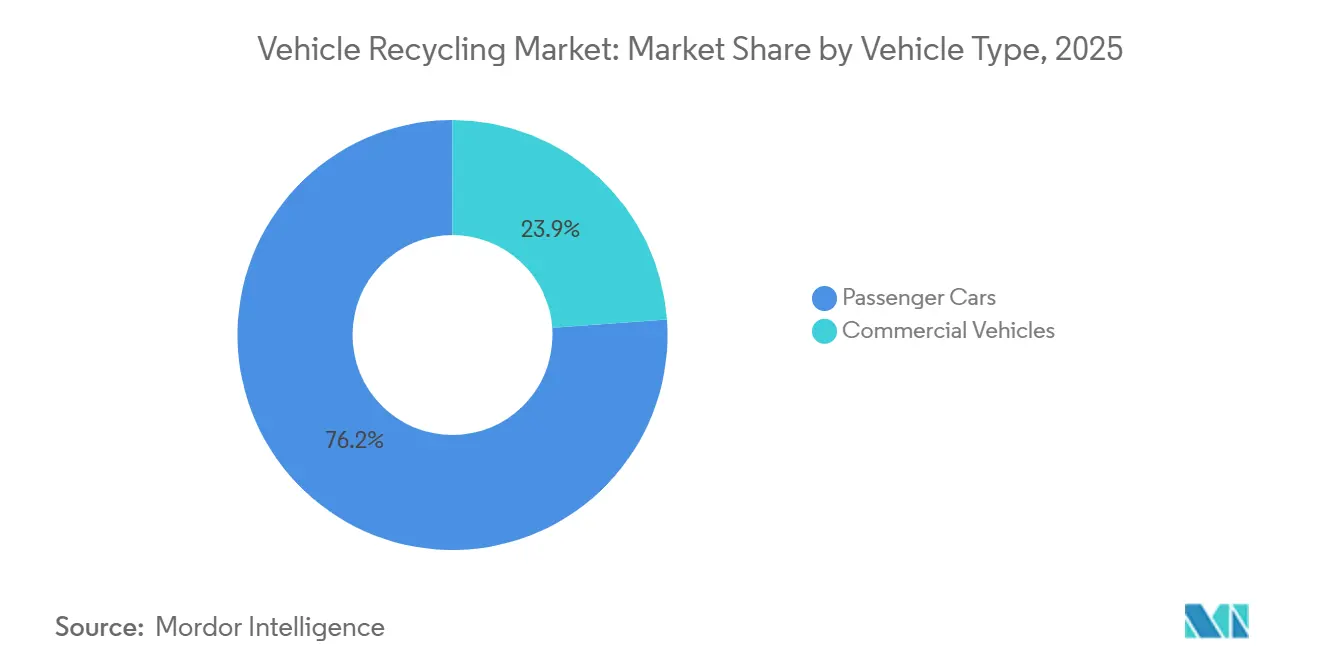
- By vehicle type, passenger cars led with 76.15% of the vehicle recycling market share in 2025, while commercial vehicles are projected to expand at a 13.21% CAGR to 2031.
- By material, iron and steel accounted for 60.34% of the vehicle recycling market size in 2025, and aluminum is advancing at a 13.68% CAGR through 2031.
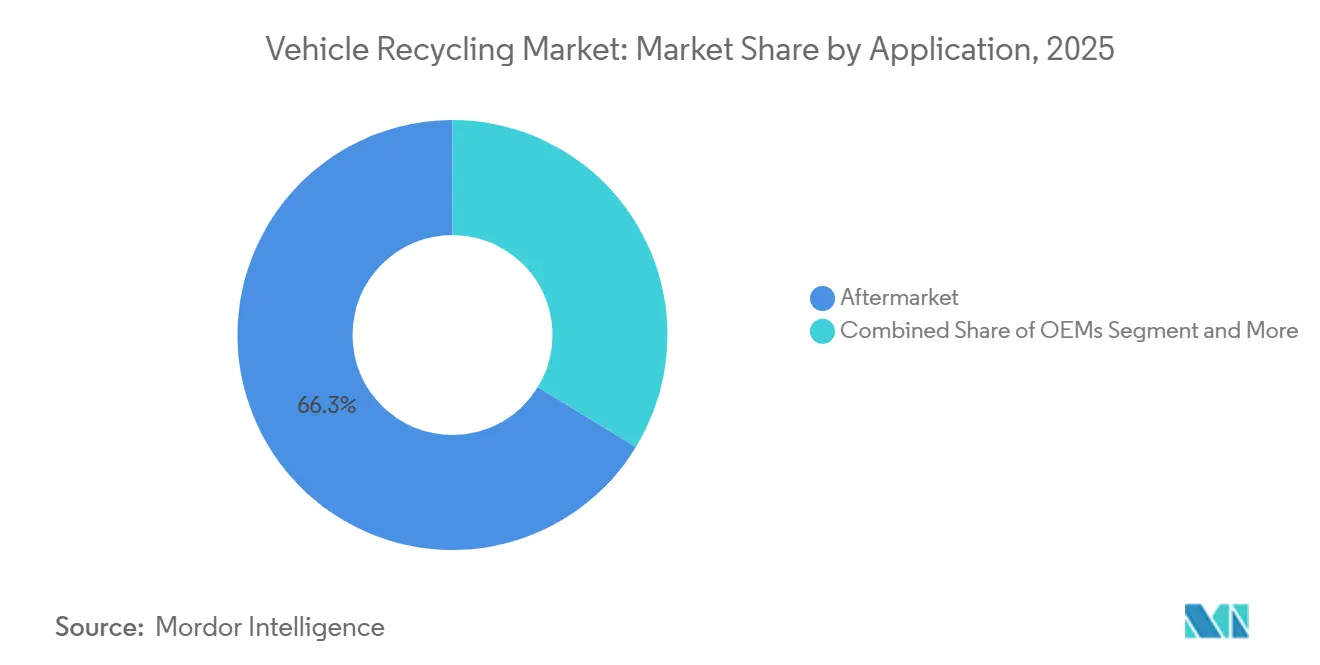
- By application, aftermarket channels held 66.28% of the vehicle recycling market share in 2025, whereas scrap processors and dismantlers recorded the highest forecast CAGR at 15.32% to 2031.
- By the recycling process, manual dismantling and depollution captured 58.18% of the vehicle recycling market share in 2025, and advanced Li-ion battery recycling is forecast to grow at 16.44% CAGR through 2031.
- By geography, North America held 44.27% of the vehicle recycling market share in 2025, and Asia-Pacific is forecast to grow at 14.13% CAGR through 2031.
Note: Market size and forecast figures in this report are generated using Mordor Intelligence’s proprietary estimation framework, updated with the latest available data and insights as of January 2026.
Market Trends and Insights
Drivers Impact Analysis of Vehicle Recycling Market*
| Driver | (~) % Impact on CAGR Forecast | Geographic Relevance | Impact Timeline |
|---|---|---|---|
| ELV Directives in EU, China, India | +2.3% | EU core, China and India rapid adoption | Medium term (2-4 years) |
| Recycled Aluminum and Steel | +2.1% | Asia-Pacific core, spill-over to North America | Medium term (2-4 years) |
| Volatile Virgin-Metal Prices | +1.9% | Global, acute in North America and EU | Short term (≤ 2 years) |
| AI-Enabled Robotic Dismantling | +1.7% | North America and EU, pilot deployments in Asia-Pacific | Medium term (2-4 years) |
| OEM Closed-Loop Traceability | +1.5% | North America and EU | Long term (≥ 4 years) |
| Digital Salvage Auctions Speed | +1.4% | North America, expanding to EU and Asia-Pacific | Short term (≤ 2 years) |
| Source: Mordor Intelligence | |||
Stringent ELV Directives in EU, China, India
Revised rules in the European Union mandate that 15% of plastic in new cars be recycled by 2032 and require automakers to publish disassembly guides, which shifts bargaining power toward certified yards able to supply clean, traceable scrap [1]“Revision of the End-of-Life Vehicles Directive,” European Commission, europa.eu . India’s ELV Management Rules introduce escalating steel-recovery targets and a centralized tracking portal to channel fleets to registered scrapping facilities. Chinese provinces such as Guangdong tie subsidies to proof of certified recycling, nudging owners away from informal dismantlers. The directives have widened the compliance gap, lifting premiums for provenance-verified material. ASEAN is drafting battery passport norms that extend similar traceability to lithium-ion cells, creating an aligned regulatory block.
Recycled Aluminum and Steel Critical for Lightweight EV Frames
BYD and Hantek have introduced a one-piece aluminum frame that replaces numerous stamped components, reduces curb mass, and incorporates recycled content, highlighting the connection between lightweighting and secondary metal flows. Recycling aluminum not only conserves resources but also significantly reduces carbon emissions, a key figure often highlighted by automakers in their fleet-average disclosures. Rivian’s pickup, using scrap-sourced aluminum, manages to maintain a competitive weight even with a sizable battery. This achievement underscores the possibility of aligning EV payload objectives with the use of recycled materials. In the realm of commercial trucks, mini-mill steelmakers like Nucor are integrating automotive shred into their furnaces. This strategy not only reduces costs but also diminishes scope-3 emissions. The Asia-Pacific region, witnessing a rapid surge in electric vehicle adoption, is now producing less scrap than it needs to meet its growing demand, leading to a burgeoning trans-Pacific trade in sorted aluminum.
Volatile Virgin-Metal Prices Push OEM Demand for Scrap Feedstock
Copper and aluminum price swings are provoking long-term supply contracts with recyclers. Ford and Novelis run a closed loop that recycles F-150 production scrap into body sheet, cutting energy use by 95% compared with primary smelting [2]“Closed-Loop Aluminum Recycling,” Ford Motor Company, ford.com. Volvo harnesses blockchain technology to authenticate the journey of recycled aluminum, enabling auditors to align each melt batch with its corresponding dismantler lot. Currently, premiums for chemistry-controlled scrap offer consistent margins, in contrast to the unpredictability of futures. In North America and the EU, where labor costs render manual alloy separation costly, OEMs are increasingly co-investing in sorting enhancements at their partner yards.
AI-Enabled Robotic Dismantling Boosts Recovery Yields
Machine-vision-guided arms now detach catalytic converters and wiring harnesses with high accuracy, reducing contamination between ferrous and non-ferrous flows. Radius Recycling’s Portland pilot improved alloy-specific yields through hyperspectral sorting. Copart grades damage photos quickly, significantly reducing auction cycles and raising sale prices. Battery packs remain the frontier; prototype robots in Japan sense residual charge before gripping modules, an advance not yet commercialized. Investors view automation as a hedge against acute labor shortages in the United States and Europe.
Restraints Impact Analysis of Vehicle Recycling Market*
| Restraint | (~) % Impact on CAGR Forecast | Geographic Relevance | Impact Timeline |
|---|---|---|---|
| Advanced Shredding and Depollution | -1.6% | Global, acute in emerging Asia-Pacific and South America | Medium term (2-4 years) |
| Fragmented ELV Collection Channels | -1.3% | India, Brazil, Nigeria, Egypt, Mexico | Long term (≥ 4 years) |
| Safety Risks of High-Voltage Battery | -0.9% | Global, regulatory gaps in the Middle East, Africa, and South America | Short term (≤ 2 years) |
| Fiber-Reinforced Composite Recycling | -0.7% | EU and North America luxury segments | Long term (≥ 4 years) |
| Source: Mordor Intelligence | |||
High CAPEX for Advanced Shredding and Depollution Lines
Aurubis invested in a Georgia copper-recycling plant, achieving exceptional purity levels with its advanced plasma furnaces. This level of purity remains out of reach for many operators in emerging markets. To illustrate, midsize shredders with optical sorters and compliant battery-depollution bays incur high costs. In India and Nigeria, local lenders classify such projects as high-risk, resulting in elevated interest rates. This financial burden reinforces the dominance of low-cost informal yards, which offer lower payouts for end-of-life vehicles than formal facilities. Certified sites face challenges with under-utilization; for example, India’s registered yards operated at minimal capacity during the fiscal year 2024-2025. Without access to concessional finance, the expansion of these facilities struggles to keep pace with growing demand.
Fragmented ELV Collection Channels in Emerging Countries
By 2025, India faced a significant gap in infrastructure for handling End-of-Life Vehicles (ELVs), with an insufficient number of Automated Testing Stations to meet its targets. This gap has driven many vehicle owners to rely on informal scrap buyers. Similarly, both Nigeria and Mexico experience comparable challenges. In these countries, valuable components such as engines and catalytic converters are often stripped from vehicles, leaving the hulks abandoned and causing environmental concerns, including soil contamination. Weak enforcement of regulations enables informal yards to undercut formal operations, reducing throughput for certified plants. Meanwhile, Brazil's proposed take-back mandate stalled in 2025 due to fiscal constraints. The fragmented flow of feedstock leaves certified capacities underutilized and forces OEMs to import traceable scrap at higher costs.
*Our forecasts treat driver/restraint impacts as directional, not additive. The impact forecasts reflect baseline growth, mix effects, and variable interactions.
Vehicle Recycling Market Segment Analysis
By Vehicle Type:
Fleet Electrification Accelerates Commercial RecyclingCommercial vehicles are forecast to grow at a 13.21% CAGR through 2031, although passenger cars accounted for 76.15% of the vehicle recycling market revenue in 2025. Battery-electric vans, buses, and medium-duty trucks contain dense battery packs that increase per-unit scrap value and support investment in high-voltage depollution bays. Class 8 trucks generate significantly more recyclable metal than compact sedans, increasing revenue per vehicle. In North America, vehicle recycling volumes remain stable as the average passenger car age reached a record high in 2025. In Europe, the rapid phaseout of internal combustion engine (ICE) vehicles accelerates scrappage rates and increases the flow of end-of-life vehicles to recycling yards. Regulations further emphasize regional differences. In India, fleets exceeding a specified age must undergo fitness tests, supporting a steady supply of vehicles for recycling. However, private cars often enter informal yards, where operators strip parts without following proper recycling practices.
Secondary effects further reinforce these dynamics. Commercial fleet operators increasingly incorporate battery buyback guarantees into their lease structures, strengthening partnerships with certified recyclers. Stricter EU depollution regulations for larger vehicles increase compliance costs for informal operators, gradually shifting market share toward larger certified plants. In 2025, a major shipment of electric buses drove up battery pack volumes. Although passenger car recycling in emerging regions has a larger base, it remains fragmented and faces regulatory delays, contributing to its slower CAGR.


By Material:
Aluminum’s Lightweighting Premium Drives Share GainsIron and steel accounted for 60.34% of the vehicle recycling market revenue in 2025, but aluminum is set to expand by 13.68% annually through 2031 as automakers prioritize lightweight structures. Aluminum substitution becomes appealing as reducing vehicle mass enhances EV range. The Yangwang U8L frame, consolidating multiple parts into a single casting, incorporates recycled content, highlighting a design trend towards circularity. Ford, in collaboration with Novelis, has established a closed-loop system that reintroduces scrap coils into fresh body sheets within weeks. This not only shields margins from fluctuations in spot prices but also significantly reduces energy consumption. Meanwhile, Nucor's mini-mills are capitalizing on the trend, channeling automotive shred into electric furnaces, resulting in cost savings on raw material imports.
Regional supply-demand disparities influence trade dynamics. The Asia-Pacific region, witnessing a rapid surge in EV adoption, grapples with a shortage of end-of-life aluminum. This shortfall has led to a reliance on imports of sorted scrap from North America and Europe, where vehicles tend to be older. Copper, despite being lighter in tonnage, commands a premium price. This premium positioning turns the recovery of motors and harnesses into a lucrative venture. On the other hand, plastics and glass are not reaping their due financial rewards. The challenge lies in mixed substrates, which hinder the efficiency of mechanical recycling. However, the EU is taking proactive steps, aiming to bridge this gap with a recycled-plastic mandate set for 2032.
By Application:
Scrap Processors Gain as Formal Networks ExpandAftermarket parts accounted for 66.28% of the vehicle recycling market's revenue in 2025. Yet, scrap processors and dismantlers are poised for a 15.32% CAGR through 2031, the fastest among applications in the vehicle recycling market. India’s ELV law sets stepped steel-recovery obligations and digital tracking, channeling vehicles to registered facilities despite only 156 test stations running in 2025. The EU’s revised directive obliges automakers to disclose material bills and disassembly steps, effectively compelling them to tie up with certified processors that can supply batch-level data. Toyota Tsusho’s purchase of Radius Recycling adds several yards to its metals supply chain, ensuring that melt shops receive steady feedstock without speculative buying [3]“Acquisition of Radius Recycling,” Toyota Tsusho Corporation, toyotatsusho.com.
As fleets age, the aftermarket benefits, especially with remanufactured parts, offer significant cost savings. In 2025, LKQ reported strong free cash flow and divested its Self Service unit, redirecting focus to higher-margin collision and battery remanufacturing through a partnership with Princeton NuEnergy. While OEMs sourcing certified scrap directly is still niche, it's on the rise, bolstered by maturing digital provenance, with Volvo's blockchain pilot leading the way. Processors adopting ISO 14001 certification and IoT-based batch tagging see price premiums and recoup their IT investments within a few years.

By Recycling Process:
Battery Recycling Leads Process InnovationManual dismantling and depollution still accounted for 58.18% of the vehicle recycling market revenue in 2025. Still, advanced Li-ion battery recycling will post a 16.44% CAGR through 2031, redefining process economics within the vehicle recycling market. Legacy depollution relies on hand tools for fluid draining and airbag removal, exposing workers to chemical burns and repetitive strain injuries. At Radius Recycling’s Portland plant, AI-guided shredders, in tandem with eddy-current and optical sorters, have significantly improved aluminum alloy recovery yields. However, a notable portion of the input still ends up as shredder residue in landfills.
In battery recycling, a combination of pyrometallurgy and hydrometallurgy achieves high purities of cobalt and lithium. Li-Cycle, now owned by Glencore, uses a spoke-and-hub model that scales mechanical shredding operations near scrap sources and refines black mass at a central hub. Following project delays, the Rochester hub commenced operations in mid-2026. Safety remains a critical consideration, as each robotic depollution bay requires real-time voltage monitoring and entails high costs. Furthermore, since 2024, insurance premiums for high-voltage tasks have increased. In the U.S., regulatory inconsistencies are evident, especially when juxtaposed with California’s stringent voltage isolation requirements. Meanwhile, the EU offers guidelines but delegates enforcement to its member states.
Geography Analysis
North America Vehicle Recycling Market
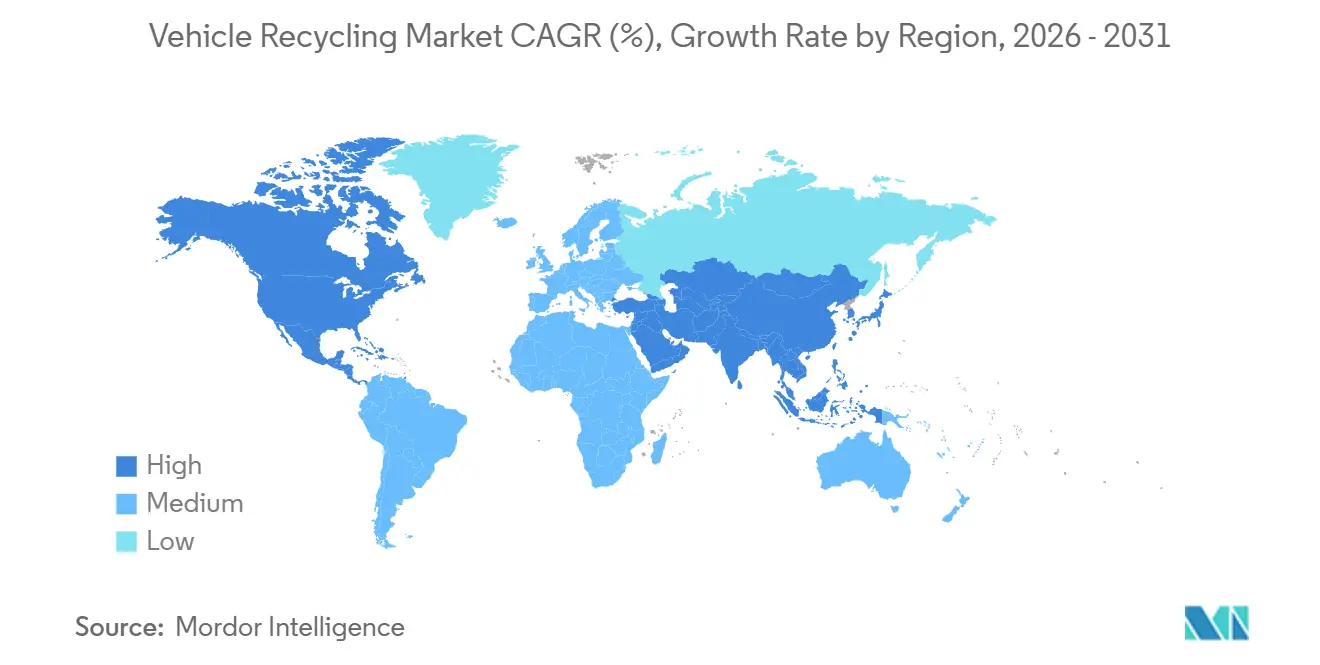
North America accounted for 44.27% of the vehicle recycling market revenue in 2025, supported by an average fleet age that funnels a steady stream of ELVs to dismantlers. Digital sales dominated, with a substantial portion of Insurance Auto Auctions’ transactions occurring online, reducing inventory days and enhancing returns. Copart used AI grading, enabling a single car listing to attract buyers across NAFTA borders and resulting in prices that surpassed pre-digital benchmarks. In a strategic move, LKQ divested its Self Service division to focus on collision parts and battery modules, signaling a shift towards more profitable streams. Meanwhile, the lack of federal ELV legislation allowed states to implement varied rules, introducing compliance challenges but minimal enforcement.
APAC Vehicle Recycling Market
Asia-Pacific is set for a 14.13% CAGR to 2031. By 2030, India’s ELV stock will double to 50 million, yet formal yards will process only a small fraction of vehicles due to a persistent price gap with informal buyers [4]“Registered Vehicle Scrapping Facility Data 2025,” Ministry of Road Transport and Highways, India, morth.gov.in. In China, provincial subsidies in regions like Guangdong and Zhejiang are directing EV scrap to certified plants, although national legislation remains inconsistent. BYD's aluminum-heavy EV frames are driving demand for clean secondary metals. Japan's mature law achieves high recovery rates but faces consolidation challenges due to cost pressures. Meanwhile, ASEAN's 2025 draft for a battery passport is set to mandate cell-level traceability across borders, raising standards for formal recyclers.
EMEA and South America Vehicle Recycling Market
Europe’s updated End-of-Life Vehicles (ELV) Directive, finalized in 2024, requires automakers to adopt circular design principles and meet recycled-plastic targets, thereby driving investment in chemical recycling. While Northern Europe boasts a dense network of certified facilities, Southern and Eastern regions still see a significant portion of ELVs funneled to informal yards. Aurubis, reflecting trans-Atlantic material dynamics, is sourcing European scrap for its newly established U.S. smelter. In contrast, South America and the Middle East & Africa lag, struggling with voluntary or under-funded take-back regulations. Brazil's take-back mandate has stalled, and in Nigeria, informal yards operate unchecked, contaminating groundwater without facing repercussions.

Competitive Landscape
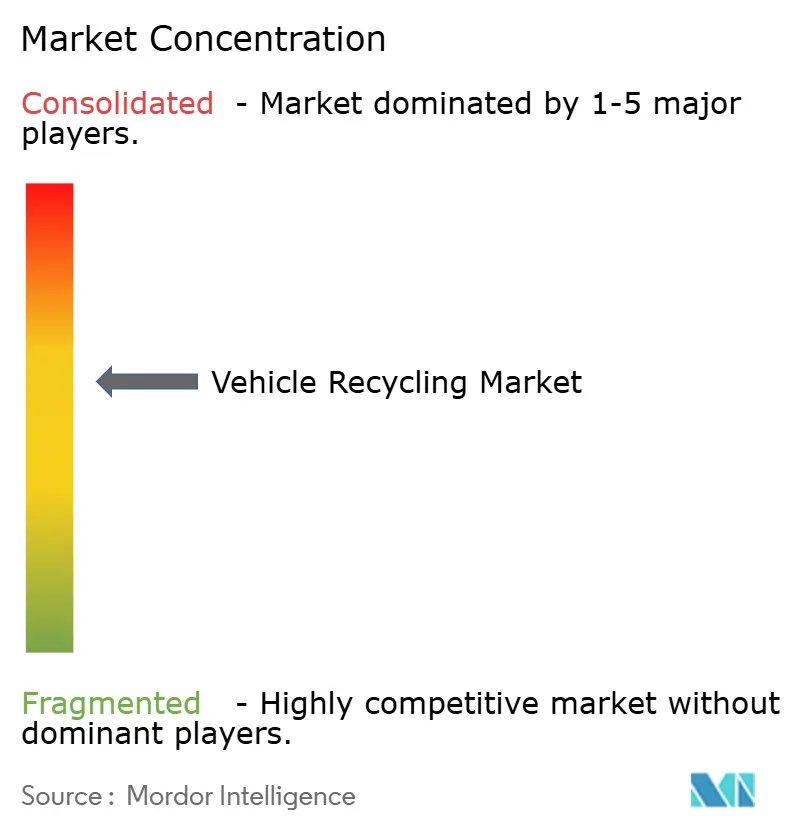
The vehicle recycling market exhibits moderate fragmentation, with a significant portion of global revenues concentrated among the top companies. Strategic moves in the market are primarily focused on achieving scale integration. For instance, Toyota Tsusho has expanded its operations by acquiring Radius Recycling, which includes numerous facilities and stores. These additions are expected to support a joint venture in North Carolina, aimed at battery materials production starting in the coming years. Similarly, Aurubis has allocated resources to establish a copper complex in Georgia to recycle automotive harness scrap.
Technological advancements are playing a pivotal role in reshaping the competitive landscape. Copart’s digital platform enhances operational efficiency by automating damage inspections and enabling cross-border bids, thereby improving recovery outcomes. LKQ has also leveraged technology through its portal, enabling efficient parts sourcing across a wide network of affiliates. Additionally, Radius Recycling has implemented advanced sorting technology to improve aluminum yields, while Volvo’s blockchain tracking system is enabling manufacturers to secure premiums for low-carbon alloys.
However, the high capital requirements pose a barrier to new entrants; establishing a compliant shredder line demands a significant investment, and battery-bay insurance costs are on the rise. The trend of consolidation is evident, as seen in Glencore's recent acquisition of Li-Cycle. Industry insiders anticipate further mergers, especially in regions that remain underserved and where securing feedstock guarantees proves challenging. Companies that adeptly navigate both traceability technology and regional collection strategies are poised to seize a larger share of the burgeoning vehicle recycling market.
Vehicle Recycling Industry Leaders
Sims Metal
European Metal Recycling Limited
Radius Recycling, Inc.
Scholz Recycling GmbH
Hensel Recycling Group
- *Disclaimer: Major Players sorted in no particular order
Vehicle Recycling Market Companies Covered in this Report
- ASM Auto Recycling Ltd.
- Ecobat
- Hensel Recycling Group
- INDRA Automobile Recycling
- Keiaisha Co., Ltd.
- Radius Recycling, Inc.
- Scholz Recycling GmbH
- Sims Metal
- European Metal Recycling Limited
- Nucor Corporation
- Aurubis AG
- Toyota Tsusho Corporation
- Hyundai Glovis
- Li-Cycle Holdings Corp.

Recent Industry Developments in Vehicle Recycling Market
- August 2026: Tata Motors opened a registered vehicle scrapping facility in Patna, expanding its network of such centers across India to 12. The facility, named Re.Wi.Re can dismantle up to 15,000 vehicles annually, strengthening the company’s presence in India’s still-nascent end-of-life vehicle recycling business.
- July 2026: Ashok Leyland partnered with Rosmerta Recycling to facilitate the responsible scrappage of end-of-life commercial vehicles across India. The partnership supports the Government of India’s Voluntary Vehicle Modernization Program, which encourages the replacement of older, polluting vehicles with cleaner, more efficient alternatives.
- February 2026: BMW Group and PreZero established a closed-loop program for European end-of-life vehicles (ELVs) at the IPAI campus in Heilbronn, Germany.


Global Vehicle Recycling Market Report Scope
The scope includes segmentation by vehicle type (passenger cars and commercial vehicles), material (iron and steel, aluminum, rubber, copper, glass, plastic, and others), application (OEMs, aftermarket, and scrap processors/dismantlers), and recycling process (manual dismantling and depollution, shredding and magnetic/eddy sorting, and advanced Li-ion battery recycling). The analysis also covers regional-level segmentation, including North America, South America, Europe, Asia-Pacific, the Middle East, and Africa. Market size and growth forecasts are presented in USD by value.
| Passenger Cars |
| Commercial Vehicles |
| Iron and Steel |
| Aluminum |
| Rubber |
| Copper |
| Glass |
| Plastic |
| Others |
| Original Equipment Manufacturers (OEMs) |
| Aftermarket |
| Scrap Processors/Dismantlers |
| Manual Dismantling and Depollution |
| Shredding and Magnetic/Eddy Sorting |
| Advanced Li-ion Battery Recycling |
| North America | United States |
| Canada | |
| Rest of North America | |
| South America | Brazil |
| Argentina | |
| Rest of South America | |
| Europe | Germany |
| France | |
| United Kingdom | |
| Italy | |
| Spain | |
| Russia | |
| Rest of Europe | |
| Asia-Pacific | China |
| Japan | |
| India | |
| South Korea | |
| Australia | |
| Rest of Asia-Pacific | |
| Middle East and Africa | Saudi Arabia |
| United Arab Emirates | |
| Turkey | |
| South Africa | |
| Nigeria | |
| Egypt | |
| Rest of Middle East and Africa |
| By Vehicle Type | Passenger Cars | |
| Commercial Vehicles | ||
| By Material | Iron and Steel | |
| Aluminum | ||
| Rubber | ||
| Copper | ||
| Glass | ||
| Plastic | ||
| Others | ||
| By Application | Original Equipment Manufacturers (OEMs) | |
| Aftermarket | ||
| Scrap Processors/Dismantlers | ||
| By Recycling Process | Manual Dismantling and Depollution | |
| Shredding and Magnetic/Eddy Sorting | ||
| Advanced Li-ion Battery Recycling | ||
| By Geography | North America | United States |
| Canada | ||
| Rest of North America | ||
| South America | Brazil | |
| Argentina | ||
| Rest of South America | ||
| Europe | Germany | |
| France | ||
| United Kingdom | ||
| Italy | ||
| Spain | ||
| Russia | ||
| Rest of Europe | ||
| Asia-Pacific | China | |
| Japan | ||
| India | ||
| South Korea | ||
| Australia | ||
| Rest of Asia-Pacific | ||
| Middle East and Africa | Saudi Arabia | |
| United Arab Emirates | ||
| Turkey | ||
| South Africa | ||
| Nigeria | ||
| Egypt | ||
| Rest of Middle East and Africa | ||


Key Questions Answered in the Report
How large is the vehicle recycling market, and what is its future outlook?
The vehicle recycling market size stood at USD 131.98 billion in 2026 and is projected to reach USD 243.06 billion by 2031, growing at a 12.99% CAGR through 2031.
Which segment shows the fastest growth through 2031?
Advanced Li-ion battery recycling posts the highest forecast CAGR at 16.44% as EV packs flood end-of-life streams.
Why is aluminum recycling gaining share?
Automakers use more recycled aluminum to cut EV weight and carbon footprint, driving a 13.68% CAGR for the metal segment.
What hampers formal recycling growth in emerging economies?
High capital costs and fragmented ELV collection let informal yards underbid, limiting feedstock for registered facilities.
Page last updated on:





