
Utility Terrain Vehicles Market Size and Share
Market Overview
| Study Period | 2019 - 2031 |
|---|---|
| Market Size (2026) | USD 7 Billion |
| Market Size (2031) | USD 9.01 Billion |
| Growth Rate (2026 - 2031) | 5.17 % |
| Fastest Growing Market | Asia Pacific |
| Largest Market | North America |
| Market Concentration | Medium |
Major Players *Disclaimer: Major Players sorted in no particular order Image © Mordor Intelligence. Reuse requires attribution under CC BY 4.0. | |
Utility Terrain Vehicles Market Analysis by Mordor Intelligence
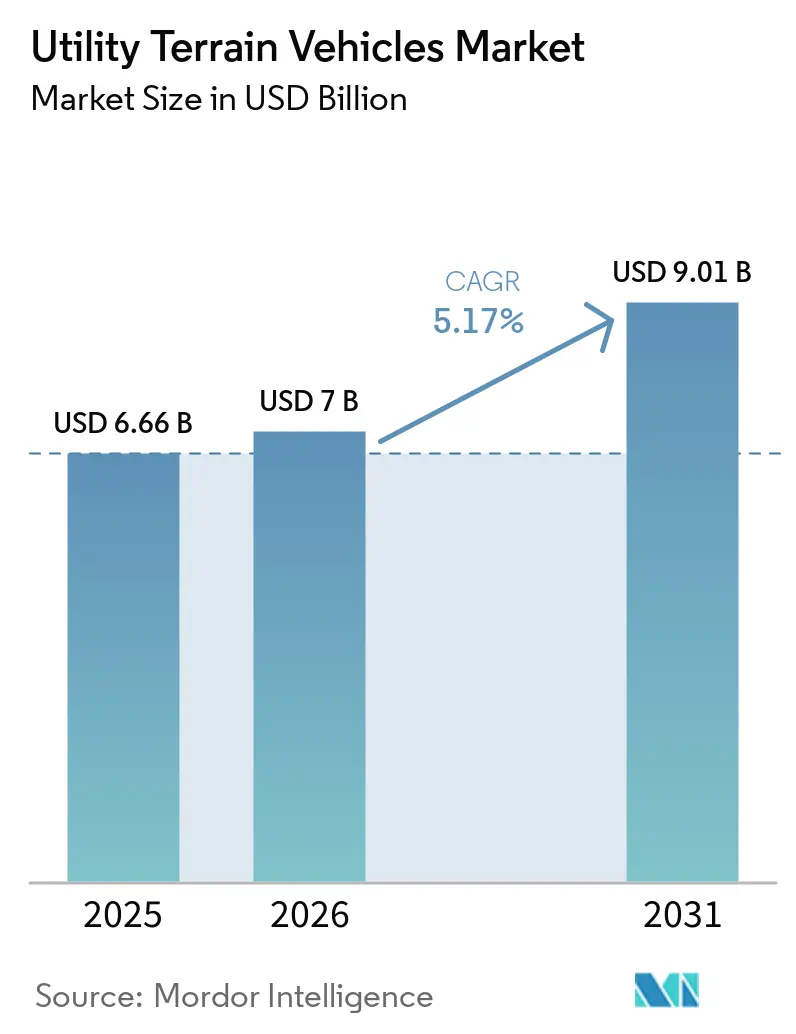
The Utility Terrain Vehicles Market size was valued at USD 6.66 billion in 2025 and is estimated to grow from USD 7.00 billion in 2026 to reach USD 9.01 billion by 2031, at a CAGR of 5.17% during the forecast period (2026-2031). Rising demand for modular light-mobility platforms in defense budgets, coupled with agricultural mechanization across the Asia-Pacific, supports constant volume growth even as recreational sales normalize in North America. Propulsion electrification is gaining momentum because zero-emission mandates in protected parks coincide with corporate sustainability targets. Manufacturers are repositioning premium models with advanced telematics to raise average transaction prices and offset tariff headwinds. Strategic localization of assembly plants and battery supply agreements signals that production networks are being realigned to shelter margins from trade friction and raw-material volatility.
Key Report Takeaways
- By application, sports and recreation led with 45.15% revenue share of the utility terrain vehicles market in 2025; military and law-enforcement fleets are projected to expand at a 5.19% CAGR through 2031.
- By propulsion type, internal-combustion units captured an 83.14% share of the utility terrain vehicle market in 2025, while battery-electric variants are advancing at a 5.28% CAGR through 2031.
- By drive type, four-wheel and all-wheel formats accounted for 76.61% of the utility terrain vehicle market share in 2025 and are forecast to grow at a 5.22% CAGR over 2026-2031.
- By seating capacity, the 3- to 4-seater category commanded a 55.47% share in 2025, and larger crew configurations are set to record a 5.27% CAGR by 2031.
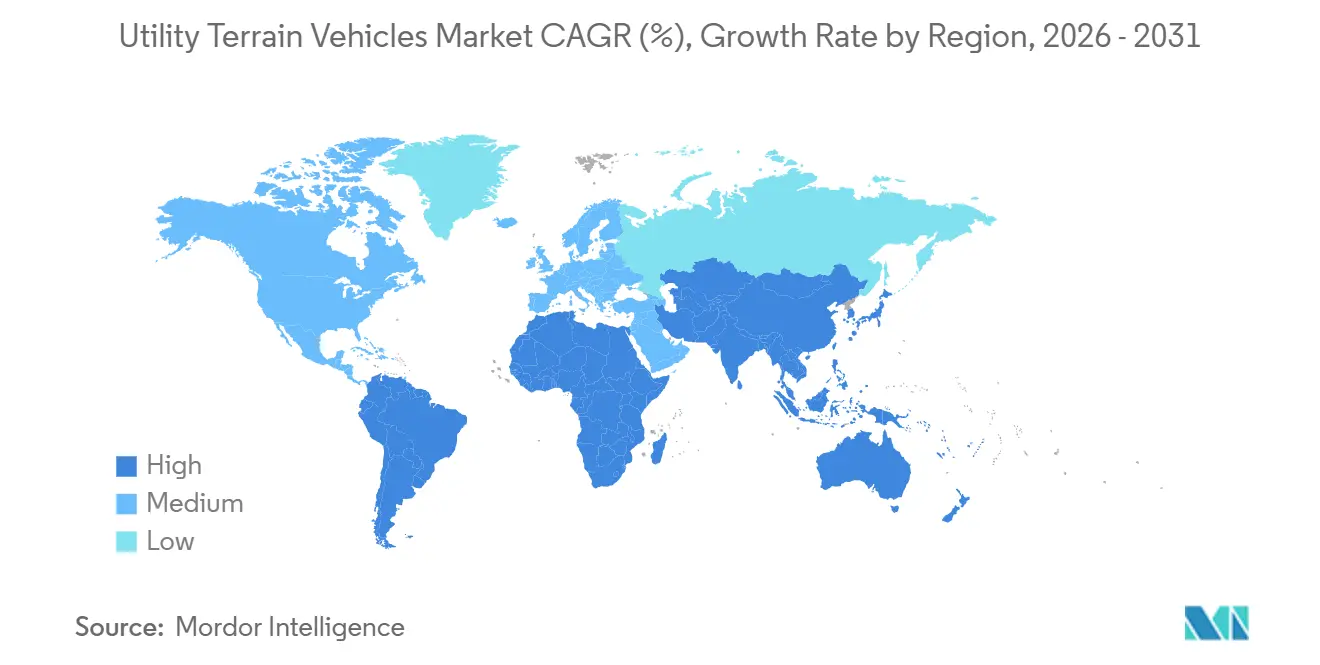
- By geography, North America accounted for 36.24% of 2025 revenue, whereas Asia-Pacific is poised to grow at a 5.25% CAGR to 2031.
Note: Market size and forecast figures in this report are generated using Mordor Intelligence’s proprietary estimation framework, updated with the latest available data and insights as of January 2026.
Market Trends and Insights
Drivers Impact Analysis of Utility Terrain Vehicles Market*
| Driver | (~) % Impact on CAGR Forecast | Geographic Relevance | Impact Timeline |
|---|---|---|---|
| Rapid Adoption in Agriculture & Forestry | +1.2% | Global, with concentration in North America, India, Brazil | Medium term (2-4 years) |
| Rising Demand for Off-Road Recreation | +0.9% | North America, Europe, Australia | Short term (≤ 2 years) |
| Growing Use on Industrial & Construction Sites | +0.8% | Asia-Pacific core, spill-over to Middle East & Africa | Medium term (2-4 years) |
| Military Modernization Programs for Light Mobility | +0.7% | North America, Europe, Middle East | Long term (≥ 4 years) |
| Telematics-Enabled Autonomous Follow-Me UTV Fleets | +0.6% | North America, Europe, advanced APAC markets (Japan, South Korea) | Long term (≥ 4 years) |
| Incentives for Zero-Emission Vehicles in Protected Parks | +0.5% | North America (California, New York), Europe (UK, Germany) | Short term (≤ 2 years) |
| Source: Mordor Intelligence | |||
Rapid Adoption in Agriculture & Forestry
Farm operators are substituting pickups and small tractors with UTVs for chores that demand frequent stops, tight turning radii, and light implement mounting. Kubota integrated its KubotaNOW telematics suite across its RTV lines, offering three years of GPS tracking and geofencing at no additional cost, which lowers theft risk and streamlines fleet oversight. John Deere Gator platforms now support precision-ag payloads such as spray booms and soil-sampling rigs, thereby minimizing soil compaction compared with full-size tractors. Autonomous guidance solutions like FarmX Perceptive Navigation enable a single operator to supervise several UTVs during planting and harvest, resulting in labor savings of 20-30% on large acreages. Forestry contractors prefer four-wheel-drive layouts that haul chainsaws and fuel over steep trails, thereby reinforcing demand for 3- to 4-seater cabins that accommodate crews at logging sites [1].
Rising Demand for Off-Road Recreation
Recreational trail riding and dune exploration continue to anchor sales across the utility terrain vehicles market in North America, even though overall unit volume fell 7.2% to about 520,000 units in 2024. Manufacturers are countering softer volume with higher-spec launches such as Polaris RANGER XP Kinetic, which delivers 110 horsepower, 140 pound-feet of torque, and up to 80 miles of range at a USD 28,999 price point. Honda refreshed its Pioneer 1000 line for the first time in a decade and will introduce a sealed-cab Elite variant with HVAC in late 2026, underscoring a shift toward comfort features that appeal to multi-day backcountry users. These premium offerings help sustain revenue growth and highlight how brand loyalty influences discretionary purchases. Expanding financing programs and bundled accessories further improve wallet share among enthusiasts who prioritize performance over price [2].
Growing Use on Industrial & Construction Sites
Construction managers deploy UTVs to shuttle tools, concrete samples, and inspectors across expansive job sites, saving fuel and navigating mud better than full-size pickups. Caterpillar plans to launch the TUL100 utility loader with a 1,000-pound lift capacity in early 2027, signaling intensifying competition from compact track loaders. Xeleqt’s OmniTraQ AI telematics monitors engine hours and issues predictive-maintenance alerts, reducing unscheduled downtime for rental fleets. Equipment-rental majors such as JLG integrate ClearSky connectivity, demonstrating that real-time diagnostics are now baseline expectations for industrial buyers. This push toward analytics-driven uptime compels UTV OEMs to standardize telematics hardware and subscription models that enhance total cost of ownership arguments [3].
Military Modernization Programs for Light Mobility
Defense agencies are increasingly turning to commercial-off-the-shelf UTVs, enhancing them with communication mounts and lightweight ballistic kits. This shift is largely due to traditional tactical vehicles surpassing helicopter sling-load limits and exhibiting limited parts commonality. Recently, the U.S. Marine Corps awarded a contract for a fleet of ultra-light tactical vehicles designed to fit within a helicopter fuselage and capable of carrying significant payloads. Meanwhile, the UK Ministry of Defense allocated substantial funding to procure a large number of light tactical mobility UTVs to replace its aging vehicle fleet.
Restraints Impact Analysis of Utility Terrain Vehicles Market*
| Restraint | (~) % Impact on CAGR Forecast | Geographic Relevance | Impact Timeline |
|---|---|---|---|
| High Upfront & Maintenance Cost vs. ATVs | -0.6% | Global, with higher sensitivity in price-conscious APAC and South America | Short term (≤ 2 years) |
| Competition from Compact Track Loaders & Mini-EVs | -0.5% | North America, Europe, advanced APAC markets | Medium term (2-4 years) |
| Safety Incidents Tightening Trail-Access Rules | -0.4% | North America (Utah, Wisconsin, Iowa), Europe | Medium term (2-4 years) |
| Lithium Supply Constraints for Electrified UTVs | -0.3% | Global, with acute impact on North America and Europe EV programs | Long term (≥ 4 years) |
| Source: Mordor Intelligence | |||
High Upfront & Maintenance Cost vs. ATVs
Utility terrain vehicles (UTVs) are significantly more expensive than their all-terrain vehicle (ATV) counterparts, a factor that deters budget-conscious buyers in emerging markets. Polaris has priced its entry-level RANGER 500 at a price point that positions it above mid-tier ATVs with similar towing capacities. The automotive-style transmissions and differentials in UTVs require specialized servicing, leading to higher maintenance costs, especially in areas with limited dealer networks. Consequently, many smallholders in the Asia-Pacific and South America are opting to stick with ATVs or pickup trucks, hindering the growth of the UTV market in these regions.
Competition from Compact Track Loaders & Mini-EVs
Industrial customers are gravitating towards compact track loaders, drawn by their enhanced lift capacities and universal attachment interfaces. Caterpillar's upcoming compact loader is set to compete directly with high-payload UTVs, boasting enclosed-cab comfort while maintaining a competitive price point. In Southeast Asia, Chinese mini-electric vehicles are underpricing entry-level UTVs, capturing the attention of budget-conscious buyers and stunting the growth of the commercial segment in the utility terrain vehicles market.
*Our forecasts treat driver/restraint impacts as directional, not additive. The impact forecasts reflect baseline growth, mix effects, and variable interactions.
Utility Terrain Vehicles Market Segment Analysis
By Application:
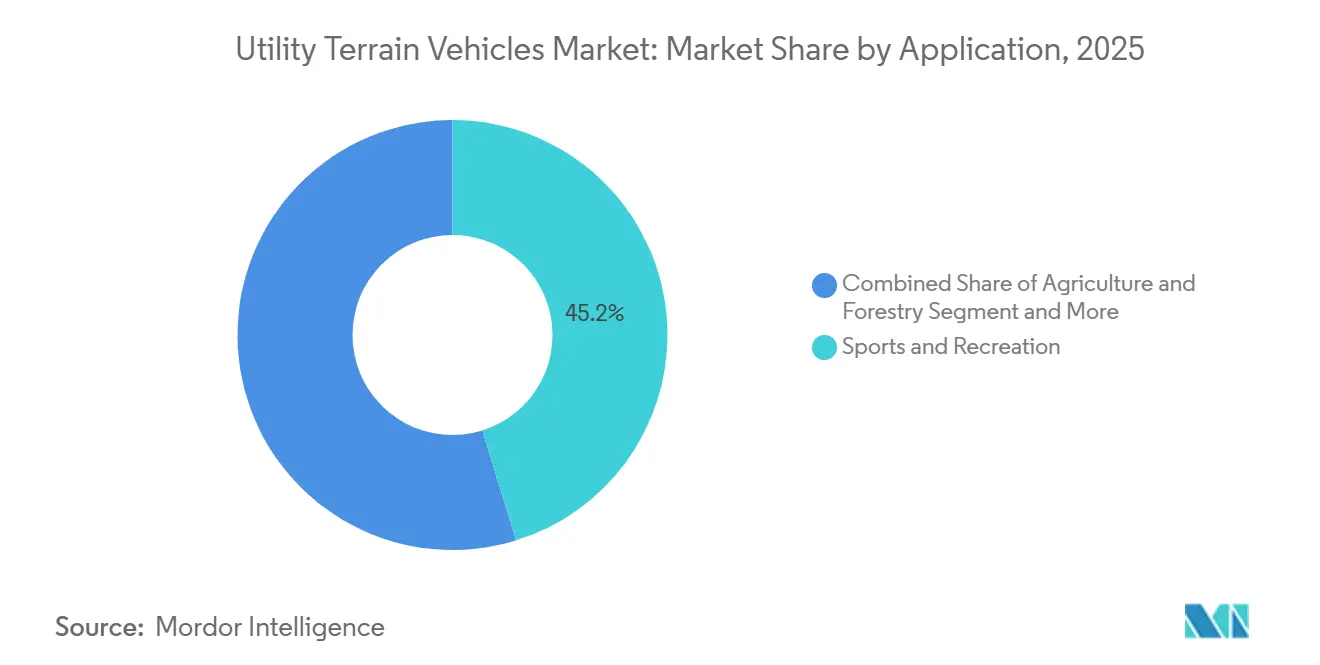
Military Spending Lifts Tactical FleetsSports and recreation held 45.15% of 2025 revenue, reflecting entrenched trail culture in North America and a growing adventure-tourism scene in Europe. Military and law-enforcement fleets will grow at a 5.19% CAGR to 2031 as defense planners prioritize modular, air-transportable mobility. In a clear shift towards ruggedized commercial platforms, the United States Marine Corps has contracted for several ultra-light tactical vehicle units. Meanwhile, the UK Ministry of Defense is set to acquire a significant number of light-mobility UTVs. Highlighting the trend further, Albuquerque Fire Rescue, a search-and-rescue agency, has invested in high-spec units with substantial costs. This underscores the lucrative opportunities for OEMs in specialized public-safety roles.
Agriculture and forestry applications benefit from bundled telematics that lower theft risk and enable data-driven agronomy. Kubota’s inclusion of three-year KubotaNOW service on every RTV streamlines fleet management and solidifies loyalty. Industrial and construction use cases continue to expand, yet competition from compact track loaders pressures price realization. Overall, defense and public-safety procurement add stability, while recreational and agricultural demand maintain volume, ensuring balanced growth in the utility terrain vehicles market size at the application level.

By Propulsion Type:
Electrification Gains TractionInternal-combustion gasoline and diesel powertrains captured 83.14% of 2025 shipments, anchored by low upfront cost and expansive service networks. Battery-electric models will post a 5.28% CAGR through 2031 as incentive programs bridge price gaps. California’s voucher covering up to USD 13,500 per vehicle and New York’s replenished rebates lower acquisition hurdles for park services. Polaris Pro XD Kinetic and Can-Am Outlander Electric illustrate how OEMs are tailoring range and payload to government fleets where duty cycles align with electric constraints.
Hybrid and hydrogen prototypes remain exploratory. The HySE consortium’s hydrogen UTV for Dakar 2025 and Toyota’s Tacoma H2-Overlander concept highlight long-horizon alternatives that bypass lithium constraints. Although commercialization is still distant, these pilots keep R&D pipelines active and position OEMs for future shifts in the utility terrain-vehicle industry's energy mix.
By Drive Type:
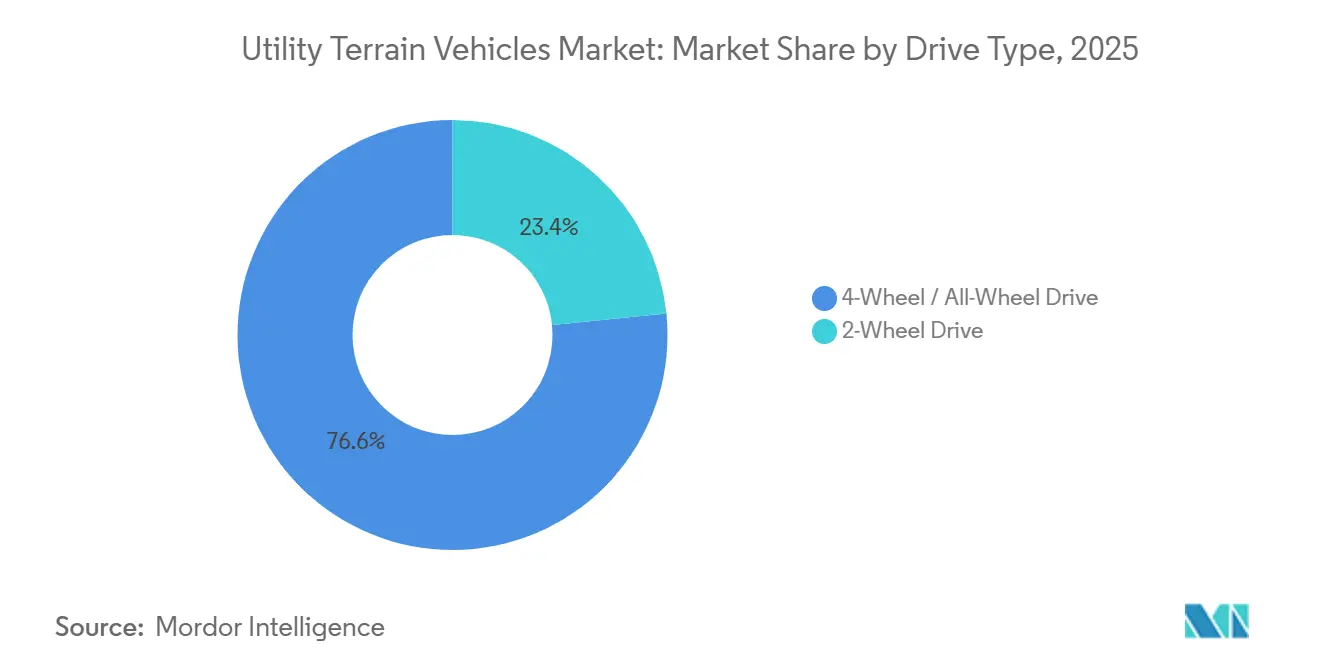
All-Wheel Traction DominatesFour-wheel and all-wheel drive configurations commanded a 76.61% share in 2025 and will continue to rise at a 5.22% CAGR because forestry, mining, and military tasks demand reliable traction. Honda’s Pioneer 1000 refresh preserved its locking differential and 2,500-pound tow capacity, reinforcing value in off-camber environments. Two-wheel drive remains cost-effective on flat terrain but lacks versatility for commercial fleets. Six-wheel variants offer unmatched flotation in sand and peat, yet high purchase prices limit their use to specialized forestry and utility operators.
Can-Am and Polaris focus product-development budgets on ride-quality upgrades and electronic stability aids, underlining how capability beats cost in purchasing criteria. Consequently, the four-wheel segment underpins sustained demand and remains the cornerstone of the utility terrain vehicles market share across geographies.
By Seating Capacity:
Crew Transport ExpandsThree-to-four-seater UTVs dominated, accounting for 55.47% of revenue in 2025, striking a balance between maneuverability and crew capacity on narrow trails. Models like the Polaris XPEDITION, priced at USD 39,499 with five-passenger seating and 2,500-pound towing capacity, illustrate a value migration toward multi-role configurations. Tourism operators and emergency services fuel uptake of more-than-four-seater platforms, which are projected to grow at a 5.27% CAGR.
Entry-level one- to two-seater units still attract cost-sensitive buyers but offer limited operational flexibility. Albuquerque Fire Rescue’s six-seat, water-tank-equipped UTVs underscore how public-safety customers favor crew-capacity builds that consolidate transport and casualty evacuation in a single platform, supporting premium pricing in the utility-terrain-vehicle market-size calculus.
Geography Analysis
North America Utility Terrain Vehicles Market
North America generated 36.24% of 2025 revenue, driven by its extensive trail networks, mechanized agriculture, and military contracts. Despite a notable sales dip in 2024, OEMs like Polaris and Honda introduced premium models, such as the XPEDITION and Pioneer 1000 Elite, to safeguard their profit margins. Starting in the near future, Section 232 tariff revisions will impose a substantial duty on imported vehicles, significantly increasing costs for manufacturers like BRP and pushing them towards reshoring production.
APAC Utility Terrain Vehicles Market
Asia-Pacific is set to grow at a 5.25% CAGR through 2031, driven by agricultural mechanization in India and Indonesia, as well as construction logistics in China. Mahindra's ambitious investment in Maharashtra aims to significantly boost its capacity, catering to both domestic and international markets. While competition from Chinese mini-EVs curtails premium growth, the demand for robust 4×4 UTVs persists, fueled by steep-terrain plantations and vast infrastructure projects.
EMEA and South America Utility Terrain Vehicles Market
Europe and South America experience moderate growth. A major defense deal in the UK bolsters European sales, and agribusinesses in Brazil and Argentina are countering currency fluctuations by purchasing. The Middle East and Africa are emerging as new frontiers, with demand primarily driven by the oil and gas sector, mining, and safari tourism.
Competitive Landscape
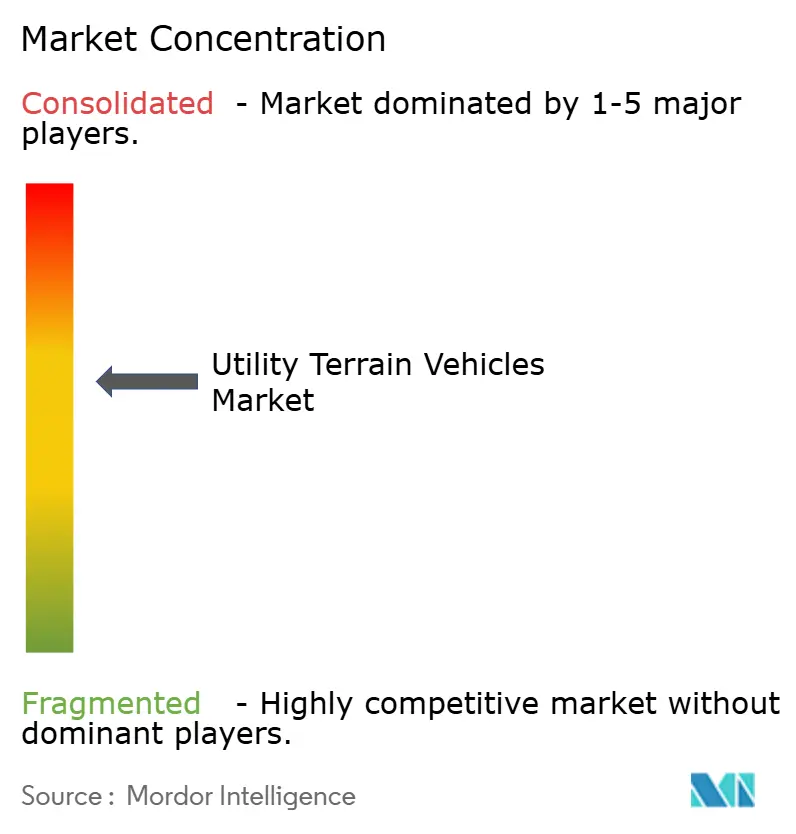
In North America and Europe, a moderate level of market concentration places Polaris, BRP, Honda, Yamaha, and John Deere at the helm, dominating most organized-dealer channels. Polaris and BRP, with their performance-oriented flagship models positioned in the premium segment, tap into robust brand communities to differentiate themselves. Meanwhile, Honda and Yamaha leverage their automotive-scale purchasing power to maintain competitive pricing on entry-level models. However, their slower product-refresh cycles risk losing ground in high-spec trims. Dominating the agricultural sector, John Deere and Kubota enhance their fleets by bundling precision-farming hardware with service contracts, ensuring a lock-in for long-term revenue.
Chinese OEMs, including CF Moto and Hisun, are making strides overseas through CKD kits and strategic licensing deals. A notable agreement between CF Moto and Arctic Cat not only secures instant dealer access in North America and Europe but also accelerates their go-to-market strategy. Meanwhile, Volcon ePowersports is making waves by targeting government fleets, offering electric units that align with zero-emission procurement mandates.
To mitigate supply risks, OEMs are vertically integrating battery packs and localizing assembly, a strategic move against tariff vulnerabilities and shipping disruptions. Looking ahead, the competitive landscape will hinge on which players can adeptly integrate telematics, electrification, and autonomy while meeting the cost expectations of commercial buyers.
Utility Terrain Vehicles Industry Leaders
-
Polaris Inc.
-
BRP Inc. (Can-Am)
-
Honda Motor Co.
-
Yamaha Motor Co.
-
Kawasaki Heavy Industries
- *Disclaimer: Major Players sorted in no particular order
Utility Terrain Vehicles Market Companies Covered in this Report
- Polaris Inc.
- BRP Inc. (Can-Am)
- Honda Motor Co.
- Yamaha Motor Co.
- Kawasaki Heavy Industries
- John Deere
- Kubota Corporation
- CF Moto
- Textron (Arctic Cat)
- Hisun Motors
- Mahindra (mPact)
- Kioti / Daedong
- Bobcat / Doosan
- LINHAI
- Segway Powersports
- Tao Motor
- BMS Motorsports
- Massimo Motor
- Volcon ePowersports
- Intimidator UTV
Recent Industry Developments in Utility Terrain Vehicles Market
- September 2025: Massimo Group announced the upcoming launch of its electric utility terrain vehicle (UTV), which is set to debut in 2026. The new model highlights the company’s commitment to meeting evolving customer demands and strengthening its competitive position in the fast-growing electric utility vehicle market.
- August 2025: Upfit UTV, a Fox Factory subsidiary that crafts custom vehicles tailored to exacting performance demands, and OMI, a global leader in electric powertrain engineering, are setting a new standard in off-road innovation.
Global Utility Terrain Vehicles Market Report Scope
The scope of the report includes Application (Sports & Recreation and More), Propulsion Type (Internal-Combustion and More), Drive Type (2-Wheel Drive and 4-Wheel / All-Wheel Drive), Seating Capacity (Less Than 2 Seater and More), and Geography.
| Sports & Recreation |
| Agriculture & Forestry |
| Industrial & Construction |
| Military & Law-Enforcement |
| Other Commercial (Tourism, Search-and-Rescue) |
| Internal-Combustion (Gasoline / Diesel) |
| Hybrid |
| Battery-Electric |
| Hydrogen Fuel-Cell |
| 2-Wheel Drive |
| 4-Wheel / All-Wheel Drive |
| Less than 2 Seater |
| 3-4 Seater |
| More than 4 Seater |
| North America | United States |
| Canada | |
| Rest of North America | |
| South America | Brazil |
| Argentina | |
| Rest of South America | |
| Europe | United Kingdom |
| Germany | |
| Spain | |
| Italy | |
| France | |
| Russia | |
| Rest of Europe | |
| Asia-Pacific | India |
| China | |
| Japan | |
| Indonesia | |
| Malaysia | |
| Singapore | |
| Vietnam | |
| Philippines | |
| South Korea | |
| Rest of Asia-Pacific | |
| Middle East and Africa | United Arab Emirates |
| Saudi Arabia | |
| Turkey | |
| Egypt | |
| South Africa | |
| Rest of Middle East and Africa |
| By Application | Sports & Recreation | |
| Agriculture & Forestry | ||
| Industrial & Construction | ||
| Military & Law-Enforcement | ||
| Other Commercial (Tourism, Search-and-Rescue) | ||
| By Propulsion Type | Internal-Combustion (Gasoline / Diesel) | |
| Hybrid | ||
| Battery-Electric | ||
| Hydrogen Fuel-Cell | ||
| By Drive Type | 2-Wheel Drive | |
| 4-Wheel / All-Wheel Drive | ||
| By Seating Capacity | Less than 2 Seater | |
| 3-4 Seater | ||
| More than 4 Seater | ||
| By Geography | North America | United States |
| Canada | ||
| Rest of North America | ||
| South America | Brazil | |
| Argentina | ||
| Rest of South America | ||
| Europe | United Kingdom | |
| Germany | ||
| Spain | ||
| Italy | ||
| France | ||
| Russia | ||
| Rest of Europe | ||
| Asia-Pacific | India | |
| China | ||
| Japan | ||
| Indonesia | ||
| Malaysia | ||
| Singapore | ||
| Vietnam | ||
| Philippines | ||
| South Korea | ||
| Rest of Asia-Pacific | ||
| Middle East and Africa | United Arab Emirates | |
| Saudi Arabia | ||
| Turkey | ||
| Egypt | ||
| South Africa | ||
| Rest of Middle East and Africa | ||
Key Questions Answered in the Report
What is the current size and projected growth rate of the utility terrain vehicles market?
The utility terrain vehicles market size was USD 6.66 billion in 2025 and is forecast to reach USD 9.01 billion by 2031, registering a 5.17% CAGR over 2026-2031.
Which region contributes the most revenue today, and which is set to grow the fastest?
North America generated 36.24% of 2025 revenue, while Asia-Pacific is expected to post the quickest expansion at a 5.25% CAGR through 2031 as agricultural mechanization and construction demand accelerate.
What key factors are driving global demand for UTVs?
Growth stems from agricultural and forestry mechanization, defense modernization programs favoring lightweight mobility, and rising recreational trail use, with additional momentum from zero-emission incentives and telematics-enabled fleet optimization.
How quickly will battery-electric UTVs gain share against internal-combustion models?
Although gasoline and diesel units commanded 83.14% of 2025 shipments, battery-electric variants are forecast to grow at a 5.28% CAGR to 2031, lifted by incentives such as California’s CORE vouchers and park-service emissions rules.
Which application segment is likely to post the highest growth?
Military and law-enforcement fleets are projected to expand at a 5.19% CAGR through 2031 as defense agencies shift from legacy tactical vehicles to ruggedized commercial platforms that fit inside transport aircraft.
How concentrated is the competitive landscape among the leading manufacturers?
The five largest suppliers account for just under 60% of global revenue.