
CNG Vehicles Market Size and Share
Market Overview
| Study Period | 2019 - 2031 |
|---|---|
| Market Size (2026) | USD 55.25 Billion |
| Market Size (2031) | USD 72.82 Billion |
| Growth Rate (2026 - 2031) | 5.68 % |
| Fastest Growing Market | Middle East and Africa |
| Largest Market | Asia Pacific |
| Market Concentration | Medium |
Major Players
*Disclaimer: Major Players sorted in no particular order Image © Mordor Intelligence. Reuse requires attribution under CC BY 4.0. |
|
CNG Vehicles Market Analysis by Mordor Intelligence
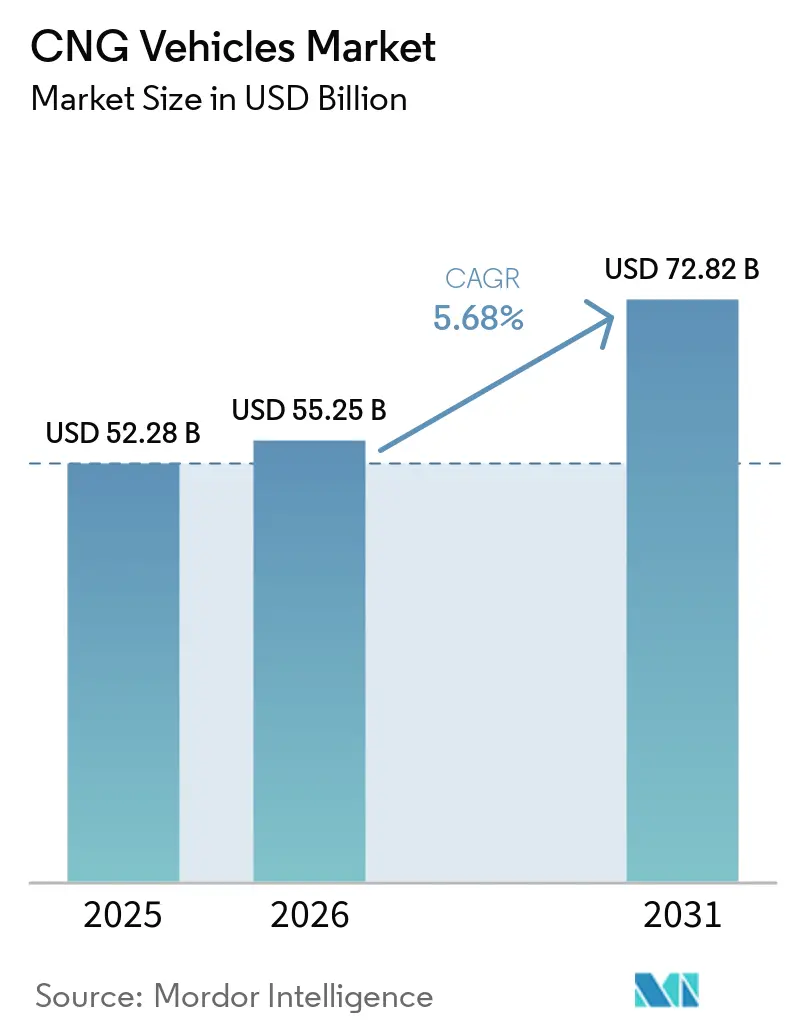
The CNG vehicles market size was valued at USD 52.28 billion in 2025 and is estimated at USD 55.25 billion in 2026, and is projected to reach USD 72.82 billion by 2031, at a CAGR of 5.68% during the forecast period (2026–2031). Robust policy support, widening fuel price differentials compared to gasoline and diesel, and increasing availability of factory-fitted models support near-term growth. Weight-saving composite cylinders, hydrogen-ready engines, and biomethane blending programs enhance the technology’s long-term relevance, enabling fleets to adapt to future fuel policy changes. Private logistics operators, public transport agencies, and ride-hailing aggregators drive station roll-outs, while OEM warranty extensions address residual-value risks. Commercial operators are adopting real-time telematics to quantify maintenance savings, expediting data-driven decisions. However, the global CNG shortage poses challenges, potentially impacting supply chains and adoption rates, particularly in regions heavily reliant on imports.
Key Report Takeaways
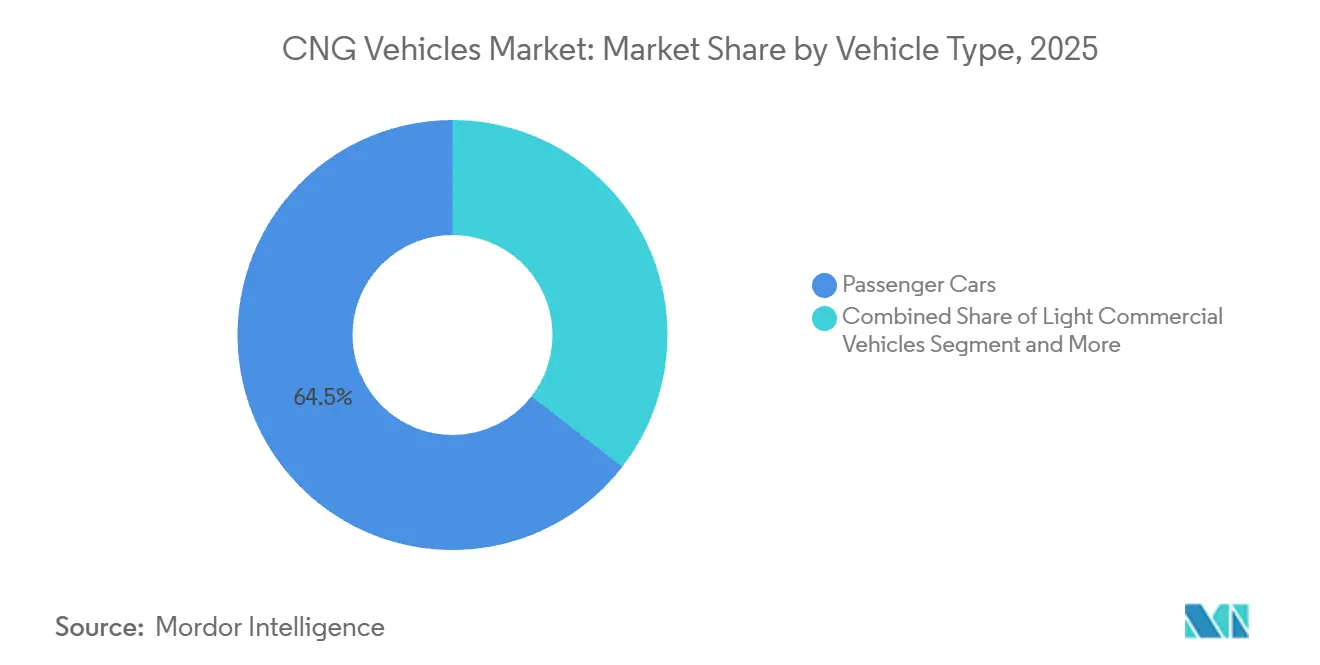
- By vehicle type, passenger cars led with a 64.48% share in the CNG vehicle market in 2025, while buses and coaches are projected to expand at a 9.14% CAGR during the forecast period (2026-2031).
- By sales channel, OEM-fitted models captured a 75.74% share in the CNG vehicle market in 2025; retrofitted vehicles are set to grow at an 8.21% CAGR during the forecast period (2026-2031).
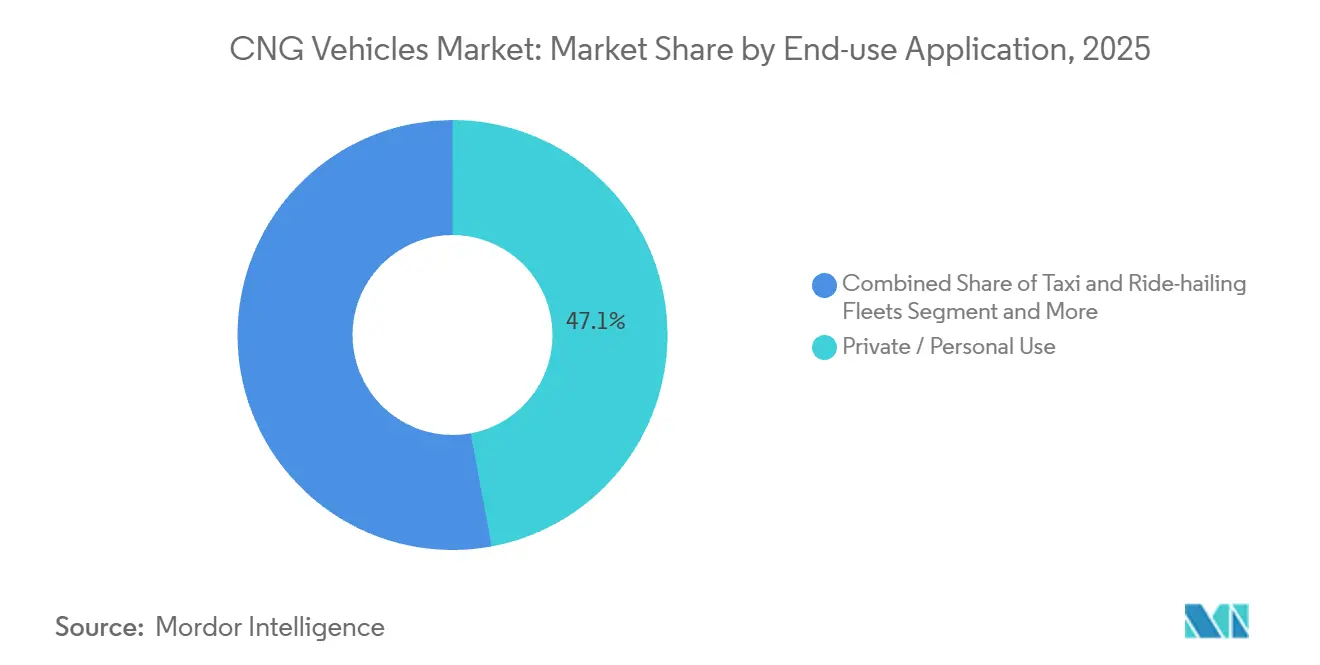
- By end-use application, private use accounted for a 47.08% share in the CNG vehicle market in 2025, whereas public transit fleets are poised for a 9.37% CAGR during the forecast period (2026-2031).
- By cylinder type, Type I held the largest 38.89% share in the CNG vehicle market in 2025. However, Type IV will register the fastest 11.62% CAGR during the forecast period (2026-2031).
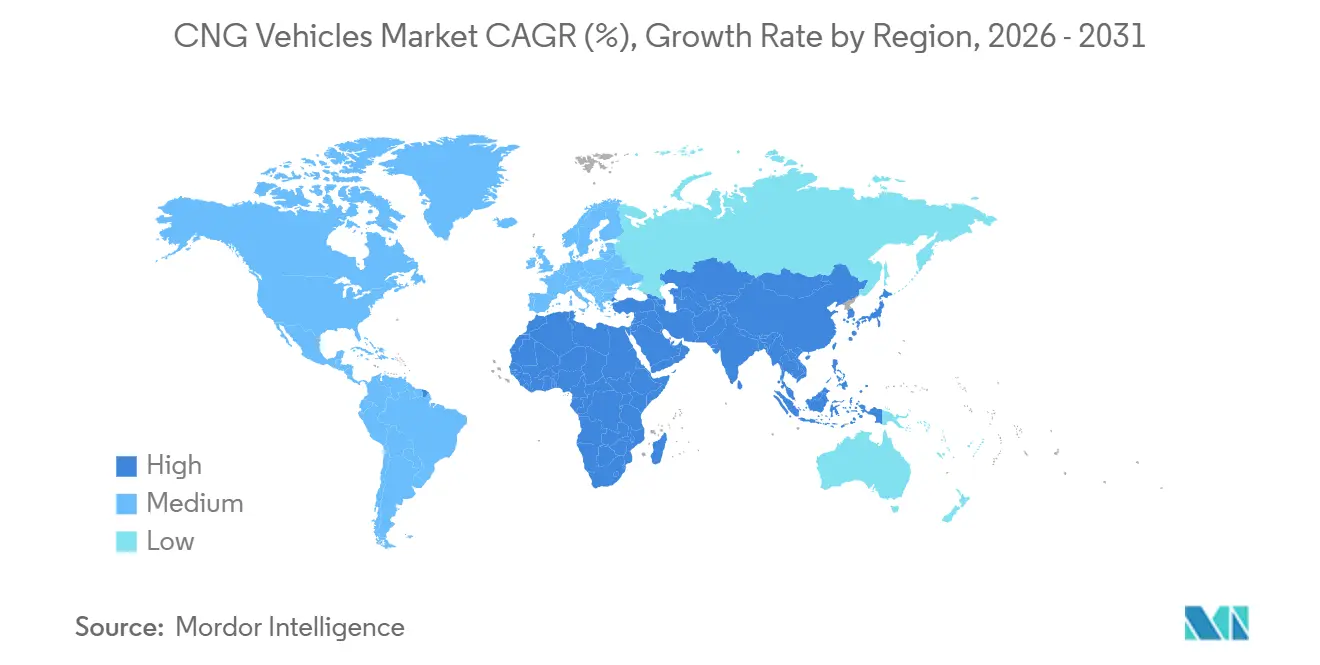
- By geography, Asia-Pacific commanded a 55.27% share in the CNG vehicle market in 2025, while the Middle East and Africa region is expected to post the highest 7.28% CAGR during the forecast period (2026-2031).
Note: Market size and forecast figures in this report are generated using Mordor Intelligence’s proprietary estimation framework, updated with the latest available data and insights as of January 2026.
Market Trends and Insights
Drivers Impact Analysis of CNG Vehicles Market*
| Driver | (~) % Impact on CAGR Forecast | Geographic Relevance | Impact Timeline |
|---|---|---|---|
| Lower Total Cost-of-Ownership | +1.8% | Global, with strongest impact in APAC and MEA | Medium term (2-4 years) |
| Tail-Pipe Emission Regulations | +1.5% | Europe, North America, India | Short term (≤ 2 years) |
| CNG Refueling Infrastructure | +1.2% | Global, concentrated in urban corridors | Long term (≥ 4 years) |
| Bio-CNG Blending Targets | +0.9% | Europe, California, early adoption in APAC | Medium term (2-4 years) |
| Fleet-Wide Telematics | +0.8% | North America, Europe, urban APAC | Short term (≤ 2 years) |
| Hydrogen-Ready CNG Engine | +0.6% | Europe, Japan, pilot programs globally | Long term (≥ 4 years) |
| Source: Mordor Intelligence | |||
Lower Total Cost-of-Ownership Versus Gasoline and Diesel
Fleet economics increasingly support the adoption of compressed natural gas (CNG) due to the widening of pump price spreads and maintenance analytics that demonstrate improvements in engine longevity. Operators have reported achieving fuel cost savings ranging from 30% to 40% when compared to diesel, along with powertrain lifespan extensions of approximately 15% to 25%. These benefits are particularly significant in high-utilization applications, including parcel delivery services and urban bus operations. Telematics platforms provide comprehensive cost-per-mile data, enabling fleet managers to evaluate and optimize fuel strategies with greater accuracy. Verified cost savings align closely with financial objectives aimed at reducing overall operating expenses. Additionally, procurement policies are increasingly incorporating CNG adoption triggers that are based on predefined fuel-spread thresholds, thereby formalizing and streamlining future demand planning processes.
Stringent Tail-Pipe Emission Regulations
New regulations in Europe and North America have introduced stricter limits on nitrogen oxide (NOx) and particulate emissions, creating significant challenges for diesel engines to achieve compliance without the incorporation of expensive after-treatment systems. In comparison, compressed natural gas (CNG) powertrains are capable of meeting many of these regulatory standards, providing fleet operators with a practical and cost-effective compliance solution. In India, the implementation of BS VI standards resulted in a notable 40% increase in CNG vehicle registrations over a period of 18 months. Similarly, the forthcoming compliance requirements for U.S. Class-8 trucks under the Environmental Protection Agency (EPA) Phase 3 rules are driving increased pre-purchase activity. This regulatory environment is also encouraging original equipment manufacturers (OEMs) to expand their CNG vehicle offerings. These developments have collectively contributed to a policy-driven increase in demand for CNG vehicles, occurring in advance of the anticipated widespread adoption of electrification technologies.
Expanding CNG Refueling Infrastructure and OEM-Backed Warranty
Global station counts continue to rise, aided by joint ventures between fuel retailers and automakers. More than 700 public CNG sites operate in the United States alone, a network density that now covers all major interstate freight corridors[1]“Alternative Fuels Data Center — Natural Gas Vehicle Fueling Stations,” U.S. Department of Energy, afdc.energy.gov. Original equipment manufacturers (OEMs) enhance confidence by providing warranties on CNG variants that are equivalent to those offered for gasoline powertrains. This approach helps mitigate residual value uncertainty for fleet financiers. Station developers implement modular skid designs, which significantly reduce civil construction costs and streamline the permitting process. Additionally, mobile refuelers are deployed to serve low-volume depots effectively. These combined efforts address the traditional chicken and egg challenge, thereby enabling the adoption of CNG technology in second-tier cities and suburban logistics hubs.
Renewable Natural Gas Blending Targets in the EU and California
Mandated biomethane percentages have transformed compressed natural gas (CNG) vehicles into near-zero-carbon assets, addressing earlier criticisms that they served only as transitional technologies. California’s Low Carbon Fuel Standard credits further reduce operating costs by generating tradable compliance certificates, while European Union directives ensure demand stability for biomethane producers. Vehicle original equipment manufacturers (OEMs) incorporate bio-CNG availability into total-cost-of-ownership calculations, providing fleets with a structured pathway aligned with corporate net-zero emission targets beyond 2030[2]"Low Carbon Fuel Standard," California Air Resources Board, arb.ca.gov.. This policy-driven approach to decarbonization redefines the CNG vehicle market as a long-term and integral component of diversified fleet strategies rather than a temporary or transitional solution. CNG infrastructure is predominantly concentrated in states such as California, followed by Oklahoma, Texas, Pennsylvania, and Florida. The increasing focus on biomethane integration and supportive regulatory frameworks further solidifies the role of CNG vehicles in achieving sustainable transportation objectives.
Restraints Impact Analysis of CNG Vehicles Market*
| Restraint | (~) % Impact on CAGR Forecast | Geographic Relevance | Impact Timeline |
|---|---|---|---|
| Sparse Rural Station Density | -0.9% | Global, particularly acute in North America and Australia | Long term (≥ 4 years) |
| Falling Battery-Electric TCO | -0.8% | Europe, China, urban North America | Medium term (2-4 years) |
| Methane-Slip Compliance Risk | -0.7% | United States, with spillover to export markets | Short term (≤ 2 years) |
| Volatile LNG/CNG Pricing | -0.5% | Global, most severe in import-dependent regions | Short term (≤ 2 years) |
| Source: Mordor Intelligence | |||
Sparse Rural Station Density Outside Top 50 Metro Areas
Station development remains concentrated in urban areas, as the average throughput in rural markets often fails to justify the capital investment required for each site. Fleets operating across extensive routes frequently evaluate the costs associated with range anxiety in comparison to potential fuel savings, which often results in delays in adopting compressed natural gas (CNG) conversions. Although public-private grants provide some financial assistance, they typically cover only 20 to 30% of project costs, leaving the financial feasibility of such projects uncertain. Portable compression units and advancements in on-vehicle storage technologies offer partial solutions to address these challenges but cannot fully replace the need for a dense and fixed station network. This situation has created a geographic disparity in the adoption of CNG infrastructure, which continues to hinder the potential for comprehensive national growth in this market.
Rapidly Falling Battery-Electric TCO in Light-Duty Segment
Lithium-ion battery pack prices are experiencing a consistent decline[3]"Lithium-Ion Battery Pack Prices Fall to $108 Per Kilowatt-Hour, Despite Rising Metal Prices," BloombergNEF, bnef.com, which is reducing the cost advantage of compressed natural gas (CNG) as a fuel option in passenger vehicles and last-mile delivery vans. The expansion of urban charging infrastructure, particularly in major European and Chinese cities, is further accelerating this trend. This development is encouraging ride-hailing fleets to transition directly to electric vehicles, bypassing intermediate fuel technologies. Consequently, CNG is increasingly at risk of being categorized as a transitional solution, primarily suited for high-utilization or payload-sensitive applications. This perception has raised concerns among investors regarding the depreciation timelines of CNG-related assets. In response to these uncertainties, original equipment manufacturers (OEMs) are introducing dual-fuel models or hydrogen-compatible vehicles, reflecting the ongoing ambiguity surrounding the distribution of powertrain technologies in the mid-2030s.
*Our forecasts treat driver/restraint impacts as directional, not additive. The impact forecasts reflect baseline growth, mix effects, and variable interactions.
CNG Vehicles Market Segment Analysis
By Vehicle Type:
Passenger Cars Maintain Scale as Buses Outpace GrowthIn 2025, passenger cars held a dominant 64.48% share of the CNG vehicle market, solidifying their lead in unit sales. However, the growth trajectory is shifting towards commercial vehicles. Buses and coaches are set to be the fastest-growing segment, with a projected CAGR of 9.14% through 2031. This growth is largely attributed to public transit authorities seeking immediate emission reductions while avoiding the complexities of full electrification. Trucks continue to dominate long-haul routes, particularly in areas lacking high-power charging stations. Simultaneously, two- and three-wheelers are experiencing growth in South Asia, where fuel prices significantly influence consumer choices.
Light commercial vehicles occupy a strategic position, leveraging CNG's reliability for urban deliveries, which is advantageous given battery range constraints. By 2031, the market size for CNG buses is expected to nearly double, driven by public investments unlocking fleet procurement cycles. Technology roadmaps are now incorporating hydrogen-ready modifications, enabling agencies to extend chassis amortization over multi-fuel lifetimes. On the passenger front, OEMs are introducing bi-fuel variants at minimal price premiums, ensuring steady demand even as battery-electric vehicles gain a larger share in affluent metropolitan areas.



By Sales Channel:
Factory-Fitted Dominance with Retrofit UpsideIn 2025, OEM integration dominated the CNG vehicle market, capturing a 75.74% share. This trend highlights a clear preference among fleets and consumers for powertrains meticulously engineered at the factory. Opting for factory-fitted models not only streamlines warranty management but also provides financiers with enhanced clarity on residual-value projections, enabling more competitive lease rates. For automakers, this results in consistent demand for essential components such as injectors, cylinders, and control units. Such predictability facilitates volume contracts, effectively reducing component costs. Marketing strategies emphasize the convenience of servicing at authorized workshops, positioning factory-fitted CNGs as a seamless alternative to traditional gasoline. This approach collectively raises industry standards, shaping elevated buyer expectations.
Conversely, retrofitted fleets are projected to grow at a CAGR of 8.21%. Conversion kits not only extend asset life but also ensure compliance with tightening emission regulations. Additionally, certifications for dealer-installed equipment and three-year engine warranties address reliability concerns that previously hindered aftermarket growth. Standardized installation protocols minimize downtime, allowing smaller operators to convert vehicles during routine maintenance rather than extended shop stays. Geographically, retrofitting initiatives are being rolled out in alignment with station density. Initial availability is focused on states with established CNG corridors, paving the way for broader national expansion. As a result, retrofitting is evolving from a niche solution into a significant growth avenue, leveraging the existing vehicle landscape.
By End-Use Application:
Public Transit Leads Growth CurveIn 2025, bi-fuel subcompact cars, favored by price-sensitive households for their cost-effective commuting, propelled private use to capture a 47.08% share of the CNG vehicle market. However, in cities witnessing swift advancements in electric vehicle incentives and charging infrastructure, the momentum for personal adoption is declining. Public transit agencies, benefiting from bulk procurement, fixed-route operations, and the ability to amortize depot compressors over extensive mileages, are set to experience a 9.37% CAGR from 2026 to 2031. Meanwhile, taxi and ride-hailing fleets, positioned between the two extremes, leverage their high utilization rates and proximity to urban stations to achieve significant fuel savings and quick payback periods. Ultimately, choices in applications are increasingly influenced by the maturity of infrastructure and regulatory pressures, rather than passenger comfort alone.
Industrial fleets in the CNG vehicle market are expanding, driven by the availability of on-site gas at ports, mining centers, and logistics parks, which also offer private refueling options. Partnerships with retail fuel brands such as Circle K and QuikTrip highlight a strategic shift toward fleet accounts, where fuel supply is bundled with loyalty analytics to monitor costs per kilometer. Municipal sanitation and utility trucks are turning to CNG, especially when city councils integrate greenhouse gas targets into their procurement standards, guaranteeing consistent demand regardless of public sentiment. Furthermore, aggregated telematics data not only substantiates maintenance reductions but elevates these anecdotal advantages to key performance indicators at the board level. Such validated outcomes reinforce the multi-segment adoption of CNG vehicles.
By Cylinder Type:
Composites Unlock Payload EconomicsIn 2025, Type I all-metal cylinders commanded a leading 38.89% share of the CNG vehicle market, due to their affordability and durability in demanding conditions. Fleet managers value the easy inspection processes and predictable failure patterns of steel tanks. Meanwhile, Type IV is set to achieve an 11.62% CAGR from 2026 to 2031. This growth is driven by rising freight rates, prompting operators to maximize payloads. This focus highlights the advantages of Type IV polymer-liner composites, which are significantly lighter. Such weight reductions allow for increased cargo capacity and extended driving ranges, benefits particularly valued in parcel, grocery, and bulk-liquid transport. This evolving cost-benefit analysis paves the way for a surge in composite adoption over the next five years.
Modern material science has integrated micro-sensors within composite walls, providing fleet dashboards with real-time pressure and temperature data. Hexagon Composites’ latest designs showcase the seamless integration of this data with preventive maintenance software, resulting in reduced unplanned downtimes and lower insurance costs. As manufacturing scales up, the price difference with steel is diminishing, with some high-volume contracts anticipating a price parity soon. Regulatory bodies are revising homologation standards to encompass digital health monitoring, steering procurement teams towards more advanced cylinders. As a result, the competitive landscape is shifting focus from raw material costs to the value of embedded intelligence and associated service ecosystems.
Geography Analysis
APAC CNG Vehicles Market
Asia-Pacific leads the market, contributing significantly to revenues. India’s policy framework, including vehicle incentives, station grants, and regulatory timelines, has established CNG corridors as the preferred option for intercity buses and ride-share sedans. In China, CNG is prioritized for commercial fleets in inland provinces where battery charging remains economically unviable. Japan promotes hydrogen-ready CNG drivelines as a strategic option to adapt to future fuel transitions. Regional OEM supply chains, encompassing components such as injectors and cylinders, are localized to reduce costs, facilitating CNG adoption beyond tier-one cities.
MEA CNG Vehicles Market
The Middle East and Africa region is experiencing the fastest growth globally, with a CAGR of 7.28%, as gas-rich countries utilize CNG to reduce gasoline imports and capitalize on domestic gas reserves. Nigeria’s Presidential CNG Initiative combines concessional loans with tax incentives to drive bus-fleet conversions. The UAE leverages its LNG infrastructure to develop multi-fuel service hubs integrating natural gas, hydrogen, and EV charging, positioning logistics corridors for long-term sustainability. However, rural areas face limited penetration, necessitating mobile refueling solutions to enable last-mile adoption.
Europe and North America CNG Vehicles Market
Europe and North America exhibit steady growth trajectories. Strict emission regulations and biomethane mandates enhance CNG’s environmental appeal, even as fleet electrification gains traction. In the United States, over 700 public stations support coast-to-coast freight operations, while EPA Phase 3 regulations increase compliance pressures on diesel fleets. In Europe, truck OEMs collaborate with fuel-system specialists to implement high-pressure direct-injection (HPDI) technologies, reducing methane emissions while maintaining diesel-like torque performance. This trend is exemplified by Volvo Group’s partnership with Westport.

Competitive Landscape
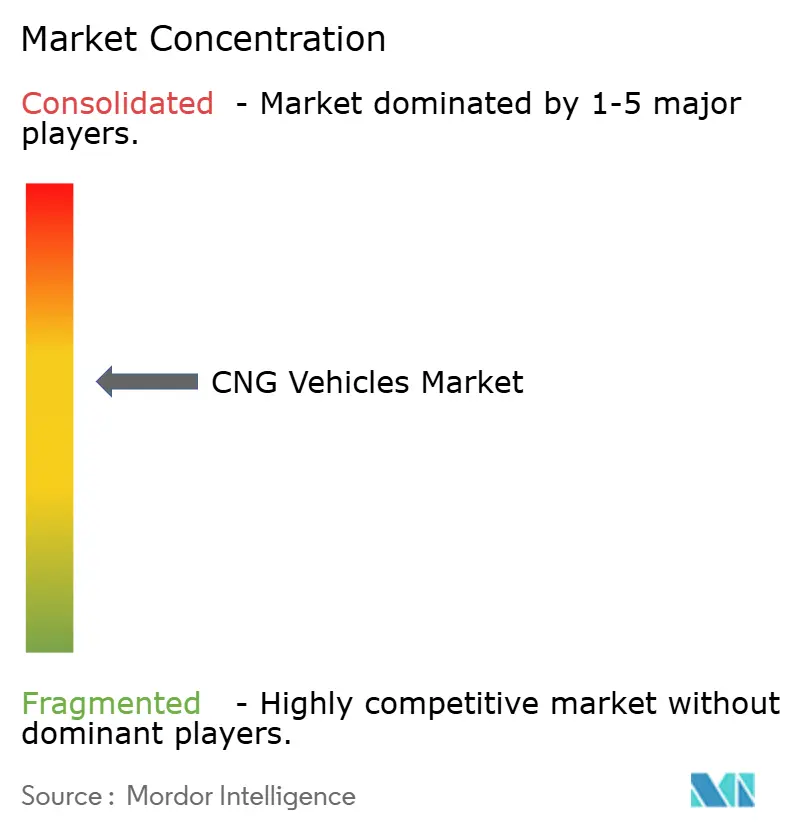
The global market is fragmented, with key players such as Suzuki, Hyundai, Ford Motor Company, Tata Motors, and several Chinese OEMs sharing leadership. This structure prevents any single company from dominating pricing or technology roadmaps, encouraging innovation in powertrain and storage subsystems. Regional specialists establish niches in lightweight cylinders, high-pressure injectors, and turnkey station packages. Manageable capital requirements allow start-ups to enter the market, focusing on hydrogen-ready conversions and telematics add-ons. This creates a competitive environment that values agility over production scale.
Partnerships are critical for differentiation. For instance, the collaboration between Westport and Volvo on HPDI shows how component innovators use OEM scale to accelerate commercialization. Cylinder suppliers like Hexagon Composites integrate lightweight tanks with telematics gateways, shifting competition toward data analytics. Energy companies invest in station networks, aligning fuel sales with vehicle demand. These collaborations reduce development timelines and distribute risk, enabling mid-tier brands to launch globally compliant CNG models.
Regional policy differences drive varied strategies. In India, Suzuki and Tata focus on price-sensitive passenger cars, while in Europe, Iveco and Daimler Truck target long-haul and municipal fleets, leveraging biomethane for near-zero carbon claims. Chinese brands use domestic policies to export CNG buses to Africa and Latin America, increasing price competitiveness. As hydrogen-ready engines advance, OEMs are developing modular powertrain bays for multiple gaseous fuels, ensuring asset value retention. This approach blurs segment boundaries and emphasizes software integration as a key competitive area.
CNG Vehicles Industry Leaders
-
Suzuki Motor Corporation
-
Hyundai Motor Company
-
Tata Motors Limited
-
AB Volvo Group
-
Ford Motor Company
- *Disclaimer: Major Players sorted in no particular order
CNG Vehicles Market Companies Covered in this Report
- Suzuki Motor Corp
- Hyundai Motor Co
- Tata Motors Limited
- AB Volvo Group
- CNH Industrial (Iveco)
- General Motors
- Ford Motor Company
- MAN Truck and Bus SE
- Scania AB
- Ashok Leyland Ltd.
- Isuzu Motors Ltd.
- Westport Fuel Systems Inc.
- Landi Renzo SpA
- Hexagon Composites ASA
- Everest Kanto Cylinders Ltd.

Recent Industry Developments in CNG Vehicles Market
- January 2026: In January 2026, Tata Motors launched new petrol and CNG variants of its XPRES sedan, expanding its fleet vehicle lineup beyond its earlier electric-only offering. The CNG variant is targeted at commercial fleet operators, offering a lower-cost alternative to both petrol and EV options while maintaining operational flexibility.
- August 2025: Landi Technologies and American CNG, LLC have forged a groundbreaking strategic alliance. This partnership integrates top-tier engine technology, advanced high-pressure fuel systems, in-house cylinder production, and nationwide installation services. The result is a comprehensive RNG/CNG solution tailored for Original Equipment Manufacturers (OEMs), Fleet Management Companies (FMCs), dealers, and fleets throughout North America.
- June 2025: In collaboration with Astra Vehicle Technologies, Iveco has unveiled the S-Way 500 CNG 6×2 truck. This new model boasts a gross vehicle weight capacity of 44 tonnes and achieves CO2 reductions of up to 95% when stacked against its diesel counterparts. The truck made its grand entrance at the 2025 Road Transport Expo, showcased as a bespoke display model adorned with hand-painted artwork.


Global CNG Vehicles Market Report Scope
The scope of the report includes vehicle type, sales channel, end-use application, cylinder type, and geography. By vehicle type, the market is segmented into passenger cars, light commercial vehicles, buses and coaches, medium- and heavy-duty trucks, and two- and three-wheelers. By sales channel, the market is segmented into OEM-fitted and retrofitted/after-market. By end-use application, the market is segmented into private/personal use, taxi and ride-hailing fleets, public transit authorities, and industrial and utility fleets. By cylinder type, the market is segmented into Type I (all-metal), Type II (metal hoop-wrapped), Type III (full composite), and Type IV (polymer-liner composite). By geography, the market is segmented into North America, South America, Europe, Asia-Pacific, and the Middle East and Africa. The Market Forecasts are Provided in Terms of Value (USD) and Volume (Units).
| Passenger Cars |
| Light Commercial Vehicles |
| Buses and Coaches |
| Trucks (Medium and Heavy-Duty) |
| Two and Three-Wheelers |
| OEM-fitted |
| Retrofitted/ After-market |
| Private/Personal Use |
| Taxi and Ride-hailing Fleets |
| Public Transit Authorities |
| Industrial and Utility Fleets |
| Type I (All-metal) |
| Type II (Metal hoop-wrapped) |
| Type III (Full composite) |
| Type IV (Polymer-liner composite) |
| North America | United States |
| Canada | |
| Rest of North America | |
| South America | Brazil |
| Argentina | |
| Colombia | |
| Rest of South America | |
| Europe | Germany |
| United Kingdom | |
| France | |
| Italy | |
| Spain | |
| Russia | |
| Rest of Europe | |
| Asia-Pacific | China |
| India | |
| Japan | |
| South Korea | |
| Indonesia | |
| Thailand | |
| Rest of Asia-Pacific | |
| Middle East and Africa | Turkey |
| Saudi Arabia | |
| United Arab Emirates | |
| Qatar | |
| South Africa | |
| Nigeria | |
| Egypt | |
| Kenya | |
| Rest of Middle East and Africa |
| By Vehicle Type | Passenger Cars | |
| Light Commercial Vehicles | ||
| Buses and Coaches | ||
| Trucks (Medium and Heavy-Duty) | ||
| Two and Three-Wheelers | ||
| By Sales Channel | OEM-fitted | |
| Retrofitted/ After-market | ||
| By End-use Application | Private/Personal Use | |
| Taxi and Ride-hailing Fleets | ||
| Public Transit Authorities | ||
| Industrial and Utility Fleets | ||
| By Cylinder Type | Type I (All-metal) | |
| Type II (Metal hoop-wrapped) | ||
| Type III (Full composite) | ||
| Type IV (Polymer-liner composite) | ||
| By Geography | North America | United States |
| Canada | ||
| Rest of North America | ||
| South America | Brazil | |
| Argentina | ||
| Colombia | ||
| Rest of South America | ||
| Europe | Germany | |
| United Kingdom | ||
| France | ||
| Italy | ||
| Spain | ||
| Russia | ||
| Rest of Europe | ||
| Asia-Pacific | China | |
| India | ||
| Japan | ||
| South Korea | ||
| Indonesia | ||
| Thailand | ||
| Rest of Asia-Pacific | ||
| Middle East and Africa | Turkey | |
| Saudi Arabia | ||
| United Arab Emirates | ||
| Qatar | ||
| South Africa | ||
| Nigeria | ||
| Egypt | ||
| Kenya | ||
| Rest of Middle East and Africa | ||


Key Questions Answered in the Report
How fast is the CNG vehicle market expected to grow through 2031?
It is forecast to expand at a 5.68% CAGR, taking value from USD 55.25 billion in 2026 to USD 72.82 billion by 2031.
Which region currently leads in CNG vehicle adoption?
Asia-Pacific holds 55.27% of 2025 revenue, thanks to India’s and China’s infrastructure and policy support.
What segment is growing the quickest inside the CNG vehicle space?
Buses and coaches register the fastest 9.14% CAGR as transit agencies seek immediate emission cuts.
How does biomethane influence the outlook for CNG vehicles?
EU and California blending mandates turn CNG fleets into near-zero-carbon assets, extending technology relevance beyond a transition role.
What strategic moves are leading companies making?
Partnerships like Westport-Volvo for HPDI engines and Landi Technologies-American CNG for integrated RNG offerings exemplify technology-driven collaboration.
Page last updated on:





