
United States Trade Credit Insurance Market Size and Share
Market Overview
| Study Period | 2020 - 2031 |
|---|---|
| Forecast Data Period | 2026 - 2031 |
| Base Year Market Size (2025) | USD 2.25 Billion |
| Market Size (2026) | USD 2.45 Billion |
| Market Size (2031) | USD 4.01 Billion |
| Growth Rate (2026 - 2031) | 10.36 % |
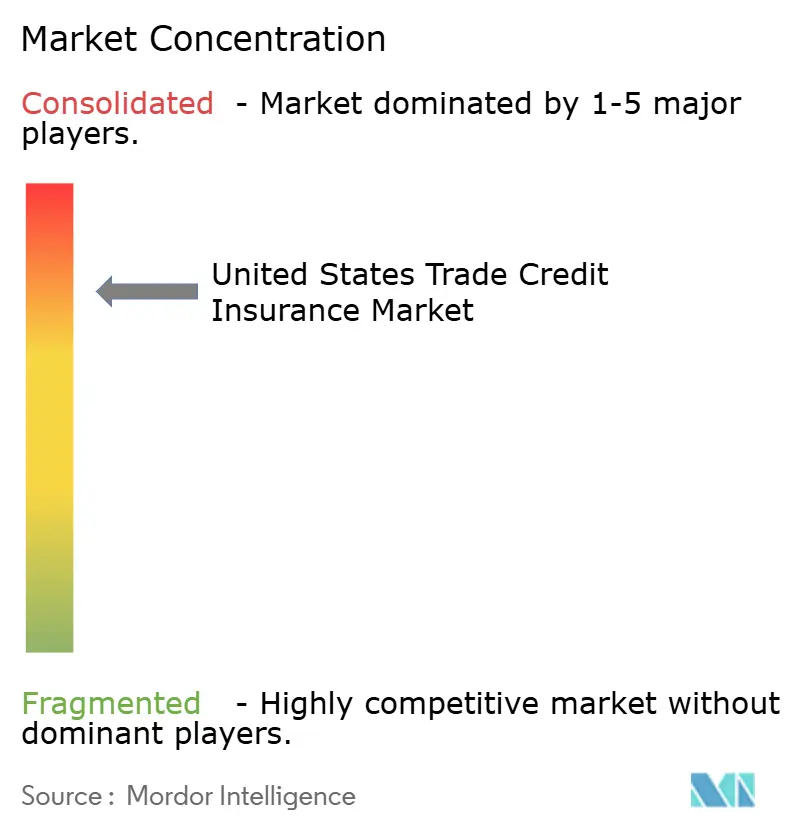
| Market Concentration | High |
Major Players *Disclaimer: Major Players sorted in no particular order Image © Mordor Intelligence. Reuse requires attribution under CC BY 4.0. | |
United States Trade Credit Insurance Market Analysis by Mordor Intelligence
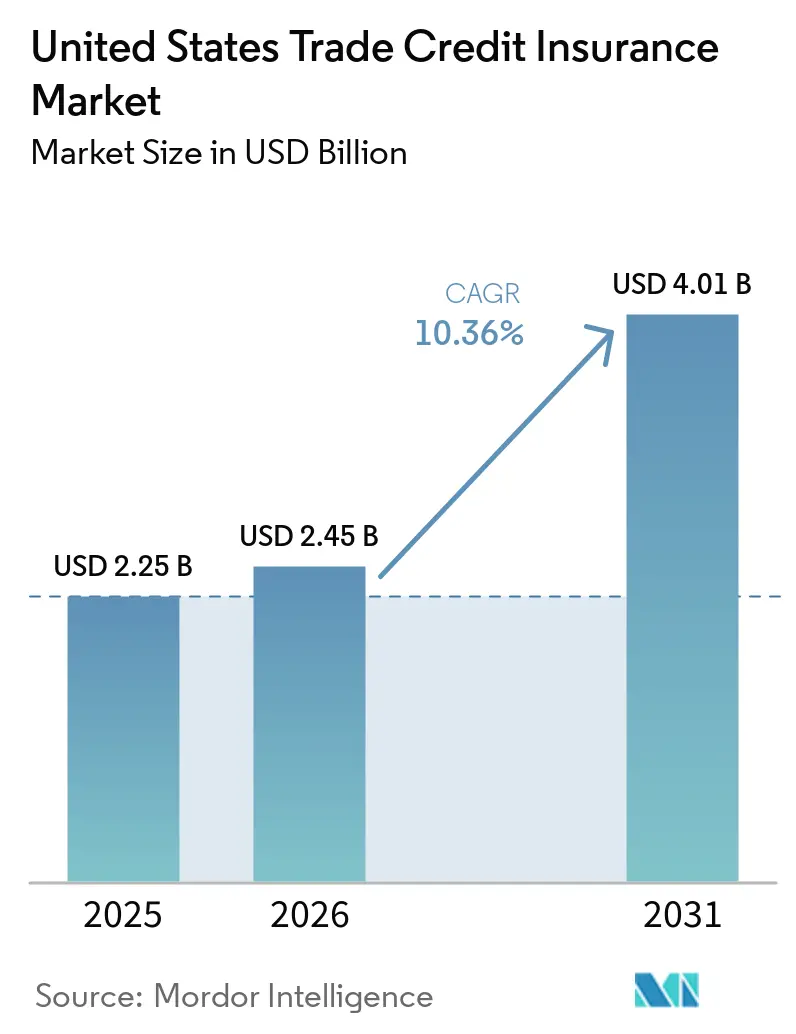
The United States Trade Credit Insurance Market size is projected to expand from USD 2.25 billion in 2025 and USD 2.45 billion in 2026 to USD 4.01 billion by 2031, registering a CAGR of 10.36% between 2026 to 2031.
The United States trade credit insurance market is expanding as insolvency risk, tariff-related buyer stress, and receivables funding needs are rising simultaneously. The United States corporate bankruptcy filings reached 446 year-to-date through July 2025, the highest 7-month total since 2010, and Atradius expects the United States insolvencies to rise by another 8% in 2026, keeping protection demand high across both exporters and domestic sellers. The tariff regime is adding pressure to credit quality, with Atradius describing the effective United States import tariff rate as above 18%, the highest level since 1930, prompting more firms to reassess unsecured open-account sales. At the same time, the United States trade credit insurance market is benefiting from greater use by banks, fintech lenders, and treasury teams that treat insured receivables as a financing asset rather than solely as a loss-protection tool. Pricing remains competitive, with WTW expecting rate movement from -5% to flat, yet the market still faces risk from tighter credit limits in tariff-sensitive buyer groups and from claim disputes in large, layered receivables structures after failures such as First Brands Group. The United States uptake also continues to trail Europe and Asia, which leaves room for wider adoption as more companies move away from internal credit-risk retention and toward insured trade structures.
Key Report Takeaways
- By enterprise size, large enterprises captured 60% of the United States trade credit insurance market share in 2025, while SMEs are projected to grow at a 10.9% CAGR through 2031.
- By coverage, whole turnover coverage accounted for 83% of the United States trade credit insurance market share in 2025, while single buyer coverage is forecast to expand at a 12% CAGR through 203.
- By application, international business held 59% of 2025 premiums in the United States trade credit insurance market, while domestic applications are forecast to grow at a 11.8% CAGR through 2031.
- By end use, food and beverage accounted for 29% of 2025 premiums in the United States trade credit insurance market, while automotive is projected to grow at a 12.8% CAGR through 2031.
- By region, the South accounted for 34.37% of 2025 premiums in the United States trade credit insurance market, and is projected to grow at a 11.24% CAGR through 2031.
Note: Market size and forecast figures in this report are generated using Mordor Intelligence’s proprietary estimation framework, updated with the latest available data and insights as of January 2026.
United States Trade Credit Insurance Market Trends and Insights
Drivers Impact Analysis*
| Driver | (~) % Impact on CAGR Forecast | Geographic Relevance | Impact Timeline |
|---|---|---|---|
| Rising United States Export Exposure | +2.1% | South, West, Northeast, major export hubs | Medium term (2-4 years) |
| Buyer Insolvency Volatility | +2.8% | Global, concentrated in Midwest and South | Short term (≤ 2 years) |
| Bank-Linked Receivables Demand | +1.9% | Northeast, with spillover to South and West | Medium term (2-4 years) |
| SME Credit Risk Awareness | +1.4% | National, with early gains in Texas, New York, California | Medium term (2-4 years) |
| Real-Time Underwriting Adoption | +1.2% | National | Long term (≥ 4 years) |
| E-Commerce Trade Credit Growth | +1.0% | West Coast, Northeast, with spillover to Midwest | Long term (≥ 4 years) |
| Source: Mordor Intelligence | |||
Rising United States Export Exposure
The United States trade credit insurance market continues to draw core demand from exporters because open-account trade still exposes sellers to delayed payment and default risk across unfamiliar buyer pools. Allianz Trade reported that export optimism fell from 80% to 40% after the April 2025 tariff announcements, while 48% of surveyed companies also reported elevated non-payment risk, underscoring how trade disruption is increasing the need for protection rather than reducing it[1]. Tariffs are also pushing United States exporters to diversify their buyer networks across Europe and Asia, creating fresh underwriting demand where internal credit teams have limited visibility into new counterparties. In the United States trade credit insurance market, this shift matters because new export corridors often begin with less payment history and weaker seller confidence in buyer quality. EXIM also remains important because simplified export credit products are providing smaller firms with an earlier entry point into structured risk transfer, supporting longer-term adoption beyond large corporate exporters. The result is a driver tied to both short-term tariff stress and a longer-term reset in how United States firms build overseas customer books.
Buyer Insolvency Volatility
Buyer insolvency volatility is the strongest immediate demand support for the United States trade credit insurance market because it directly affects expected losses on open receivables. S&P Global Market Intelligence said the United States corporate bankruptcy filings reached 446 through July 2025, and July alone recorded 71 filings, the highest monthly total since July 2020[2]. Atradius expects the United States insolvencies to rise by 8% in 2026, after a 7% increase in 2025, and Epiq reported that commercial Chapter 11 filings in April 2026 reached 644, up 42% year over year, indicating that stress is extending beyond a few isolated sectors. Subchapter V filings also increased sharply, which is important because many mid-sized suppliers and private businesses had previously managed buyer risk informally rather than through insurance. The First Brands Group filing in September 2025, with USD 11.6 billion in liabilities, became a major reference point for underwriters because it exposed the vulnerability of layered receivables finance structures inside tariff-exposed automotive supply chains. In the United States trade credit insurance market, each wave of buyer failures supports new sales because previously uninsured sellers tend to reassess credit protection only after a visible default cycle.
Bank-Linked Receivables Demand
Bank-linked receivables demand is changing the role of the United States trade credit insurance market from a stand-alone insurance purchase into a financing enabler. WTW said financial institution demand remains extremely competitive, with underwriters showing flexible risk acceptance because banks and structured finance participants are now a fast-growing source of placements. Atradius said 60% of credit insurance enquiries now come from financial institutions seeking capital relief on trade receivables assets, which shows how treasury and bank desks increasingly treat insured invoices as a distinct asset class[3]. AXA XL also described bank-fronted trade credit structures as a growing and cost-effective product in the United States, with more use of syndicated facilities where several insurers participate on the same risk. This matters for the United States trade credit insurance market because premium growth can come from larger insured asset pools even when the number of direct corporate policyholders does not rise at the same pace. It also supports greater use of single-buyer and structured cover where lenders need protection on concentrated receivables rather than on a full buyer ledger.
SME Credit Risk Awareness
SME awareness is becoming a more visible growth driver in the United States trade credit insurance market because funding conditions are making unmanaged receivables risk harder to absorb. The Federal Reserve said small firms reported subdued loan demand amid tight credit conditions, which increases the appeal of receivables-backed liquidity and the insurance support that often sits behind it. The Journal of Small Business Strategy also described trade credit insurance as a useful tool for SMEs facing tariff-related cash flow uncertainty, even though financial literacy gaps still limit its deployment in many firms[4]. EXIM’s Equity Express Select, launched in 2024, provides emerging exporters with a simplified path to short-term export credit coverage, helping reduce the jump from uninsured trade to formal policy use. Atradius found that 43% of credit-based B2B sales in the United States were overdue, and that bad debts accounted for 5% of long-overdue invoices, making it easier for owners and advisors to quantify the cost of remaining uninsured. As a result, the United States trade credit insurance market is starting to see SMEs move from occasional policy interest toward more regular adoption, especially where banks, brokers, and accountants are actively involved in the buying decision.
Restraints Impact Analysis*
| Restraint | (~) % Impact on CAGR Forecast | Geographic Relevance | Impact Timeline |
|---|---|---|---|
| High Premium and Friction Costs | -1.6% | National, most acute for SMEs outside the Northeast and South | Short term (≤ 2 years) |
| Limited SME Policy Awareness | -1.0% | National, concentrated in the Midwest and non-coastal South | Medium term (2-4 years) |
| Capacity Constraints for Risky Buyers | -0.8% | National, most visible in automotive, metals, and retail | Short term (≤ 2 years) |
| State-Level Compliance Complexity | -0.4% | Multi-state operators, especially carriers filing across 50 states | Long term (≥ 4 years) |
| Source: Mordor Intelligence | |||
High Premium and Friction Costs
Premium costs and operating friction continue to slow the United States trade credit insurance market, even though pricing is currently soft at the portfolio level. Many eligible companies still avoid coverage because they view it as expensive or too restrictive in terms of conditions and exclusions. Whole turnover structures often require full declaration of eligible buyer exposures, and that can feel heavy for mid-sized companies that sell to a narrow customer base and want more selective protection. Tariff-sensitive receivables also carry tighter underwriting, which means some buyer groups face higher premiums or reduced limits at the very time sellers most want cover. Overall rate movement is still expected to range from -5% to flat in 2026, but many uninsured companies compare current quotes to older, high-risk pricing and continue to assume the product is harder to justify than it is in the current market. That gap between actual market conditions and buyer perception remains a practical drag on new policy conversion.
Limited SME Policy Awareness
Limited awareness remains the main structural restraint on broader penetration in the United States trade credit insurance market. GTR said the United States still lags Europe and Asia in uptake, even though more firms are now using trade credit insurance, and carriers see the region as a clear growth priority. Many smaller firms still absorb credit losses internally, use financing products that do not fully transfer default risk, or insure only the most extreme exposures rather than building insurance into routine credit policy. This confusion is reinforced by the growing range of receivables products in the market, since buyers often struggle to separate financing tools from true risk-transfer instruments. Broker education has historically focused on larger accounts with better commission economics, leaving the mid-market and small-business segments with less direct engagement. Until that education gap narrows, the United States trade credit insurance market will continue to grow more slowly than the underlying level of buyer-payment risk would otherwise support.
*Our forecasts treat driver/restraint impacts as directional, not additive. The impact forecasts reflect baseline growth, mix effects, and variable interactions.
Segment Analysis
By Enterprise Size: Large Enterprises Anchor Premiums, SMEs Signal Structural Shift
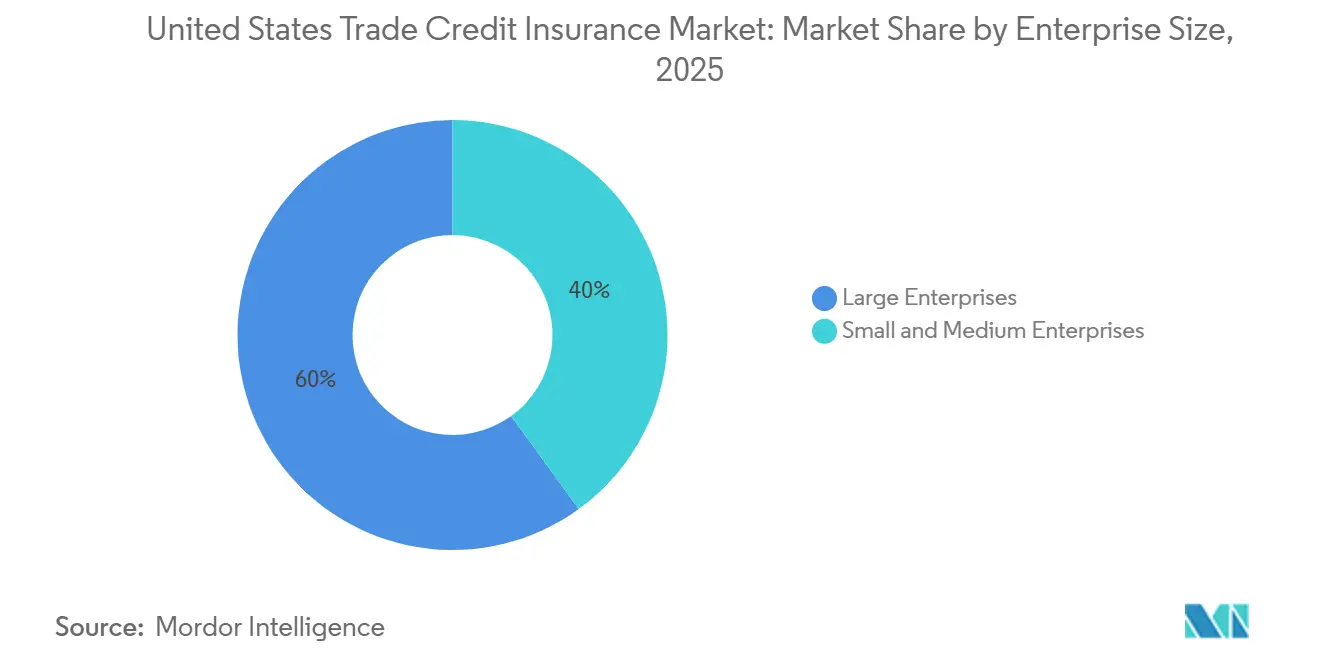
Large enterprises accounted for 60% of 2025 revenue and remain the primary source of premium volume in the United States trade credit insurance market. Their broader buyer portfolios, larger policy limits, and integration of insurance into receivables and supply chain finance structures make them a stable segment. These companies renew coverage not only for default protection but also to enhance collateral quality, funding access, and internal credit governance. Whole-turnover policies align well with their needs, reducing adverse selection and improving portfolio visibility. Additionally, large enterprises often have international exposure, making them early adopters of export-focused policies. Despite soft pricing periods, this segment anchors the market due to its ability to manage compliance and reporting demands, supported by dedicated credit management teams.
Small and medium enterprises (SMEs) are the fastest-growing segment, with the United States trade credit insurance market for SMEs projected to grow at a 10.9% CAGR from 2026 to 2031. Tighter bank lending, rising buyer defaults, and increased demand for receivables-backed funding are driving this growth. SMEs are increasingly turning to trade credit insurance to preserve working capital, secure financing, and protect key customer relationships. Improved product access, digital administration, and flexible distribution models are lowering barriers for smaller businesses. While many SMEs start with selective or buyer-specific protection, this entry point often evolves as they gain confidence in the product. Over the forecast period, SME growth is expected to reshape the market mix, even as large enterprises continue to dominate current revenue.
By Coverage: Whole Turnover Policy Dominance Intact, Single Buyer Surges on FI Demand
Whole turnover coverage dominated the United States trade credit insurance market in 2025, accounting for 83% of the market share. This structure remains integral as it aligns with large corporate treasury processes, bank lending requirements, and portfolio-based underwriting strategies. Whole-turnover policies enable underwriters to diversify risk across buyer books, ensuring steadier pricing and consistent policy performance. Policyholders benefit from reduced adverse selection and clearer collateral frameworks, which are crucial for receivables financing. Additionally, the accounting treatment of insured receivables enhances visibility on loss expectations and portfolio quality. As a result, whole turnover remains the preferred choice for large enterprises, maintaining its dominance even as market growth shifts toward other segments.
Single-buyer coverage is the fastest-growing segment of the United States trade credit insurance market, projected to expand at a 12% CAGR between 2026 and 2031. This growth is driven by lenders and financiers seeking targeted protection for concentrated receivables pools. Financial institutions increasingly request single-buyer policies to address specific exposures rather than full customer ledgers. This modular approach appeals to companies with concentrated risks, such as reliance on a single retailer or distributor, and sectors sensitive to tariffs. Single-buyer policies provide a practical entry point for firms hesitant to adopt full-ledger coverage, offering flexibility and targeted risk management. Over time, this format may act as a gateway to broader portfolio insurance as businesses recognize its financing and loss-control benefits.
By Application: International Use Leads, Domestic Receivables Exposure Fuels Fastest Growth
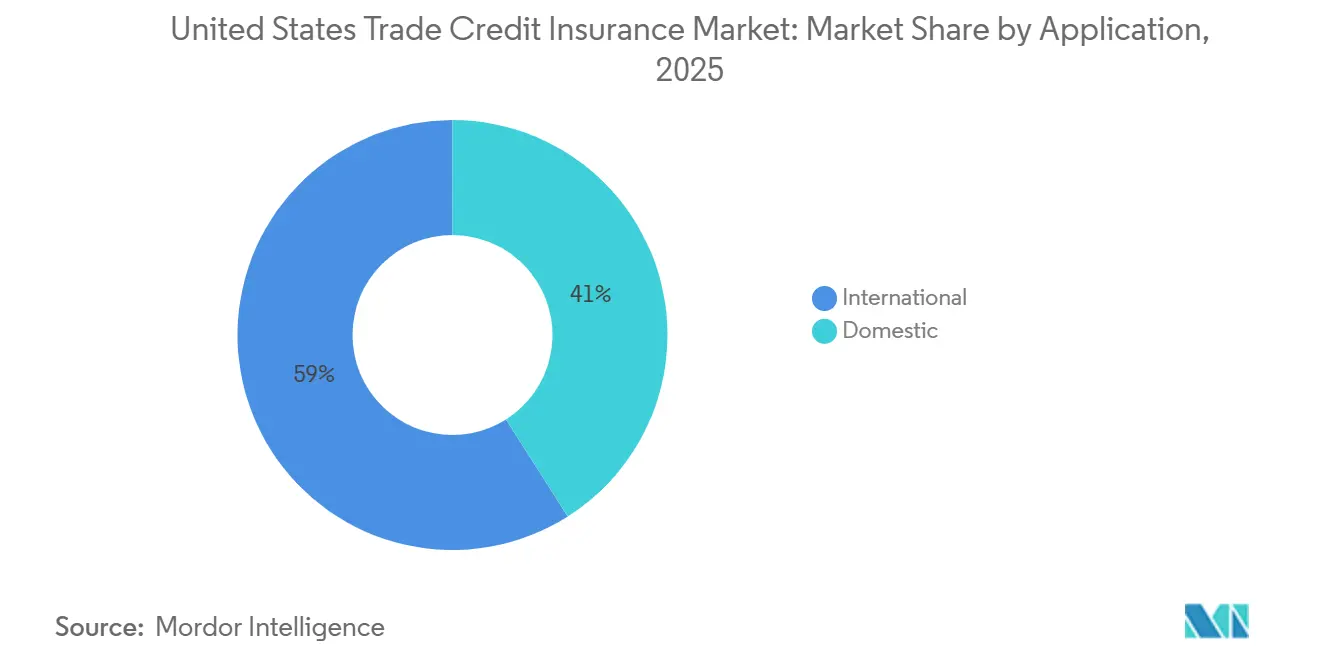
International applications accounted for 59% of 2025 premiums, and they remain the largest use case in the United States trade credit insurance market because export sellers have historically faced the clearest need for formal credit protection against unfamiliar counterparties and cross-border payment risk. EXIM continues to provide a benchmark for short-term export credit insurance, covering up to 95% of the invoice value on qualifying policies, thereby supporting adoption and setting expectations for exporters entering insured trade structures. The tariff cycle has not removed this need. Instead, it has made payment risk harder to predict and pushed sellers toward new trade corridors and new buyer groups. When exporters diversify away from stressed or politically sensitive relationships, they often need outside underwriting support because internal data on those new buyers is limited. That keeps international business at the center of the United States trade credit insurance market even when tariff headlines appear negative for global trade.
The international segment also reflects a long institutional history. United States companies first adopted trade credit insurance at scale in export settings, where payment terms were extended across borders and collection options were more complex than in domestic trade. Private insurers and EXIM therefore built much of the early market infrastructure around export-led usage, and that legacy still shapes current premium mix. The segment is especially important for large corporates with diversified customer bases, multi-country sales operations, and bank-linked trade finance needs. Those companies often use insurance not just to protect invoices but also to support financing efficiency and internal credit policy across overseas books. For that reason, the international side of the United States trade credit insurance market remains large even as domestic demand accelerates.
By End Use: Food and Beverage Leads Premiums, Automotive Sector Drives Fastest Expansion
Food and beverage accounted for 29% of 2025 premiums and led the United States trade credit insurance market, as the sector combines thin margins, high inventory turnover, strong buyer concentration, and constant working capital pressure. Those characteristics make unpaid invoices more damaging than in sectors that can absorb longer cash cycles or wider margin compression. The sector also faces supply chain volatility driven by commodity prices and shifts in consumer demand, which can quickly affect the credit quality of distributors and retailers. In the United States trade credit insurance market, food and beverage therefore behaves less like an opportunistic buyer group and more like a recurring user of receivables protection. That steady need explains why the segment continues to lead even as more cyclically stressed sectors begin to grow faster.
Food and beverage also benefit from being highly compatible with the whole turnover policy design. Sellers often manage large buyer books with repeat orders, standardized payment terms, and ongoing exposure across chains, distributors, and regional accounts. That makes portfolio insurance more practical than a buyer-by-buyer approach and supports long-term relationships between underwriters, brokers, and insureds. The segment’s claims profile can be severe because delays in payment quickly translate into liquidity pressure when stock turnover is high and replacement inventory must still be funded. For many companies, the policy is used alongside tighter credit control rather than in place of it, which reinforces renewal behavior. This combination of recurring exposure and routine operational use keeps food and beverage central to the United States trade credit insurance market.
Automotive is the fastest-growing end-use segment, and the United States trade credit insurance market size for automotive is forecast to expand at 12.8% CAGR between 2026-2031 because tariff exposure and supplier distress have intensified default risk across import-dependent chains. The First Brands Group Chapter 11 filing in September 2025, with USD 11.6 billion in liabilities, became the clearest example of this pressure and forced underwriters to revisit assumptions on receivables linked to multi-layered finance structures. Atradius also identified automotive as a sector needing elevated underwriting scrutiny in 2026, which aligns with the broader rise in insolvency risk across exposed industrial supply chains. In the United States trade credit insurance market, automotive growth is therefore being driven by stress rather than simple volume expansion. Sellers, lenders, and insurers all have stronger incentives to monitor concentrated buyer relationships and secure cover where payment failure could spread quickly through a supplier base. That makes the sector a focal point for both premium growth and underwriting caution.
Other end uses are also broadening the mix, although they do not match food and beverage on current scale or automotive on forecast pace. IT and telecom benefit from longer B2B billing cycles and open-account sales for hardware and software-related procurement, which makes selective cover useful in concentrated customer relationships. Healthcare demand is growing in parts of the medical device and pharmaceutical supply chain where payment cycles with hospital systems can create receivables concentration risk. Energy-related trade in export-oriented states also contributes to policy demand, especially where counterparties are tied to volatile industrial cycles or cross-border sales. These categories show that the United States trade credit insurance market is not dependent on one sector alone, even if premium leadership and fastest growth are currently concentrated in food and beverage and automotive.
Geography Analysis
The South is a major export-linked region in the United States trade credit insurance market because Texas, Louisiana, and Florida connect domestic production and distribution systems to Latin American and global buyers. Texas supports demand from energy, chemicals, and advanced manufacturing exporters, while Florida serves as a strong gateway for trade with Latin America. These patterns support both whole-turnover and single-buyer placements because exporters often have a mix of diversified domestic receivables and concentrated overseas counterparties. The South also benefits from growing spillover from Northeast-led financing structures as banks and brokers expand placement activity into regional corporate and middle-market accounts. This combination of export intensity, sector diversity, and expanding financing access has positioned the South as the largest regional segment of the United States trade credit insurance market, accounting for 34.37% of the total share in 2025. In addition, it is projected to be the fastest-growing region, with a forecast CAGR of 11.24%, reflecting continued expansion in cross-border trade and the increasing adoption of credit insurance solutions. This helps explain why the United States trade credit insurance market is not concentrated only in traditional financial hubs, even though underwriting and structuring capability remain strongest there.
The Northeast remains the core operating center of the United States trade credit insurance market because it combines the deepest financial infrastructure with a concentrated base of food, pharmaceutical, and chemical manufacturing clients. New York is especially important because banks, specialty brokers, and structured finance participants there are central to the 60% of credit insurance inquiries that Atradius said now come from financial institutions. That financial density supports more complex placements, stronger broker access, and faster adoption of bank-linked structures than in many other regions. The mid-Atlantic corridor also contributes steady premium flow through longer supply chains and regular trade-credit terms across industrial and healthcare-related sectors. Atradius’s rollout of its Arcade pricing platform in Connecticut in May 2026 shows how carriers are still investing in state-level underwriting and filing processes in the region rather than treating it as a mature market with limited need for product refinement. The Northeast, therefore, functions as both a demand center and an operating base for national strategy in the United States trade credit insurance market.
The Midwest is shaped by exposure to automotive, metals, steel, and food processing, which made it one of the clearest pressure points during the 2025 and 2026 insolvency cycle. S&P Global Market Intelligence said industrial-sector bankruptcies reached 70 filings through July 2025, the highest among major sectors, which carries direct weight for Midwest manufacturing states such as Ohio, Michigan, Indiana, and Illinois. The First Brands collapse in Ohio gave underwriters a concrete reminder that invoice finance risk in the region can spread quickly through supplier networks when a large auto-related borrower fails. The Midwest also has a sizable pool of smaller manufacturers that have traditionally relied on internal credit control rather than formal insurance, creating a large yet underpenetrated opportunity for brokers and carriers. As small business Chapter 11 activity rises, this region is likely to see faster awareness-led adoption than its historical usage levels would suggest. That makes the Midwest a region where risk, stress, and market expansion are happening together.
The West is increasingly important because domestic growth, technology-led commerce, and digital integration are changing how policies are distributed and administered. California brings together large food exporters, technology platforms, and complex B2B payment flows, which create varied use cases for receivables protection. The region also has an early-adopter profile for embedded financial tools, which supports new routes to insurance placement even as traditional awareness remains uneven. That matters for the United States trade credit insurance market because future growth depends not only on underwriting capacity but also on lower-friction distribution and administration. As policy workflows become easier to connect with order-to-cash systems and financing platforms, the West is likely to remain an important testing ground for next-generation trade credit insurance delivery.
Competitive Landscape
The United States trade credit insurance market is concentrated, with Allianz Trade, Atradius, and Coface holding dominant positions in the global short-term trade credit market. Their extensive buyer data, wide geographic reach, and robust claims infrastructure enable policyholders to benefit from quick limit decisions, reliable monitoring, and comprehensive buyer intelligence, which are crucial during volatile credit conditions. This concentration allows leading carriers to influence underwriting standards, technology advancements, and product innovation, while still maintaining opportunities for competition.
Top-tier carriers are strengthening their positions through strategic initiatives. Coface launched Syndicate 2546 at Lloyd’s in July 2025, expanding access to rated capacity for clients needing Lloyd’s paper. Atradius introduced its Arcade pricing platform in Connecticut in May 2026 to streamline pricing and underwriting. Allianz Trade partnered with Klear in May 2026 to extend credit protection into middle-market working capital programs. These moves highlight how leading firms are leveraging scale to integrate insurance capacity with financing channels and digital tools, solidifying their competitive edge.
The second tier, including Chubb, AIG, Zurich, QBE, and others, competes through broader P&C relationships, sector expertise, and broker reach rather than dedicated buyer-intelligence scale. These firms provide alternative capacity and sector-specific support, maintaining competitive pressure and preserving the soft pricing environment. Distribution remains fragmented, with major brokers like Aon and Marsh playing key roles in mid-market education and policy placement. However, the shift toward embedded and platform-based delivery is growing, especially in receivables finance and digital order systems. This dynamic ensures the market remains moderately concentrated in underwriting but highly competitive in distribution and client acquisition.
United States Trade Credit Insurance Industry Leaders
-
Allianz Trade
-
Atradius N.V.
-
Coface SA
-
Chubb Limited
-
American International Group, Inc.
- *Disclaimer: Major Players sorted in no particular order
Recent Industry Developments
- April 2026: Klear and Allianz Trade North America announced an insurance-backed receivables financing program that gives middle-market suppliers access to non-dilutive working capital for non-investment-grade receivables. The partnership provides institutional-grade credit protection to growth-stage companies historically been underserved by traditional lenders.
- April 2026: Moody’s and Cartan Trade signed a data supply agreement under which Moody’s provides credit risk insights and data analytics to support Cartan Trade’s governance infrastructure. The agreement highlights the importance of real-time data in specialty trade credit underwriting.
- April 2026: The United States International Development Finance Corporation and Chubb, along with AIG, Berkshire Hathaway, Liberty Mutual, CNA, Starr, and Travelers as additional reinsurance partners, announced a USD 40 billion maritime reinsurance facility providing war risk coverage for vessels in the Strait of Hormuz. While it sits outside core trade credit, it shows the expanding role of the United States insurers in government-backed trade risk programs.
- July 2025: Coface launched Lloyd’s Syndicate 2546 in partnership with Apollo Syndicate Management after receiving Lloyd’s in-principle approval. The syndicate offers AA-rated trade credit solutions to a global client base and commenced underwriting in 2025.
United States Trade Credit Insurance Market Report Scope
| Large Enterprises |
| Small and Medium Enterprises |
| Single Buyer Coverage |
| Whole Turnover Coverage |
| International |
| Domestic |
| Food and Beverage |
| Automotive |
| IT and Telecom |
| Healthcare |
| Energy |
| Other End Uses |
| Northeast |
| Midwest |
| South |
| West |
| By Enterprise Size | Large Enterprises |
| Small and Medium Enterprises | |
| By Coverage | Single Buyer Coverage |
| Whole Turnover Coverage | |
| By Application | International |
| Domestic | |
| By End Use | Food and Beverage |
| Automotive | |
| IT and Telecom | |
| Healthcare | |
| Energy | |
| Other End Uses | |
| By Region | Northeast |
| Midwest | |
| South | |
| West |
Key Questions Answered in the Report
What is driving growth in United States trade credit insurance through 2031?
Growth is being driven by rising insolvencies, tariff-related buyer stress, stronger use of insured receivables in financing, and wider SME adoption. The market is projected to rise from USD 2.45 billion in 2026 to USD 4.01 billion by 2031 at a 10.4% CAGR.
Which buyer group currently contributes the most premium volume?
Large enterprises remain the leading buyer group, holding 60% of 2025 revenue because they use trade credit insurance in treasury, supply chain finance, and bank-linked receivables programs.
Why is domestic application growing faster than international use?
Domestic application is growing at 11.8% CAGR because overdue B2B sales, rising Chapter 11 filings, and tighter credit conditions are forcing the United States companies to formalize protection on local receivables.
Why does whole turnover coverage still dominate?
Whole turnover coverage held 83% of the market in 2025 because it fits bank collateral rules, large buyer books, and portfolio-based underwriting that supports cleaner financing structures.
Which end-use sector is seeing the fastest expansion?
Automotive is the fastest-growing end-use segment at 12.8% CAGR through 2031, mainly because tariff pressure and supplier failures have increased credit stress across import-dependent chains.
How concentrated is competition among insurers?
The market is moderately concentrated at the underwriting tier because Allianz Trade, Atradius, and Coface control around 70% of global short-term capacity, while distribution remains fragmented across large brokers and specialist intermediaries.