
Market Overview
| Study Period | 2021 - 2031 |
|---|---|
| Forecast Data Period | 2026 - 2031 |
| Historical Data Period | 2021 - 2024 |
| Growth Rate | 10.62 % |
| Market Concentration | Medium |
Major Players *Disclaimer: Major Players sorted in no particular order Image © Mordor Intelligence. Reuse requires attribution under CC BY 4.0. | |
United States High-voltage Direct Current (HVDC) Transmission Systems Market Analysis by Mordor Intelligence
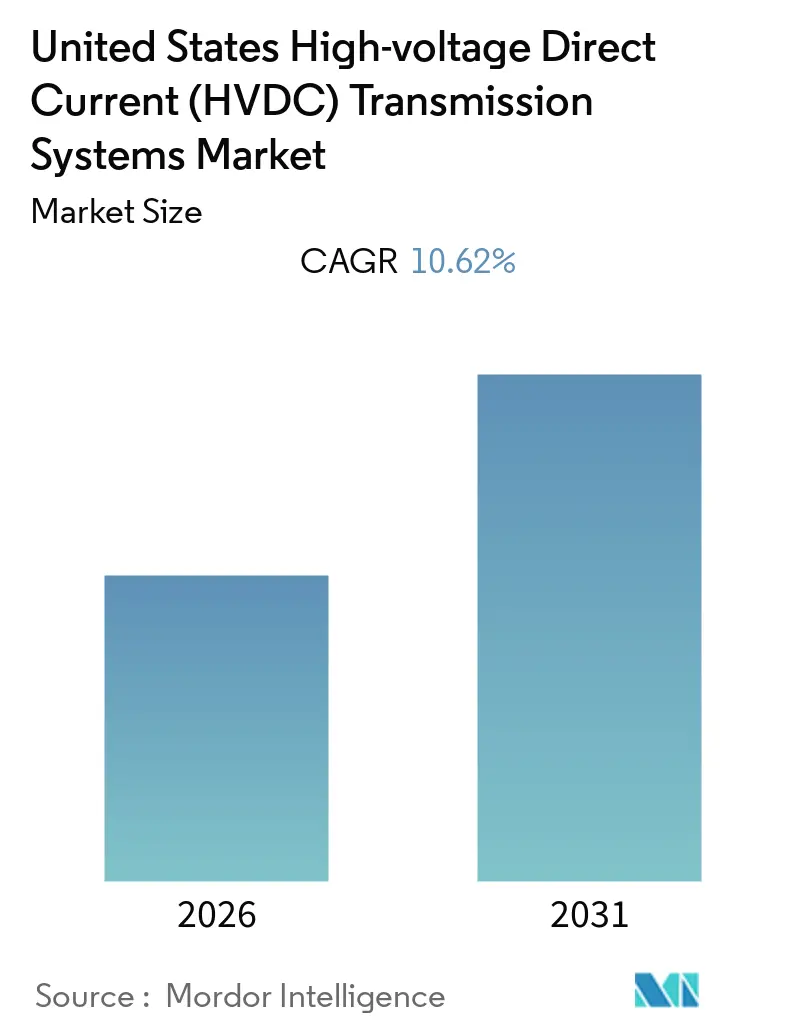
The United States High-voltage Direct Current (HVDC) Transmission Systems Market size is expected to register a CAGR of 10.62% during the forecast period (2026-2031).
- The submarine HVDC transmission system is expected to witness significant growth due to upcoming project developments and an increasing focus on power trading between countries.
- Technological advancements in HVDC transmission systems are expected to help in mitigating operational issues with offshore wind- and solar-based electricity transmission systems. Hence, this is expected to provide a better opportunity for the growth of the HVDC transmission system market in the country.
- The increasing penetration of renewable energy sources is likely to drive the US high-voltage direct current (HVDC) transmission systems market during the forecast period.
Note: Market size and forecast figures in this report are generated using Mordor Intelligence’s proprietary estimation framework, updated with the latest available data and insights as of 2026.
United States High-voltage Direct Current (HVDC) Transmission Systems Market Trends and Insights
The Submarine HVDC Transmission System Type is Expected to Witness Significant Growth
- The submarine transmission of electricity is gaining importance on account of the increasing focus on power trading between countries. The HVDC submarine power transmission system is considered a key technology for the development of future power transmission networks. It is also the only solution available for the transfer of high power across long subsea distances. For these reasons, HVDC lines are preferred for interconnecting offshore wind plants worldwide.
- In the HVDC transmission system, the submarine power cables can be less costly, especially on a long link where the capacitance of the cable requires too much additional charging current.
- As of 2020, the upcoming projects in the United States such as Atlantic Wind Connection-Transmission (worth USD 5 billion approx.), Grain Belt Express Clean Line (worth USD 3 billion approx.), and Trans-West Express Transmission Line (worth USD 3 billion approx.) are anticipated to create a huge demand for HVDC transmission systems.
- In June 2021, SOO Green HVDC Link announced the selection of Prysmian Group as its preferred supplier of high-voltage direct current cable systems for the first-of-its-kind transmission project to be installed underground along with existing railroad rights of way. The 2,100 MW interregional project, considered the first link in a national clean energy grid, will connect two of the largest energy markets in the United States.
- Factors such as the increasing number of offshore wind farms, along with interconnections between countries through submarine cables, are expected to increase the demand for submarine transmission systems over the forecast period.
- Therefore, owing to the above points, submarine HVDC transmission systems are expected to witness significant growth during the forecast period.
Increased Penetration of Renewable Energy Sources Driving the Market Demand
- The US power supply is undergoing a significant transition, shifting away from fossil fuels and moving toward renewable energy sources. Moreover, wind and solar PV are on track to become the cheapest sources of electricity, thereby providing new opportunities for decarbonization. Also, as more significant number of coal plants are decommissioned, renewable generation is expected to play a vital role in fulfilling the increasing energy demand.
- Moreover, the cost of renewable power generation, mainly solar and wind power generation, is continuously declining. The primary reasons are manufacturing innovations, improvement in wind turbine materials and designs, economies of scale, and advances in thermal energy storage systems for concentrated solar power (CSP) plants.
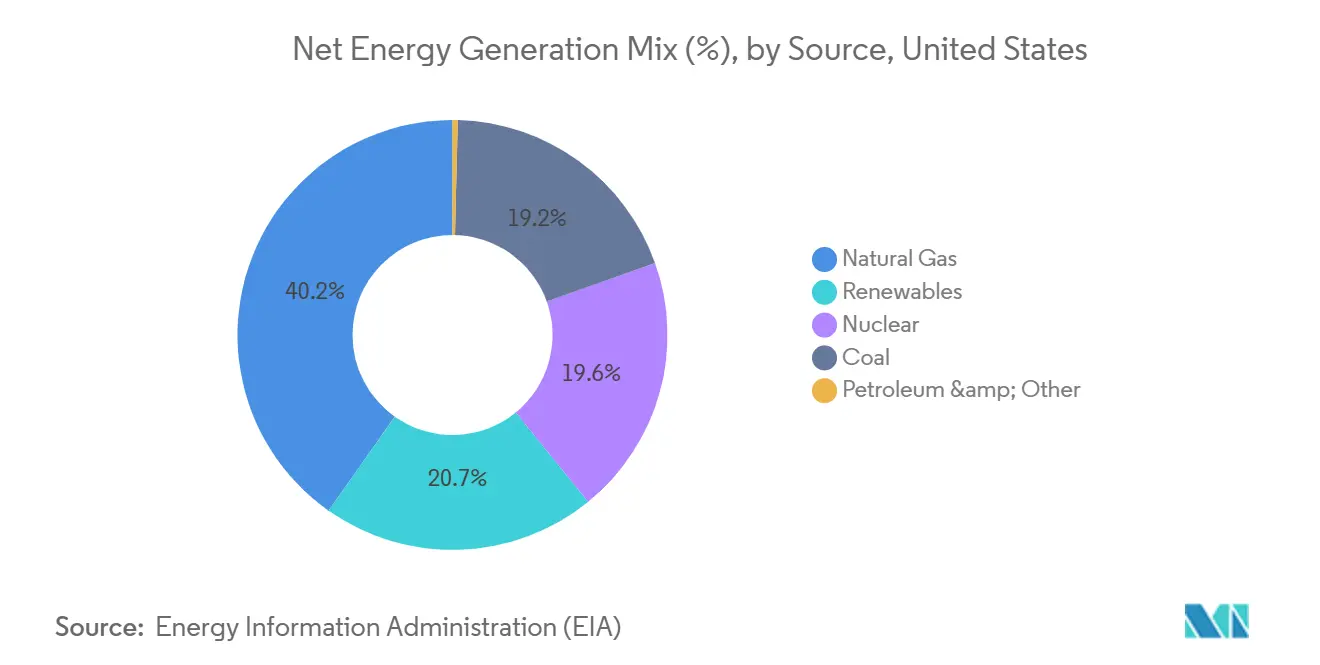
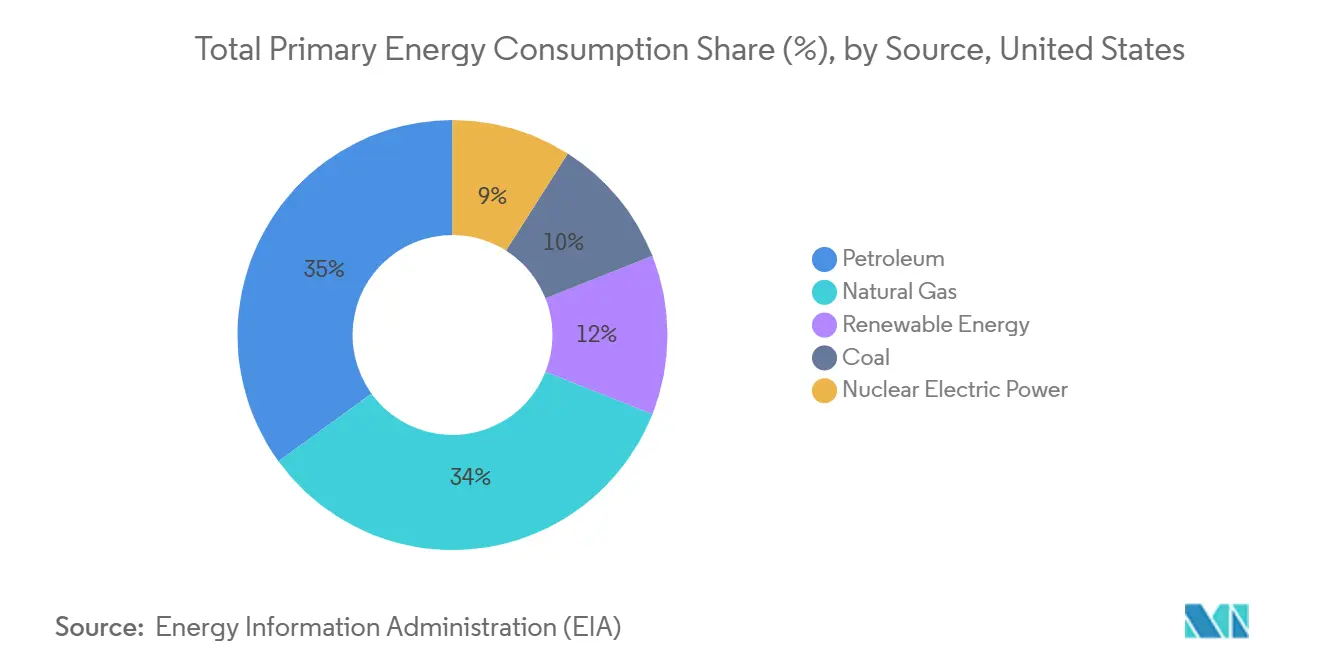
- Furthermore, during 2020, renewable energy in the United States provided about 11.59 quadrillion British thermal units (Btu) equal to 12% of the total energy consumption. The electric power sector accounted for about 60% of the total US renewable energy consumption in 2020, and about 20% of the total US electricity generation was from renewable energy sources.
- Besides, the renewable power plants are generally located in rural areas and require long-distance transmission lines to provide generated electricity to the consumers. HVDC has become an integral part of many transmission grids, as it can connect remote sources of electrical generation (renewable sources, like hydro or wind) to load centers where it is needed, hundreds or even thousands of kilometers away.
- There are plans underway to develop the 600 kV, 4,000 MW Plains and Eastern Clean Line to deliver wind power from the OklahomaTexas Panhandle to Arkansas, Tennessee, and other states in the region.
- Additionally, a Danish investment firm and Siemens AG are backing a proposed USD 2.5 billion underground high-voltage direct-current transmission line, which may be the first of its kind in the United States.
- In October 2021, Orsted and Eversource selected Siemens Energy to supply a transmission system for a 924 MW offshore wind farm powering New York State. Sunrise wind will be the first offshore wind project in the United States to use HVDC transmission technology.
- Therefore, owing to the above points, increasing renewable energy installations are expected to drive the US high-voltage direct current (HVDC) transmission systems market during the forecast period.
Regulatory Landscape
HVDC transmission development in the United States is shaped by federal backstop authority and reliability requirements. Under the Federal Power Act (FPA) Section 216 (as amended by the Infrastructure Investment and Jobs Act), the US Department of Energy (DOE) identifies National Interest Electric Transmission Corridors (NIETCs), and the Federal Energy Regulatory Commission (FERC) can issue permits for certain interstate electric transmission facilities in those corridors under defined conditions, including state inaction or denial.
FERC Order No. 1977 (effective July 2024) updated the application requirements and process for permits to site interstate electric transmission facilities, aligning documentation and environmental-justice related elements with the post-IIJA framework. On grid-operations side, reliability standards affecting inverter-based resources (relevant to HVDC-connected systems and ride-through performance) were updated via Federal Register action in July 2025. DOE programs such as the HVDC Cost Reduction (CORE) Initiative target standardization and technology development, with a stated goal of cutting the levelized cost of energy transmitted by HVDC systems by 35% by 2035.
Value Chain Analysis
The US HVDC transmission systems value chain runs from project developers and utilities to EPC and integrators, then to OEMs and service providers. Developers and utilities cover route selection, interconnection strategy, and offtake arrangements. EPC and integrators handle system engineering, converter station design, controls, and protection, while OEMs supply converter stations and transmission media (submarine, underground, and overhead). Construction contractors, cable installation specialists, and testing and commissioning providers execute field deployment, followed by operations and maintenance services for converter stations and cable or line assets.
Near-term execution is constrained by HVDC-specific equipment availability, particularly converter-transformers and high-voltage cables. Procurement lead times extend beyond five years in some cases, driven by limited domestic manufacturing capacity and high global demand. The supply profile is reinforced by the absence of US-headquartered top-tier HVDC cable manufacturers and reliance on imported HVDC converter-transformers in the evidence base, which elevates the importance of supplier qualification, long-lead procurement planning, and localization initiatives for developers and OEMs.
Competitive Landscape
The US high-voltage direct current (HVDC) transmission systems market is moderately fragmented. The key players in the market include General Electric Company, Toshiba Corporation, Siemens Energy AG, LS Electric Co. Ltd, and NKT AS, among others.
United States High-voltage Direct Current (HVDC) Transmission Systems Industry Leaders
-
General Electric Company
-
Toshiba Corporation
-
NKT A/S
-
LS Electric Co., Ltd.
-
Siemens Energy AG
- *Disclaimer: Major Players sorted in no particular order
_Transmission_Systems_Market_-_Market_Concentration.webp)
Market Opportunities and Future Outlook
Opportunities for HVDC transmission systems in the United States connect to interregional transfer, offshore wind integration, and urban load delivery, where right-of-way constraints often favor high-capacity underground or submarine solutions. Recent project milestones provide market proof points, including the 3,000 MW SunZia Transmission HVDC project reaching full commercial operation in June 2026. This milestone supports a reference architecture for long-haul HVDC corridors that move renewable generation from resource regions to demand centers.
Policy and financing mechanisms also create room for additional HVDC buildout and related component demand. The DOE Loan Programs Office issued a conditional loan guarantee of up to USD 4.9 billion for the proposed 5,000 MW Grain Belt Express HVDC line, which supports development-stage de-risking for major interregional links. At the same time, DOE runs the HVDC CORE Initiative with a stated 35% cost-reduction target by 2035, and planning frameworks such as FERC Order No. 1920 push transmission providers toward more structured long-term regional and interregional planning. That direction increases the need for HVDC solutions where long-distance, high-capacity transfer and controllability are prioritized.
Recent Industry Developments
- June 2026: NKT celebrated the commercial operation of the Champlain Hudson Power Express (CHPE) HVDC transmission line in the United States. The milestone strengthens the reference base for high-capacity HVDC delivery into dense urban load zones and supports supplier credibility for future US submarine and underground HVDC awards. It also signals a shift from multi-year procurement and construction into operations-focused service and lifecycle support demand.
- March 2026: Toshiba Energy Systems and Solutions Corporation received an order from J-POWER Transmission Network Co., Ltd. to supply a VSC-HVDC system for renewal of Pole 1 of the Hokkaido-Honshu HVDC Link. The award underscores continued momentum for voltage-sourced converter platforms in grid renewal programs, reinforcing technology roadmaps that US developers and utilities track when specifying controls, protection, and stability features. It also reflects the competitive importance of proven VSC references as large-scale HVDC procurement cycles progress.
- July 2025: Reliability standards for frequency and voltage protection settings and ride-through for inverter-based resources were updated via Federal Register action. These updates influence grid-code compliance and performance requirements for HVDC-connected systems and associated converter controls, shaping technical specifications and testing regimes. The change increases the value of OEM and integrator capabilities in modeling, validation, and compliance documentation during project development and commissioning.
Research Methodology Framework and Report Scope
Market Definition and Coverage
This market covers the value of HVDC transmission systems installed and supplied in the United States, including the core equipment needed to convert and move electricity over HVDC links through overhead, underground, or submarine routes.
Scope exclusions: We exclude AC transmission equipment, distribution grid hardware, and non-transmission electrical balance-of-plant items that are not specific to an HVDC link.
Segmentation Overview
- Transmission Type
- Submarine HVDC Transmission System
- HVDC Overhead Transmission System
- HVDC Underground Transmission System
- Component
- Converter Stations
- Transmission Medium (Cables)
Data Sources, Market Sizing, and Validation
Desk Research
Desk work starts by building a fact base on where HVDC is being planned and why it is selected, and then we translate that into a measurable demand pool. Public sources such as the U.S. Energy Information Administration (EIA), Federal Energy Regulatory Commission (FERC) filings and orders, North American Electric Reliability Corporation (NERC) reliability assessments, and U.S. Bureau of Economic Analysis (BEA) price and investment series help anchor the macro direction and grid investment cycle.
Next, we add project and procurement signals from sources such as DOE grid program releases, ISO and RTO planning documents, and state utility commission dockets, and then we check them against company annual reports, investor presentations, and reputable press coverage of major transmission approvals. For cost and technology context, we also review peer reviewed power systems literature and patent databases to understand converter and cable technology shifts and expected cost movement. The sources listed here are illustrative, and many additional public references were used for data collection, validation, and clarification.
Primary Interviews and Surveys
Primary work is used to validate what portion of the announced pipeline is likely to move forward, and what the realistic timing and procurement scope looks like once permitting and interconnection steps are considered. We speak with utilities and transmission developers, engineering and construction participants, component suppliers, and independent grid experts across the United States so assumptions on converter station scope, cable requirements, and typical pricing are not left untested.
Distribution of primary research fieldwork respondents
| Company type | Respondent position |
|---|---|
| Top tier: 36% | CXOs: 13% |
| Mid tier: 48% | Functional/Unit leaders: 40% |
| Smaller Players: 16% | Managers: 47% |
Market-Sizing & Forecasting
The core model is built top down, where U.S. transmission buildout signals are reconstructed into likely HVDC system demand using project pipelines, route types (overhead, underground, submarine), and the typical equipment package needed per link. To keep this practical, we translate plans into measurable inputs such as number of HVDC links moving through planning stages, typical converter station counts per project, cable and line length by route type, and expected power capacity ranges that influence equipment sizing.
Once that demand pool is formed, selective bottom-up checks are used to keep totals realistic, such as sampled project cost ranges, indicative equipment pricing from interviews, and cross checks against converter and cable supply availability. When project level disclosure is incomplete, gaps are handled by using analogous U.S. projects with similar route type and capacity, and then the assumptions are rechecked with experts before being applied broadly. For forecasting, we lean on scenario analysis tied to drivers that are repeatedly mentioned by stakeholders, including renewable interconnection buildout, offshore wind related subsea link timing, permitting and queue reform pace, and the annual rhythm of utility transmission planning updates.
Data Validation & Update Cycle
Validation is done in layers so single source errors do not flow into the final number. We compare the model outputs against independent signals such as the pace of major transmission approvals, reported grid capital spending direction, and the observable cadence of large project announcements, and then any sharp variances are reviewed before sign off.
If an assumption appears to drive an outsized change, we re contact relevant interviewees and recheck the linked secondary references so the adjustment is evidence based and traceable. Reports are refreshed annually, and interim updates are made when material events occur, such as major policy changes, delayed permitting outcomes, or large project cancellations. Before delivery, an analyst does a final review pass to ensure clients receive the most current view available at that time.
Mordor Intelligence's United States High Voltage Direct Current Hvdc Transmission Systems Market Market Sizing Compared With Other Published Estimates
Published market sizes for U.S. HVDC often do not match because each study draws the line differently on what counts as a system sale versus a broader grid investment. Differences also come from the time window used, the treatment of large one off projects, and whether the values are stated in current dollars or adjusted pricing.
Some published figures roll up a wider HVDC transmission spend bucket that can include general transmission works and a broader set of applications. In Mordor Intelligence sizing, the total is limited to HVDC transmission systems in the United States and is counted through converter stations and HVDC transmission medium (cables), aligned to the overhead, underground, and submarine link types used in grid plans.
Benchmark comparison
| Source | Market Size | Gaps in Research Methodology |
|---|---|---|
| Mordor Intelligence | USD 3.80 B (2026) | |
| Trade Publisher A | USD 3.50 B (2024) | Uses a different base year and is presented as an HVDC transmission market value without clearly separating U.S. project timing effects and the equipment scope split between converter stations and transmission medium. |
| Industry Publisher B | USD 12.94 B (2025) | Appears to apply a broader spend definition with higher value capture, which can happen when related grid works or a wider set of HVDC project costs are included rather than focusing on the HVDC system package tied to specific link types. |
The spread across the three figures is mainly explained by scope width and the year selected for quoting, and then amplified by how project timing is treated in a lumpy investment market. Our approach stays repeatable by mapping link type activity to a consistent equipment bill of scope, and then pressure testing the outputs with interviews and cross checks so the final number is not driven by a single assumption.
Key Questions Answered in the Report
What is the current United States High-voltage Direct Current (HVDC) Transmission Systems Market size?
The United States High-voltage Direct Current (HVDC) Transmission Systems Market is projected to register a CAGR of 10.62% during the forecast period (2026-2031)
Who are the key players in United States High-voltage Direct Current (HVDC) Transmission Systems Market?
General Electric Company, Toshiba Corporation, NKT A/S, LS Electric Co., Ltd. and Siemens Energy AG are the major companies operating in the United States High-voltage Direct Current (HVDC) Transmission Systems Market.
What years does this United States High-voltage Direct Current (HVDC) Transmission Systems Market cover?
The report covers the United States High-voltage Direct Current (HVDC) Transmission Systems Market historical market size for years: 2021, 2022, 2023, 2024 and 2025. The report also forecasts the United States High-voltage Direct Current (HVDC) Transmission Systems Market size for years: 2026, 2027, 2028, 2029, 2030 and 2031.