
Market Overview
| Study Period | 2021 - 2031 |
|---|---|
| Forecast Data Period | 2026 - 2031 |
| Historical Data Period | 2021 - 2024 |
| Growth Rate | 6.43 % |
| Market Concentration | High |
Major Players *Disclaimer: Major Players sorted in no particular order Image © Mordor Intelligence. Reuse requires attribution under CC BY 4.0. | |
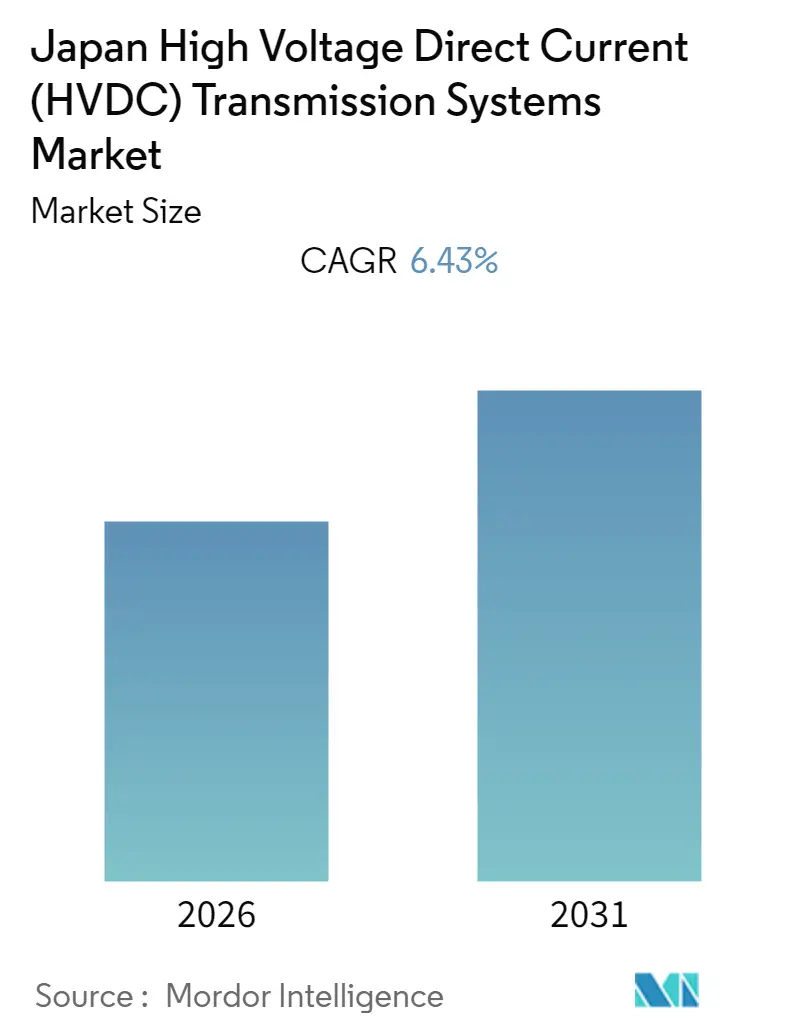
Japan High Voltage Direct Current (HVDC) Transmission Systems Market Analysis by Mordor Intelligence
The Japan High Voltage Direct Current (HVDC) Transmission Systems Market size is expected to register a CAGR of 6.43% during the forecast period.
Japan's power grid infrastructure is undergoing a significant transformation driven by the country's ambitious energy transition goals and geographical challenges. The nation's unique position as an archipelago, combined with its vulnerability to natural disasters, has necessitated the development of robust and efficient power transmission systems. The Japanese government has announced an aggressive plan to eliminate approximately 4,000 kilometers of overhead power lines by 2025, replacing them with underground lines at various strategic locations, including major transportation routes, world heritage sites, and tourist destinations. This grid modernization initiative reflects the country's commitment to building a more resilient and aesthetically pleasing power transmission network.
The technological landscape of Japan's HVDC transmission sector has witnessed remarkable advancements, particularly in the development of voltage source converter (VSC) technology and modular multilevel converters. These innovations have enabled more efficient power transmission across different frequency zones, addressing Japan's unique challenge of operating two distinct frequency systems—50 Hz in eastern Japan and 60 Hz in western Japan. The successful implementation of the Hida-Shinano frequency conversion facility, with its substantial 900 MW interconnection capacity, demonstrates the industry's capability to overcome complex technical challenges while ensuring system reliability and stability.
Japan's commitment to renewable energy integration has emerged as a crucial factor shaping the HVDC transmission landscape. The government has set an ambitious target to install 45 gigawatts (GW) of offshore wind power capacity by 2040, necessitating significant expansion and modernization of the country's power grid infrastructure. This renewable energy push has catalyzed innovations in submarine power cable technology and HVDC converter station design, with Japanese manufacturers developing advanced HVDC technology solutions capable of handling higher voltage levels and longer transmission distances.
The industry has witnessed significant technological breakthroughs in cable design and materials, particularly in the development of cross-linked polyethylene (XLPE) cables that enable polarity reversal operations and higher operational conductor temperatures. These advancements have been complemented by innovations in converter station technology, including the implementation of advanced control and protection systems that provide enhanced stability and reliability. Japanese manufacturers have been at the forefront of developing specialized solutions for challenging environmental conditions, such as systems capable of operating in temperature ranges from -30°C to +35°C, demonstrating the industry's ability to adapt to diverse operational requirements. The development of HVDC cable technology has been instrumental in supporting these advancements.
Note: Market size and forecast figures in this report are generated using Mordor Intelligence’s proprietary estimation framework, updated with the latest available data and insights as of 2026.
Japan High Voltage Direct Current (HVDC) Transmission Systems Market Trends and Insights
Growing Integration of Renewable Energy Sources
Japan's power supply infrastructure is undergoing a significant transformation with an increasing focus on renewable energy transmission, particularly wind and solar power generation. The declining costs of renewable power generation, driven by manufacturing innovations, improved wind turbine materials and designs, and economies of scale, have made these sources increasingly attractive. According to the New Energy and Industrial Technology Development Organization (NEDO), Japan possesses an impressive offshore wind power potential of approximately 1,380 million kW along its coastal regions, with roughly 70% concentrated in the Hokkaido, Tohoku, and Kyushu regions. This substantial renewable potential, primarily located away from major load centers, necessitates robust electrical transmission systems.
The government's commitment to renewable energy integration is evident through concrete actions and policies. In June 2020, Japan launched its first offshore wind energy auctions under the offshore wind promotion law of 2019, followed by the commencement of construction at the Akita Noshiro offshore wind farm in April 2021, marking the country's first large-scale offshore wind project. HVDC transmission systems are particularly well-suited for connecting these remote renewable generation sources to load centers, offering approximately 50% lower losses compared to HVAC systems, along with high availability and minimal maintenance requirements. These technical advantages make HVDC power transmission systems increasingly attractive for power transmission companies looking to efficiently integrate renewable power plants into the grid.
Geographical Need for Inter-Island Power Transmission
Japan's unique geographical composition, consisting of four major islands - Hokkaido, Honshu, Shikoku, Kyushu - and numerous smaller islands, creates an inherent need for efficient power transmission infrastructure. The submarine HVDC transmission systems have emerged as the optimal solution for inter-island power connectivity, offering superior technical capabilities compared to traditional AC transmission. These systems are particularly crucial as they enable the establishment of reliable grid interconnection between islands operating at different frequencies, with Japan's power grid divided between 50 Hz and 60 Hz regions.
The effectiveness of HVDC systems for inter-island connections has been demonstrated through various successful implementations. For instance, the Hida-Shinano frequency conversion facility, commissioned in 2021, represents a significant advancement in Japan's power infrastructure, featuring a direct current transmission system with an interconnection capacity of 900 MW. This system efficiently connects the 60 Hz Chubu Electric Power area to the 50 Hz TEPCO area via an approximately 89 km long aerial cable. The submarine power transmission systems' sophisticated structure, though more complex than overhead transmission lines, provides essential benefits such as protection from natural calamities and minimal power losses, making them ideal for Japan's archipelagic geography and varying frequency requirements.
Segment Analysis
HVDC Overhead Transmission System Segment in Japan HVDC Transmission Systems Market
The HVDC overhead transmission line system segment holds a dominant position in the Japan HVDC transmission systems market, accounting for approximately 21.55% market share in 2025. This segment's leadership is primarily attributed to its cost-effectiveness and simpler line tower construction requirements compared to HVAC transmission lines. The overhead HVDC transmission infrastructure demonstrates superior capabilities in transporting more power compared to HVAC systems, requiring only two insulated conductors for a bipolar overhead line instead of three conductors needed in alternating current systems. The segment's strong market position is further reinforced by its lower per-unit costs, including cost per kilometer of line and per MW of transmitted power, making it an economically viable choice for long-distance power transmission projects in Japan.

HVDC Underground and Submarine Transmission System Segment in Japan HVDC Transmission Systems Market
The HVDC underground and submarine power cable transmission system segment is emerging as the fastest-growing segment in the Japan HVDC transmission systems market for the period 2025-2031. This remarkable growth is driven by several factors, including the increasing focus on connecting Japan's various islands through HVDC transmission systems. The segment's growth is particularly supported by its advantageous properties such as enhanced safety from natural calamities and lower power losses during transmission. The Japanese government's ambitious plans to install 45 GW of offshore wind energy by 2040 are creating substantial opportunities for HVDC cable systems. Additionally, the geographical characteristics of Japan, comprising four major islands and numerous smaller ones, make submarine HVDC systems an essential choice for ensuring reliable power connectivity across the nation.
Segment Analysis: Component
Converter Stations Segment in Japan HVDC Transmission Systems Market
The HVDC converter station segment dominated the Japan HVDC transmission systems market in 2024, holding approximately 77% of the total market share. This significant market position is primarily attributed to the increasing demand for bulk power transmission across different regions in Japan. The segment's growth is further bolstered by the rising penetration of HVDC systems and the growing need to connect AC lines to DC lines for efficient power transmission. Converter stations form the core element of HVDC transmission systems, being essential at either end of the transmission link. The technological advancements in converter stations, particularly in voltage source converter (VSC) and line-commutated converters (LCC), have enhanced their efficiency and reliability, making them increasingly indispensable in modern power transmission infrastructure.
Transmission Medium (Cables) Segment in Japan HVDC Transmission Systems Market
The transmission medium (cables) segment is projected to witness substantial growth during the forecast period 2024-2029, driven by Japan's unique geographical characteristics and increasing focus on renewable energy integration. The growth is particularly notable in submarine and underground cable applications, as Japan's island geography necessitates reliable underwater power transmission solutions. The segment's expansion is further supported by the country's ambitious offshore wind energy goals and the government's initiatives to replace overhead power lines with underground alternatives in specific areas. The development of advanced cable technologies, including mass-impregnated cables and cross-linked polyethylene (XLPE) cables, is enhancing the segment's growth potential by offering improved performance and reliability in power transmission.
Regulatory Landscape
Japan's HVDC transmission development is governed primarily by the Electricity Business Act and the planning and coordination role of the Organization for Cross-regional Coordination of Transmission Operators (OCCTO) under the Ministry of Economy, Trade and Industry (METI). Electric power companies submit electricity supply plans annually to OCCTO for aggregation and submission to METI, which helps align utility and developer investment with OCCTO's long-term cross-regional network policy and master plan (updated in March 2023) that frames wide-area reinforcement needed for Japan's 2050 carbon neutrality direction.
In March 2026, the Cabinet approved a bill to amend the Electricity Business Act that introduces a framework for METI to certify large-scale transmission and generation plans and supports a more proactive approach to backbone-grid development. The same reform package also introduces a new financing framework that enables OCCTO to utilize fiscal investment and loan programs for transmission development (with OCCTO participation typically capped). This complements the operational shift toward non-firm grid access introduced in April 2023 for certain generation facilities, which helps use existing network capacity more effectively while new interconnection, including HVDC, is built.
Value Chain Analysis
Japan's HVDC value chain spans upstream raw materials (copper and aluminum conductors, XLPE insulation compounds, steel for towers and station structures), midstream manufacture of HVDC cables (underground and submarine), converter transformers, valves and power electronics, control and protection systems, and switchgear. Downstream activities cover EPC, installation (including marine-lay capability for subsea routes), commissioning, and long-term service. Domestic majors, including Toshiba Energy Systems and Solutions, Hitachi Energy, Mitsubishi Electric, and Sumitomo Electric Industries, form the core technology and manufacturing base, with utilities and grid companies typically procuring projects through consortium delivery models that combine converter-station engineering, cable manufacture, and specialized installation.
Project development and delivery are closely tied to OCCTO and utility planning cycles, because interregional interconnection and frequency-conversion investments are evaluated against the master plan and annual supply plans. Key constraints include long lead times for converter equipment and limited high-voltage cable manufacturing capacity, along with permitting and marine construction scheduling for submarine links. Recent procurement activity, such as Toshiba's March 2026 order from J-POWER Transmission Network for a VSC-HVDC system to renew Pole 1 of the Hokkaido-Honshu HVDC Link, shows how grid reinforcement requirements flow through into converter-station design, factory manufacturing, and multi-year service and spares commitments.
Competitive Landscape
Top Companies in Japan HVDC Transmission Systems Market
The Japanese HVDC transmission systems market is dominated by established industrial conglomerates with significant technological capabilities. These companies have demonstrated a strong commitment to product innovation, particularly in developing advanced converter technologies, digital solutions, and efficient power transmission systems. Market leaders are actively pursuing strategic collaborations and partnerships to enhance their technological capabilities, as evidenced by joint ventures and memorandums of understanding between Japanese and international players. Companies are investing heavily in research and development facilities, with several players establishing dedicated HVDC verification centers and testing facilities across Japan. The focus on operational agility is reflected in the integration of digital solutions, IoT architecture, and smart grid transmission technologies into HVDC systems. Market participants are also expanding their service offerings to include comprehensive lifecycle management, from installation and commissioning to maintenance and upgrades.
Domestic Players Lead Consolidated Market Structure
The Japanese HVDC transmission systems market exhibits a highly consolidated structure dominated by domestic industrial conglomerates with a deep-rooted presence in the power sector. These major players, including Toshiba Corporation, Hitachi ABB Power Grids, Mitsubishi Electric Corporation, and Sumitomo Electric Industries, leverage their extensive manufacturing capabilities, established distribution networks, and strong relationships with utilities and government bodies. The market has witnessed significant consolidation through strategic mergers and acquisitions, notably the formation of Hitachi ABB Power Grids through Hitachi's acquisition of ABB's power grid infrastructure business, strengthening the combined entity's position in the domestic market.
The competitive landscape is characterized by high entry barriers due to the capital-intensive nature of operations, the requirement for advanced technological expertise, and the need for established relationships with utilities and regulatory bodies. Market participants have adopted vertical integration strategies, maintaining control over critical components of the value chain from raw material procurement to installation and after-sales services. The presence of international players is limited, with most foreign companies operating through joint ventures or technical collaborations with domestic players, reflecting the importance of local market knowledge and established relationships in the Japanese power sector.
Innovation and Integration Drive Future Success
Success in the Japanese HVDC transmission systems market increasingly depends on companies' ability to innovate and integrate advanced technologies while maintaining strong relationships with key stakeholders. Incumbent players must focus on developing next-generation HVDC technology, particularly in areas such as voltage source converters, digital control systems, and grid integration solutions for renewable energy sources. Companies need to strengthen their service capabilities, offering comprehensive solutions that encompass project planning, installation, maintenance, and upgrades while adapting to evolving grid requirements and environmental regulations.
For contenders seeking to gain market share, strategic partnerships with established players and investment in specialized technological capabilities present viable entry strategies. The increasing focus on renewable energy integration and grid modernization creates opportunities for companies with innovative solutions in these areas. Success also depends on understanding and adapting to Japan's unique regulatory environment and building strong relationships with utilities and government bodies. Companies must consider the concentration of end-users in the power utility sector and develop strategies to address their specific requirements while maintaining technological leadership and operational efficiency.
Japan High Voltage Direct Current (HVDC) Transmission Systems Industry Leaders
-
Toshiba Corporation
-
Mitsubishi Electric Corporation
-
Sumitomo Electric Industries Ltd
-
Hitachi ABB Power Grids Ltd
- *Disclaimer: Major Players sorted in no particular order
.webp)
Market Opportunities and Future Outlook
The largest whitespace in Japan's HVDC transmission systems market is tied to wide-area reinforcement needed to move renewable generation from northern regions to major demand centers, as formalized in OCCTO's master plan work on nation-wide transmission networks. The master plan identifies multi-gigawatt scale HVDC transfer needs from Hokkaido toward Tohoku and onward toward the Tokyo area, which structurally favors long-distance HVDC links, frequency-conversion assets, and associated converter-station upgrades. A clear market signal is the March 2026 award to Toshiba Energy Systems and Solutions by J-POWER Transmission Network for renewal of Pole 1 of the Hokkaido-Honshu HVDC Link using VSC-HVDC technology, which supports the replacement cycle for legacy interconnections and raises demand for modern converter controls, protection, and power-electronics supply.
Opportunities also concentrate in long submarine corridors and multi-terminal configurations that reduce curtailment and improve interregional power flow control, backed by public R&D and planning programs. NEDO's RIGHT Project (FY2020-FY2025) targets multi-terminal HVDC technologies for wind integration and interregional control, while concepts such as the Japan Sea Route (an approximately 800 km submarine HVDC connection concept with 2 GW class capacity) broaden demand for submarine cables, cable-lay services, and HVDC-ready offshore and coastal landing infrastructure. On the supply side, cable makers' capacity planning is becoming a differentiator, with Furukawa Electric pointing to capital expenditure needs starting in 2026 for power cable manufacturing facilities aligned to wide-area interconnection requirements, tightening the linkage between domestic manufacturing expansion and the project pipeline.
Recent Industry Developments
- July 2026: Sumitomo Electric Industries, in a consortium with Van Oord, announced an HVDC cable framework agreement with SSEN Transmission that includes plans for a 2026 call-off for 525 kV cables for the Shetland 2 link. The announcement highlights Japanese cable manufacturers deepening their role in high-voltage subsea HVDC supply and referencing localized capability build-out tied to European project execution.
- March 2026: Toshiba Energy Systems and Solutions Corporation received an order from J-POWER Transmission Network Co., Ltd. to design, procure, and install a VSC-HVDC system for renewal of Pole 1 of the Hokkaido-Honshu HVDC Link, with commercial operation planned for fiscal year 2031. The project signals ongoing replacement of aging interconnection assets with VSC-based technology and supports multi-year demand for converter-station engineering, controls, and lifecycle service.
- April 2024: OCCTO published updated guidance on the grid access process flow, reflecting the practical procedures used by generators and developers to progress connection studies and applications. The process clarification supports throughput for new connections and reinforcements, which directly influences the pace at which large transmission upgrades, including interregional links, advance through pre-construction stages.
Research Methodology Framework and Report Scope
Market Definition and Coverage
This market covers spending in Japan on HVDC transmission systems that enable bulk power transfer using direct current, including the core system elements needed to transmit and convert power between AC and DC for grid use.
Scope exclusions: We exclude conventional HVAC transmission-only builds and routine O&M services that are not part of new system supply or major system upgrades.
Segmentation Overview
- Transmission Type
- HVDC Overhead Transmission System
- HVDC Underground and Submarine Transmission System
- Component
- Converter Stations
- Transmission Medium (Cables)
Data Sources, Market Sizing, and Validation
Desk Research
Desk research was used to set the factual base for Japan power transmission investment, grid plans, and the near-term project pipeline that drives HVDC ordering. To keep inputs traceable, we focused on public sources such as Japan ministry energy and infrastructure releases, transmission operator planning documents, regulator publications, and international energy statistics (for example, IEA style datasets and similar).
We also referenced customs trade statistics for high-voltage cable and electrical equipment categories, association publications on power and cables, and peer-reviewed papers that clarify converter technology and loss-performance ranges in Japan conditions. Company annual reports, investor decks, and trusted press were used to cross-check announced awards, commissioning timelines, and typical project packaging. Where public disclosures were thin, we used paid subscription databases for company financials and for shipment-level trade signals selectively to validate directionality. These desk sources are illustrative only, and we also relied on other public and paid references to fill gaps and confirm assumptions.
Primary Interviews and Surveys
Primary work was done through expert interviews and structured questionnaires with utilities, EPC and engineering teams, component supply chain participants, and independent technical consultants active in Japan transmission. Since this is Japan-only coverage, the focus stayed on local procurement practices, typical project scope splits between converter stations and cables, and the timing from award to revenue recognition. Those inputs helped us adjust secondary assumptions that looked too early or too optimistic against Japan delivery patterns.
Distribution of primary research fieldwork respondents
| Company type | Respondent position |
|---|---|
| Top tier: 26% | CXOs: 17% |
| Mid tier: 53% | Functional/Unit leaders: 41% |
| Smaller Players: 21% | Managers: 42% |
Market-Sizing & Forecasting
Sizing started from a top-down build that reconstructs Japan HVDC demand using grid expansion plans and confirmed HVDC project activity, then translated that into annual system value using typical scope splits and delivery schedules. We corroborated the totals with selective bottom-up checks, where sampled project values and implied ASP x volume for cables and converter stations were used to see if the market level was realistic.
The variables that mattered most included (as examples) the count and capacity of announced or tendered interconnections, the share of underground and submarine routing versus overhead, converter technology choices, average route length assumptions for cable-heavy projects, and typical lead times from contract award to commissioning. For forecasting, scenario analysis was applied around the project pipeline. We tested base, delayed, and accelerated commissioning paths and then aligned the timing assumptions to what interviewees described as a practical ordering cadence. Where project values were not disclosed, we used benchmark ranges from similar Japan-relevant builds, and we recognized revenue only in the years that matched expected delivery and acceptance timing.
Data Validation & Update Cycle
Outputs were validated by checking whether modeled HVDC spending matched independent signals, such as major tender activity, grid capex direction, and trade movement in high-voltage cable and electrical conversion equipment categories. We reviewed outliers at the project level (for example, unusually high value per kilometer or station cost shares that did not match typical HVDC packaging) and revised assumptions after follow-up outreach when needed.
Before sign-off, the model goes through multi-step analyst review so unit logic, currency treatment, and timing stay consistent across years. The report is refreshed annually, and interim adjustments are made when material events occur, such as a large award, cancellation, or a clear change in commissioning dates. Right before delivery, a final update pass is completed so the numbers reflect the latest publicly available and field-validated information.
Mordor Intelligence's Japan High Voltage Direct Current Hvdc Transmission Systems Market Market Sizing Compared With Other Published Estimates
Published market sizes for Japan HVDC transmission systems can look far apart, and the gap is usually driven by how firms treat project timing, what they include in system scope, and whether values are booked on award dates or on delivery and commissioning progress.
Some estimates appear to fold in a wider electrical transmission spend pool, which can capture broader grid equipment and services beyond HVDC-specific packages. In the Mordor Intelligence estimate, the count is limited to HVDC system supply value tied to converter stations and HVDC transmission medium (cables) for Japan projects, and it is staged by realistic award-to-delivery timing rather than being pulled forward into a single year.
Benchmark comparison
| Source | Market Size | Gaps in Research Methodology |
|---|---|---|
| Mordor Intelligence | USD 0.74 B (2025) | |
| Industry Publisher A | USD 0.12 B (2024) | Uses a narrower base that appears to recognize a smaller active pipeline in the base year, and may treat multi-year projects conservatively with limited carryover into annualized revenue. |
| Industry Publisher B | USD 0.86 B (2025) | Likely applies a broader project value capture and faster ramp assumptions, which can pull more of the pipeline into the current year using aggressive commissioning and booking timing. |
The spread in the table is largely explained by two choices that change totals quickly in this market: what parts of a transmission build are counted as HVDC system value, and how project revenue is timed across years. By keeping scope tied to HVDC-specific packages and staging value with practical delivery schedules, the estimate stays easier to audit against project announcements, tender activity, and observed procurement cycles.
Key Questions Answered in the Report
What is the current Japan High Voltage Direct Current (HVDC) Transmission Systems Market size?
The Japan High Voltage Direct Current (HVDC) Transmission Systems Market is projected to register a CAGR of 6.43% during the forecast period (2026-2031)
Who are the key players in Japan High Voltage Direct Current (HVDC) Transmission Systems Market?
Toshiba Corporation, Mitsubishi Electric Corporation, Sumitomo Electric Industries Ltd and Hitachi ABB Power Grids Ltd are the major companies operating in the Japan High Voltage Direct Current (HVDC) Transmission Systems Market.
What years does this Japan High Voltage Direct Current (HVDC) Transmission Systems Market cover?
The report covers the Japan High Voltage Direct Current (HVDC) Transmission Systems Market historical market size for years: 2020, 2021, 2022, 2023, 2024 and 2025. The report also forecasts the Japan High Voltage Direct Current (HVDC) Transmission Systems Market size for years: 2026, 2027, 2028, 2029, 2030 and 2031.